Features Reduction using Wavelet and Discriminative
Common Vector and Recognizing Faces using RBF
T. Kathirvalavakumar
J. Jebakumari Beulah Vasanthi
Department of Computer Science, Department of Computer Applications VHNSN College, Virudhunagar, India ANJA College, Sivakasi, India
ABSTRACT
Recognizing patterns by radial basis function network using reduced features obtained through wavelet transformation and discriminative common vector is proposed. Wavelet coefficients obtained after applying wavelet transformations on input patterns, are used to extract significant features from the samples. The discriminative common vectors are extracted using the within-class scatter matrix method from the wavelet coefficients. The discriminative common vectors are classified using radial basis function network. The proposed system is validated using three face databases such as ORL, The Japanese Female Facial Expression (JAFFE) and Essex Face database. The proposed method reduces the number of features, minimizes the computational complexity and provides better recognition rates.
General Terms
Face Recognition
Keywords
Feature extraction, Wavelet transformation, Discriminative common vector, Radial basis function network.
1. INTRODUCTION
Pattern recognition tasks are predominant all over the world and there have been growing interests on pattern recognition problems in the community of machine learning. Typical pattern recognition systems are designed using two steps. The first step is a feature extractor that finds features within the data which are specific to the task being solved. The second step is a classifier, which may use any general procedure or neural network for doing classification. The feature extractor typically requires most design effort, since it usually be based on what the application is trying to achieve.
In the past, many feature extraction approaches have been studied. Principal component analysis (PCA) is the typical method, by which faces are represented by a linear combination of weighted eigenvectors, known as eigenfaces [1]. In practice, there are several limitations accompanying PCA-based methods. In this, the pixelwise covariance among the pixels may not be sufficient for recognition. PCA usually gives high similarities indiscriminately for two images of a single person or from two different persons. The Linear Discriminant Analysis (LDA) method overcomes the limitations of the Eigenface method using Fisher linear discriminant Model [2, 3]. Cevikalp et al. have proposed a new face recognition method called the Discriminative Common Vector (DCV), in which one algorithm uses
within-class scatter matrix of the samples in the training set while the other uses the subspace methods and the Gram-Schmidt orthogonalization procedure is used to obtain the DCV [4]. The Common Vector (CV) method has been originally proposed for isolated word recognition problem and then it was applied to the face recognition problem [5].
A novel face recognition approach based on kernel discriminative common vectors (KDCV) and RBF network is proposed. In this, kernel DCV (KDCV) algorithm is employed to generate discriminative common vector and DCV generated by the KDCV are used as the hidden-layer units of the RBF network [6] for recognizing the patterns. Boosting Kernel Discriminative Common Vector (BKDCV) [7] is used to further improve the overall performance of KDCV by integrating the boosting and KDCV techniques. Cevikalp et al. have proposed a DCV method with kernels, which first map all data samples to a higher dimensional feature space through a nonlinear mapping, and then, the DCV method is applied in the mapped space [8]. Carlos et al. have performed the feature reduction based on discriminative common vector which result in less load time and improved recognition rate [9].
functions: cosine fractional-power polynomial kernel and non-normal Gaussian RBF kernel.
Radial Basis Function Neural Network is a special type of artificial neural network suitable for classification, time-series forecasting and so on. The principle of back propagation is used to tune the RBF network [17, 18]. Balasubramanian et al. [19] have presented a method for automatic real time face and mouth in video sequences recognition using radial basis function neural networks (RBFNN). Bicheng Li and Hujun Yin have presented a face recognition system using radial basis function neural network and wavelet transformation [20]. RBF neural network with a new incremental learning method based on the regularized orthogonal least square (ROLS) algorithm is proposed by Yee Wan Wong for face recognition [21].
In this paper, a face recognition system which extracts features in reduced dimension namely discriminant common vectors using within class scatter matrix from the wavelet coefficients is proposed. The features, discriminative common vectors are recognized by the radial basis function neural network. The paper is organized as follows: Section 2 describes feature extraction using wavelet transform and the discriminative common vector. Section 3 presents recognition process using radial basis function network. Section 4 describes the data set and experiment results along with discussions.
2. FEATURE EXTRACTION
Feature extraction in the sense of some linear or nonlinear transform of the data with subsequent feature selection is commonly used for reducing the dimensionality of the patterns. The wavelet transformation is applied and then discriminant common vectors are obtained from the wavelet coefficients during feature extraction. This proposed work comprises of an effective face representation using wavelet transformation and DCV and is recognized using RBF network. In the first step, we used Wavelet transformation on the face images in order to get a dimensionally reduced face features. In the second step of the proposed work, the DCV values are obtained from the wavelet coefficients using the within class scatter matrix method.
2.1
Wavelet transform
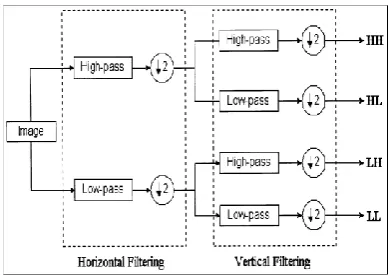
[image:2.595.314.509.86.224.2]Wavelet transform can result in robust representations with regard to lighting changes and be capable of capturing substantial facial features while keeping computational complexity low [10]. In the proposed work, wavelet transform is created by passing the face image through a series of filter bank stages. In the level-1 of wavelet transformation, the face image is applied to low pass and high pass filter and the values are down sampled by a factor in the horizontal direction. In the level-2, the filtered output of level-1 is then filtered by an identical filter pair in the vertical direction. The decomposition of the image into four wavelet frequency subbands is denoted by approximation (LL) and detailed coefficients (HL, LH, and HH) [22]. Each of these subband can be thought of as a smaller version of the image representing different image properties. The approximation wavelet coefficient is known as low frequency subband and the changes in pose or scale of a face affect only their low-frequency spectrum. In this proposed work, the low low-frequency approximation wavelet coefficients are only considered for further processing. The 2D wavelet transform is shown in Fig. 1[10]. The original image and the output of wavelet decomposition after level-2 are shown in Fig.2.
Fig 1: 2-D Wavelet Transformation
Fig 2: Original image and 2-level wavelet decomposition
2.2
Discriminative common vector
Wavelet coefficients can be applied directly in most of the applications. The direct use of wavelet coefficients may not extract the most discriminative features for two reasons such as there is much redundant or irrelevant information contained in wavelet coefficients and it cannot recover new meaning underlying features which have more discriminative power. In order to overcome the deficiency of direct use of wavelet coefficients, it is proposed to construct discriminant features from the wavelet coefficients using within-class scatter matrix method. A common vector for each individual class is obtained by removing all the features that are in the direction of the eigenvectors corresponding to the nonzero eigen values of within-class scatter matrix of all classes. The new set of vectors, called the discriminative common vectors, are used for recognition.
Let the training set be composed of C classes, where each class contains N samples. Let
x
mi denotesm
th sample ofi
th class. Within-class scatter matrix of the samples is constructed to obtain feature vectors, which is defined as [4]T w
BB
S
(1)where the matrix B is given by
]
,...,
,
,...,
[
x
11 1x
1N 1x
12 2x
CN CB
[image:2.595.321.529.261.398.2]where xij is ith sample of class j and μj is mean of the samples in the jth class.
Let us define Q = [α1,…, αr], whichis the set of orthonormal eigenvectors corresponding to the non-null eigenvalues of Sw and r is the dimension of Sw. Next choose an input sample and project it on the null space of Sw in order to get the common vectors, defined as:
x
comi
x
im
Q
Q
x
mi (3) where m = 1…N samples and i = 1…C classes. Calculate the principal components of Scom (the eigenvectors wk), which correspond to the non zero eigenvalues as defined as:w
W
S
W
W
J
comT
opt
)
arg
max[
]
(
(4)where Scom is computed as
S
com
B
comB
comT (5) (5)where
B
comis given by
B
com
[
x
1com
com...
x
comC
com]
(6) (6)The Feature Vector of Training set is calculated as
i m T i
W
x
(7)Similarly, to recognize a test imagextest, the feature vector of
this test image is found by
test WTxtest (8)
The above method is summarized as follows:
1. Compute nonzero eigenvalues and corresponding eigenvectors of Sw using the matrix
BB
T, where B is computed using equation (2).2. Choose an input sample from each class and project it onto the null space of Sw to obtain the common vectors. Compute xcomi using equation (3).
3. Compute the eigenvectors wkofScom, corresponding to the nonzero eigenvalues, by using the equations (4) and (5).
4. The feature vector for training set and test set is obtained using equation (7) and (8) respectively. The entire proposed work is summarized as follows.
1. Apply wavelet transformation and compute the wavelet coefficients for each pattern.
2. Compute the DCV Coefficients using the with-in class scatter matrix method.
3. Train the RBF network for recognizing DCV coefficients using algorithm in section 3.1.
4. Compute the DCV Coefficients for testing samples and find output of the RBF network.
5. Compute the recognition rate.
3. RECOGNITION BY RBF NETWORK
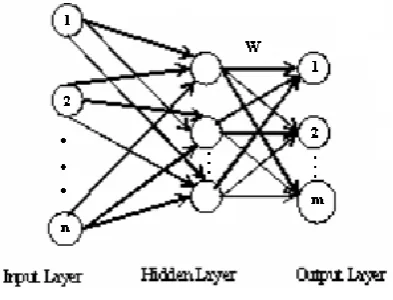
[image:3.595.325.522.253.403.2]Radial Basis Function neural network (RBF) is used for recognition of discriminative common vectors which contains three layers: input, hidden and output layers. Fig. 3 displays the basic structure of the RBF network. The number of nodes in the input layer corresponds to the dimension of DCV coefficients. The n input neurons are normalized and then sent to each of the neurons in the hidden layer. The basis function of the hidden layer neurons are considered as Gaussian function and computed basis function output are passed to the output layer.
Fig 3: Structure of the RBF network
The hidden layer output (basis function) is computed as
2 2
exp ) (
X X
j
(9)
where
X
(
x
1,x
2,...x
n)
T is the normalized input vector,
is the center and
is the width.The output of the output layer is computed as
(
)
1
X
w
y
jk
j ji i
(10)where
k
is the number of hidden neurons,w
ji are the weights connecting the hidden layer neuron j and output layer neuron i. The weights are adjusted using the formula,
w
(t
1)
w
(t)
(
d
i
y
i)
j(
X
)
(11)where
is a positive learning rate parameter and di is the desired output.3.1 Algorithm
Step 1. Generate random numbers to initialize the weights of the RBF network.
Step 2. Enter the input pattern (DCV coefficients) and expected output values.
Step 3. For each input pattern, compute hidden layer output using equation (9).
Step 4. Compute the output layer output using equation (10).
Step 5. Find the error as the difference between desired and obtained actual output.
Step 6. Adjust the hidden layer weights according to equation (11).
Step 7. Find output of the output layer.
Step 8. Compute sum of squared error of the network. Step 9. Repeat steps 3-8 for all input patterns.
Step 10. Repeat steps 3-9 until the acceptable minimum error level is reached.
4. RESULTS AND DISCUSSIONS
The proposed work has been carried out using Matlab 7.1 on AMD Athlon processor with 1.81 GHz system and 640 MB RAM. The proposed work is tested on three face databases such as ORL, the Japanese Female Facial Expression (JAFFE) and Essex Face database. Better recognition is achieved when the classification is done using the radial basis function neural network. The RBF network is trained by considering different learning rate values and the network which is giving better results is discussed here. The centers of the basis function are selected randomly. 2-level wavelet transformation is used in the experiment as it gives better recognition rate.
The ORL face data base contains 40 faces of size as 112 x 92 and each face has 10 different facial views representing various expressions, small occlusion by glasses, different scale and orientations. Hence, there are 400 face images in the database. In the proposed method 5 different poses of 20 person’s face are used for training and 5 different poses of 20 person’s faces are used for testing the proposed method. The 5 poses for training and 5 poses for testing are considered sequentially. The Japanese Female Facial Expression contains different facial expressions posed by Japanese female models in which 5 different poses of 15 models are used for training and the other 5 different poses of 15 models are used for testing. The actual dimension of the image is 256x256. The Essex Face database is having faces of more than 150 male and female with 20 images per individual of University of Essex, UK with the size of 180 x 200. Table 1 shows the reduced size of the resultant wavelet coefficient, for different types of wavelet, after applying 2-level wavelet transformation.
Table 1. Size of the wavelet coefficients
Wavelet Name
Size of the wavelet Coefficients ORL
Database
JAFFE Database
Essex Database
Haar 28 x 23 64 x 64 45 x 50 Sym4 33 x 28 69 x 69 55 x 50 Sym8 39 x 34 75 x 75 61 x 56 Db4 33 x 28 69 x 69 55 x 50 Db6 36 x 31 72 x 72 58 x 53 Coif2 36 x 31 72 x 72 58 x 53 Coif4 45 x 40 81 x 81 67 x 62
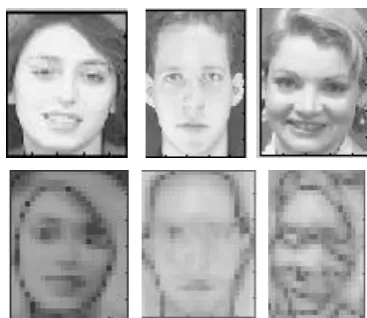
The original face image and their corresponding wavelet representations after two levels wavelet decomposition are shown in Fig. 4. The original face image and their corresponding Discriminative Common vectors representations are shown in Fig. 5. Three level wavelet transform is applied on input patterns with dimension 112×92 and obtained 14x12 dimensioned image representations as a result.
Fig 4: Original image and the wavelet representations after 2-level decomposition
[image:4.595.320.533.161.267.2]
Fig 5: Original image, the discriminative common vectors
[image:4.595.334.518.295.454.2]The recognition rate for different classes using RBF with wavelet coefficients is shown in Table 2 and RBF with DCV of wavelet coefficients is presented in Table 3. The chart given in Fig. 6 compares the recognition rate of RBF with Wavelet and RBF with Wavelet and DCV for different classes.
Table 2. Recognition rate of RBF with wavelet – ORL
Method Classes Recognition rate (%)
RBF + Wavelet
5 93.33
7 95.24
10 94.44
15 96.67
[image:4.595.320.537.559.646.2]20 97.6
Table 3. Recognition rate of RBF wavelet and DCV - ORL
Method Classes Recognition rate (%)
RBF + DCV + Wavelet
5 94.44
7 96.67
10 95.24
15 97.33
[image:4.595.313.545.676.762.2]Fig 6: Comparison of Recognition Rates
Some sample faces of JAFFE database are shown in Fig.7. After applying 3-level wavelet transformation the size is reduced to 32x32 and the resultant images are shown in Fig.8.
Fig 7: Sample faces of JAFFE database
Fig 8: After 3-level decomposition
The wavelet coefficients are obtained from the samples and recognition process proceeded with the obtained Wavelet coefficients and DCV of wavelet coefficients. The sample images from Essex database and its corresponding wavelet coefficients at various levels with the dimensions are shown in Fig. 9. The image corresponding to discriminative common vector obtained for the Essex data base is shown in Fig.10. Original image Level = 1 Level = 2 Level = 3
200 x 180 100 x 90 50 x 45 25 x 23
Fig 9: Wavelet decomposition at various levels
[image:5.595.308.572.463.700.2]
Fig 10: Sample face and its discriminative common vector
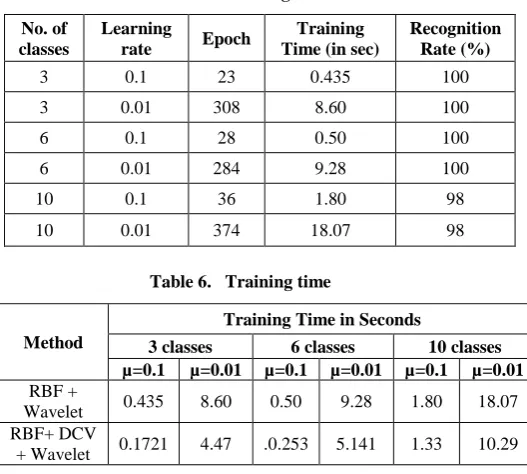
Training and then testing process are carried out for 25 different times. The recognition rates discussed here are the average of 25 different trials. The recognition rates of the three databases for different wavelets namely Haar, Sym4, Sym8, Db4, Db6, Coif2, Coif4 are shown in Table 4. The RBF network is trained by setting different learning rate. The epoch, training time and recognition rate for various classes
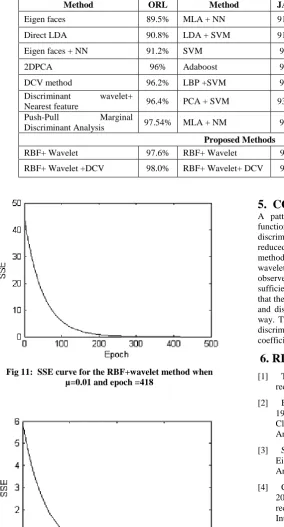
with different learning rate are listed in the Table 5 for ORL database. The Time complexity of both the methods such as RBF with wavelet and RBF with wavelet and DCV are compared and listed in Table 6. The recognition rate obtained for Haar wavelet after applying 3-level decomposition is shown in Table 7. It has been observed that recognition rate of 3-level wavelet transformation is lesser than 2-level wavelet transformation. Table 8 is the comparative table of the recognition rates obtained for three different databases. The recognition rate 97.54% is obtained by the method Push-Pull Marginal Discriminant Analysis on ORL database. The MLA+NM method has the recognition rate of 97% on JAFFE database. When Essex database is used, the recognition rate of 97.2% has been achieved by Curvelet with SVM. Eigen face, wavelet face and SVM methods have better results when combined with neural networks (NN) or convolution neural networks. The sum of square error curves for the proposed method RBF with wavelet and RBF with wavelet and DCV are shown in Fig. 11 and Fig. 12 respectively.
Table 4. Recognition rates for three databases
Wavelet Name
Recognition Rate (%) ORL
Database
JAFFE Database
Essex Database
Haar 98.0 98.4 98.45
Sym4 97.0 97.33 97.67
Sym8 96.67 96.67 96.45
Db4 96.66 97.0 96.5
Db6 97.0 96.67 97.0
Coif2 95.67 96.0 98.0
Coif4 96.0 97.0 96.33
Table 5. Epoch, training time and recognition rate for different learning rate
No. of classes
Learning
rate Epoch
Training Time (in sec)
Recognition Rate (%)
3 0.1 23 0.435 100
3 0.01 308 8.60 100
6 0.1 28 0.50 100
6 0.01 284 9.28 100
10 0.1 36 1.80 98
10 0.01 374 18.07 98
Table 6. Training time
Table 7. Recognition rate for 3-level Wavelet transformation
Wavelet Name ORL JAFFE ESSEX
Haar – 3 Level 90.08% 90.14% 90.32%
Method
Training Time in Seconds
3 classes 6 classes 10 classes µ=0.1 µ=0.01 µ=0.1 µ=0.01 µ=0.1 µ=0.01
RBF +
Wavelet 0.435 8.60 0.50 9.28 1.80 18.07 RBF+ DCV
[image:5.595.57.277.505.667.2]Table 8. Comparison of recognition rates
Method ORL Method JAFFE Method Essex
Eigen faces 89.5% MLA + NN 91.14% Wavelet + HMM 84.2%
Direct LDA 90.8% LDA + SVM 91.27% DWT+ PCA 86.1%
Eigen faces + NN 91.2% SVM 91.6% PZM 88.02%
2DPCA 96% Adaboost 92.4% Gabor + SHMM 88.7%
DCV method 96.2% LBP +SVM 92.0% DM 91.72%
Discriminant wavelet+
Nearest feature 96.4% PCA + SVM 93.43% Fisher faces 92.62%
Push-Pull Marginal
Discriminant Analysis 97.54% MLA + NM 97.0% Curvelet + SVM 97.2%
Proposed Methods
RBF+ Wavelet 97.6% RBF+ Wavelet 98.0% RBF+ Wavelet 97.33%
[image:6.595.57.342.91.619.2]RBF+ Wavelet +DCV 98.0% RBF+ Wavelet+ DCV 98.4% RBF+ Wavelet+ DCV 98.45%
Fig 11: SSE curve for the RBF+wavelet method when µ=0.01 and epoch =418
Fig 12: SSE curve for the RBF+wavelet +DCV method when µ=0.01 and epoch =327
5. CONCLUSION
A pattern recognition system comprised of radial basis function network using wavelet transformation and discriminative common vector is proposed. The features are reduced and extracted using wavelet transformation and DCV method. The proposed work uses only the low frequency wavelet coefficients of 2-level wavelet transformation and it is observed that only those low frequency components are sufficient for the better recognition process. It has been found that the execution time of RBF is minimized when the wavelet and discriminative common vectors are used in a combined way. The recognition rate is improved due to the significant discriminative common vectors obtained from the wavelet coefficients.
6. REFERENCES
[1] Turk, M. and Pentland, A. 1991. Eigenfaces for recognition. J. Cogn. Neuroscience, 3, 71–86.
[2] Belhumeur, P.N, Hespanha, J.P and Kriegman, D.J. 1997. Eigenfaces vs. Fisherfaces: Recognition Using Class Specific Linear Projection. IEEE Trans. Pattern Analysis and Machine Intelligence, 19(7), 711-720. [3] Swets, D.L. and Weng. J. 1996. Using Discriminant
Eigenfeatures for Image Retrieval. IEEE Trans. Pattern Analysis and Machine Intelligence, 18(8), 831-836. [4] Cevikalp, H., Neamtu, M., Wilkes, M. and Barkana, A.
2005. Discriminative common vectors for face recognition, IEEE Trans. Pattern Anal. Mach. Intelligence, 27 (1), 4–13.
[5] Cevikalp, H., Barkana, B. and Barkana, A. 2005. A comparison of the common vector and the discriminative common vector methods for face recognition. In: Proc. 9th World Multi-Conf. Systemics, Cybern. and Inf., Orlando, FL.
[7] Lakshmi, C. and Ponnavaikko, M. 2009. Boosting Kernel Discriminative Common Vectors for Face Recognition. Journal of Computer Science, 5 (11), 801-810.
[8] Cevikalp, H., Neamtu, M. and Wilkes, M. 2006. Discriminative common vectors method with kernels. IEEE Trans. Neural Network, 17 (6), 1550–1565. [9] Carlos M. Travieso, Marcos del Pozo, Miguel A. Ferrer
and Jesus B. Alonso. 2010. Reducing Features using Discriminative Common Vectors. Cognitive Computation, 2, 160 – 164.
[10] Bai-Ling Zhang, Haihong Zhang and Shuzhi Sam Ge. 2005. Face Recognition by Applying Wavelet Subband Representation and Kernel Associative Memory. IEEE Transactions on Neural networks, 15(1), 166-177. [11] Feng, G.C., Yuen, P.C. and Dai, D.Q. 2001. Human
face recognition using PCA on wavelet subband. J. Electron. Imaging, 9, 226–233.
[12] Bicheng Li and Hujun Yin. 2005. Face Recognition Using RBF Neural Networks and Wavelet Transform. Lecture Notes in Computer Science, Springer, 105-111. [13] Chengjun Liu and Harry Wechsler. 2002. Gabor
Feature Based Classification Using the Enhanced Fisher Linear Discriminant Model for Face Recognition. IEEE Trans. Image Processing, 11(4), 467-476.
[14] Jen Tzung Chien and Chia Chen Wu. 2002. Discriminant Waveletfaces and Nearest Feature Classifiers for Face Recognition. IEEE Transactions on Pattern analysis and Machine intelligence, 24(12), 1644-1649.
[15] LinLin Shen, Li Bai and Michael Fairhurst. 2007. Gabor wavelets and General Discriminant Analysis for
face identification and verification. Image and Vision Computing, 25, 553–563.
[16] Guang Dai, Dit-YanYeung and Yun-Tao Qian. 2007. Face recognition using a kernel fractional-step discriminant analysis algorithm. Pattern Recognition, 40, 229–243.
[17] Prathihar, D.K. 2008. Soft Computing, Narosa Publishing House, New Delhi.
[18] Haykin, S. 1995. Neural Networks: A Comprehensive Foundation, Macmillan, NewYork.
[19] Balasubramanian, M., Palanivel, S. and Ramalingam, V. 2009. Real time face and mouth recognition using radial basis function neural networks, Expert Systems with Applications, 36, 6879–6888.
[20] Bicheng Li and Hujun Yin. 2005. Face Recognition Using RBF Neural Networks and Wavelet Transform, Lecture Notes in Computer Science, Springer, 105-111. [21] Yee Wan Wong. 2011. Radial Basis Function Neural
Network with Incremental Learning for Face Recognition, IEEE Transactions on Systems, Man, and Cybernetics, Part B: Cybernetics, 41(4), 940 – 949. [22] Kathirvalavakumar, T. and Vasanthi, J. J. B. 2012. Face
Representation Using Combined Method of Gabor Filters, Wavelet Transformation and DCV and Recognition Using RBF. Journal of Intelligent Learning Systems and Applications, 4(4), 266-273.
[23] Kathirvalavakumar, T. and Vasanthi, J. J. B. 2013. Face Recognition Based on Wavelet Packet Coefficients and Radial Basis Function Neural Networks.Journal of Intelligent Learning Systems and Applications, 5(2), 115-122.