Image Edge Detection using Modified Ant Colony
Optimization Algorithm based on Weighted Heuristics
Puneet Rai
Asst. Prof., CS&IT Deptt. MIT, Moradabad, U.P. India
Maitreyee Dutta,
PhD.Associate Prof., CS&IT Deptt. NITTTR, Chandigarh, India
ABSTRACT
Ant Colony Optimization (ACO) is nature inspired algorithm based on foraging behavior of ants. The algorithm is based on the fact how ants deposit pheromone while searching for food. ACO generates a pheromone matrix which gives the edge information present at each pixel position of image, formed by ants dispatched on image. The movement of ants depends on local variance of image’s intensity value. This paper proposes an improved method based on heuristic which assigns weight to the neighborhood. Experimental results are provided to support the superior performance of the proposed approach.
Keywords
Ant Colony Optimization, Weighted Heuristics, Edge Detection, Pheromone
1. INTRODUCTION
Detection of edges in an image is a very important step for the image understanding. Indeed, high-level processing tasks such as image segmentation and object recognition, etc. directly depend on the quality of the edges detected.
It is a preprocessing step in applications of image segmentation and computer vision particularly in the areas of feature detection and feature extraction. Edges represent important contour features in the corresponding image as they refers to the process of detecting points in a digital image at which the image brightness changes sharply, or more formally has discontinuities [1].
Recently natural swarm inspired algorithms like Particle Swarm Optimization (PSO) [2][3], Ant Colony Optimization (ACO) have found their way into this domain.
Proposed by Italian Scholar M.Dorigo et al [4][5], Ant Colony Optimization is inspired by natural behavior of ants that they deposit pheromone to give signal to other ants so that they follow some preferable path to reach the source of food. The pheromone trails evaporate with time. On a longer path pheromone has more time to evaporate, thus shorter paths are favored as they acts as compensation for pheromone evaporation. Ants follow shorter paths because the density of pheromone is higher on shorter paths. Many ACO algorithms have been developed [6], to name a few max-min ant system[7], ant colony system[8], etc.
In this paper, we propose ACO algorithm which works on weighted heuristics. The proposed approach exploits a number
of ants, which moves on the image based on local variation of intensities of neighboring pixels assigned with weight.
The paper is organized as follows. In section II fundamental concepts of ACO are provided. Then an ACO based approach with weighted heuristic is proposed in section III. Experimental results are presented in section IV. Finally section V concludes the paper.
2. ANT COLONY OPTIMIZATION
ACO is a probabilistic method that aims to find the optimized solution of target problem through a guided search over the solution space by constructing the pheromone information.
In an ACO algorithm, ants move through a search space, the graph, which consists of nodes and edges. The movement of the ants is probabilistically dictated by the transition probabilities, which reflects the likelihood that an ant will move from a given node to another. This value is influenced by the heuristic information and the pheromone information.
The heuristic information is solely dependent on the instance of the problem. Pheromone values are used and updated during the search. The algorithm consists of three main steps. The first is the initialization process. The second is the iterative construction-and-update process, where the goal is to construct the final pheromone matrix. The construction-and-update process is performed several times, once per iteration. The final step is the decision process, where the edges are identified based on the final pheromone values.
According to the ant system [4], suppose K ants are used to find the optimal solution in a problem space of M1 × M2 Nodes.
Then the three steps will be applied as follows.
2.1 Initialization Process
Each of the ants is assigned a random position in the image. The initial value of each element in the pheromone matrix is set to a constant, which is small but non-zero. The heuristic information matrix is constructed.
2.2Iterative
Construction
and
Update
Process
Ant moves from one node to another node with transition probability
Where, is the pheromone value for the pixel
, is the neighborhood pixels of pixel , is
the heuristic information at the pixel . The amount of pheromone on the node on the nth iteration,
, is
updated according to following equation.
(2) Where is the pheromone decay coefficient; is
the initial pheromone value. After all the ants finish the construction process, global pheromone update [6] is performed on pixels that have been visited by at least one ant:
(3)
Where is the amount of pheromone deposited by the kth
ant on pixel is the pheromone evaporation constant.
2.3 Decision Process
Finally the pheromone matrix is used to decide which pixel is edge pixel or not using thresholding process.
3. PROPOSED ACO ALGORITHM
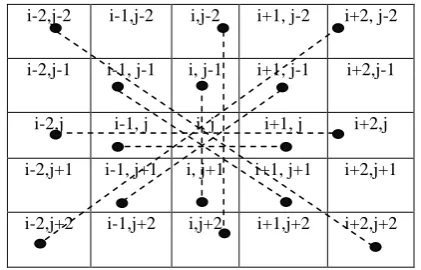
We propose two modifications to the existing ACO technique. First the heuristic information which is used to determine the probability using which ants move from one pixel to another [9][10][11].
In the proposed method we have used weights to for calculating the heuristic value. As the ant moves farther the weight is reduced. This gives addition information about the neighborhood to calculate transition probability. Second we have assigned the initial pheromone matrix by the value
Till now no standard method has been explained to
initialize the pheromone matrix. This will allow the ants to explore other pixels that may be considered as edge pixels.
A m × n 2-D image can be represented as 2-D matrix with the image pixels as its elements(Fig. 1).
3.1 Initialization Process
Artificial ants are distributed over the image, they move from one pixel to another using the transition probability which depends on local intensity. The initial value of each element in
the pheromone matrix is set to a constant given by ,
where M1 × M2 is the size of image.
The heuristic value at pixel (i, j) is determined by local statistics at that pixel:
f(0,0) f(1,0) f(2,0) … f(m-1,0)
f(0,1) f(1,1) f(2,1) … f(m-1,1)
f(0,2) f(1,2) f(2,2) … f(m-1,2)
. . .
. . .
. . .
… . . .
[image:2.595.320.531.394.529.2]f(0,n-1) f(1,n-1) f(2,n-1) … f(m-1,n-1)
Fig. 1: Matrix representation of digital image
Where the intensity value at pixel is is a
function that operates on the local group of pixels around the pixel . The proposed method assigns weight to the pixels in neighborhood of the pixel , to calculate the value of
, this improves the results in significant way as it covers
a greater area to calculate the transition probability. It is given by
(5)
is the maximum intensity variation in the whole image
and serves as normalization factor.
i-2,j-2 i-1,j-2 i,j-2 i+1, j-2 i+2, j-2
i-2,j-1 i-1, j-1 i, j-1 i+1, j-1 i+2,j-1
i-2,j i-1, j i, j i+1, j i+2,j
i-2,j+1 i-1, j+1 i, j+1 i+1, j+1 i+2,j+1
i-2,j+2 i-1,j+2 i,j+2 i+1,j+2 i+2,j+2
3.2Iterative construction and update Process
At the n-th construction step, the k-th ant moves from node i to node j with transition probability
Where, is the pheromone value for the pixel
, is the neighborhood pixels of pixel , is
the heuristic information at the pixel . The constants and control the influence of the pheromone and the heuristic information, respectively.
The amount of pheromone on the node on the nth
iteration, , is updated according to following equation.
construction process, global pheromone update is performed on pixels that have been visited by at least one ant:
Where is the amount of pheromone deposited by the kth ant on pixel is the pheromone evaporation constant. The deposited amount of pheromone is equal to the average of the heuristic information associated with the pixels that belong to the tour of the kth ant if pixel was
visited by the kth ant in its current tour; 0 otherwise.
3.3 Decision Process
Pheromone matrix is used for decision making that which pixel is to be considered as edge pixel by using Ostu method of thresholding[12].
4.EXPERIMENTAL RESULTS
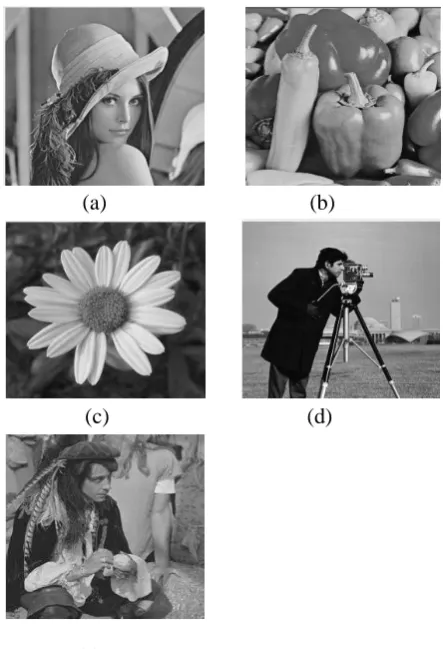
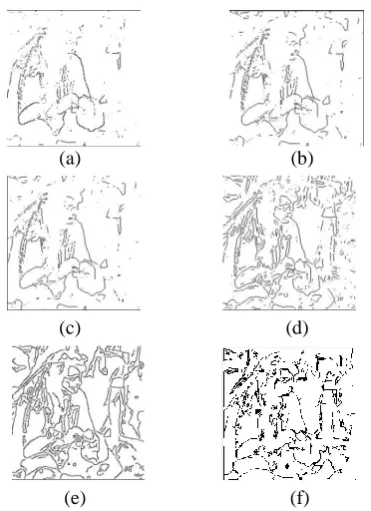
[image:3.595.321.543.79.404.2] [image:3.595.86.252.354.488.2]Experiments are conducted based on some test images. The size of images is 256 × 256. The results are compared with Roberts, Sobel, Prewitt, LoG and Canny Operators. Parameters used for experiments are summarized in following table.
Table 1: Parameters used in Experiment
Parameter
: Initial pheromone value N: No. of Iterations
L: No. of construction steps K: No. of Ants
α: Controls influence of pheromone trail
β:controls influence of heuristic information
[image:3.595.318.512.455.726.2]φ:Pheromone decay coefficient ρ:Pheromone evaporation coefficient
Table 2: Values used in Experiment
Parameter Value
N 1-10 (Variable)
L 40
K 512
α 1
β 1
φ 0.05
ρ 0.1
(a) (b)
(c) (d)
(e)
Fig.2: Test images used in this paper (a) Lena (b) Pepper (c) Flower (d) Camera (e) Man
(a) (b)
(c) (d)
(e)
(f)
Fig.3:Edge image of test image Lena using (a)Roberts (b)Sobel (c)Prewitt (d) LoG (e) Canny (f) Proposed ACO
[image:3.595.93.246.511.662.2]5. CONCLUSIONS
This paper presents a modified and improved ACO based method. We have defined the heuristic function that is calculated by assigning weights and priorities based on edginess of pixels. The experimental results show that the proposed technique gives better performance as compared to other existing algorithms.
Table 3 shows the comparative analysis of the proposed method with existing conventional methods. Further the results in [9][10] and [11] gives edges which are thick, non continuous and with less clear image content. But the proposed method gives thin and clear edges.
[image:4.595.330.516.90.350.2] [image:4.595.46.287.297.691.2]Because the quality of edge varies with the values and parameters used for extracting the heuristic values so this research can be further extended on a strategy for calculating more effective heuristic information
Table 3: Comparative analysis of edge detection methods
Roberts Very thick edges, prominent discontinuities
Sobel Thick edges, may or may not be discontinuous
Prewit Discontinuities present but thin edges
LoG Malfunctioning at corners and curves
Canny Good for noisy images but complex
Proposed
Method
Continuous, Very thin and clear edges
(a)
(b)
(c)
(d)
[image:4.595.46.286.301.674.2]
(e)
(f)
Fig. 4:Edge image of test image Pepper using (a)Roberts (b)Sobel (c)Prewitt (d) LoG (e) Canny (f) Proposed ACO
Method.
(a) (b)
(c) (d)
(e) (f)
Fig. 5:Edge image of test image Flower using (a)Roberts (b)Sobel (c)Prewitt (d) LoG (e) Canny (f) Proposed ACO
Method.
(a) (b)
(c) (d)
(e) (f)
Fig. 6 :Edge image of test image Camera using (a)Roberts (b)Sobel (c)Prewitt (d) LoG (e) Canny (f) Proposed ACO
[image:4.595.340.509.408.659.2]
(a) (b)
(c) (d)
[image:5.595.77.263.67.323.2]
(e) (f)
Fig. 7 :Edge image of test image Man using (a)Roberts (b)Sobel (c)Prewitt (d) LoG (e) Canny (f) Proposed ACO
Method.
6. REFERENCES
[1] S.Nagabhushana, “Computer vision and image processing”, New Age International, pp 86-90,2006,
[2] R. C. Eberhart and J. Kennedy, “A new optimizer using particle swarm theory”, Proceedings of International conference on Micro Machine and Human science, Japan, pp. 39-43, 1995.
[3] J. Kennedy and R. C. Eberhart, “Particle swarm optimization”, Proceedings of IEEE International
Conference on Neural Networks, Piscataway, NJ, pp.1942-1948, 1995.
[4] M. Dorigo, V. Maniezzo, and A. Colorni, “Ant System: Optimization by a Colony of Cooperating Agents,” IEEE Transactions on Systems, Man and Cybernetics, Part B, vol. 26, pp. 29-41, 1996.
[5] M. Dorigo and T. Stützle, Ant Colony Optimization, Cambridge: MIT Press, 2004.
[6] M. Dorigo, M. Birattari, and T. Stutzle, “Ant colony optimization,”IEEE Computational Intelligence Magazine, vol. 1, pp. 28–39, Nov.2006.
[7] T. Stutzle and H. Holger H, “Max-Min ant system,” Future Generation Computer Systems, vol. 16, pp. 889–914,Jun. 2000.
[8] M. Dorigo and L. M. Gambardella, “Ant colony system: A cooperative learning approach to the traveling salesman problem,” IEEE Trans. On Evolutionary Computation, vol. 1, pp. 53–66, Apr. 1997.
[9] R. Rajeshwari et.al., “A Modified Ant Colony Optimization Based Approach for Image Edge Detection.”,Proceedings of International Conference on Image Information Processing (ICIIP 2011.)
[10] Peng Xiao, Jun Li and Jian-Ping Li , “An improved Ant colony Optimization Algorithm for Image Extracting”, International Conference on Apperceiving Computing and Intelligence Analysis (ICACIA), 2010.
[11] Jing Tian, Weiyu Yu, and Shengli Xie, “An Ant Colony Optimization Algorithm For Image Edge Detection”,IEEE Congress on Evolutionary Computation, 2008. CEC 2008. (IEEE World Congress on Computational Intelligence).