http://dx.doi.org/10.4236/jmp.2014.513121
An Optimization Technique for Inverse
Crack Detection
Håkan Wirdelius
Department of Materials and Manufacturing Technology, Chalmers University of Technology, Göteborg, Sweden
Email: [email protected]
Received 2 May 2014; revised 29 May 2014; accepted 21 June 2014
Copyright © 2014 by author and Scientific Research Publishing Inc.
This work is licensed under the Creative Commons Attribution International License (CC BY). http://creativecommons.org/licenses/by/4.0/
Abstract
Any attempts to apply techniques that are based on indirect measurements of parameters that are believed to correlate to any material properties (or state) in an in-line situation must by necessity identify a mathematical model of this relationship. The most conventional approach is to use some empirically based model. If the analysis instead is based on an analytical model of a physical ex-planation, this trainee period can be minimized and the system is more dynamic and less sensitive to changes within the chain of production. A numerical solution to the inverse problem of ultra-sonic crack detection is in this case investigated. This solution is achieved by applying optimiza-tion techniques to a realistic model of the ultrasonic defect detecoptimiza-tion situaoptimiza-tion. This model in-cludes a general model of an ultrasonic contact probe working as transmitter and/or receiver and its interaction with the defect. The inverse problem is reduced to minimization of a nonlinear least squares problem and is performed with a quasi-Newton algorithm consisting of a locally conver-gent SVD-Newton method combined with a backtracking line search algorithm. The set of synthet-ic data the model is fitted with are generated both by numersynthet-ical integration and with the two-dimensional stationary-phase method while the forward solver in the optimization procedure is based on the latter. In both these cases, the convergence, in terms of numbers of iterations, is sufficient when the initial guess is reasonably close.
Keywords
Inverse Problem, Ultrasonic NDT, Quasi-Newton Algorithm
1. Introduction
im-proper to just detect a flaw or the presence of inferior material im-properties. The need of quantitative information has given rise to more fundamental approaches to nondestructive evaluation (NDE) with growing emphasis on theoretical modeling of the ultrasonic inspection situation.
In the previous research, we have developed a complete mathematical model of the ultrasonic NDT situation (UTDefect) which has been incorporated into different simulation software (SUNDT and simSUNDT). The de-velopment has been ongoing since almost twenty years and has been validated and described in a numerous journal and conference contributions (see e.g. [1]-[3]). The model includes a general model of an ultrasonic contact probe working as transmitter and/or receiver and the interaction of the ultrasound with the defect. This realistic model offers the possibility of avoiding, or at least reducing, time-consuming and costly experimental work. It can also be useful in the design of inspection routines as it gives an estimate of weather a postulated defect can be detected or not.
The practical situation when ultrasonic NDE is used is in fact an inverse problem, i.e. based on the signals from transmitting and receiving probes an interpretation is performed (see Figure 1). This interpretation is then often based on earlier experiences or by comparing with experimental work or computer simulations. Analytical solutions to the inverse problem have up today only been found for very simple situations and are often based upon a linearization of the inverse problem performed by the Born approximation (an extensive review discuss-ing this is available by Bates et al. [4]). This linearization limits the applicability since it, at least in principle, restricts the problem to weak penetrable scatterers or low frequencies. Even so this assumption has actually been successfully applied for more complex ultrasonic situations [5]. A slightly different approach, still based on the Born approximation, has been to retrieve a large amount of point source information and address the inversion by various time domain back propagation techniques (Synthetic Aperture Focussing Techniques described in e.g. [6] [7]). Degtyar et al. [8] introduced an inversion procedure based on a nonlinear least-squares method to de-termine elastic constants from group or phase velocity data in orthotropic and transversely isotropic materials. Corresponding approach has also been used in order to retrieve viscoelastic material properties based on ultra-sonic experimental data (Castaings et al. [9] [10]).
To investigate its possibility, we approach the inverse problem by applying optimization techniques to our previous general model of the ultrasonic inspection in the present paper. This choice of technique is based on a paper by Björkberg and Kristensson [4] where an optimization technique is successfully used to numerically solve an electromagnetic inverse problem. This problem originates from geophysical prospecting applications and differs from ours in the sense that all components of the scattered field is available by measurements from bore holes in the ground. In ultrasonic NDT situations, only two electric pulses in time, representing the incom-ing and scattered field, respectively, are the available information from the transmitter and receiver.
The aim of this paper is to investigate if it is possible to numerically solve the inverse problem that occurs in ultrasonic crack detection, by minimizing the mean-square error between the ultrasonic model and correspond-ing data.
The plan of the present paper is the following. In the first section, we briefly discuss the model of the NDT situation previously presented by Boström and Wirdelius [11] [12]. This includes the probe model, the interaction
Inspection situation (inverse problem) Simulated situation (direct problem)
of the probe field with the defect and the reciprocity argument that handles the action of the probe when it is acting as a receiver. The next section presents the optimization technique that is used and is followed by a sec-tion with numerical results based on previous secsec-tions. Finally, we give some concluding remarks and sugges-tions for future considerasugges-tions.
2. Model of the Ultrasonic Inspection
The governing linearized equations for wave propagation in an elastic medium are the equation of motion, Hooke’s law and the strain-displacement relation. If time harmonic conditions are assumed (time factor e−i tω is suppressed) these three relations can be combined into the elastodynamic equation of motion governing the displacement field u
2 2
0
p s
k−∇∇ ⋅ −u k−∇×∇× + =u u (1) where
(
)
2 2 2 2 2 p s k kρω λ µ
ρω µ
= +
=
are the compressional and shear wave numbers, respectively (ρ is the density, λ and µ are the Lamé con-stants of the elastic half-space).
The total displacement field is given by the sum of the incident field
( )
ui and the scattered field( )
usi s
= +
u u u (2) Let us expand the incident field in terms of regular spherical partial vector waves
(
ReΨn)
and the scattered field in corresponding outgoing spherical partial vector waves( )
Ψn , i.e.Re i n n n s n n n a f = =
∑
∑
Ψ Ψ uu (3)
Then it is possible to find a linear relationship between the expansion coefficients for the incident and scat-tered field and this entity is known as the transition matrix T
n nn n
n f T a′ ′
′
=
∑
(4)All information about the scatterer is contained in its transition matrix and there are various methods of evaluating it. Most common is to use the null-field approach [12] but in our case with a prescribed open penny-shaped crack it is more convenient to use an integral equation method previously described by Boström and Eriksson [13]. The T matrix of a spherical cavity is obtained by separation-of-variables.
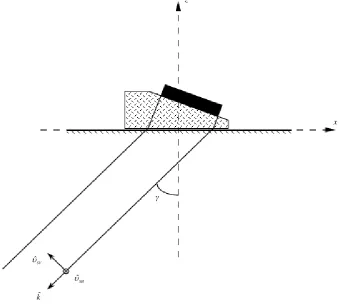
We now introduce a coordinate system as in Figure 2 with the z axis normal to the scanning surface and the x axis chosen so that the probe beam is emitted into the third quadrant of the xz plane with the angle γ with the negative z axis. In Figure 2, we have introduced ˆk= −cosγzˆ−sinγxˆ as the propagation direction and vˆ is the S wave polarization direction (with v kˆ ˆ⋅ =0 and xˆ, yˆ and ˆz as the unit vectors). We choose
ˆSH ˆ
v = y and vˆSV =vˆSH× =kˆ sinγzˆ−cosγxˆ in order to distinguish between horizontally and vertically polar-ized shear waves.
In order to model a probe of specific type and angle, the traction vector corresponding to a plane wave of identical type and angle is taken as boundary conditions on the surface of the elastic half-space. Now let the contact probe be characterized by this prescribed traction on the surface of the elastic half-space and assume that this area, corresponding to the acting probe, is elliptic or rectangular.
We then get
(
)
[
]
[
]
sin
2 2 2
sin
sin
ˆ
ˆ ˆ
2sin sin2 P probe
ˆ
sin2 cos2 pro
be
ˆ
cos probe
p
s
p
ik x
p s p
ik x s
ik x s
Agi k k k x e
Agi k x e SV
Agi k y e S
z z H γ γ γ
µ γ δ γ
µ γ δ γ
µ δ γ
x z
γ
ˆSV
υ
ˆSH
υ
ˆ
k
[image:4.595.141.481.90.398.2]
Figure 2. Geometry of the probe with definition of coordinate system and propagation/ polarization directions.
beneath the probe and t=0 elsewhere (A represents the amplitude). The function g=g x y
( )
, and the con-stant δ∈[ ]
0,1 enables reduction of edge effects and varied coupling respectively (for further details see [14]). In order to solve this boundary value problem and combine the incident field with the transition matrix formula-tion, we make following ansatz for the displacement field radiated from the probe( )
3( ) (
)
1 dˆ j ˆ j ˆ;
j= C− γξ γ γ
=
∑ ∫
u r φ r (6)
with the plane vector wave functions, φj
( )
γˆ;r , defined as in Boström et al. [15], and with the coefficients( )
ˆ jξ γ as unknowns. Then the corresponding traction on the surface can be written as
( )
3( )
( )
1
0 j dˆ j ˆ j j 0
z= =
∑
= γξ γ φ z=t u t (7)
which is identified as a 2D Fourier transform with corresponding inverse transform of the applied traction vector (Equation (5)). This reduces the evaluation of the expansion coefficients to solving a system of equations. In or-der to incorporate the probe model into the T matrix formulation we have to transform our displacement field from the plane vector waves centred at the contact area into spherical vector wave functions suitably oriented and centred at the defect. This involves a transformation, a translation and a rotation as discussed in Boström and Wirdelius [1].
The characterization of the probe acting as a transmitter is encapsulated in the expansion coefficients for the incident field
( )
an and to evaluate its behaviour as a receiver we use a electromechanical reciprocity argument by Auld [16] and define two elastodynamic states:1 1
2 2
, : a acting as transmitter with defect present
, : b acting as transmitter without defect present
u t
(each probe acting with incident power P). Then the change in the electrical response of probe b, due to the presence of a defect (enclosed by a control surface S), is found as
[
2 1 1 2]
d4P S
i
S ω
δΓ = −
∫
u ⋅ − ⋅t u t (9)Expanding the two states in spherical vector wave functions and using the Betti identities we end up with the following expression for the electrical signal response
'
characterization of transmitting probe by ~ with characterization of defect by
characterization of receiving probe by a n
b a
n nn n nn
nn b
n
a
a T a T
a δ ′ ′ ′ ′ Γ
∑
(10)3. Optimization Technique
In the previous section, the theory for the direct problem (the ultrasonic NDT model) has been presented while we in this section introduce the optimization techniques that are used to numerically solve the corresponding inverse problem (see [11] [14] for further details).
The optimization problem is to fit a set of data
(
y di, i)
, i=1,,m , with a model m(
x,yi)
. Let us define the residual function as( )
:(
,,)
n m
i i i
m n
r m y d
→ >
= −
R
x x (11)
where x∈n is a point in parameter space, yi is the coordinate, di is the data of the ith “sampling” and
( )
i
r x denotes the ith component function of R x
( )
. Then the optimization can be stated as a minimization problem (referred to as a nonlinear least-squares problem)( )
( ) ( )
T( )
21 1 1 minimize 2 2 n m i i
f = r x
∈ = =
∑
x x R x R x (12)
A quadratic model of f x
( )
around the current point xc is achieved by a two term Taylor expansion( )
( )
( ) (
)
(
)
( ) (
)
( ) ( )
( ) ( )(
)
(
)
{
( ) ( )
( )
}
(
)
T T 2 T
T T T T
1
2
1 1
.
2 2
c c c c c c c
c c c c c c c c c c
g f f f
R R R J J J S
= + ∇ − + − ∇ −
= + − + − + −
x x x x x x x x x x
x x x x x x x x x x x x x
(13)
with the Jacobian matrix J∈ n× m, with components J x
( )
ij = ∂ri( )
x ∂xj and the second derivate matrix of R x( )
as( )
( )
2( )
1
m
i i
i= r x r x
=
∑
∇S x (14)
The next iterate x+ is then found as the minimizer of Equation (14) by applying Newton’s method (see Den-nis and Schnabel [14]), i.e.
( ) ( )
T( )
1( ) ( )
Tc c c c c c
−
+ = − +
x x J x J x S x J x R x (15)
This is a fast local method since it is locally (i.e. near the true minimizer xtr) q-quadratically convergent but has the drawback of the necessity of calculating S x
( )
which is usually either unavailable or inconvenient to obtain.Instead of using the quadratic model gc
( )
x , we introduce the affine model of R x( )
around the current point xc( )
:( )
,( )(
)
n m
c
c c c c
m n
→ >
= + −
G
This is an over determined system of linear equations and therefore we cannot expect to find an x+ that satis-fies Gc
( )
x+ =0. A logical consequence is then to choose the next iterate x+ as the solution to the linear least-squares problem( )
2( )
2
1
ˆ minimize
2
n c gc
∈ =
x G x x (17)
If J x
( )
c has full rank the solution can be written as( ) ( )
T 1( ) ( )
Tc c c c c
− + = −
x x J x J x J x R x (18)
The only difference between the quadratic models gc
( )
x (Newton method) and gˆc( )
x (Gauss-Newton method) is the lack of second order information of ∇2f( )
xc in the latter which makes it q-quadratically con-vergent only if S x( )
tr =0 (i.e. R x( )
linear or R x( )
tr =0: a zero-residual problem). If it is a small-residual problem then the convergence will be q-linear. However, for large-residual problems it may not be locally con-vergent at all.In order to enhance the Gauss-Newton method we introduce the singular value decomposition (SVD) of the Jacobian matrix
(
J∈ n× m)
(
)
(
)
T 0, 1, , min ,
,
0,
ii i m n
ij
d i m n
d i j
σ = ≥ = = = ∈ × = ≠
J UDV D D (19)
where U∈ m× m and V∈ n× n are orthogonal matrices. The diagonal elements of D (i.e. the singular values of J) are the nonnegative square roots of the eigenvalues of J JT if m≥n (or JJT if n≥m) and the columns of U and V are eigenvectors of J JT and correspondingly JJT if n≥m.
Furthermore we define a pseudoinverse of J, the Moore-Penrose inverse, as
†= † T,
J VD U D†=
(
)
† † † 1 , 0 0, 0 0, i i
ii n m
i
ij d
d i j
σ σ
σ
>
= ∈ × = = ≠
D (20)
Then the minimizer of Equation (17) is found by (i.e. SVD-Newton iterate)
( ) ( )
†c c c
+ = −
x x J x R x (21)
In order to suppress linear dependence of the column vectors, which will occur in the case of problems that are insensitive to variations of, or a linear combination of, parameters, we introduce the regularized Moore-Penrose inverse as
† † T
, λ = λ
J VD U
(
)
2 † † † 2 † 1 , 0, 0, i i
ii n m
i
ij d
d i j
λ λ σ λ σ σ λ ≥ =
= < ∈ ×
= ≠
D D (22)
where the regularizing parameter, λ, has the effect of masking off directions in parameter space in which the problem is ill-conditioned.
The previous discussed locally convergent variation of the Newton method has to be supplemented by a global strategy in order to also enable global convergence to the problem. The direction of the Newton step is always a descent direction (if S x
( )
c is limited this includes the Gauss-Newton) but the step may well be too large and therefore not globally convergent.(
)
( )
( )
T 1k k k c k
f x + ≤ f x +
αζ
∇f x p (23) if also(
)
T(
)
T( )
T(
]
1 , ,1
k k k k k k k k
f + f
ζ
β
fβ
α
∇ x p = ∇ x + p p ≥ ∇ x p ∈ (24)
is satisfied. Then there can be proven that given any direction pk such that
( )
T0
k k
f
∇ x p < (25)
there exists ζ >k 0 such that any method that generates a sequence
{ }
xk obeying these three conditions(
23→25)
, is at each iteration globally convergent. Let us define fˆ( )
ζ
= f(
xk+ζ
pk)
and, if we need to backtrack, use the most current information about ˆf to model it, and then take the value ofζ that minimizes this model as our next value of ζk.Initially we have; fˆ 0
( )
= f( )
xk , fˆ 0′( )
= ∇f( )
xk Tpk and fˆ 1( )
= f(
xk+pk)
, which result in the fol-lowing quadratic model of fˆ( )
ζ( )
ˆ( )
ˆ( )
ˆ( )
2 ˆ( )
ˆ( )
ˆq 1 0 0 0 0
g
ζ
=f − f − f′ ζ
+ f′ζ
+f (26)then
( )
( )
( )
( )
( )
( )
ˆ ˆ ˆ ˆ
ˆ 0 2 1 0 0 ˆ ˆ 0 and ˆ ˆ 0
q q
f f f f g g
ζ
= − ′ − − ′ ⇔ ′ζ
= ′′ζ
> (27)and ˆ 0,1 2
ζ
∈ is our new choice of ζk.
In order to ensure proximity we in the numerical calculations start up with a SVD-Newton step (using Equa-tion (22)) and if this full step does not give an acceptable decrease in the residual we use the above described backtracking line search along this direction.
4. Numerical Results
In this section we present numerical examples of the optimization algorithm developed by Björkberg and Kris-tensson [11] and here implemented into the elastodynamic problem of defect detection. Our choice of NDE- situation has been the pulse-echo measurement on a elastic half-space with the material assumed to be steel with compression and shear wave speeds 5940 m/s and 3230 m/s (Poison’s ratio v=0.29). A major limitation of the numerical optimization is of course the necessity to postulate the defect geometry (i.e. a priori information on the used T matrix).
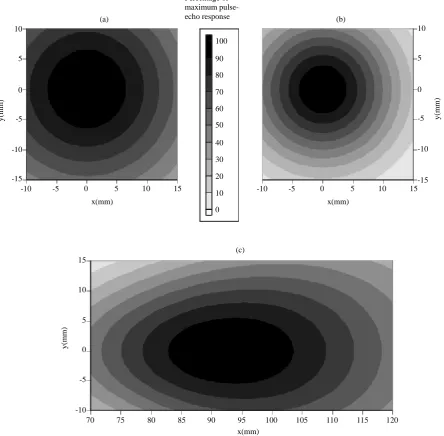
We have restricted our optimization to three combinations of defect geometry and scanning probe: spherical cavity (diameter 10 mm) detected with an unangled circular (diameter 10 mm) P probe, open horizontal penny- shaped crack (diameter 10 mm) detected with an unangled circular (diameter 10 mm) P probe and the same crack lying perpendicular to the surface scanned by a 60˚ angled quadratic (side 10 mm) SV probe. All defects are situated at a depth of 60 mm and given a radius of 5 mm and corresponding single frequency C-scans are found in Figures 3(a)-(c)) with individual normalization.
-10 -5 0 5 10 15 x(mm)
-10 -5 0 5 10 15
x(mm)
-15 -10 -5 5 10
0
y
(mm)
y
(mm)
-15 -10 -5 5 10
0
(a) (b)
(c)
x(mm)
70 75 80 85 90 95 100 105 110 115 120
-10 10 15
-5 5
0
y
(mm)
[image:8.595.91.536.93.529.2]0 10 20 30 40 50 60 70 80 90 100 Percentage of maximum pulse- echo response
Figure 3. Pulse-echo amplitude as a function of probe position (all probes operating at 1 MHz single frequency): A/ Unangled circular (diameter 10 mm) P probe with a spherical cavity defect (diameter 10 mm) located at the depth 60 mm. B/ Unangled circular (diameter 10 mm) P probe with a penny-shaped crack (diameter 10 mm) located at the depth 60 mm and parallel to the surface. C/60˚ angled quadratic (side 10 mm) SV probe with a penny-shaped crack (diameter 10 mm) located at the depth 60 mm and perpendicular to the surface.
In the expression for the expansion coefficients, ana and anb, a double integral has to be evaluated. To avoid a quite computer time-consuming numerical integration (i.e. Gauss-Legendre qudrature), we have chosen to evaluate this with the two-dimensional stationary-phase method (the distance between defect and probe is used as the large parameter). In the far field this have been found to be accurate at least within the main lobe (see [1]) and in order to avoid what is referred to as an “inverse crime” (see Colton and Kress [17]), we have also opti-mized with a “stationary-phase solver” on a integral solution of the direct problem. It is also necessary to sup-press the comsup-pression part when using an angled SV probe to get the optimization successful.
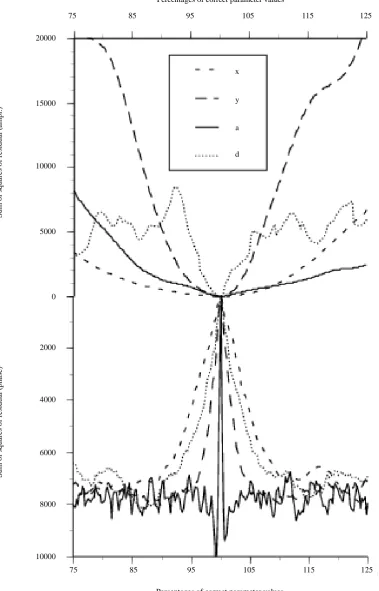
Percentages of correct parameter values 75
S
u
m
o
f s
q
u
ar
es
o
f r
es
id
u
al
(
p
h
as
e)
85 95 105 115 125
S
u
m
o
f s
q
u
ar
es
o
f r
es
id
u
al
(
am
p
l.)
14000 12000 10000 8000 6000 4000 2000 0 2000 4000 6000 8000 10000 12000 14000
Percentages of correct parameter values
75 85 95 105 115 125
x
y
a
[image:9.595.130.502.90.670.2]d
Percentages of correct parameter values 75
S
u
m
o
f s
q
u
ar
es
o
f r
es
id
u
al
(
p
h
as
e)
85 95 105 115 125
S
u
m
o
f s
q
u
ar
es
o
f r
es
id
u
al
(
am
p
l.)
14000 12000 10000 8000 6000 4000 2000 0 2000 4000 6000 8000 10000 12000 14000
Percentages of correct parameter values
75 85 95 105 115 125
x
y
a
[image:10.595.126.506.93.679.2]d
Percentages of correct parameter values 75
S
u
m
o
f
sq
u
ar
es
o
f
res
id
u
al
(
p
h
as
e)
85 95 105 115 125
S
u
m
o
f s
q
u
ar
es
o
f r
es
id
u
al
(
am
p
l.)
10000 8000 6000 4000 2000 0 5000 10000 15000 20000
Percentages of correct parameter values
75 85 95 105 115 125
x
y
a
[image:11.595.127.507.93.685.2]d
S
u
m
o
f
sq
u
ar
es
o
f
re
si
d
u
al
P
er
ce
n
ta
g
es
o
f
co
rr
ec
t p
ar
am
et
er
v
al
u
es
120 130 140 150
Iterate
0 5 10
x
y
a
d
15 20
110
100
90
80
0
50
100
150
200
250
300
350
Iterate
[image:12.595.138.494.84.691.2]0 5 10 15 20
weight function characterizing the probe as that proposed by Boström and Wirdelius [1]. In this model a sym-metric sine square function is used as the frequency spectrum and our model of the signal response can therefore be written as
(
)
2(
( )
)
(
)
,yi sin yi Γ ,yi , i 1, ,m
ω
x =ω
δ
x = (28)with m as the product of geometrical sampling points and the number of frequencies.
No normalization has been incorporated into the ultrasonic NDT model and therefore the actual residual value is individual in each case. The maximum amplitude of signal response for the three cases shown in Figure 3 varies as 3 3
max max
Γ B Γ A 4.5
δ δ ≈ and 3 3
max max
ΓA ΓC 9
δ δ ≈ .
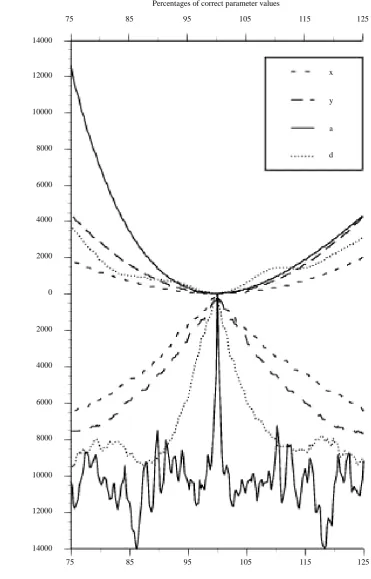
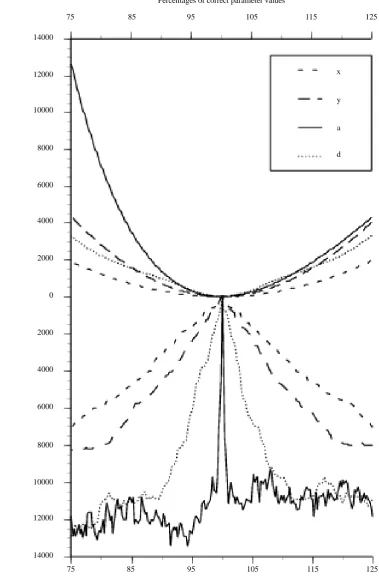
[image:13.595.185.442.289.699.2]The parameter that is limiting the optimization is the size and this is also obvious in the parametric study of the penny-shaped crack parallel to the scanned surface. In fact, the number of frequencies had to be increased to 50 (10 frequencies are used in Figure 6) in order to get the optimization to converge. Even then the initial guess had to be within a deviation of 15 percentages in order to converge.
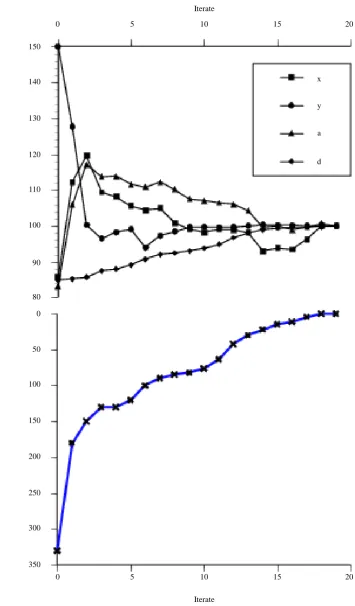
Figures 7-9 shows the result from the optimization of the situation of a 60˚ angled SV probe with a penny-shaped crack perpendicular to the surface. In Figure 7the initial guess of crack diameter is 85% of the
S
u
m
o
f
sq
u
ar
es
o
f
re
si
d
u
al
P
er
ce
n
ta
g
es
o
f
co
rr
ec
t p
ar
am
et
er
v
al
u
es
120
a(-15) 110
90
85
80 0
50
100
150
200
250
300
350
Iterate
0 5 10 15 20
a(-10)
a(+10) 115
100 105
95
Iterate
0 5 10 15 20
Figure 8.The depth variation when optimization is performed as in
S
u
m
o
f
sq
u
ar
es
o
f
re
si
d
u
al
P
er
ce
n
ta
g
es
o
f
co
rr
ec
t p
ar
am
et
er
v
al
u
es
120
Iterate
0 5 10
d(-15)
15 20
110
100
90
80
0
50
100
150
200
250
300
350
Iterate
0 5 10 15 20
85 95 105 115
d(-10)
d(+10)
correct value and all the parameters convergence rate is presented in the figure while we have chosen to present the diameter and depth convergence rate as a function of initial guess of diameter in Figure 8 and Figure 9, re-spectively. This is due to the fact that these two parameters are not independent of each other. The over-estima- tion of the depth at second iterate found in Figure 8is as seen strongly dependent on the initial guess of diame-ter and critical in diame-terms of convergence. The two major stopping cridiame-teria of the optimization are the distance between two steps and sufficient decrease of the residual.
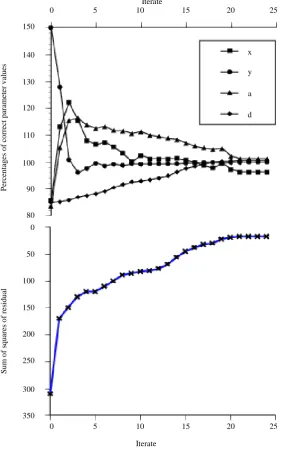
In Figure 10, we present the optimization on the same NDT situation using an asymptotic probe model on data achieved by the corresponding integral solution. This reduce the convergence from being q-quadratical to being q-linear and the number of iterates increases from 20 to 25 before the stopping criterion of step size ends the optimization. At the minimum all parameters are within 1% deviation from the values representing the “true” minimizer, except for the x parameter that ends at 96% of its corresponding value.
S
u
m
o
f
sq
u
ar
es
o
f
re
si
d
u
al
P
er
ce
n
ta
g
es
o
f
co
rr
ec
t p
ar
am
et
er
v
al
u
es
120 130 140 150
x
y
a
d
110
100
90
80 0
50
100
150
200
250
300
350
Iterate
0 5 10 15 20 25
Iterate
[image:15.595.172.456.235.686.2]0 5 10 15 20 25
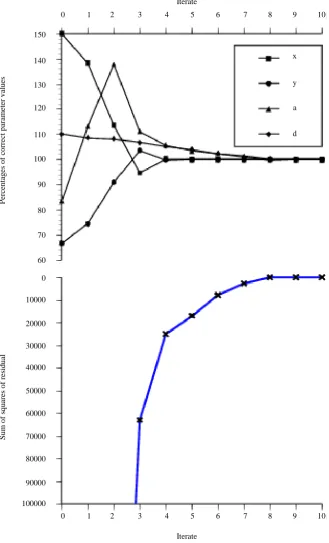
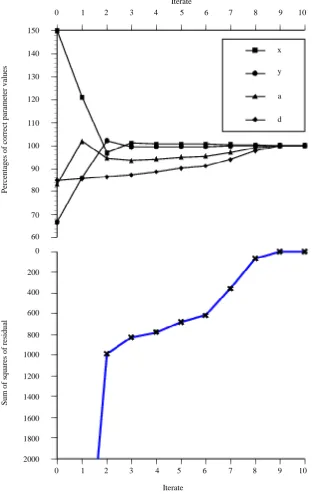
Figure 11 present the result of the optimization on the situation of an unangled P probe with a penny-shaped crack parallel to the scanning surface. The problem with overestimation of the depth parameter at the second it-eratation is also present for this situation. Even though this effect is more pronounced in this case, the true minimizer is already found at the 10:th iterate.
S
u
m
o
f
sq
u
ar
es
o
f
re
si
d
u
al
P
er
ce
n
ta
g
es
o
f
co
rr
ec
t p
ar
am
et
er
v
al
u
es
120 130 140 150
x
y
a
d 110
100
90
80
0
100000
Iterate 0
90000 80000 70000 60000 50000 40000 30000 20000 10000 70
60
1 2 3 4 5 6 7 8 9 10
Iterate
0 1 2 3 4 5 6 7 8 9 10
In Figures 12-15, the type of defect is altered to a spherical cavity and scanned by an unangled P probe. For this situation the dependence between depth and diameter are even more obvious since the maximum signal re-sponse is dependent on the distance represented by the difference between these two. The asymptotic probe model is used for data in Figure 12 while the numerical integrated solution is data in Figures 13-15. The non-zero residual problem in Figures 13-15 reduces the rate of convergence in terms of iteration as expected but the optimization actually becomes more insensitive to deviations from the “true” value in the initial guess of the size. At the minimum a cavity two percentages larger and oriented two percentages less in depth than that used to generate the data is found.
S
u
m
o
f
sq
u
ar
es
o
f
re
si
d
u
al
P
er
ce
n
ta
g
es
o
f
co
rr
ec
t p
ar
am
et
er
v
al
u
es
120 130 140 150
x
y
a
d 110
100
90
80
0
2000
Iterate 0
1800 1600 1400 1200 1000 800 600 400 200 70
60
1 2 3 4 5 6 7 8 9 10
Iterate
[image:17.595.157.471.200.695.2]0 1 2 3 4 5 6 7 8 9 10
S
u
m
o
f
sq
u
are
s o
f
re
si
d
u
al
P
er
ce
n
ta
g
es
o
f
co
rr
ec
t p
ar
am
et
er
v
al
u
es
180
Iterate
0 5 10
x
15 20
140
100
60
20
0
1000
Iterate
0 5 10 15 20
40 80 120
160 y
a
25 d
25
2000
3000
4000
5000
6000
7000
8000
9000
10000 200
S
u
m
o
f
sq
u
ar
es
o
f
re
si
d
u
al
P
er
cen
tag
es
o
f
co
rr
ect
p
ar
am
et
er
v
al
u
es
Iterate
0 5 10 15 20
140
100
60
0
1000
Iterate
0 5 10 15 20
80 120
a(-40)
25 25
2000
3000
4000
5000
6000
7000
8000
9000
10000 110 130
90
70
a(-25)
[image:19.595.141.495.90.689.2]a(+20)
S
u
m
o
f
sq
u
ar
es
o
f
re
si
d
u
al
P
er
ce
n
ta
g
es
o
f
co
rr
ec
t p
ar
am
et
er
v
al
u
es
Iterate
0 5 10 15 20
100
60
0
1000
Iterate
0 5 10 15 20
80 120
25 d(-40)
25
2000
3000
4000
5000
6000
7000
8000
9000
10000 110
90
70
d(-25)
d(+20)
5. Concluding Remarks
In the preceding sections, we have studied a numerical inverse solution to the non-destructive testing situation. The method we have used to achieve this has been the application of an optimization technique on a model of the ultrasonic inspection situation. If the inverse algorithm, described in previous sections, is to be used together with experimental NDT data a more general T matrix has to be implemented. Such as the T matrix for an elliptic or rectangular crack, oriented by three Euler angles, increases the number of parameters to eight which call for improvement of the convergence. One conclusion that can be made from the numerical section is that there is a distinct difference between global parameters compared with local (i.e. 3A/3B: a and d, 3C: x, a and d), in terms of convergence.
References
[1] Boström, A. and Wirdelius, H. (1995) The Journal of the Acoustical Society of America, 97, 2836-2848. http://dx.doi.org/10.1121/1.411850
[2] Wirdelius, H. (2007) Experimental Validation of the UTDefect Simulation Software.6th International Conference on NDE in Relation to Structural Integrity for Nuclear and Pressurized Components, Budapest, 8-10 October 2007, 9 p. [3] Persson, G. and Wirdelius, H. (2010) AIP Conference Proceedings, 1211, 2125-2132.
http://dx.doi.org/10.1063/1.3362392
[4] Bates, R.H.T., Smith, V.A. and Murch, R.D. (1991) Physics Reports, 201, 185-277. http://dx.doi.org/10.1016/0370-1573(91)90026-I
[5] Guillaume, H., Lhémery, A., Calmon, P. and Lasserre, F. (2005) Ultrasonics, 43, 619-628. http://dx.doi.org/10.1016/j.ultras.2005.03.006
[6] Mayer, K., Marklein, R., Langenberg, K.J. and Kreutter, T. (1990) Ultrasonics, 28, 241-255. http://dx.doi.org/10.1016/0041-624X(90)90091-2
[7] Marklein, R., Langenberg, K.J., Mayer, K., Miao, J., Shlivinski, A., Zimmer, A., Müller, W., Schmitz, V., Kohl, C. and Mletzko, U. (2005) Advances in Radio Science, 3, 167-174. http://dx.doi.org/10.5194/ars-3-167-2005
[8] Degtyar, A.D. and Rokhlin, S.I. (1997) The Journal of the Acoustical Society of America, 102, 3458-3466. http://dx.doi.org/10.1121/1.419588
[9] Castaings, M., Hosten, B. and Kundu, T. (2000) NDT & E International, 33, 377-392. http://dx.doi.org/10.1016/S0963-8695(00)00004-9
[10] Hosten, B. and Castaings, M. (2008) Composites Part A: Applied Science and Manufacturing, 39, 1054-1058. [11] Björkberg, J. and Kristensson, G. (1997) Progress in Electromagnetics Research, 15, 141-164.
http://dx.doi.org/10.2528/PIER95081800
[12] Wirdelius, H. (1992) Journal of Nondestructive Evaluation, 11, 29-39. http://dx.doi.org/10.1007/BF00566015 [13] Boström, A. and Eriksson, A.S. (1993) Proceedings of the Royal Society of London A, 443, 183-201.
http://dx.doi.org/10.1098/rspa.1993.0139
[14] Dennis, J.E. and Schnabel, R.B. (1983) Numerical Methods for Unconstrained Optimization and Nonlinear Equations. Prentice-Hall, Englewoods Cliffs.
[15] Boström, A., Kristensson, G. and Ström, S. (1991) Transformation Properties of Plane, Spherical and Cylindrical Sca-lar and Vector Wave Functions. In: Varadan, V.K., Varadan, V.V. and Lakhtakia, A., Eds., Vol. 1, Field Representa-tions and Introduction to Scattering, North Holland, Amsterdam, 165-210.
[16] Auld, B.A. (1979) Wave Motion, 1, 3-10. http://dx.doi.org/10.1016/0165-2125(79)90020-9
currently publishing more than 200 open access, online, peer-reviewed journals covering a wide range of academic disciplines. SCIRP serves the worldwide academic communities and contributes to the progress and application of science with its publication.
Other selected journals from SCIRP are listed as below. Submit your manuscript to us via either