Fuzzy Pareto-optimal Solution to Fully Fuzzy
Multi objective
Linear programming problem
S. Mohanaselvi
Assistant professor, Department of Mathematics, SRM University, Kattankulathur,
Chennai - 603203, INDIA
K. Ganesan
Professor & Head Department of Mathematics, SRM University, Kattankulathur,
Chennai - 603203, INDIA
ABSTRACT
This paper proposes a new algorithm for the solution of fully fuzzy Multi objective linear programming problems involving triangular fuzzy number without converting them to equivalent classical problems. Based on the fuzzy ideal and fuzzy negative ideal solution of each single fuzzy objective function we propose an algorithm which provides a fuzzy Pareto-optimal solution for the given fully fuzzy multi objective linear programming problem. By the proposed method, the Decision Maker will have the flexibility of choosing
r
[0,1]
depending upon the situation and can obtain an improved fuzzy Pareto optimal solution. A numerical example is provided to illustrate the theory developed in this paper.Keywords
Triangular fuzzy number, Fuzzy ranking, Fuzzy arithmetic, Fuzzy Multi objective linear programming problem.
1.
INTRODUCTION
The classical mathematical programming problem is used to find an optimal solution for single objective function whereas many problems in real world may involve multiple objectives with conflicting nature. These types of problems can be formulated as Multi objective linear programming problems (MOLPP) and there is no best solution exists in this case because we cannot improve all objective functions simultaneously. Improvement of one objective function may result in worsening of at least one of the other objective functions. Many researchers have developed various algorithms for solving MOLPP. If the coefficients involved in the objective and constraint functions are imprecise in nature which is interpreted as fuzzy numbers, then the resulting problem is referred to as a fully fuzzy Multi objective linear programming problem (FFMOLPP). Multi objective with imprecise parameters make the problem complicated to solve them using traditional approaches.
Decision making under fuzzy environment was first proposed by Bellman and Zadeh. Zimmermann [13] proposed an application of fuzzy optimization techniques to linear programming problem with single and multi-objective functions. Lai and Hwang [7] classified the solution approaches of fuzzy multi objective decision making. Feyzan Arikan [5] introduced a two-phase approach for solving multi-objective programming problems with fuzzy coefficients. Hiroaki Kuwano [6] proposed a goal programming approach for solving FFMOLPP with possiblistic variables. Buckley [3] applied fuzzy Monto carlo
method to generate a approximate solution for FFMOLPP. The method of fuzzy ranking was introduced by Miao-Ling Wang [8] to find the non dominated solution set to FFMOLPP and developed a technique of intra-parametric programming to solve the given problem. Xue-quan Li [12] proposed a two phase max-min fuzzy compromise approach to solve MOLPP. Chen and Chou [4] proposed a fuzzy approach to solve MOLPP. Omar Mohamed Saad [11] has suggested about the stability of the
pareto optimal solution in decision space for FFMOLPP. In this paper, we have proposed an algorithm to solve FFMOLPP without converting to crisp equivalent problem and obtained a fuzzy Pareto-optimal solution. This paper is organized as follows: In section 2, we recall the basic concepts and the results of triangular fuzzy numbers and their arithmetic operations. In section 3, we introduce the Fuzzy Multi objective linear programming problem with triangular fuzzy number and related results. In section 4, we propose a new algorithm to find the fuzzy Pareto-optimal solution for the given FFMOLPP. In section 5, a numerical example is provided to illustrate the theory developed in this paper.2.
PRELIMINARIES
In this section we recall the basic concepts and the results of triangular fuzzy number and their arithmetic operations. Definition 2.1 [10] A fuzzy set
a%
defined on the set of real numbersR
is said to be a fuzzy number if its membership functiona : R
%
[0,1]
has the following characteristics: (i)a%
is convex, that is
1 2 1 2
x x x x
a (λ
%
1- λ
) min a ( ), a ( ) ,
%
%
1 2
for all x , x Rand [0,1].
(ii)
a%
is normal i.e. there exists anx
R
such that
a x
%
1
(iii)
a%
is Piecewise continuous.
1
1 2
2 1 3
2 3
3 2
x - a
, for a
x
a
a - a
a - x
a x
, for a
x
a
a - a
0, elsewhere
%
We denote this triangular fuzzy number by
a = (a , a , a ).
%
1 2 3We use
F(R)
to denote the set of all triangular fuzzy numbers. Also ifm
a
2represents the modal value or midpoint,
( a
2
a )
1 represents the left spread and3 2
(a
a )
represents the right spread of the triangular fuzzy numbera = (a , a , a ),
%
1 2 3 then the triangular fuzzy numbera%
can be represented by the triplet a%
,m,
. i.e. a = (a , a , a ) =% 1 2 3
, m,
.Definition 2.3 [10] A triangular fuzzy number
a
%
F(R)
can also be represented as a pair a%
a, a
of functions
a r and a r for
0
r
1
which satisfies the following requirements:(i)a r is a bounded monotonic increasing left continuous
function.(ii)a r is a bounded monotonic decreasing left continuous
function.(iii)a r
a r
,0
r
1
Definition 2.4 [10] For an arbitrary triangular fuzzy number
a
%
a, a
, the numbera
0a(1) a(1)
2
is said to be a location index number ofa%
. The two non-decreasing left continuous functionsa
*
(a
0
a),
a
*
( a
0a )
are called the left fuzziness index function and the right fuzziness index function respectively. Hence every triangular fuzzy numbera = (a , a , a )
%
1 2 3 can also be represented by
*
0 *
a% a , a , a .
2.1
Ranking of triangular Fuzzy Numbers
Several approaches for the ranking of fuzzy numbers have been proposed in the literature. Abbasbandy and Hajjari [1] proposed a new ranking method based on the left and the right spreads at somer
- levels of fuzzy numbers by1
0 0
1
Mag(a)
( a
a
a ) f (r) dr
2
%
Hence for any triangular fuzzy number
*
1 2 3 0 *
a = (a , a , a )% a , a , a represented in terms of location index number, left fuzziness index function and the
right fuzziness index function respectively, we define the magnitude of the triangular fuzzy number
a%
bywhere the function
f (r)
is a non-negative and increasing function on[0,1]
withf (0) 0,
f (1) 1
and1
0
1 f (r) dr
2
.
The function
f (r)
can be considered as a weighting function. In real life applications,f (r)
can be chosen by the decision maker according to the situation. In this paper, for convenience we usef (r)
r
.
For any two triangular fuzzy numbers a%
a , a , a0 * *
and
*
0 *
b% b , b , b in
F(R)
, we define the ranking ofa%
andb%
by comparing the Mag(a%) and Mag(b%
)onR
as follows: (i)a%fb
%
if and only if Mag(a) % Mag(b)%(ii) a%p
b
%
if and only if Mag(a) % Mag(b)% (iii).a
%
b
%
if and only if Mag(a) % Mag(b)%2.2
Arithmetic operation on triangular
Fuzzy Numbers
Ming Ma et al. [9] have proposed a new fuzzy arithmetic based upon both location index and fuzziness index functions. The location index number is taken in the ordinary arithmetic, whereas the fuzziness index functions are considered to follow the lattice rule which is least upper bound in the lattice L. That is for a, bL we define
a
b
max a, b
and a
b
min a, b .
For arbitrary triangular fuzzy numbers a%
a , a , a0 * *
and
*
0 *
b% b , b , b and
, , ,
,
the arithmetic operations on the triangular fuzzy numbers are defined by
* *
0 0 * *
a b% % a b , a b , a b .
In particular for any two triangular fuzzy numbers
*
0 *
a% a , a , a and b%
b , b , b0 * *
, we define:
* *
0 * 0 *
* *
0 0 * *
i Addition: a
b
a , a , a
b , b , b
a
b , max a , b , max a , b
%
%
* *
0 * 0 *
* *
0 0 * *
ii Subtraction: a
b
a , a , a
b , b , b
a
b , max a , b , max a , b
%
%
(iii).Multiplication:
a b
%
%
*
*
0 * 0 *
a , a , a b , b , b
1
0 0
1
Mag(a)
( a
4a
a ) f (r) dr .
2
* *
0 0 * *
a
b , max a , b , max a , b
(iv).Division
a
%
b
%
*
*
0 * 0 *
a , a , a b , b , b
a
0
b , max a , b , max a , b
0
* *
* *
3.
FUZZY MULTI OBJECTIVE LINEAR
PROGRAMMING
PROBLEM
WITH
TRIANGULAR FUZZY NUMBER
Let
F(R)
be set of all triangular fuzzy numbers. A fuzzy multi objective linear programming problem with triangular fuzzy numbers is defined as follows:T
1 2 N
n n n
1 1j j 2 2j j k kj j
j 1 j 1 j 1
max Z (Z Z Z
Z Z Z
, ,..., )
where c x , c x ,..., c x
% % % %
% %% % %% % %%
n
ij j i 0
j 1
subject to
a x
b
for all i=1,2,...,m
%% p
%
(1)
n
i j j i 0
j 1
a x
b
for all i = m +1,...m
%%f
%
j
and x
% f
0
%
for all j 1, 2,...., n
Where
a , c , x , b
% % %
ij j j%
i
F(R)
,
i
1, 2,3,
.m and
j 1, 2,3,
., n.
If
a , c , x and b%
% % %
ij j j i are represented by location index number, left fuzziness index function and right fuzziness index function respectively, then the above problem can be rewritten as follows:1 2 N
n
* *
1 1j 0 1j * 1j j 0 j * j
j 1 n
* *
2 2 j 0 2 j * 2 j j 0 j * j
j 1
*
k kj 0 kj * kj
max Z (Z Z Z
Z Z
Z
, ,..., )
where (c ) , (c ) , (c ) (x ) , (x ) , (x ) ; (c ) , (c ) , (c ) (x ) , (x ) , (x ) ; (2) ...
(c ) , (c ) , (c ) (
% % % %
% %
% n *
j 0 j * j
j 1
x ) , (x ) , (x )
Subject to the constraints
n
* *
ij 0 ij * ij j 0 j * j j 1
* j 0 j * j
(a ) , (a ) , (a )
(x ) , (x ) , (x )
(b ) , (b ) , (b ) ,
p
0
for all i 1,2,...,m
n
* *
ij 0 ij * ij j 0 j * j j 1
* j 0 j * j
(a ) , (a ) , (a )
(x ) , (x ) , (x )
(b ) , (b ) , (b ) ,
f
0
for all im 1,...m and (x ) , (x ) , (x )j 0 j * j * f 0% for all j 1, 2,...n.
Practically, it is difficult to reach fuzzy optimal for all objective functions subject to the given constraints in problem (1) and (2).
Definition 3.1A fuzzy vector
x
%
X
%
is said to be a fuzzy feasible solution if it satisfy the given constraints of the problem (2).Definition 3.2 A fuzzy feasible solution
x
%
is said to be a complete fuzzy optimal solution for (2) if there existsx
%
X
%
such that
Z ( x )
%
k%
Z (x), k =1,2,...,N,
%
k%
for all x%X%.Since the objective functions conflict with each other, a complete fuzzy optimal solution that simultaneously maximize all the multiple fuzzy objective functions doesn’t exist always. Thus instead of complete fuzzy optimal solution, a new solution concept called fuzzy Pareto-optimality is introduced for FFMOLPP.
Definition 3.3 A fuzzy feasible solution is said to be a fuzzy Pareto-optimal solution for (1) if there doesn’t exist
x
%
X
%
such that
Z ( x )
%
k%
Z (x)
%
k%
for allk
(k
1, 2,..., N
) ands s
Z ( x )% % Z (x)% %for at least one s.
Definition 3.4 A fuzzy ideal solution of (1) is defined as a vector, whose components are composed by maximum value of each fuzzy objective function under the given constraints
1 2 k 1 2 N
Z%[Z Z% %
,
,...,
Z%] [max
Z%, max
Z%,..., max
Z%].
Definition 3.5 A fuzzy negative ideal solution of (1) is defined as a vector, whose components are composed by minimum value of each fuzzy objective function under the given constraints,
1 2 k 1 2 N
Z%[Z Z% %
,
,...,
Z%] [min
Z%, min
Z%,..., min
Z%]
Definition 3.6 From fuzzy ideal and negative fuzzy ideal solution we can find the possible range Z , Zk kfor the
th
k
fuzzy objective function. WithZ
k and
Z
k
, define a non-decreasing linear membership function for the
k
thfuzzy objective function as follows:
1 ( )
( )
1 , 1, 2,.... .
0 ( ) (4)
k k
k
k k
k k k
k k
k k
if Z x Z
Z Z x
x if Z Z Z k N
Z Z
if Z x Z
% %
% %
% %
% %
% %
4.
A NEW ALGORITHM TO SOLVE
FUZZY MULTI OBJECTIVE LINEAR
PROGRAMMING PROBLEM
An algorithm to find the fuzzy Pareto optimal solution to a fully fuzzy multi objective linear programming problem is presented as follows:
Step 1: Represent each fuzzy data
a
%
(a , a , a )
1 2 3 in terms of a%
a , a , a0 * *
.Step 2: Find the fuzzy ideal solution
Z
kand fuzzy negative ideal solutionZ
k of each single fuzzy objective function subject to the given constraints using fuzzy version of simplex algorithm proposed by Mohanaselvi and Ganesan [10]. Step 3: Define the membership of each fuzzy objective function’s satisfaction degree using equation (4).Step 4: Formulate a new problem for maximizing the satisfaction degree
of the final decision maker subject to the original constraints along with the additional constraint
,
1, 2,....
k
x
k
N
. Solve this single objective model for obtaining the fuzzy Pareto-optimal solution of FFMOLPP. That is by the well known max-min operator, problem (1) can be reformulated as
1 2
0
max
min
( ),
( ),...,
N( )
x
x
x
x
.
ij 0
1
ij 0
1
. . max
such that , 1, 2,.... .
a for all i=1,2,...,m (5)
a for all i = m +1,...m [0,1]and 0 for all 1, 2,... .
k n
j i
j n
j i j
j
i e
x k N
x b
x b
x j n
% % % p
% % %f
% %f
Theorem: 4.1
A solution to the FFMOLPP (5) exists and is a fuzzy Pareto-optimal solution to (1).
Proof:
Suppose
x
%
is not a fuzzy Pareto-optimal solution for problem (1), then there exists a fuzzy Pareto-optimal solutionx
%
. Then, for every k, we haveZ ( x )
%
k%
Z (x )
%
k%
andi i
Z ( x )
%
%
Z (x ), i
%
%
1, 2,..., N
.That is for everyk, we have
k
x
k
x
and
1,
,
i
N
ix
ix
,So
x
min
1(x ),
2(x ),...,
N(x )
min
1(x ),
2(x ),...,
N(x )
x
This shows that
x
%
is not the only optimal solution of (5), which is a contradiction. This contradiction proves thatx
%
is a fuzzy Pareto-optimal solution to (1).5.
NUMERICAL EXAMPLE
Consider an example discussed in Buckley.J.J et al [3]
1 1 2
2 1 2
1 2
1 2
1 2
1 2
1 2
max Z
4, 5, 6 x
2, 3, 4 x
max Z
1, 2, 3 x
6,8,10 x
subject to 0,1, 2 x
3, 4, 5 x
95,100,105
2, 3, 4 x
1, 2, 3 x
140,150,160
3, 5, 7 x
2, 3, 4 x
180, 200, 220
1, 2, 3 x
6,8,10 x
70, 75,80
and
x , x
0.
%
%
%
%
%
%
%
%
%
%
%
%
%
% %
Solution:
Step 1: Representing the triangular fuzzy numbers in terms of left and right index function, we have
1 1 2
2 1 2
1 2
1 2
1 2
max Z 5,1 r,1 r x 3,1 r,1 r x max Z 2,1 r,1 r x 8, 2 2r, 2 2r x subject to
1,1 r,1 r x 4,1 r,1 r x 100, 5 5r, 5 5r 3,1 r,1 r x 2,1 r,1 r x 150,10 10r,10 10r 5,1 r,1 r x 4,1 r,1 r x 200, 20 20r, 20 20r
% %
% %
% %
% %
% %
2,1 r,1 r x
%1
8,1 r,1 r x
%2
75, 5 5r, 5 5r
andx , x
% %
1 2
0,
%
r
0,1
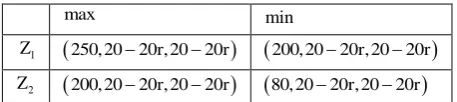
[image:4.595.320.549.551.602.2]Step 2: Using fuzzy version of simplex algorithm proposed by Mohanaselvi and Ganesan [10], the fuzzy ideal and fuzzy negative ideal solution of each single fuzzy objective function subject to the given constraints is given by:
Table 5. 1. Fuzzy Ideal and Fuzzy Negative ideal solutions
max min
1
Z
250, 2020r, 2020r
200, 2020r, 2020r
2
Z
200, 2020r, 2020r
80, 2020r, 2020r
Since the objective functions conflict with each other, a complete fuzzy optimal solution that simultaneously maximize all the multiple fuzzy objective functions doesn’t exist always. Thus instead of complete fuzzy optimal solution, a new solution concept called fuzzy Pareto-optimality is introduced for FFMOLPP.Step 3: Define the membership of each fuzzy objective function’s Z and 1 Z satisfaction degree. 2
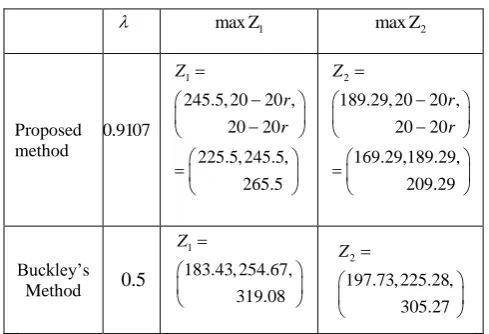
Solving the above problem we get the Solution as: 0.9107
,
x
%
1
41.07, 20 20 , 20 20
r
r
and
2
13.39, 20 20 , 20 20
%
[image:5.595.43.288.153.320.2]x
r
r
.Table 5. 2. Comparison study of the proposed method
max Z 1 max Z 2
Proposed method
0.9107
1
245.5, 20 20 , 20 20 225.5, 245.5,
265.5
Z
r r
2
189.29, 20 20 , 20 20 169.29,189.29,
209.29
Z
r r
Buckley’s Method
0.5
1
183.43, 254.67, 319.08
Z
2
197.73, 225.28, 305.27
Z
We see that the largest possible range of objective functions
1
Z
andZ
2are[200, 250]
and[80, 200]
respectively by the proposed method. Whenr
1
, the solution becomes1
Z
245.5
andZ
2
189.29
which lies inside the possible range where as it is not so in the case of Buckley [3].6.
CONCLUSION
In this study we have introduced a new algorithm for solving fully fuzzy Multi objective linear programming problem with triangular fuzzy number without converting to equivalent classical problem. The triangular fuzzy numbers are represented in terms of location index number, left fuzziness index function and right fuzziness index function respectively. Multi objective linear programming with imprecise parameters makes the problem complicated and hence the traditional approaches fails to give a solution to those problems. Based on the fuzzy ideal and fuzzy negative ideal solution of each single fuzzy objective function of the given fuzzy MOLP, the proposed algorithm provides a fuzzy Pareto-optimal solution for the given fully fuzzy multi objective linear programming problem in an improved way. This idea can be extended for solving multi-level multi objective linear programming problem with fuzzy coefficients. A numerical example discussed by Buckley [3] is solved using the proposed method without converting the given problem to crisp equivalent problem. It is to be noted that by applying the proposed method, the Decision Maker have the flexibility of choosing
r
[0,1]
depending upon the situation and he can obtain the fuzzy Pareto optimal solution for the given problem.7.
ACKNOWLEGEMENT
The authors are grateful to the anonymous referees and the editors for their constructive comments and valuable suggestions.
8.
REFERENCES
[1] Abbasbandy.S and Hajjari. T, A new approach for ranking of trapezoidal fuzzy numbers, Computers and Mathematics with Applications, 57, 413–419, (2009). [2] Bellman, R.E and Zadeh, L.A., Decision-making in fuzzy
environment, Management sciences, 17(4) (1970), 141-164.
[3] Buckley.J.J et al Monto carlo Method in Fuzzy Optimization, Springer-verlang Berline Heidelberg ,STUDFUZZ 22, 81-88, 2008.
[4] H.K.Chen, H.W.Chou, Solving multiobjective linear programming problem – a generic approach, Fuzzy sets and systems, 82 (1996) 35-38.
[5] Feyzan Arikan, Zulal Gungor, A two phase approach for multi-objective programming problems with fuzzy coefficients, Information sciences, 177(2007), 5191-5202.
[6] Hiroaki kuwano, On the fuzzy multi-objective linear programming problem: Goal programming approach, Fuzzy sets and systems, 82 (1996), 57-64.
[7] Y.J.Lai and C.L.Hwang, Fuzzy Multiple Objective Decision Making, Lecture Notes in Economics and Mathematical systems, Vol.404 (springer,Berlin, 1994). [8] Miao-Ling Wang, Finding the nondominated solution set
of a fuzzy multiobjective linear program by using fuzzy ranking method, Ming Hsin Journal,Volume 31,(2005),137-145.
[9] Ming Ma, Menahem Friedman, Abraham kandel, A new fuzzy arithmetic, Fuzzy sets and systems,108,83-90,(1999).
[10]S. Mohanaselvi and K. Ganesan, Fully Fuzzy linear programs with triangular fuzzy number, International journal of Mathematical Archieve, 3(5),(2012),1838-1845.
[11]Omar Mohamed saad, Stability on multi objective linear programming problem with fuzzy parameters, Fuzzy sets and systems, 74 (1995), 207-215.
[12]Xue-quan Li, Bo Zhang, Hui Li, Computing efficient solutions to fuzzy multiple objective linear programming problems, Fuzzy sets and system,157(2006),1328-1332. [13]Zimmermann H. J., Fuzzy programming and linear