http://dx.doi.org/10.4236/ojdm.2015.53003
Independence Numbers in Trees
Min-Jen Jou1, Jenq-Jong Lin21Department of Information Technology, Ling Tung University, Taichung Taiwan 2Department of Finance, Ling Tung University, Taichung Taiwan
Email: [email protected], [email protected]
Received 3 March 2015; accepted 14 July 2015; published 17 July 2015 Copyright © 2015 by authors and Scientific Research Publishing Inc.
This work is licensed under the Creative Commons Attribution International License (CC BY).
http://creativecommons.org/licenses/by/4.0/
Abstract
The independence number α
( )
G of a graph G is the maximum cardinality among all independentsets of G. For any tree T of order n≥ 2, it is easy to see that
( )
n
T n
α 1
2 ≤ ≤ − . In addition, if there
are duplicated leaves in a tree, then these duplicated leaves are all lying in every maximum inde-pendent set. In this paper, we will show that if T is a tree of order n≥ 4 without duplicated leaves, then
( )
n T
α 2 1
3
−
≤ . Moreover, we constructively characterize the extremal trees T of order n≥ 4,
which are without duplicated leaves, achieving these upper bounds.
Keywords
Independent Set, Independence Number, Tree
1. Introduction
All graphs considered in this paper are finite, loopless, and without multiple edges. For a graph G, we refer to
( )
V G and E G
( )
as the vertex set and the edge set, respectively. The cardinality of V G( )
is called the or-der of G, denoted by G. The (open) neighborhood NG( )
x of a vertex x is the set of vertices adjacent to x inG, and the close neighborhood NG
[ ]
x is NG( ) { }
x x . A vertex x is said to be a leaf if NG( )
x =1. A vertexv of G is a support vertex if it is adjacent to a leaf in G. Two distinct vertices u and v are called duplicated if
( )
( )
G G
N u =N v . Note that u and v are duplicated vertices in a tree, and then they are both leaves. The n-path
n
P is the path of order n≥1. For a subset A⊆V G
( )
, the induced subgraph induced by A is the graph AG with vertex set A and the edge set(
)
{
( )
: and}
G
A set I⊆V G
( )
is an independent set of G if no two vertices of I are adjacent in G. The independence num-ber α( )
G of G is the maximum cardinality among all independent sets of G. If I is an independent set of Gwith cardinality α
( )
G , we call I an α -set of G. If I is an α -set of G containing all leaves of G, we call I anL
α -set of G.
The independence problem is to find an α -set in G. The problem is known to be NP-hard in many special classes of graphs. Over the past few years, several studies have been made on independence (see [2]-[6]). For
any tree T of order n≥2, it is easy to see that
( )
1 2n
T n
α
≤ ≤ −
. In addition, if there are duplicated leaves in
a tree, then these duplicated leaves are all lying in every maximum independent set. In this paper, we will show
that if T is a tree of order n≥4 without duplicated leaves, then
( )
2 1 3n T
α ≤ −
. Moreover, we constructively
characterize the extremal trees T of order n≥4, which are without duplicated leaves, achieving these upper bounds.
2. The Upper Bound
In this section, we will show a sharp upper bound on the independence number of a tree T without duplicated leaves.
Lemma 1 If H is an induced subgraphofG,then α
( )
H ≤α( )
G .Proof. If S is an α-set of H, then S is an independent set of G. It follows that α
( )
H = ≤S α( )
G . Lemma 2 ([4]) If T is a tree of order n≥1, then
( )
2
n T
α ≥
.
Lemma 3 ([5]) If T is a tree of order n≥3, then there exists an αL-set of T.
Lemma 4 For an integer n≥4,
( )
2 12 3
n
n n
P
α = ≤ −
.
Proof. It is straightforward to check that 2 1
2 3
n n−
≤
for n≥4. Let P vn: 1− − −v2 vn. Since Pn is a
tree of order n≥4, by Lemma 2, we have that
( )
2 nn P
α ≥
. Suppose that there exists an independent set I of
Pn with 1
2
n I ≥ +
, then there exists i, 1≤ ≤ −i n 1, such that vi∈I and vi+1∈I. This is a contradiction,
therefore we obtain that
( )
2 nn P
α =
.
Theorem 1 If T is a tree of order n≥4 without duplicated leaves, then
( )
2 13
n T
α ≤ −
.
Proof. We prove it by induction on n≥4. By Lemma 4 and T is a tree without duplicated leaves, it’s true for all n≤6. For all n≥7 we assume that the assertion is true for all n′ <n. Suppose that T is a tree of order
7
n≥ without duplicated leaves and x is a leaf lying on a longest path of T. Let y∈NT
( )
x . Since T has no duplicated leaves, this implies that dT( )
y =2, say NT( ) { }
y = x z, . Let T′ = −T NT[ ]
x , then T' is a tree of order n−2. For the case in which T' has no duplicated leaves, by induction hypothesis, we have that( )
2(
2)
1 2 53 3
n n
T
α ′ ≤ − − = −
. Since an α-set of T', together with
{ }
x , form an α-set of T. Therefore weobtain that
( )
( )
1 2 5 1 2 2 2 13 3 3
n n n
T T
α =α ′ + ≤ − + = − ≤ −
. For the other case in which T' has duplicated
leaves z and z′, then T′′=T′−
{ }
z is a tree of order n− ≥3 4 without duplicated leaves. By inductionhy-pothesis, we have that
( )
2(
3)
1 2 73 3
n n
T
α ′′ ≤ − − = −
an α -set of T. Therefore, we obtain that
( )
( )
2 2 7 2 2 13 3
n n
T T
α =α ′′ + ≤ − + = −
. Hence we conclude that
( )
2 13
n T
α ≤ −
. Note that the result in Theorem 1 is sharp and some such T are illustrated below.
3. Extremal Trees
Let T
( )
n be the class of all trees T of order n≥4 without duplicated leaves such that( )
2 1 3n T
α = −
. We will constructively characterize these extremal trees. Let L T
( )
and U T( )
, respectively, denote the col-lections of all leaves and all support vertices of T. First, we define four operations on a tree T of order n≥4 as follows, where I is an αL-set of T.Operation O1. Join a vertex u∈I of T to a vertex v1 of P1 such that IO1=
(
I−{ }
u)
{ }
v1 , where 2T = ≡n (mod 3).
Operation O2. Join a vertex u∈Ic\U T
( )
of T to a vertex v1 of P1 such that IO2=I{ }
v1 , where 0,1T = ≡n (mod 3).
Operation O3. Join a vertex u of T to a leaf v2 of P2 (say P v2: 1−v2) such that IO3=I
{ }
v1 , where 1, 2T = ≡n (mod 3).
Operation O4. Join a vertex c
u∈I of T to a leaf v3 of P3 (say P v3: 1− −v2 v3) such that IO4=I
{
v v1, 3}
.Lemma 5 Suppose that T∈T
( )
n for n≥4. If I is an αL-set of T, then( )
(
(
)
)
(
)
0, if 2 mod 3 ,
\ 1, if 1 mod 3 ,
2, if 0 mod 3 .
c
n
I U T n
n
≡
≤ ≡
≡
Proof. It’s true for all n≤6. So we assume that n≥7. Since I is an αL-set of T, this implies that
( )
cU T ⊆I . By Theorem 1, we have that
(
)
(
)
( )
2 3 2 1
2 1, if 3 2,
3
2 3 1 1
2 , if 3 1,
3
2 3 1
2 1, if 3 .
3
k
k n k
k
I k n k
k
k n k
+ −
= + = +
+ −
= = = +
−
= − =
Hence we obtain that Ic = −n I = +k 1. Let B= −I L T
( )
={
z z1, 2,,zb}
. Note that( )
c T i
N z ⊆I and
( )
2T i
N z ≥ for every i. In addition, NT
( )
zi NT( )
zj ≤1, these imply that 1( )
1b c
T i i
I ≥
= N z ≥ +b . Thus we obtain that B = ≤b Ic − =1 k. It follows that( )
( )
( )
(
)
(
) (
)
(
) ( )
( ) (
)
\
2
3 2 2 2 1 0, if 3 2,
3 1 2 2 1, if 3 1,
3 2 2 1 2, if 3 .
c c c
c
I U T I U T I L T
I I b n I k
k k k n k
k k k n k
k k k n k
= − = −
= − − ≤ − +
+ − + + = = +
= + − + = = +
− − + = =
This completes the proof.
Lemma 6 Let T∈T
( )
n be a tree of order n≡2 mod 3(
)
with an αL-set I. Suppose that T' is obtainedfrom T by Operation O1, then T′ ∈T
(
n+1)
is a tree of order n+1 and IO1 is an αL-set of T'.( )
=c
I U T . Let T' be the tree obtained from T by Operation O1. Since u∈I, this implies that u is not a support vertex of T and T' is a tree of order n+1 without duplicated leaves. On the other hand, IO1 is an independent
set of T′ with L T
( )
′ ⊆IO1 such that(
)
( )
1(
)
2 1 1 2 1 2 1 1
3 O 3 3
n n n
T I I
α
+ − ≥ ′ ≥ = = − = + −
, where
2
n≡ (mod 3). Hence
( )
2(
1)
1 3n T
α ′ = + −
. In conclusion, T′ ∈T
(
n+1)
is a tree of order n+1 with anL
α -set IO1.
Lemma 7 Let T∈T
( )
n be a tree of order n≡0,1 mod 3(
)
with an αL-set I such that( )
1c
I −U T ≥ . If T′ is obtained from T by Operation O2, then T′ ∈T
(
n+1)
is a tree of order n+1 and IO2 is an αL-setof T′.
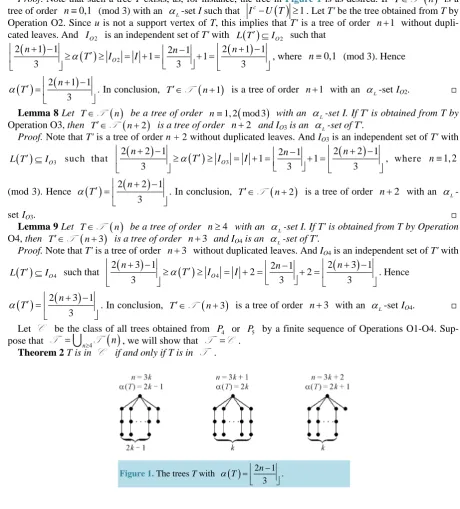
Proof. Note that such a tree T exists, as, for instance, the tree in Figure 1 is as desired. If T∈T
( )
n is a tree of order n≡0,1 (mod 3) with an αL-set I such that( )
1c
I −U T ≥ . Let T' be the tree obtained from T by Operation O2. Since u is not a support vertex of T, this implies that T' is a tree of order n+1 without dupli-cated leaves. And IO2 is an independent set of T' with L T
( )
′ ⊆IO2 such that(
)
( )
(
)
2
2 1 1 2 1 2 1 1
1 1
3 O 3 3
n n n
T I I
α
+ − + −
≥ ′ ≥ = + = − + =
, where n≡0,1 (mod 3). Hence
( )
2(
1)
13
n T
α ′ = + −
. In conclusion, T′∈T
(
n+1)
is a tree of order n+1 with an αL-set IO2. Lemma 8 Let T∈T
( )
n be a tree of order n≡1, 2 mod 3(
)
with an αL-set I. If T' is obtained from T by Operation O3, then T′ ∈T(
n+2)
is a tree of order n+2 and IO3 is an αL-set of T'.Proof. Note that T' is a tree of order n + 2 without duplicated leaves. And IO3 is an independent set of T' with
( )
O3L T′ ⊆I such that
(
)
( )
3(
)
2 2 1 2 1 2 2 1
1 1
3 O 3 3
n n n
T I I
α
+ − ≥ ′ ≥ = + = − + = + −
, where n≡1, 2
(mod 3). Hence
( )
2(
2)
1 3n T
α ′ = + −
. In conclusion, T′ ∈T
(
n+2)
is a tree of order n+2 with an αL- set IO3. Lemma 9 Let T∈T
( )
n be a tree of order n≥4 with an αL-set I. If T' is obtained from T by Operation O4, then T′∈T(
n+3)
is a tree of order n+3 and IO4 is an αL-set of T'.Proof. Note that T' is a tree of order n+3 without duplicated leaves. And IO4 is an independent set of T' with
( )
O4L T′ ⊆I such that
(
)
( )
4(
)
2 3 1 2 1 2 3 1
2 2
3 O 3 3
n n n
T I I
α
+ − ≥ ′ ≥ = + = − + = + −
. Hence
( )
2(
3)
13
n T
α ′ = + −
. In conclusion, T′ ∈T
(
n+3)
is a tree of order n+3 with an αL-set IO4. Let C be the class of all trees obtained from P4 or P5 by a finite sequence of Operations O1-O4.Sup-pose that T =
n≥4T( )
n , we will show that T =C .Theorem 2 T is in C if and only if T is in T .
Figure 1. The trees T with
( )
2 1 3n T
α = −
[image:4.595.79.540.234.744.2]Proof. If T is in C , by Lemmas 6, 7, 8 and 9, then T is in T . Now, we want to show the converse by con-tradiction. Suppose to the contrary that there exists a tree T∈T and T∉C such that T is as small as possible. We can see that T ≥7. Let P x: − − −y z be a longest path of T. Then NT
( ) { }
y = x z, and[ ]
T
T′ = −T N x is a tree of order n′ = −n 2. We consider two cases. Case 1. T' has no duplicated leaves.
For an αL-set I of T, I′ = −I
{ }
x is an independent set of T', this implies that α( )
T′ ≥ I′ =α( )
T −1. ByTheorem 1, we have that 2 1 1 2 4
( )
1( )
2(
2)
1 2 5 2 43 3 3 3 3
n
n n n n
T T
α α − −
− − − −
− = = − ≤ ′ ≤ = ≤
. Then
( )
2(
2)
1 2 11
3 3
n n
T
α ′ = − − = − −
and n≡0,1 (mod 3). This follows that T′∈T
( )
n′ , where 2 1, 2n′ = − ≡n (mod 3), by hypothesis, T′∈C . Note that T can be obtained from T′ by Operation O3, this implies that T∈C , which is a contradiction.
Case 2. T' has duplicated leaves z and z'.
Let T′′=T′−
{ }
z . Then T′′ is a tree of order n−3. Since z' is a leaf of T, this implies that z and z' are in every αL-set of T. For an αL-set I of T, I′′ = −I{ }
x z, is an independent set of T′′, thus( )
T I( )
T 2α ′′ ≥ ′′ =α − . By Theorem 1, we have that
( )
( )
2(
3)
12 1 2 7 2 7
2 2
3 3 3 3
n
n n n
T T
α α − −
− − −
− = = − ≤ ′′ ≤ =
. Then
( )
(
)
2 3 1
3
n T
α ′′ = − −
. This fol- lows that T′′∈T
( )
n′′ , where n′′ = −n 3, by hypothesis, T′′∈C . Note that T can be obtained from T′′ by Operation O4, this implies that T∈C , which is a contradiction.By Cases 1 and 2, we conclude that T is in T , then T is in C . Now, we obtain the main theorem in this paper.
Theorem 3 Suppose that T is a tree of order n≥4 without duplicated leaves, then
( )
2 13
n T
α ≤ −
.
Fur-thermore, the equality holds if and only if T∈C .
References
[1] Bondy, J.A. and Murty, U.S.R. (1976) Graph Theory with Application. North-Holland, New York.
[2] Harant, J. (1998) A Lower Bound on the Independence Number of a Graph. Discrete Mathematics, 188, 239-243.
http://dx.doi.org/10.1016/S0012-365X(98)00048-X
[3] Hattingh, J.H., Jonack, E., Joubert, E.J. and Plummer, A.R. (2007) Total Restrained Domination in Trees. Discrete Mathematics, 307, 1643-1650. http://dx.doi.org/10.1016/j.disc.2006.09.014
[4] Jou, M.-J. (2010) Dominating Sets and Independent Sets in a Tree. Ars Combinatoria, 96, 499-504.
[5] Jou, M.-J. (2010) Upper Domination Number and Domination Number in a Tree. Ars Combinatoria, 94, 245-250. [6] Luo, R. and Zhao, Y. (2006) A Note on Vizing’s Independence Number Conjecture of Edge Chromatic Critical Graphs,