Predicting Human Assessment of Machine Translation
Quality by Combining Automatic Evaluation Metrics
using Binary Classifiers
Michael Paul and Andrew Finch and Eiichiro Sumita
MASTAR Project
National Institute of Information and Communcations Technology 3-5 Hikaridai, Seika-cho, Soraku-gun, Kyoto 619–0289
ABSTRACT
This paper presents a method to predict human assessments of ma-chine translation (MT) quality based on a combination of binary classifiers using acoding matrix. The multiclass categorization problem is reduced to a set of binary problems that are solved us-ing standard classification learnus-ing algorithms trained on the results of multiple automatic evaluation metrics. Experimental results us-ing a large-scale human-annotated evaluation corpus show that the decomposition into binary classifiers achieves higher classification accuracies than the multiclass categorization problem. In addition, the proposed method achieves a higher correlation with human judgments on the sentence level compared to standard automatic evaluation measures.
General Terms:
Machine Translation, Machine Learning, Machine Translation Evaluation
Keywords:
Evaluation Metric Combination, Human Assessment Prediction-ifx
1. INTRODUCTION
The evaluation of MT quality is a difficult task because there may exist many possible ways to translate a given source sen-tence. Moreover, the usability of a given translation depends on numerous factors such as the intended use of the translation, the characteristics of the MT software, and the nature of the transla-tion process. Early attempts tried to manually produce numerical judgments of MT quality with respect to a set of reference trans-lations [25]. Recent human assessment of MT quality has been carried out by either assigning a single grade on a scale of 5 or 7 specifying the fluency or adequacy of a given translation [19] or relatively ranking multiple translations of the same input to each other [7].
Although the human evaluation of MT output provides the most direct and reliable assessment, it is time consuming, costly and subjective, i.e., evaluation results might vary from person to per-son for the same translation output due to different backgrounds, bilingual experience, and inconsistent judgments caused by the high complexity of the multiclass grading task.
These drawbacks of human assessment schemes have encour-aged many researchers to seek reliable methods for estimating such measures automatically. Various automatic evaluation mea-sures have been proposed to make the evaluation of MT out-puts cheaper and faster. However, automatic metrics have not yet proved able to consistently predict the usefulness of MT tech-nologies. Each automatic metric focuses on different aspects of the translation output and its correlation with human judges de-pends largely on the type of human assessment.
Moreover, recent evaluation campaigns on newswire [19, 18] and travel data [17] investigated how well these evaluation metrics correlate with human judgments. The results showed that high correlations to human judges were obtained for some metrics when ranking MT system outputs on the document level. How-ever, none of the automatic metrics turned out to be satisfactory in predicting the translation quality of a single translation. In order to overcome the above shortcomings of automatic evaluation metrics and combine their strengths, this paper investigates the usage of multiple evaluation metrics to predict human assessments of machine translation (MT) quality. The proposed method applies multiple automatic evaluation metrics, such as BLEU and METEOR, to a given translation task and uses the obtained sentence-level metric scores as features of the standard classification learning algorithms in order to predict the subjective grades assigned by humans for a given translation. The proposed method reduces the complexity of such multiclass categorization problems by (1) dividing the multiclass problem into binary classification tasks, (2) learning discriminative models based on features extracted from multiple automatic evaluation metric results, (3) producing binary indicators of translation quality on the sentence level, and (4) solving the multiclass classification problem by combining the results of the binary classifiers using acoding matrix. The main advantages of the proposed method are:
—thereduction of classification ambiguitydue to the decompo-sition of a multiclass classification task into a set of binary classification problems;
—the combination of multiple automatic evaluation metrics to predict human judgments taking into account different aspects of translation quality.
The framework for reducing multiclass to binary classification and the combination of the binary results to solve the multiclass classification problem are described in Section 2. The human and automatic evaluation metrics investigated in this paper are described in Section 3. Section 4 gives a brief overview of re-lated research on predicting human assessments and outlines the main differences of the proposed method. The proposed method is described in Section 5 and its effectiveness is evaluated in Sec-tion 6 for English translaSec-tions of Chinese and Japanese source sentences in the travel domain.
2. MULTICLASS TO BINARY CLASSIFIER
REDUCTION
multi-ple binary problems that are solved using binary learning algo-rithms. The combination of the classifiers generated on the bi-nary problems using error-correcting output codes is then used to solve the multiclass task [8]. The theoretical properties of com-bining binary classifiers to solve multiclass categorization prob-lems are investigated in [Allwein et al. 2000] [3].
There are many ways in which a multiclass problem can be de-composed into a number of binary classification problems. The most well-known approaches are the one-against-all and all-pairs. In the one-against-allapproach, a classifier for each of the classes is trained where all training examples that belong to that class are used as positive examples and all others as neg-ative examples. In theall-pairsapproach, classifiers are trained for each pair of classes whereby all training examples that do not belong to any of the classes in question are ignored [11]. Such decompositions of the multiclass problem can be represented by acoding matrixM, where each classcof the multiclass problem is associated with a row of binary classifiersb. Ifkis the number of classes andlis the number of binary classification problems, the coding matrix is defined as:
M= (mi,j)i=1,...,k;j=1,...,l
mi,j∈ {–1, 0, +1},
If the training examples that belong to classcare considered as positive examples for a binary classifierb, thenmc,b=+1.
Sim-ilarly, ifmc,b=–1 the training examples of classcare used as
negative examples for the training ofb.mc,b=0 indicates that the
[image:2.595.336.521.96.233.2]respective training examples are not used for the training of clas-sifierb[8, 3]. Examples of coding matrices forone-against-all andall-pairs(k=3,l=3) are given in Table 1.
Table 1. Coding Matrix Examples
one-against-all all-pairs
c1•c23 c2•c13 c3•c12 c1•c2 c1•c3 c2•c3
c1 +1 –1 –1 c1 +1 +1 0
c2 –1 +1 –1 c2 –1 0 +1
c3 –1 –1 +1 c3 0 –1 –1
In this paper, the above coding matrix approach is applied to predict the outcomes of subjective evaluation metrics introduced in Section 3.
3. ASSESSMENT OF TRANSLATION QUALITY
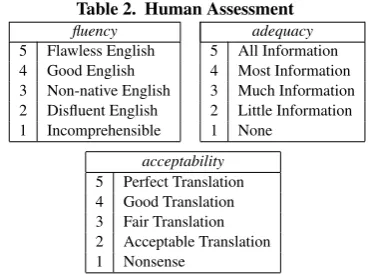
Various approaches on how to assess the quality of a translation have been proposed. In this paper, human assessments of transla-tion quality with respect to thefluency, theadequacyand the ac-ceptabilityof the translation are investigated.Fluencyindicates how natural the evaluation segment sounds to a native speaker of English. Foradequacy, the evaluator is presented with the source language input as well as a “gold standard” translation and has to judge how much of the information from the original trans-lation is expressed in the transtrans-lation [26].Acceptabilityjudges how easy to understand the translation is [23]. Thefluency, ad-equacyandacceptabilityjudgments consist of one of the grades listed in Table 2.
The high cost of such human evaluation metrics has triggered a huge interest in the development of automatic evaluation metrics for machine translation. Table 3 introduces some metrics that are widely used in the MT research community.
4. PREDICTION OF HUMAN ASSESSMENTS
Most of the previously proposed approaches to predict human as-sessments of translation quality utilize supervised learning meth-ods such asdecision trees(DT),support vector machines(SVM), orperceptrons to learn discriminative models that are able to come closer to human quality judgments. Such classifiers can
Table 2. Human Assessment
fluency adequacy
5 Flawless English 5 All Information
4 Good English 4 Most Information
3 Non-native English 3 Much Information 2 Disfluent English 2 Little Information
1 Incomprehensible 1 None
[image:2.595.318.537.241.467.2]acceptability 5 Perfect Translation 4 Good Translation 3 Fair Translation 2 Acceptable Translation 1 Nonsense
Table 3. Automatic Evaluation Metrics BLEU: the geometric mean of n-gram precision of the system
output with respect to reference translations. Scores range between 0 (worst) and 1 (best) [16]
NIST: a variant of BLEU using the arithmetic mean of weighted n-gram precision values. Scores are positive with 0 being the worst possible [9]
METEOR: calculates unigram overlaps between a translation and reference texts. For the experiments reported in this paper, onlyexact matcheswere taken into account. Scores range between 0 (worst) and 1 (best) [4] GTM: measures the similarity between texts by using a
unigram-based F-measure. Scores range between 0 (worst) and 1 (best) [24]
WER: Word Error Rate: the minimal edit distance between the system output and the closest reference transla-tion divided by the number of words in the reference. Scores are positive with 0 being the best possible [14] PER: Position independentWER: a variant ofWERthat
disregards word ordering [15]
TER: Translation Edit Rate: a variant ofWERthat allows phrasal shifts [22]
be trained on a set of features extracted from human-evaluated MT system outputs.
The work described in [Quirk 1994] [20] uses statistical mea-sures to estimate confidence on the word/phrase level and gath-ers system-specific features about the translation process itself to train binary classifiers. Empirical thresholds on automatic eval-uation scores are utilized to distinguish between good and bad translations. [Quirk 1994] also investigates the feasibility of var-ious learning approaches for the multiclass classification prob-lem for a very small data set in the domain of technical docu-mentation. [Akiba et al. 2001] [2] utilized DT classifiers trained on multipleedit-distancefeatures where combinations of lexical (stem, word, part-of-speech) and semantic (thesaurus-based se-mantic class) matches were used to compare MT system outputs with reference translations and to approximate human scores of acceptabilitydirectly. [Kulesza and Shieber 2004] [13] trained a binary SVM classifier based on automatic scoring features in order to distinguish between “human-produced” and “machine-generated” translations of newswire data instead of predicting human judgments directly.
The proposed approach also utilizes a supervised learning method to predict human assessments of translation quality, but differs in the following two aspects:
(1) Reduction of Classification Ambiguity:
The decomposition of a multiclass classification task into a set of binary classification problems reduces the complexity of the learning task, resulting in higher classification accuracy.
(2) Feature Set:
[image:2.595.55.285.411.480.2]evaluation metrics, thus taking into account different aspects of translation quality addressed by each of the metrics. The method does not depend on a specific MT system nor on the target language.
5. HUMAN ASSESSMENT PREDICTION BY
BINARY CLASSIFIER COMBINATION
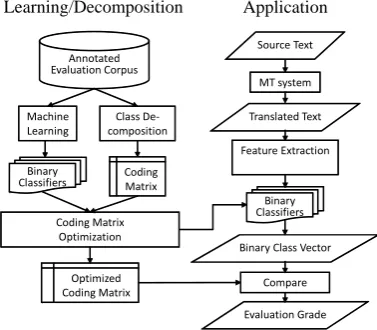
The proposed prediction method is divided into three phases: (1) a learning phase in which binary classifiers are trained on the feature set that is extracted from a database of human and machine-evaluated MT system outputs, (2) adecomposition phasein which the optimal set of binary classifiers that maxi-mizes the classification accuracy of the recombination step on a development set is selected, (3) anapplication phasein which the binary classifiers are applied to unseen sentences, and the re-sults of the binary classifiers are combined using the optimized coding matrix to predict a human score. A flow chart summariz-ing the major processsummariz-ing steps of each phase is given in Figure 1.
^ŽƵƌĐĞdĞdžƚ
ǀĂůƵĂƚŝŽŶ'ƌĂĚĞ DdƐLJƐƚĞŵ
dƌĂŶƐůĂƚĞĚdĞdžƚ
&ĞĂƚƵƌĞdžƚƌĂĐƚŝŽŶ
ŝŶĂƌLJůĂƐƐsĞĐƚŽƌ
ŽŵƉĂƌĞ ŶŶŽƚĂƚĞĚ
ǀĂůƵĂƚŝŽŶŽƌƉƵƐ
ŽĚŝŶŐDĂƚƌŝdž KƉƚŝŵŝnjĂƚŝŽŶ
KƉƚŝŵŝnjĞĚ ŽĚŝŶŐDĂƚƌŝdž
ŝŶĂƌLJ ůĂƐƐŝĨŝĞƌƐ ůĂƐƐĞͲ
ĐŽŵƉŽƐŝƚŝŽŶ DĂĐŚŝŶĞ
>ĞĂƌŶŝŶŐ
ŝŶĂƌLJ
ůĂƐƐŝĨŝĞƌƐ ŽĚŝŶŐDĂƚƌŝdž
[image:3.595.364.497.113.194.2]Application Learning/Decomposition
Fig. 1. Flow Chart of the Proposed Prediction Method
5.1 Learning Phase
Discriminative models for the multiclass and binary classifica-tion problem are obtained by using standard learning algorithms. The proposed method is not limited to a specific classification learning method. For the experiments described in Section 6, a standard implementation of decision trees [21] was utilized. The feature set consists of the scores of the seven automatic eval-uation metrics listed in Table 3. All automatic evaleval-uation metrics were applied to the input data sets consisting of English MT out-puts whose translation quality was manually assessed by humans using the metrics introduced in Section 3. In addition to the met-ric scores, metmet-ric-internal features, likengram-precisionscores, andlength ratiosbetween references and MT outputs, were also utilized, resulting in a total of 54 training features.
5.2 Decomposition Phase
For the experiments described in Section 6, both the one-against-alland theall-pairsbinary classifiers described in Section 2 were utilized . In addition,boundaryclassifiers were trained on the whole training set. In this case, all training examples annotated with a class better than the class in question were used as positive examples, and all other training examples as negative examples. Table 4 lists the 17 binary classification problems that were uti-lized to decompose the human assessment problems introduced in Section 3.
Table 4. Decomposition of Human Assessment of Translation Quality
type binary classifier
one-against-all 5,4,3,2,1 all-pairs 5 4,5 3,5 2,5 1,
4 3,4 2,4 1,
3 2,3 1,
2 1
boundary 54 321,543 21
In order to identify the optimal coding matrix for the respec-tive tasks, the binary classifiers were first ordered according to their classification accuracy on the development set. In the sec-ond step, the multiclass performance was evaluated iteratively, where the worst performing binary classifier was omitted from the coding matrix after each iteration. Finally, the coding matrix achieving the best classification accuracy for the multiclass task was used for the evaluation of the test set.
5.3 Application Phase
[image:3.595.75.264.311.476.2]Given an input example, all binary classifiers are applied once for each column of the coding matrix resulting in a vectorvofl bi-nary classification results. The multiclass label is predicted as the labelcfor which the respective rowrofMis “closest”. In [All-wein et al. 2000] [3], the distance betweenrandvis calculated by (a) a generalizedHamming distancethat counts the number of positions for which the corresponding vectors are different and (b) aloss-based decodingthat takes into account the magnitude of the binary classifier scores. For the experiments described in Section 6, the Hamming-distance approach was adopted.
Table 5. Coding Matrix Application v= (+1, +1, –1)
type multiclass distance selection
c1 1
one-against-all c2 1 c1orc2
c3 3
c1 1
all-pairs c2 3 c1
c3 2
An example for the distance calculation is given in Table 5. Let’s assume that the application of the three binary classifiers listed in Table 1 results in the classification vectorv= (+1, +1, –1) for a given input. Using theone-against-allcoding matrix, the min-imal distance forvis 1 for both matrix rows,c1andc2. In the
case of a draw, the priority order of binary classifiers obtained on the development set is used to identify the more reliable row by recursively recalculating the distance for a subset of classifiers with the less accurate one removed. For theall-pairscoding ma-trix, classc1would be selected due to its lesser distance.
6. EVALUATION
The evaluation of the proposed method was carried out using the Basic Travel Expression Corpus(BTEC). This contains tourism-related sentences similar to those usually found in phrase books for tourists going abroad [12]. In total, 3,524 Japanese input sen-tences were translated by MT systems of various types1,
pro-ducing 82,406 English translations. 54,576 translations were
[image:3.595.332.526.428.519.2]notated with human scores foracceptabilityand 36,302 transla-tions were annotated with human scores foradequacy/fluency. The distribution of the human scores for the given translations is summarized in Figure 2. Where multiple human judgments were assigned to a single translation output, the median of the respec-tive human scores was used in the experiments.
㻟㻞㻚㻡㻌
㻝㻜㻚㻠㻌
㻝㻢㻚㻣㻌 㻝㻣㻚㻡㻌 㻞㻞㻚㻥㻌 㻟㻜㻚㻤㻌
㻝㻟㻚㻝㻌
㻝㻜㻚㻥㻌
㻝㻢㻚㻡㻌
㻞㻤㻚㻣㻌
㻝㻢㻚㻟㻌
㻝㻝㻚㻡㻌
㻝㻠㻚㻡㻌 㻝㻠㻚㻣㻌
㻠㻟㻚㻜㻌
0 5 10 15 20 25 30 35 40 45 50
5 4 3 2 1
fluency
adequacy
acceptability
[image:4.595.345.513.97.527.2](%)
Fig. 2. Human Score Distribution
The annotated corpus was split into three data sets: (1) the training set (train) consisting of 25,988 translations for ade-quacy/fluencyand 49,516 MT outputs foracceptability, (2) the development set (devset) consisting of 2,024 sentences (4 MT outputs for each of 506 input sentences) for all three metrics, and (3) the evaluation set (testset) taken from the IWSLT evalu-ation campaign [1] (CSTAR03 data set, 506 input sentences, up to 16 reference translations per sentence). Forfluencyand ade-quacy, 7,590 test sentences with 15 MT outputs for each were available. Foracceptability, 3,036 sentences with 6 MT outputs for each were used for evaluation.
6.1 Coding Matrix Optimization
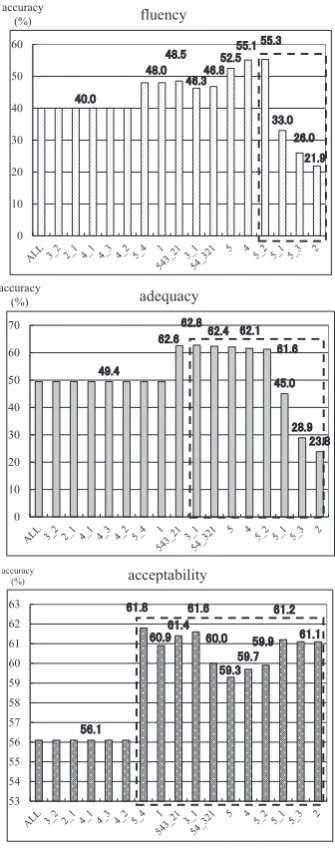
Figure 3 summarizes the iterative evaluation of the binary classification combination using the devset as described in Section 5.2. Starting with the complete coding matrix (ALL), the worst performing binary classifier, i.e., the classifier that achieved the lowest accuracy when evaluated in isolation, is omitted in the next iteration. This iterative elimination process continues until only a single binary classifier is left. The dash square indicates the subset of binary classifiers selected for the coding matrix utilized for the test set evaluation.
For example, in the case of thefluencyevaluation task, the binary classifier “3 2” achieved the lowest classification accuracy score and therefore is omitted in the first iteration. The re-evaluation of the reduced coding matrix after each iteration revealed that the overall system performance does not change until iteration 7, where the omission of the binary classifier “5 4” leads to an im-provement in accuracy. The highest accuracy scores is achieved in iteration 14. Therefore, a coding matrix taking into account the binary classifiers “5 1”, “5 3”, “2”, and “3” is applied to the test set evaluation of thefluencytask.
6.2 Classification Accuracy
The baseline of the multiclass classification task was defined as the class most frequently occurring in the training data set. Ta-ble 6 summarizes the baseline performance for all three subjec-tive evaluation metrics.
Table 6. Baseline Accuracy (testset) fluency adequacy acceptability
32.5% 30.8% 43.0%
fluency
accuracy (%)
㻠㻜㻚㻜㻌
㻠㻤㻚㻜㻌 㻠㻤㻚㻡㻌
㻠㻢㻚㻟㻌㻠㻢㻚㻤㻌 㻡㻞㻚㻡㻌㻡㻡㻚㻝㻌㻡㻡㻚㻟㻌
㻟㻟㻚㻜㻌 㻞㻢㻚㻜㻌
㻞㻝㻚㻥㻌
0 10 20 30 40 50 60
adequacy accuracy
(%)
㻠㻥㻚㻠㻌 㻢㻞㻚㻢㻌
㻢㻞㻚㻤㻌 㻢㻞㻚㻠㻌 㻢㻞㻚㻝㻌
㻢㻝㻚㻢㻌
㻠㻡㻚㻜㻌
㻞㻤㻚㻥㻌 㻞㻟㻚㻤㻌
0 10 20 30 40 50 60 70
acceptability accuracy
(%)
㻡㻢㻚㻝㻌 㻢㻝㻚㻤㻌
㻢㻜㻚㻥㻌 㻢㻝㻚㻠㻌
㻢㻝㻚㻢㻌
㻢㻜㻚㻜㻌
㻡㻥㻚㻟㻌 㻡㻥㻚㻣㻌
㻡㻥㻚㻥㻌 㻢㻝㻚㻞㻌
㻢㻝㻚㻝㻌
53 54 55 56 57 58 59 60 61 62 63
Fig. 3. Coding Matrix Optimization (devset)
[image:4.595.62.277.180.315.2]The classification accuracies of the multiclass task, i.e. the mul-ticlass classifier learned directly from the training set, and the binary classifier performance is summarized in Table 7. The re-sults show that the learning approach outperforms the baseline of the multiclass classification task for all three metrics gaining 16.7% forfluency, 25.2% foradequacyand 18.1% for accept-ability.
Table 7. Multiclass Prediction Accuracy (testset)
fluency adequacy acceptability
49.2% 56.0% 61.1%
Moreover, the accuracy figures of the binary classifiers are sum-marized in Figure 4. The performance of the binary classifiers varies widely, depending on the classification task as well as the evaluation metric. Accuracies of 78%-94% were achieved for theone-against-allclassifiers, 76%-83% for theboundary clas-sifiers, and 54%-92% for theall-pairsclassifiers. However, the majority of the binary classifiers achieved a higher accuracy than the multiclass classifier for all evaluation metrics.
[image:4.595.354.507.638.672.2]㻠㻥㻚㻞㻌 㻣㻡㻚㻣㻌
㻣㻢㻚㻞 㻤㻜㻚㻡㻌
㻤㻜㻚㻡㻌
㻤㻠㻚㻟㻌 㻤㻠㻚㻠㻌
㻡㻟㻚㻥㻌
㻢㻟㻚㻤㻌
㻣㻤㻚㻞㻌
㻡㻡㻚㻟㻌
㻢㻡㻚㻜㻌 㻢㻝㻚㻜㻌
㻣㻣㻚㻤㻌
㻤㻤㻚㻥㻌
㻤㻤㻚㻟㻌 㻤㻣㻚㻡㻌
㻣㻤㻚㻤㻌
40 50 60 70 80 90 100
fluency accuracy
(%)
㻡㻢㻚㻜㻌 㻤㻞㻚㻝㻌
㻤㻜㻚㻤㻌 㻣㻡㻚㻝㻌
㻤㻢㻚㻥㻌
㻤㻢㻚㻡㻌 㻤㻢㻚㻢㻌
㻢㻤㻚㻣㻌 㻢㻢㻚㻤㻌
㻣㻤㻚㻣㻌 㻢㻞㻚㻠㻌
㻤㻝㻚㻡
㻢㻥㻚㻣㻌
㻤㻞㻚㻡㻌 㻤㻢㻚㻟㻌
㻥㻠㻚㻠㻌
㻥㻜㻚㻤㻌
㻣㻣㻚㻡㻌
40 50 60 70 80 90 100
accuracy
(%) adequacy
㻢㻝㻚㻝㻌 㻤㻞㻚㻣㻌
㻤㻝㻚㻤㻌㻣㻡㻚㻝㻌
㻤㻠㻚㻜㻌 㻤㻥㻚㻡㻌 㻥㻞㻚㻠㻌
㻡㻤㻚㻥㻌 㻢㻥㻚㻥㻌
㻤㻡㻚㻥㻌
㻢㻠㻚㻝㻌 㻤㻝㻚㻝㻌
㻤㻞㻚㻠㻌㻤㻤㻚㻥㻌㻤㻡㻚㻢㻌 㻤㻤㻚㻟㻌 㻥㻞㻚㻟㻌
㻤㻜㻚㻜㻌
40 50 60 70 80 90 100
acceptability
[image:5.595.73.268.99.475.2]accuracy (%)
Fig. 4. Classifier Accuracy (testset)
40 45 50 55 60 65 70 75
multiclass coding matrix
fluency adequacy acceptability
49.2 / 56.0 / 61.1 55.2 / 62.6 / 62.3
accuracy (%)
Fig. 5. Classifier Combination Accuracy (testset)
Figure 5. The classification accuracy of the proposed method is 55.2% for fluency, 62.6% foradequacyand 62.3% for ac-ceptability. Thus, the proposed method outperforms the base-line as well as the multiclass classification task for all subjec-tive evaluation metrics achieving a gain of 22.7% / 6.0% in flu-ency, 32.2% / 6.6% inadequacyand 19.3% / 1.2% in acceptabil-ity compared to the baseline / multiclass performance, respec-tively.
6.3 Correlation to Human Assessments
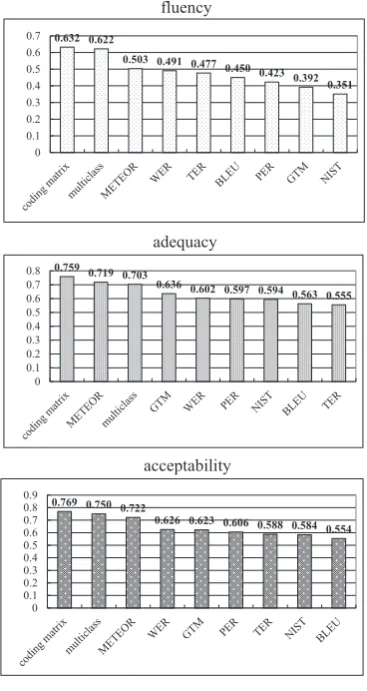
In order to investigate the correlation of the proposed metrics towards human judgments on the sentence level, the Spearman rank correlation coefficient for the obtained results was calcu-lated. In addition, the multiclass classifier and the automatic eval-uation metrics listed in Table 3 were used to rank the test sen-tences and calculate its Spearman rank correlation with human assessments.
The correlation coefficients are summarized in Figure 6. The re-sults show that the proposed method outperforms all other met-rics, achieving correlation coefficients of 0.632 / 0.759 / 0.769 forfluency/adequacy/acceptabilitywhere all score differences were statistical significant at the 95% level. Concerning the auto-matic evaluation metrics, METEOR achieved the highest corre-lation towards human assessment on the sentence level for all three subjective evaluation metrics. The correlation of the re-maining automatic metrics is considerably lower and depends largely on the type of human assessment.
0.632 0.622
0.503 0.491 0.477 0.450
0.423 0.392 0.351
0 0.1 0.2 0.3 0.4 0.5 0.6 0.7
fluency
0.759
0.719 0.703
0.636 0.602
0.597 0.594 0.563 0.555
0 0.1 0.2 0.3 0.4 0.5 0.6 0.7 0.8
adequacy
0.769 0.750 0.722
0.626 0.623 0.606 0.588 0.584 0.554
0 0.1 0.2 0.3 0.4 0.5 0.6 0.7 0.8 0.9
[image:5.595.337.521.100.446.2]acceptability
Fig. 6. Correlation with Human Assessments (testset)
6.4 Upper Bound
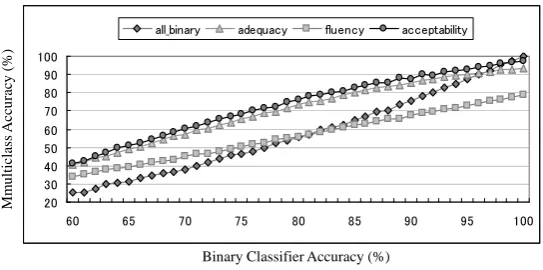
In order to get an idea about the potential of the proposed method, its upper bound was simulated by randomly adjusting the prediction result of each binary classifier to achieve a certain classification accuracy, and applied the coding matrix approach to the set of binary classifiers having the same classification curacy. Figure 7 shows the upper boundary for classification ac-curacies between 60% and 100%, whereby the optimized coding matrix of the experiments described in Section 6.2 were used for fluency,adequacyandacceptability, respectively. Theall binary result shows the performance when the baseline coding matrix using all 17 binary classifiers is applied.
The results show that for each metrics the multiclass classifica-tion task performance is almost linearly related to the perfor-mance of the binary classifiers and that improving the accuracy of the binary classifiers will result in a better overall perfor-mance.
Two potential improvements of the proposed method to be in-vestigated in the near future are (1) additional features that help to classify the given task more accurately, and (2) the automatic learning of the optimal combination of binary classifiers with re-spect to the overall system performance.
7. DISCUSSION
㻞㻜 㻟㻜 㻠㻜 㻡㻜 㻢㻜 㻣㻜 㻤㻜 㻥㻜 㻝㻜㻜
㻢㻜 㻢㻡 㻣㻜 㻣㻡 㻤㻜 㻤㻡 㻥㻜 㻥㻡 㻝㻜㻜
㼍㼘㼘㼋㼎㼕㼚㼍㼞㼥 㼍㼐㼑㼝㼡㼍㼏㼥 㼒㼘㼡㼑㼚㼏㼥 㼍㼏㼏㼑㼜㼠㼍㼎㼕㼘㼕㼠㼥
M
m
u
lt
ic
la
ss
A
cc
u
ra
cy
(
%
)
[image:6.595.163.435.101.236.2]Binary Classifier Accuracy (%)
Fig. 7. Upper Boundary of Reducing Multiclass to Binary Classifier (testset)
costs in human assessment of MT outputs, new possibilities are offered by the advent of crowdsourcing services such as Ama-zon’s Mechanical Turk2 and CrowdFlower3, which in recent
years have attracted a lot of attention both from industry and academia as a means for collecting data for human language technologies at low cost [7, 5]. Having collected a certain amount of judgments for a specific translation task, the human data an-notations and the derived prediction models can be re-used to judge the quality of translations of unseen sentences from the same translation domain without the need of humans in the loop. In addition, looking at the results of recent shared MT evalu-ation tasks, quite different score ranges were obtained for au-tomatic evaluation metrics depending on (a) the domain from which the input sentences were taken, (b) the language pairs in-volved, and (c) the amount of reference translations used to cal-culate the automatic evaluation scores which gives rise to con-cerns on the scalability and robustness of the proposed method. However, score distribution transformation techniques such as z-transform4, can be used to compare different metric scores of
the same domain [17], but also to adapt already collected human annotated gradings to evaluation tasks having different score dis-tributions. Hence, the proposed method of combining automatic evaluation metrics to predict human assessment of translation quality forms a general framework that can be applied across languages and translation domains.
8. CONCLUSION
In this paper, a robust and reliable method to learn discrimina-tive models based on the results of multiple automatic evaluation metrics was proposed to predict translation quality at the sen-tence level. The prediction is carried out by reducing the multi-class multi-classification problem to a set of binary multi-classification tasks and combining the respective results using a coding matrix in order to predict the multiclass label for a given input sentence. The effectiveness of the proposed method was verified us-ing three types of human assessment of translation quality commonly used within the MT research community. The ex-periments showed that the proposed method outperforms a baseline method that selects the most frequent class con-tained in the training set and a standard multiclass classi-fication model (decision tree) that learns its discriminative model directly from the training corpus. The proposed method achieved a gain of 22.7% / 6.0% influency, 32.2% / 6.6% in ad-equacyand 19.3% / 1.2% inacceptabilitycompared to the base-line / multiclass performance, respectively. Moreover, the pro-posed metric achieved high correlation to human judgments at
2http://www.mturk.com 3http://crowdflower.com
4A transformation into score distributions with zero mean and unit vari-ance.
the sentence level, outperforming not only the multiclass ap-proach but also all of the automatic scoring metrics utilized. Future extensions of the proposed method will investigate the use of additional features, such as the confidence estimation fea-tures [6] and additional evaluation metrics like IMPACT [10] that obtained high correlations at sentence-level in recent MT evalu-ation campaigns. This is expected to improve the performance of the binary classifiers and boost the overall performance further.
9. REFERENCES
[1] Yasuhiro Akiba, Marcello Federico, Noriko Kando, Hiromi Nakaiwa, Michael Paul, and Jun’ichi Tsujii. Overview of the IWSLT04 evaluation campaign. InProc. of the Interna-tional Workshop on Spoken Language Translation, pages 1–12, Kyoto, Japan, 2004.
[2] Yasuhiro Akiba, Kenji Imamura, and Eiichiro Sumita. Us-ing multiple edit distances to automatically rank machine translation output. InProc. of MT Summit VIII, pages 15– 20, 2001.
[3] Erin Allwein, Robert Schapire, and Yoram Singer. Reduc-ing multiclass to binary: A unifyReduc-ing approach for margin classifiers.Journal of Machine Learning Research, 1:113– 141, 2000.
[4] Satanjeev Banerjee and Alon Lavie. METEOR: An auto-matic metric for MT evaluation with improved correlation with human judgments. InProceedings of the ACL Work-shop on Intrinsic and Extrinsic Evaluation Measures for Machine Translation and/or Summarization, pages 65–72, Ann Arbor, Michigan, 2005.
[5] Luisa Bentivogli, Marcello Federico, Giovanni Moretti, and Michael Paul. Getting Expert Quality from the Crowd for MT Evaluation. In Proceedings of the MT Summmit XIII, pages 521–528, Xiamen, China, 2011.
[6] John Blatz, Erin Fitzgerald, George Foster, Simona Gan-drabur, Cyril Goutte, Alex Kulesza, Alberto Sanchis, and Nicola Ueffing. Confidence estimation for SMT. InFinal Report of the JHU Summer Workshop, 2003.
[7] Chris Callison-Burch, Philipp Koehn, Christof Monz, Kay Peterson, Mark Przybocki, and Omar Zaidan. Findings of the 2010 joint workshop on smt and metrics for machine translation. InProceedings of the Joint Fifth Workshop on SMT and MetricsMATR, pages 17–53, Uppsala, Sweden, 2010. Association for Computational Linguistics. [8] Thomas G. Dietterich and Ghulum Bakiri. Solving
multi-class learning problems via error-correcting output codes. Journal of Artificial Intelligence Research, 2:263–286, 1995.
Proc. of the HLT 2002, pages 257–258, San Diego, USA, 2002.
[10] Hiroshi Echizen-ya and Kenji Araki. Automatic evalua-tion of machine translaevalua-tion based on recursive acquisievalua-tion of an intuitive common parts continuum. InProc. of the MT SUMMIT XI, pages 151–158, Copenhagen, Denmark, 2007.
[11] Trevor Hastie and Robert Tibshirani. Classification by pair-wise coupling. The Annals of Statistics, 26(2):451–471, 1998.
[12] Genichiro Kikui, Seiichi Yamamoto, Toshiyuki Takezawa, and Eiichiro Sumita. Comparative study on corpora for speech translation.IEEE Transactions on Audio, Speech, Language Processing, 14(5):1674–1682, 2006.
[13] Alex Kulesza and Stuart M. Shieber. A learning approach to improving sentence-level MT evaluation. InProc. of the TMI04, USA, 2004.
[14] Sonja Niessen, Franz J. Och, Gregor Leusch, and Hermann Ney. An evaluation tool for machine translation: Fast eval-uation for machine translation research. InProc. of the 2nd LREC, pages 39–45, Athens, Greece, 2000.
[15] Franz J. Och and Hermann Ney. Statistical multi-source translation. InProc. of the MT Summit VIII, pages 253– 258, Santiago de Compostella, Spain, 2001.
[16] Kishore Papineni, Salim Roukos, Todd Ward, and Wei-Jing Zhu. BLEU: a method for automatic evaluation of ma-chine translation. InProc. of the 40th ACL, pages 311–318, Philadelphia, USA, 2002.
[17] Michael Paul, Marcello Federico, and Sebastian St¨ucker. Overview of the IWSLT 2010 Evaluation Campaign. In Proc. of IWSLT, pages 3–27, Paris, France, 2010.
[18] Mark Przybocki and Kay Peterson. NIST Open Machine Translation Evaluation. http://www.nist.gov/speech/tests/mt, 2009.
[19] Mark Przybocki, Kay Peterson, and Sebastien Bronsart. Metrics for MAchine TRanslation Chal-lenge (MetricsMATR08). http://nist.gov/speech/ tests/metricsmatr/2008/results, 2008.
[20] Christopher B. Quirk. Training a sentence-level machine translation confidence measure. In Proc. of 4th LREC, pages 825–828, Portugal, 2004.
[21] Rulequest. Data mining tool c5.0. http://rulequest.com/see5-info.html, 2004.
[22] Matthew Snover, Bonnie Dorr, Richard Schwartz, Linnea Micciulla, and John Makhoul. A study of translation edit rate with targeted human annotation. InProc. of the AMTA, pages 223–231, Cambridge and USA, 2006.
[23] Eiichiro Sumita, Setsuo Yamada, Kazuhide Yamamoto, Michael Paul, Hideki Kashioka, Kai Ishikawa, and Satoshi Shirai. Solutions to problems inherent in spoken-language translation: The ATR-MATRIX approach. InProc. of the MT Summit VII, pages 229–235, Singapore, 1999. [24] Joseph Turian, Luke Shen, and I. Melamed. Evaluation of
machine translation and its evaluation. InProc. of the MT Summit IX, pages 386–393, New Orleans, USA, 2003. [25] John White, Theresa O’Connell, and Lynn Carlson.
Eval-uation of machine translation. In Proc. of the Human Language Technology Workshop (ARPA), pages 206–210, 1993.