© 2017, IRJET | Impact Factor value: 5.181 | ISO 9001:2008 Certified Journal | Page 2205
Blur Classification and Deblurring of Images
Anwesa Roy
1, Pooja Aher
2, Krushna Kalaskar
3,Priya Agarwal
41
Anwesa Roy,
2Pooja Aher,
3Krushna Kalaskar,
4Priya Agarwal,
4Prof. Shital S. Bhandare,
123
Students, Dept. of Computer Engineering, KKWIEER, Nashik,Maharashtra,India
4
Guide,Dept. of Computer Engineering, KKWIEER, Nashik,Maharashtra,India
---***---Abstract -
Images have become an integral part of our livestoday , in social networking, scientific applications or surveillance systems and where there is image, comes the concept of blurring. Blurring of an image is a major cause of image degradation which can be caused by various blurs namely, Gaussian blur, motion blur, defocus blur, average blur or threshold blur. Thereby, the proposed system aims at performing blur classification, estimation of parameters and deblurring in a three stage framework through deep learning. Firstly, the proposed system identifies the blur type from a mixed input of images i.e. black and white or colour image degraded by various blurs with different parameters using a pre-trained deep neural Network(DNN) in a supervised way. Following this, estimation of the blur parameters is done by applying the general regression neural network(GRNN).Lastly, the image is segmented and deblurred using efficient deblurring technique.The robustness ,effectiveness , efficiency and competency of the proposed system shall be noted and accordingly applied to real world scenarios to demonstrate the same.
Key Words: Blur Classification, Blur Parameter Estimation, Deblurring, Deep Neural Network, General Regression Neural Network.
1.INTRODUCTION
In the 21st century, all are very much aware of images and pictures and hence, there exists consistently clicking, uploading, downloading images on a regular basis. Hence, the blurring of images becomes a giant menace which are invariably caused by different factors such as atmospheric turbulence, camera relative motion, lens aberrations etc. Therefore, the idea of deblurring of images became the core of our project.
The restoration of blurred images, photographs i.e., image deblurring is the process of deriving hidden sharp images from inadequate information the degradation model. Therefore, to remove blur in images where the blurring parameter is unknown and is locally blurred, a three-stage framework is introduced to classify the blur type ,estimate the parameters and thereby deblur the image. A pre-trained dataset using DNN(Deep Neural Network) is induced to identify the blur type and GRNN(General Regression
Neural Network) to estimate the blurring parameters of each type of blur.
Classification and deblurring of images have many real time applications such as in surveillance systems, satellite imaging and crime investigations.
© 2017, IRJET | Impact Factor value: 5.181 | ISO 9001:2008 Certified Journal | Page 2206 structure of the image data, a novel deep architecture with
greedy layer-wise reconstruction and global fine-tuning is proposed. So as to adapt real-world image classification tasks, a BDBN is developed under a semi-supervised learning framework, which makes the deep model work well when labelled images are insufficient.It is an efficient DBN working system which can also be incorporated for blur classification and parameter estimation[9]. This paper is concerned with the digital estimation of the frequency response of a two-dimensional spatially invariant linear system through which an image has been passed and blurred. For the cases of uniform linear camera motion and an out-of-focus lens system it is shown that the power cepstrum of the image contains sufficient information to identify the blur. Methods for deblurring are presented, including restoration of the density version of the image. The restoration procedure consumes only a modest amount of computation time. The observed blurred patches used as training and testing samples have characteristics that are not as obvious as their frequency coefficients which are not purely reliable[10]. Image blur kernel classification and parameter estimation are critical for blind image deblurring. In this paper, a two-stage system using Deep Belief Networks (TDBN) is proposed to first classify the blur type and then identify its parameters. In the blur type classification, this method attempts to identify the blur type from mixed input of various blurs with different parameters. A semi-supervised DBN is trained to project the input samples in a discriminative feature space, and then classify those features. Moreover, in the parameter identification, the proposed edge detection on logarithm spectrum helps DBN to identify the blur parameters with very high accuracy. Here, as the parameter identification is also done using the TDBN it is not highly efficient as the variation between blur parameters of the same blur type is not as great as that between blur types[11]. Efficient marginal likelihood optimization in blind deconvolution MAPx k algorithms can be successfully used for robust and efficient segmentation and deblurring of images after finding the blur type and estimating the parameters of blurring[3].
1.1 Methodology
Image degradation and deblurring of images can be caused due to many factors such as atmospheric turbulence, camera relative motion or lens aberrations etc. which depend on environmental exposure or human errors that are not controllable and are involuntary. Hence, classification of blur type and deblurring of the input image becomes a tedious procedure for a large datasets.
Hence, to avoid such issues an efficient classification system via deep learning and deblurring of the image is being proposed.
The proposed system focuses on the following methodologies:
1.KNN Classification algorithm is used along with learned Deep Belief Network(DBN) to classify the blur type of the
input image to ensure correct determination of the blur type to make the further procedure easy and sound.
2.Learning of a General Regression Neural Network(GRNN) applying regression analysis on the previous output to determine blurring parameters which are very difficult to distinguish.
3.Further these estimated parameters performs deblurring and segmentation of the input image to display most relevant and clear deblurred image using deconvolution strategies.
The efficiency issues for the classification the blur type is monitored by using an edge detector to obtain binary input values for the DBN training which benefits the blur analysis task. The general regression neural network is applied for the prediction of the continuous parameter which performs better than the neural networks with back propagation. Blind deconvolution is an efficient technique of deblurring the image from estimated parameters using the MAPx,k coefficients.
As previously mentioned in the above documentation, the proposed system consists of three modules which are
explained as follows:-
1.In the first module , KNN Classification algorithm is used along with learned Deep Belief Network(DBN) to classify the
blur type of the input image .
2. The second module concurrently takes input from the first module and estimates the blurring parameters of the specified blur type by learning of a General Regression Neural Network(GRNN) applying regression analysis. 3.Further these estimated parameters will be passed on to the third module concurrently which will perform deblurring and segmentation of the input image to display most relevant and clear deblurred image using
deconvolution strategies.
Accordingly, the proposed system adopts a multi-core computing system to initiate concurrent inter module
functioning and operation.
We also observe a few outcomes of the proposed system
which are as follows:
1.For entered blur input image, we obtain correct categorization of the blur type and efficient blur kernel parameter estimation and thereby deblurring the image into a deblurred, clear, prominent image which has many real time applications.
2.To develop a learning based method using a pre-trained deep neural network(DNN) and a general regression neural network(GRNN).
© 2017, IRJET | Impact Factor value: 5.181 | ISO 9001:2008 Certified Journal | Page 2207 blur kernel indicating the learning of the neural network.
The aim is to maintain the efficiency and robustness of the
proposed system.
Blur classification and image deblurring has many real time applications which are in the surveillance system, satellite imaging, forensic investigation, crime investigation.
1.2 Blur Features
Features for Motion and Defocus Blurs: If we apply the Fourier Transform (FT) to both sides of Eq. (5), we can obtain: G(u)= Q(u)F(u)+ N(u) (9)
where u ={ u1,u2}. For the defocus blur, Q(u)= J1(πRr) πRr , r =u2 1 +u2 2. J1 is the first-order Bessel function of the first kind and the amplitude is characterized by almost-periodic circles of radius R along which the Fourier magnitude takes value zero.1 For the motion blur, the FT of the PSF is a sinc function: Q(u)= sin(πMω) πMω , ω =±1 M ,± 2 M ,... . In order to know the PSF Q(u), we attempt to identify the type and parameters of Q from the observation image G(u). Therefore, the normalized logarithm of G can be used in our implementation: log(|G(u)|)norm = log(|G(u)|)−log(|Gmin|) log(|Gmax|)−log(|Gmin|) (10) where G represents G(u), Gmax = maxu(G(u)), and Gmin = minu(G(u)). The patterns in these images (log(|G(u)|)norm) can represent the motion blur or the defocus blur intuitively. Hence, no extra preprocessing needs to be done for the blur type classification. However, defocus blurs with different radii are easy to be confused, which also has been proved in our experiments. Therefore, for blur parameter identification, an edge detection step is proposed here. Since the highest intensities concentrate around the center of the spectrum and decrease towards its borders, the binarization threshold has to be adapted for each individual pixel, which is computationally prohibitive. If a classic edge detector is applied directly, redundant edges would interfere with the pattern we need for the DBN training. Many improved edge detectors have been explored to solve this issue, however, most of them do not apply to the logarithmic power spectra data, which cause even worse performance.
2. Forming the Three- Phase Structure
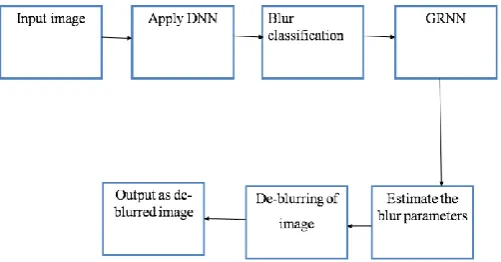
The proposed method is formed by two-stage learning and a deblurring technique forming the three phase structure which is shown in the Figure-1. First, the identification of blur patterns is carried out by using the logarithmic spectra of the input blurred patches. The output of this stage is 3 labels: the Gaussian blur, the motion blur and the defocus blur. With the label information, the classified blur vectors will be used in the second stage for the blur parameter estimation. At this stage, motion blur and defocus blur will be further preprocessed by the edge detector before the training but Gaussian blur vectors remain the same [11], the appropriate feature for Gaussian blur is the logarithmic spectra without edge detection. This stage outputs various
[image:3.595.309.560.156.287.2]estimated parameters for individual GRNN which is used for the deblurring using deconvolution technique which is the third and last stage of the proposed framework.
Fig -1: The proposed architecture.
3. Proposed Algorithm
Architectural design of a system is the total pictorial representation of the proposed system. The block diagram gives the total representation of the modules and their execution flows.
There are total three main modules which is to be designed in the proposed system which are as follows: 1) Blur-type Classification using DNN(Deep Neural Network).
2) Estimation of parameters sing GRNN(General Regression Neural Network).
3) Deblurring of image using deconvolution.
System Description:
Input: Blurred image (can be black and white or colour). Output: Deblurred Image.
Functions : F1, F2, F3
Mathematical Formulation:
Let S be system such that S={I, O, F} where,
I= Blurred image (can be black and white or colour). O= Deblurred Image.
F=F1, F2,F3 (set of functions) where,
F1():Blur type classification using DDN. F2():Blur parameter estimation using GRNN.
F3():Segmentation & Deblurring of image using deconvolution.
Success Conditions: Appropriate Image Format. Failure Conditions: Irrelevant image Format.
© 2017, IRJET | Impact Factor value: 5.181 | ISO 9001:2008 Certified Journal | Page 2208 initial classification of the blur type is done by applying
discriminative deep learning to the general feature extractor for common blur kernels with various parameters.
Input: Blur image.
Output:Classify type of blur and deblur the given image. The input consists of the k closest training examples in the feature space. The output depends on whether K-NN is used for classification or regression. In k-NN classification, the output is a class membership. An object is classified by a majority vote of its neighbours, with the object being assigned to the class most common among its k nearest neighbours (k is a positive integer, typically small). If k = 1, then the object is simply assigned to the class of that single nearest neighbour. In k-NN regression, the output is the property value for the object. This value is the average of the values of its k nearest neighbours. K-NN is a type of instance-based learning where the function is only approximated locally and all computation is deferred until classification. Both for classification and regression, it can be useful to assign weight to the contributions of the neighbours, so that the nearer neighbours contribute more to the average than the more distant ones.
Figure-2: The diagram of pre-trained DNN
The training process of the proposed DNN is described in Algorithm 1 and illustrated in Figure 3. The input layer is trained in the first RBM as the visible layer. Then, a representation of the input blurred sample is obtained for further hidden layers.
Figure-3: Algorithm 1 DNN Pretraining
The next layer is trained as an RBM by greedy layer-wise information reconstruction. The training process of RBM is to update weights between two adjacent layers and the biases of each layer. Repeat the first and second steps until the parameters in all layers (visible and all hidden layers) are learned. • In the supervised learning part, the above trained para- meter W,b,a are used for initializing the weights in the deep neural network.
© 2017, IRJET | Impact Factor value: 5.181 | ISO 9001:2008 Certified Journal | Page 2209 backpropagation neural networks in terms of the results of
prediction . The main function of a GRNN is to estimate a joint probability density function of the input independent variables and the output. As shown in Fig. 4, GRNN is composed of an input layer, a hidden layer, “unnormalized” output units, a summation unit, and normalized outputs. GRNN is trained using a one-pass learning algorithm without any iterations. Intuitively, in the training process, the target values for the training vectors help to define cluster centroids, which act as part of the weights for the summation units. Assume that the training vectors can be represented as X and the training targets are Y. In the pattern layer, each hidden unit is corresponding to an input sample. From the pattern layer to the summation layer, each weight is the target for the input sample.
Figure-4: The diagram of GRNN.
In the testing stage, for any input T, the Euclidean distance between this input and the hidden units are calculated. In the summation layer, the weighted average of the possible ‘target’ is calculated for each hidden node and then averaged by the normalization process.
The primary objective of the proposed system is to ensure definite, efficient and polished deblurring of any input image. It is done by classifying its blur type and estimating its blur kernel inducing the learning of the neural network. The aim is to maintain the efficiency and robustness of the proposed system.
The scope of the project is restricted only to images from the following datasets :
1. Oxford Image Dataset 2. Caltech 101 Dataset
3. Berkeley Segmentation Dataset 4. Pascal VOC 2007 Dataset 5. Binary Images Dataset.
Classification of blur type will depend on the various types of blurs in the training and testing samples of the dataset. System will accept only structured dataset of images in binary and colour with valid image format.
User needs to select training and testing datasets from available datasets in the system.
If the required type of dataset is not available in the system then user is required to provide appropriately trained dataset.
4. CONCLUSIONS
Thus, a system is proposed for blur classification and deblurring of images (colour and black and white) that can be used to restore degraded images which has many real time applications in surveillance systems, satellite imaging, forensics and crime investigations. The main aim of the devised proposed system is to deploy an efficient and robust classification mechanism using the learning and classification algorithms in neural networks which makes the deblurring of the images easy and proficient using deconvolution.
ACKNOWLEDGEMENT
We would like to take this opportunity to thank our internal guide Prof. Shital S. Bhandare for giving us all the help and guidance we needed. We are really grateful to them for her kind support. Her valuable suggestions were very helpful. We are also grateful to Prof. Dr. S.S. Sane, Head of Computer Engineering Department, K. K. Wagh Institute Of Engineering Education & Research for his indispensable support, suggestions. In the end our special thanks to our family and friends for their continuous motivation and support throughout this time.
REFERENCES
[1] D. Krishnan and R. Fergus, “Fast image deconvolution using hyper- Laplacian priors,” in Proc. Conf. Adv. Neural Inf. Process. Syst., Vancouver, BC, Canada, 2009, pp. 1–9.
[2] S. Cho and S. Lee, “Fast motion deblurring,” in Proc. ACM SIGGRAPH Asia, Yokohama, Japan, 2009, Art. no. 145.
[3] A. Levin, Y. Weiss, F. Durand, and W. T. Freeman, “Efficient marginal likelihood optimization in blind deconvolution,” in Proc. IEEE Conf. Comput. Vis. Pattern Recognit., Colorado Springs, CO, USA, Jun. 2011, pp. 2657– 2664.
[4] D. Krishnan, T. Tay, and R. Fergus, “Blind deconvolution using a normalized sparsity measure,” in Proc. IEEE Conf. Comput. Vis. Pattern Recognit., Colorado Springs, CO, USA, Jun. 2011, pp. 233–240.
© 2017, IRJET | Impact Factor value: 5.181 | ISO 9001:2008 Certified Journal | Page 2210 [6] R. Liu, Z. Li, and J. Jia, “Image partial blur detection and
classification,” in Proc. IEEE Conf. Comput. Vis. Pattern Recognit., Anchorage, AK, USA, Jun. 2008, pp. 1–8.
[7] A. Ciancio, A. L. N. T. da Costa, E. A. B. da Silva, A. Said, R. Samadani, and P. Obrador, “No-reference blur assessment of digital pictures based on multifeature classifiers,” IEEE Trans. Image Process., vol. 20, no. 1, pp. 64–75, Jan. 2011.
[8] J. Rugna and H. Konik, “Automatic blur detection for metadata extrac- tion in conten-based retrieval context,” in Proc. SPIE Internet Imag. V, vol. 5304. San Diego, CA, USA, 2003. Conf., Bristol, U.K., 2013, pp. 70.1–70.11.
[9] S.-H. Zhong, Y. Liu, and Y. Liu, “Bilinear deep learning for image classification,” in Proc. 19th ACM Int. Conf. Multimedia, Scottsdale, AZ, USA, 2011, pp. 343–352.
[10] M. Cannon, “Blind deconvolution of spatially invariant image blurs with phase,” IEEE Trans. Acoust., Speech, Signal Process., vol. 24, no. 1, pp. 58–63, Feb. 1976.