Realistic estimation and synthesis of articulated human motion must satisfy anatomical constraints on joint angles. A data-driven approach is used to learn human joint limits from 3D motion capture datasets. We represent joint constraints with a new formulation(s1,s2,τ)using swing-twist representation in exponential maps form. Our
parameterization is applied on Human3.6M dataset to create the lookup-map for each joint. These maps enable us to generate ‘synthetic’ datasets in entire joint rotation space of a given joint. A set of neural network discriminators is then trained with synthetic datasets to learn valid/invalid joint rotations. The discriminators achieve accuracy of [ 94.4−99.4%] for different joints. We validate precision-accuracy trade-off of discriminators and qualitatively evaluate classified poses with an interactive tool. The learned discriminators can be used as ‘priors’ for human pose estimation and motion synthesis.
Keywords: Human pose estimation, Motion capture, Joint constraint
1 Introduction
3D human pose estimation from monocular images using kinematic models [1–3] has produced state of artrobust
results compared to direct 2D-to-3D regression models [4,5]. An enormous collection of human motion capture (mocap) datasets are now publicly available to train deep neural networks. Recently, [6] has even employed a syn-thetic human motion dataset for better training of deep neural networks. But, the synthesis of realistic human motion for long run is an open problem [7].
Often, a‘penalty term’is used for exceeding joint limits, but these joint limits are worked out from a limited dataset [8, 9]. To the best of our knowledge, no recent attempt has been reported to obtain more realistic and statistically valid joint limits from publicly available mocap datasets.
The artifacts and outliers in the mocap data can be pruned using joint constraints inferred directly from respective datasets. The imposition of accurate joint con-straints aspriorsis valuable for realistic 3D human pose
*Correspondence:[email protected]
†Pramod Murthy and Hammad T. Butt contributed equally to this work.
1Department of Augmented Vision, Deutsches Forschungszentrum für
Künstliche Intelligenz (DFKI), Trippstadter Straße 122, 67663 Kaiserslautern, Germany
2TU Kaiserslautern, Kaiserslautern, Germany
Full list of author information is available at the end of the article
estimation and motion synthesis. A data-driven learning of joint constraints from mocap datasets is a challeng-ing task. The presence of outliers and voids due to sparse data makes it imperative to choose a representation of joint space, which is robust to such artifacts. Moreover, the instances of class representinginvalid joint rotations
are missing in existing motion capture datasets. One-class learning on these dataset, using positive-unlabelled (PU) algorithms has associated challenges. Instead, we
synthesize both valid and invalid samples for balanced learning.
The main contributions of our paper are (i) set of neural network discriminators to classify valid and invalid rota-tions for different joints (ii) a new formulation of swing-twist(s1,s2,τ)representation to represent joint rotations (iii) discretized look-up map based on above parameteri-zation to synthesize labels in a given joint space.
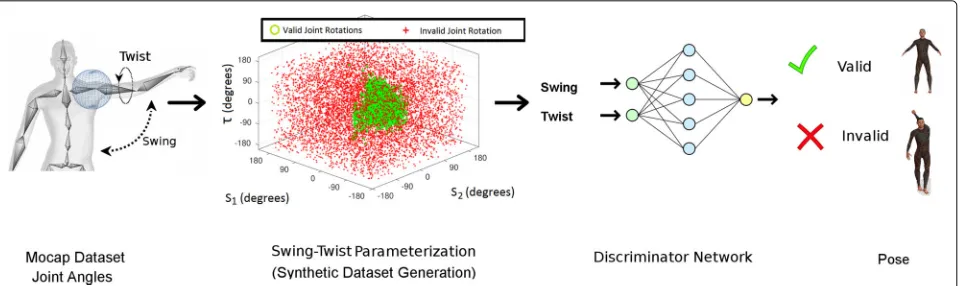
The overview of the current work for the left shoulder joint is depicted in the Fig.1. Our three-parameter rep-resentation is unambiguous and free of anomalies, which makes it easier to learn a joint rotation manifold. Thus, neural network discriminators trained on our represen-tation yield good accuracy and qualitative precision with very few parameters.
Fig. 1The joint angles (left shoulder) from motion capture datasets are transformed into(s1,s2,τ)swing-twist representation. Synthetic dataset is
generated to train neural network discriminators (using look-up maps not shown in figure). Discriminator network learns joint constraints to classify valid/invalid joint rotations
2 Related works
The joint constraints are dependent on the choice of representation for joint rotations. A straightforward approach to apply joint constraints in terms of Euler angles is to assume minimum and maximum limits on each angle (box-model) [10]. However, this approach is too crude to capture realistic anatomical joint limits. Euler angles representation also leads to discontiguous cluster of valid poses in joint space and often causes the prob-lem of Gimbal lock [11]. Due to these limitations, the joint limits based on box model are not optimal choice. The swing-twist representation in [11–14] of joint rotation is devised to efficiently classify validity of a joint rotation. However, interdependence of swing and twist (intra-joint dependence) has not been satisfactorily addressed in ear-lier works.
In a data-driven approach, Herda et al. [15] has pro-posed a parameterization in terms of an implicit surface on joint trajectory data in quaternion space. The authors extend their method to deal with inter-joint dependen-cies1, but it is computationally expensive and is not intu-itive to interpret the joint limits. Further, the imposed limits are directly on captured data, which might lead to unrealistic limits especially in the presence of voids and sparse mocap data. Also, only the vector part(sinθ) of quaternion is used in [15] to represent joint limits. It clearly ignores information in scalar part(cosθ)leading to ambiguity in rotation angle of joint. The quaternion also has dual representation (+q and−q) for a given joint rota-tion. A preprocessing step is often necessary over motion trajectory to mitigate the effects of duality.
Recently, Akhter et al. [9] learned pose-conditioned joint angle limits of trained gymnasts and athletes from a more controlled mocap dataset. Their work encodes only swing of a body segment in a discretized binary occupancy map. The occupancy map is defined using local spherical coordinates of the joint on a unit sphere. A table-look-up function for validity of pose is conditioned for every child
joint based on its immediate parent in a kinematic chain while ignoring the intra-joint dependency1.
Aforementioned limitations of previous works form the motivation of our research. We use an exponential map parameterization instead to represent joint rotations in present work. The exponential map representation avoid singularities as well as non-contiguous clusters [10]. It also avoids the duality problem in representation as described earlier.
We derive our joint constraints using more comprehen-sive Human 3.6 Million(H36M) dataset [16]. To overcome the limitation of intra-joint dependency, an additional parameter representing twist is learned. We encode lower and upper bounds of twistτ around a joint axis on occu-pancy map for a given swing(s1,s2).
3 Proposed methodology
The constraints of a 3D human joint rotation for rou-tine activities are learned by using Human3.6M (H36M) dataset [16]. Our joint constraints parameterization is based on swing-twist formulation. Initially, we decom-pose the joint rotation (expressed in quaternion form) into swing and twist parts. Later, we express each of the swing and twist in exponential map and arrive at(s1,s2,τ).
In comparison, Akhter et al. [9] learn joint rotation constraints from a motion capture dataset based on extreme range of joint movements. Moreover, they ignore twist around axis as they parameterize joint rotation from local 3D Cartesian coordinates to the spherical coordinates(φ,θ)representing swing of body segment. In current work, we compare our joint limits (swing part) derived from a range of normal activities performed by human subjects (in H36M) with extreme range limits provided by [9].
3.1 Swing-twist decomposition
q2
s+q2y q2s +q2y q2s+q2y
sx=
⎛ ⎜
⎝(qs·qx−qy·qz) q2
s+q2y ⎞ ⎟ ⎠,sz=
⎛ ⎜
⎝(qs·qz+qx·qy) q2
s+q2y ⎞ ⎟ ⎠
(1)
Then, we introduce ηtwist := (0,τ, 0) and ηswing := (s1, 0,s2) as respective exponential map counter-parts, and get,
τ =2·arctan sy
cy
,
s1=2·arctan
s2 x+s2z
czx
· sx
s2 x+s2z
,
s2=2·arctan
s2 x+s2z
czx
· sz
s2 x+s2z
(2)
Using the Eq. (2), we get swing components(s1,s2)and the twist componentτ of a joint rotation in exponential map. This representation is convenient as it (i) is unambiguous (no duality), (ii) avoids non-contiguous regions/jumps in joint trajectory, and (iii) requires no additional constraints like unit norm. Compared with swing-twist decomposi-tion in quaternion form [13], it requires less parameters (3 parameters inηtwist,ηswingversus 5 inqtwistandqswing). Consequently, it provides optimal joint representation for learning valid/invalid poses.
4 Implementation
The Euler angle representation of joint angles in H36M and [9] dataset are transformed into(s1,s2,τ) represen-tation, as described in previous section. The resulting joint rotation space is continuous, contiguous and well-behaved for discriminative learning (Fig.2).
It is found that considerable outliers are present in mocap dataset provided by Akhter et al. [9]. For instance, left and right knee flexion of all subjects performing var-ious activities is shown in Fig. 3. It clearly shows an impractical knee extension (upward) of up to – 20◦ for certain motion sequences in dataset. Moreover, we believe that limited set of mocap data of [9] is not enough to learn inter-joint dependency, i.e., insufficient instances of swing
LetMbe the set of all samples of H36M dataset for joint J, represented in(s1,s2,τ)space . We define a 2D grid
si,sj
on swing subspace, wheresi,sj ∈ {−180,. . ., 180}and a discrete mapping as follows
Ds(s1,s2):=
⎧ ⎨ ⎩
si,sj iffs1∈[si,si+1] ands2∈[sj,sj+1] undefined otherwise
(3)
Now for each grid squaresi,sj, if at least one mocap sample∈ Mlies in it, we term it as valid swing bin. The discretized swing occupancy map is thus defined by
Os
si,sj:= ⎧ ⎨ ⎩
1 iff∃(s1,s2,τ)∈M such thatDs(s1,s2)=
si,sj
0 otherwise
(4)
With each valid occupancy bin, we further associate minimum and maximum bounds of τ, based on all the instances of mocap data occuring in that bin
Lt
si,sj:= ⎧ ⎪ ⎪ ⎪ ⎪ ⎨ ⎪ ⎪ ⎪ ⎪ ⎩
[τmin,τmax] ∀(s1,s2,τ)∈M s.t.Os
si,sj=1,
τmin=inf(τ)and τmax=sup(τ) undefined otherwise
(5)
In order to obtain smooth twist angle bounds, we apply 3×3 Gaussian kernel(s) on(s1,s2,τmin)and(s1,s2,τmax) surfaces. Now given any (s1,s2,τ), we define a validity function in the following way
isValid(s1,s2,τ)=
⎧ ⎪ ⎪ ⎨ ⎪ ⎪ ⎩
1 iffOs◦Ds(s1,s2)=1 andτ ∈[τmin,τmax] , [τmin,τmax]=Lt◦Ds(s1,s2) 0 otherwise
(6)
We generate synthetic ground truth of labeled samples in(s1,s2,τ)space of a joint J by uniform random sampling on s1,s2,τ ∈[− 180, 180] and using isValid() function defined in Eq.6.
4.2 Training discriminators
Fig. 2The comparison of right hip joint’s range of swing present in H36M [16] and Akhter et al. [9] dataset
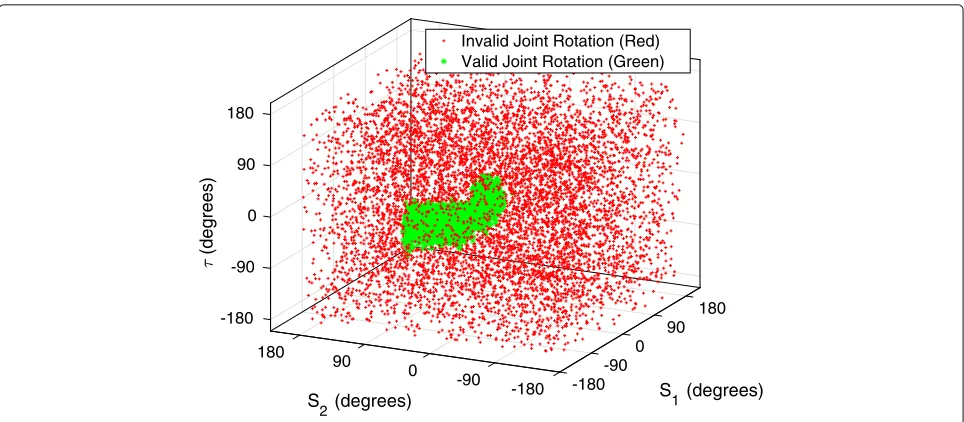
the sets representing valid and invalid classes are imbal-anced. We perform random sampling of valid and invalid instances to obtain 25%/75% sets respectively. The sam-pled sets are equally spaced ‘labeled’ training instances in entire joint space. An example of such sampled joint space for right hip joint (right up leg) is as shown in Fig.4.
A balanced (50%/50%) subset is selected from these sampled valid/invalid instances using random sampling.
The subset is again divided into training, validation, and test samples in a ratio (70%, 15%, 15%). For com-parison, we also tested over-sampling of valid class and under-sampling of invalid class to obtain balanced sub-set independently. However, the sampling proposed above leads to least variation of performance, when evaluation is performed on multiple test sets. The neural network discriminator are trained for each joint, using an equal
0 2 4 6 8 10
Frames of all activities 105 -20
0 20 40 60 80 100 120 140 160 180
Flexion / Extension (degrees)
Left knee (Red) Right knee (Blue)
180 90
S
1 (degrees) -180
0 180
90
S
2 (degrees)
-90 0
-90 -180 -180
Fig. 4Generated synthetic dataset for right hip joint with valid (green) and invalid (red) samples
number of valid/invalid instances in each batch. We train an ensemble of 20 discriminators for each joint to evaluate performance.
We also qualitatively evaluate the ability of neural network to discriminate valid/invalid joint rotations by means of an interactive validation tool. The tool also helps us to ascertain any anomalous examples found in motion capture datasets contradictory to the learned joint limits.
5 Results and discussion
The learning of a smooth implicit function by neural network represents the valid range of rotation for a spe-cific joint, i.e, valid swing and twist component of joint rotation.
We achieve over 95% accuracy (on all joints discrimi-nators) using only one hidden layer in a fully connected neural network (FCN) (results are shown in Table1). The table reports the result obtained for best among 20 classi-fier trained for each joint. The number of optimal hidden nodes obtaining best result is also reported for each joint in Table 1. A choice of 4, 8, 16, and 32 hidden nodes is tested. The optimal number of hidden nodes is decided when performance plateau is reached. The network with eight hidden nodes is found optimal for most of the joints. In our view, this is only feasible due to our choice of joint rotation parameterization, which is free of ambigu-ities and discontinuambigu-ities over the joint rotation manifold. The discretization scheme proposed on swing map(s1,s2) for complete range of τ rotation is also more intuitive. It avoids the limitations mentioned by [15] in his earlier work on quaternion-based joint limits. The representa-tion of joint manifold in quaternion space and Euler angle space is further highlighted in Figs.5and6respectively.
The anomalies of both representations can be noted ver-sus our proposed representation shown in Fig.4. The dis-cretization of joint space in quaternion and Euler angles to label invalid region is not straightforward as evident from these figures. Therefore, no further analysis is offered in this paper.
The output of discriminator also shows that learning is smooth and effectively accounts for outliers in the data. The corresponding outliers insyntheticdataset which are learned as invalid by discriminator are shown in Fig.7.
Table 1The joint discriminator networks classification accuracy on synthetic datasets of respective joint rotations
Joint name [16] Accuracy (%) False positive (%)
False negative (%)
Optimal hidden layer
Right up leg 98.7 0.3 1.0 8
Right foot 97.7 1 1.3 8
Left up leg 98.9 0.3 0.8 8
Left foot 98.2 0.6 1.2 8
Spine 99.4 0.1 0.5 16
Spine1 99.4 0 0.6 16
Neck 94.4 2.3 3.3 8
Head 97.7 0.9 1.4 8
Left shoulder 97.9 0.7 1.5 16
Left arm 96.8 0.5 2.7 8
Left hand 94.7 2.1 3.3 8
Right shoulder 95.1 1.5 3.3 16
Right arm 95.5 1.63 2.9 8
Fig. 5Quaternion (vector part) joint rotation space of right hip (right-up-leg) used by Herda et al.[15] shows duality of valid joint rotation. Anti-podal points + q and−q in the cluster represent same rotation
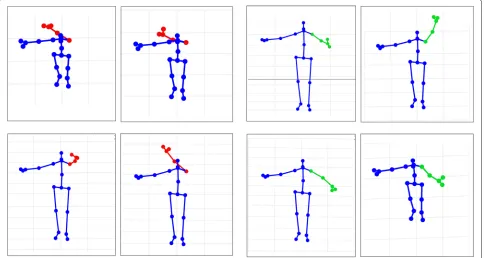
However, the accuracy on ‘synthetic’ ground truth is not an absolute figure of merit, due to voids and sparse data. Hence, the precision of joint rotation classification in a given pose is further evaluated qualitatively using an inter-active tool. The output of our interinter-active pose validation tool is as depicted in Fig. 8. There was no improve-ment found in precision (vs accuracy trade-off ) as well with further increase in number of neurons or hidden
layers for joint discriminators. As a pilot study, we per-form only limited qualitative tests to check veracity of our method. The detailed evaluation with multiple partic-ipants to validate synthetic invalid poses and evaluate dis-criminator performance will be undertaken in extended work.
The intra-joint (parent-child) dependency of range of rotation in a hierarchy of joints [9,15] is implicitly learned
-180
180 180
90 90
S
1 (degrees) S2 (degrees)
0
0 -90
-90 -180
Fig. 7Discriminator network output of valid left shoulder joint rotations in(s1,s2,τ)space
in our approach. Our approach emphasizes the coupling of parent-child arising from twist itself. For example, a constraint on the twist of upper limb avoidsunrealistic
pose of the lower limb by twist propagation along the kine-matic chain. Thus, presented with any(s1,s2,τ) param-eterized joint rotation, our trained neural network(s) are able to decide for the valid or invalid joints independently. The Table2shows a discriminative comparison matrix on test poses of left shoulder using Akhter et al. [9] and our
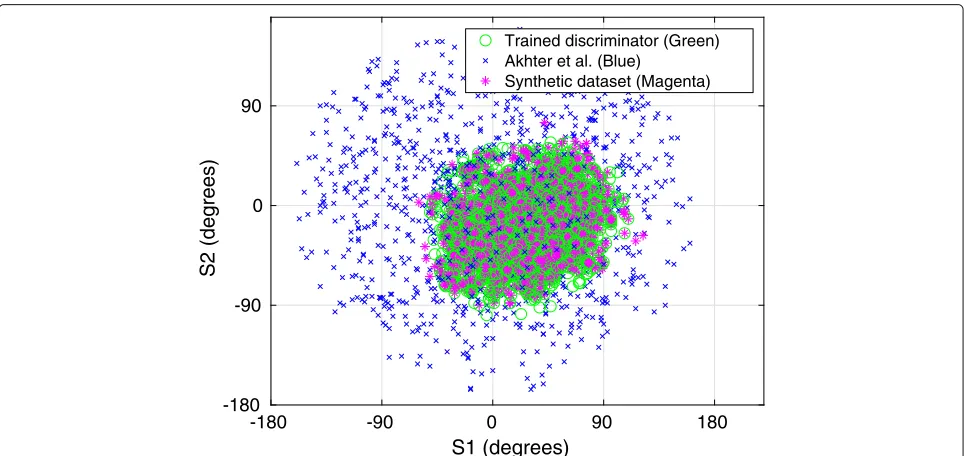
trained network. All poses classified as valid by our net-work are also found valid by [9]. However, since [9] does not take into account twist, the joint rotations classified as invalid by our network on account of twist are still valid in [9]. Figure9further highlights that Akhter et al. isValid() function allows unrealistic swing of left shoulder as almost whole (90%) of swing space is classified as valid. On the contrary, valid region in swing space learned by our dis-criminator is more plausible. These two factors account
-180 -90 0 90 180
S1 (degrees)
-180 -90 0 90
S2 (degrees)
Trained discriminator (Green) Akhter et al. (Blue)
Synthetic dataset (Magenta)
Fig. 9The valid left shoulder joint rotation of (i) trained discriminators output (green), (ii) Akhter et al. dataset (blue) [9], and (iii) synthetic dataset (magenta)
for high instances (36.65%) of left shoulder poses classi-fied as invalid by our network while still being classiclassi-fied as valid by [9] in Table2.
6 Conclusion
The articulated movement of human body is constrained by the limits on 3D joint rotations. We present a formu-lation of swing and twist components of joint rotations in exponential maps to learn joint limits by data-driven approach. Our representation is used to encode valid poses in an intuitive and physically meaningful way. A discretized look-up map is derived to label valid/invalid rotations in parametrized joint space. And we train a set of neural network discriminators to classify valid and invalid rotations for different joints. Our trained discriminators used as priors will lead to accurate learning of 3D human pose estimation and motion synthesis. The learned joint constraints are useful to represent normal range of human motion especially vital for social affordance applications like vision-based human-robot interaction. Data-driven
Table 2Comparison of classification results between learned discriminator (ours) and Akhter et al. [9] on generated left shoulder synthetic dataset
Akhter et.al
Valid Invalid
Ours Valid 99.92% 0.08%
Invalid 36.65% 63.35%
approach also provides meaningful limits to monitor the rehabilitation of patient’s with joint injuries. Since the learning is performed using a data-driven approach, the quality of learned constraints depends on the range of motion available in the mocap data. Therefore, we would be extending the current method by capturing more data and using other publicly available motion capture datasets. Our visualization tool can guide collection of motion data close to constraints. A more comprehensive qualitative study to validate synthetic invalid poses with the help of human evaluation would also result in better ground truth generation.
Endnote
1Inter-joint dependency is defined between the parent
joint and the subsequent children joint angles in a kine-matic chain, while intra-joint dependency exists between swing and twist of the same joint.
Acknowledgements
The authors would like to acknowledge the support provided by Deutsches Forschungszentrum für Künstliche Intelligenz (DFKI), Kaiserslautern, Germany and National University of Sciences of Technology (NUST), Pakistan for this work.
Funding
The authors declare that they have no competing interests.
Publisher’s Note
Springer Nature remains neutral with regard to jurisdictional claims in published maps and institutional affiliations.
Author details
1Department of Augmented Vision, Deutsches Forschungszentrum für
Künstliche Intelligenz (DFKI), Trippstadter Straße 122, 67663 Kaiserslautern, Germany.2TU Kaiserslautern, Kaiserslautern, Germany.3National University of Sciences & Technology, Islamabad, Pakistan.
Received: 13 March 2019 Accepted: 6 May 2019
References
1. Kanazawa A, Black MJ, Jacobs DW, Malik J (2018) End-to-end recovery of human shape and pose. In: Proceedings of the IEEE Conference on Computer Vision and Pattern Regognition (CVPR): 19-21 June 2018; Salt Lake City Utah, USA. IEEE. pp 7122–7131
2. Mehta D, Sridhar S, Sotnychenko O, Rhodin H, Shafiei M, Seidel H-P, Xu W, Casas D, Theobalt C (2017) Vnect: Real-time 3d human pose estimation with a single RGB camera. ACM Trans Graph (TOG) 36(4):44
3. Zhou X, Sun X, Zhang W, Liang S, Wei Y (2016) Deep kinematic pose regression. In: European Conference on Computer Vision (ECCV): 8-16 October 2016; Amsterdam, Netherlands. Springer, Cham. pp 186–201 4. Park S, Hwang J, Kwak N (2016) 3d human pose estimation using
convolutional neural networks with 2d pose information. In: European Conference on Computer Vision (ECCV): 8-16 October 2016; Amsterdam, Netherlands. Springer, Cham. pp 156–169
5. Tekin B, Marquez Neila P, Salzmann M, Fua P (2017) Learning to fuse 2d and 3d image cues for monocular body pose estimation. In: Proceedings of the IEEE International Conference on Computer Vision (ICCV): 22-29 October 2017; Venice, Italy. IEEE. pp 3941–3950
6. Varol G, Romero J, Martin X, Mahmood N, Black MJ, Laptev I, Schmid C (2017) Learning from synthetic humans. Proceedings of the IEEE Conference on Computer Vision and Pattern Recognition (CVPR): 21-26 July 2017; Hawaii, United States:109–117. IEEE
7. Pavllo D, Grangier D, Auli M (2018) QuaterNet: A Quaternion-based Recurrent Model for Human Motion. In: British Machine Vision Conference (BMVC): 3-6 September 2018; Newcastle, UK. BMVA. p 299 8. Elhayek A, Kovalenko O, Murthy P, Malik J, Stricker D (2018) Fully
automatic multi-person human motion capture for vr applications. In: EuroVR International Conference on Virtual Reality and Augmented Reality: 22–23 October 2018; London, UK. Springer, Cham. pp 28–47 9. Akhter I, Black MJ (2015) Pose-conditioned joint angle limits for 3d human
pose reconstruction. In: Proceedings of the IEEE Conference on Computer Vision and Pattern Regognition (CVPR): 8-10 June 2015; Boston Massachusetts, USA. IEEE. pp 1446–1455
10. Engell-Nørregård M, Erleben K (2009) Estimation of joint types and joint limits from motion capture data. In: International Conference in Central Europe on Computer Graphics, Visualization and Computer Vision (WSCG): 2-5 February 2009; Plzen, Czech Republic. Eurographics. pp 9–16 11. Baerlocher P, Boulic R (2001) Parametrization and range of motion of the
![Fig. 2 The comparison of right hip joint’s range of swing present in H36M [16] and Akhter et al](https://thumb-us.123doks.com/thumbv2/123dok_us/843016.1582029/4.595.59.539.481.714/fig-comparison-right-joint-range-swing-present-akhter.webp)
![Fig. 5 Quaternion (vector part) joint rotation space of right hip (right-up-leg) used by Herda et al.[15] shows duality of valid joint rotation](https://thumb-us.123doks.com/thumbv2/123dok_us/843016.1582029/6.595.57.540.484.705/quaternion-vector-joint-rotation-herda-shows-duality-rotation.webp)