© 2017, IRJET | Impact Factor value: 5.181 | ISO 9001:2008 Certified Journal | Page 1309
Efficient Secure Multi-Neuron Attack Defensive and Routing Security
Technique in Wireless Mesh Network
Gagandeep Singh
1, Ms. Maninder Kaur
21
M.tech Student, Doaba institute of engineering & technology, Ghataur,Punjab , India
2HOD ( M.tech), Doaba institute of engineering & technology, Ghataur,Punjab , India
---***---Abstract -
Mesh wireless network is an advanceddeveloping technology that will modify the world more efficiently or effectively. It is regarded as a highly capable field being adding significant in mobile wireless networks of the future group. Low-altitude Unmanned Aerial Vehicles combined with WLAN Mesh Networks have facilitated the emergence of airborne network-assisted applications. In misadventure release, they are key solutions:
(i) On-demur ubiquitous network access or (ii) Efficient investigation of sized areas.
However, these solutions still face major security experiments as WMNs are disposed to routing attacks. Thus, the network can be sabotaged, or the attacker might manipulate payload data or even attack the UAVs. Contemporary security standards, such as the IEEE 802.11i or the retreat mechanisms of IEEE 802.11s mesh typical, are susceptible to routing attacks as we experimentally showed in previous works. Therefore, a secure routing protocol is essential for making feasible the deployment of UAV-WMN. As future as identified, no one of the present investigation methods have increased receipt in practice owed to their high above or strong expectations. Here, has been presented the encryption technique for Secure, or Efficient mesh Routing approach. In this thesis, the optimization method used for reduce the worm hole attack effects has been described.
This paper discusses dissimilar encryption or Neural Network technique to establish algorithm which considers packet delivery. The existing PASER routing protocols are compared using new approach or the conception of the secure technique that is implemented in NN and DES with Mesh wireless network based on encryption technique. Our proposal prevents clone attack than the IEEE 802.11s/i security mechanisms or the well-known, secure NN without making restrictive assumptions.
Key Words: Packet Delivery Rate, End to End Delay,
Throughput, DES, PASER, NN, Clone Attack.
1.
INTRODUCTION
A network is a cluster connected with 3 or many notebook systems that are paired alongside to talk collectively. The particular contacts between nodes are established
mistreatment often were advertising or Wi-Fi advertising. Completely different systems discuss assets available in the community. These kinds of nodes will adapt to the owners just like PC, cell phones, hosting space moreover while network component.
1.1
Wireless Mesh Network
Wireless mesh system created down the assembly of wireless admittance facts connected at every system consumer’s locale. Each system user is also a worker, forwarding data for following knob. The stemming arrangement is rationalized or simplified for every knob essential only transfer as far as the next knob. Wireless mesh stemming could allow people living in distant zones or minor industries working with pastoral districts to join the systems collected for reasonable Internet networks.
Mesh System mesh system is a system topology in which every knob relays data for the system. All mesh knobs co-operate in the portion of data in the system. Mesh systems can communicate post using either a saturating method or a routing technique .With routing, the message is broadcast along a path by hopping from knob to knob until it reaches its endpoint. To ensure all its paths’ accessibility, the system must allow for permanent associates or must re-configure itself approximately broken paths, using self-healing procedures such as Straight Path Bridging. Self-healing permits a routing-based system to operate when knobs break-down or when a connection becomes unreliable.
© 2017, IRJET | Impact Factor value: 5.181 | ISO 9001:2008 Certified Journal | Page 1310 A consequence, the system is naturally quite dependable,
as there is regularly other than single track amongst a foundation or an endpoint in the system. Although mostly used in a wireless situation, this concept can also apply to wired systems or to software interaction. A mesh system whose handles are all attached to each other is a fully connected system. Fully connected restless systems have the compensation of security or reliability: troubles in a cable affect only the two knobs attached to it. However, in such set of connections, the number of cables, or therefore the cost, goes up quickly as the number of knobs increases.
1.1.1
External Attack in Wireless Mesh Network
They are individuals which are launched by intruders who are not part of a WMN or try to gain illegitimate access to the system. Thus, by this they can increase the calculation power of the system or can degrade the performance of the system. Some attacks that are possible in the WMN by the intruder in the system as: DDoS (Denial of Service) attack. This attack is the main problem in WMN as it directs the false messages in the system, thus making the system to choke down or making the capitals unavailable. Thus noticing the DDoS attacks in the systems is still in research. Other external attack in the WMN is the encryption or verification. Allowing to this the verification of the system is complete with the access opinions, the authentication is done by the access points is may be using the WEP or using WPA technology; as these procedures are found out to be co-operated by some hacking software. So these Procedures need to be revised. Encryption is done while distribution the data was encrypted with the shared key. As in the system all of the packets being encrypted with their communal key, so there is the option of the attack by guessing the shared key, so that the message can be forged.
1.1.2
Internal Attack in Wireless Mesh Network
Internal attack is launched by the internal knobs which area part of the WMN, they may be the selfish knobs or the malicious knobs that have been possibly been compromised by the attackers. By this they have admitted to all of the key indoor verification information. So to detect the attack internally some mechanisms should be employed to detect or isolate the misbehaving knobs. The example of the mechanism is the practice of IDS.
1.2 Data Encryption Standard Algorithm
The secret key algorithm is a security provides the similar key to encode and decode data. This algorithms uses a different key for encoding and decoding, and the decoding key can’t derived from the encoding key.
DES (Data Encryption Standard) Key Algorithm could be separated into binary Kinds:
Torrent ciphers and Chunk ciphers.
In stream cipher encoding an individual bit of plain-text at an interval time, whereas Block-ciphers offer at several of bits, i.e., normally 64-bits in new ciphers and encode them as an individual unit .The secret key algorithm is a symmetric key chunk cipher printed by the National Institute of Standards and Technology.
The secret key is an operation of a Feistel Cipher. It usages 16-rounds Feistel structure. The chunk’s scope is 64-bit. Nevertheless, key distance is 64-bit, DES has an operative key length of 56 bits, since 8 of the 64 bits of the most important are not rummage-sale by the encryption algorithm or purpose as checkered bits lone. Universal Construction of DES is showed in the fig no.1.2. .Meanwhile DES is based on the Feistel Cipher all that is required to require DES is:
Curved function Significant schedule
Any other processing , Original and final version
Fig-2 Data Encryption Standard
1.3 Neural Network
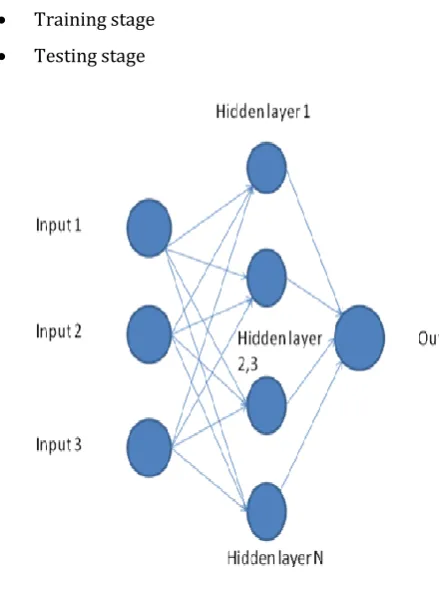
© 2017, IRJET | Impact Factor value: 5.181 | ISO 9001:2008 Certified Journal | Page 1311 There are two main stages in a classification system:
Training stage Testing stage
Fig -3 Neural Network
Neural Network is an organically stimulated organization algorithm. It consists of amount of simple neuron like processing units, prearranged in layers. Every unit in a layer relates to all the units in the preceding layer. These connections are not all equal: each joining may have a different strength or weight. The bulks on these contacts encode the information on a network. Frequently the units in a neural network are also called nodes.
Data arrives at the inputs and permits through the network, layer by layer; pending it arrives at the productivities. Throughout consistent process, that is when it acts as a classifier, there is no comment between layers. This is why they are identifying neural system.
2. LITERATURE SURVEY
Mohamad Sbeitietal discussed about WLAN Mesh Systems in paper titled PASER: Secure or Efficient Routing Approach for Airborne Mesh Networks. In this paper the author has simplified the entrance of airborne system-assisted applications. In adversity relief, they were a key solution for (i) On-demand or everywhere system access and (ii) Well-organized exploration of sized areas. However, these solutions still feature main security challenge as WMNs are horizontal to steering attacks. Therefore, the complex can be disrupted, or the attacker might operate, load data or even take over the UAVs. Existing sanctuary standards, such as the
IEEE 802.11i or the sanctuary mechanism of the IEEE 802.11s network typically, were susceptible to direction-finding attacks as they experimentally show in preceding works. Therefore, a protected routing procedure was crucial for making possible the placement of UAV-WMN. As far as we know, not a single person of the existing investigate approach had gained reception in performing due to their high-slide or strong assumptions. Here, they near the Position-Aware, Secure, or Efficient mesh Routing approach. The suggestion averts more doses than the IEEE 802.11s/i safety instruments or the well-known protected steering protocol ARAN, without making defensive expectations.
3. PROPOSED SYSTEM
Step I. First wireless mesh network created which connects one UAV node to another UAV node. To communicate the information in connecting form, this network is linked together.
Step II. In next step the source and destination node is selected in this network. The Main Head node name is Key Distributed Centre is plotted.
Step III. In ‘Main Head’ normal id’s and unique id’s as created in the wireless mesh networks to travel on position to another position in the mesh networks.
Step IV. The unique id generates, the purpose is Main Head communicates a secure message and send the trusted node, which is defined by the KDC administration.
[image:3.595.55.275.120.415.2]© 2017, IRJET | Impact Factor value: 5.181 | ISO 9001:2008 Certified Journal | Page 1312
Fig -4: Proposed Flow chart
Step VI. Then implemented the encryption technique to provide the security in the mesh networks. Secret key encryption algorithm is used for encryption. Where the secret key algorithm will be deployed was implementing a security which provides the similar key to encode and decode data. This algorithm uses a dissimilar key for encoding and decoding, and the decoding key can’t derive from the encoding key.
New Secret Key Algorithm could be separated into binary types:
a) Stream-ciphers b) Block-ciphers
In stream cipher, this is encoded a single bit of plaintext as execute at a time, whereas Block-ciphers offers a number of bits, i.e., normally 64-bits in new ciphers and encode them as an individual unit.
Step VII. The performance parameters are calculated based on the PASER (Power Aware Secure, Efficient Routing Protocol) with Encryption Techniques (Distance Probability, Throughput, packet delivery rate and frame error rate based on delay (0%, 10% and 20%).
Step VIII. The proposed approach is implemented named as Neural Network Algorithm. This is resolving the network issues and transmits the data securely and calculates the performance parameters, .e throughput, delay and delivery rate etc.
Step IX. Comparison between the existing and proposed approach and proved that proposed work is better than previous one.
4. RESULTS AND DISCUSSION
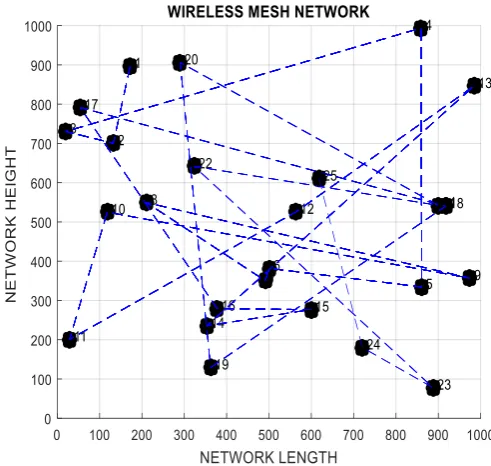
[image:4.595.40.286.91.558.2]In this section, the result in wireless mesh network with neural network and compare with PASER (position awer secure efficient routing protocol) to reduce the delay with frame error rate and enhance the packet delivery rate (%). In existing work using PASER approach to achieved the delay increases and packet delivery rate decreases.
Fig -5 Wireless mesh network
[image:4.595.322.568.463.696.2]© 2017, IRJET | Impact Factor value: 5.181 | ISO 9001:2008 Certified Journal | Page 1313 size 1000. The unmanned air vehicles (UAV) plotted in
the given area i.e. 1000*1000 and connected one UAV to another UAV is called WMN.
MESH system with connected UAVs for the broadcast of packets from initial node to the sink in which source or destination is plotted in pink and crayon color or all other knobs with their ids. It defined that the plot the start node and destination node in the wireless mesh network. In source node means continue the packet travel and destination node means end the transmission node in the WMN.
Fig-6 Trusted Node
The fig-6 shows that the trusted node means secure data transmission. We use authentication process to generate the trusted node in the network. To send the information securely.
Fig-7 Registration Complete
The fig-7 message box defines that the unmanned air vehicles are authorized vehicle registration is completed with KDC. When uav follows the authentication process then gives the registration message.
Fig-8 Packet Transferred
The fig-8 message box defines that the packet will be delivered or transferred from unmanned air vehicles. The packet will be transfer means KDC generate the trusted nodes in the network and it will sent the information securely transfer one uav to another uav.
Fig-9 Clone attacker Node
In fig-9 message box shows that the attacked UAV is 8 from the route to which attacker attacks in the system or will deviate all the packets from the route. The clone attack occurs in the network then generates the multiple copies in the network. In attacker node catch the information in any case then loss the original packets in the WMNs.
Fig-10 Trusted Node
The fig-10 message box shows the attacked knob which is 10 in the system which is in blue color or reset knobs are the trusted vehicles in the red color. We use authentication process to generate the trusted node in the network. To send the information securely with one node to another node.
Fig-11 Routing Delay with Paser
© 2017, IRJET | Impact Factor value: 5.181 | ISO 9001:2008 Certified Journal | Page 1314
Fig-12 Probability Density Function
The fig-12 shows above the probability density function in D-NN WMNs which shows the probability of receiving the path damage when attacker attacks in the systems or the red line shows the average probability for the designed system function.
Fig-13 Packet Delivery Rate with Paser
In fig-13 the packet delivery rate for the successful broadcast of packets from the start node to the sink node through trusted vehicles which shows that 70% delivery packets are transmitted using secure transmission.
Fig-14 Throughput with Paser
The fig-14 shows Throughput for the successful transmission of packets from the initial node to the destination through trusted vehicles which shows that 33% throughput achieved in (PASER) are transmitted using secure broadcast. Throughput is the maximum rate of production or the maximum rate at which something can be processed.
Fig-15 Packet Delivery Rate with NN
The fig-15 the packet delivery rate for the successful transmission of packets from source to the destination through trusted vehicles which shows that 98% throughput with NN are transmitted using secure transmission. It is the ratio of actual packet delivered to total packets sent.
Fig-16 Routing Delay with NN
In fig-16 the routing delay to transfer the packets from the basics to the destination having FER which is edge error rate in NN. These are showing the delay in between the transfer of the packets when the FER with NNis0%, FER with NNis10% or FER with NN is 20%. Little delay results in the high Packet Delivery rate.
Fig-17 Throughput with NN
© 2017, IRJET | Impact Factor value: 5.181 | ISO 9001:2008 Certified Journal | Page 1315
Table – 1: Performance Parameters
Performance Parameters Values
Delay 0% 64.63ms
Delay 10% 6.4ms
Delay 20% 12.93ms
Throughput 70%
[image:7.595.38.288.121.232.2]Packet Delivery rate 98%
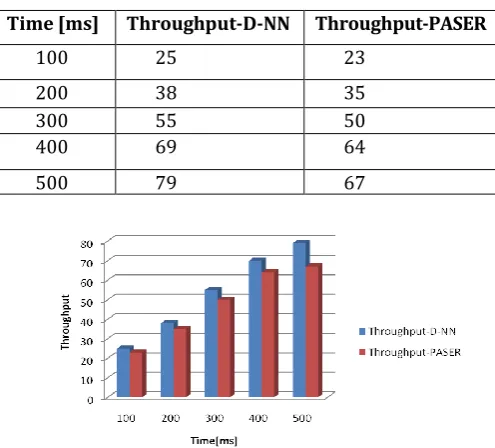
Table – 2: Comparison between Throughput of NN and PASER
Time [ms] Throughput-D-NN Throughput-PASER
100 25 23
200 38 35
300 55 50
400 69 64
500 79 67
Fig-18 Comparison between throughput NN and PASER
Table -3 represents that the comparison based on PASER and D-NN in throughput (%).In NN there is improvement in the accuracy of the wireless mesh network. In this method it is observed and prevention is performed in the network with the help of data ant colony optimization technique and secret key algorithm.
Table - 3: Comparison between Packet delivery Rate NN with PASER
Time [ms] Packet delivery
rate D-NN Packet Delivery Rate PASER
100 84 54
200 89 58
300 93 60
400 95 69
500 98 70
Fig-19 Comparison between PDR NN and PASER
The fig-19 represents that the comparison based on PASER and D-NN in the PDR (%). We improve the packet delivery with D-NN and PASER. We implement the proposed approach to enhance the performance of the information transmission.
5. CONCLUSIONS
WMNs are the efficacious technology that provides internet access in rural areas in a cost effective way with the modus operandi. This security becomes paramount and a critical parameter for wireless mesh network because of its vulnerability to various attacks and requirement of intensive care for impregnability and unassailability. The attacks have been conversed about and their genre herein. Distinguished routing protocols, and meta-heuristic algorithm schemes could be implemented to protect the network. There are assorted techniques which are hypothesized in this thesis on the essence of distinct parameters. Using the network simulator MATLAB 2016a, realistic mobility patterns of unmanned air vehicles or experimentally derived data transfer model of unmanned air DES-NN- WMN has compare presentation evaluation like packet delivery rate, end to end delay or throughput.
ACKNOWLEDGEMENT
The author is thankful to Mrs. Maninder Kaur, Office Incharge, DIET and her staff for providing the necessary facilities for the preparation of the paper. Without the proper guidance of them it is not possible to learn about latest technologies and research works
REFERENCES
[1] Sbeiti, Mohamad, et al. "PASER: Secure or Efficient Routing Approach for Airborne Mesh Networks." IEEE March 2016.
[image:7.595.38.286.275.499.2]© 2017, IRJET | Impact Factor value: 5.181 | ISO 9001:2008 Certified Journal | Page 1316 [3] Agnihotri, Mohit, et al. "Topology Formation in Mesh
networks considering Role Suitability."
[4] Akyildiz, Ian F., Xudong Wang, or Weilin Wang. "Wireless mesh networks: a survey." Computer networks 47.4 (2005): 445-487.
[5] Apostolaras, Apostolos, et al. "A Mechanism for Mobile Data Offloading to Wireless Mesh Networks." (2016).Acharjee, Tapodhir, Pinky Borah, and Sudipta Roy."A New Hybrid Algorithm to Eliminate Wormhole Attack in Wireless Mesh Networks." 2015 International Conference on Computational Intelligence and Communication Networks (CICN).IEEE, 2015.
[6] B. Sun, Y. Guan, ,J. Chen ,U.W Pooch, ”Detecting Black
hole attack In Mobile Ad-hoc
Netwoks”.5thEuropeenPersonel Mobile
Communications Conference,2003,pp. 490-495.
[7] Branch, Joel W., et al. "In-networ k outlier detection in wireless sensor networks." Knowledge or information systems 34.1 (2013): 23-54.
[8] De Judicibus, Dario, et al. "Method or system for secured transactions over a wireless networ k." U.S. Patent No. 8,352,360. 8 Jan. 2013.
[9] Dia, Hussein. "An object-oriented neural network approach to short-term traffic forecasting." European Journal of Operational Research 131, no. 2 (2001): 253-261.
[10] Singh, Rajpreet, and Sanjeev Dewra. "Performance evaluation of star, tree & mesh optical network topologies using optimized Raman-EDFA Hybrid Optical Amplifier." 2015 International Conference on Trends in Automation, Communications and Computing Technology (I-TACT-15).Vol. 1.IEEE, 2015.
[11] Srikrishna, Devabhaktuni, or Amalavoyal Chari. "Selection of routing paths based upon path quality of a wireless mesh network." U.S. Patent No. 6,965,575. 15 Nov. 2005.
[12] Subhashis Banerjee ,Mousumi Sardar, or koushikmajumder,” Black-hole attack mitigation in manet”, springer international publishing switzerlor 2014.
[13] Kishor Jyoti Sarma,et.al,” A Survey of Black Hole Attack Detection in Manet”, Advanced Information Networking or Applications (AINA), 2014 24th IEEE International Conference on. IEEE, 2014.