© 2017, IRJET | Impact Factor value: 6.171 | ISO 9001:2008 Certified Journal | Page 1169
Effect of Partial Replacement of Sand by Iron Ore Tailings on the
Compressive Strength of Concrete
Shivam Tiwari
1, Anubhav Rai
2, Y.K. Bajpai
31M.Tech Student, Department of Civil Engineering, G.G.I.T.S. Jabalpur, M.P, India 2Assistant Professor, Department of Civil Engineering, G.G.I.T.S. Jabalpur, M.P, India 3Professor and Head of the Department of Civil Engineering, G.G.I.T.S. Jabalpur, M.P, India
---***---Abstract -Iron ore tailing (IOT) is a waste generated from
iron ore industry. Millions of tonnes of IOT are produced every year in India and disposal of the same is a huge problem as it cause to environmental pollution. In other hand availability of sand is continuously depleted. Hence, partially or fully replacements of fine aggregate by the other compatible material are being researched in view of conserving the ecological balance. In this work, the effects of partial replacement of sand by iron ore tailing on the compressive strength of concrete are experimentally studied. In the present work iron tailing were used as partial replacement to fine aggregates at levels of 0%, 5%, 10%,15% and 20% and the basic material properties,
strength parameters are studied. Experimental
investigation was done using M25 mix and tests were carried out as per recommended procedures by relevant codes. The mix proportions used for concrete are 1: 1.484: 2.698.
Key Words: Concrete, Compressive strength, Iron ore tailing (IOT), Fine Aggregate (FA), River sand (RS).
1. INTRODUCTION
Concrete is the most widely used composite material today. The ingredients of concrete are coarse aggregate, fine aggregate, binding material and water. Rapid increase in construction activities leads to acute shortage of conventional construction materials. It is conventional that sand is being used as fine aggregate in concrete. For the past two years, due to administrative restrictions the availability of sand in India is very low and price of sand is rapidly increases. On the other hand, the modern technological society is generating substantially high amounts of solid wastes both in municipal and industrial sectors posing challenging task for this effective and efficient disposal. In India approximately 10 – 12 million tons of such mined ore is lost as tailings. The safe disposal or utilization of such vast mineral wealth in the form iron dust has remained a major unsolved and challenging task for the Indian iron ore industry. In future, the proportion of iron ore wastes generated is likely to increase due to higher demand for iron ore as a number of steel plants have been planned for future in many parts of the country. In order to reduce the adverse impact of indiscriminate mining of natural sand, iron ore tailings which is the waste
products of mining industries is used as an alternative to the river sand in the manufacturing of concrete.
1.1 Objectives
Determining the properties of iron ore tailing and comparing the results with the fine aggregate i.e. sand.
Partial replacement of iron ore tailing with the conventional sand.
Determining the workability of concrete at different percentages of IOT.
Determining the strength properties of concrete for 7, 14, 21 and 28 days
2. Material and Methodology
2.1 Material
2.1.1 Cement
For making concrete OPC 43 grade cement (JP cement) was used in the research.
2.1.2 Fine aggregate
The aggregate size is lesser than 4.75 mm is considered as fine aggregate. The sand used for the experimental programmers was locally available Narmada sand and conformed to grading zone II as per IS: 383-1970. The specific gravity were found to be 2.645
2.1.3 Coarse Aggregate
Coarse aggregates are those which are retained on IS sieve size 4.75 mm. Crushed stone angular shaped of 10 mm and 20 mm size from a local source was used as coarse aggregate. The specific gravity was found to be 2.85 for 20 mm size aggregate and 2.80 for 10 mm aggregate.
2.1.4 Iron Ore Tailing
© 2017, IRJET | Impact Factor value: 6.171 | ISO 9001:2008 Certified Journal | Page 1170 Fig -1: Iron Ore Tailing
Table -1: Physical Property of Iron Ore Tailing
Parameters IOT
Particle shape Spherical
Density 14.4 kN/ m³
Specific gravity 3.10
Color Dark tan (brown)
Optimum dry density (ODD) 1.71 gm/cc
Optimum moisture content
(OMC) 21 %
2.2 Mix Proportion
[image:2.595.317.550.89.262.2]The concrete mix is designed as per IS 10262 –2009. The grade of concrete which we adopted was M25 with the water cement ratio of 0.45. The mix proportions used for concrete are 1: 1.458: 2.529
Table -2: Mix Proportions
GRADE CEMENT AGGREGATE FINE AGGREGATE COARSE RATIO W/C
M 25 438 Kg 649.82 Kg 1181.745 Kg 0.45
2.3 Test Specimen
Cubes of size 150mm X150mm X150 mm were prepared using the standard moulds. The samples were casted using the six different percentages of iron ore tailing (0%, 5%, 10%, 15%, & 20%). The samples were demoulded after 24 hours from casting and kept in a water tank for 7, 14, 21 and 28 days curing. A total of 48 specimens are casted for testing the properties such as compressive strength.
Fig -2: Prepration of cubes
Fig -3: Demoulding of cubes
[image:2.595.316.550.532.725.2]© 2017, IRJET | Impact Factor value: 6.171 | ISO 9001:2008 Certified Journal | Page 1171 Fig -5: Compressive testing machine
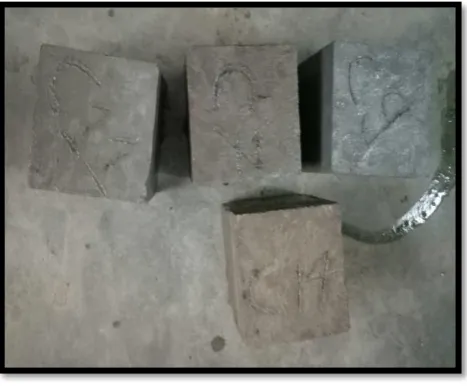
Fig -6: Cubes specimen after testing
3. Results
The results of fresh properties of concrete such as workability by slump cone are determined and hardened properties such as Compressive Strength are presented and discussed below
3.1 Measurement of Workability
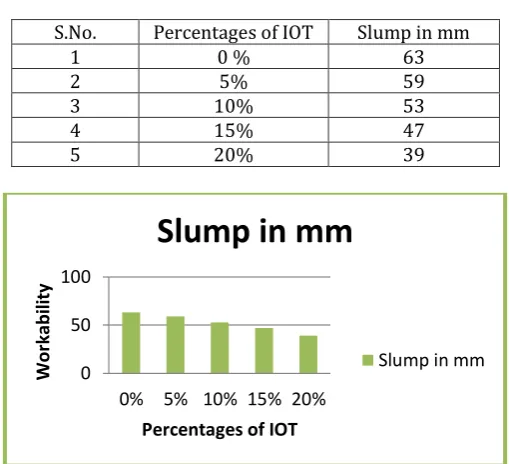
Test adopted for measurement of workability in the present investigation was Slump cone Test and the test results shown in table 3.
[image:3.595.42.279.264.414.2]Fig -7: Slump cone test
Table -3: Workability (Slump Cone Test)
S.No. Percentages of IOT Slump in mm
1 0 % 63
2 5% 59
3 10% 53
4 15% 47
5 20% 39
Chart -1: Workability of concrete M25 grade concrete with partial replacement of sand by IOT
3.2 Compressive Strength
Compressive strength test were conducted on 150 mm size concrete cubes in compressive testing machine accordance with the specifications of Bureau of Indian Standards. The test results are given in Table 4.
Table -4: Compressive Strength
S.No. Percentages of IOT 7 days Compressive Strength (mPa) 14 days days 21 days 28
1 0 % 24.456 29.674 32.519 35.807
2 5% 24.948 30.444 33.674 36.178
3 10% 25.393 30.43 34.652 36.889
4 15% 25.319 31.393 35.215 37.185
5 20% 25.141 30.859 34.978 36.785
Chart -2: Compressive strength of cube with 0% replacement of sand by IOT
0 50 100
0% 5% 10% 15% 20%
W
or
ka
b
ili
ty
Percentages of IOT
Slump in mm
Slump in mm
15 20 25 30 35 40
7 14 21 28
Co
m
p
re
ssi
ve
st
re
n
gt
h
in
N/
m
m
2
Curing Days
Compressive Strength at 0 % IOT
[image:3.595.42.566.485.757.2] [image:3.595.290.560.485.729.2]© 2017, IRJET | Impact Factor value: 6.171 | ISO 9001:2008 Certified Journal | Page 1172 Chart -3: Compressive strength of cube with 5%
replacement of sand by IOT
Chart -4: Compressive strength of cube with 10% replacement of sand by IOT
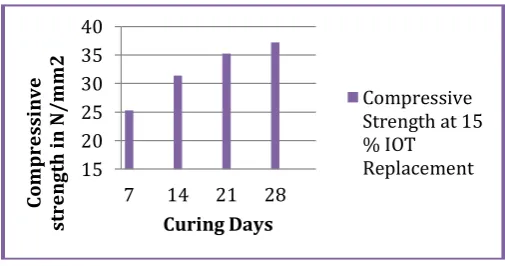
Chart -5: Compressive strength of cube with 15% replacement of sand by IOT
Chart -6: Compressive strength of cube with 20% replacement of sand by IOT
Chart -7: Compressive strength of M25 grade concrete with partial replacement of sand by IOT
4. Discussion
4.1 Workability test result
Table 3, shows the Workability of concrete mixes made with partial replacement of sand with iron ore tailing. The workability of concrete decreases by addition of Iron Ore Tailing.
4.2 Compressive Strength test result
Table 4, shows the Compressive strength of concrete mixes made with partial replacement of sand with iron ore tailing was determined at 7, 14, 21 and 28 days. It was found that Compressive strength of concrete increases gradually by addition of Iron ore tailing from 0% to 15% and after that strength of concrete decreases. Hence it can be concluded that 15% replacement of sand with IOT gives best result for compressive strength of concrete.
5. Conclusions
The following conclusions are drawn based on the above experimental study.
As the iron ore tailing percentage increases the workability of mix reduces hence for better workability use of super plasticizers is recommended.
Replacement of 15% Iron Ore Tailing gives best result for compressive strength.
As percentage of iron ore tailing increases more than 15% the compressive strength of concrete decreases. 15 20 25 30 35 40
7 14 21 28
Co m p re ssi n ve st re n gt h in N/ m m 2 Curing Days Compressive Strength at 5 % IOT Replacement 15 25 35 45
7 14 21 28
Co m p re ssi n ve st re n gt h in N/ m m 2 Curing Days Compressive Strength at 10 % IOT Replacement 15 20 25 30 35 40
7 14 21 28
Co m p re ssi n ve st re n gt h in N/ m m 2 Curing Days Compressive Strength at 15 % IOT Replacement 15 20 25 30 35 40
7 14 21 28
Co m p re ssi n ve st re n gt h in N/ m m 2 Curing Days Compressive Strength at 20 % IOT Replacement 20 22 24 26 28 30 32 34 36 38 40
7 14 21 28
[image:4.595.202.550.37.280.2] [image:4.595.36.289.419.552.2]© 2017, IRJET | Impact Factor value: 6.171 | ISO 9001:2008 Certified Journal | Page 1173
Iron ore tailing as a replacement to the sand will solve two problems with one effort, namely, elimination of solid waste problem on one hand and provision of a needed construction material on other hand. The Iron ore tailing reduces the cost production of concrete.
REFERENCES
[1] IS 10262:2009- “Indian standard concrete mix
proportioning – guidelines (first revision)” BIS, New Delhi.
[2] IS 456:2000-“code of practice of plain and reinforced
concrete” BIS, New Delhi.
[3] IS:383-1970-“Specification for coarse and fine
aggregates from natural sources for concrete” BIS, New Delhi.
[4] Ananthayya M.B1, Prema Kumar W.P.2 and Vijay K.3
(August - 2014) - Effect of Partial Replacement of Sand by Iron Ore Tailing (IOT) and Cement by Ground Granulated Blast Furnace Slag (GGBFS) on the Compressive Strength of Concrete
[5] Dr. Prema Kumar W.P.1, Mr. Ananthayya M.B.2 and Mr.
Vijay K.3 (July - 2014) - Effect of Replacing Sand by Iron Ore Tailings on the Compressive Strength of Concrete and Flexural Strength of Reinforced Concrete Beams
[6] Chaithanya M.B1, Shashi kumar N.V2, G Narayana3, B.K
Narendra4 (August-2015) - Properties of SFRC with partial replacement of cement & sand by C.O.T & I.O.T
[7] Sahil Goyal1, Keshav Singh2, Ahmad Hussain3,
Priyanka Ramkripal Singh4 (April-May, 2015) - Study partial replacement of sand with iron ore tailing on compressive strength of concrete
[8] Zhigang Zhu1 ,Beixing Li2 and Mingkai Zhou3 (August-
2015) - The Influences of Iron Ore Tailings as Fine Aggregate on the Strength of Ultra-High Performance Concrete
[9] Manjula1, Sachin H. S.2, Shivakumar K. M.3, Ranjitha D.
R.4 and Santhosh B. M.5 (June-2015) - Utilization of Iron Ore Tailings as a Replacement to Fine Aggregates in Pre-Stressed Concrete Sleepers
[10] T. I. Ugama1, S. P. Ejeh2 and D. Y Amartey3 (2014) -
Effect of Iron Ore Tailing on the Properties of Concrete
[11] T. I. Ugama1 and S. P. Ejeh2 (Sept.-2014) - Iron Ore
Tailing As Fine Aggregate In Mortar Used For Masonry
[12] Vikrant Sabat 1, Mujahed Shaikh 2, Mahesh Kanap 3,
Mahendra Chaudhari 4 and Sagar Suryawanshi 5 (August-2015) - Use of Iron ore Tailings as a Construction Material
[13] Swetha K S1, Shashi Kumar N V2, Bhavya S3 and S.B