© 2017, IRJET | Impact Factor value: 5.181 | ISO 9001:2008 Certified Journal | Page 2055
Efficient Altered Fingerprint Analysis and Rectification of Distorted
Fingerprint
Ms. Vidya Ramesh Patil
1, Prof. (Dr). B. D. Phulpagar
21
Student, Dept. of Computer Engineering, PES Modern College of Engineering Pune, Maharashtra, India
2Professor, Dept. of Computer Engineering, PES Modern College of Engineering Pune, Maharashtra, India
---***---Abstract -
Identifying person accurately is important aspect
in many application areas like criminal cases. Face recognition system should be fault tolerant to handle such cases. Fingerprint recognition system has suffering through Positive and Negative classifications. Multi label classification can give best feature. In positive classification, where the physical access control systems and user should negotiate for self-identification. The false case classification broadly talks about low quality of images in case of user identification may authenticate malicious user. Distortion detection can categorized in two-class classification problem which can be solved using the registered ridge orientation map and period map of a fingerprint is used as the feature vector and a Lib SVM classifier is trained to perform the classification task. Distorted fingerprint rectification (or equivalently distortion field estimation) is viewed as a regression problem, where the input is a distorted fingerprint and the output is the distortion field. For such problems Detection and Rectification of distorted fingerprint is must.
Key Words: Ridge Pattern, Nearest Neighbour Regression,
Orientation Field Map, Ridge Orientation map, PCA, Ridge Density.
1. INTRODUCTION
In the last forty-year the fingerprint recognition technology has immersed but there is several challenging problems present in fingerprint technology and Major problems can be working with low the quality fingerprints. It has been identified using FVC2006 data-set that Fingerprint matching accuracy determined over same algorithm among various data-sets.
The NIST [4] has conducted the evaluation and observed that there are many differences between matching the fingerprints accurately. Plain, Rolled, and Latent fingerprint matching technologies has many problems while recognizing the images. Basically there are two types of recognition systems i.e. positive recognition system and negative recognition system. In positive recognition system, physical access control system and user should cooperate and identify .In Negative recognition system; the fingerprint was not made by the person indicated. In positive recognition system, if the quality of image is not up to the mark then it seems to be fail for legitimate users also which in turn results into inconvenience. Low quality fingerprint
recognition result is termed as negative recognition system however, which is much more serious than positive recognition system, since malicious users may purposely degenerate fingerprint quality to preclude fingerprint system from finding the real identity. A number of factors like degradation of fingerprint image quality, including small finger area, cuts and abrasions on the finger, wet or dry finger, dirt on the finger or sensor, and skin distortion[6].
Low quality fingerprint recognition result is termed as negative recognition system however, which is much more serious than positive recognition system, since malicious users may purposely degenerate fingerprint quality to preclude fingerprint system from finding the real identity. A number of factors like degradation of fingerprint image quality, including small finger area, cuts and abrasions on the finger, wet or dry finger, dirt on the finger or sensor, and skin distortion. The aftermath of low quality fingerprints depends on the type of the fingerprint recognition system. Those fingerprints we call Altered Fingerprint [6].
2. Literature Review
[2.1] Hardware based Distortion Detection [5]
Fingerprint acquisition detects modified fingerprint so that modified fingerprint can be rejected. Researchers proposed to detect inappropriate force using specially designed hardware Bolle et al. [5] proposed to detect immoderate force and torque exerted by using a force sensor. After this they have received outcome that monitored fingerprint acquisition improves matching performance. Fujii [6] has suggested approach to detect distortion by detecting distortion using a transparent film attached to the sensor surface. Dorai et al. [5] have proposed to detect distortion by analyzing the speed in video of fingerprint. This method has following limitations –i) Fingerprint sensors should have classic video capturing capability;
ii) Fails for existing database images and
iii) Could not check distorted fingerprints before pressing on the sensor.
[2.2] Distortion-Tolerant Matching [4]
© 2017, IRJET | Impact Factor value: 5.181 | ISO 9001:2008 Certified Journal | Page 2056
i) A global rigid transformation and to reduce distortion,use tolerant box of fixed size or adaptive size
ii) Explicitly model the spatial transformation by thin plate spline (TPS) model
iii) Enforce constraint on distortion locally However, allowing larger distortion in fingerprint recognition will definitely result in higher false match rate.
This will introduce major distortion in matching performance will result slower matching speed.
[2.3] Finger Specific Statistic for Distortion
Rectification
In this approach Ross et al studied the transformation pattern from group of training fingerprint images of same finger and transmuted template with mean deformation. It showed that these results have higher minutiae point matching correctness. Though, it has below shortcoming. (i) Many applications have only one fingerprint of a person but this approach requires multiple images which is not convenient.
(ii) Even though multiple fingerprint images of same person is available but still it’s not possible to cover skin problems like distortion.
[2.4] General Approach for Distortion Rectification
This method is interestingly developed by Bolle and Statistics Senior. This method is used to remove alteration just before similar stage. It is assumed that fingerprint ridges are equally spaced with some distance. Thus, it deals with fingerprint distortion using normalization of ridge density for the entire fingerprint images for fixed value. It has lack of distortion detection algorithm and to overcome this, they performed rectification algorithm to each fingerprint. This method is compared with listed method and it has bellow benefits -(i) No need of specialized hardware (ii) Work with single fingerprint images
(iii) No need to maintain training data-sets of same finger [1].
Though ridge density is not fixed within a finger or not fixed across the finger. Many research and scientist have described that fingerprint matching correctness by using ridge density in formation in minutiae point matches. This method has bellow limitations- Simply normalizing ridge density of every fingerprint might lose insightful information for fingerprint might improve deceived matching score. With no constraint on authentic measure of orientation map. Even it is resulting fixed ridge period map though it might generate unexpected orientation map [8]. Another severe limitation of degrades genuine matching score. And above database consisting of six fingerprint images and finger rotation was not considered.
Above demerits was not addressed because testing was performs on small data-sets. Which has six fingers and fingerprints rotation was ignored. Bolle and Senior scientist methods shares advantages over shortcoming of other methods. As this method based on statistic's operation and learned measures from real altered images from distorted data-sets [9].
This methods handles finger rotation as well. And also it deals with different types of alteration as long as that type of distortion present in training images. Wide spread experiments are conducted to verify the statistics method. This is significant for preliminary study work [1]. It also detects alteration of using simply hand erases features and lack of quality improved function.
3. SYSTEM ARCHITECTURE
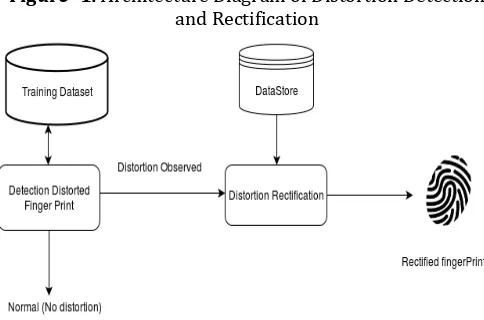
Above system shows actual flow of system. The input to system will be fingerprint. At first stage of distortion of fingerprint is detected. The system classifies the distorted fingerprint and normal fingerprint using SVM.
[image:2.595.310.552.415.575.2]In stage one if it is determined that, thus provided finger image has distortion then that finger image will be processed by next stage for rectification to achieved higher accuracy.
Figure -1: Architecture Diagram of Distortion Detection and Rectification
© 2017, IRJET | Impact Factor value: 5.181 | ISO 9001:2008 Certified Journal | Page 2057
In feature extraction, feature vector is gatheredusing sampling approach for registered orientation map and period graph. In sampled grid finger centered is marked. It is assumed that two sampled grid must be different. The constructed period map from sampling grid cover entire finger and orientating map after sampling cover only top portion of finger. The reason of the orientation map just below finger image center are distinct within neutral finger image. Performance matching experiments for distortion rectification uses three datasets. Those are FVC 2004 DB, Tsingua and NIST SD27
The proposed system conducted experiments on three DB mainly FVC2004DBL contains distorted images after by skin disease and Tsingua altered finger images consist 320 altered finger video files.
The survey conducted by NIST used NIST SD27 database as source of latent fingerprint database experiments conducted ensured that algorithm could increase the matching performance of altered fingerprint.
Figure-2 Fingerprint Distortion Classification
3.1 Mathematical Model
Let, Distortion Detection System C = {I, F, O}, where I = input fingerprint image from FVC 2002 DB2 data set. F= {N, V, ɵ, S}
The Normalized image (N),
Where, I(x,y) = the grey-level value at pixel (x,y) N(x,y) = Normalized gray value
M = Estimated mean of I(x,y) V = Estimated variance of I(x,y) M0,V0 = Desired mean and variance. The Orientation Field estimation –
Where, νx(i ‘ , j‘ ) = The local orientation vector at pixel (i,j) in x direction.
νy(i ‘ , j‘ ) = The local orientation vector at pixel (i ‘ , j‘ ) in y direction.
The Orientation Field Approximation,
The feature vector,
Fingerprint rectification of distorted image, Similarity of correlating two edges(S) –
Where (xi ...xm) and (Xi ...Xm) are the set of minutia for each fingerprint.
O = Classification on fingerprint in two normal and distorted data-sets. The distortion field of the ith pair of fingerprints is given by –
Where xiN and xiD denote the ith pair of normal fingerprint and distortion fingerprint.
The Mean Distortion Field –
The overall Difference matrix D –
Output (O) = Rectified fingerprint image.
4. SYSTEM ANALYSIS
4.1 Data-sets
FVC2004 DB1: FVC2004 DB1 data-set is more difficult than FVC2002 and FVC2000 ones, due to the perturbations deliberately introduced. DB1 contains images taken by optical sensor which has image size- 640x480 i.e 307k pixels and resolution- 500 dpi. It contains total of 120 finger images and 12 impressions per fingerprint images (1440 impressions) collected. In early edition size of data-sets was to hold 110 finger wide as well as 8 impressions per finger deep (d) (880 fingerprints total); Gathered more additional data for the case of grouping /labeling errors.
© 2017, IRJET | Impact Factor value: 5.181 | ISO 9001:2008 Certified Journal | Page 2058
NIST SD27: This data-set is altered fingerprint database. Itcontains 258 latent fingerprints fr . This is available with marked-up minutiae on the latent, as well as the matching minutiae identified on the ten-print.
NIST SD29: This fingerprint data is available in two resolutions. Special Database 29 images are 500 ppi and Special Database 30 images are 1000 ppi. This fingerprint database offers the user complete paired fingerprint cards that include all ten rolled fingerprints and the plain/flat impressions at the bottom of the card.
4.2 Hardware & Software Requirement
Memory: 8GB
Processor: Intel (R) Core CPU @2.50 GHz
Hard disk Capacity: 512 GB
OS: Windows 8.1
Visual Studio 13
4.3 Performance Parameters
Distorted fingerprint two class classification problem. Distorted fingerprint is categorized into positive samples and normal fingerprint which is used as negative samples. If distorted fingerprint comes into positive sample then true positive occurs otherwise false positive.
The purpose of rectification to improve matching performance. To measure performance researcher conducted experiment on four databases. To evaluate rectification algorithm verifinger is used as fingerprint matcher. Matching score of verifinger is linked to FAR [7].
Figure-3 Comparative results
5. RESULT
Fig.3 shows that Distortion Classification and Distortion Rectification process giving better result than previous result. Experimental result shows that distortion detection and rectification processing is improved.
6. CONCLUSIONS
In this paper efficient Distortion detection and its rectification is proposed. In Altered Fingerprint analysis SVM classifier is trained to classify to altered and normal fingerprint using registered ridge orientation and period map. BPNeural python library is used to train data-set which internally uses Back Propagation algorithm. To rectify altered fingerprint canonical co-relation analysis (subset of PCA) is used to get statistical model. Thus, matching score is improved and effective Fingerprint Matching can be achieved. The experimental result is conducted on FVC2004DB1 and NIST SD29.
ACKNOWLEDGEMENT
Efficient Altered Fingerprint Analysis and Rectification of Distorted Fingerprint has been a wonderful subject to research upon, which leads one’s mind to explore new heights in the field of Computer Engineering. I dedicate all my dissertation works to my esteemed guide, Prof. (Dr). B. D. Phulpagar, whose interest and guidance helped me to complete the work successfully. I express my immense pleasure and thankfulness to all the teachers and staff of the department of Computer Engineering, P.E.S Modern College of Engineering, Shivajinagar, Pune -05 for their co-operation and support. Last but not the least, I thank all others, and especially my friends who in one way or another helped me in the successful completion of this dissertation.
REFERENCES
[1] X. Si, J. Feng, and J. Zhou, “Detecting fingerprint distortion from a single image, in Proc. IEEE Int. Workshop Inf. 2012, pp. 1–6.
[2] G. D. Maltoni, D. Maio, A. K. Jain, and S. Prabhakar, “Handbook of Fingerprint Recognition”, 2nd ed. Berlin, Germany: Springer–Verlag,2009
[3] Pavol Marak Alexander Hambal k[3] Pavol Marak, A. Hambel, “ Fingerprint recognition system using artificial neural network as feature extractor: design and performance evaluation”, in Tatra Mt. Math. Publ. 2016, 117134.
[4] V. N. Dvornychenko, and M. D. Garris, “Summary of NIST latent fingerprint testing workshop”, Nat. Inst. Standards Technol., Gaithersburg,MD,USA, Tech. Rep. NISTIR 7377, Nov. 2006.
© 2017, IRJET | Impact Factor value: 5.181 | ISO 9001:2008 Certified Journal | Page 2059
[6] S. Yoon, J. Feng, and A. K. Jain,” Altered Fingerprints:Analysis and detection” , IEEE Trans. Pattern Anal. Mach. Intell., vol. 34, no. 3, pp. 451–464, Mar. 2012.
[7] L. Hong, Y. Wan, and A. K. Jain, “Fingerprint image enhancement: Algorithm and performance evaluation”, IEEE Trans. Pattern Anal. Mach. Intell., vol. 20, no. 8, pp. 777–789, Aug. 1998.
[8] J. Feng, J. Zhou, and A. K. Jain, “Orientation field estimation for latent fingerprint enhancement”, IEEE Trans. Pattern Anal. Mach. Intell.,vol. 35, no. 4, pp. 925–940, Apr. 2013.
[9] X. Yang, J. Feng, and J. Zhou,” Localized dictionaries based orientation field estimation for latent fingerprints”, IEEE Trans. Pattern Anal. Mach. Intell., vol. 36, no. 5, pp. 955–969, May 2014.
[10] X. Chen, J. Tian, and X. Yang, “A new algorithm for distorted fingerprints matching based on normalized fuzzy similarity measure”, IEEE Trans. Image Process.,vol. 15, no. 3, pp. 767776, Mar.2006.
[11] Z. M. Kovacs-Vajna, “A fingerprint verification system based on triangular matching and dynamic time warping IEEE Trans. Pattern Anal.Mach. Intell., vol. 22, no. 11, pp. 12661276, Nov. 2000.
[12] A. Senior, and R. Bolle, “Improved fingerprint matching by distortion removal”, in IEICE Trans. Inf. Syst., vol. 84, no. 7, pp. 825–831, Jul. 2001.
[13] J. Dai, J. Feng, and J. Zhou, “Robust and efficient ridge-based palmprint matching “, in IEEE Trans. Pattern Anal. Mach. Intell., vol. 34, no. 8, pp. 1618–1632, Aug. 2012
[14] C.-C. Chang, and C.-J. Lin,” LIBSVB: A Library for support vector machines“, in ACM Trans. Intell. Syst. Technol.,vol. 2, pp. 27:1–27:27,2011.