P
a w e l
Z
a b c z y k
Thesis subm itted to the Department of Economics of the
London School of Economics for the degree of Doctor of
Philosophy.
All rights reserved
INFORMATION TO ALL USERS
The quality of this reproduction is dependent upon the quality of the copy submitted.
In the unlikely event that the author did not send a complete manuscript
and there are missing pages, th ese will be noted. Also, if material had to be removed, a note will indicate the deletion.
Dissertation Publishing
UMI U615297
Published by ProQuest LLC 2014. Copyright in the Dissertation held by the Author. Microform Edition © ProQuest LLC.
All rights reserved. This work is protected against unauthorized copying under Title 17, United States Code.
ProQuest LLC
789 East Eisenhower Parkway P.O. Box 1346
A b stract
This thesis is a collection of four essays dealing with issues on the verge of
macroeconomics and finance. The first two chapters are joint with Bianca De
Paoli. In the first one, we try to analyze factors causing risk premia to vary
over time. The second one is an attempt to understand how these factors
-manifesting themselves through swings in the desire to save for precautionary
reasons - affect monetary policy.
We show analytically that in endowment economies, procyclical recession ex
pectations can ’outweigh’ countercyclical changes in ’risk-aversion’ - generating
counterfactual risk-premium behavior. However, allowing shocks or habits to
be sufficiently persistent, or explicitly accounting for the impact of habits on
consumption, suffices to generate countercyclical recession risks and risk pre
mia. We also show that taking note of precautionary saving motives justifies
an accommodative policy bias in the face of persistent, adverse disturbances.
Equally, policy should be more restrictive - i.e. ‘lean against the wind’ - follow
ing positive shocks.
Both of these essays rely on approximate solutions to a simple, external habit
model. In the third chapter, I derive closed form formulae for the model’s
solution. I then use these formulae to estimate the model and analyze its ability
to jointly fit consumption growth and asset price data. I find no specification
capable of simultaneously matching these data and argue that ‘exotic’ shock
distributions are an unlikely panacea.
In general, however, closed form formulae for asset prices cannot be derived an
alytically and need to be approximated. The final chapter proposes a method
of doing exactly that. In contrast to several alternative approaches, the approx
imating function is not restricted to be a polynomial in state variables. This
flexibility and efficient use of nested solutions can allow ‘low-order’ formulae to
D eclaration
I certify that this thesis is solely my own work other than where I have clearly
indicated that it is the work of others (in which case the extent of any work
carried out jointly by me and any other person is clearly identified in it).
The copyright of this thesis rests with the author. Quotation from it is per
mitted, provided that full acknowledgement is made. This thesis may not be
reproduced without the prior written consent of the author.
I warrant that this authorization does not, to the best of my belief, infringe the
rights of any third party.
Pawel Zabczyk
Signature
S ta tem en t C oncerning C onjoint W ork
Chapters 1 and 2 in my thesis axe based on unpublished research with Bianca
De Paoli (Bank of England). Both of us worked on all aspects of the papers
and, while hard to quantify exactly, my personal share equalled approximately
50% .
Pawel Zabczyk
Signature
A ck now ledgem ents
I would have never finished this thesis alone. It is equally clear, that I will never
be able to fully express my gratitude to those who helped me complete it.
With that caveat in mind, I’d like to start by thanking my supervisor Alex
Michaelides. He was always there when I needed him, gave me lots of good
comments and advice, and despite my persistent efforts to the contrary, ensured
I stay on the long and winding path to submission. Thank you!
While Alex ensured I get to the end, I actually started thinking about a PhD in
Poland under the tutelage of Wlodzimierz Siwinski. Following that, during my
first years at the LSE, I was supervised by Gianluca Benigno. I’m very grateful
to both of them for their help and continued support. I’m also grateful to my
examiners - Wouter den Haan and Francisco Gomes - for valuable comments
and suggestions, which will improve future vintages of all papers in this thesis.
I’d like to particularly thank Bianca De Paoli - my co-author in Chapters 1 and
2. I count myself fortunate to have worked with her and have definitely learnt
a great deal in the process (and not only economics!).
Many people at the LSE had an impact on the way I think and occasionally
nudged me in the right direction. Of these I’d like to single out Alwyn Young
and Francesco Caselli both of whom have really made a difference! I’d also like
to thank Mike McMahon for sharing his PhD files - which saved me a lot of time
exactly when I needed it most - and to Mark Wilbor - as close to a ‘surrogate
mother’ of all students as the Economics Department will ever have!
Throughout my PhD I was very fortunate to work in the Bank of England.
Andrew Bailey made the whole arrangement possible and many people along
the way provided great support and showed extreme flexibility in dealing with
its consequences. My special thanks go to Jens Larsen, Peter Westaway, Mark
Cornelius, Martin Brooke and Andrew Hauser as well as Mike Joyce, Andy
Blake, Karen May hew and - last but definitely not least - Claire Willis!
Olga and my Parents gave me all the help and support I could have wanted and
more. I simply cannot thank them enough.
Finally, financial support from the ESRC grant PTA-030-2004-00859 is gratefully
A b stra ct 2
A ck now led gem en ts 5
In tro d u ctio n 11
1 W h y d o risk prem ia vary over tim e? A th eo retica l in v estig a tio n
under hab it form ation 14
1.1 Introduction... 14
1.2 Model and Notation ... 16
1.3 R esu lts... 19
1.3.1 No Endogenous Feedback of Habits on Consumption . . 20
1.3.2 Allowing for Endogenous F e e d b a c k ... 23
1.4 Summary and C onclusions... 26
1.A A p p e n d ix ... 27
2 C yclical R isk A version , P reca u tio n a ry Savin g and M on etary P o licy 30 2.1 Introduction... 30
2.2 M o d e l ... 33
2.3 Cyclical Risk Aversion and Precautionary S a v i n g ... 36
2.4 Precautionary Saving and Monetary P o lic y ... 38
2.5 Quantitative A nalysis... 39
2.6 C on clu sion s... 44
3 A sse t P rices U n d er P ersisten t H ab its and A rbitrary Shocks to
C on su m p tion G row th 57
3.1 Introduction... 57
3.2 The Asset Pricing M o d e l... 62
3.3 Conditions for Well-Defined U t i l i t y ... 65
3.4 Asset Prices and the Equity Risk Prem ium ... 6 6 3.4.1 D efinitions... 6 6 3.4.2 The Asset Pricing Equation and its Fundamental Solutions 67 3.5 Can the Model Fit the D a t a ? ... 72
3.5.1 Preliminary Consumption Data A n a ly s is ... 73
3.5.2 Estimating Consumption Growth P a r a m e te r s... 82
3.5.3 What Consumption Disasters?... 89
3.5.4 Estimating Asset Pricing P aram eters... 89
3.6 C on clu sion s... 92
3.A A p p e n d ix ... 93
4 A p p ro x im a tin g S o lu tio n s o f A sset P ricin g M odels: T h e Im p licit F u nction A pp roach 123 4.1 Introduction... 123
4.2 The Theoretical U n d erp in nin gs... 127
4.2.1 Recasting the Asset Pricing Equation as a Fixed Point P r o b lem ... 127
4.3 A pplications... 132
4.3.1 A Difference-Form External Habit M o d e l... 132
4.3.2 A Persistent Habit E x te n s io n ... 140
4.3.3 The Model of Abel ( 1 9 9 0 ) ... 146
4.3.4 The Model of Campbell and Cochrane (1999) ... 150
4.3.5 The Model of Bansal and Yaron ( 2 0 0 4 ) ... 155
4.4 C on clu sion s... 159
4.A A p p e n d ix ... 160
1.1 Impulse Responses to a Productivity Shock... 25
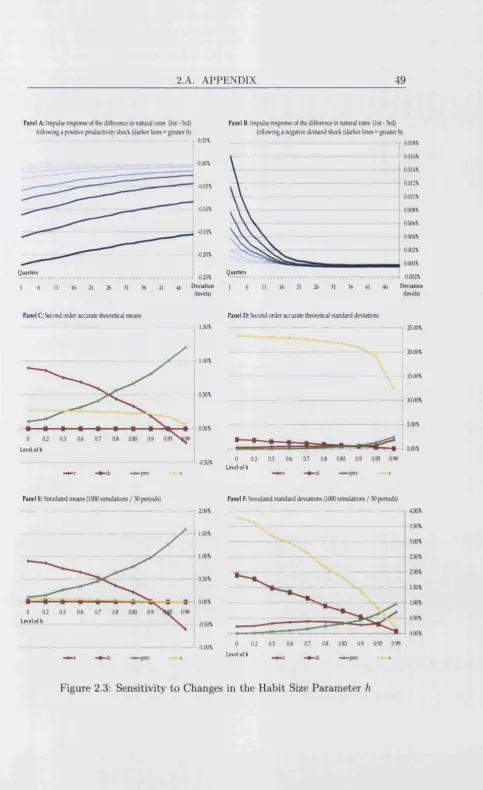
2.1 Natural Rate of Interest Following a Positive Productivity Shock 41 2.2 Natural Rate of Interest Following a Negative Preference Shock 42 2.3 Sensitivity to Changes in the Habit Size Parameter h ... 49
2.4 Sensitivity to Changes in the Habit Persistence Parameter 0 . . 50
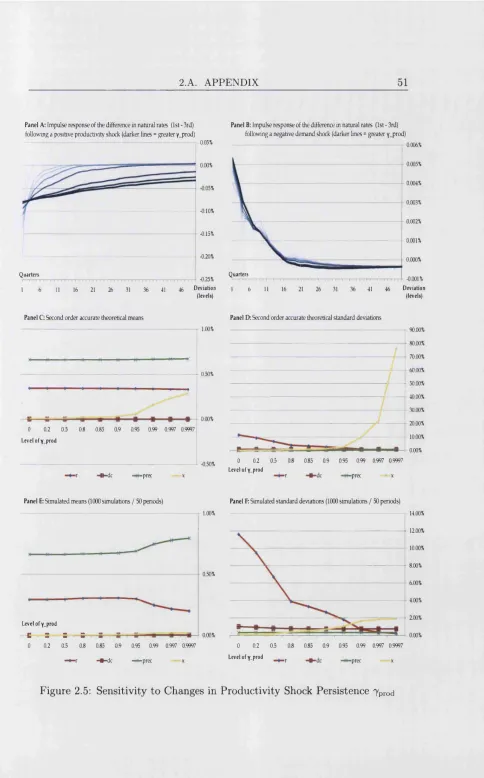
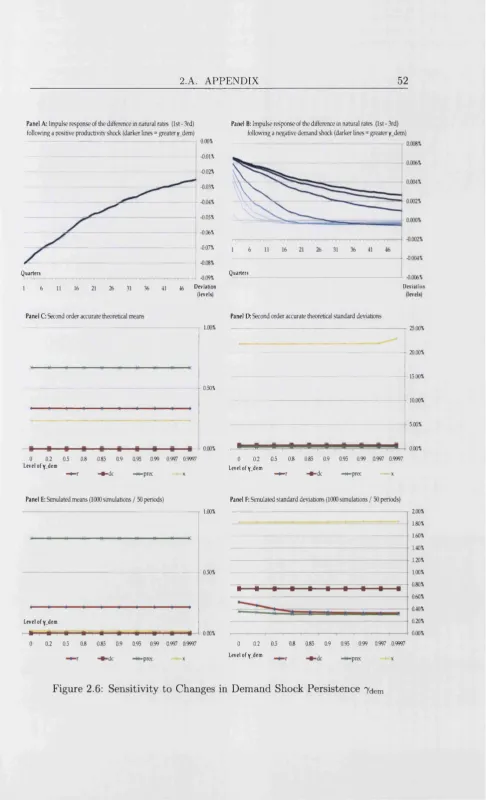
2.5 Sensitivity to Changes in Productivity Shock Persistence 7pr0d • 51 2.6 Sensitivity to Changes in Demand Shock Persistence 7dem . . . 52
2.7 Sensitivity to Changes in the Coefficient of Risk Aversion p . . . 53
2.8 Sensitivity to Changes in Productivity Shock Variance <jprod . . 54
2.9 Sensitivity to Changes in Demand Shock Variance Odem... 55
3.1 US Annual Consumption Growth Series... 74
3.2 US Annual Consumption Growth Series... 75
3.3 Overview of Annual R esid u a ls... 76
3.4 Overview of Quarterly Residuals... 78
3.5 Overview of Distributions Analyzed ( I ) ... 79
3.6 Overview of Distributions Analyzed (II) ... 80
3.7 One Step Ahead UK Consumption Growth Forecasts (I) . . . . 87
3.8 One Step Ahead UK Consumption Growth Forecasts (II) . . . . 87
3.9 One Step Ahead UK Consumption Growth Forecasts (III) . . . 87
3.10 One Step Ahead US Consumption Growth Forecasts ( I ) ... 8 8 3.11 One Step Ahead US Consumption Growth Forecasts (II) . . . . 8 8 3.12 One Step Ahead US Consumption Growth Forecasts (III) . . . . 8 8 3.13 Actual vs Model Implied UK Bond Returns (I) 114
3.14 Actual vs Model Implied UK Equity Returns ( I ) ... 114
3.15 Model Implied UK Risk Premia ( I ) ... 114
3.16 Actual vs Model Implied UK Bond Returns ( I I ) ... 115
3.18 Model Implied UK Risk Premia ( I I ) ... 115
3.19 Actual vs Model Implied US Bond Returns ( I ) ... 116
3.20 Actual vs Model Implied US Equity Returns ( I ) ... 116
3.21 Model Implied US Equity Risk Premia ( I ) ... 116
3.22 Actual vs Model Implied US Bond Returns ( I I ) ... 117
3.23 Actual vs Model Implied US Equity Returns (I I )... 117
3.24 Model Implied US Equity Risk Premia ( I I ) ... 117
3.25 UK Cons. Growth and Equity Returns: Triangular Shocks . . . 118
3.26 UK Cons. Growth and Equity Returns: Irwin Hall (3) Shocks . 118 3.27 UK Cons. Growth and Equity Returns: Irwin Hall (5) Shocks . 118 3.28 UK Cons. Growth and Equity Returns: Gamma 2 Shocks . . . 119
3.29 UK Cons. Growth and Equity Returns: Gamma 5 Shocks . . . 119
3.30 UK Cons. Growth and Equity Returns: Gamma 10 Shocks . . . 119
3.31 UK Cons. Growth and Equity Returns: Gaussian Shocks . . . . 120
3.32 US Cons. Growth and Equity Returns: Triangular Shocks . . . 120
3.33 US Cons. Growth and Equity Returns: Irwin Hall (3) Shocks . . 120
3.34 US Cons. Growth and Equity Returns: Irwin Hall (5) Shocks . . 121
3.35 US Cons. Growth and Equity Returns: Gamma 5 Shocks . . . . 121
3.36 US Cons. Growth and Equity Returns: Gamma 10 Shocks . . . 1 2 1 3.37 US Cons. Growth and Equity Returns: Normal S h o c k s ... 1 2 2 4.1 Pol. Functions Derived Using Perturbation: Habit Model . . . . 139
4.2 Pol. Functions Derived Using the Implicit Approach: Habit Model 140 4.3 Perturbation vs Implicit Approach Approximations: Habit Model 141 4.4 Pol. Functions Derived Using Perturbation: Abel’s Mode l . . . . 151
4.5 Pol. Functions Derived Using the Implicit Approach: Abel’s Modell51
2 .1 Parameter Values Used in the Quantitative A nalysis... 56 2.2 Policy Exercise Parameters... 56
3.1 Overview of Distributions U s e d ... 81
3.2 Overview of Final Parameter Estimates - US Data S e t 83
3.3 Overview of Final Parameter Estimates - UK Data S e t ... 83
3.4 Estimated Model Properties - by D istrib u tio n ... 85
3.5 Means and Standard Deviations of Simulated and Historical Data 109
3.6 Autocorrelations of Simulated and Historical Data (I) 110
3.7 Autocorrelations of Simulated and Historical Data ( I I ) ... I l l
3.8 Cross-Correlations of Simulated and Historical Data ( I ) ... 112
This thesis is a collection of four essays dealing with issues on the verge of
macroeconomics and finance. The first two chapters are joint with Bianca De
Paoli. In the first one, we try to analyze factors causing risk premia to vary
over time. The second one is an attempt to understand how these factors
-manifesting themselves through swings in the desire to save for precautionary
reasons - affect monetary policy.
Both of these essays rely on approximate solutions to a simple, external habit
model. In the third chapter, I derive closed form formulae for the model’s
solution. I then use these formulae to estimate the model and analyze its ability
to jointly fit consumption growth and asset price data. In general, however,
closed form formulae for asset prices cannot be derived analytically and need to
be approximated. The final chapter proposes a method of doing exactly that
and applies it to five popular models.
In the remainder of the introduction I discuss each of the four contributions in
a bit more detail.
W h y do risk prem ia vary over tim e? A th eo ret
ical in vestigation under habit form ation
In this essay we study the dynamics of risk premia in a model with external habit
formation and highlight the significance of ’recession predictability’. While un
der the specification of Campbell and Cochrane (1999) the equity risk premium
is countercyclical because increases in risk aversion are reinforced by rising reces
sion risks - this need not be the case more generally. We show analytically that in
endowment economies, procyclical recession expectations can ’outweigh’ coun
behavior. However, allowing shocks or habits to be sufficiently persistent, or ex
plicitly accounting for the impact of habits on consumption suffices to generate
countercyclical recession risks and risk premia.
C yclical R isk A version , P recau tion ary Saving and
M on etary P o licy
This chapter analyzes the conduct of monetary policy in an environment in
which cyclical swings in risk appetite affect households’ propensity to save. It
uses a New-Keynesian model featuring external habit formation to show that
taking note of precautionary saving motives justifies an accommodative policy
bias in the face of persistent, adverse disturbances. Equally, policy should be
more restrictive - i.e. ‘lean against the wind’ - following positive shocks. Since
the size of these ‘risk-adjustments’ is increasing in the degree of macroeconomic
volatility, ignoring this channel could lead to larger policy errors in turbulent
periods.
A sset P rices U n d er P ersisten t H ab its and A rbi
trary Shocks to C on su m p tion G row th
The third essay derives closed-form solutions for the equity price-dividend ra
tio and equity risk-premium in a model in which agents have difference-form
external habits. The setup allows for arbitrary shock distributions, correlated
consumption growth and persistent extensions of the keeping-up and
catching-up with the Joneses specifications. We use the exact solutions to study the
ability of alternative estimated models including one capturing rare events
-to simultaneously account for consumption, equity and bond returns in the UK
and US. We find no specification capable of simultaneously matching these data
A p p roxim atin g Solutions o f A sset P ricin g M o d
els: T h e Im plicit Function A pproach
The final chapter proposes a new method of approximating solutions of asset
pricing models. It shows how such models can be restricted and solved exactly
and how these exact formulae can be used to approximate solutions of the orig
inal, unrestricted problems. It also demonstrates how approximation errors can
be assessed. In contrast to several alternative approaches, the approximating
function is not restricted to be a polynomial in state variables. This flexibility
and efficient use of nested solutions can allow ‘low-order’ formulae to exceed the
accuracy of higher-order perturbation approximations. The approach is illus
W h y do risk prem ia vary over
tim e? A th eoretical in vestigation
under habit form ation
1.1
In trod u ction
Existing empirical evidence suggests that risk premia vary countercyclically over
time (Harvey (1989) and Li (2001) focus on equities; Campbell and Shiller (1991)
and Cochrane and Piazessi (2005) present evidence for the term premium; Lustig
and Verdelhan (2007) document strong countercyclicality in the exchange rate
risk premium). The two most seminal, representative-agent models proposed
in this context seem to rely on very different mechanisms of accounting for the
empirical regularities. In Campbell and Cochrane (1999), risk aversion fluctu
ates countercyclically as agents’ consumption moves relative to a reference habit
level. In Bansal and Yaron (2004), shifts in premia are driven by predictable
components in consumption as well as time-varying volatility. In this paper we
focus on the habit mechanism and show that it also heavily relies on cyclical
variation in underlying state variables. In particular, it depends on the fact that
recession risks change predictably over the cycle. 1
While Campbell and Cochrane (2000) have also stressed the role of predictabil
ity in the context of consumption based asset pricing models, the quantitative
importance of the recession risk channel has not been studied extensively.2 The
likely reason is that under the original specification of Campbell and Cochrane
(1999), slow-moving habits ensure that recession expectations vary countercycli
cally. Accordingly, the ‘recession risk’ channel reinforces the ‘risk-aversion’ chan
nel and amplifies countercyclical variation in risk premia. Our first contribution
is to document that under simpler, but commonly used habit specifications, this
need not be the case. In particular, we show that in a model with non-persistent
habits and trend-stationary consumption - recession risks vary procyclically,
offsetting the impact of countercyclical risk-aversion and generating procycli
cal premia. We also demonstrate how increasing the degree of persistence in
consumption and habits can overturn this result.
The benchmark endowment-economy framework we adopt is that of Lucas’
(1978) and Mehra and Prescott’s (1985) asset pricing model. While the par
simony of our setup keeps the analysis tractable and enables us to prove most
results analytically, the danger is that misspecifying the process for consumption
might invalidate the conclusions. To address this point, we verify our findings un
der a wide range of specifications - including the standard ‘finance’ assumption
of i.i.d. consumption growth, persistent consumption growth dynamics (Carroll
et al., 2008) and allowing for alternative trend specifications (Den Haan, 1995).
The finding that increasing shock and habit persistence changes the cyclical
properties of ‘recession risks’ and is more likely to make risk-premia vary coun
tercyclically survives irrespective of the exact set of underlying assumptions.
Since a slowly time-varying, countercyclical risk premium is key for matching
asset pricing data (Campbell and Cochrane, 1999, p. 207) any model with pro
cyclical recession risks might fail along the asset pricing dimension. This finding
could potentially have important implications for dynamic macroeconomic mod
els which rely on non-persistent habit specifications (Christiano et al., 2005;
Smets and Wouters, 2007; Uhlig, 2007) and which are increasingly frequently
used to address asset pricing questions (Jermann, 1998; De Paoli et al., 2007;
Hordahl et al., 2008; Rudebusch and Swanson, 2008).3 In the remainder of this
paper we thus try to clarify risk-premium implications of habit formation in
production-economy models.
2Collard et al. (2006) examine the implications of consumption predictability in an internal
habit model where risk aversion is, by construction, constant. Thus, implicitly, the variation in equity risk premia in their model is driven entirely by changing recession risks.
An important complication which arises in non-endowment economy models is
that habits - in addition to affecting the degree of fluctuations in risk aversion
and recession risks - also have an endogenous impact on the dynamics of con
sumption (in particular, they have a well documented role in helping to generate
hump-shaped consumption impulse responses; see also Fuhrer (2000); Christiano
et al. (2005); Smets and Wouters (2007)). To avoid obfuscating these different
channels, we start by proving results analytically in an endowment economy
setup under the assumption of ‘hump-shaped’ consumption dynamics (proxy for
the general equilibrium impact of habits). We then verify these results numer
ically in a fully specified dynamic general equilibrium model. In summary, our
second contribution is to show that allowing habits to endogenously feed back on
consumption is likely to make recession risks vary countercyclically regardless
of the degree of persistence in the habit process. This suggests a potentially
important role for habit formation in helping to match risk-premium dynamics
in production-economy models.
Several existing contributions explore issues related to those we analyze. Li
(2007) documents that premia in the framework of Campbell and Cochrane
(1999) are not robustly countercyclical - a point similar to the one we make,
though in a different setup. Den Haan (1995) considers a related set of driving
processes for consumption, but focuses on their implications for the slope of the
yield curve. In addition, there are many papers showing how habits in the utility
help match empirical properties of anything from yield curve dynamics (Wachter,
2006) to exchange rate risk premia (Verdelhan, 2009), though we are unaware of
any which explicitly investigate the implications of time-varying recession-risks
in a general equilibrium context.
In the remainder, we set up the model, present the analytical results and discuss
the underlying intuition, before summarizing and concluding.
1.2
M od el and N o ta tio n
Our analysis proceeds in the simplest possible setup - that of Lucas’ (1978) asset
pricing model augmented by allowing for external habits.4 Agents, indexed by
t € [0,1] choose consumption C \, investment in riskless bonds B\ and investment
in risky assets S\ to maximize expected lifetime utility
m a x E
1 ~ P )
Ci + V / B i + V [S i = B U + S('_i {V[ + A ) (1.2)
where X t denotes the external habit, Vt is the time t price of a one-period
bond, paying a unit of the consumption-good next period and Vtr is the price
of a perfectly divisible risky asset entitling its owner to the stream of dividends
Dt+ij Dt+ 2 • • -5
The way in which habits X t are defined has important implications for the
dynamics of asset prices and risk premia. We choose not to adopt the non
linear specification of Campbell and Cochrane (1999) because the latter hasn’t
been used in any larger, production economy DSGE models, isn’t particularly
tractable or tightly parameterized6 and finally - in contrast to simpler, linear
specifications - the rationale for referring to X t as ‘habits’ is not immediately
clear.
Instead, our approach is to posit that habits are an average of past levels of
aggregate consumption Ct, with a single parameter (f> G [0,1] controlling persis
tence
X t : = ( l - 0 ) C U + 0 X t_i. (1.3)
By deliberately keeping the setup simple, our results can shed light on the relar
tive importance of various channels driving the results in Campbell and Cochrane
(1999) who use an equation like (1.3) as a foundation of their model. Further
more, when (f> = 0 the specification simplifies to one in which habits are purely a
function of last period’s aggregate consumption, which has been frequently used
in the macro literature. Finally, despite the simplicity, the implied coefficient
5 There are a few reasons why we choose the external rather than internal habit specifi cation. As noted in Campbell and Cochrane (1999), external habits simplify the analysis by eliminating terms in marginal utility by which extra consumption today raises habits tomor row. Crucially, even though marginal utility under the two specifications differs, what matters for asset prices is the ratio of marginal utilities. As the NBER working paper version of the Campbell and Cochrane article suggests - under linear habits, similar to those we consider - the ratios behave very much alike. Accordingly, we chose to focus on the more tractable, external habit setup.
of risk aversion varies countercyclically, and so we retain crucial features of the
successful nonlinear specification. 7
The standard first order conditions with respect to asset holdings are
R{+1 ■ E( M U i = 1 E, M j+1 R \+l =1
(1.4)
where the stochastic discount factor AtJ, the marginal utihty of consumption k \
and gross returns on bonds H ( and risky assets R rt are given by8
M l +1 :=0 ■ ^ A!m :=(Ct+l - h X t+1) - p
. _ 1 p r _ ^ + l + A + l
'~v{
^ +
1
VtT
'
We then let excess consumption C \ and the surplus ratio S t be defined as
CZ: = Ct - h X t S t := Ct ~ HXt = g . (1.5)
Ct
ct
As in Campbell and Cochrane (1999) (p.2 2 0), we shall refer to periods with low
values of the surplus consumption ratio as ‘recessions’ and the term F,t l/S t+ i
(or
St
Efl/S't+i) will be used to characterize the ‘fear of recessions’ channel.9The textbook definition of the equity risk premium rpt is
rpt := Et (log (R[+i)) - log (flj+ i) = Etr(r+1 - r/+1 (1.6)
where lower-case letters denote logs. Notably, our measure of the risk premium
corresponds to a generic asset held for one period. Thus, since neither the
length of that period nor the asset payoffs have been specified, the subsequent
7The parsimony of our setup comes at a cost. For example, to ensure that habits never exceed consumption and so utility remains well-defined we would need restrictions on the support of shocks driving consumption growth. While such conditions are derived in the third chapter, in the remainder we ignore the problem and proceed under the assumption of normality. Furthermore, unlike Campbell and Cochrane (1999), we have no means of using precautionary saving motives to exactly offset the intratemporal substitution effect implying that our risk-free rate is going to be volatile. Given that the stated goal of this paper is analyzing premium cyclicality rather than exactly matching asset price dynamics, we consider the implied detriment in fit a small price to pay for tractability.
8For analytical tractability, we shall restrict attention to a symmetric equilibrium, i.e. we
assume that individual consumption C l as well as marginal utility AJ and M \ - the stochastic
discount factor - equal their respective aggregate equivalents C t, A* and M
exposition applies to premia on any risky asset.
Finally, we can define the coefficient of relative risk aversion as10
U j p u X t) v(C u X t) := —Ct
Uc(Cu X t)
where Uy(-,-) denotes the partial derivative of utility function [/(•, •) with respect
to y. Since this coefficient measures agents’ willingness to enter pure consump
tion gambles, given habits fixed at reference level X t , this can be referred to as
consumption risk aversion. It is easy to show that if the utility function and ex ternal habits are as in equations (1.1) - (1.3) then the coefficient of consumption
risk aversion is countercyclical. 11
1.3
R esu lts
To analyze the determinants of risk premium dynamics in the model, we can
derive a second order approximation to the first order conditions. This approx
imation implies
rpt + - v a r t rrt+1 « pcovt (cet+ urrt+1). (1.7)
Jensen’s inequality term aside, the risk premium is proportional to excess con
sumption relative risk aversion p and the conditional covariance of returns rt+i
with excess consumption ct+ v Following Li (2001), and under the assumptions
discussed therein (see Appendix A for a brief discussion), we can apply Stein’s
lemma and express covt (cf+l,r l+1) as
covt (cet+1,r rt+1) = covt(ct+ u rrt+l) E*— . (1.8)
&t+1
Mechanically, equation (1.8) demonstrates that agents’ expectations about re
cessions matter because they affect the covariance of excess consumption and
returns. Combined with equation (1.7) this shows that if covt (ct+\ , r rt+l) is time
invariant, then only changes in these expectations are going to affect risk pre
10 As noted in Campbell et al. (1997) ” risk aversion may also be measured by the normalized
curvature of the value function [...] or by the volatility of the stochastic discount factor [...] While these measures of risk aversion are different from each other in this model, they all move inversely with S t ”
11Even though risk aversion % and recession risks, as summarized by E t l / S t+ i, are both
mium cyclicality. 12
Crucially, equation (1.8) can further be rewritten as
1 S
rpt + - v a r t rrt+1 « Tjt covt(ct+i,rrt+1) ( L9 )
which demonstrates that the risk premium is determined by the coefficient of
risk aversion rjt, the covariance of consumption and returns as well as the ‘fear
or recessions’ variable E t ( l / S t+ i) /( I /S t) - which determines whether agents ex
pect their living conditions to improve or deteriorate next period. Since the
coefficient of relative risk aversion rjt is countercyclical and the covariance term
approximately constant therefore the only factor with the potential to distort
the cyclicality of rpt is the recession expectation term.
In the remainder of this paper we shall therefore study how assumptions made
about consumption and habits affect the cyclicality of E tS t/St+ i. In the first
subsection we shall implicitly ignore the fact that habits have the potential
to endogenously affect the dynamics of consumption. In the second part we
explicitly try and account for such feedbacks and investigate the impact of hump
shaped consumption responses on the cyclicality of recession expectations (in an
endowment and production economy).
1.3.1
N o E n d o g en o u s Feedback o f H a b its on C on su m p
tio n
In this section we investigate factors driving risk premium cyclicality under dif
ferent specifications for the endowment process. Following Den Haan (1995), we
examine the case in which consumption is stationary around a linear trend and
one in which it is growth-rate stationary (the case of i.i.d. consumption growth is
nested by both of these specifications). We shall show that if consumption is not
sufficiently persistent then habits need to adjust slowly, as otherwise procyclical
changes in recession expectations E tS t/ S t+i could more than offset the impact
of countercyclical risk aversion leading to procyclical risk premium dynamics.
T ren d -S tation ary C on su m p tion P ro cess
P ro p o sitio n 1. If the conditional variance of returns vart (rt+i) and their
conditional covariance with consumption covt(r[+1, c*+i) are constant and
log-consumption follows
q = «o + K\t + 7Q _ i + Et et ~ i i . d . ( 0 , a 2), 7 G [0 ,1 ] (1 -1 0 )
then the derivative of the risk premium rpt with respect to the current shock
realization can be expressed as13,14
« E tSrf^C & hO - ~ *)
s = 0
.□
(1.11)The proof of this and all subsequent propositions can be found in Appendix A.
Since, in general, the sign of the risk premium is ambiguous, in order to build
some intuition we now focus on two popular nested specifications - one in which
habits fully adjust in a single period and another in which log-consumption is a
random walk.
C orollary 1. Under the assumptions of Proposition 1, if habits only depend
on past periods’ consumption ((f> = 0) then the premium is procyclical
=
EtS ^ C ^ \h { \
- 7) > 0.D (1.12)Under the assumptions of Corollary 1, following an adverse shock, recession
risks abate and agents expect future conditions to improve (given the AR (1)
nature of the endowment process, consumption is expected to increase while
habits will unambiguously fall). Since habits adjust fully in a single period,
excess consumption, which is all agents care about, is expected to increase fol
lowing the negative shock. Thus, even more risk averse agents will require lower
compensation for bearing risk and consequently risk premia fall.
13In the absence of output in our simple model, we use consumption as a measure of cycli cal stance. Hence if variables positively co-move with consumption - as measured by their
derivative with respect to shocks to consumption growth et - we say they are procyclical.
On the face of it, the fact that the risk premium is procyclical if <f> — 0 could be important as that assumption is frequently used in macro-models. As demon
strated in the following subsections, however, this conclusion does not survive
extensions to production economies - where the internal propagation mechanism
starts playing a role - or alternative assumptions about consumption dynamics.
C orollary 2. Under the assumptions of Proposition 1 if log-consumption
follows a random walk («o = «i = 0,7 = 1) and habits are persistent ((f) > 0) then the risk premium is countercyclical as
=
-E tsr+\cr+\h(
1 < 0.D (1.13)* S=1
Under the assumptions of Corollary 2, shocks to consumption are permanent
and habits adjust gradually. In this setting, after adverse shocks - as expected
excess consumption falls - expectations of future conditions deteriorate (reces
sion risks become larger) leading to an increase in the risk premium. This shows
that a combination of permanent shocks and persistent habits generates coun
tercyclically varying risk premia.
Equation (1.11) generalizes this point and shows that a sufficiently persistent
shock yields countercyclical premium variation. While the effect of increasing
habit persistence (j) might seem less clear cut, evaluating expression (1.1 1) for
plausible parameter values suggests that raising <f) has a similar effect.
G ro w th -S tation ary C o n su m p tio n P ro cess
The final specification we focus on assumes that log consumption growth is an
AR(1) process.
A q = k + S A c t-i 4- et et ~ Af.i.d.(0,cr2), £ e [ 0 , 1]. (1-14)
This formulation is supported by recent empirical evidence on sticky consump
tion growth - see e.g. Carroll et al. (2008).
P ro p o sitio n 2. If the conditional variance of returns var* W +i) and their
sumption follows a stochastic process as in equation (1.14), then
^
= —E(St2+1(l - 0) • J g - • (tf + (1 +
S) <0 D
(L15)
Under this endowment specification, in contrast to the case of autoregressive
detrended consumption (see Corollary 1), risk premia are countercyclical even
under a non-persistent habit specification ( 0 = 0). 15
1.3.2
A llo w in g for E n d o g en o u s F eedback o f H a b its on
C o n su m p tio n
As argued previously, more sophisticated, production-economy general equilib
rium models are likely to introduce a variety of state-dependencies into con
sumption’s law of motion. 16 Importantly, Fuhrer (2000) documented that habits
help generate hump-shaped consumption impulse responses we now inspect the
‘recession risk’ channel under hump-shaped consumption dynamics.
In what follows we show that - relative to the specifications of the previous
subsection - the perceived risk of recession under hump-shaped consumption
dynamics is more likely to be countercyclical, amplifying the countercyclical
risk-aversion channel. So, in a fully general equilibrium setting, habits help
generate countercyclically varying risk-premia not only because they imply a
countercyclical risk aversion, but also because they generate countercyclical ‘re
cession risks’.
To illustrate this point, we first derive analytical results in an endowment econ
omy in which the exogenous law of motion for consumption implies hump-shaped
impulse responses. Arguably, this analysis has a partial equilibrium flavor, as
habit persistence does not map into the shape of the ‘hump’ - which is controlled
by different parameters. Accordingly, we conclude by numerically analyzing risk
premium dynamics in a fully-fledged production economy model. The latter
confirms that endogenous hump-shaped consumption responses are associated
with countercyclical risk premium variation, even for non-persistent habits.
15Note that, irrespective of the consumption specification, cyclicality of premia is defined
as their ‘on-impact’ response to the white-noise disturbance term e.
E n d ow m en t E con om y
To capture the idea that the peak response of consumption is not attained
immediately after the shock hits (i.e. to model ‘hump-shaped’ consumption
responses) we now assume that the detrended endowment follows an ARMA(1,1)
process17
ct =
« 0 + « i £+ jct-i + et + 0et-u
£t ~
A/ ’. t . d. ( 0, <72), 7 G [ 0 , 1]. ( 1 - 1 6 )P r o p o sitio n 3. If the conditional variance of returns var* (rt+i) and their
conditional covariance with consumption covt(r£+1,c*+i) are constant and
log-consumption follows the specification in equation (1.16) then
drpt
det E ts r ^ c r +\ h ( i - 4>)
Ct - ( y + 9)
X > SCU
8 = 0 (1.17)In particular, if habits only depend on past periods’ consumption (</> = 0 ) and
7 -f 9 > 1 then
drpt
det E tS & C & h C t 1 - ( 7 + 6)
<
o .a
(1.18)Equation (1.17) demonstrates that 6 - the parameter controlling the size of the
‘hump’ - can play a similar role to 7 - i.e. consumption persistence. It suggests
that models with hump-shaped consumption responses may be able to generate
countercyclical premia without persistent habits or shocks. In the case of
non-persistent habits, described in equation (1.18), if 7+ # > 1 then the risk premium
is unambiguously countercyclical.
Under this specification log-consumption decreases further in the period after
an adverse shock, following which it converges back to its steady state (i.e.
it bottoms out in period two). That is, after a bad shock agents expect the
future to get worse (i.e. recession risks increase) and therefore require a higher
compensation for bearing risk.
0.40 0.20%
0.15% 0.35
0.10%
0.30
0.05% 0.25
0.00%
0.20
-0.05%
-0.10%
0.10
-0.15%
0.05 -0.20%
-0.25% 0.00
1 1 21 31 41 51 61 71 81 91
Figure 1.1: Response of Consumption (Solid Line, LHS) and the Equity Risk Prem ium (dashed line, RHS) to a P roductivity Shock in the Model of De Paoli et al. (2007)
P rod u ction Econom y
We now scrutinize the dynamics of the equity risk prem ium in a production economy w ith real rigidities. In particular, we use th e model docum ented in De Paoli et al. (2007).18 The setup features non-persistent habit form ation (i.e. /i / 0 b ut (j) = 0) and explicitly models capital and capital adjustm ent costs. W hile the stru ctu ral shocks are AR(1) the m odel’s internal propagation mechanism generates a hum p-shaped response of consum ption to productivity shocks - see also Figure 1.
To com pute the response of the equity risk prem ium to a productivity shock, we used a third-order perturbation approxim ation to the m odel’s policy function.19 Figure 1 confirms th a t in a general equilibrium framework with habit form ation
18We use the flexible price version of the model. The calibration is detailed in Table A, p.40.
19Third order is the lowest which allows for time variation in risk premia. As discussed in Schmitt-Grohe and Uribe (2004) — a first-order approximation would imply that premia are zero at all times, while a second-order approximation would only allow for constant premia.
The approximation was computed using D ynare++ [www.dynare.org] and Perturbation AIM
[image:27.595.26.511.25.805.2]consumption has a sluggish response to the shock, generating countercyclical
recession risks and thus countercyclical risk premia. This suggests that the
findings of Proposition 3 also apply to a production-economy model.
1.4
Sum m ary and C onclusions
We have used the simplest possible framework to analyze the determinants of risk
premium dynamics. We demonstrated that due to changing recession risks, risk
premia can be procyclical even though the volatility of consumption is constant
and despite a countercyclically varying risk aversion coefficient. We have also
documented that persistent habits, shocks or features generating hump shaped
consumption responses are all likely to make the premium countercyclical.
Fundamentally, the countercyclicality of the premium rests on agents’ belief that
changes in economic conditions are persistent. In other words, after an adverse
shock, more risk-averse agents will only require a larger premium on risky assets
if they don’t expect their future conditions to improve massively. Expressed
alternatively, our work explicitly explores the role of countercyclical recession
risks - a feature that is implicit in Campbell and Cochrane (1999), and similar
in spirit to the mechanism driving the results in Bansal and Yaron (2004). Our
results suggest that factors which help match activity data - i.e. allowing for
consumption habits and persistent shocks - axe also likely to help along the asset
pricing dimension.
Changes in premia substantially contribute to asset price volatility and so having
a good understanding of factors driving them is crucial for modeling asset prices.
Given the increasing frequency with which macroeconomic models are being
used to address asset pricing puzzles, it is key to clarify how and why changes
in standard modeling assumptions translate into different dynamics of premia.
While this study attempts to clarify these issues, further analysis of risk premium
dynamics could still be undertaken. For example, in production-economy models
the dynamics of term-premia or the inflation risk premium would depend on
other aspects of the transmission mechanism. We believe that examining these
l .A
A p p en d ix
P ro o f o f P roposition 1
Li (2001) demonstrates that under certain distributional assumptions on c*,r[
and Ct
rPt = ~ v a r t (r[+1) + 6 covt (c*+i, r[+1) + AtS covt (c*+i, r[+1) (1.19)
where Xt = E t (dst+i/dct+i) — E t( l / S t+i) — 1. Repeated use of the definition
of habits equation (1.3) and the endowment specification equation (1.10)
-makes it possible to express S t as
St+i —
+oo 1 - (C7e“0+'“ (t+I>+E,+1) 1 h (l
3= 0
(1.20)
Thus, computing the derivative of the above expression we have
+oo
dXt
dCt = E t - d a = E tS ^ C t-+\ h ( l - 4>) 1 - 7 C f 1 x y c t_
3= 0
which, can be plugged into the chain rule dXt/det = dXt/dCt • dCt/dct • d c t/d e t
to yield
^ « E ts n \ C ; +\ h ( i - <j>)
+CX )
s=0
P roof o f P roposition 2
Denoting gross consumption growth by cf := Ct/ C t~1 and defining x t := X t/C t
equations (1.14) and (1.3) can be written as
4+i = exp(« + Et+ i ) • (cf)5 (1.22)
x t = ((1 - <f>) + 4>xt-1) • (cf_i)_1. (1.23)
Iterating on (1.23) we can express x t as
+oo
*i—
1 n +oos s
n*< = ( i - < t > ) I K ^ - i ) ' 1 } = (1 - X y j I K ^ - j ) _1 [ (L24)
i = l J = 0 s = 0 j = 0 which implies that
St+i = (1 - h x t+1) = ^1 - h( 1 - 0 ) ■ ( 1 2 5 )
Similarly as in the case of a deterministic trend in consumption we can now
compute the derivative
dS<m 9 4
where n l =2afc = 1• Exploiting equation (1.22) we know that
- = - (c?+0 “2^ = s { 4 ^ 4 Y l 0 .2 6 )
= - (4 +i 4 r 2(4 +1 + 4 ^ ) = - ( i + S)i4 +l) - \ 4 ) - 2 (1.27)
and so
d St + 1
3 4
Accordingly
-P roof o f -P roposition 3
Given that
Xt = Et
+00
5=0
- 1
- 1 (1.29)
and treating Xt as a function of two variables A(Ct, Ct+i)
= E tsr+\c r +\h (1 - <e), ~ = - E tsr+\c r +\h ( i - $
£
t s = 0
we can apply the chain rule
dXt _ d>H dC± dct dXt dCt + 1 / dct+i dct+i dct \
det dCt dct det dCt+\ dct+i \ det dct det )
to obtain that
+00
« E ts £ c r +\h (1 - <t>) Ct — (9 + 7) 4>sCt-, s=0
C yclical R isk A version,
P recau tion ary Saving and
M on etary P o licy
2.1
In trod u ction
A lot of modern policy analysis is conducted using linear, or linearized, models.
While these may be able to replicate salient features of macroeconomic dynamics,
there are important areas where their ability to ‘match data’ is less satisfactory.
In particular, all linear models are ‘certainty-equivalent’, which implies that co
efficients of their policy-rules are independent of the level of shock volatility. A
striking consequence of this fact is that, absent ad-hoc adjustments, expected
returns on all assets are identical - i.e. risk-premia are restricted to
counter-factually equal zero. To the extent that asset prices reflect agents’ attitudes
towards risk, using models so badly misspecified along this dimension could re
sult in systematically biased policy recommendations. This paper investigates
the issue in more depth.
Rather than trying to analyze many aspects of uncertainty, we focus on just
one - precautionary savings.1 Given that some studies (Carroll and Samwick,
1998) estimate that in excess of 40% of all wealth accumulation has to do with
precautionary motives, incorporating this channel is likely to be important. At
the same time, focusing on a single aspect of risk makes it easier to establish
traction with standard New-Keynesian models and allows us to derive our results
analytically - retaining some of the linearized framework’s appeal.
Since we are motivated by the benchmark model’s failure to match asset price
data, we extend the setup by allowing for persistent external habits - whose ap
peal in the asset pricing context was demonstrated by Campbell and Cochrane
(1999). At the same time, we retain standard features such as monopolistic com
petition and staggered Calvo (1983) price setting. In our framework, external
habits generate cyclical swings in risk aversion, which translate into fluctuations
in the desire to save for precautionary reasons. Crucially, to give this channel
bite, we consider a nonlinear approximation to the consumption-Euler equation
- explicitly accounting for a state-dependant precautionary saving motive.2
Incorporating cyclical risk aversion has clear implications for the propagation
mechanism of shocks and consequently for the appropriate policy response. Con
sider, for example, the case in which a negative demand disturbance hits the
economy. Increases in risk aversion and the desire to save for precautionary rear
sons would likely magnify its negative impact. Consequently, if policy-makers
ignored these extra ‘precautionary’ effects, then they would under-react to the
shock. By the same token, low risk aversion and reduced desire to accumu
late buffer-stock savings associated with economic booms would strengthen the
case for using policy relatively more aggressively - subsequently referred to as
‘leaning against the wind’.
Our first contribution is to characterize conditions under which models with
habits generate countercyclical variation in the desire to save for precautionary
reasons. We show that a countercyclical coefficient of risk aversion, which is a
standard feature of all habit models, might not be sufficient to generate realistic
dynamics. What is necessary is that the persistence of shocks and habits is
sufficiently high - i.e. agents must expect a fall in living conditions to persist in
order for higher risk aversion to translate into a greater desire to save.3
We then analyze policy implications of such swings in precautionary saving
motives. We derive expressions for the ‘natural’ rate of interest - i.e. the one that
2But, as stressed previously, this is the only deviation from linearity which we consider.
3Arguably, since these conditions closely mirror those for risk premium countercyclicality
would prevail if prices were fully flexible - both in a linear, ‘certainty-equivalent’
setup and in a world in which agents save for precautionary reasons. Since in
our framework the policy of complete price stability mimics the flexible price
allocation (Woodford, 2003), therefore, by describing the implications of buffer
stock savings for the level of the natural rate, we also characterize monetary
policy consistent with price stability. In a habit model, as shown by Amato and
Laubach (2004), such a policy is also close to the social optimum, which is why
we focus on it in the remainder.
We find that properly accounting for swings in risk appetite and the desire
to save reduces the magnitude of monetary policy responses to productivity
shocks. Following a positive productivity shock, central bankers striving to
maintain price stability cut rates to boost demand and prevent falls in the price
level. However, since a persistent positive productivity shock also reduces agents’
desire to save, the cut in rates required to boost demand is smaller - i.e. the
intertemporal substitution effect is partially offset by swings in the precautionary
motive. Conversely, given that a positive demand shock merits interest rate hikes
- and since associated falls in precautionary motives exacerbate the increases
in demand - policy needs to have a ‘contractionary bias’ during booms, and an
accommodative slant during downturns, once changes in precautionary motives
are accounted for.
Our analytical expressions show that the size of the ‘precautionary’ correction
is increasing in the degree of shock volatility. This has two important implicar
tions. First, it stresses the dependence of the policy multiplier on underlying
uncertainty - i.e. once the impact of uncertainty on agents’ behavior is factored
in, the output or consumption implications of a 25bp policy cut could be very
different during a period of ‘great moderation’ than in a financial crisis. Second,
higher volatility translates into greater ‘precautionary’ corrections - meaning
that ignoring the impact of swings in ‘buffer-stock’ motives would tend to lead
to largest systematic policy mistakes in highly turbulent periods.
The remainder of the paper is structured as follows. In the next section we
present the model. We also characterize the linearized system of equilibrium
conditions and the corresponding natural rate of interest. In Section 3, we in
corporate the precautionary savings channel and analyze its implications for the
natural rate of interest and thus monetary policy. We then use simulations to
illustrate our results and inspect their robustness before concluding by summar
2.2
M od el
Our model economy is inhabited by a continuum of consumer-producers living
on the unit interval (and indexed by j G [0,1]). Agents are assumed to maximize
expected utility, which is given by
UJ = E f / r ‘ ( _ S f o t t r 1) (2<1)
{ l ~ p * + 1 J
where C3t denotes agent j’s consumption, X t is the level of habits and is a
preference shock. The second term in the large bracket captures the disutility
of producing yt(j) units of the differentiated output good given productivity
denoted by £yit.4
We define the coefficient of relative risk aversion as5
'«■*•>
(22>
where surplus consumption
St
is given bySt ■■=
(2.3)
and Uy(',') denotes the partial derivative of utility function [/(•, •) with respect to
y. Since this coefficient measures agents’ willingness to enter pure consumption
gambles, given habits equal to X t , it can be referred to as consumption risk
aversion. It is easy to show that is countercyclical, when - as in
Campbell and Cochrane (1999) -
St
is used as a measure of cyclical stance.We assume that habits X t are ‘external’ - i.e. individual agents treat them as
exogenous. We adopt a slow-moving habit specification under which
x t = ( l - (f>)ct- 1 + (j)xt- 1 (2.4)
4Given the Calvo price setting specification that we subsequently adopt, households’ pro duction income could be different depending on the type of good produced. In the remainder, as in Woodford (2003), we assume that there exist competitive financial markets in which these risks are efficiently shared.
where
(j>
controls the persistence of the habit process and small letters denote logs. We further assume that both preference and productivity shocks are autoregressive processes given by
£d,t
+ 1 —')dem^d,t
“b^d,t
+ 1Ey,t
+ 1 —rfjyrod£y, t
“I-^y,t
+ 1with £xj = log(^X)t) and the disturbances ex>t+i being mean zero i.i.d. random
variables with variance given by i G {d, y}.
Aggregate consumption and price indices,
Ct
andPt,
are defined asCt =
_ i ° r j
/ Ct{zy~^ dz Pt = f p ( z ) 1
Jo J IJo dz
where a > 0 is the elasticity of substitution between the differentiated varieties.
Conditional on the specification above, we can characterize agents’ intratemporal
and intertemporal decisions. Optimality implies, respectively
y t U ) = ( m y \ t
1 = R tE t ,£ d ,t+ i(C rf+ i —
hXt+i) p
Zd,t(Ct-hXt)-p
Alternatively, we could rewrite the consumption Euler equation as
1 = RtEtXit+i
where the stochastic discount factor M t+1 is defined as
ka
— a €d,t+i(Ct+i — hXt+i)~p
Alt+i = (J
(2.5)
(2.6)
(2.7)
U t i P t - h X t )
-p
(2.8)Prices axe assumed to follow a partial adjustment rule a la Calvo (1983). Produc
ers of differentiated goods know the form of their individual demand functions,
given by (2.5), and maximize profits taking aggregate demand Yt and price level
Pt as given. In each period, a fraction a G [0,1) of randomly chosen producers is
not allowed to change the nominal price of their output. The remaining fraction
of firms, given by (1 — a), chooses prices optimally by maximizing the expected
his price at time t can be shown to satisfy
+00
T = t
y t A J )
( a p y ~ T ( ( 7 - 1 ) = 0 (2.9)
where yt,r(j) is producer j ’s time t estimate of demand for his good at time T,
should he be unable to reset his price Pt(j) before period T. It can be proved
that equation (2.9) implies that the price index evolves according to
(Pt)1-" = aP£7
+ (1 -a) (pt)
— \1—a (2.10)where we exploit the fact that all producers who reset prices at time t equate
them to pt. Thus, using the market clearing condition Ct = Yt) we can summarize
the log-linearized system of equilibrium conditions by6
' rt = E t(p (1 - h)-1 (Aym - h A x t+i) - Asd,t+i)
< 7rt = k («0 (1 - h)~l yt - p (1 - h)~l hxt - r)£y,t - £d,t) + PEtTrt+i
k x t = (1 - (j>)yt-\ + <t>xt- \.
Prom the system above we can derive the equilibrium interest rate consistent
with price stability (i.e. 7rt = log(Pt+i/P t) = 0 for every t) in a linear world
r* = KiEt(Aeyt+i - (1 - h)A £d,t+i - hAx*+1) (2.11)
where x* is the flexible-price level of habits and where
«o = ( 1 — h)r] + p and = p pn Q l .
Note that r* is also the equilibrium interest rate that would prevail if prices were
perfectly flexible.
Expression (2.11) shows that the interest rate consistent with full price stability
falls [rises] following a positive supply [demand] shock - with the magnitude of
the response, on impact, given by [(1 — h)«i].