Enlivening analysis through performance: ‘Practising set
theory’
D e b o r a h M a w e r
This is a sister article to one that appeared in this journal in 1999, which established benefits in coupling instrumental study and voice-leading analysis, primarily for performers but also for analysts. That analytical students too were more receptive to study when connected with their instrument was the cue for the present article; performance has much to offer the teaching/learning of non-tonal analytical techniques founded on the basic tenets of set theory. This article details an experimental curriculum, ‘Practising set theory’, tested at Lancaster University across 2001–2, in comparison with more traditional methods employed across 1995–2002, and in relation to the new ‘Music benchmark statement’ (2002). Beyond the specifics, it is hoped this research may interest other practitioners seeking alternative pedagogical approaches to parts of the Music curriculum perceived as difficult or especially demanding.
I n t r o d u c t i o n
We have come a long way from the days when it was assumed that analysis had all the answers (e.g. Berry, 1989) and that these should be imparted to grateful performers through a one-way street of knowledge flow. The truth is that analysts have at least as much to gain through the practice of performance, and that performance is as cap-able of setting an agenda for analysis as vice versa. Indeed, performers are analysts in the sense that they too are involved in an aesthetic, experiential interpretation of the music. It is also true that, whilst the new Music benchmarking statement (March 2002; www.qaa.ac.uk/crntwork/benchmark/phase2/music.pdf) rightly extols the virtues of synthesising ‘academic’ and performing disciplines, students may not fully explore the interplay unless we encourage them to do so through imaginative curriculum design. Even in a UK university setting, a pigeonhole mentality exists that sometimes makes it difficult for students to apply insights learnt in one part of a course within another. Beyond this setting, it is hoped that some of the ideas raised here may enjoy a wider resonance, both at secondary school/college level and overseas. Certainly, the earlier and more widely that ‘academic’/performance interplay is explored, the greater the long-term benefits, with potentially higher levels of learning outcomes.
Although distinctive ‘joint’ courses, such as those pioneered between the Royal Northern College of Music and Manchester University or between King’s College London and the Royal Academy of Music, continue to thrive in a logistically circumscribed way, the idea of interdisciplinarity is now also being pursued rather more successfully within individual institutions. The reasons for this increased synthesis within conservatoires and universities no doubt relate at some level to the instigation of the UK Research Assessment Exercise, and, more arguably, to a parallel raising of the status of teaching and learning practices.
The desirability of ‘academic’/performance synthesis is also well reflected in the new UK Music benchmarks; these benchmarks, now in place for most subject disciplines, seek to establish minimum standards of expected attainment and subject knowledge/skill coverage across wide-ranging curricula offered at institutions of higher education (HE). Thus, such benchmarks go some way towards the equivalent of a National Curriculum for UK higher education, whilst still enabling greater curricular scope and diversity than exists presently at primary or secondary school level.
In its discussion of teaching, learning and assessment, the Music benchmark statement acknowledges that ‘the study of music at HE level [and other levels] is intrinsically multi-disciplinary’ (Programme design: 5.1.1). One may consider, for instance, the second bullet point on performance skills (4.1.2), which foregrounds ‘powers of interpretation: the ability to find creative links between the results of personal research, textual and musical analysis, scholarship, reflection and listening skills, and the process of performing’.
Under general skills, it is refreshing to see reference to ‘enhanced powers of imagination/creativity’, highlighting ‘curiosity and the desire to explore’ and ‘openness to new, personal, different or alternative thinking’. (Analytically speaking, the need to encourage ‘creative thought’ was part of the motivation behind the previous ‘Voice-leading for Strings’ project – a motivation shared by a previous analytical contributor to this journal (Howell, 1996: 124–5).) The most relevant portions of the benchmarks (Standards 6.2) are found under ‘Knowledge and understanding (intellectual skills)’, where even at a basic threshold level, honours Music students should be able ‘to show an understanding of the relationship between theory and practice in music’, and under ‘Practical skills and musicianship’, where students should ‘demonstrate a measure of personal expression, imagination and creativity in practical music-making. . .and the ability to communicate through music employing appropriate technical and interpretative means’.
It is equally important that we should practise what we preach by exploring alternative, imaginative and creative teaching/learning methods. In fact, the possibility of employing ‘practical exercises’ (though not defined in detail) is mentioned in the section on teaching and learning methods (5.3.2), ‘usually connected with the development of creative, analytical and aural skills’. Clearly, the establishing of a strong ideological foundation within the Music benchmarking does not in itself endorse the specific proposal connecting set-theoretic analysis and performance, which must stand or fall on its own merits. Nonetheless, the seriousness with which musical interrelationships are pursued in the benchmarks provides a context that usefully reflects recent UK practice (including the earlier ‘Voice-leading for Strings’ initiative).
intellectually fascinating and fun (Mawer, 1992: 8). This criterion of fun is especially crucial (and tested) when devising teaching/learning methods for non-tonal analysis in the shape of set theory. This concern to increase the accessibility of music analysis is also one shared in the pages of this journal by Tim Howell (Howell, 1996: 124–5). Beyond analysis, the connection between student interest and motivation has been well made in an Australian instrumental teaching context by James Renwick and Gary McPherson: ‘Motivational research in academic subjects has demonstrated that when students are interested in an activity. . .they are more likely to engage in higher-level cognitive functioning, find it easier to concentrate, persevere, and enjoy their learning’ (Renwick & McPherson, 2002: 173). The fact that we, as researchers, do not always consider this dimension sufficiently is also articulated in this same source: ‘research on motivational aspects of musical learning has largely bypassed interest and intrinsic motivation’. (For more on this topic, including the importance of enjoyment and also self-esteem, see Hallam, 2001: 66–7.)
What of the context for ‘Practising set theory’ in terms of broader music educational research? The idea of learning about music through a holistic and balanced approach which acknowledges its multifaceted nature has been well established in Keith Swanwick’s extensive UK research; perhaps most influential has been Swanwick’s theoretical/philosophical model, CLASP (Composition; Literature Studies; Audition; Skill acquisition; Performance), eloquently propounded some 20 years ago (Swanwick, 1979). More recently, American educational research that has influenced ‘Practising set theory’ has been articulated in Music Matters (Elliott, 1995); this is not to take on board David Elliott’s ideas wholesale, which would probably lose the music theory en route. To Elliott, music is primarily about acts and experiences of physical doing: ‘musicing’, or music-making, as opposed essentially to Bennett Reimer’s more traditional aesthetic concept of music education (Reimer, 1970), which arguably advocates a more passive appreciation of a canon of masterworks. (For more on this whole debate, see Plummeridge, 1999 and Finney, 2002.) Whilst Elliott’s philosophy is founded essentially on pre-tertiary education (though written for tertiary-level students and practising teachers), there is no reason to believe that it stops being relevant at this point. Most students and practitioners favour ‘active learning’ at any stage: witness the title of the new journal of the Institute of Learning and Teaching:Active Learning in Higher Education.
T h e p o t e n t i a l b e n e fi t s o f t e a c h i n g a n a l y s i s ( p a r t i a l l y ) t h r o u g h p e r f o r m a n c e
It has been argued that, in addition to the essentials of technique, instrumental teaching must also be about the holistic development of musicianship (Wright, 1998); similarly, beyond its technical essentials, analytical teaching should also concern itself with musicianship. The use of performance in teaching analysis, or other academic material, can be immensely valuable for various reasons. It ensures that students are not just passive onlookers at products; they are actively engaged in the analytical processes being explored. As Elliott notes: ‘A student’s involvement in making develops his or her ability to shift concentration back and forth between the process of making. . .and the outcome of his efforts’ (Elliott, 1995: 173). Implicit is that the sheer variety of activities and pacing plays a significant role in stimulating learning. Peer pressure is also a healthy influence: if students are likely to be asked to contribute to the class both on their instruments and verbally, they cannot afford to switch off and leave the doing to someone else. Thus performance encourages responsibility for part of the learning process: ‘To give attention to how things are done. . .is to modify one’s viewpoint and understanding. Students so informed expand their sense of responsibility and the locus of their energy’ (ibid.).
Of course, this view rather takes for granted that the thing being done isworth doing: the crucial components here are value and creativity. To get started, a student must have an initial conviction about the value, relevance and applicability of a curriculum topic – the ‘why’ as well as the ‘what’ and ‘how’. For study to be sustained, there must be creative space left open for the student analyst-cum-performer to explore and question; mutual trust is needed to foster greater student responsibility and involvement. The more this enquiry stimulates imagination and enjoyment, the more likely it is to surmount the inevitable hurdles and doubts. At the heart of this creativity is music as physical sound in time – to be felt, heard and responded to. For musical performance in conjunction with analysis, this ‘feeling’ of the music can take on powerful proprioceptive qualities: in other words, there can be a strong correspondence between perceptions of musical structure and the physical movements (of instrument, fingering, breathing, etc.) involved in the phenomenology of music – the ‘translating’ of such structures into sound.
Beyond the more obvious benefits of teaching analysis at least partially through performance are those which relate to peer learning (see Hunter, 1999); when analytical ideas are performed in a class setting, engaging students in supportive critique and formative assessment follows on very naturally.
W h y t h e ( c o n t i n u i n g ) n e e d f o r n o n - t o n a l a n a l y s i s , e s p e c i a l l y s e t t h e o r y ?
be directed by issues of contingent history, sociology, culture, gender issues, psychology, semiotics, aesthetics, and so on.
Whilst celebrating this diversification and interdisciplinarity and being aware that pitch should not automatically be privileged above other parameters (especially in a twentieth-century context), we should not lose sight of detailed pitch-orientated analyses. There is presently a backlash against more formalist approaches – which, sensitively and purposefully employed, still have an important role to play – and a danger of moving to the other extreme where students lack the technical armoury to pay close attention to the score. This concern connects with secondary/college-level musical study: within a ‘new look’ Advanced-level (18+ examination) curriculum that admirably embraces breadth, it is probably impossible not to lose something by way of technical depth. Nevertheless, when twentieth-century repertory is being studied in the classroom or in instrumental lessons, there remains a need for real probing of the music.
Arguably, the two most important pitch-orientated methods developed in the twentieth century were voice-leading analysis for tonal/post-tonal music (see Mawer, 1999) and set theory for atonal and other non-tonal musics, pioneered in what has become its definitive form by Allen Forte (Forte, 1973, 1988). Set theory especially has sometimes suffered from a bad press and, on occasions, deservedly so. Its application must move with the times to enjoy a wider popularity, and this means maintaining and developing its musical relevance, rather than focusing on its abstracted systematic/mathematical basis. (There are parallels with the application of voice-leading, where it may or may not be useful for students to explore the original metaphysical philosophies that directed Heinrich Schenker’s thinking (Schenker, 1979).) We do not need to be over-purist about this; set theory may often profitably be combined with other analytical/interpretative approaches.
Indeed, one reason for my favouring the broad term ‘non-tonal’ over the narrower ‘atonal’ is to point up the fact that voice-leading and set-theoretic (pedagogical) approaches may enjoy a fruitful meeting point in many modal repertoires. In other words, there is significant common ground between my original ‘Voice-leading for Strings’ project and the present ‘sister’ project. (From a set-theoretic stance, Allen Forte is explicit in his later development of his 1973 theory that, in devising a modern harmonic species, he seeks to mediate between divorced tonal and atonal terms of reference (Forte, 1988).) Practically and analytically, it makes sense for students at various levels and in various learning environments to expand their tonal thinking to embrace both modal and atonal constructs.
A p p r o a c h e s t o t e a c h i n g n o n - t o n a l a n a l y s i s
this basis, the most important development has been that of pitch-class set ‘genera’ (Forte, 1988), as a more intuitive and convincing way of establishing large-scale family groupings of connected sets, which has largely superseded the more difficult, mathematically abstracted, notion of Kh complexes originally advocated by Forte.
Material for teaching set theory includes Forte’s text of 1973, although this is much more a manifesto than a manual, and has never been user-friendly, not least because it emanates from a period in American music theory which sought to maximise the scientific dimension of music in a way that feels particularly alien to today’s students. An early approach to teaching set theory which aimed ‘to induce an enjoyable understanding of atonal music, for listening, composing, or performing’ wasBasic Atonal Theory (Rahn, 1980), though this text has dated and is still too mathematically involved for its musical aims. More recent texts include those by Robert Morris (1987, 1991) and Joseph Straus (1990a), and, from a British perspective, Early Twentieth-Century Music in the series Models of Musical Analysis (Dunsby, 1993) and A Guide to Musical Analysis (Cook, 1994). Mention should also be made of an attractively light-hearted introduction to set theory by Peter Castine (1994) which incorporates aptly surreal quotations from Lewis Carroll!
Perhaps one of the most imaginative texts, which still enjoys a faithful student following, is Analytic Approaches to Twentieth-Century Music (Lester, 1989). The strengths of Joel Lester’s book lie in the wealth of real music examples he imports, the existence of analytical and compositional exercises, and most importantly the context that he provides for set theory which acknowledges rhythm, metre, texture and timbre. To do this book justice, however, demands substantially more time for a twentieth-century course than is usually available; furthermore, the book was published too early to embrace Forte’s useful formulation of pitch-class set genera of 1988.
Apart from these standard texts, set-theoretic teaching/learning aids now prove highly suitable to dissemination via the Internet, not least because of the increasing number of so-called set theory ‘calculators’ used to assist with the purely mechanical aspects of pitch-class set identification and comparison (often by means of a keyboard), which may be downloaded for both PC and Macintosh platforms. One particularly noteworthy web site which offers a comprehensive introduction to set theory is theMusic Theory and Analysis site, designed and maintained in the United States by the influential teacher and composer-cum-theorist Larry Solomon (2003): http://music.theory.home.att.net/theory.htm. This site encompasses a lucid and accessible set-theoretic primer, a glossary of terms, a listing of pitch-class sets, a ‘calculator’, and Solomon’s updatedMusic Analysis System (1984, rev. 2002). It also offers other relevant software, bibliographies, links to related web sites and sample analyses. (For larger-scale analyses using varying amounts of set theory, see also van den Toorn, 1983; Straus, 1990b; and Mawer, 1997.)
E v o l u t i o n o f c u r r i c u l u m d e s i g n f o r ‘ P r a c t i s i n g s e t t h e o r y ’
Fig. 1 Evolution of curriculum/project design, 1995–2002
succinct, user-friendly and engaging introduction to Fortean set theory which would work for UK students within a short-course format, since study time at Lancaster University, as elsewhere, is limited by all the other elements vying for timetable space. ‘Practising set theory’ was arrived at through an evolutionary process between 1995 and 2002, with curriculum designs 1–3, as shown in Figure 1 above. Student numbers varied both from one academic session to another and between learning stages 1 (foundational level) and 2 (specialist level).
Curriculum design 1 aimed to provide the required introduction through standard course delivery: intensive interactive lectures and workshops across five weeks, using the original Kh complex version of set theory (see ‘Approaches’ above), and taught from 1995 to 1999. Although student course data were collected for each session, in the interests of manageability only data from the final year prior to design change are referred to here (Group A/learning stage 1, 1998–9).
Design 2 delivered the same course objectives using the genera-based version of set theory (for more detail, see the section ‘Curriculum content’ below), and was taught from 2000 to 2002. The decision to opt for genera in the longer term was partly informed by the responses of the trial Group A, then at learning stage 2 (1999–2000), who had the benefit of experiencing both versions: thus useful comparative data could be obtained from Group A1/2. From this cohort (on 24/25 questionnaire returns), some 40 per cent (10 students) favoured the change to a genera basis alone; a further 24 per cent (6) advocated teaching both methods; 16 per cent (4) wanted to preserve the status quo; whilst another 16 per cent (4) remained undecided. (Two additional sets of student course data were provided by Groups B and C, both at learning stage 1.)
C u r r i c u l u m c o n t e n t : e x e r c i s e s a n d m u s i c a l e x p l o r a t i o n s
‘Practising set theory’ works through a series of ‘lessons’, each of which contains three or so specific exercises designed to develop the set-theoretical basis through practical class activity, supported by private study; the substantive content is summarised at the end. The circumscribed exercises, to be played and improvised around, are supported by excerpts of real music which exemplify a particular technique and are to be performed on various instruments.
The musical theory ‘grows’ from small to large scale as the student progresses: lesson 1 is concerned with thinking and hearing in 12 semitones, thus rethinking a decade of focusing on seven-note scales! Students experiment with creating small chromatic sets, or cells, of pitches. At the other end, lesson 8 arrives at the large-scale panorama provided by ‘genera’ – different sonic families comprising a number of related sets; these ‘types’ may be characterised as: wholetone, diminished, augmented, chromatic, atonal/tonal hybrid, diatonic, and so on (see Forte, 1988). Students seem to like this approach, one (from Group B/2, 2001–2) commenting that ‘the set theory course is cleverly taught as it slowly builds up to the full picture, and doesn’t overwhelm you at the start’.
En route, students will have learnt to observe and hear properties of particular sets, such as those with symmetrical pitch patterns (e.g. the pentatonic construct: C, D, F, G), or those which have common pitches when transposed (e.g. another pentatonic construct: C, F, B; F, B, E). They will also have identified and measured the extent of motivic difference between slightly modified pitch patterns with the same number of notes (e.g. C, C#, D, E, expanded to C, C#, D, E), and will have perceived connections between sets of different sizes (e.g. C, C#, E, as a subset of C, C#, E, E, F#, G), both at pitch and in various transpositions.
In order to give a flavour of the content, it is useful to present selected examples from lessons 1, 2 and 8 in a little more detail. The initial exercise of lesson 1 asks students to start thinking in 12 semitones by practising chromatic scales – both played and sung – and by ensuring that they can orientate themselves by means of labelled pitch classes (pcs) from 0 to 11 (C–B), as illustrated in Figure 2. Students then explore interval classes (ics), also working from the nearest C pitch, as a logical point of reference. In this way, by making use of intervallic inversions and enharmonic equivalence, there is only a need for six interval classes, as demonstrated in Figure 3.
Fig. 2 Labelling of pitch classes (pcs)
Fig. 3 Labelling of interval classes (ics)
Fig. 4 Pc set 3–1; brief improvisation sample
using set 3–1, as in the unmeasured sample markedMysteriously in Figure 4, and then to improvise circumscribed phrases of their own. Variety can be achieved even with such limited means by rearranging the pitch ordering, selecting different registers, repetitions and ornamentations, e.g. trills, grace-notes; experimentation is encouraged through trying out varied metric/rhythmic identities and contrasting styles, or characters (e.g. a student suggestion of ‘Dark and mystical’).1
Excerpts from the openings of the third and fourth of Andr´e Jolivet’s delightfully imaginative and intricate Cinq incantations [Five Incantations] (1936) for solo flute are then incorporated (Figure 5), to illustrate chromatic 3–1 (and expanded 5–1) cells in real musical settings. These chromatic cells appear in what may be viewed as an untransposed format, commencing on C, and also in transposition upon other scalic degrees. Although originally intended for flute, the excerpt was tested out more freely within the pilot scheme on various treble-clef melody instruments, including violin: see ‘Implementation’ below.
Transpositions and reorderings are reinforced in a final exercise, with the 3–1 cell moved from C, C#, D (arguably its prime-form (P0)) onto other scalic degrees: up five semitones (t5), and up seven semitones (t7). Again, students are urged to find improvisational possibilities, albeit still with restricted elements, as suggested by the accentuated 5/8 sample marked Spritely in Figure 6. The clarinet might be particularly well suited to articulating this little fragment. The selecting of suitable modal/atonal styles and characterisations, such as those used by Bart ´ok or Stravinsky, is also helpful here (e.g. a student suggestion of ‘Solemn and lugubrious’!).
[image:9.493.66.424.174.239.2]Fig. 5 Andr´e Jolivet,Cinq incantations [Five Incantations]: (a) No. 3 ‘That the harvest should be rich’ (opening); (b) No. 4 ‘For a serene communion’ (bars 1–4), annotated score
Fig. 6 Pc set 3–1 with transposition; brief improvisation sample
Fig. 7 B´ela Bart ´ok,Mikrokosmos, VI: ‘From the diary of a fly’ (bars 1–5; annotated short score)
[image:10.493.70.428.68.266.2] [image:10.493.72.434.320.374.2] [image:10.493.70.431.425.521.2]Fig. 8 Improvisation sample for complementary sets 4–1/8–1
Fig. 9 B´ela Bart ´ok, String Quartet No. 3:Prima parte (bars 1–6; annotated short score)
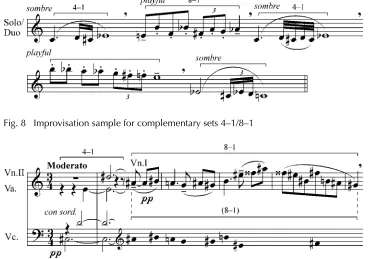
comprises two intervals of a semitone, e.g. C–C# and C#–D, and one interval of a tone, e.g. C–D; the other entries within the vector are simply zeros because the cell contains no minor or major thirds, and no perfect or augmented fourths. Whilst the interval vector offers a useful shorthand, and it is possible to ‘play out’ the full intervallic contents of a given set, the idea is musically quite distanced and limited. Of greater potential (and applicability within the pilot scheme) is another Fortean concept introduced here: the possibility of one set being balanced by its polar opposite, e.g. sets 4–1 and 8–1, which together create a fully chromatic whole. The supporting exercise asks students to compose a short piece that contrasts/complements 4–1 and its opposite partner, 8–1, keeping the actual pitches mutually exclusive at first too: C, C#, D, Eand E, F, F#, G, A, A, B, B. A dialogue between two alternating ‘voices’ (sombre: legato, low register, and playful: staccato, upper register) is suggested in Figure 8; on the pilot scheme this was especially well illustrated by viola. Once more the supporting musical example (Figure 9) makes reference to Bart ´ok, this time the opening of the String Quartet No. 3 (1927):Prima parte, which contrasts a muted chord C#, D, D#, E (set 4–1) on second violin, viola and cello against the first violin’s melodic line, comprising pitches E#, F#, G, G#, A, A#, B, B# (set 8–1). (This is in fact the ‘set work’ for the location used to test out the project; see again below.)
[image:11.493.61.419.69.180.2] [image:11.493.56.424.73.332.2]Fig. 10 A selection of Forte’s pc set genera
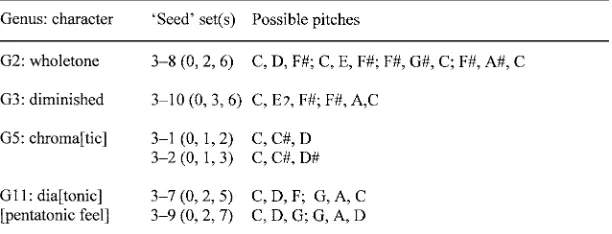
spawn a larger group of connected sets, rather like triads for tonality (see Forte, 1988). Students explore a selection of genera, as shown in Figure 10, accepting that a particular piece may make use of just one genus or, more commonly, several different genera – some appearing much more distinctly than others. Again, improvisation is encouraged by creating brief pieces founded on, for instance: the wholetone pitch collections of Genus 2 (on C and C#, e.g. ‘Dream-like’ on piano); the diminished seventh frameworks of the diminished Genus 3 (on C, C#, and D, e.g. ‘Thoughtful’ on piano); modal contrast between the chromatic Genus 5 and the pentatonic type Genus 11 (e.g. ‘Evil/Dreamy’ as an improvised piano duo, which created much class amusement within the trials!). This coupling and contrasting of Genera 5 and 11 is highly germane to Bart ´ok’s String Quartet No. 3, as the focal point of the pilot scheme course.
Once students are familiar with the idea of genera, they may well want to experiment with devising and playing their own contextually derived set groupings, along the lines of Richard Parks’s valuable work on Debussy (Parks, 1989), rather than keeping with Forte’s universal, abstracted system. Whilst acknowledging the reservations of some on the value of methodological analysis in the undergraduate curriculum (see Howell, 1996: 126–7), my response is that, having had a basic, clear introduction to set theory, broadly along Fortean lines, students are more likely to be in an informed and confident position to make adaptations and, in time, find their own routes.
I m p l e m e n t a t i o n o f ‘ P r a c t i s i n g s e t t h e o r y ’ : p i l o t s c h e m e ( 2 0 0 1 – 2 )
[image:12.493.69.375.70.187.2]turn, the package had at least an indirect impact upon the students’ group presentations and subsequent individual, assessed assignments.
F i n d i n g s
The informal findings were measured by various sets of questionnaires (taking heed of advice in Cohen & Manion on the ‘self-completion questionnaire’ (1994: 92–105)), verbal discussion, and recordings of class sessions. Final individual assessment levels were also analysed as an additional indicator of the outcomes of the experiment. Given that the specialist Group B/2 student cohort was relatively small – 15, as against 25 and 35 for some of the other groups (see again Figure 1) – special consideration was afforded to qualitative responses in addition to basic quantitative results. Indeed, in view of the specific study aim to enliven and popularise a mathematical, computer-related analysis through creative performance participation, acknowledgement of the human factor, especially individual student voices, was more than usually important. (For detailed investigation of the qualitative angle and valuing of personal voices, see studies such as Schratz (1993), and more recently Walford (2001) and Schostak (2002), which include dealing with compromise, problematics, subject and object.)
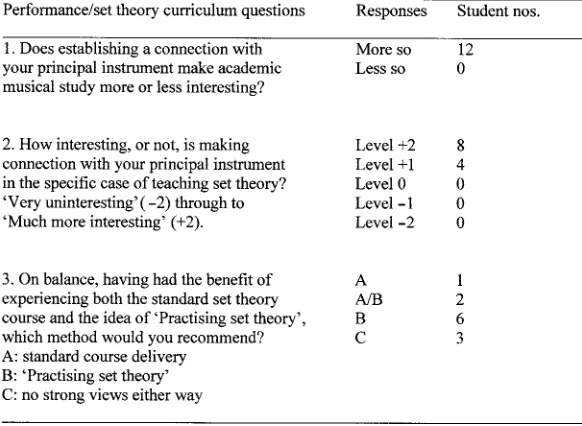
In answer to the first general question on the Performance/Set Theory Curriculum Questionnaire given out in the final session of the course, the 2001–02 Group B/2 respondents (12/15 questionnaire returns) were unanimous that instrumental connection made academic study more interesting (see Figure 11). Reasons discussed included the following: instrumental connection enabled two students to loosen their ‘classical’ bonds
[image:13.493.60.351.364.577.2]and explore less well-known twentieth-century music; for a keen singer, theory brought an added dimension, whereas theory without practice would not have held much interest; for another two students, it helped in understanding how things worked – in experimenting on instruments it became apparent how easy or hard an idea was; and for a further four students, this form of study made the content more relevant, realistic and personal. Another student expressed honestly that they were more inclined to remember and learn from what they had played. Perhaps the ultimate reason expressed was that: ‘You can feel and be a part of what you study’. This response nicely matched the educational rationale: seeking to promote motivation through participation, as active learning. ‘Feel’ suggests physical experience but also, crucially, emotional investment; equally, it relates to the proprioceptive synthesis discussed earlier.
In response to the second, more specifically directed, question about how interesting, or not, making connection with one’s instrument was in the case of set theory, again all students considered that this made study more interesting. (Some two-thirds of Group B/2 claimed that this enabled the study to be ‘much more interesting’, selecting the highest rating on the questionnaire.) The personal student-perceived advantages were as follows:
r
‘much more fun; more relevant; greater interaction with the issues andtwentieth-century styles; makes a hard subject more approachable’;
r
‘much less static than a “normal” lecture’;r
‘puts emphasis [through genera] on hearing distinct sonorities (e.g. pentatonic,chromatic), making it easier to understand’;
r
‘makes you more familiar with the notes of sets, telling them apart by character andrealising their potential’;
r
‘allows exploration of other skills (e.g. improvisation), together with sounds andrepertoire not always used in [instrumental] lessons’;
r
‘gets players away from the idea of perfection; allows people just to play, experimentand illustrate academic points’;
r
‘involves the whole class; can help to build confidence when everyone has to do it;conversely, you experience it for yourself’;
r
‘can only be an advantage because things can get repetitive when we’re just writingstuff down all the time’.
Two particularly insightful respondents commented that this teaching method afforded an ‘opportunity tofeel the dissonance rather than just to hear it’ and that ‘it helped me absorb the theory by actually playing it (even more than just listening would)’. Again, these responses endorsed the roles of physicality and the experiential within the learning process. In the interests of balance, the disadvantages of such teaching through performance were also identified:
r
‘takes more time to cover the same amount of theory, but will probably remainan interesting topic [long-term investment view]; course length would need to be increased, with more seminars’;
r
‘works better with smaller numbers as everyone then gets a turn and no one can “hider
‘confidence can be an issue for a nervous player, especially improvising in front ofthe group [but see also advantages above]; some students might decline to play’ [interestingly, this was not in fact an issue in practice];
r
‘some challenging rhythms to overcome in musical excerpts’;r
‘repertoire needs to be adapted for transposing instruments’.When responding to this question, five students felt the need to make clear that they saw no major disadvantages.
Where question 3 was concerned, half of the students favoured adopting the ‘Practising set theory’ model as a new ‘way in’ (B), a minority remained predictably undecided (C), whilst a couple saw merit in combining the standard genera course (design 2) with the practical version (A/B), particularly endorsing ‘Practising set theory’ as a means of revision (‘a refresher course’). Essentially, this ‘third way’ replicated the distinctive learning experience of this student group, although it was not actually catered for in my ‘either/or’ framing of the question since my own stance had been to view this as a transitional phase. I suppose this simply reinforces the familiar dictum that ‘we like what we know’.
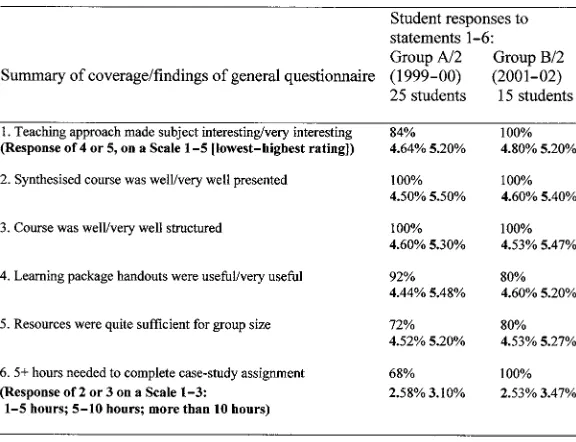
Fig. 12 Comparative responses to general questionnaire: Groups A/2 (1999–2000) and B/2 (2001–02)
[image:15.493.60.348.273.494.2]scale 1–5) is in fact constant across the groups at 20 per cent. The perception of high levels of presentation remains constant at 100 per cent (Statement 2), but ‘Practising set theory’ may have impacted on the highest rating (down from 60 per cent to 50 per cent) since lecturer control is reduced with more spontaneous, less predictable classes(!) Responses to Statement 3, on course structuring, are again essentially constant and endorse the structure employed. The reason for a declining response regarding the usefulness of learning package handouts (Statement 4), with the highest rating down significantly from one academic session to the next, is unclear. It may well be, however, that a larger class inevitably puts a high value on handouts, whereas the increased personal interaction possible in a smaller class setting renders handout support less important. Nonetheless, the 2001– 02 cohort clearly felt satisfied with the general level of resourcing (Statement 5), which was in fact increased from 1999–2000 as a direct corollary of ‘Practising set theory’. Finally, the perceived amount of student input necessary to complete the assignment increased significantly from cohort A/2 to B/2; this probably relates both to the higher levels of interest expressed (Statement 1) and to higher levels of achievement (recorded in Figure 13).
Further to the tabulated data in Figure 12, some student comments were relevant specifically to the set-theoretic dimension. For 2001–02 (B/2) returns, in response to ‘What were the two best aspects of this course?’, two students itemised ‘playing set theory’, whilst another two identified ‘the practical side, [which] encouraged confidence’. Such confidence- and esteem-building through focusing consistently on the positives of student endeavour are crucial to motivation and subsequent curricular success. (For more on these connections, see again Hallam, 2001: 67.) Conversely, just to show that it is not possible to win everyone over, in response to ‘What were the two worst aspects of this course?’, one student apologised for specifying ‘set-theoretic analysis’! On the other hand, that same respondent (together with at least one other) freely admitted that they had gained a ‘new way of looking at music’. Other identified gains from the course as a whole included a ‘wider knowledge of complementation and set theory’ (on the part of two students) and ‘further understanding of how set theory can be applied to different composers’. Given the perceptions of difficulty surrounding analysis in general and set theory in particular, it was gratifying that one student considered the course ‘very enjoyable’, whilst another felt it was ‘lots of fun, [and] seems more real’.
good-humoured. These students did genuinely seem to enjoy learning through doing: the fun element had come into play, with spontaneous student banter that did not threaten the underlying sense of purpose and commitment.
Lastly, in Figure 13, we may make assessment comparisons between Group A/2 (genera; no performance) and Group B/2 (genera; with performance) that reveal the achievement level for the individual, written assignments of the second group to be dramatically higher than for the first. Minority representation at third-class for Group A is replaced by a similar representation at first-class for Group B; furthermore, the main ‘clumping’ of student achievement moves up a whole degree classification across the two cohorts, from 60 per cent at 2/2 to 67 per cent at 2/1.
Fig. 13 Final tutor assessments for Groups A/2 and B/2 (1999–2002)
Clearly, in order to know whether this rise is wholly, or at least partially, attributable to a different learning means, we need to examine the extraneous variables (as discussed in Cohen & Manion, 1994: 170–2). Although internal levels of maturation were comparable and the teaching staff were unchanged, it is possible that, as an external variable, Group B was of a generally higher ability than Group A; however, analysis of the overall degree results of these two cohorts does not strongly support this: 58 per cent of Group B achieved a final 2/1 degree classification as against 50 per cent of Group A. As already mentioned, a second, internal variable was that of class size, with Group A/2 comprising 25 students and Group B/2 only 15 students, and it is likely that the higher staff–student ratio for Group B/2 had some impact upon the higher levels of achievement. A further factor to be borne in mind is that in some instances set theory might only account for part of the final assessment, since additional analytical means could be included at the students’ choice. Whilst not downplaying these complicating factors, they do not in themselves account convincingly for the full extent of the difference in assessment levels, a significant element of which has, therefore, to be attributable to the alternative learning means.
C o n c l u s i o n
[image:17.493.58.353.204.312.2]curricula – at HE and other levels – between what are perceived as ‘academic’ components, especially analytical ones, and performance in the broadest sense: private practising, playing, improvising, ensemble work, and listening. The student response is quite consistent that, even at a third-year level of university study where only about half were performance specialists (though all were of post-Grade 8 standard), foregrounding performance is a powerful way of maximising student involvement – and, on current results, also achievement – within a demanding academic curriculum. Such synthesis is also one way of encouraging closer contact and fruitful interaction between academic lecturers and instrumental teaching staff.
It is striking to note the consistency of student approach in favouring a focus upon instrumental learning, whether as a means or an end, across quite diverse educational contexts and maturation levels: the reactions of the Lancaster University music students were remarkably similar in measuring ‘task value’ to those found in recent instrumental research, where a high task value governed involvement in further creative activities (McPherson & McCormick, 1999), and where ‘Doing well on my instrument is important to me’ and, ultimately, ‘Playing my instrument is my favourite activity’ (McPherson & McCormick, 2000).
If we return to the Music benchmark statement, there is still an implicit sense that, whilst performers definitely need to assimilate appropriate academic knowledge and understanding, the opposite does not necessarily follow to the same extent. Obviously not all musicians set out to be performers, but we may still be downplaying the degree to which the act of physical doing, of playing things out (whether or not as a performance specialist), is a useful means to an analytical, or indeed historical, end. Certainly, there is much scope for development if students’ experiences at Lancaster University are typical: ‘It’s good to connect academic study with practical performance as it’s something that no other course really encourages, apart from composition.’ Playing devil’s advocate though, one might argue that part of the attraction to the students who practised set theory was indeed the novelty of the means and that if performance were widely used as a tool in academic lecture settings, part of the allure might be lost. On this one, only time will tell.
Whatever the outcomes of that particular argument, as a result of consistently positive questionnaires, productive class discussions and improved assessments, it is now intended to continue ‘Practising set theory’ as a third-year revision aid and also to embed these practical principles within the second-year music techniques course where set theory is first introduced (i.e. Group D/1), from 2002–03. Finally, beyond its specifics, it is hoped that the idea of ‘Practising set theory’ may serve as a possible model to other practitioners looking for a way to popularise and provide an alternative ‘take’ on a subject area typically perceived by students as ‘difficult’ and in need of enlivening.
A c k n o w l e d g e m e n t s
N o t e
1. Audio examples of the teaching materials and the students’ improvisations will be included on the nextBJME CD.
R e f e r e n c e s
BABBITT, M. (1955) ‘Some aspects of twelve-tone composition’.The Score,12, 53–61.
BABBITT, M. (1961) ‘Set structure as a compositional determinant’.Journal of Music Theory,5, 1, 72–94. BERRY, W. (1989)Musical Structure and Performance. New Haven, CT: Yale University Press.
BURNARD, P. (2000) ‘How children ascribe meaning to improvisation and composition: rethinking pedagogy in music education’.Music Education Research,2, 1, 7–23.
CASTINE, P. (1994)Set Theory Objects: Abstractions for Computer-Aided Analysis and Composition of Serial and Atonal Music. European University Studies: Series 36 Musicology, vol. 121. Frankfurt am Main: Peter Lang.
COHEN, L. & MANION, L. (1994)Research Methods in Education. London & New York: Routledge. COOK, N. J. (1994)A Guide to Musical Analysis. Oxford: Oxford University Press.
DUNSBY, J. (Ed.) (1993) Early Twentieth-Century Music. Models of Musical Analysis. Oxford: Basil Blackwell.
ELLIOTT, D. J. (1995)Music Matters: A New Philosophy of Music Education. New York & Oxford: Oxford University Press.
FINNEY, J. (2002) ‘Music education as aesthetic education: a rethink’.British Journal of Music Education,
19, 2, 119–34.
FORTE, A. (1973)The Structure of Atonal Music. New Haven, CT: Yale University Press.
FORTE, A. (1978)The Harmonic Organization of the ‘Rite of Spring’. New Haven, CT: Yale University Press. FORTE, A. (1988) ‘Pitch-class set genera and the origin of modern harmonic species’.Journal of Music
Theory,32, 2, 187–270.
HALLAM, S. (2001) ‘Learning in music: complexity and diversity’, in C. Philpott & C. Plummeridge (Eds), Issues in Music Teaching, pp. 61–75. London & New York: Routledge/Falmer.
HOWELL, T. (1996) ‘Musical analysis: back to basics’.British Journal of Music Education,13, 2, 123–34. HUNTER. D. (1999) ‘Developing peer-learning programmes in music: group presentations and peer
assessment’.British Journal of Music Education,16, 1, 51–63.
LESTER, J. (1989)Analytic Approaches to Twentieth-Century Music. New York: Norton.
MAWER, D. (1992) “‘Composing out” the principles of music analysis across the wider musical community’. Society for Music Analysis Newsletter,1, 8–12.
MAWER, D. (1997)Darius Milhaud: Modality and Structure in Music of the 1920s. Aldershot: Ashgate. MAWER, D. (1999) ‘Bridging the divide: embedding voice-leading analysis in string pedagogy and
performance’.British Journal of Music Education,16, 2, 179–95.
MCPHERSON, G. E. & MCCORMICK, J. (1999) ‘Motivational and self-regulated learning components of musical practice’.Bulletin for the Council for Research in Music Education,141, 98–102.
MCPHERSON, G. E. & MCCORMICK, J. (2000) ‘The contribution of motivational factors to instrumental performance in a music examination’.Research Studies in Music Education,15, 31–9.
MORRIS, R. D. (1987)Composition with Pitch-Classes. New Haven, CT: Yale University Press. MORRIS, R. D. (1991)Class Notes for Atonal Music Theory. Hanover, NH: Frog Peak Music. PARKS, R. (1989)The Music of Claude Debussy. New Haven, CT: Yale University Press.
PERLE, G. (1968)Serial Composition and Atonality. Berkeley & Los Angeles, CA: University of California Press.
RAHN, J. (1980)Basic Atonal Theory. New York & London: Longman.
REIMER, B. (1970)A Philosophy of Music Education. Englewood Cliffs, NJ: Prentice Hall.
RENWICK, J. M. & MCPHERSON, G. E. (2002) ‘Interest and choice: student-selected repertoire and its effect on practising behaviour’.British Journal of Music Education,19, 2, 173–88.
SCHENKER, H. (1979)Free Composition (Der freie Satz). New York: Longman Inc.
SCHOSTAK, J. F. (2002)Understanding, Designing and Conducting Qualitative Research in Education: Framing the Project. Buckingham & Philadelphia, PA: Open University Press.
SCHRATZ, M. (Ed.) (1993)Qualitative Voices in Educational Research. Social Research and Educational Studies Series: 9. London & Washington, DC: The Falmer Press.
STRAUS, J. N. (1990a)Introduction to Post-Tonal Theory. Englewood Cliffs, NJ: Prentice Hall.
STRAUS, J. N. (1990b)Remaking the Past: Musical Modernism and the Influence of the Tonal Tradition. Cambridge, MA: Harvard University Press.
SWANWICK, K. (1979)A Basis for Music Education. Windsor: NFER–Nelson.
SWANWICK, K. & FRANCA, C. C. (1999) ‘Composing, performing and audience-listening as indicators of musical understanding’.British Journal of Music Education,16, 1, 5–19.
WALFORD, G. (2001)Doing Qualitative Educational Research: A Personal Guide to the Research Process. London & New York: Continuum.
WRIGHT, R. (1998) ‘A holistic approach to music education’.British Journal of Music Education,15, 1, 71–81.
VAN DEN TOORN, P. C. (1983)The Music of Igor Stravinsky. New Haven, CT: Yale University Press.
Software references
SOLOMON, L. (1984, rev. 2002)Music Analysis System (MAS). Downloadable freeware program for Windows or DOS.

![Fig. 5Andr´e Jolivet, Cinq incantations [Five Incantations]: (a) No. 3 ‘That the harvestshould be rich’ (opening); (b) No](https://thumb-us.123doks.com/thumbv2/123dok_us/7995669.760215/10.493.70.431.425.521/fig-andr-jolivet-cinq-incantations-incantations-harvestshould-opening.webp)