Four Stage Encryption Generalizations: Partitioned
Output Cryptosystem
Sangapu Venkata Appaji
Assistant Professor
Department of Information Technology, Gokaraju Ranga raju Institute of Engineering and
Technology, Hyderabad, India
Gomatam V S Acharyulu,
Ph.D.Professor
Department of Computer Science and Engineering Geethanjali College of Engineering and
Technology, Hyderabad, India
ABSTRACT
The Four Stage Encryption System introduced by Acharyulu and Appaji provides secrecy even when the attacker has some samples of plain texts and their corresponding cipher texts obtained with the same key, because the cipher text generated each time, for the same plain text with the same key, is different. In other words, the system is secure against adaptive chosen-plain text attack. Another interesting feature is that even the size of the cipher text, for given plain text under a given key, is unpredictable. In this paper the four stage encryption system is generalized as Generated Partitioned Output Crypto System and some variations that can be taken up are suggested. A pure mathematical system called Partitioned Output Crypto System is introduced as a further step of generalization in order to study the properties of the system. A correlation with the existing systems is taken up as a part of the study of the properties. It‟s observed that the system shares the properties of multifunction.
General Terms
Cryptography, Cryptanalysis, Security.
Keywords
Block Ciphers, Cryptosystems, Ciphers, Multi-functions, Partitions.
1.
INTRODUCTION
A cryptosystem [5], [4] is a quintet (M, C, K, e, d), where [5], [4]
1.P is a finite set, called message space (plain texts).
2.C is a finite set, called cryptotext space (cyptotexts).
3.K is a finite set, called key space.
4.e is a function, e : K M C, whose domain K M is the set of all order pairs (k, m) where k and m are elements of K and M respectively.
5.d is a function, d : K C M, whose domain K C is the set of all ordered pairs (k, c) where k and c are elements of K and C respectively, such that d(k, e(k, m)) = m for any m in P. It is sometimes convenient to write the dependence on k as subscript. Then for each k in K, we get a pair of functions ek : M C and dk : C M such that dk(ek(m)) = m for all m in M.
In order for (M, C, K, e, d) to be a successful cipher, it must have the following properties:
1.For any key k in K, and plain text m in M, it must be easy to compute the cipher text ek(m).
2.For any key k in K, and cipher text c in C, it must be easy to compute dk (c).
3.Given one or more cipher texts, c1, c2, …, cn in C encrypted using the key k in K, it must be very difficult to compute any of the plain texts dk(c1), dk(c2), … , dk(cn) without the knowledge of k.
There is a fourth property that is desirable, although it is more difficult to achieve.
4.Given one or more pairs of plaintexts and the subsequent cipher texts (p1, c1), (p2, c2), ... , (pn, cn) it must be hard to decrypt any cipher text c that is not in the given list without knowing k. This is known as security against a chosen plaintext attack. .
Four stage encryption system [1], [2] has some interesting features. In order to give further scope of work, this system is generalized the system is called generated output cryptosystem (GPOCS). A few variants of this generalized system were given in the examples. A mathematical structure called partitioned output cryptosystem is also suggested in order to study the properties of system.
Manes and Benson studied sum ordered partial rings [3], [8], [9], [10] in an abstract way and showed that many properties enjoyed by the set of all partialfuctions from D into D is denoted by Pfn(D, D), the set of all multifunctions from D into D is denoted by Mfn(D, D), and the set of all multisets is denoted by Mset(D, D) in the context of representing recursive programs as matrices of partial functions. They found that every so-ring contains an inverse sub semi group of inversible elements. It is interesting to note the properties of Mfn(D, E), the set of all multifunctions of D into E, in the context of Cryptosystems, as they share some properties. By a multifunction from a set D into a set E, we mean a function f: D 2E, where D is the domain of f and for any given element d of D, f(d) is a subset of E, possibly empty. The set of all multifunctions from D into E is denoted by Mfn(D, E). one can easily realize that multifunction is a relation from D in to E.
2.
RELATED WORK
The four stage encryption and decryption are given as follows [2], [12].
2.1
Four Stage Encryption Algorithm
Let A be the input alphabet, a finite ordered set of symbols comprising the language [2].Let K= K0 K1 K2 be the three stage key, where each Ki is an element of A+, the set of non-null strings of A. Let A+ be the string to be encrypted. The following steps encrypt into
Step 1: Construct 𝑍 = ∪𝑎 ∈ 𝐴𝑎𝐴𝑖𝑛𝑑𝑒𝑥 (𝑘0(𝑖𝑛𝑑𝑒𝑥 𝑎 ) and let m
𝑍 = A ( 𝑎 ∈ A index(K0 index a ), where K0(i) stands for the (i mod |K0 |)th + 1 letter of K0 .
Step 2: Construct a permutation matrix M of order m from K1 as follows: Let i = 1 and p = 1
While j ≤ 𝑚 do
Let i be the index of pth letter of K1.
If i is a repetition, increment until an unrepeated number is obtained.
Let i be a column vector of size m with ith entry as a 1 and all other entries as 0.
Let 𝛿𝑖 be the jthcolumn of the matrix M.
Increment j.
Let p = (j mod |K1|) + 1.
End while.
Step 3: Let Y = ZM. (Y is a permutation of Z)
Step 4: Construct an n-partition of m using K2 as follows: Let m1, m2, … , mn be the indices of the letters of the word K2 taken in round robin pattern. Let q = m1+ m2+ ⋯ +
mn and r = Z div q (quotient of |Z| divided by q). Partition Y by taking in order the r.m1, r.m2, … , r.mn-1 the remaining elements as the last block. Let these blocks be Y1, Y2, … , Yn.
Step 5: For each a A, a random function fa : N Yia is
generated, where ia is the index fa in A.
Step 6: Let the encrypted text be null string.
Step 7: For each letter a of the plain text , do
Find t = o(𝑎, 𝛼), the order of occurrence of a in . Encrypt a by fa (t).
Concatenate 𝑓𝑎 𝑡 to . i.e. = fa (o(a,)).
End for.
Step 8: Return .
2.2
Four Stage Decryption Algorithm
Let A be the input alphabet, a finite ordered set of symbols comprising the language. Let K= K0 K1 K2 be the three stage key, where each Ki is an element of A+ , the set of non-null strings of A. Let A+ be the string to be encrypted. The following steps encrypt into Step 1: Construct 𝑍 = ∪𝑎 ∈ 𝐴𝑎𝐴𝑖𝑛𝑑𝑒𝑥 (𝑘0(𝑖𝑛𝑑𝑒𝑥 𝑎 ) and let m
= 𝑍 = A ( 𝑎 ∈ A index(K0 index a ), where K0(i) stands for the (i mod |K0 |)
th
+ 1 letter of K0 .
Step 2: Construct a permutation matrix M of order m from K1 as follows: Let j = 1 and p = 1.
While j <= m do
Let i be the index of pth letter of K1.
If i is a repetition, increment until an unrepeated number is obtained.
Let i be a column vector of size m with ith entry as a 1 and all other entries as 0.
Let 𝛿𝑖 be the jth column of the matrix M.
Increment j.
Let p = (j mod |K1|) + 1.
End while.
Step 3: Let Y = ZM. (Y is a permutation of Z).
Step 4: Construct an n-partition of m using K2 as follows: Let m1, m2, … , mn be the indices of the letters of the word K2 taken in round robin pattern. Letq = m1+ m2+ ⋯ + mn and r = Z div q (quotient of |Z| divided by q). Partition Y by taking in order the r.m1, r.m2, … , r.mn-1 the remaing elements
as the last block. Let these blocks be Y1, Y2, ... , Yn.
Step 5: Let be a null string.
Step 6: Let a be the first letter of (by letter we mean an element of A).
Step7: Compute q = index (K0 (index (a)).
Step8: Consider a prestring of length q of . Let this prestring be .
Step9: Search in the blocks of partitioned output alphabet. Suppose belongs to the block Yk. Let ak be the input alphabet corresponding to the block Yk.
Step10: Let ak to be concatenated to
Step11: Delete from
Step12: Repeat the step 6 through 11 taking as the resulting string obtained in step 11 until becomes null.
Step13: Return
3.
GENERATED PARTITIONED
OUTPUT CRYPTO SYSTEM
Generated Partitioned Output Crypto System is a generalization of the Four Stage Encryption System [2]. It reveals the central idea behind the four stage encryption System and allows the users and researchers to design the output alphabet generation as well as further encryption in their own way. The GPOCS is defined as follows.
3.1
Definition
A Generated Partitioned Output Crypto System (GPOCS) is a sextuple (A, S, K0, P, , δ) where
A = {a1, a2, . . . , an} is a finite set, called the set of input alphabet.
S = {z1, z2, . . . , zm} is a finite set n m, called output generating set.
K0 : S N, the set of positive integers, called output generating function.
P = {Z1, Z2, . . . , Zn} a partition of Z, called key partition, where Z =∪a ∈ s a SK0 a −1 .
= (1, 2, . . . , n) is an array of mappings;
for each i, i : N → Zi, called the encrypting function array.
δ : Z → A defined by δ(z) = aj if z belongs to Zj for any z in Z, called decryption function.
3.2
Examples
K0, P, can be chosen by the user so that they form a key for the system. Though it looks abstract, the user can design a method to get them from ordinary style of keys usually adopted in cryptography. The partitioning of the output alphabet is done by means of a permutation followed by an n-partition of m, where n and m are the sizes of the input and output alphabet respectively. Examine the following illustrations of GPOCS.
3.2.1
Example
Let K0 : A N be defined by K0(a) = 1, K0(b) = 2, K0(c) = 3, K0(d) = 2. Then a AK0 a −1
= {a}, b AK0 b −1= {ba, bb, bc,
bd}, c AK0 C −1= {caa, cab, cac, cad, cba, cbb, cbc, cbd, cca,
ccb, ccc, ccd, cda, cdb, cdc, cdd}, and dAK0 d −1= {da, db,
dc, dd}. Then Z = {a, ba, bb, bc, bd, caa, cab, cac, cad, cba, cbb, cbc, cbd, cca, ccb, ccc, ccd, cda, cdb, cdc, cdd, da, db, dc, dd}. Let K1 = (5, 19, 8, 21, 3, 12, 16, 1, 20, 6, 18, 7, 2, 14, 4, 9, 10, 13, 15, 17, 11) be the permutation matrix where „h‟ represents a column containing 1 in hth place and 0 in all other places. Then K1 Z = {bd, db, cac, dd, bb, cbc, ccc, a, dc, caa, da, cab, ba, cca, bc, cad, cba, cbd, ccb, ccd, cbb}. Let K2 = (3, 9, 5, 4), so that P = K2 K1 Z = {{bd, db, cac}, {dd, bb, cbc, ccc, a, dc, caa, da, cab}, {ba, cca, bc, cad, cba}, {cbd, ccb, ccd, cbb}}.
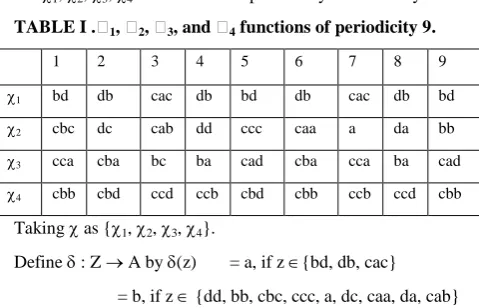
[image:3.595.47.287.352.506.2]Let 1, 2, 3, 4 be functions of periodicity 9 defined by:
TABLE I .1, 2, 3, and 4 functions of periodicity 9.
1 2 3 4 5 6 7 8 9
1 bd db cac db bd db cac db bd
2 cbc dc cab dd ccc caa a da bb
3 cca cba bc ba cad cba cca ba cad
4 cbb cbd ccd ccb cbd cbb ccb ccd cbb
Taking as {1, 2, 3, 4}.
Define : Z A by (z) = a, if z {bd, db, cac}
= b, if z {dd, bb, cbc, ccc, a, dc, caa, da, cab}
= c, if z {ba, cca, bc, cad, cba}
= d, if z {cbd, ccb, ccd, cbb}.
Then (A, S, K0, P, , δ) is a GPOCS.
With this GPOCS, the plain text „baddadcab‟ encrypts as „cbcbdcbbcbddbccdccacacdc‟. To decrypt, we use K0, K1, and K2 to find the partitioned output. The first character in the cipher text is „c‟ and K0(c) = 3. So we consider the first three characters, which can be decrypted as „b‟. The next character is „b‟ and K0(b) = 2. So the next two characters are decrypted as „a‟. Proceeding in this way, the cipher text gets decrypted into „baddadcab‟.
This example is almost a Four Stage Encryption System, except that K0, K1, K2, K3 are designed from a string of input alphabet.
3.2.2
Example
Let A = {g, h, i, k}.Let S = {l, m, n, o, p, q} is output alphabet generating function. Let K0 : S N be defined by K0(l) = 3, K0(m) = 2, K0(n) = 3, K0(o) = 2, K0(p) = 3, K0(q) = 2.
The output alphabet Z contains 126 elements, each of which is a string of input alphabet. Let K1= {120, 125, 123, 122, 121, 126, 110, 111, 112, 113, 117, 119, 118, 114, 115, 116, 109, 108, 107, 105, 104, 1, 2, 103, 101, 106, 100, 62, 63, 64, 60, 43, 44, 46, 45, 47, 49, 40, 41, 42, 48, 59, 58, 57, 53, 52, 51, 56, 55, 54, 124, 30, 31, 34, 37, 35, 36, 38, 39, 33, 32, 90, 94, 95, 97, 98, 99, 92, 93, 91, 96, 70, 71, 74, 75, 77, 78, 79, 72, 73, 76, 1, 9, 8, 7, 6, 4, 3, 2, 5, 10, 22, 21, 24, 25, 27, 28, 26, 23, 29, 20, 11, 14, 15, 17, 16, 18, 19, 12, 13, 88, 80, 89, 87, 84, 83, 81, 85, 86, 82, 69, 65, 66, 61, 67, 68, 50} be a permutation matrix where h represents a column containing 1 in hth place and 0 in all other places. Then K1 Z = {pqq, qp, qn, … , nmm} is the permuted output alphabet.
Let K2 = (25, 30, 40, 31), so that P = K2 K1 Z = {{ pqq, qp qn, qm, ql, qq, ppm, ppn, ppo, ppp, pqn, pqp, pqo, ppq, pql, pqm, ppl, poq, pop, pon, pom, pnq, pol, pnp, poo}, {pno, nom, non, noo, nnq, nll, nlm, nlo, nln, nlp, nml, mo, mp, mq, nlq, nnp, nno, nnn, nmp, nmo, nmn, nnm, nnl, nmq, qo, lpq, lql, lqo, ml, lqp}, {lqq, mm, mn, lqn, lqm, plq, pmo, pmp, pnl, pnm, pnn, pmm, pmn, pml, pmq, npo, npp, nqm, nqn, nqp, nqq, ol, npq, nql, nqo, lll, lmn, lmm, lml, llq, llo, lln, llm, llp, lmo, loo, lon, loq, lpl, lpn}, {lpo, lpm, lop, lpp, lom, lmp, lnm, lnn, lnp, lno, lnq, lol, lnq, lnl, plo, om, plp, pln, oq, op, on, pll, plm, oo, npn, nop, noq, nol, npl, npm, nmm}}.
Let = {1, 2, 3, 4} be defined by: 1 (n) = ((3n + 5) mod 25) + 1,2 (n) = ((n + 3)mod 30) + 1, 3 (n) = ((n
+ 7) mod 40) + 1, 4 (n) = ((n + 3) mod 31) + 1. Let be defined as in the definition. Clearly (A, S, K0, P, , δ) is a GPOCS.
The encrypted text of the plaintext „ghikghigh‟ is „pponnopmolnmpqp‟. To decrypt, K0, K1, and K2 are used to find the partitioned output. The first character in the cipher text is „p‟ and K0(p) = 3. So we consider the first three characters, which can be decrypted as „g‟. The next character is „n‟ and K0(n) = 3. So the next three characters are decrypted as „h‟. Proceeding in this way, the cipher text gets decrypted into „ghikghigh‟.
3.2.3
Example
Let A = {a, b, c, d}.Let S = {s, t, u, v, w} is output alphabet generating function.
Let K0: S N be defined by K0(s) =4, K0(t) = 2, K0(u) = 3, K0(v) = 2. K0 (w) = 3. The output alphabet Z contains 185 elements. A permutation matrix K1 of order 185 is taken and K1Z is computed. Let K2 = (30, 45, 76, 34) and compute P = K2 K1 Z. Let = {1, 2, 3, 4} be random functions from N into the respective blocks and be defined as in the definition. Clearly (A, S, K0, P, , δ) is a GPOCS.
With suitable choice of K2 and , the plain text „cadbaddad‟ is encrypted into „stsvwwsvuwusswuvu vuvtstu tuuwuvuvu‟.
3.3
A Way to design Keys in GPOCS
Given an output generating set S, a key K0 is defined as a function from the set S in to the set of natural numbers N. For each element a S, SK0 a −1 is computed. This set isprefixed with the element „a‟. In other words, the set
aSK0 a −1is computed for each element aS. Now the output
alphabet is the union of all such sets. Sothe output alphabet
Z, Z treated as column matrix, permutes the elements of Z. Let this permutation be U = K1 Z = (u1, u2, … , um). The third stage key K2 = (m1, m2, … , mn) is an n-partition of m (an ordered n-tuple of positive integers whose sum is m). Then the partition P = {Z1, Z2, . . . , Zn} is given by Z1 = {u1, … , um1}, the set of first m1 elements of U, Z2 = {um1+1, … , um1+m2}, the set of all next m2 elements of U and so on. The fourth stage key is a set of n functions = {1, 2, . . . n} where i : N → Zi for each i. Here these may be any functions of our choice. We may consider a function with Np = {1, 2, … , p} as the domain or a periodic function of periodicity p for a sufficiently large p. Again in any of these cases these n functions can be associated with n binary matrices. If Np is considered as the domain, for each i, let Bi be a mi p binary matrix in which each row contains exactly one 1. Now i(n) = Zi Bi en in which en = (0, 0, … , 1, … , 0) 1 being at the nth place. In the later case also, i(n) = Zi Bi en (mod p) + 1. The third stage key may be defined as K3 = {Bi : 1 i n}. So, finally we have K0, K1, K2, K3 the four stages of keys for encryption. We illustrate the above key structure by an example.
3.3.1
Example
Let A = {e, f, g, h}, S = {a, b, c, d}, and K0 : S → N be defined as K0(a) = 2, K0(b) = 2, K0(c) = 2, K0(d) = 2. Then the output alphabet Z = {aa, ab, ac, ad, ba, bb, bc, bd, ca, cb, cc,cd, da, db, dc, dd}. Let K1, K2 be defined as follows:
1 0 0 0 0 0 0 0 0 0 0 0 0 0 0 0 0 0 0 1 0 0 0 0 0 0 0 0 0 0 0 0 0 0 0 0 0 0 0 0 1 0 0 0 0 0 0 0 0 0 0 0 0 0 0 0 0 0 0 1 0 0 0 0 0 0 0 0 0 0 0 0 0 0 0 0 0 0 0 1 0 0 0 0 1 0 0 0 0 0 0 0 0 0 0 0 0 0 0 0 0 0 0 1 0 0 0 0 0 0 0 0 0 0 0 0 0 0 0 0 0 0 0 0 0 1 0 0 0 0 1 0 0 0 0 0 0 0 0 0 0 0 0 0 0 0 0 0 0 0 1 0 0 0 0 0 0 0 0 0 0 0 0 0 0 0 0 0 0 0 0 0 0 0 1 0 0 1 0 0 0 0 0 0 0 0 0 0 0 0 0 0 0 0 0 0 0 1 0 0 0 0 0 0 0 0 0 0 0 0 0 0 0 0 0 0 0 1 0 0 0 0 0 0 0 0 0 0 0 0 0 0 0 0 1 0 0 0 0 0 0 0 0 0 0 0 0 0 0 0 0 0 1 0 0 0 K1 ,
K2 = (5, 3, 3, 5).
Then K1 Z = {ad, bb, bc, cc, dc, ab, cb, db, ac, ca, cd, aa, ba, bd, da, dd} and P = {{ad, bb, bc, cc, dc}, {ab, cb, db}, {ac, ca, cd}, {aa, ba, bd, da, dd}}.
Let p = 8 and the functions be defined as periodic functions by the following matrices:
B1=
1 0 0 0 0 0 0 0 0 1 0 0 0 0 0 1 0 0 1 0 0 0 1 0 0 0 0 1 0 1 0 0 0 0 0 0 1 0 0 0
,
B2=
1 0 1 0 0 1 0 0 0 1 0 0 1 0 1 0 0 0 1 1 1 0 0 1 ,
B3=
1 0 1 0 1 0 0 1 0 1 0 1 0 0 1 0 0 0 1 0 0 1 0 0 ,
B4=
1 0 0 0 0 0 0 0 0 1 0 0 0 0 0 1 0 0 1 0 0 0 1 0 0 0 0 1 0 1 0 0 0 0 0 0 1 0 0 0
Clearly, = {1, 2, 3, 4} where
1 : 1 → ad, 2 → bb, 3 → bc, 4 → cc, 5 → dc, 6 → cc, 7 → bc, 8 → bb
2 : 1 → ab, 2 → cb, 3 → db, 4 → db, 5 → cb, 6 → ab, 7 → cb, 8 → db
3 : 1 → ac, 2 → ca, 3 → cd, 4 → ca, 5 → ac, 6 → cd, 7 → ca, 8 → ac
4 : 1 → aa, 2 → ba, 3 → bd, 4 → da, 5 → dd, 6 → ba, 7 → bd, 8 → da
and i(n) = i((n%8)+1) for n > 8 for any 1 ≤ i ≤ 4.
3.4
An application of GPOCS
In the real world requirement, we need to have the keys as words, numbers, or some other pattern. The users cannot remember or understand the actual process hidden from the users. Here, as a first application, a sentence of four words, each word being sufficiently long is considered as a key. From these words, we build the four stages of keys, which are functions with appropriate domains and ranges. The following example illustrates the procedure
3.4.1
Example
Let the input alphabet A = {a, b, c, d}.Let the key be „bad acad acb dacab‟.
From the first word „bad‟, the key K0 is: K0(a) = 2, the index of the first letter of the word „bad‟ in A. K0(b) = 1, the index of the second letter of the word „bad‟ in A. K0(c) = 4, the index of the third letter of the word „bad‟ in A. K0(d) = 2, the index of the first letter of the word „bad‟, since all the letters of the key are exhausted. In general, K0(ai) = j, where ai is the ith letter of the first word in the key.
The output alphabet is Z = {aa, ab, ac, ad, b, caaa, caab, caac, caad, caba, cabb, cabc, cabd, caca, cacb, cacc, cacd, cada, cadb, cadc, cadd, cbaa, cbab, cbac, cbad, cbba, cbbb, cbbc, cbbd, cbca, cbcb, cbcc, cbcd, cbda, cbdb, cbdc, cbdd, ccaa, ccab, ccac, ccad, ccba, ccbb, ccbc, ccbd, ccca, cccb, cccc, cccd, ccda, ccdb, ccdc, ccdd, cdaa, cdab, cdac, cdad, cdba, cdbb, cdbc, cdbd, cdca, cdcb, cdcc, cdcd, cdda, cddb, cddc, cddd, da, db, dc, dd}. Clearly, |Z| = 73.
Let us consider the indices of the letters of the second word in order. If some number repeats, replace it by some other number within the length of the word. For example, increment the number until a number that is different from the existing ones is arrived. Let consider a matrix with the columns corresponding to these numbers. i.e., for the number k, the corresponding column contains 1 in its kth place and 0s in the rest of the places. These vectors are repeated cyclically incrementing the positions of 1s until we get |Z| number of vectors.
Coming to the present example, the second word of the key is „acad‟. The corresponding numbers are 1, 3, 1, 4 respectively. 1 is repeated and hence the second one is replaced by 3. So the numbers are 1, 3, 2, 4. Now the matrix representing the key K1 is (1, 3, 2, 4, 5, 7, 6, 8, 9, 11, 10, 12, …… , 73). Now, ZK1 = {aa, ac, ab, ad, b, caab, caaa, caac, caad, cabb, caba, cabc, cabd, cacb, caca, cacc, cacd, cadb, cada, cadc, cadd, cbab, cbaa, cbac, cbad, cbbb, cbba, cbbc, cbbd, cbcb, cbca, cbcc, cbcd, cbdb, cbda, cbdc, cbdd, ccab, ccaa, ccac, ccad, ccbb, ccba, ccbc, ccbd, cccb, ccca, cccc, cccd, ccdb, ccda, ccdc, ccdd, cdab, cdaa, cdac, cdad, cdbb, cdba, cdbc, cdbd, cdcb, cdca, cdcc, cdcd, cddb, cdda, cddc, cddd, db, da, dc, dd}.
The numbers are extended to the size n of the input alphabet by repeating these numbers cyclically getting i1, i2, … , in. Let their total be t = i1 + i2 + … + in. Let q be the quotient obtained by dividing |Z| by t. Let the sizes of the blocks be q.i1, q.i2, …, q.ik-1, and t – (q.i1 + q.i2 + … , q.ik-1). i.e., the key K2 = (q.i1, q.i2, … , q.ik-1, t – (q.i1 + q.i2 + … , q.ik-1)). ZK1 is now partitioned according to these block sizes to get P, the key partition.
In our example, the third word is „acb‟. The indices are 1, 3, 2. Extending, we get 1, 3, 2, 1. The sum t = 1 + 3 + 2 + 1 = 7. The quotient q = 10, when 73 is divided by 7. A partition of 73 is (10, 30, 20, 13). Then P = {{aa, ac, ab, ad, b, caab, caaa, caac, caad, cabb}, {caba, cabc, cabd, cacb, caca, cacc, cacd, cadb, cada, cadc, cadd, cbab, cbaa, cbac, cbad, cbbb, cbba, cbbc, cbbd, cbcb, cbca, cbcc, cbcd, cbdb, cbda, cbdc, cbdd, ccab, ccaa, ccac}, {ccad, ccbb, ccba, ccbc, ccbd, cccb, ccca, cccc, cccd, ccdb, ccda, ccdc, ccdd, cdab, cdaa, cdac, cdad, cdbb, cdba, cdbc}, {cdbd, cdcb, cdca, cdcc, cdcd, cddb, cdda, cddc, cddd, db, da, dc, dd}}.
Finally, the fourth word „dacabc‟ generates the encryption function key array as follows. The indices of the word are 4, 1, 3, 1 – a repetition and replaced by 2 (1 is incremented until an unrepeated number is arrived at), index of the next letter is 2 – again a repetition and is replaced by 5, and finally, the index of the letter is 3, which is replaced by 6. So we obtained a sequence of numbers: 4, 1, 3, 2, 5, 6. We can extend this sequence by adding 6, the length of the word to these numbers and the 12, 18, the multiples of 6. The sequence obtained is: 4, 1, 3, 2, 5, 6, 10, 7, 9, 8, 11, 12, 16, 13, 15, 14, 17, 18 … From this sequence, the first 30 (the maximum of 10, 30, 20, and 13) numbers are taken to form the matrix B1 and next 30 to form B2 and so on. For example, B1 = (e4 e1 e3 e2 e5 e6 e10 e7 e9 e8 …), a 10 30 matrix, where ei stands for a column matrix of size 10 with 1 in ((i mod 10) + 1)th place and all other entries are zeros. B2 is a 30 30, B3 is a 20 30, and B4 is a 13 30 matrices obtained in a similar manner. These matrices form the key K3 = (B1, B2, B3, B4). Now, given any plain text we can encode it using this key structure (K0, K1, K2, K3) and any cipher text encoded in this way can be decoded using (K0, K1, K2, K3).
4.
PARTITIONED OUTPUT CRYPTO
SYSTEM
To further study the properties of the system, a pure mathematical system, called Partitioned Output Cryptosystem, is proposed. A sketch of Partitioned Output Cryptosystem and its properties are presented in this section.
4.1
Definition
A Partitioned Output Crypto System (POCS) is a quintuple (A, Z, P, , δ) where
A = {a1, a2, … , an} is a finite set, called the set of input alphabet
Z = {z1, z2, … , zm} is a finite set (m ≥ n), called the set of output alphabet.
P = {Z1, Z2, … , Zn} a partition of Z, called key partition.
= {1, 2, … , n} is a set of mappings; for each i, i : N → Zi, called the encrypting function array.
δ : Z → A defined by δ(z) = aj if z belongs to Zj for any z in Z, called decryption function.
For any word w = ai1ai2…aik in A*, define (w) = i1(o(ai1, w))
i2(o(ai2, w)) . . . ik(o(aik, w)), where o(a, w) stands for the
order of occurrence of a in the word w. i.e., Each aj of w is replaced by j(p), where aj is the pth occurrence of itself in w.
(w) is called the encrypted word of the word w. The decrypting function, δ can be extended to Z*, as Δ (u) = δ (zj1) δ (zj2) . . . δ (zjk) for any u = zj1zj2 . . . zjk in Z*. Δ (u) is called the decrypted word of the word u. Clearly δ (i(n)) = ai for all i, 1 ≤ i ≤ n; and hence Δ((w)) = w for all w in Z*.
4.2
Examples
4.2.1
Example
Let A = {a, b, c, d},Z = {e, f, g, h, j, k, l, m, n, o, p, q, r, s, t, u, v, w, x, y, z}
P = {{h, k, l, p, t, x, z}, {f, o, s, y}, {g, n, q, v}, {e, j, m, r, u, w}}
= {1, 2, 3, 4} where 1 : 1→ t, 2→ h, 3→ x, 4→ l, 5 → k, 6 → z, 7 → p and 1(n) = 1((n%7)+1) for n > 7.
2: 1 → o, 2 → s, 3 → y, 4 → f, and 2(n) = 2((n%4) +1) for n > 4.
3 : 1 → g, 2 → q, 3 → n, 4 → v, and 3(n) = 3((n%4)+1) for n > 4.
4 : 1 → u, 2 → r, 3 → e, 4 → m, 5 → j, 6 → w and 4(n) =
4((n%6)+1) for n > 6, where n%k stands for the remainder of n divided by k.
Then (A, Z, P, ) is a POCS.
Let w = cadbaddacdadba. Then (w) is computed as follows.
3(o(c, w)) = 3(1) = g, 1(o(a, w)) = 1(1) = t, 4(o(d, w)) =
4(1) = u, 2(o(b, w)) = 2(1) = o, 1(o(a, w)) = 1(2) = h,
4(o(d, w)) = 4(2) = r, 4(o(d, w)) = 4(3) = e, . . .etc. Hence
(w) = gtuohrexqmljsk. The word cadbaddacdadba is encrypted as gtuohrexqmljsk. Notice that though a and d are repeated very often in the plain text, the encrypted text wont reflect those characteristics. Generally the encrypted text can be decrypted by a third party by knowing the frequency of characters in the plain text.
4.2.2
Example
Let A = {a, b, c, d}Z = {aa, ab, ac, ad, ba, bb, bc, bd, ca, cb, cc, cd, da, db, dc, dd}
P = {{ad, bb, bc, cc, dc}, {ab, cb, db}, {ac, ca, cd}, {aa, ba, bd, da, dd}
= {1, 2, 3, 4} where
1 : 1 → ad, 2 → bb, 3 → bc, 4 → cc, 5 → dc, 6 → cc, 7 → bc, 8 → bb
2 : 1 → ab, 2 → cb, 3 → db, 4 → db, 5 → cb, 6 → ab, 7 → cb, 8 → db
3 : 1 → ac, 2 → ca, 3 → cd, 4 → ca, 5 → ac, 6 → cd 7 → ca, 8 → ac
4 : 1 → aa 2 → ba, 3 → bd, 4 → da, 5 → dd, 6 → ba, 7 → bd, 8 → da and i(n) = i((n%8)+1) for n > 8 for any 1 ≤ i ≤ 4.
Then (A, Z, P, ) is a POCS.
Let w = cadbaddacdadba. Then (w) is computed as follows.
4(o(d, w)) = 4(2) = ba, 4(o(d, w)) = 4(3) = bd, ... etc. Hence (w) = aaacaaabbbbabdbccadaccddcbdc.
The word cadbaddacdadba is encrypted as aaacaaabbbbabdbccadaccddcbdc. Notice that the encrypted word has double length as that of the plain text and it is difficult to decrypt the text without knowing the encryption function array.
4.2.3
Example
Let A = {a, b, c, d}Z = {ab, ac, ad, ba, bc, bd, ca, cb, cd, da, db, dc, dd }
P = {{ad, bc, dc, db}, {ab, cb}, {ac, ca, cd}, {ba, bd, da}}
= {1, 2, 3, 4} where χ1 : 1 → ad, 2 → bc, 3 → dc, 4 → db, and 1(n) = 1(n%4 + 1) for n > 4 χ2 : 1 → ab, 2 → cb, and 2(n) = 2(n%2 + 1) for n > 2 χ3 : 1 → ac, 2 → ca, 3 →
cd and 3(n%3 + 1) for n > 3 χ4 : 1 → ba, 2 → bd, 3 → da, and 4(n%3 + 1) for n > 3.
Then (A, Z, P, ) is a POCS.
Letw=cadbaddacdadba. Then χ(w)= acadbaabbcbddadcc
abadbbdac. The word cadbaddacdadba is encrypted as acadbaabbcbddadccabadbbdac.
Notice that the encrypted word has double length as that of the plain text and it is difficult to decrypt the text without knowing the encryption function array. In the previous examples, the size of the encrypted word is a multiple of the size of the original word. This allows a chance of estimating the chance of guessing the size of the original word by considering all possible divisors of the size of the encrypted word.
4.2.4
Example
Let A = {a, b, c, d}Z = {a, ba, bc, bd, cab, cad, cba, cbd, cda, cdb, dabc, dacb, dbac, dbca, dcab, dcba}
P = {{cab, bd, dcba}, {cad, dabc, a, ba, cda, dbac}, {dcab, cdb, dbca}, {cba, cbd, dacb, bc}}
= {1, 2, 3, 4} where
1 : 1 → cab, 2 → bd, 3 → dcba, and 1(n) = 1(n%3 + 1) for n > 3
2: 1→ cad, 2→ dabc, 3→ a, 4→ ba, 5→ cda, 6→ dbac
2(n) = 2(n%6+1) for n > 63: 1 → dcab, 2 → cbd, 3 → dbca, and 3(n%3 + 1) for n > 3
4: 1 → cba, 2 → cbd, 3 → dacb, 4 → bc, and 4(n%3 + 1) for n > 4
Then (A, Z, P, ) is a POCS.
Let w = cadbad. Then (w) = dcabcabcbacadbdcbd. Since each alphabet is encoded into a word of different size, decryption without knowing the key partition. Here the output alphabet (word) has a length of 1 if it starts with a, 2 if it starts with b, 3 if it starts with c, and 4 if it starts with d, so that there will not be any problem in decryption.
4.3
Elementary Properties of POCS
We study some elementary properties of POCS and show that POCS is a generalization of a cryptosystem. Both symmetric and asymmetric ciphers can be explained through POCS.4.3.1
Definition
Two cryptosystems [4], [5], [7]are k-equivalent if they encrypt and decrypt in the same way for a given key k. i.e. for any given message they give raise to the same decrypted word and vice versa.
4.3.2
Theorem: The POCS (A, Z, P,
, δ) is
P-equivalent to a Crypto system [4], [5].
Proof: Suppose (A, Z, P, , δ) is a POCS.Consider the cryptosystem (M, C, K, e, d)
where M = A*, C = Z*, K is the set of all n-block partitions of Z. For the partition P in K, eP and dP are defined as follows: eP (m) = (m) for all m in M and dP(c) = Δ(c) for all c in C. Clearly (M, C, K, e, d) is a cryptosystem and for the key P in K, eP = χ and dP = Δ. Hence the (A, Z, P, , δ) is P-equivalent to (M, C, K, e, d).
4.4
Three Stages of Key design in POCS
First the output needs to be partitioned. This requires:1. A permutation of the output alphabet.
2. A an n-partition of the integer m (i.e. m should be express as the sum of n positive integers: m = k1 + … + kn).
3. The first block of the partition P contains the first k1 elements; the second block of partition P contains k2
elements and so on.
After getting a partition P, a function from A to P may be defined. This function may be ignored if proper care is taken in the initial permutation. We just suppose that 1 is mapped onto P1, 2 is mapped onto P2 and so on.
Now we are left with defining χ. So the three levels of the key generations involve:
1.Initial permutation of the output alphabet Z.
2.Partitioning m.
3.Defining .
While encoding a word, we need all these three stages of key functions. But to decode a word we need to know only function δ.
4.4.1
Theorem: The POCS (A, Z, P, , δ) is an
asynchronous crypto system.
Proof: The proof is trivial by the previous explanation.
For any f in Mfn (D, E) [3], [8], [9], [10] f can be extended to
f : D* E* as f(w) = f(ai1) f(ai2) … f(aik) for any w = ai1 ai2
… aik in A*. When there is no confusion, f is write as f.
4.4.2
Theorem: Suppose (A, Z, P,, δ) is a
POCS. Then for any word w in A
*, (w)
f(w) for some f in Mfn(A, Z).
Proof: Suppose (A, Z, P, , δ) is a POCS.
Define f : A 2Z by f(ai) = Zi for all i.
Let w = ai1 ai2 … aik be an element A*.
Then (w) = zi1 zi2 … zik where zih Zih for 1 h k.
So (w) = zi1 zi2 … zik Zi1 Zi2 … Zik = f(ai1) f(ai2) … f(aik) = f(w).
4.4.3
Definition (Mfn
+(D, E))
Suppose D and E are two sets. A multifunction [3], [8], [9], [10] f from D into E is said to be a perfect multi function if f(d) is nonempty for every d in D and dD f(d) = E. The set of all perfect multifunctions from D into E is denoted by Mfn+(D, E).
4.4.4
Theorem: Suppose A and Z are two
nonempty finite sets and f
Mfn
+(D, E).
Then there exists a POCS (A, Z, P,
,
)
such that (w) f(w) for any w A
+.
Proof: Let f Mfn+(A, Z).Suppose P = {f(a1), f(a2), … , f(an)}. Since f is a perfect multifunction, P is a partition of Z.
Let = {χ1, χ2, . . . , χn} be a set of functions where each i : N Zi for 1 i n.
Let : Z A be defined by (z) = ai if z Zi.
Clearly (A, Z, P, , ) is a POCS.
Clearly for any w in A*, (w) f(w). By the above two theorems, we understand that each element f of Mfn+(A, Z) corresponds to a partition P of Z, and each partition P of Z corresponds to an element f of Mfn+(A, Z) By defining and , we get a POCS. Since is a consequence of P, we need only to define to get a POCS. So, each perfect multifunction f represents a set of POCS. Let us denote this set by POCSf
(A, Z). For a given input alphabet A and output alphabet Z, let us denote the set of all POCS with A and Z as input and output alphabet by P (A, Z).
4.4.5
Theorem: P (A, Z) =
f M fn +(A, Z)
POCS
f(A, Z).
Proof: The proof is a direct consequence.
5.
ANYLASIS OF POCS
In this system, the output alphabet can be known if it is not a block of output alphabet, such as the one explained in example „4.2.1’ If each output alphabet is a block of alphabet of fixed size (as in example 4.2.2 or 4.2.3) the size of the block can be guessed on knowing the number of alphabet in any cipher text. But if each output alphabet is variable size block of alphabet (as in example 4.2.4), then it is highly impossible to know the output alphabet. As the prediction of output alphabet itself is difficult, decoding that becomes highly impossible.
Let us suppose that the output alphabet is known and that it is not blocks of alphabet (as in example 4.2.1). In order to decrypt a given cipher, one should guess the n-partition of m,
one out of x possible partitions, where 𝑚 − 1
𝑚 − 𝑛 x 𝑚 − 1𝑚 − 𝑛 . As m is very much larger than n, x also will be
large (at least 𝑚 − 1
𝑚 − 𝑛 ). In other words, K2 is difficult of this
order. Again one has to guess the initial permutation (K2), one out of possible m! permutations. So the decryption will be to guess one out of x*m!. So the probability of guessing the key pair (K1, K2) is 1/(x*m!).
The probability of guessing the key pair in example 4.2.1 is
1/(665*22!) =1/747460483972109107200
000 = 1.337863367285800494247954502632 * 10-24. This probability is achieved just with an output size of 22. As we increasing the size of the output alphabet, the chances for decrypting a given cipher decreases.
In general the cryptosystems will be having same size of input and output alphabet. There by however the algorithm is made to encrypt, the final function that encrypts should be a bijection (one-one and onto). In other words it is simply a permutation. So if the input size is n, then the number of permutations is only n! and the probability of guessing the key is 1/n!. So, to enhance the security, one needs to increase the size of the input alphabet or consider a big block of input alphabet as input alphabet. In POCS without changing the input alphabet, we achieve more secured encryption as explained by the following theorems.
5.1
Theorem (Probability of breaking
POCS)
Suppose the size of the input alphabet is n and that of output alphabet is kn in a POCS. Then the probability of guessing the key pair (K1, K2) is approximately (((k-1)n)! n!) / (kn)!2.
Proof: The number of ways to choose K2 lies between
𝑘𝑛 − 1
𝑘𝑛 − 𝑛 and 𝑘𝑛 − 1𝑘𝑛 − 𝑛. So the least possible value is 𝑘𝑛 − 1
𝑘𝑛 − 𝑛 which is approximately equal to 𝑘𝑛𝑘𝑛 − 𝑛 = 𝑘𝑛𝑛 .
So, the number of ways to select K2 can be taken as 𝑘𝑛
𝑛 .
The number of ways to choose the key K1 is (kn)! and hence
the number of ways to choose the key pair (K1, K2) is 𝑘𝑛
𝑛
(kn)! = (kn)! (kn)! / (((k-1)n)! n!). Hence, the probability to guess the key pair is (((k-1)n)! n!) / (kn)!2.
5.2
Theorem (Probability of breaking
POCS compared to general
cryptosystems)
The probability to guess the key in a general crypto system is
at least kn
n times of the probability to guess the key in
POCS, where n and kn are respectively the sizes of input and output alphabet in POCS and kn being the size of alphabet in general crypto system.
Proof: Let us consider the alphabet (input and output) size of a general cryptosystem to be kn.
The probability to guess a key in general crypto system is 1 / (kn)! Whereas that in POCS is (((k-1)n)! n!) / (kn)!2. Hence the probability to guess a key in general crypto system is (kn)!
/ (((k-1)n)! n!) = 𝑘𝑛
𝑛 times that in POCS.
5.3
Theorem: (Probability of breaking
POCS compared to general
cryptosystems)
The probability to guess the key in a block cipher [4], [5], [6],
[7], [11], alphabet of size n and block size k is at least nk
n
times of the probability to guess the key in POCS with n and nk respectively being the sizes of input and output alphabet in POCS.
Proof: The proof is similar to the above since in block cipher, the alphabet may be treated as the set of all blocks of the alphabet. If we take the input alphabet as the English alphabet A containing 26 letters and the output alphabet as A2, the strings of length 2, then the probability to break POCS is 5.7746226578042013138408988185728 1046 times that of a block cipher system with alphabet A having a block of size 2.
6.
CONCLUSION
In this paper, we generalized the four stage encryption as generated Partitioned Output Cryptosystem (GPOCS) based on multifunction concept to increase the security without altering the input alphabet size. The output alphabet may be changed so that the security is enhanced. It is also observed that the security is much higher compared to general crypto systems in use.
7.
REFERENCES
[1] Gomatam V S Acharyulu, Sangapu V Appaji, “Analysis of Four Stage Encryption”, International Journal of Research in Computer and Communication Technology, Vol. 6, Issue 4, pp. 338-339, Nov. 2012.
[2] Gomatam V S Acharyulu, Sangapu V Appaji, “Four Stage Encryption”, International Journal of Research in Computer and Communication Technology, Vol. 1, Issue 4, pp. 129-132, sep. 2012.
[3] Gomatam V S Acharyulu, Matrix Representable SO-Rings, Semigroup Forum, Vol.46, pp. 37-47, 1993.
[4] C. A. Henk, “Introduction”, in Fundamentals of cryptology a professional reference and interactive tutorial van Tilborg”, Eindhoven University of Technology, The Netherlands kluwer academic publishersboston/dordrecht/London,pp.3,
http://hyperelliptic.org/tanja//teaching/cryptoI13/cryptodi ct.pdf.
[5] J. Hoffstein, J. Jipher, J. H. Silverman, “Intrduction to Cryptography” in Introduction to Mathematical Cryptography, Springer-Verlag, 2008, pp. 38.
[6] C. Kaufman, R. Perlman, M. Speciner, “Network Security. Upper Saddle River”, NJ: Prentice Hall, 2002
[7] Moses Liskov, L. Ronald Rivest, David Wagner. "Tweakable Block Ciphers". Journal of Cryptology, 24(3), pp. July, 2011.
[8] E. G. Manes, M. A. Arbib, “Algebraic Approaches to Prgram Semantics”, Spriger-Verlag, New ork, Inc., 1986.
[9] E. G. Manes, D.B. Benson, “Inverse semigroup of sum-ordered semi ring”, Semigroup Forum, Vol. 31, pp. 129-152, 1985
[10]M. E. Streenstrup E., Sum-Ordered Partial Semirings, Doctoral Thesis, Department of Computer and Information Science, University of Massachusetts, 1985.
[11]William Stallings, “Cryptography and Network Security Principles and Practice Fifth Edition”,Prentice Hall, pp. 68, 198-214, 2011.