A comprehensive literature classification
of simulation optimisation methods
Hachicha, Wafik and Ammeri, Ahmed and Masmoudi,
Faouzi and Chachoub, Habib
Unit of Mechanic, Modelling and Production (U2MP), Unit of
Logistic, Industrial and Quality Management (LOGIQ), University
of Sfax
24 May 2010
Online at
https://mpra.ub.uni-muenchen.de/27652/
1
A COMPREHENSIVE LITERATURE CLASSIFICATION OF
SIMULATION-OPTIMIZATION METHODS
Ahmed AMMERI, Habib CHABCHOUB
LOGIQ / ISGI
High Institute of Industrial Management of Sfax B.P. 954, 3018, Sfax, Tunisia
[email protected], [email protected]
Wafik HACHICHA, Faouzi MASMOUDI
U2MP/ ENIS Engineering School of Sfax B.P. 1173, 3038 Sfax, Tunisia
[email protected], [email protected]
ABSTRACT: Simulation Optimization (SO) provides a structured approach to the system design and configuration when analytical expressions for input/output relationships are unavailable. Several excellent surveys have been written on this topic. Each survey concentrates on only few classification criteria. This paper presents a literature survey with all classification criteria on techniques for SO according to the problem of characteristics such as shape of the response surface (global as compared to local optimization), objective functions (single or multiple objectives) and parameter spaces (discrete or continuous parameters). The survey focuses specifically on the SO problem that involves single per-formance measure.
KEYWORDS: Simulation Optimization, classification methods, literature survey
1 INTRODUCTION
Many real world problems in management and manufac-turing are very complex and mathematically intractable so that simulation is the appropriate tool for system analysis and performance evaluation. Computer simula-tion requires developing a program that mimics the be-havior of a system as it evolves over time and records the overall system performance. As the technology of com-puter hardware and software advances, simulation has emerged as an essential tool in research and real world applications. With the continuing developments in com-puter technology, simulation is receiving increasing atten-tion as a decision-making tool.
Therefore, computer simulation is frequently used in evaluating complex systems and optimizing responses. However, simulation is not without pitfalls. Simulation output is subject to random errors and requires proper statistical analysis. Furthermore, simulation models are “run” rather than solved. It is traditionally viewed as a tool for performance evaluation instead of decision mak-ing or optimization. In recent years researchers have at-tempted to combine simulation and optimization proce-dures to provide a complete solution. However, Simula-tion is merely a tool for problem solving; by itself, it can-not provide an answer. In addition to a good model, one also needs a sound technique to utilize the information from a simulation to make a decision. One such technique is optimization via simulation.
Simulation Optimization (SO) provides a structured ap-proach to system design and configuration when analytic
2 techniques according to the characteristics of the prlems such as objective functions (single or multiple ob-jectives) and parameter spaces (discrete or continuous parameters) and shape of the response surface (global as compared to local optimization). They also discussed major advantages, drawbacks and, comparisons of these techniques in the paper.
(Piera and al, 2004) described a new approach to inte-grate evaluation (simulation) methods with search meth-ods (optimization) based not only on simulation results but also information from the simulation model. (Fu, 2006) develop a simulation optimization algorithm for determining the traffic light signal timings for an inter-section of two one-way street traffic flows modelled as single-server queues. The system performance is esti-mated via stochastic discrete-event simulation, and gradi-ent-based search based on stochastic approximation is applied. (Rosen and al, 2007) propose a SO method that involves a preference model, specifically adapted for de-cision making with simulation models. The proposed SO method is evaluated against two SO methods with em-bedded deterministic, multiple criteria decision making strategies. (Almeder and Preusser, 2007) presented a new approach that combines the advantages of complex simu-lation models and abstract optimization models. More recently (Fu and al, 2008) give a tutorial introduction to SO, beginning by classifying the problem setting accord-ing to the decision variables and constraints, puttaccord-ing the setting in the simulation context, and then summarize the main approaches to SO. (Alrefaei and Diabat, 2009) have focused on simulated annealing algorithm for solving multi-objective SO problems. The algorithm is based on the idea of simulated annealing with constant tempera-ture, and uses a rule for accepting a candidate solution that depends on the individual estimated objective func-tion values. For more comprehensive studies on this topic, the reader can referred to some others reviews pa-pers including (Glynn, 1989), (Metketon, 1987), (Azadi-var, 1992), (Fu, 1994), (Kleijnen, 1995) and references therein.
Applications of the SO approach exist in many fields. With respect to operations research problems we mention above all inventory models (Kochel and Nielander, 2005), logistic systems (Kochel and al, 2003; Yoo and al, 2010), and manufacturing systems (Kochel and Nie-lander, 2002; Kampf and Kochel, 2006).
As a result of this literature survey, there are several ways SO problems can be classified. We can classify SO problems regarding their input variables (quantitative variables and qualitative variables), output variables (a single objective SO problems or multi-objective problems), parameter spaces (discrete or continuous parameters), the shape of the response surface (global as compared to local optimization) or by their Optimization Procedure. Our main contribution in this paper is to provide a literature survey with all classification criteria and to propose a global classification scheme of SO methods.
The remainder of the paper is organized as follows: Sec-tion 2 we establish a common framework for simulaSec-tion optimization problems and present the notation to be used. Section 3 presents a literature survey with all classi-fication criteria on techniques for simulation optimiza-tion. Finally Section 4 draws conclusions.
2. PROBLEM DESCRIPTION
SO refers to the process for finding optimal system de-sign whose performance is estimated by simulation (Kabirian and Ólafsson, 2007), and the problem setting thus contains the usual optimization components:
9 Decision variables,
9 objective function, and
9 Constraints.
The SO can be defined as the latter case: repeated analy-sis of the simulation model with different values of de-sign parameters, in an attempt to identify best simulated system performance. The design parameters of the real system are set to the ‘optimal’ parameter values deter-mined by the SO exercise, rather than in an ad hoc man-ner based on qualitative insights gained from exercising the simulation model. A very general formulation of the above SO problem is to minimize the expected value of the objective function with respect to its constraint set as: The general SO problem setting is as follows:
) Min
Θ
θ∈ f(θ , (1)
where θ is a p-dimensional vector of all the decision vari-ables, Θ is the feasible region and
f
:
Θ
→
R
is the objective function. If f(θ) is a one-dimensional vector, the problem is single objective optimization, whereas if its dimension is more than one, the problem becomes mul-tiobjective. The optimum is denoted by θ*. Without loss of generality, we will consider the minimization problem throughout the paper.We assume that the system under consideration is com-plex enough that the expected performance f(θ) of each system design
θ
∈
Θ
cannot be determined exactly, but is instead estimated through simulation. The optimization model response function is represented by f(θ) which is usually the expected value (long-term average) of some simulated system performance measure Y as a function of the design parameter vector θ. That is) ) , ( E( ) Y θ ε
f(θ = (2)
where ε represents the stochastic effects in the system. The form of f is not known. Its value is estimated using n
MOPGP’10 - May 24-26, 2010 - Sousse - Tunisia
3
Simulation optimization methods
Local optimization Global optimization
Θa discrete set Θcontinuous
Θ is large or ∞
f continuous
f differentiable
Metamodel Methods Tabu Search
Simulated Annealing
Bayesian/Sampling Algorithms
Gradient Surface Methods
Stochastic Gradient Estimation
No Gradient Approaches Random Search
Θ is finite, small
Statistical Selection Methods
Ranking and Selection
Multiple Comparaison Gradient Approaches
Others
Perturbation Analysis ( PA)
Likelihood Ratios (LR)≡Score Function (SF)
General Search Strategies Others
Evolutionary Algorithms
Ordinal Optimization
Nested Partitions Method
Others
Genetic Algorithm Evolutionary Programming
Evolution Strategy Neural Network Metamodels
Radial basis Function Metamodels
Sample path optimization
Simplex search method
Hooke and Jeeves method Response Surface Metamodels
Spatial Correlation Metamodels
Finite Difference (FD)
Frequency Domain Analysis (FDA)
[image:4.842.63.774.33.531.2]Harmonic Analysis (HA) Regression Spline Metamodels
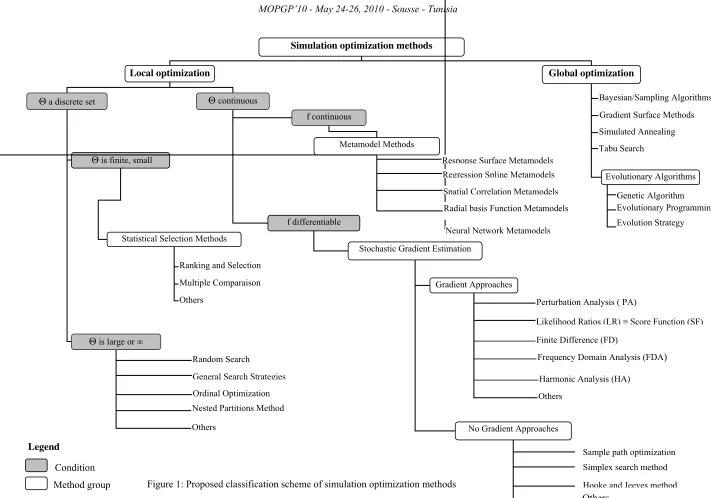
Figure 1: Proposed classification scheme of simulation optimization methods
Others Condition
4
-∑
= ∧= n
i i
n Y f
1
)
(θ (3)
In Eq. (3) the dependence of Y on the value of θ has been suppressed. While f(θ) is deterministic, its estimate is stochastic, since the simulation run time must be finite (so n < ∞).
It should be noted that, the general formulation (1) sub-sumes the usual mathematical programming settings (which prefers x to θ for its decision variables):
•If f(θ) is a scalar function, the problem is single objec-tive optimization; whereas if it is a vector, the problem becomes multi-objective
•f(θ) is linear in θ and Θ can be expressed as a set of linear equations in θ corresponds to linear program-ming, or mixed integer linear programming if part of the Θ space involves an integer (e.g., {0,1} binary) con-straint.
3. THE PROPOSED CLASSIFICATION
As pointed out by (Tekin and Sabuncuoglu, 2004) the existing studies can be classified under two main head-ings: local optimization; and global optimization. Local optimization techniques are further classified in terms of discrete and continuous parameter spaces the discrete case can also further classified into finite parameter space and infinite parameter space. The main goal of this re-search is to propose a global classification scheme of SO problems. This structure is shown in Figure 1. For more details on the major techniques, we have presented, in table 1, table 2, and table 3 other SO references
3.1 Local optimization
Local optimization problems are discussed in terms of discrete and continuous decision spaces. In a discrete space, decision variables take a discrete set of values such as the number of machines in the system, alternative loca-tions of depots, different scheduling rules or policies, etc. Several techniques have been developed for simulation optimization when the input parameter values (i.e, the size of Θ) is discrete. If the set Θ is finite and small, rank-ing and selection and multiple comparisons procedures are appropriate. If the set is infinite but very large, then techniques such as ordinal optimization and general search strategies, see (Tekin and Sabuncuoglu, 2004), (Swisher and al, 2004). On the other hand, in a continu-ous space, the feasible region consists of real-valued de-cision variables such as order quantity and reorder quan-tity in inventory problems, release time of factory orders, etc. If Θ is continuous, other search methods can be em-ployed. Stochastic gradient-based optimization methods such as: methods for estimating the gradient of f, Simplex search and Metamodel-based optimization methods see (Andradottir, 1998), (Swisher and Hyden, 2000).
3.1.1 Discrete input parameter methods
The discrete input parameter case differentiates tech-niques appropriate for small and for large numbers of feasible input parameter values. As discussed in (Swisher and al, 2000) several techniques have been developed. If the set Θ is finite and small, ranking and selection and multiple comparison procedures are appropriate. If the set
Θ is infinite or very large, then techniques such as ordinal optimization, random search, nested partitions method and general search strategies have been adapted for the simulation environnement. However in the continuous case, gradient-based methods or metamodel based opti-mization can be used.
Tableau 1: Methods based on discrete input parameter
Optimization simulation
methods
References
Finite space
Ranking and Selection
(Koenig and Law, 1985), (Chen and al, 1996; 1997), (Morrice and al, 1998; 1999), (Hyden and Schruben, 1999), (Branke and al, 2007)
Multiple Comparison
Procedures
(Hsu, 1984), (Hsu and Nelson, 1988), (Yang and Nelson, 1989; 1991), (Golds-man and Nelson, 1990), (Kolonja and al, 1993), (Matejeik and Nelson, 1993; 1995), (Bofinger and lewis, 1992), (Yuan and Nelson, 1993), (Nakayama, 1995; 1996; 1997; 2000), (Damerdji and Nakayama, 1996; 1999). (Swisher and al, 2000), (Nel-son and al, 2001),
Infinite space
Ordinal Optimization
(Ho.Sreenivas and Vakili, 1992), (Deng and al, 1992, (Ho, 1994), , (Ho and Deng, 1994), (Dai, 1995), ), (Chen, 1995; 1996), , (Ho and Larson, 1995), (Chen and al, 1996), (Ho and Larson, 1995), (Xie, 1997), (Deng and Ho, 1997)(Lau and Ho, 1997),
(Lee and al, 1999).
General Search Strategies
Eglese, 1990), (Fleischer, 1995), (Leipins and Hilliard, 1989), (Muhlenbein, 1997), (Glover and Laguna, 1997), ( Manz and al, 1989), ( Haddock and Mittenhall, 1992), ( Baretto and al, 1999), ( Zeng and Wu, 1993), (Yucesan and Jacobson, 1996), ( Stuckman and al, 1991), (Brady and Mc Garvey, 1998), (Dummler, 1999), (Fac-cenda and Tenga, 1992), (Tompkins and Azadivar, 1995), (Glover et al, 1996), (Hall and al, 1996), ( Hall and Bowden, 1997).
Random Search
(Andradottir, 2005), (Fu, 2007), (Chen et al, 2008).
Nested Partitions
Methods
MOPGP’10 - May 24-26, 2010 - Sousse - Tunisia
5
-3.1.1.1 Finite space
When the optimization involves selecting the best of a few alternatives, that is Θ = {θ1, θ2, θm}, where m is relatively small, then it may be possible to evaluate every solution and compare the performance. The two most popular methodologies for the class of the problem are:
Raking and Selection (R&S) and Multiple Comparison Procedures (MCPs). (R&S) focuses on selecting the op-timal input parameter values. In MCPs the idea is to run a number of replications and make conclusions on a per-formance measure by constructing confidence intervals.
MCPs approach the optimization problem as a statistical inference problem and, unlike R&S procedures, do not guarantee a decision. For excellent review of these tech-niques, one can refer to (Kim and Nelson, 2006)
3.1.1.2 Infinite space
When it is not possible to evaluate every solution using a statistical selection procedure, and the set Θ is very large different other methods must be applied. Such as Ordinal optimization reduces the search for an optimal solution from sampling over a very large set of solutions to sam-pling over a smaller, more manageable set of good solu-tions. A more detailed treatment of this topic can found in (Ho and Deng, 1994), (Lee et al, 1999).
General search strategies such as simulated annealing
(Eglese, 1990); (Fleischer, 1995), genetic algorithms
(Leipins and Hlliard, 1989); (Muhlenbein, 1997) and tabu search (Glover and Laguna, 1997). (Glover and Laguna 1997) have been adapted for the stochastic environment associated with discrete-event simulation optimization.
Random search (RS) was first developed for deterministic optimization, but has been extended to the stochastic set-ting. (RS) can work on an infinite parameter space. Inputs of upper and lower bounds on each of the controllable factors define an overall search region. For more details on random search methods in simulation, see (Andradot-tir, 2005)
Nested Partitions (NP) is a randomized method for global optimization. The motivation for this method is that some parts of the feasible region may be most likely to contain the global optima. Hence it is efficient to concentrate the computational effort in these regions. The Nested Parti-tions Method takes a global perspective and combines global and local search techniques. For more details, see
(Shi and Olafsson, 1997), (Shi and al, 1999).
3.1.2 Continuous input parameter methods
The feasible region, Θ, is uncountable and infinite when the set of in put parameters are continuous. Continuous simulation optimization problems fall into two categories: metamodel methods and stochastic gradient estimation.
3.1.2.1 Metamodel Methods
Metamodeling, which was first described by (Blanning, 1975) is a process of developing a mathematical relation-ship between a response measure of interest and a set of input variables. Metamodels Methods are often con-structed in two primary stages. The first stage uses a fac-torial experimental design to collect a structured data set that is then used to find the functional relationship be-tween decision variables and responses. After a meta-model is constructed, the what-if analysis can be obtained without the further consumption of expensive computing resources. See (Hurrion and Birgil, 1999), (Kleijnen, 1987) (Yesilyurt and Patera, 1995), (Barton and Meck-esheimer, 2006).
3.1.2.2 Stochastic gradient estimation.
The goal of stochastic gradient estimation is to estimate the gradient of the performance measure with respect to the parameters. An extensive body of research exists for SO problems of this type. Input parameter methods may be classified as either based or non gradient-based.
a) Gradient based Approaches
A considerable amount of research has focused specifi-cally on techniques for gradient estimation, such as, finite difference estimation, perturbation analysis (see Ho, 1984; Glynn, 1989; Suri, 1989), likelihood ratio estima-tors (see Glynn, 1987; Rubinstein and Shapiro, 1993) and frequency domain experimentation (Schruben and Cogli-ano, 1991)
Perturbation analysis (PA) estimates all gradients of an objective function from a single simulation run (Bettonvil 1989), (Glasserman 1991), (Ho and Cao, 1991). The idea is that in a system, if a decision parameter is perturbed by an infinitesimal amount, the sensitivity of the output vari-able to the parameter can be estimated by tracing its pat-tern of propagation.
The likelihood ratio (LR), (or the score functions), method involves expressing the performance measure as an integral involving the product of the densities of the underlying random variables. In the (LR) the expressing gradient of the expected value of an output variable is expressed as the expected value of a function. Since its introduction to simulation field a significant volume of work on this topic has been reported in the literature. A sample of these works can be found in (Glynn, 1989a), (Glynn, 1989b), (Reiman and Weiss, 1986), (Glynn 1987), (Rubinstein 1991), and (Rubinstein and Shapiro 1993).
6 -Tableau 2: Methods based on continuous input parameter
Simulation optimization
methods
References
Metamodel methods
Response surface metamodels
(Daugherty and Turnquist, 1980), (Myers and Montgomery, 2002), (Santner et al, 2003), (Myers et al, 2004), (Jaluria, 2009), (Jach P.C, 2008), (Hachicha et al. 2010), (Barton and Meckesheimer, 2006) and (Kleijnen, 2008),
Regression spline metamodels
(Eubank, 1988), (Breiman, 1991), (Friedman, 1991).
Spatial cor-relation (kriging) metamodels
(Sacks and al, 1989), (Simpson and al, 1998), (Booker et al, 1999), (Meckesheirmer et al, 2002), (Mitchell and Morris, 1992), ( Barton, 1992; 1998), (Kleijnen, 2005), (Santner et al, 2003).
Radial basis function metamodels
(Franke, 1982), (Tu and Barton, 1997), (Shin et al, 2002).
Neural network metamodels
(Masson and Wang, 1990), (Kolmogorov, 1961), (Netlab, 2005).
Gradient Approaches
Perturbation analysis
(Bettonvil 1989), (Glasserman 1991), (Ho and Cao, 1991), (Wardi et al, 1991), (Chong and Ramadge, 1993), (Fu and Hu, 1994), (Donohue and Spearman, 1993)., (Dai, 2000),
Harmonic
analysis (Jacobson and Schruben 1999).
Likelihood ratios
(Glynn, 1989b), (Glynn, 1989a), (Reiman and Weiss, 1986), (Glynn 1987), (Rubinstein 1991), (Rubinstein and Shapiro 1993),, (Fu, 1994), (Nakayama and Shahabudin, 1998), (Nakayama et al, 1994), (Andradottir, 1996), (Fu and Hu, 1999).
Finite difference
(Fu, 2006), (Pegden and Gately, 1977), (Chen et al, 2008), (Fu, 2007).
Frequency domain analysis
(Schruben and Cogliano, 1981), (Hazra et al, 1997), (Heidergott, 1995), (Morrice and Schruben, 1989)
Non-gradient approaches
Sample path optimization
(Gurkan et al, 1994), (Robinson, 1996), (Plambeck et al, 1996), (Healy and Schruben, 1991), (Healy and Xu, 1994), (Robinson, 1996), (Shapiro and Wardi, 1996), (Kley-wegt et al, 2001), (Hunt, 2005).
Simplex search method
(Azadavir and Lee, 1988), (Haddock and Bengu, 1987), (Barton and Ivey, 1991; 1996) , (Barton and Ivey, 1996), (Humphrey and Wilson, 1998),
Hooke and Jeeves method
(Haddock and Bengu, 1987)
Frequency domain experiments involve addressing three questions: how does one determine the unit of the ex-perimental or oscillation index, how does one select the driving frequencies, and how does one set the oscillation
amplitudes. For more details on this technique, see (Schruben and Cogliano, 1981), (Morrice and Schruben, 1989), (Hazra et al, 1997), (Heidergott, 1995), Harmonic analysis (Jacobson and Schruben 1999), have been stud-ied with the objective of developing efficient gradient estimators applicable to a broad class of discrete-event simulation models. These gradient estimators are then imbedded in optimization algorithms which control the step size taken in the gradient direction at each iteration.
b) Non-gradient based approaches
Non-gradient approaches provide an alternative to gradi-ent estimation-based procedures. These methods include the Nelder-Mead (simplex) method, the Hooke and Jeeves method and Sample Path Method. The main idea of these methods is to take a large enough set of samples so that the stochastic problem is basically turned back into a de-terministic problem to which the tools of nonlinear pro-gramming could be applied; for more details, see (Had-dock and Bengu, 1987), (Barton and Ivey, 1991; 1996), (Gurkan et al, 1994), (Robinson, 1996), (Humphrey and Wilson, 1998), (Kleywegt et al, 2001)
3.2 Global search methods
Different methods can be used, such as evolutionary algo-rithms, simulated annealing, tabu search, Bayes-ian/sampling algorithms, and gradient surface method. Several of them are iterative.
3.2.1 Evolutionary Algorithms
Evolutionary Algorithms (EAs) are population-based metaheuristic optimization algorithms that use biology-inspired mechanisms like mutation, crossover, natural selection, and survival of the fittest in order to refine a set of solution candidates iteratively. The most popular (EA) are Genetic Algorithms (GAs), Evolutionary Programing (EP) and Evolution strategy (ES). For more material on the (EAs) see for example: (Back and al, 1997), (Hall et al, 1996), (Schwefel, 1995), (Biethahn and Nissen, 1994), (Maria, 1995), (Pierraval and Tautou, 1997), (Muhlebein, 1997), (Pirreval and Paris, 2000), (Cassady et al, 2000), (Yuan, 2009), (Farzanegan and Vahidipour, 2009).
3.2.2 Simulated Annealing
Simulated Annealing (SA) is a stochastic optimization method analogous to the physical annealing process where an alloy is cooled gradually so that a minimal en-ergy state is achieved. Overviews of this heuristic can be found in (Kirkpatrick et al, 1983), (Van Laarhoven and Aarts, 1987), (Johnson et al, 1989), (Eglese, 1990) and (Koulamas et al, 1994), (Fleischer, 1995), (Alrefaei et al, 1995).
3.2.3 Tabu Search
meta-MOPGP’10 - May 24-26, 2010 - Sousse - Tunisia
7 -heuristic search, together with associated strategies for exploiting such memory, equipping it to penetrate com-plexities that often confound other approaches.
Tableau 3: Methods based on Global search
Simulation Optimization
methods
References
Bayesian Sampling algorithms
(Lorenzen, 1985), (Easom, 1990),
(Stuckman and Easom, 1992)
Gradient
Sur-face Methods (Ho et al, 1992), (Fu, 2007).
Simulated An-nealing
(Van Laarhoven and Aarts, 1987), (John-son et al, 1989), (Eglese, 1990), (Koulamas et al, 1994), (Stuckman et al, 1991), (Chen et al, 2008), Kirkpatrick et al, 1983), (Fleischer, 1995), (Alrefaei et al, 1995), (Manz et al, 1989), (Brady and McGravey, 1998), (April et al, 2003), (Barretto et al, 1998), (Suman and Kumar, 2006), (Mah-moud et al, 2009).
Tabu Search
(Glover, 1989; 1990), (Glover and Laguna, 1997), (Hu, 1992), (Osman, 1993), (Lutz et al, 1998), (Martin et al, 1998), (Dengis and Alabas, 2000), (April et al, 2003), (Hedar and Fukushima, 2006).
Evolutionary Algorithms
(Biethahn and Nissen, 1994), (Maria, 1995) (Schwefel, 1995), (Hall et al, 1996), (Back et al, 1997), , (Pierraval and Tautou, 1997), (Muhlebein, 1997), (Pirreval and Paris, 2000), (Cassady et al, 2000), (April et al, 2003), (Haupt and Haupt, 2004) (Yuan, 2009), (Farzanegan and Vahidipour, 2009).
TS is an adaptive procedure with the ability to utilize many other methods which it directs to overcome their limitations of getting stuck in local optima. For more de-tails for this method the reader can referred to (Osman, 1993), (Glover and Laguna, 1997), (Hu, 1992), (Osman, 1993), (Lutz et al, 1998), (Martin et al, 1998), (Dengis and Alabas, 2000), (April et al, 2003), (Hedar and Fukushima, 2006).
3.2.4 Bayesian/sampling algorithms
The Bayesian/Sampling (B/S) methodology is a search strategy where at each iteration; the next guess is chosen to be the point that maximizes the probability of not ex-ceeding the previous value by some positive constant. See (Lorenzen, 1985) and (Easom, 1990) for more de-tails.
3.2.5 Gradient surface method
Gradient surface method (GSM) combines the advan-tages of response surface methodology (RSM) and
effi-cient derivative estimation techniques like perturbation analysis (PA) or likelihood ratio method (LR). In GSM, the gradient estimation is obtained by PA (or LR), and the performance gradient surface is obtained from obser-vations at various points in a fashion similar to the RSM. Zero points of the successive approximating gradient surface are then taken as the estimates of the optimal so-lution. GSM is characterized by several attractive fea-tures: it is a single-run method and more efficient than RSM; it uses at each iteration step the information from all data points rather than just the local gradient; it tries to capture the global features of the gradient surface and thereby quickly arrives at the vicinity of the optimal solu-tion. See (Ho et al, 1992) and (Fu, 2007) for more details.
4. CONCLUSION
Simulation Optimization (SO) is an optimization itself; it is required if one wants to find the best steady-state val-ues of important process variables. This is an active re-search area that has sparked as much interest in the aca-demic world as in practical settings. The most exciting developments are usually reported annually in the Winter Simulation Conference. In this paper we provide a gen-eral overview of the different approaches for simulation optimization with all classification criteria found in the research literature and we propose a global classification scheme of SO methods. Comparative studies based on performances measure between these approaches will be our research perspective.
REFERENCES
Almeder.C., Preusser. M. (2007) a hybrid simulation op-timization approach for supply chains. Proc. EUROSIM, pp. 9-13 Sept, Ljubljana, Slovenia
Andradottir, S. (1996) Optimization of the transient and steady-state behavior of discrete event systems. Man-agement Science, 42, pp.717-737.
Andradóttir, S. (1998). A review of simulation optimiza-tion techniques. In: Medeiros, D.J., Watson, E.F., Carson, J.S., Manivannan, M.S. (Eds.), Proceedings of the 1998 Winter Simulation Conference. IEEE Press, Piscataway, NJ, pp. 151–158.
Andradottir, S. (2005). An overview of simulation opti-mization via random search. Chapter 21 in Hand-books in Operations Research and Management Sci-ence: Simulation, S.G. Henderson and B.L. Nel-son,eds., Elsevier.
Andradóttir, S. (2006). An overview of simulation opti-mization with random search. In Handbooks in Op-erations Research and Management Science: Simula-tion, ed. S.G. Henderson and B.L. Nelson, Chapter 20, pp. 617-632. Elsevier.
April, J., Glover, F., Kelly, J. P., & Laguna, M. (2003). Practical introduction to simulation optimization. In
Proceedings of the 2003 winter simulation confer-ence, Vol. 1 pp. 71–78, New Orleans, LA.
8
-Mathematics and Computers in Simulation, 30, pp. 331-345.
Azadivar, F (1992). Atutorial on simulation optimization. in Proceedings of the 1992 Winter Simulation Confer-ence. J.J. Swain, D.Goldsman, R.Ccrain and J.Rwilson, eds EEE, Piscataway, NJ, pp. 198-204. Back, T., Hammel, K. and Schwefel, H.P. (1997).
Evolu-tionary computation: comments on the historical and current state. IEEE Transactions on Evolutionary Computation, 1, pp. 3-16.
Barretto, M.R.P., Brito, N.M.J., Chwif, L. and Moseato, L.A. (1998). Scheduling with the LEO algorithm. Technical Report. Society of Manufacturing Engi-neers, pp.10-17.
Barretto, M.R.P., Eldabi, T., Chwif, L. and Paul, J.R. (1999) Simulation optimization with the linear move and exchange move optimization algorithm, in Pro-ceedings of the 1999 Winter Simulation Conference.
IEEE Press, Piscataway, NJ, pp. 806-811.
Barton, R.R. (1992). Metamodels for simulation input– output relations. In: Swain, J.J., Goldsman, D., Crain, R.C.,Wilson, J.R. (Eds.), Proceedings of the 1992 Winter Simulation Conference. IEEE Press, Piscata-way, NJ, pp. 289–299.
Barton, R.R. (1998). Simulation metamodels. In: Medeiros, D.J., Watson, E.F., Carson, J.S., Manivan-nan, M.S. (Eds.), Proceedings of the 1998 Winter Simulation Conference. IEEE Press, Piscataway, NJ, pp. 167–174.
Barton, R.R. and J.S. Ivey. (1991). Modifications of the nelder-mead simplex method for stochastic simulation response optimization. Proceedings of the 1991 Win-ter Simulation Conference, pp.945-953.
Barton, R.R. and J.S. Ivey. (1996). Nelder-mead simplex modifications for simulation optimization. Manage-ment Science 42, pp.954-973.
Barton, R. R., and M. Meckesheimer. (2006). Meta-modelbased simulation optimization. In Handbooks in Operations Research and Management Science: Simulation, ed. S. G. Henderson and B. L. Nelson, Chapter 18, pp.535–574. Elsevier
Bechhofer, R.E., Santner, T.J. and Goldsman, D. (1995) Design and Analysis of Experiments of Statistical Se-lection, Screening, and Multiple Comparisons, Wiley, New York, NY.
Bettonvil, B. (1989). A formal description of discrete event dynamic systems including infinitesimal pertur-bation analysis. European Journal of Operational Re-search 42; pp.213-222.
Biethahn, J. and Nissen, V. (1994). Combinations of simulation and evolutionary algorithms in manage-ment science and economics. Annals of Operations Research, 52, pp.183-208.
Blanning W.R (1975), The construction and implementa-tion of metamodels, Simulation 24–25 (6) pp. 177– 184
Bofinger, E. and G.J. Lewis. (1992). Two-stage proce-dures for multiple comparisons with a control. Ameri-can Journal of Mathematical and Management Sci-ences 12; pp.253-275.
Booker, A.J., Dennis, J.E., Frank, P.D., Serafini, D.B., Torczon, V., Trosset, M.W. (1999). A rigorous framework for optimization of expensive functions by surrogates. Structural Optimization 17, pp.1–13. Brady, T. and McGarvey, B. (1998). Heuristic
optimiza-tion using computer simulaoptimiza-tion: a study of staffing levels in a pharmaceutical manufacturing laboratory, in Proceedings of the 1998 Winter Simulation Confer-ence. IEEE Press, Piscataway, NJ, pp. 1423-1428. Branke, J., S. E. Chick, and C. Schmidt. 2007. Selecting a
selection procedure. Management Science 53; pp.1916–1932.
Breiman, L. (1991). The Π method for estimating multi-variate functions from noisy data (with discussion).
Technometrics 33, pp.125–160.
Cassady, C.R., Bowden, R.O., Liew, L. and Pohl, E.A. (2000) Combining preventive maintenance and statis-tical process control: a preliminary investigation.IIE Transactions, 32, pp.471-478.
Carson.Y and Maria. A, (1997). Simulation optimization: Methods and Applications. Proceedings of the 1997 Winter Simulation Conference
Chang, H. S., M. C. Fu, J. Hu, and S. I. Marcus. (2007). Simulation-based algorithms for Markov decision processes. Springer.
Chen, C.H. (1995). An effective approach to smartly al-locate computing budget for discrete event simulation.
Proceedings of the IEEE Conference on Decision and Control, pp.2598-2603.
Chen, C.H. (1996) A lower bound for the correct subset selection probability and its application to discrete event system simulations. IEEE Transactions on Automatic Control, 41, pp.1227-1231.
Chen, H. C., C. H. Chen, L. Dai, and E. Y¨ucesan. (1997). New development of optimal computing budget allocation for discrete event simulation. In Proceedings of the 1997 Winter Simulation Confer-ence, pp.334–341. Piscataway, NJ: IEEE.
Chen, C. H., Fu, M., Shi, L. (2008). Simulation and Op-timization, Tutorials in Operations Research, pp. 247-260, Informs, Hanover, MD
Chong, E.K.P. and Ramadge, P.J. (1993) Optimization of queues using infinitesimal perturbation analysis. SIAM Journal on Control and Optimization, 31, pp.698-732.
Dai, L. (1995). Convergence properties of ordinal com-parison in the simulation of discrete event dynamic systems.Proceedings of the IEEE Conference on De-cision and Control, pp.2604-2609.
Dai, L. (2000) Perturbation analysis via coupling. IEEE Transactions on Automatic Control, 45, pp.614-628. Damerdji, H. and M.K. Nakayama. (1996). Two-stage
procedures for multiple comparisons with a control in steady-state simulations. Proceedings of the 1996 Winter Simulation Conference, pp.372-375.
MOPGP’10 - May 24-26, 2010 - Sousse - Tunisia
9 -Deng, M. and Y.C. Ho. (1997). Iterative ordinal
optimi-zation and its application. Proceedings of the IEEE Conference on Decision and Control, pp.3562-3567. Deng, M., Y.C. Ho, and J.Q. Hu. (1992). Effect of
corre-lated estimation errors in ordinal optimization. Pro-ceedings of the 1992 Winter Simulation Conference, pp.466-474.
Dengiz, B. and Alabas, C. (2000) Simulation optimiza-tion using tabu search, in Proceedings of the 2000 Winter Simulation Conference, IEEE Press, Piscata-way, NJ, pp. 805-810.
Dolgui, A. and D. Ofitserov. (1997). A stochastic method for discrete and continuous optimization in manufac-turing systems. Journal of Intelligent Manufacturing,
8; pp.405-413.
Donohue, K.L. and Spearman, M.L. (1993) Improving the design of stochastic production lines--an approach using perturbation analysis. International Journal of Production Research, 31, pp.2789-2806.
Easom, E. (1990) A survey of global optimization tech-niques. M.S. thesis. University of Louisville, Louis-ville, KY.
Eubank, R.L. (1988). Spline Smoothing and Nonparamet-ric Regression. Dekker, New York.
Eglese, R.W. (1990) Simulated annealing: a tool for op-erational research. European Journal of Operational Research, 46, pp.271-281.
Farzanegan. A, Vahidipour. S. M, (2009).Optimization of comminution circuit simulations based on genetic al-gorithms search method. Minerals Engineering 22, pp.719–726
Fleischer, M. (1995). Simulated Annealing: Past, Present, and Future, Proceedings of the 1995 Winter Simula-tion Conference, pp.155-161
Friedman, J.H. (1991). Multivariate adaptive regression splines. The Annals of Statistics 19, pp.1–141.
Franke, R. (1982). Scattered data interpolation: Tests of some methods. Mathematics of Computation 38, pp.181–200.
Fu, M.C. (1994) Optimization via simulation: a review.
Annals of Operations Research, 53, pp. 199-247. Fu, M. C. (2006). Simulation Optimization of Traffic
Light Signal Timings via Perturbation Analysis.
Smith School of Business Institute for Systems Re-search. University of Maryland
Fu, M. C. (2007). Are we there yet? the marriage between simulation & optimization. OR/MS Today June; pp.16-17.
Fu, M. C. (2008). What you should know about simula-tion and derivatives. Naval Research Logistics. forth-coming
Fu, M.C. and Hu, J.Q. (1994) Smoothed perturbation analysis derivative estimation for Markov chains. Op-erations Research Letters, 15, pp.241-251.
Fu, M. C., F. W. Glover and J. April (2005) Simulation optimization: a review, new developments, and appli-cations, paper presented at Proceedings of the 2005 Winter Simulation Conference, pp.83–95, Piscataway, New Jersey, USA.
Fu, M.C, Chen C.Chung, and Shi. L, (2008) Some top-ics for simulation optimization. Proceedings of the 2008 Winter Simulation Conference.
Fu, M.C. and Hu, J.Q. (1999) Efficient design and sensi-tivity analysis of control charts using Monte Carlo simulation. Management Science, 45, pp.395-413. Glasserman, P. (1991). Gradient Estimation via
Perturba-tion Analysis. Kluwer Academic Publishers, Boston, Massachusetts.
Glover, F. (1989). Tabu Search - Part I, ORSA Journal on Computing, Vol. 1, No. 3, Summer 1989.
Glover, F. (1990). Tabu Search - Part II, ORSA Journal on Computing, Vol. 2, No. 1, Winter 1990
Glover, F. and Laguna, M. (1997) Tabu Search, Kluwer, Norwell, MA.
Glover, F., J. P. Kelly, and M. Laguna. (1996). New Ad-vances and Applications of Combining Simulation and Optimization, Proceedings of the 1996 Winter Simulation Conference, pp.144-152.
Glynn, P.W. (1987). Likelihood ratio gradient estimation: an overview. Proceedings of the 1987 Winter Simula-tion Conference, pp.366-375.
Glynn, P. W. (1989a). Likelihood Ratio Derivative Esti-mators for Stochastic Systems, Proceedings of the 1989 Winter Simulation Conference, pp. 374-380. Glynn, P. W. (1989b). Optimization of Stochastic
Sys-tems Via Simulation, Proceedings of the 1989 Winter Simulation Conference, pp.90-105.
Goldsman, D. and B.L. Nelson. (1990). Batch-size effects on simulation optimization using multiple compari-sons. Proceedings of the 1990 Winter Simulation Conference, pp.288-293.
Goldsman, D. and B.L. Nelson. (1998). Comparing sys-tems via simulation. In Handbook on Simulation, ed. J. Banks, John Wiley & Sons, Inc., New York.
Goldsman, D. and B.L. Nelson. (1998b). Statistical screening, selection and multiple comparison proce-dures in computer simulation. Proceedings of the 1998 Winter Simulation Conference, pp.159-166. Gurkan, G., A.Y. Ozge, and S.M. Robinson. (1994).
Sample-path optimization in simulation. Proceedings of the 1994 Winter Simulation Conference, pp.247-254.
Hachicha, W., Ammeri, A., Masmoudi, F., Chabchoub, H. (2010). A multi-product lot size in make-to-order supply chain using discrete event simulation and re-sponse surface methodology. International Journal of Services, Economics and Management, In press. Haddock, J. and G. Bengu. (1987). Application of a
simu-lation optimization system for a continuous review inventory system. Proceedings of the 1987 Winter Simulation Conference, pp.382-390
Haddock, J. and J. Mittenhall. (1992). Simulation optimi-zation using simulated annealing. Computers and In-dustrial Engineering 22; pp.387-395.
10 -Hall, J., Bowden, R. and Usher, J. (1996) Using evolution
strategies and simulation to optimize a pool produc-tion system. Journal of Materials Processing Tech-nology, 61, pp.47-52.
Haupt, R. L., & Haupt, S. E. (2004). Practical genetic algorithms (2nd ed.). New York: John Wiley.
Hazra, M.M., Morrice, D.J. and Park, S.K. (1997) A simulation clock-based solution to the frequency-domain experiment indexing problem. IIE Transac-tions, 29, pp.769-782.
Hedar, A. R., & Fukushima, M. (2006). Tabu search di-rected by direct search methods for nonlinear global optimization. European Journal of Operational Re-search, 170(3), pp.329–349
Heidergott, B. (1995) Sensitivity analysis of a manufac-turing workstation using perturbation analysis tech-niques. International Journal of Production Research,
33, pp.611-622.
Healy K. J. and L. W. Schruben. (1991). Retrospective simulation response optimization. In Proceedings of the 1991 Winter Simulation Conference, ed. B. L. Nelson, W. D. Kelton, and G. M. Clark, pp.901–906. Institute of Electrical and Electronics Engineers, Pis-cataway, New Jersey.
Healy K. J. and Y. Xu. (1994). Simulation based retro-spective approaches to stochastic system optimiza-tion. Preprint
Ho, Y.C. (1994). Overview of ordinal optimization. Pro-ceedings of the IEEE Conference on Decision and-Control, pp.1975-1977.
Ho, Y.C. and M. Deng. (1994). The problem of large search space in stochastic optimization. Proceedings of the IEEE Conference on Decision and Control, pp. 1470-1475.
Ho, Y.C. and M.E. Larson. (1995). Ordinal optimization approach to rare event probability problems.Discrete Event Dynamic Systems: Theory and Applications 5; pp.281-301.
Ho, Y.C., Shi, L., Dai, L. and Gong, W.B. (1992) Opti-mizing discrete event dynamic systems via the gradi-ent surface method. Discrete Event Dynamic Systems,
2, pp.99-120.
Ho, Y.C., R. Sreenivas, and P. Vakili. (1992). Ordinal optimization of discrete event dynamic systems. Dis-crete Event Dynamical Systems 2, pp.61-88.
Ho, Y.C. and Cao, R. (1991) Perturbation Analysis of Discrete Event Dynamic Systems, Kluwer, Norwell, MA.
Hu, N.F. (1992) Tabu search method with random moves for globally optimal-design. International Journal for Numerical Methods in Engineering, 35, pp.1055-1070.
Hsu, J.C. (1984). Constrained simultaneous confidence intervals for multiple comparisons with the best. An-nals of Statistics 12; pp.1136-1144.
Hsu, J.C. and B.L. Nelson. (1988). Optimization over a finite number of system designs with one-stage sam-pling and multiple comparisons with the best. Pro-ceedings of the 1988 Winter Simulation Conference, pp.451-457.
Humphrey, D.G. and J.R. Wilson. (1998). A revised sim-plex search procedure for stochastic simulation re-sponse-surface optimization. Proceedings of the 1998 Winter Simulation Conference, pp.751-759.
Hurrion. R.D, S. Birgil, (1999)A comparison of factorial and random experimental design methods for the de-velopment of regression and neural network simula-tion metamodels, Journal of the Operational Re-search Society 50 pp.1018–1033.
Hunt, F. Y. (2005). Sample path optimality for a Markov optimization problem. Stochastic Processes and Their Applications, 115(6), pp.769–779.
Hyden, P. and L.W. Schruben. (1999). Designing simul-taneous simulation experiments. Proceedings of the 1999 Winter Simulation Conference, pp.389-394 Jack P.C. Kleijnen (2008). Response surface
methodol-ogy for constrained simulation optimization: An overview. Simulation Modelling Practice and Theory
16, pp. 50–64
Jacobson, S.H. and L.W. Schruben. (1999). A harmonic analysis approach to simulation sensitivity analysis.
IIE Transactions 31, pp. 231-243.
Jaluria, Y ; (2009). Simulation-based optimization of thermal systems. Applied Thermal Engineering 29, pp.1346–1355
Johnson, D.S., Aragon, C.R., McGeoch, K.A. and Schevon, C. (1989) Optimization by simulated an-nealing: an experimental evaluation: part 1, graph par-titioning. Operations Research, 37, pp.865-893. Kabirian, A., Olafsson, S., (2007). Allocation of
simula-tion runs for simulasimula-tion optimizasimula-tion. In: Proceedings of the 2007 Winter Simulation Conference, pp 363-371.
Kampf, M. & Kochel, P. (2006). Simulation-based se-quencing and lot size optimisation for a production-and-inventory system with multiple items. Interna-tional Journal of Production Economics, 104, pp.191-200
Kim.S and Nelson.B (2006). Selecting the best system.
Handbook in OR & MS, Vol. 13
Kim, S. (2006). Gradient-based simulation optimization. In Proceedings of the 2006 winter simulation confer-ence ; pp. 159–167 Monterey, CA.
Kleijnen, J.P.C. (1987). Statistical Tools for Simulation Practitioners. Dekker, New York.
Kleijnen, J.P.C. (1995). Sensitivity analysis and optimi-zation simulation: design of experiments and case studies, In Proceedings of the 1995 winter simulation conference, C. Alexopoulos, K.Kang, W. R. Lilegdon and D.Goldsman, eds IEEE, Piscataway, N,J pp. 133– 140.
Kleijnen, J.P.C. (2005). An overview of the design and analysis of simulation experiments for sensitivity analysis. European Journal of Operational Research
164, pp.287–300.
Kleijnen, J. (2008). Design and analysis of simulation experiments.New York: Springer.
MOPGP’10 - May 24-26, 2010 - Sousse - Tunisia
11 -stochastic discrete optimization. SIAM Journal on Op-timization 12 ; pp.479–502.
Koenig, L.W. and A.M. Law. (1985). A procedure for selecting a subset of size m containing the l best of k independent normal populations, with applications to simulation. Communications in Statistics B14:719 Koulamas, C., Antony, S.R. and Jaen, R. (1994) A survey
of simulated annealing applications to operations re-search problems. International Journal of Manage-ment Sciences, 22, pp. 41-56.
Kochel, P.; Kunze, S.; Nielander, U., (2003). Optimal control of a distributed service system with moving resources: Application to the fleet sizing and alloca-tion problem. Internat. Journal of Production Eco-nomics, v.81-82, pp.443-459
Kochel, P. & Nielander, U. (2002). Kanban optimization by simulation and evolution. Production Planning & Control, 13, pp.725-734
Kochel,P. & Nielander, U.(2005). Simulation-based op-timisation of Multi-echelon inventory systems. Inter-national Journal of Production Economics, 93-94, pp.505-513.
Lau, T.W.E. and Ho, Y.C. (1997) Universal alignment probabilities and subset selection for ordinal optimi-zation. Journal of Optimization Theory Applications,
93, pp. 455-489.
Law, A.M., Kelton, W.D. (2000). Simulation Modeling and Analysis, 3rd edition. McGraw Hill, New York.
Lee, L.H, T.W.E. Lau., and Y.C. Ho. (1999). Explanation of goal softening in ordinal optimization. IEEE Transactions on Automatic Control (44); pp.94-98. Lee, Y.H., K.J. Park, and Y.B. Kim. (1997). Single run
optimization using the reverse-simulation method. Proceedings of the 1997 Winter Simulation Confer-ence, pp.187-193.
Liepins, G.E. and Hilliard, M.R. (1989) Genetic algo-rithms: foundations and applications. Annals of Op-erations Research, 21, pp.31-58.
Lorenzen, T.J. (1985) Minimum cost sampling plans us-ing Bayesian methods.Naval Research Logistics, 32, pp.57-69.
Lutz, C.M., Davis, K.R. and Sun, M.H. (1998) Determin-ing buffer location and size in production lines usDetermin-ing tabu search. European Journal of Operational Re-search, 106, pp.301-316.
Mahmoud H. Alrefaei , Ali H. Diabat (2009) A simulated annealing technique for multi-objective simulation optimization. Applied Mathematics and Computation
215, pp.3029–3035
Manz, E.M., Haddock, J. and Mittenthal, J. (1989) Opti-mization of an automated manufacturing system simulation model using simulated annealing, in P ro-ceedings of the 1989 Winter Simulation Conference.
IEEE Press, Piscataway, NJ, pp. 390-395.
Maria, A. (1995). Genetic Algorithm for Multimodal Continuous Optimization Problems, PhD Disserta-tion, University of Oklahoma, Norman.
Martin, A.D., Chang, T.M., Yih, Y. and Kincaid, R.K. (1998) Using tabu search to determine the number of
kanbans and lotsizes in a generic kanban system. An-nals of Operations Research, 78, pp.201-217.
Matejcik, F.J. and B.L. Nelson. (1993). Simultaneous ranking, selection and multiple comparisons for simu-lation. Proceedings of the 1993 Winter Simulation Conference, pp.386-392.
Matejcik, F.J. and B.L. Nelson. (1995). Two-stage multi-ple comparisons with the best for computer simula-tion. Operations Research 43, pp.633-640.
Másson, E.,Wang, Y.-J. (1990). Introduction to computa-tion and learning in artificial neural networks. Euro-pean Journal of Operational Research 47, pp.1–28. Meckesheimer, M., Booker, A.J., Barton, R.R., Simpson,
T.W. (2002). Computationally inexpensive meta-model assessment strategies. AIAA Journal 40, pp. 2053–2060.
Mitchell, T.J., Morris, M.D. (1992). The spatial correla-tion funccorrela-tion approach to response surface estimacorrela-tion. In: Swain, J.J., Goldsman, D., Crain, R.C., Wilson, J.R. (Eds.), Proceedings of the 1992 Winter Simula-tion Conference. IEEE Press, Piscataway, NJ, pp. 565–571.
Morrice, D. J., and L. W. Schruben. (1989). Simulation Sensitivity Analysis Using Frequency Domain Ex-periments, Proceedings of the 1989 Winter Simulation Conference, pp.367-373.
Morrice, D.J., J. Butler, and P.W. Mullarkey. (1998). An approach to ranking and selection for multiple per-formance measures. Proceedings of the 1998 Winter Simulation Conference, pp.719-725.
Morrice, D.J., J. Butler, P.W. Mullarkey, and S. Gavireni. (1999). Sensitivity analysis in ranking and selection for multiple performance measures. Proceedings of the 1999 Winter Simulation Conference, pp.618-624. Muhlenbein, H. (1997). Genetic algorithms. In Local
Search in Combinatorial Optimization, eds. E. Aarts and J.K. Lenstra, pp.137-172.
Myers, R.H., Montgomery, D.C. (2002). Response Sur-face Methodology: Process and Product Optimization Using Designed Experiments, 2nd edition. Wiley, New York.
Myers, R. H., Montgomery, D. C., Vining, G. G., Borror, C. M., & Kowalski, S. M. (2004). Response surface methodology: A retrospective and literature survey.
Journal of Quality Technology, 36(1), pp.53–77 Nakayama, M.K. (1995). Selecting the best system in
steady-state simulations using batch means. Proceed-ings of the 1995 Winter Simulation Conference,
pp.362-366.
Nakayama, M.K. (1996) Multiple comparisons with the best in steady-state simulations. Proceedings of the Second International Workshop on Mathematical Methods in Stochastic Simulation and Experimental Design, pp.230-235.
Nakayama, M.K. (1997). Multiple-comparison proce-dures for steady-state simulations.Annals of Statistics
25:2433-2450.
12 -measures in generalized semi-Markov processes.
Management Science, 44, pp.1426-1441.
Nakayama, M.K., Goyal, A. and Glynn, P.W. (1994) Likelihood ratio sensitivity analysis for Markovian models of highly dependable systems. Operations Re-search, 42, pp.137-157.
Nakayama, M.K. (2000). Multiple comparisons with the best using common random numbers in steady-state simulations. Journal of Statistical Planning and Infer-ence 85; pp.37-48.
Nelson, B.L., Swann, J., Goldsman, D. and Song, W. (2001) Simple procedures for selecting the best simu-lated system when the number of alternatives is large. Operations Research, 49, pp.950-963.
Netlab(2005).HowtouseNetlab.Available at
http://homepages.cae.wisc.edu/~ece539/software/ net-lab/intro.htm.
Nocedal, J., & Wright, S. J. (2006). Numerical optimiza-tion (2nd ed.). New York: Springer-Verlag
Ólafsson, S and Kim, J. (2002). Simulation optimiza-tion: towards a framework for black-box simulation optimization, Proceedings of the 2002 Winter Simula-tion Conference E. Yücesan, C.-H. Chen, J. L. Snow-don, and J. M. Charnes, eds.
Osman, I. H. (1993). Metastrategy Simulated Annealing and Tabu Search Algorithms for the Vehicle Routing Problem, Annals of Operations Research, 41, pp.421-451
Paul. Ray. J and Chanev. Tomas.S. (1998). Simulation optimisation using a genetic algorithm. Simulation Practice and Theory 6, pp.601–611.
Pegden, C.D. and Gately, M.P. (1977) Decision optimiza-tion for GASP 4 simulaoptimiza-tion models, in Proceedings of the 1977 Winter Simulation Conference. IEEE Press, Piscataway, NJ, pp. 125-133.
Pflug, G. C. (1996). Optimization of stochastic models. Kluwer Academic.
Pierreval, H. and Paris, J. (2000) Distributed evolutionary algorithms for simulation optimization. IEEE Trans-actions on Systems, Man and Cybernetics, Part A: systems and Humans, 30, pp.15-24.
Pierreval, H. and Tautou, L. (1997) Using evolutionary algorithms and simulation for the optimization of manufacturing systems.IIE Transactions, 29, pp.181-189.
Piera, M.A., Guasch, A., and Riera, D., (2004). Optimiza-tion of logistic and manufacturing systems through simulation- a colored Petri net-based methodology, Simulation, 80(3), 121-129.
Plambeck, E. L., B.-R. Fu, S. M. Robinson, and R. Suri. (1996). Sample-path optimization of convex stochas-tic performance functions. Mathematical Program-ming 75; pp.137–176.
Reiman, M. I. and A. Weiss. (1986). Sensitivity Analysis Via Likelihood Ratios, Proceedings of the 1986 Win-ter Simulation Conference, 285-289.
Robinson, S.M. (1996). Analysis of sample-path optimi-zation. Mathematics of Operations Research 21; pp.513- 528.
Rosen. S.L, Harmonosky.C.M and Traband.M.T. (2007). A simulation optimization method that considers un-certainty and multiple performance measures. Euro-pean Journal of Operational Research 181, 315–330 Rubinstein, R.Y. (1991). How to optimize discrete-event
systems from a single sample path by the score func-tion method. Annals of Operations Research 27; pp.175-212.
Rubinstein, R.Y. and A. Shapiro. (1993). Discrete Event Systems: Sensitivity Analysis and Stochastic Ap-proximation using the Score Function Method, John Wiley & Sons, Inc., Chichester
Santner, T.J., Williams, B.J., Notz, W.I. (2003). The De-sign and Analysis of Computer Experiments. Spinger-Verlag, New York.
Schruben, L.W. (1997). Simulation optimization using simultaneous replications and event time dilation.
Proceedings of the 1997 Winter Simulation Confer-ence, pp.177-180.
Schruben, L.W. and Cogliano, V.J. (1981) Simulation sensitivity analysis: a frequency domain approach, in
Proceedings of the 1981 Winter Simulation Confer-ence, IEEE Press, Piscataway, NJ, pp. 455-459. Schwefel, H. P. (1995). Evolution and Optimum Seeking,
John Wiley.
Shapiro, A., and Y. Wardi. (1996). Convergence analysis of gradient descent stochastic algorithms.Journal on Optimization Theory and Application 91; pp.439–454. Shi, L. and S. Ólafsson. (1997). An integrated framework
for deterministic and stochastic optimization
.Proceedings of the 1997 Winter Simulation Confer-ence, pp.358-365.
Shi, L., C.H. Chen, and E. Yücesan. (1999). Simultane-ous simulation experiments and nested partition for discrete resource allocation in supply chain manage-ment. Proceedings of the 1999 Winter Simulation Conference, pp.395-401.
Shin, M., Sargent, R.G., Goel, A.L. (2002). Gaussian radial basis functions for simulation metamodeling. In: Yücesan, E., Chen, C.-H., Snowdon, J.L., Charnes, J.M. (Eds.), Proceedings of the 2002 Winter Simula-tion Conference. IEEE Press, Piscataway, NJ, pp. 483–488
Simpson, T.W., Mauery, T.M., Korte, J.J., Mistree, F. (1998). Comparison of response surface and kriging-models for multidisciplinary design optimization. In:
7th Symposium on Multidisciplinary Analysis and Op-timization. AIAA-98-4755. AIAA, St. Louis, MO, pp. 381–391.
Stuckman, B., G. Evans, and M. Mollaghasemi. (1991). Comparison of Global Search Methods for Design Optimization Using Simulation, Proceedings of the 1991 Winter Simulation Conference, pp.937-944. Suman, B., & Kumar, P. (2006). A survey of simulated
annealing as a tool for single and multiobjective op-timization.Journal of the Operational Research Soci-ety, 57(10), pp.1143–1160.
MOPGP’10 - May 24-26, 2010 - Sousse - Tunisia
13 -discrete in put parameter -discrete-event simulation optimization.IIE Transactions, 36, pp.591–600. Swisher, J.R. and P.D. Hyden (2000). A survey of
simu-lation optimization techniques and procedures. Pro-ceedings of the 2000 Winter Simulation Conference.
Tekin, E., & Sabuncuoglu, I. (2004). Simulation optimi-zation: A comprehensive review on theory and appli-cations. IIE Transactions, 36(11), pp.1067–1081. Tompkins, G. and F. Azadivar. (1995). Genetic
algo-rithms in optimizing simulated systems. Proceedings of the 1995 Winter Simulation Conference, pp.757-762.
Tomick, J., Arnold, S., Barton, R.R. (1995). Sample size selection for improved Nelder–Mead performance. In: Alexopolous, C., Kang, K., Lilegdon,W.R., Golds-man, D. (Eds.), Proceedings of the 1995 Winter Simu-lation Conference. IEEE Press, Piscataway, NJ, pp. 341–345
Tukey, J.W. (1953). The problem of multiple compari-sons. Unpublished manuscript.
Tu, C.-H., Barton, R.R. (1997). Production yield estima-tion by the metamodel method with a boundaryfo-cused experiment design. In: Proceedings of DETC’97, 1997 ASME Design Engineering Technical Conference. DETC97/DTM3870. ASME, Fairfield, NJ.
Van Laarhoven, P.J.M. and Aarts, E.H.L. (1987) Simu-lated Annealing: Theory and Applications, Reidel, Dordrecht, The Netherlands.
Xie, X. (1997). Dynamics and convergence rate of ordi-nal comparison of stochastic discrete-event systems.
IEEE Transactions on Automatic Control 42:586-590. Yoo.T; Cho.H and Yücesan.E (2010) Hybrid algorithm
for discrete event simulation based supply chain op-timization. Expert Systems with Applications 37, pp.2354–2361
Yesilyurt, S., Patera, A.T. (1995). Surrogates for numeri-cal simulations; optimization of eddy-promoter heat exchangers. Computer Methods in Applied Mechanics and Engineering 121, pp. 231–257.
Yuan.F,C; (2009). Simulation–optimization mechanism for expansion strategy using real option theory. Ex-pert Systems with Applications 36, pp.829–837 Yuan, M. and B.L. Nelson. (1993). Multiple comparisons
with the best for steady-state simulation. ACM Trans-actions on Modeling and Computer Simulation 3; pp.66-79.
Yucesan, E. and Jacobson, S.H. (1996) Computational issues for accessibility in discrete event simulation.
ACM Transactions on Modeling and Computer Simu-lation, 6, pp.53-75.
Zeng, J. and J. Wu. (1993). DEDS (discrete event dy-namic systems) simulation-optimization algorithm us-ing simulated-annealus-ing combined with perturbation analysis.Zidonghua Xuebao Acta Automatica Sinica,