Median voter model cannot solve all the
problems of voting system
Islam, Jamal and Mohajan, Haradhan and Moolio, Pahlaj
International Journal of Economics and Research
11 November 2010
Online at
https://mpra.ub.uni-muenchen.de/50696/
MEDIAN VOTER MODEL CANNOT SOLVE ALL THE PROBLEMS
OF VOTING SYSTEM
Jamal Nazrul Islam1, Haradhan Kumar Mohajan2, Pahlaj Moolio3
i) A country where fewer weapons are legal. For example where the semi-automatic gun is the most dangerous legal weapon.
ABSTRACT
The median voter theorem is one of the most prominent results of formal political theory and economics, and is widely used to study interactions between them. The median voter is the person in the middle of the distribution on the single dimension and is a more accurate predictor of decision outcomes under simple majority voting system. Politicians believe that elections are logically imperfect. Median voting model has such imperfections less than the other models and an attempt has been taken to explore these in some details. Although the median voting model plays a pioneer role in modern democracy but it can not solve all the problems of voting system, and the paper deals where the median voter theorem fails.
Keywords: Median voter, Single-peakedness, Single-crossing and Top monotonicity. JEL. Classification:
INTRODUCTION
The method of majority voting prevailed before the dawn of recorded history but the concept of median voter theorem (MVT) came from the Duncan Black (1948). Greek Philosopher Aristotle in 330 B.C. wrote ‘Analysis of Political Decision Making’. French political philosopher and mathematician Marquis de Condorcet gave the idea of pivotal voter. But neither Aristotle nor Condorcet gave any information about the median voter and we had to wait Black’s work on majority voting which was given in 1948. Black’s MVT states that, “If all voters’ preferences are single-peaked on a single dimension then the bliss point of the median voter is a Condorcet winner”. This important result has been crucial in the development of public economics and political economy. If an alternative beats every other alternative in sequence of pair-wise majority contests then it is called Condorcet winner. In voting system every voter’s preference ordering i.e., the preference profile, taken collectively, form the input, the output is usually a single certain winner or a set of winners. The methods of transforming preference profiles into winners; i.e., mappings from the set of possible preference profiles into the set of alternatives is called voting procedures. For each preference profile the mapping produces a single winning alternative. In political economics such a mapping is called a social decision function.
Voting equilibria does not exist when in majority voting paradox arises. Arrow’s impossibility theorem is one of the predictions of voting difficulties (Islam 1997, 2008, Islam
et al. 2009 a, b). In median voter model there is a Condorcet winner which is an equilibrium outcome.
An agent’s bliss point is ideal point in policy space. If any agent moves away from the ‘bliss point’ he must move away to a less preferred policy i.e., his utility declines monotonically as policy moves away from it. For example, one voter’s ideal point might be a country where people are allowed to own any weapon up to and including a pistol. This voter would be less happy in both:
ii) A country where more weapons are legal. For example artillery, tanks, nuclear bombs are legal weapons.
Or a voter’s ideal point could be a country with a 10 % tax rate. This voter would be less happy in both:
1
Emeritus Professor, Research Centre for Mathematical and Physical Sciences, University of Chittagong, Chittagong, Bangladesh. Phone: +880-31-616780.
2 Assistant Professor, Premier University, Chittagong, Bangladesh. E-mail: [email protected] 3
i) A country where taxes are higher, so that the voters have more services, but they are not worth the taxes.
ii) A country where taxes are lower, so that the voters have more earnings after-tax income, but the service cuts are not worth it.
All preferences have not “single-peaked”. For example, consider a wealthy father. If spending on education is high, he sends his sons to public university. But otherwise he sends them to private university, and gets no benefit from education spending. So his preferences would look like this:
pick 1: high spending, pick 2: low spending, pick 3: medium spending.
The median voter is the person in the middle of the distribution on the single dimension. A Condorcet winner is the alternative that beats all others in pair-wise majority votes and is named after the French political philosopher Marquis de Condorcet (1943-1994). In this paper the concept of Median Voter is described following Black (1948, 1958), Rothstein (1990), Gans and Smart (1994), Myerson (1996), Klaus et al. (1997), Klaus (2001), Conglaton (2004), Saporiti and Thome (2006), Barbera and Moreno (2008), Saporiti (2008), Penn et al. (2008), Manjunath (2009), Barbera (2010) and Islam et al. (2011).
Assume that voters’ preferences are “single-peaked”. Suppose we have a two-party election. Voters’ care about and are perfectly informed about party positions on exactly one issue: A
vs. B. The electoral rule is “winner-takes-all”- whoever gets more votes wins. Both of them want to win, and care more about that than everything else put together. The two parties compete in exactly one way: By taking a stand on the issue. The electorate may be divided into three groups: those who definitely vote for the more A party, those who definitely vote for the more B party, and the people in the middle, who pick whichever party is closer to them. In equilibrium, parties’ platforms cannot be different, because both parties gain votes by moving closer to each other. One party would get more than 50% of the votes by moving a little closer to the median. The equilibrium platform is the median of the distribution. If both parties are at the median, then staying there gets 50% of the votes, but moving a little to the left or right gets fewer than 50%.
In the U.S.A. 2007 national election the Democrat leader Barack Obama won with the favor of median voters. Obama promised for a change in the country which was in favor of the median voters. Also in Bangladesh in the 2008 national election Great Alliance won by applying the same strategy. Hence median voters’ policy is effective in many situations. Here we have discussed relatively simple models of voting system but the real political settings are more complex than the models seem to imply (Congleton 2004). We used simple model basically for three reasons namely, i) simple models allow knowledge to be transferred from person to person than those of more complex models, ii) simple models provide us some clear knowledge of voting whereas complex models do not always provide so, iii) from simple models we, the common people, can understand the main features of the voting system which is a theme of democracy.
The paper is exposition of median voting system. Borda (1781), Condorcet (1785), (both are French political philosophers and mathematicians) and even many modern politicians believe that elections are logically imperfect. Median voting model has such imperfections less than the other models and in this paper we will explore these in some details. Recently median voter’s model have been developed for the median voter’s demand for other forms of regulation, for public goods and services for national and defense by changing the constraints to fit the policy of interest.
median voter is unlikely to be well informed. The MVT may not hold if voters do not have single-peaked preferences. Then Condorcet cycle (Islam et al. 2011) arises and violates the MVT.
In median voter model individuals are anonymous, unanimous and non-dictatorial. They are anonymous, because the names of the individuals play no role in taking social choices. They are unanimous, since they respect any unanimous consensus in the society about the most preferred alternative. Every strategy-proof social choice rule is dictatorial i.e. there is an individual whose preferences always dictate the final choice regardless of other individuals’ preferences. So that in median voter model each individual must be non-dictatorial.
Recent studies show that the median voter model can explain federal, state, and local spending, as well as international tariff policies. The median voter model appears to be quite robust as a model of public policy formation in areas where the median voter can credibly be thought to understand and care about public policy. Finally we may say that the median voter model can serve as a very useful first approximation of governance within democratic policies.
The paper is organized as follows:
In section II we briefly give the basic concept of who is (are) median voter(s) with simple examples following Conglaton (2004). Here we define weak and strong form MVT and show that in both cases median voter gains.
In section III we have discussed main portion of the median voter model. Here we describe single-peakedness, single-dippedness, single-crossing by introducing diagrams where necessary [for detail see Black 1948 and 1958, Gans and Smart 1994, Myerson 1996, Klaus
et al. 1997, Klaus 2001, Conglaton 2004, Ballester and Haeringer 2006, Saporiti and Thome 2006, Barbera and Moreno 2008, Penn et al. 2008, Sapority 2008, Manjunath 2009, Barbera 2010 and Islam et al. 2011]. In section IV we introduce top-monotonicity following Barbera and Moreno (2008) by weakening the notion of single-peakedness about indifferences by considering that there are more individuals which are indifference then majority rule may destroy but yet there exists Condorcet winner. Here we include some definitions and examples to clarify the concept of top-monotonicity. Section V is limitation of the median voter model where we show that MVT can not solve every problems of voting system (Islam
et al. 2011) and final section VI gives concluding remarks.
BASIC CONCEPTS OF THE MEDIAN VOTER
We consider, three individuals A, B, C visited the U.S.A. from Bangladesh.They had to stay in a residential hotel, A chose a hotel which cost $1000, B chose a hotel which cost $1500 and
C chose a luxurious hotel which cost $3000 per night. We can say B as a median voter, since exactly the same number of individuals prefer a more expensive hotel than B and as prefer a less expensive hotel than B, of course here one each (Conglaton 2004).
Although the median voter model implies that the median voter gets what he wants but in some cases gains depend on the usual Paretian sense of welfare economics. In an electoral contest between two candidates if a median voter exists government policy will maximize the welfare of the median voter in equilibrium. As a result median voter plays a pioneer role in modern democracy.
MATHEMATICAL DISCUSSION OF MEDIAN VOTER MODEL Notations
Let N ={1,2...,n} be the set of individuals or voters which is finite subset of the
non-negative real line R+and #
( )
N =n>2 is odd. The set of alternatives or social options is denoted by Y ={
x,y,z,...}
. In this section and throughout the paper we consider each voter ranks the list of candidates in order of preference i.e., for three candidates x, y and z the preference profile of a voter may be as follows:1. x
2. y
3. z.
Here x is one’s first choice, y is second choice and z is third choice. For convenience, we will use this profile as, xPyPz. Let P
( )
Y N be the set of binary relations which is complete, transitive and anti-symmetric binary preferences on Y. Let P∈P( )
Y N be the preference ordering over the elements of Y. For any pair x,y∈Y, xPy denotes the strict preference for xagainst y. Here Y is complete, transitive and anti-symmetric i.e., for x,y∈Ycompleteness implies xPy or yPx such that x≠ y, transitivity implies if xPy, yPz then xPz and anti-symmetry implies xPy or yPx such that x = y. Let L denote any linear order over Y. Two alternatives x and y are consecutive in L if xLy or yLx and there exists no alternative z such that xLzLy or yLzLx. For any set A⊆Y the least preferred alternative of i∈N on A with preference relation Pi is denoted by
(
A P)
{
x y A{ }
x yPx}
li , i = :∀ ∈ \ , i .
We define l
(
A,P) ( )
=l A =∪i∈Nli(
A,Pi)
. Similarly we define the most preferred alternative inA as,
(
A P)
{
x y A{ }
x xPy}
mi , i = :∀ ∈ \ , i .
So that
(
A P)
m( )
A i Nmi(
A Pi)
m , = =∪∈ , .
Single-peakedness, Single-dippedness and Single-crossing
We have two basic versions of the MVT: (i) Single-peaked preference (Black 1958) and (ii) Single-crossing property (Gans and Smart 1994). Now we briefly discuss these following Arrow (1963), Myerson (1996), Ballester and Haeringer (2006), Saporiti and Thome (2006), Barbera and Moreno (2008), Saporiti (2008) and Penn et al. (2008). These two versions are as follows:
Single-peakedness
Single-peaked preferences have played an important role in the literature ever since they were used by Black (1948) to formulate a domain restriction that is sufficient for the exclusion of cycles according to the majority rule. A set of preference relations is single-peaked if there is linear order of the alternatives such that every preference relation has a unique most preferred alternative or ideal point, over this ordering, and the preference for any other alternatives monotonically decreases by moving away from the ideal point.
or multiple dimensions. In single dimension consider political terms of a Left-Right
ideological dimension which is represented by a single line pictured as in Figure 1 with five points (x, y, z, u and v) are marked on it. Consider these to be ideal or bliss points of five voters. For all x,y∈Y , we may write x< y to mean that x is left to y in the spatial voting model. According to MVT ‘z’is a winner.
•
•
•
•
•
[image:6.595.119.472.321.528.2]L x y z u v R
Figure 1. Five voters’ ideal points on a single dimension.
Now consider three voters V1, V2 ,and V3. Let their ideal points marked on the x-axis and their utilities on the y-axis as in Figure 2. The utility of each voter depends from their ideal point which gives a single peak for each voter. Therefore they have a single-peaked of the preferences. Single-peakedness is the oldest and probably the best known restriction on individuals’ preferences guaranteeing the existence of voting equilibria (Black 1958).
Now we can define (Ballester and Haeringer 2006) single-peaked preference as follows:
Utility
V2
V1
V3
•
•
•
L x y z R
Figure 2. Single-peaked preferences.
Definition 1: A preference profile P is single-picked if there exists a linear order L such that for each individual i∈N, and any two alternatives x,y∈Y , mi
( )LxLy
Y or yLxLmi( )
Y imply xPiy.Definition 2: Given a preference relation Pi and a set A⊆Y , a linear order L over A is an admissible orientation of A with respect to Pi if for any triple of alternatives of A; mi
( )
A , x and y such that mi( )LxLy
A or yLxLmi( )
A , we have xPiy.Let Li
(
A,Pi)
be the set of all linear orders that are admissible orientations of A with respect to Pi and L(
A,P)
=L (A )= ∩i∈NL i(
A,Pi)
be the set of all linear orders that are admissible orientations for all individuals.( )
x u( )
yui > i , where ui
( ) (
x =u x1,x2,...,xn)
is the utility function of the individual i (Islam 1997, 2008, Islam et al. 2009a, b). We observed that on either side of pi, voter i always prefers alternatives that are closer to pi. This is called the single-peakedness assumption. Now assume that the number of voters is odd, the median voter’s ideal point is the alternative*
p such that,
{
: *}
# 2 #
p p i N
i <
≥ and N ≥#
{
i: p*< pi}
2 #
.
The voters who have ideal points at p*and to its left form a majority that prefers p*over any alternative to the right of p*, while the voters who have ideal points at p*and to its right form a majority that prefers p* over any alternative to the left of p*. So the median voter’s ideal point p* is a Condorcet winner in Y.
Single-dipped Preferences
Single-dipped (or single-caved) preferences usually arise in public good situations which indicate that each agent has a worst share, below which and above which her preference increases. For example, consider two types of work which have negative cross effects like; perhaps, teaching and management in a university: combinations of the two types of work may be less preferred than pure one-type tasks. We will discuss briefly single-dipped preferences following Klaus et al. (1997), Klaus (2001), Manjunath (2009) and Barbera (2010).
Let us consider a set of agents N =
{
1 ,2,...,n}
and a complete binary relation Ri for eachN
i∈ , on [0, K] where K∈ℜ+. Single-dippedness of Ri means that there exists a point
( )
R[ ]
Kd i ∈ 0, , the dip of agent i, such that for all x,y∈
[ ]
0,K with x< y≤d( )
Ri or( )
Rid y
x> ≥ we have xPiy (Figure 3 ).
R
•
•
•
0 d y x K
Figure 3. Single-dipped preference relation d
( )
Ri ∈[ ]
0,K , where xPy.
d d
•
•
0 x y K
Figure 4. The preference relation in the enlarged domain trough
R , where x,y∈
[ ]
d,d , xIy.A natural enlargement of the domain of single-dipped preferences is the set of single-troughed preferences, trough
trough
R
R∈ if there is an interval
[ ]
d,d ⊆[ ]
0,K such that for each x,y∈[ ]
0,K , if x< y≤d orx y
d ≤ < then xPy and if x,y∈
[ ]
d,d , then xIy (Figure 4 ).Sometimes the preference relation of an agent may be indifferent between 0 and K but it may happen that she prefers near 0 to near K (Figure 5).
•
[image:8.595.196.394.158.250.2]0 d K
Figure 5. Single-dipped preferences over a convex frontier.
Single-crossing Property
Forx,y∈Y , we may write x< y to mean that x is left to y in the spatial voting model. Let the voters’ preferences are transitive ordered in some political spectrum say from leftist to
rightist (Myerson 1996). We mean i< j that voter i is to the left of voter j in this political spectrum. For any two voters i and j such that i< j, for any two policy alternatives x and y
such thatx< y,
if ui
( )
x <ui( )
y then uj( )
x <uj( )
ybut if uj
( )
x <uj( )
y then ui( )
x <ui( )
y .This assumption is called the single-crossing (SC) property. Single-crossing does not exclude individuals’ preferences but which do not monotonically decrease on both sides of the ideal point as single-peakedness does.
We can also define an easier way single-crossing as follows (Saporiti 2008): Let > is linear order of Y and is a linear order of single-crossing, and SC⊂ P
( )
Y N. For all x,y∈Y and for all P,P′∈SC the single-crossing property indicates,[
y> x, P′P&yPx]
⇒ yP′x &[
y>x, P′P&xP′y]
⇒ xPy . Saporiti (2008, p 3) gave two examples of single-crossingas follows:“Suppose a moderately rich individual prefers a high tax rate to another relatively smaller tax rate, so that he reveals a preference for a greater redistribution of income. Then, the single-crossing property requires that a relatively poorer individual, who receives a higher benefit from redistribution, also prefers the higher tax rate. Sometimes this is interpreted in the literature by saying that there is a complementary between income and taxation, in the sense that lower incomes increase the incremental benefit of greater tax rates. For another example, consider a strong army which prefers a large territorial concession and a small probability of war to a small concession and a high probability of war. Then, under single-crossing, with a lower expected payoff from war, should also prefer the large concession”.
If the number of voters is odd and their order is complete and transitive, then there is some median voter M such that
{
i∈N:i<M} {
=# j∈N:M < j}
# .
Let T ⊆Y be a triple that contains three distinct alternatives (say x, y, z). Now we define order-restriction (OR) as follows (Rothstein 1990):
Order restriction
If B and C be sets of integers, let B >> C means that every element of B is greater than every element of C. A preference profile R is order-restricted on A iff there is a permutation
N N →
:
π such that for all distinct x,y∈N,
( )
{
π i :xPiy}
>>{
π( )
i :xIiy}
>>{
π( )
i :yPix}
, or( )
{
π i :xPiy}
<<{
π( )
i :xIiy}
<<{
π( )
i :yPix}
.In preference relation we can state two conditions as follows (Rothstein 1990):
1) to group together all people who strictly prefer x to y, all who are indifferent, and all who strictly prefer y to x; and
2) to place these groups in order of strict preference, indifference; and strict reverse preference.
Now we set an example following Rothstein (1990) as follows:
Example 1: Let T =
{
x,y,z}
be a triple. The preference relation being as follows:z yP xP1 1 ,
z yI xP2 2 ,
x zP yP3 3 .
In this arrangement
{ }
x,y and{ }
x,z satisfy condition (1) but{ }
y,z does not. Now let the preference relation be as follows:z yI xP1 1 ,
z yP xP2 2 ,
x zP yP3 3 .
Here conditions (1) and (2) are met. Hence the preference family is order-restricted on T. Now we define value restriction (VR) as follows (Sen 1970):
Value-restriction
In a triple T there is some alternative, say x, such that all the concerned individuals (individuals who are not indifferent) agree that it is not worst, or agree that it is not best, or agree that it is not medium i.e. for all concerned i ;
VR(1):
(
∀i∈N;xPiy∨xPiz)
or
VR(2):
(
∀i∈N;yPix∨zPix)
or
VR(3):
(
∀i∈N;(
xPiy&xPiz) (
∨ yPix&zPix)
)
.Here VR(1) states that x is never on the bottom, or “not worst,” and VR(2) states that x is “not best,” and VR(3) states that x is “not medium” . Sen (1970) proved that VR(1) is equivalent to single-peakedness on T and VR(2) is equivalent to single-dippedness on T. Let
{ }
Ri i∈N denotethe entire family of preference relations, Rothstein (1990) proved the following theorems:
Theorem 1:Given
{ }
Ri i∈N, and T a triple in Y,(a) If preferences satisfy OR then they satisfy VR. (b) The converse of (a) is false.
Theorem 2:Given { }Ri i∈N, and T a triple in Y,
(b) The converse of (a) is false.
Theorem 3: Given
{ }
Ri i∈N, and T a triple in Y, if all individuals have strict preferences for every pair, then preferences satisfy VR(1) or VR(2) if and only if they satisfy OR.Theorem 1 states OR is strictly stronger than VR. Theorem 2 states that OR is strictly weaker than single-peakedness or single-dippedness. Theorem 3 states that on triples OR is equivalent to single-peakedness and single-dippedness when individual indifference is not allowed.
ANALYSIS OF TOP-MONOTONICITY
For all i∈N for any A⊂Y we denote by ti
( )
A the set of maximal elements of Ri on A. So that ti( ) {
A = x∈A:xRiy, ∀y∈A}
. We call ti( )
A the top of i in A. When ti( )
A is a singleton,( )
Ati will be called individual i’s peak on A.
Single-peakedness requires each individual to have a unique maximal element. For any individual, any alternative x to the right of its peak is preferred to any other that is further to the right of it and similar case for any alternative y to the left of its peak. As a result no individual is indifferent between two alternatives on the same side of its peak. Indifference classes may consist of at most two alternatives, one to the right and one to the left of the individual’s peak.
Now if we will weaken the notion of single-peakedness about indifferences by considering that there are more individuals which are indifference then majority rule may destroy. But good news is that in this case does not create any cycle and yet Condorcet winner exists. Before define top-monotonicity (Barbera and Moreno 2008) first we define these types of preferences such as single-plateaued and order-restricted preferences as follows:
Single-plateaued
A preference profile P is single-plateaued iff there exists a linear order > of the set of alternatives such that;
a) the set of alternatives in the top of each of the voters is an interval
( )
Ati = [pi−
( )
A ,pi+( )
A ] relative to >, called the plateau of i, and b) for all i∈N, for all ti( )
A , and for all y,z∈A[z y pi
( )
A z y pi( )
A+
− > ≥
≤
< or ] ⇒ yPiz.
Top-monotonicity is a weakening condition than single-peakedness and single-plateauedness. In this situation we yet can say that Condorcet winners exist under single-peakedness preferences, and that they coincide with the median(s) of the distribution of the voters’ peaks. We see that single-peakedness and order-restriction are equivalent and have been proven by Gans and Smart (1996). Now we are in a position to define top-monotonicity condition.
Top-monotonicity
A preference profile R is top-monotonic iff there exists a linear order > of the set of the alternatives, such that for all A∈Y for all i, j∈N, all x∈ti
( )
A , all y∈tj( )
A , and anyA z∈ ,
[
z < y<x or z > y> x]
⇒ yRiz if z∈ti( )
A ∪tj( )
A and yPiz if z∉ti( )
A ∪tj( )
A . We observe that when we compare top-monotonicity with peakedness and single-plateauedness we see that it represents a significant weakening of these conditions. Finally we can say that top-monotonicity satisfies MVT.order-restriction then single-crossing can be changed to order-restriction (Barbera and Moreno 2008).
Example 2: In this example we will see that the given preference profile satisfies single-peakedness but not single-crossing. Let A=
{
x,y,z,u}
and N ={
1 ,2 ,3}
.The preference relations being as follows:
zPyPxPu for individual 1,
yPxPuPz for individual 2,
xPyPzPu for individual 3.
This preference profile can be expressed as in Figure 6. Individual 1’s peak is z, individual 2’s peak is y, individual 3’s peak is x, relative to z< y< x<u. But the
P1
P2
P3
•
•
•
•
z y x u
Figure 6. Preference profile (Example 2).
profile violates single-crossing relative to z< y< x<u, for any order P of the violation single-crossing. By the definition this example satisfies top-monotonicity relative to
u x y
z< < < .
Example 3: In this example we will see that the given preference profile satisfies single-crossing but not single-peakedness. Let A=
{
x,y,z}
and N ={
1 ,2 ,3}
. The preference relations being as follows:xPyPz for individual 1,
xIyPz for individual 2,
zPxIy for individual 3.
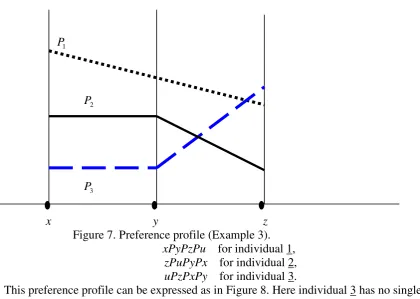
This preference profile can be expressed as in Figure 7. For P2 P1 we can write yP2z and
z
yP1 , also for P3 P2 we can write xI3y and yP2z. So that preference profiles satisfy single-crossing on A, relative to x< y< z. From Figure 7 we see that individuals 2 and 3 have no single-peak or single-plateau. But according to the definition the preference profile this example satisfies top-monotonicity relative tox< y<z.
Example 4: (is given below) shows that top-monotonicity satisfies even the preference profile does not satisfy single-peakedness, single-crossing or single-plateau.
P1
P2
P3
•
•
•
x y zFigure 7. Preference profile (Example 3).
xPyPzPu for individual 1,
zPuPyPx for individual 2,
uPzPxPy for individual 3.
This preference profile can be expressed as in Figure 8. Here individual 3 has no single-peak. If P3 P2 P1 then xP1y and yP2x but xP3y. If P2 P3 P1
P1
P2
P3
•
•
•
•
[image:12.595.68.489.66.365.2]x y z u
Figure 8. Preference profile (Example 4).
then zP1u and uP3z but zP2u. At last if P3 P1 P2 then uP2yand yP1u but uP3y. Hence preference profile is not order-restricted and not single-crossing. But by the definition the preference profile is top-monotonic relative tox< y<z<u.
Non-single-peakedness
A preference profile is not single-peaked if for any linear ordering of alternatives there is always an agent for whom there is one alternative ordered between two preferred ones i.e.,
∉
L Li
(
A,P)
⇒∃i∈N, for x,y,z∈A such that x, y and z are consecutive in this order in Lpreferences. Then Condorcet cycle (Islam et al. 2011) must arise as a result the MVT must fail. In Figure 9 voter V2 does not has single-peaked preference.
The preference relations being as follows:
xPyPz for voter 1,
xPzPy for voter 2,
zPyPx for voter 3. Utility
V2
V1
V3
•
•
•
L x y z RFigure 9. Non-single-peaked preferences.
The preferences satisfy a condition single-dipped preference and have an ordering.
Comparison among Restrictions
In the light of above discussion we see that single-crossing and single-peakedness are different assumptions. Both assumptions give us a result which is “the median
voter’s ideal point is a Condorcet winner”. On the other hand both assumptions give different property i.e., single-crossingproperty implies the ideal point of the median voter and the single-peakedness property implies the median of the voters’
P1
P3
P2
•
•
•
x y zideal points. Single-crossing assumption follows transitive ordering but does not follow the single-peakedness assumption. Single-peakedness and single-crossing appeared independently of each other in the economic literature, that they do not imply one another, and that each one results from its own underlying logic.
Now we set an example to show the difference between crossing and single-peakedness (Saporiti 2008). Consider the set of preference relations as follows:
z yP
xP1 1 for individual 1,
y zP
xP2 2 for individual 2,
x yP
zP3 3 for individual 3 .
We observe that this set has single-crossing property on Y =
{
x,y,z}
with respect to order-restriction x< y< z and the preference relation P3 P2 P1 (Figure 10). On the other hand, for every ordering of the alternatives,{
P1,P2,P3}
violates the single-peaked property because, every alternative is ranked less preferred in one preference relation.LIMITATION OF THE MEDIAN VOTER MODEL
Although median voter model plays a pioneer role in election but it does not exist always. For example in the voting paradox (is given below) we have found no median voter.
Now we discuss the Condorcet voting paradox in which there is no Condorcet winner (Condorcet 1785, Risse 2005). Let us assume that there are 17 voters of three types and three alternatives x, y, z. Let preference relations being as follows:
Type 1: xPyPz by 8 voters, Type 2: yPzPx by 5 voters, Type 3: zPxPy by 4 voters.
In an election a vote between x and y, candidate x collects 8 + 4 = 12 votes and y collects 5 votes, so that x wins. Again a vote between y and z, candidate y collects 8 + 5 = 13 votes and
z collects 4 votes, so that y wins. Again a vote between x and z, candidate x collects 8 votes and z collects 4 + 5 = 9 votes, so that z wins. We observe that there is a cycle in the voting results where x is defeated by y, and y is defeated by z,and also z is defeated by x, which is a voting paradox.
The absence of median voter equilibrium may also arise in models where candidates can manipulate information and voter turnout. Indecision and chaos may create in such majority voting models. So that MVT is an important item in the democracy in all times.
CONCLUDING REMARKS
REFERENCES
Arrow K J (1963), Social Choice and Individual Values, 2nd edn. New York, John Wiley & Sons.
Ballaester M A, Haeringer G (2006), A Characterizatio of Single-peaked Preferences:
Barcelona
Economic working paper series, working paper no. 273.
Barbera S, Moreno B (2008), Top Monotonocity: A Common Root for Single-peakedness Single-
crossing and the Median Voter Result, Centre de Refevenecin en Economia, Analitica.
working paper no. 297.
Barbera S (2010), Strategy-proof Social Choice:In Arrow K. J., Sen A. K.and Suzumura K.
A Handbook of Social Choice and Welfare, Elsevier, Amsterdam (forthcoming). Black D (1948), On the Rational of Group Decision Making, Journal of Political Economics
56: pp 23-34.
Black D (1958), Theory of Committees and Elections, Cambridge University Press.
Borda J C (1781), Me′moiré surles E′lections au scrutin. historie re l’academie oyale des sciences, Paris.
Condorcet M (1785), Essai sur l’application de l analyse a la probabilite des de′cisions rendues
a la pluralite′ des vopix, Paris.
Congleton R (2004), The Median Voter Model. In the Encyclopedia of Public Choice Vol II. edited by Charles. K. Rowley and Friedrich Schneider. (Dordrecht, Kluwer): pp 382-387. Gans J S, Smart M (1994), Majority Voting with Single-Crossing Preferences. Journal of
Public Economics. Elsevier. Vol. 59 (2): pp 219-237.
Islam J N (1997), Aspects of Mathematical Economics and Social Choice Theory, Proceedings of
the Second Chittagong Conference on Mathematical Economics and its Relevance for Develop
(ed.) J N Islam. Chittagong, Bangladesh: University of Chittagong.
Islam J N (2008), An Introduction to Mathematical Economics and Social Choice Theory, book to
appear.
Islam J N, Mohajan H K and Moolio P (2009a), Preference of Social Choice in Mathematical Economics. Indus Journal of Management and Social Sciences, 3(1): pp 17-38.
Islam J N, Mohajan H K and Moolio P (2009b), Political Economy and Social Welfare with Voting Procedure, KASBIT Business Journal, 2(1&2): pp 42-66.
Islam J N, Mohajan H K and Moolio P (2011), Method of Voting System and Manipulation of Voting: International Journal of Management and Transformation,5(1): pp 10-34. Brown Walker Press, USA.
Klaus B (2001), Coalitional Strategy-proofness in Economies with Single-dipped Preferences and the Assignment of an Indivisible Object, Games and Economic Behavior 34: pp 64-82.
Klaus B, Peters H and Storcken T (1997), Strategy-proof Division of a Private Good when Preferences are Single-dipped, Economics Letters, 55: pp 339-346.
Myerson R B (1996), Fundamentals of Social Choice Theory. Discussion Paper-1162, Centre for Mathematical Studies in Economics and Management Science, Northwestern University.
Penn E M, Gailmard S and Patty J W (2008), Strategic Manipulation in Representative Institution, unpublished manuscript.
Risse M (2005), Why the Count de Borda cannot Beat the Marquis de Condorcet, Social Choice and Welfare, 25(1): pp 95-113.
Rothstein P (1990), Order-restricted Preferences and Majority Rule, Social Choice and Welfare 7: pp 331-342.
Saporiti A, Thome F (2006), Single-crossing, Strategic Voting and the Median Choice Rule,
Social Choice and Welfare 26: pp 363-383.
Saporiti A (2008), Strategy-proof and Single-crossing, unpublished manuscript, University of Manchester.