339
BENGAL: An Automatic Benchmark Generator for Entity Recognition
and Linking
Axel-Cyrille Ngoma Ngomo1,2 Michael Röder1 Diego Moussallem1,2 Ricardo Usbeck1 René Speck1,2 1Data Science Group, University of Paderborn, Germany
2AKSW Research Group, University of Leipzig, Germany
{first.lastname}@upb.de
Abstract
The manual creation of gold standards for named entity recognition and entity linking is time- and resource-intensive. Moreover, recent works show that such gold standards contain a large propor-tion of mistakes in addipropor-tion to being difficult to maintain. We hence present BENGAL, a novel automatic generation of such gold standards as a complement to manually created benchmarks. The main advantage of our benchmarks is that they can be readily generated at any time. They are also cost-effective while being guaranteed to be free of annotation errors. We compare the per-formance of 11 tools on benchmarks in English generated by BENGALand on 16 benchmarks created manually. We show that our approach can be ported easily across languages by presenting results achieved by 4 tools on both Brazilian Por-tuguese and Spanish. Overall, our results suggest that our automatic benchmark generation approach can create varied benchmarks that have characteristics similar to those of existing benchmarks. Our approach is open-source. Our expe-rimental results are available at http: //faturl.com/bengalexpinlg and the code at https://github. com/dice-group/BENGAL.
1 Introduction
The creating of gold standard is of central im-portance for the objective assessment and devel-opment of approaches all around computer sci-ence. For example, evaluation campaigns such as BioASQ (Tsatsaronis et al.,2012) have led to an
improvement of the F-measure achieved by bio-medical question answering systems by more than 5%. While the manual creation of Named En-tity Recognition (NER) and EnEn-tity Linking (EL) gold standards (also called benchmarks) has the advantage of yielding resources which reflect hu-man processing, it also exhibits significant dis-advantages: a) Annotation mistakes: Human an-notators have to read through every sentence in the corpus and often (a) miss annotations or (b) assign wrong resources to entities for reasons as various as fatigue or lack of background knowl-edge (and this even when supported with annota-tion tools). For example, Jha et al. (2017) was able to determine that up to 38,453 of the anno-tations in commonly used benchmarks (see GER-BIL (Usbeck et al.,2015) for a list of these bench-marks) were erroneous. A manual evaluation of 25 documents from the ACE2004 benchmark re-vealed that 195 annotations were missing and 14 of 306 annotations were incorrect. Similar find-ings were reported for AIDA/CONLL (Tjong Kim Sang and De Meulder,2003) and OKE2015 ( Nuz-zolese et al., 2015). b) Volume: Manually cre-ated benchmarks are usually small (commonly
< 2,500 documents, see Table 2). Hence, they are of little help when aiming to benchmark the scalability of existing solutions (especially when these solutions use caching). c)Lack of updates: Manual benchmark generation approaches lead to static corpora which tend not to reflect the newest reference knowledge graphs (also called Knowl-edge Base (KB)s). For example, several of the benchmarks presented in GERBIL (Usbeck et al.,
NER and EL solutions.
Automatic methods are a viable and supple-mentaryapproach for the generation of gold stan-dards for NER and EL, especially as they address some of the weaknesses of the manual bench-mark creation process. The main contribution of our paper is a novel approach for the auto-matic generation of benchmarks for NER and EL dubbed BENGAL. Our approach relies on the abundance of structured data in Resource Descrip-tion Framework (RDF) on the Web and is based on Natural Language Generation (NLG) techniques which verbalize such data to generate automati-cally annotated natural language statements. Our automatic benchmark creation method addresses the drawbacks of manual benchmark generation aforementioned as follows: a)It alleviates the hu-man annotation error problem by relying on data in RDF which explicitly contain the entities to find. b) BENGAL is able to generate arbitrarily large benchmarks. Hence, it can enhance the mea-surement of both the accuracy and the scalability of approaches. c) BENGAL can be updated eas-ily to reflect the newest terminology and reference KBs. Hence, it can generate corpora that reflect the newest KBs. d) BENGAL is not biased to-wards popular resources as it can choose entities to include in the benchmark generated following a uniform distribution.e)BENGALcan be ported to any token-based language. This is exemplified by porting BENGALto Portuguese and Spanish.
2 Related Work
2.1 Gold Standards for NER and EL
According to GERBIL (Usbeck et al., 2015), the 2003 CoNLL shared task (Tjong Kim Sang and De Meulder, 2003) is the most used bench-mark dataset for recognition and linking. The ACE2004 and MSNBC (Cucerzan, 2007) news datasets were used by Ratinov et al. (Ratinov et al.,2011) to evaluate their seminal work on link-ing to Wikipedia. Another often-used corpus is AQUAINT, e.g., used by Milne and Witten (Milne and Witten, 2008). Detailed dataset statistics on some of these benchmarks can be found in Table2. A recent uptake of publicly available cor-pora (Röder et al., 2014; Steinmetz et al., 2013) based on RDF has led to the creation of many new datasets. For example, the Spotlight cor-pus and the KORE 50 dataset were proposed to showcase the usability of RDF-based
annota-tions (Mendes et al.,2011). The multilingual N3 collection (Röder et al.,2014) was introduced to widen the scope and diversity of NIF-based cor-pora. Another recent observation is the shift to-wards gold standards for micropost documents like tweets. For example, the Microposts2014 cor-pus (Cano Basave et al.,2014) was created to eval-uate NER on smaller pieces of text.
Semi-automatic approaches to benchmark cre-ation are commonly crowd-based. They use one or more recognizers to create a first set of annotations and then hand over the tasks of refinement and/or linking to crowd workers to improve the quality. Examples of such approaches includeVoyer et al.
(2010) and CALBC (Rebholz-Schuhmann et al.,
2010). Oramas et al.(2016) introduced a voting-based algorithm which analyses the hyperlinks presented in the input texts retrieved from different disambiguation systems such as Babelfy (Moro et al.,2014). Each entity mention in the input text is linked based on the degree of agreement across three EL systems.
BENGAL is the first automatic approach that makes use of structured data and can be replicated on any RDF KB for EL benchmarks.
2.2 NLG for the Web of Data
A plethora of works have investigated the genera-tion of Natural Language (NL) texts from Seman-tic Web Technologies (SWT) such as Staykova
(2014); Bouayad-Agha et al. (2014). However, the generation of NL from RDF has only recently gained momentum. This attention comes from the great number of published works such as ( Cimi-ano et al.,2013;Duma and Klein, 2013;Ell and Harth, 2014; Biran and McKeown, 2015) which used RDF as an input data and achieved promis-ing results. Moreover, the works published in the WebNLG (Colin et al., 2016) challenge, which used deep learning techniques such as (Sleimi and Gardent, 2016; Mrabet et al., 2016), also con-tributed to this interest. RDF has also been show-ing promisshow-ing benefits to the generation of bench-marks for evaluating NLG systems, e.g., ( Gar-dent et al., 2017; Perez-Beltrachini et al., 2016;
Mohammed et al., 2016; Schwitter et al., 2004;
3 The BENGALapproach
BENGAL is based on the observation that more than 150 billion facts pertaining to more than 3 billion entities are available in machine-readable form on the Web (i.e., as RDF triples).1 The basic intuition behind our approach is hence as follows: Given that NER and EL are often used in pipelines for the extraction of machine-readable facts from text, we can invert the pipeline and go from facts to text, thereby using the information in the facts to produce a gold standard that isguaranteed to con-tain no errors. In the following, we begin by giv-ing a brief formal overview of RDF. Thereafter, we present how we use RDF to generate NER and EL benchmarks automatically and at scale.
3.1 Preliminaries and Notation
3.1.1 RDF
The notation presented herein is based on the RDF 1.1 specification. An RDF graphGis a set of facts. Each fact is a triplet= (s, p, o)∈(R∪B)×P× (R∪B∪L)whereRis the set of all resources (i.e., things of the real world),P is the set of all pred-icates (binary relations), B is the set of all blank nodes (which basically express existential quan-tification) and L is the set of all literals (i.e., of datatype values). We call the setR∪P ∪L∪B
our universe and call its elements entities. A frag-ment of DBpedia2 is shown below. We will use this fragment in our examples. For the sake of space, our examples are in English. However, note that we ported BENGALto Portuguese and
Span-ish so as to exemplify that it is not biased towards a particular language. Also, the morphological rich-ness of both led us to choose them as languages.
:Albert_Einstein dbo:birthPlace :Ulm . :Albert_Einstein dbo:deathPlace :
Princeton .
:Albert_Einstein rdf:type dbo:Scientist .
:Albert_Einstein dbo:field :Physics . :Ulm dbo:country :Germany.
:Albert_Einstein rdfs:label "Albert Einstein"@en.
Listing 1: Example RDF dataset.
3.1.2 Benchmarks
We define a benchmark as a set C of anno-tated documents Di. Each documentDi is a
se-quence of characterssi1. . . sin. Each subsequence
1
http://stats.lod2.eu 2http://dbpedia.org
sij. . . sik(withj < k) of the documentDiwhich
stands for a resource r ∈ R is assumed to be marked as such. We model the marking of re-sources by the function m : C ×N×N → R
and writem(Di, j, k) = rto signify that the
sub-stringsij. . . sikstands for the resourcer. In case
the substring sij. . . sik does not stand for a
re-source, we write m(Di, j, k) = . Let D0 be
the example shown in Listing2. We would write
m(D0,0,14) =:AlbertEinstein.
Albert Einstein was born in Ulm.
Listing 2: Example sentence.
3.2 Verbalization
The notation and formal framework for verbalization in BENGAL are based on
SPARQL2NL (Ngonga Ngomo et al., 2013). Let W be the set of all words in the dictionary of our target language (e.g., English). We define the realization function ρ : R ∪P ∪L → W∗
as the function which maps each entity to a word or sequence of words from the dictionary. Formally, the goal of our NLG approach is to devise an extension ofρ to conjunctions of RDF triples. This extension maps all triples t to their realization ρ(t) and defines how these atomic realizations are to be combined. We denote the extension of ρ by the same label ρ for the sake of simplicity. We adopt a rule-based approach to devise the extension of ρ, where the rules extending ρ to RDF triples are expressed in a conjunctive manner. This means that for premises
P1, . . . , Pn and consequences K1, . . . , Km we
write P1 ∧ . . .∧ Pn ⇒ K1 ∧ . . . ∧Km. The
premises and consequences are explicated by using an extension of the Stanford dependencies.3 We rely especially on the constructs explained in Table 1. For example, a possessive depen-dency between two phrase elements e1 and e2
is represented as poss(e1, e2). For the sake
of simplicity, we sometimes reduce the con-struct subj(y,x)∧ dobj(y,z) to the triple
(x,y,z)∈W3.
3.3 Approach
BENGALassumes that it is given (1) an RDF graph
G⊆(R∪B)×P×(R∪B∪L), (2) a number of
3For a complete description of the vocabulary,
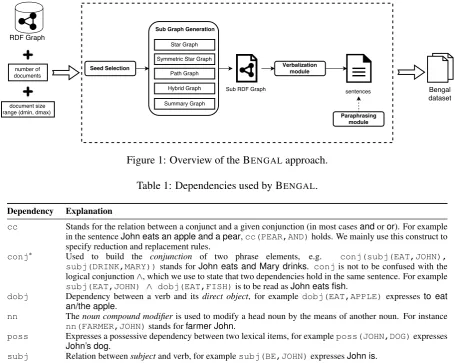
Figure 1: Overview of the BENGALapproach.
Table 1: Dependencies used by BENGAL.
Dependency Explanation
cc Stands for the relation between a conjunct and a given conjunction (in most casesandoror). For example in the sentenceJohn eats an apple and a pear,cc(PEAR,AND)holds. We mainly use this construct to specify reduction and replacement rules.
conj∗ Used to build the conjunction of two phrase elements, e.g. conj(subj(EAT,JOHN), subj(DRINK,MARY))stands forJohn eats and Mary drinks. conjis not to be confused with the logical conjunction∧, which we use to state that two dependencies hold in the same sentence. For example subj(EAT,JOHN) ∧ dobj(EAT,FISH)is to be read asJohn eats fish.
dobj Dependency between a verb and its direct object, for exampledobj(EAT,APPLE) expressesto eat an/the apple.
nn Thenoun compound modifieris used to modify a head noun by the means of another noun. For instance
nn(FARMER,JOHN)stands forfarmer John.
poss Expresses a possessive dependency between two lexical items, for exampleposs(JOHN,DOG)expresses
John’s dog.
subj Relation betweensubjectand verb, for examplesubj(BE,JOHN)expressesJohn is.
documents to generate, (3) a minimal resp. max-imal document size (i.e., number of triples to use during the generation process)dmin resp. dmax,
(4) a set of restrictions pertaining to the resources to generate and (5) a strategy for generating single documents. Given the graph G, BENGALbegins by selecting a set ofseed resourcesfromGbased on the restrictions set using parameter (4). There-after, it uses the strategy defined via parameter (5) to select a subgraph of G. This subgraph con-tains a randomly selected numberdof triples with
dmin ≤d ≤ dmax. The subgraph is then
verbal-ized. The verbalization is annotated automatically and finally returned as a single document. Each single document then may be paraphrased if this option is chosen in the initial phase. This process is repeated as many times as necessary to reach the predefined number of documents. In the fol-lowing, we present the details of each step under-lying our benchmark generation process displayed inFigure 1.
3.3.1 Seed Selection
Given that we rely on RDF, we model the seed se-lection by means of a SPARQL SELECT query with one projection variable. Note that we can use the wealth of SPARQL to devise seed selec-tion strategies of arbitrary complexity. However, given that NER and EL frameworks commonly focus on particular classes of resources, we are confronted with the condition that the seeds must be instances of a set of classes, e.g., :Person,
:Organization or :Place. The SPARQL query for our example dataset would be as follows:
SELECT ?x WHERE { {?x a :Person.} UNION
{?x a :Organization.} UNION {?x a : Place.} }
Listing 3: Example seed selection query.
3.3.2 Subgraph Generation
Our approach to generating subgraphs is reminis-cent of SPARQL query topologies as available in SPARQL query benchmarks. As these queries (e.g., FEASIBLE4queries) describe real
tion needs, their topology must stand for the type of information that is necessitated by applications and humans. We thus distinguish between three main types of subgraphs to be generated from RDF data: (1) star graphs provide information about a particular entity (e.g, the short biography of a person); (2)path graphsdescribe the relations between two entities (e.g., the relation between a gene and a side-effect); (3) hybrid graphs are a mix of both and commonly describe a specialized subject matter involving several actors (e.g., a de-scription of the cast of a movie).
Star Graphs. For each si ∈ S, we gather all
triples of the form t = (si, p, o) ∈ R ×P ×
(R ∪ L).5 The triples are then added to a list
L(si) sorted in descending order according to a
hash functionh. After randomly selecting a doc-ument sizedbetweendminanddmax, we selectd
random triples fromL(si). For the dataset shown
in Listing1andd= 2, we would for example get Listing4.
:AlbertEinstein :birthPlace :Ulm . :AlbertEinstein :deathPlace :Princeton .
Listing 4: Example dataset generated by the star strategy.
Symmetric Star Graphs. As above with t ∈ {(si, p, o)∈G∨(o, p, si)∈G}.
Path Graphs. For each si ∈ S, we begin
by computing listL(si) as in the symmetric star
graph generation. Then, we pick a random triple (si, p, o)or(o, p, si)fromL(si)that is such thato
is a resource. We then useoas seed and repeat the operation until we have generateddtriples, where
dis randomly generated as above. For the example dataset shown in Listing1andd = 2, we would for example get Listing5.
:AlbertEinstein :birthPlace :Ulm . :Ulm :country :Germany .
Listing 5: Example dataset generated by the path strategy.
Hybrid Graphs. This is a 50/50-mix of the star and path graph generation approaches. In each it-eration, we choose and apply one of the two strate-gies above randomly. For example, the hybrid graph generation can generate:
:AlbertEinstein :birthPlace :Ulm . :AlbertEinstein :deathPlace :Princeton .
5Note that we do not consider blank nodes as they cannot
be verbalized due to the existential quantification they stand for.
:Ulm :country :Germany .
Listing 6: Example dataset generated by the hybrid strategy.
Summary Graph Generation. This last strat-egy is a specialization of the star graph genera-tion where the set of triples to a resource is not chosen randomly. Instead, for each class (e.g.,
:Person) of the input KB, we begin by filter-ing the set of properties and only consider prop-erties that (1) have the said class as domain and (2) achieve a coverage above a user-set threshold (60% in our experiments) (e.g.,:birthPlace,
:deathPlace, :spouse). We then build a property co-occurence graph for the said class in which the nodes are the properties selected in the preceding step and the co-occurence of two properties p1 and p2 is the instance r of the
in-put class where ∃o1, o2 : (r, p1, o1) ∈ K ∧
(r, p2, o2) ∈ K. The resulting graph is then
clustered (e.g., by using the approach presented byNgonga Ngomo and Schumacher(2009)). We finally select the clusters which contain the prop-erties with the highest frequencies in K that al-low the selection of at least d triples from K. For example, if :birthPlace (frequency = 10), :deathPlace (frequency = 10) were in the same cluster while :spouse (frequency = 8) were in its own cluster, we would choose the pair (:birthPlace, :deathPlace) and turn the corresponding triples for our input re-source. Hence, we would return Listing4for our running example.
3.3.3 Verbalization module
The verbalization (micro-planning) strategy for the first four strategies consists of verbalizing each triple as a single sentence and is derived from SPARQL2NL (Ngonga Ngomo et al.,2013). To verbalize the subject of the triplet= (s, p, o), we use one of its labels according to Ell et al.
(2011) (e.g., the rdfs:label). If the object
o is a resource, we follow the same approach as for the subject. Importantly, the verbalization of a triple t = (s, p, o) depends mostly on the verbalization of the predicate p (see Table 1
for semantics). If p can be realized as a noun phrase, then a possessive clause can be used to express the semantics of(s, p, o). For example, if
p can be verbalized as a nominal compound like
subj(BE,ρ(p)) ∧ dobj(BE,ρ(o)). In case p’s realization is a verb, then the triple can be verbal-ized assubj(ρ(p),ρ(s)) ∧ dobj(ρ(p),ρ(o)). In our example, verbalizing (:AlbertEinstein,
dbo:birthPlace, :Ulm) would thus lead to
Albert Einstein’s birth place is Ulm., asbirth placeis a noun.
In the case of summary graphs, we go be-yond the verbalization of single sentences and merge sentences that were derived from the same cluster. For example, if p1 and p2 can be verbalized as nouns, then we
apply the following rule: ρ(s, p1, o1) ∧ ρ(s, p2, o2) ⇒ conj(poss(ρ(p1), ρ(s)) ∧ subj(BE1, ρ(p1)) ∧ dobj(BE1, ρ(o1)) ∧ poss(ρ(p2), ρ(pronoun(s))) ∧ subj(BE2, ρ(p2)) ∧ dobj(BE2, ρ(o2)). Note
that pronoun(s) returns the correct pronoun for a resource based on its type and gender. There-with, we can generate Albert Einstein’s birth place is Ulm and his death place is Princeton.
3.3.4 Paraphrasing
With this step, BENGALavoids the generation of a large number of sentences that share the same terms and the same structure. Additionally, this step makes the use of reverse engineering strate-gies for the generation more difficult as it increases the diversity of the text in the benchmarks. Our paraphrasing is largely based onAndroutsopoulos and Malakasiotis(2010) and runs as follows:
1. Change the structure of the sentence: We use the location of verbs in each sentence to ran-domly change passive into active structures and vice-versa. Sentences which describe type information (e.g., Einstein is a person) are not altered.
2. Replace synonyms: We use POS tags to se-lect alternative labels from the knowledge base and a reference dictionary to replace en-tity labels by a synonym.
An example of a paraphrase generated by BEN -GALis shown in Listing7.
Original: Edmund Pettus Bridge is a bridge. It crosses Alabama River. Its type is Through arch bridge. It was declared a National Historic Landmark on March 11, 2013.
Paraphrased: Edmund Pettus Bridge is a bridge. It crosses Alabama River.
Through arch bridge is its type. Pettus was declared a National Historic Landmark on March 11, 2013.
Listing 7: Example Paraphasing at Summary Generation
4 Experiments and Results
We generated 13 datasets in English (B1-B13), 4 datasets in Brazilian Portuguese and 4 datasets in Spanish to evaluate our approach.6 B1 to B10 were generated by running our five sub-graph gen-eration methods with and without paraphrasing. The number of documents was set to 100 while (dmin, dmax) was set to (1,5). B11 shows how
BENGAL can be used to evaluate the scalability of approaches.7 Here, we used the hybrid gener-ation strategy to generate 10,000 documents. B12 and B13 comprise 10 longer documents each with
dminset to 90. For B12, we focused on generating
a high number of entities in the documents while B13 contains less entities but the same number of documents.
We compared B1-B13 with the 16 manually created gold standards for English found in GER-BIL. The comparison was carried out in two ways. First, we assessed the features of the datasets. Then, we compared the micro F-measure of 11 NER and EL frameworks on the manually and au-tomatically generated datasets. We chose to use these 11 frameworks because they are included in GERBIL. This inclusion ensures that their inter-faces are compatible and their results comparable. In addition, we assessed the performance of multi-lingual NER and EL systems on the datasets P1-P4 to show that BENGALcan be easily ported to lan-guages other than English.
4.1 English Dataset features
The first aim of our evaluation was to quantify the variability of the datasets B1–B13 generated by BENGAL. To this end, we compared the dis-tribution of the part of speech (POS) tags of the BENGALdatasets with those of the 16 benchmark datasets. An analysis of the Pearson correlation of these distributions revealed that the manually
6
All BENGAL datasets can be found at https: //hobbitdata.informatik.uni-leipzig.de/ bengal/
created datasets (D1–D16) have a high correla-tion (0.88 on average) with a minimum of 0.61 (D10–D16). The correlation of the POS tag dis-tributions between BENGALdatasets and a manu-ally created dataset vary between 0.34 (D7–B11) and 0.89 (D14–B9) with an average of 0.67. This shows that BENGAL datasets can be generated to
be similar to manually created datasets (D14–B9) as well as to be very different to them (D7–B11). Hence, BENGALcan be used for testing sentence
structures that are not common in the current man-ually generated benchmarks.8
We also studied the distribution of entities and tokens across the datasets in our evaluation. Ta-ble 2 gives an overview of these distributions, where E is the set of entities in the corpus C. The distribution of values for the different features is very diverse across the different manually cre-ated datasets. This is mainly due to (1) different ways to annotate entities and (2) the domains of the datasets (news, description of entities, microp-osts). As shown in Table2, BENGALcan be easily configured to generate a wide variety of datasets with similar quality and number of documents to those of real datasets. This is mainly due to our ap-proach being able to generate benchmarks ranging from (1) benchmarks with sentences containing a large number of entities without any filler terms (high entity density) to (2) benchmarks which con-tain more information percon-taining to entity types and literals (low entity density).
4.2 Annotator performance
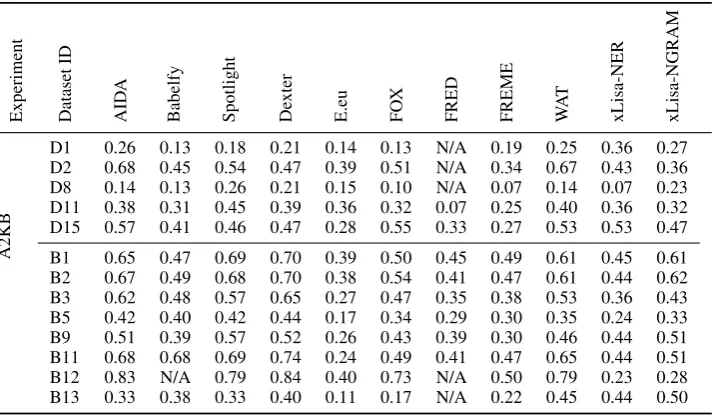
We used GERBIL to evaluate the performance of 11 annotators on the manually created as well as the BENGAL datasets. We evaluated the anno-tators within an A2KB (annotation to knowledge base) experiment setting: Each document of the corpora was sent to each annotator. The annota-tor had to find and link all entities to a reference KB (here DBpedia). We measured both the per-formance of the NER and the EL steps.
Table3shows the micro F1-score of the differ-ent annotators on chosen datasets. The manually created datasets showed diverse results. We ana-lyzed the results further by using the F1-scores of the annotators as features of the datasets. Based on these feature vectors, we calculated the Pear-son correlations between the datasets to identify
8Our complete results athttps://goo.gl/TBDxCa.
datasets with similar characteristics.9 The Pear-son correlations of the F-measures achieved by the different annotators on the AIDA/CoNLL datasets (D2–D5) are very high (0.95–1.00) while the relation between the results on the Spotlight corpus (D7) and N3Reuters128 (D13) is around -0.62. The results on D1 and D12–D15 have a cor-relation to the AIDA/CoNLL results (D2–D5) that is higher than 0.5. In contrast, the correlations of D7 and D8 to the AIDA/CoNLL datasets range from -0.54 to -0.36. These correlations highlight the diversity of the manually created datasets and suggest that creating an approach which emulates all datasets is non-trivial.
Like the correlations between the manually cre-ated datasets, the correlations between the results achieved on BENGAL datasets and hand-crafted datasets vary. The results on BENGAL corre-late most with the results on the OKE 2015 data. The highest correlations were achieved with the OKE 2015 Task 1 dataset and range between 0.89 and 0.92. This suggests that our benchmark can emulate entity-centric benchmarks. The correla-tion of BENGAL with OKE is however reduced to 0.82 in D13, suggesting that BENGAL can be parametrized so as to diverge from such bench-marks. A similar observation can be made for the correlation D12 and ACE2004, where the correla-tion increased with the size of the documents in the benchmark. The correlation between the re-sults across BENGALdatasets varies between 0.54
and 1, which further supports that BENGAL can generate a wide range of diverse datasets.
4.3 Annotator Performance on Spanish and Brazilian Portuguese
We implemented BENGAL for Brazilian
Por-tuguese by using the RDF verbalizer presented in Moussallem et al. (2018) and ran four multilingual NER and EL (MAG (Moussallem et al., 2017), DBpedia Spotlight, Babelfy, and PBOH (Ganea et al.,2016)) frameworks thereon. We also evaluated the performance of these anno-tators on subsets of the HAREM datasets (Freitas et al., 2010)10. We then extended this verbalizer to Spanish using the adaption of SimpleNLG to Spanish (Soto et al.,2017). We generated Span-ish BENGALdatasets and evaluated the
aforemen-9
All values are athttp://goo.gl/Mg3rE1.
Table 2: Excerpt of the features of the datasets used in our evaluation. The datasets B4, B6, B8 and B10 are paraphrased versions of B3, B5, B7 resp. B9 and share similar characteristics.
ID Name Doc.|C| Tokens|T| Entities|E| |T|/|C| |E|/|C| |E|/|T|
D1 ACE2004 57 21312 306 373.9 5.4 0.01
D2 AIDA/CoNLL-Complete 1393 245008 34929 175.9 25.1 0.14
D8 IITB 104 66531 18308 639.7 176.0 0.28
D11 Microposts2014-Train 2340 40684 3822 17.4 1.6 0.09 D15 OKE 2015 Task 1 evaluation 101 3064 664 30.3 6.6 0.22
B1 BENGALPath 100 100 1202 362 12.02 3.6 0.30 B2 BENGALPath Para 100 100 1250 362 12.5 3.6 0.29 B3 BENGALStar 100 100 3039 880 30.39 8.8 0.29 B5 BENGALSym 100 100 2718 725 27.18 7.25 0.26 B9 BENGALSummary 100 100 2033 637 20.33 6.37 0.31 B11 BENGALHybrid 10000 10000 556483 165254 55.6 16.5 0.30 B12 BENGALHybrid Long 10 10 9162 2417 241.7 916.2 0.26 B13 BENGALStar Long 10 10 7369 316 31.6 736.9 0.04
Table 3: Excerpt of micro F1-scores of the annotators for the A2KB experiments on chosen datasets. N/A means that the annotator stopped with an error.
Experiment Dataset
ID
AID
A
Babelfy Spotlight De
xter
E.eu FO
X
FRED FREME WA
T
xLisa-NER xLisa-NGRAM
A2KB
D1 0.26 0.13 0.18 0.21 0.14 0.13 N/A 0.19 0.25 0.36 0.27 D2 0.68 0.45 0.54 0.47 0.39 0.51 N/A 0.34 0.67 0.43 0.36 D8 0.14 0.13 0.26 0.21 0.15 0.10 N/A 0.07 0.14 0.07 0.23 D11 0.38 0.31 0.45 0.39 0.36 0.32 0.07 0.25 0.40 0.36 0.32 D15 0.57 0.41 0.46 0.47 0.28 0.55 0.33 0.27 0.53 0.53 0.47
B1 0.65 0.47 0.69 0.70 0.39 0.50 0.45 0.49 0.61 0.45 0.61 B2 0.67 0.49 0.68 0.70 0.38 0.54 0.41 0.47 0.61 0.44 0.62 B3 0.62 0.48 0.57 0.65 0.27 0.47 0.35 0.38 0.53 0.36 0.43 B5 0.42 0.40 0.42 0.44 0.17 0.34 0.29 0.30 0.35 0.24 0.33 B9 0.51 0.39 0.57 0.52 0.26 0.43 0.39 0.30 0.46 0.44 0.51 B11 0.68 0.68 0.69 0.74 0.24 0.49 0.41 0.47 0.65 0.44 0.51 B12 0.83 N/A 0.79 0.84 0.40 0.73 N/A 0.50 0.79 0.23 0.28 B13 0.33 0.38 0.33 0.40 0.11 0.17 N/A 0.22 0.45 0.44 0.50
tioned NER and EL systems on them. 11 We also included VoxEL (Rosales-Méndez et al.,2018), a recent gold standard for Spanish. While the ex-tension of BENGALto Portuguese is an important
result in itself, our results also provide additional insights in the NER and EL performance of exist-ing solutions. Our results suggest that existexist-ing so-lutions are mostly biased towards a high precision but often achieve a lower recall on this language. For example, both Spotlight’s and Babelfy’s recall remain below 0.6 in most cases while their preci-sion goes up to 0.9. This clearly results from the lack of training data for these resource-poor lan-guages. In contrast, the Spanish annotators pre-sented low but consistent results, which confirms
11All Spanish results at http://faturl.com/ bengales.
the lack of training data of these approaches on Spanish.
5 Discussion and Conclusion
We presented and evaluated BENGAL, an
ap-proach for the automatic generation of NER and EL benchmarks. Our results suggest that our approach can generate diverse benchmarks with characteristics similar to those of a large propor-tion of existing benchmarks in several languages.
Overall, our results suggest that BENGAL
benchmarks can ease the development of NER and EL tools (especially for resource-poor languages) by providing developers with insights into their performance at virtually no cost. Hence, BENGAL
[image:8.595.120.477.305.513.2]ability of BENGAL to generate longer and more complex sentences as well as the capability of gen-erating different surface forms for a given entity by relying on referring expression models such as NeuralREG model (Castro Ferreira et al., 2018). We also intend to provide thorough evaluations of annotators across other resource-poor languages and create corresponding datasets to push the de-velopment of tools to process these languages.
Acknowledgements
This work has been supported by the H2020 project HOBBIT (GA no. 688227) as well as the BMVI projects LIMBO (project no. 19F2029C), OPAL (project no. 19F20284) and also supported by the German Federal Ministry of Education and Research (BMBF) within ’KMU-innovativ: Forschung für die zivile Sicherheit’ in particu-lar ’Forschung für die zivile Sicherheit’ and the project SOLIDE (no. 13N14456). The authors gratefully acknowledge financial support from the German Federal Ministry of Education and Re-search within Eurostars, a joint programme of EU-REKA and the European Community under the project E! 9367 DIESEL and E! 9725 QAMEL.
References
Ion Androutsopoulos and Prodromos Malakasiotis. 2010. A survey of paraphrasing and textual entail-ment methods. Journal of Artificial Intelligence Re-search, pages 135–187.
Or Biran and Kathleen McKeown. 2015. Discourse planning with an n-gram model of relations. In
EMNLP, pages 1973–1977.
Nadjet Bouayad-Agha, Gerard Casamayor, and Leo Wanner. 2014. Natural language generation in the context of the semantic web. Semantic Web, 5(6):493–513.
Amparo Elizabeth Cano Basave, Giuseppe Rizzo, An-drea Varga, Matthew Rowe, Milan Stankovic, and Aba-Sah Dadzie. 2014. Making sense of microposts (#microposts2014) named entity extraction & link-ing challenge. InProceedings of 4th Workshop on Making Sense of Microposts.
Thiago Castro Ferreira, Diego Moussallem, Ákos Kádár, Sander Wubben, and Emiel Krahmer. 2018. Neuralreg: An end-to-end approach to referring ex-pression generation. InProceedings of the 56th An-nual Meeting of the Association for Computational Linguistics (Volume 1: Long Papers), pages 1959– 1969. Association for Computational Linguistics.
Philipp Cimiano, Janna Lüker, David Nagel, and Christina Unger. 2013. Exploiting ontology lex-ica for generating natural language texts from rdf data. InProceedings of the 14th European Work-shop on Natural Language Generation, pages 10– 19, Sofia, Bulgaria. Association for Computational Linguistics.
Emilie Colin, Claire Gardent, Yassine Mrabet, Shashi Narayan, and Laura Perez-Beltrachini. 2016. The webnlg challenge: Generating text from dbpedia data. In Proceedings of the 9th International Nat-ural Language Generation conference, pages 163– 167.
Silviu Cucerzan. 2007. Large-scale named entity dis-ambiguation based on wikipedia data. In Confer-ence on Empirical Methods in Natural Language Processing-CoNLL.
Daniel Duma and Ewan Klein. 2013. Generating nat-ural language from linked data: Unsupervised tem-plate extraction. InIWCS, pages 83–94.
Basil Ell and Andreas Harth. 2014. A language-independent method for the extraction of rdf verbal-ization templates. InINLG, pages 26–34.
Basil Ell, Denny Vrandeˇci´c, and Elena Simperl. 2011. Labels in the web of data. ISWC.
Marieke van Erp, Pablo Mendes, Heiko Paulheim, Filip Ilievski, Julien Plu, Giuseppe Rizzo, and Joerg Wait-elonis. 2016. Evaluating entity linking: An analysis of current benchmark datasets and a roadmap for do-ing a better job. InProceedings of LREC.
Cláudia Freitas, Paula Carvalho, Hugo Gonçalo Oliveira, Cristina Mota, and Diana Santos. 2010. Second harem: advancing the state of the art of named entity recognition in portuguese. In quot; In Nicoletta Calzolari; Khalid Choukri; Bente Maegaard; Joseph Mariani; Jan Odijk; Stelios Piperidis; Mike Rosner; Daniel Tapias (ed) Proceedings of the International Conference on Language Resources and Evaluation (LREC 2010)(Valletta 17-23 May de 2010) European Lan-guage Resources Association. European Language Resources Association.
Octavian-Eugen Ganea, Marina Ganea, Aurelien Luc-chi, Carsten Eickhoff, and Thomas Hofmann. 2016. Probabilistic bag-of-hyperlinks model for entity linking. In Proceedings of the 25th International Conference on World Wide Web, WWW ’16, pages 927–938, Republic and Canton of Geneva, Switzer-land. International World Wide Web Conferences Steering Committee.
Daniel Hewlett, Aditya Kalyanpur, Vladimir Kolovski, and Christian Halaschek-Wiener. 2005. Effective nl paraphrasing of ontologies on the semantic web. In
Workshop on end-user semantic web interaction, 4th int. semantic web conference, galway, ireland.
Kunal Jha, Michael Röder, and Axel-Cyrille Ngonga Ngomo. 2017. All that glitters is not gold–rule-based curation of reference datasets for named entity recognition and entity linking. InISWC.
Pablo N. Mendes, Max Jakob, Andres Garcia-Silva, and Christian Bizer. 2011. DBpedia Spotlight: Shedding Light on the Web of Documents. In7th International Conference on Semantic Systems (I-Semantics), pages 1–8.
David Milne and Ian H Witten. 2008. Learning to link with wikipedia. InACM CIKM.
Rania Mohammed, Laura Perez-Beltrachini, and Claire Gardent. 2016. Category-driven content selection. InProceedings of the 9th International Natural Lan-guage Generation conference, pages 94–98.
Andrea Moro, Francesco Cecconi, and Roberto Nav-igli. 2014. Multilingual word sense disambiguation and entity linking for everybody. In Proceedings of the 2014 International Conference on Posters & Demonstrations Track-Volume 1272, pages 25–28. CEUR-WS. org.
Diego Moussallem, Thiago Castro Ferreira, Mar-cos Zampieri, Maria Claudia Cavalcanti, Geraldo Xexeo, Mariana Neves, and Axel-Cyrille Ngonga Ngomo. 2018. RDF2PT: Generating Brazilian Por-tuguese Texts from RDF Data. InLREC.
Diego Moussallem, Ricardo Usbeck, Michael Röder, and Axel-Cyrille Ngonga Ngomo. 2017. MAG: A Multilingual, Knowledge-base Agnostic and De-terministic Entity Linking Approach. In K-CAP: Knowledge Capture Conference, page 8. ACM.
Yassine Mrabet, Pavlos Vougiouklis, Halil Kilicoglu, Claire Gardent, Dina Demner-Fushman, Jonathon Hare, and Elena Simperl. 2016. Aligning texts and knowledge bases with semantic sentence simplifica-tion. WebNLG 2016.
Axel-Cyrille Ngonga Ngomo, Lorenz Bühmann, Christina Unger, Jens Lehmann, and Daniel Ger-ber. 2013. Sorry, i don’t speak sparql — translating sparql queries into natural language. InProceedings of WWW, pages 977–988.
Axel-Cyrille Ngonga Ngomo and Frank Schumacher. 2009. Borderflow: A local graph clustering algo-rithm for natural language processing. In Compu-tational Linguistics and Intelligent Text Processing, pages 547–558. Springer.
Andrea Giovanni Nuzzolese, Anna Lisa Gentile, Valentina Presutti, Aldo Gangemi, Darío Garigliotti, and Roberto Navigli. 2015. Open knowledge extrac-tion challenge. In Semantic Web Evaluation Chal-lenge.
Sergio Oramas, Luis Espinosa Anke, Mohamed Sordo, Horacio Saggion, and Xavier Serra. 2016. ELMD: an automatically generated entity linking gold stan-dard dataset in the music domain. InLREC.
Laura Perez-Beltrachini, Rania Sayed, and Claire Gar-dent. 2016. Building rdf content for data-to-text generation. InCOLING, pages 1493–1502.
Lev Ratinov, Dan Roth, Doug Downey, and Mike An-derson. 2011. Local and global algorithms for dis-ambiguation to wikipedia. In Proceedings of the 49th Annual Meeting of the Association for Com-putational Linguistics: Human Language Technolo-gies, pages 1375–1384.
Dietrich Rebholz-Schuhmann, Antonio José Jimeno Yepes, Erik M Van Mulligen, Ning Kang, Jan Kors, David Milward, Peter Corbett, Ekaterina Buyko, Elena Beisswanger, and Udo Hahn. 2010. Calbc sil-ver standard corpus. Journal of bioinformatics and computational biology.
Michael Röder, Ricardo Usbeck, Daniel Gerber, Se-bastian Hellmann, and Andreas Both. 2014. N3 -A Collection of Datasets for Named Entity Recog-nition and Disambiguation in the NLP Interchange Format. InLREC.
Henry Rosales-Méndez, Aidan Hogan, and Barbara Poblete. 2018. Voxel: A benchmark dataset for mul-tilingual entity linking. In International Semantic Web Conference. Springer.
Rolf Schwitter, Marc Tilbrook, et al. 2004. Controlled natural language meets the semantic web. In Pro-ceedings of the Australasian Language Technology Workshop, volume 2, pages 55–62.
Amin Sleimi and Claire Gardent. 2016. Generat-ing paraphrases from dbpedia usGenerat-ing deep learnGenerat-ing.
WebNLG 2016, page 54.
Alejandro Ramos Soto, Julio Janeiro Gallardo, and Al-berto Bugarín Diz. 2017. Adapting simplenlg to spanish. In Proceedings of the 10th International Conference on Natural Language Generation, pages 144–148.
Kamenka Staykova. 2014. Natural language genera-tion and semantic technologies.Cybernetics and In-formation Technologies, 14(2):3–23.
Nadine Steinmetz, Magnus Knuth, and Harald Sack. 2013. Statistical analyses of named entity dis-ambiguation benchmarks. In 1st Workshop on NLP&DBpedia 2013, pages 91–102.
Erik F. Tjong Kim Sang and Fien De Meulder. 2003. Introduction to the conll-2003 shared task: language-independent named entity recognition. In
Proceedings of the seventh conference on Natural language learning at HLT-NAACL 2003 - Volume 4, pages 142–147.
George Tsatsaronis, Michael Schroeder, Georgios Paliouras, Yannis Almirantis, Ion Androutsopoulos, Eric Gaussier, Patrick Gallinari, Thierry Artieres, Michael R. Alvers, Matthias Zschunke, and Axel-Cyrille Ngonga Ngomo. 2012. BioASQ: A chal-lenge on large-scale biomedical semantic index-ing and question answerindex-ing. In AAAI Information Retrieval and Knowledge Discovery in Biomedical Text.
Ricardo Usbeck, Michael Röder, Axel-Cyrille Ngonga Ngomo, Ciro Baron, Andreas Both, Mar-tin Brümmer, Diego Ceccarelli, Marco Cornolti, Didier Cherix, Bernd Eickmann, Paolo Ferragina, Christiane Lemke, Andrea Moro, Roberto Navigli, Francesco Piccinno, Giuseppe Rizzo, Harald Sack, René Speck, Raphaël Troncy, Jörg Waitelonis, and Lars Wesemann. 2015. Gerbil: General entity annotator benchmarking framework. InWWW ’15.