Munich Personal RePEc Archive
Comparative performance of UK mutual
building societies and stock retail banks:
further evidence: a comment
Batiz-Lazo, Bernardo and Billings, Mark
University of Leicester, Nottingham University Business School
2009
Comparative performance of UK mutual building societies and stock retail
banks: further evidence: a comment
Mark Billingsa, Bernardo Bátiz-Lazob
a
Nottingham University Business School, University of Nottingham, Nottingham, NG8
1BB, UK
b
School of Management, University of Leicester, Leicester, LE1 7RH, UK
Key words: Building societies; Banks; Demutualization; Performance
JEF classification: G21 Banks, Other Depository Institutions
Abstract
Shiwakoti et al. (2008) concluded that four of the largest UK mutual societies which
converted to listed bank status in 1997 outperformed, on a variety of measures, those
societies which did not convert in the four-year periods both before and after
conversion. All four converting societies have since been subject to ownership
change, suggesting that this out-performance failed to persist, or was perhaps illusory.
We do not criticise the results obtained by the authors, but suggest that they leave
unanswered important questions, such as how to measure ‘superior’ performance and
1. Introduction
In one of several linked papers on UK mutual building societies, Shiwakoti et
al (2008, hereafter SKH) investigated the performance of UK mutual building
societies and stock retail banks in the period 1993-2000, which covers four years
before and four years after the conversion of four of the largest societies to banks
listed on the London Stock Exchange in 1997. SKH concluded that these societies
(hereafter ‘the converting societies’) outperformed those societies which did not
convert (hereafter ‘the continuing societies’) in both pre- and post-conversion periods
on a variety of measures. This is a striking conclusion, as all four converting societies
have since been subject to ownership change, suggesting that this out-performance
failed to persist, or was perhaps illusory.
We do not attempt to present a full assessment of the building society sector in
this comment, but we suggest that SKH’s analysis, although welcome, suffers from
significant shortcomings. We do not criticise the results obtained by the authors, but
we raise issues over the methodology used and interpretations of the results. We
therefore suggest that SKH’s findings leave unanswered important questions, such as
how to measure ‘superior’ performance and the appropriate time horizon over which
to evaluate corporate performance.
The measurement of long-term business performance is undoubtedly difficult.
Financial crisis has shaken the existing order in the financial sector and market
conditions have changed dramatically since the article was accepted and published. Of
independent entities, but all of the four converting societies have been subject to
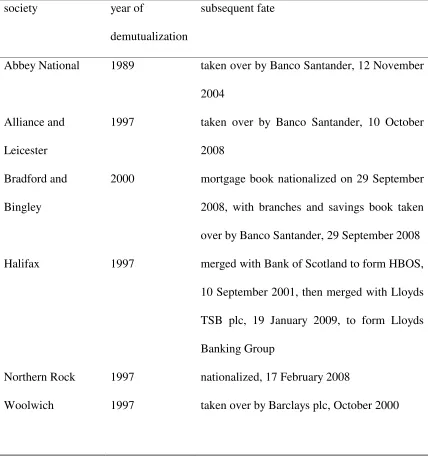
ownership change (see Table 1). While successful performance may be defined in
different ways, such a fate does not seem one of these. [INSERT TABLE 1 HERE]
The remainder of our commentary is structured as follows. We next discuss
demutualization, mergers among building societies and comment on the impact of the
current financial crisis. We then consider SKH’s performance measurement and their
interpretations. Finally we draw conclusions.
2. Building societies, demutualization, mergers and financial crisis
In the current financial crisis mutual building societies seem to be viewed with
a certain nostalgia and mutuality is suggested as a model for financial institutions
going forward. In this comment we do not argue for the theoretical superiority of any
particular organizational form, and analysis of the mutual form reveals both
advantages and disadvantages (SKH, pp. 320-322). Whether these translate into
‘superior’ performance, however measured, is an empirical question and studies such
as SKH are therefore important and welcome. Inevitably, the results of the analysis
will be sensitive to the selection of time period and performance variables. Before we
review SKH’s analysis we consider demutualization in the UK building society sector.
We do not argue that demutualizations cannot produce gains for the
organizations themselves or their members. The arguments are well-rehearsed, and
although SKH’s analysis tells us nothing about the position of the members of
unlocked value for members by giving them free shares. This provided a means of
selling their ownership rights, thereby crystallizing the otherwise intangible value of
membership through their ability to trade shares and receive dividends. Many
societies attracted ‘carpet-baggers’ who became members in anticipation of these
potential benefits of demutualization. But members of continuing societies may have
benefited from preferential terms offered by their societies. A full analysis of the
relative gains from membership of the converting and continuing societies has yet to
be carried out and would need to include a comparison of potential returns to
shareholders in converting societies and the potential benefits to the members of
continuing societies could have enjoyed as investors and/or borrowers.
In SKH’s account, demutualization of building societies can be explained in
terms of the inability of these institutions to grow further within their sector, including
constraints on management recruitment and remuneration arising from societies’
traditional reliance on internal labour markets. Effectively the large converting
societies had outgrown the movement, and anticipated demutualization by beginning
to adapt before this took place. But whilst different from other societies, and
apparently prepared for proprietary status, their subsequent failure to secure long-term
survival suggests an inability to adjust fully to their new status. This is consistent
with the findings of Shiwakoti, Ashton and Keasey (2004) (SAK), who demonstrate
that higher executive remuneration in converting societies did not reflect superior
performance (on a more limited range of measures than used in SKH). With
hindsight, demutualizations allowed managers to gain greater control over both sides
of the balance sheet and this created opportunities for growth which translated into
lending activity of building societies, were limited, and other forms of lending, such as
buy-to-let and commercial lending, offered better growth opportunities as the
economic cycle became more favourable.
There is an extensive literature on mergers and economies of scale among
building societies (summarized by Drake, 2003, pp. 310-313; also see, for example,
Haynes and Thompson, 1999, pp. 833-834). Drake (2003, p. 314) finds that
economies of scale in larger societies had not been exhausted by the time the
converting societies demutualized. There therefore remained potential gains from
organic growth or participation in mergers involving such societies. So why did the
converting societies choose to convert, rather than try to reap such gains, as the largest
continuing society, Nationwide, appears to have done? SAK may have provided the
answer (higher remuneration) and it is possible that the converting societies may have
performed better in at least some respects if they had chosen not to convert but
pursued alternative strategies. But mergers between mutual organizations face many
of the same difficulties as combinations among non-mutuals, and in particular
incumbent managers may represent a formidable barrier to hostile takeovers.
We have noted the demise of the converting societies, but we also observe that
continuing societies have experienced significant difficulties during the current
financial crisis. Some societies suffered losses through placing deposits with
Icelandic banks, several appear to have been imprudent in commercial property
lending, and all have been obliged to make additional contributions to the Financial
Services Compensation Scheme to compensate depositors in failed banks (KPMG,
societies movement for larger societies to merge with smaller financially weak
societies in ‘rescue mergers’ (see Thompson, 1997, for a discussion of merger
motives). Consolidation within the building society movement has continued since
2000 and at the time of writing the number of societies had fallen below 50 with the
prospect of further mergers. In the post-crisis consolidation the largest society,
Nationwide, has absorbed several smaller societies - the Cheshire, Barnsley, and
Dunfermline societies. Britannia has merged with Co-operative Financial Services to
create a ‘super-mutual’, a merger between the societies ranked second and third in
size, Yorkshire and Chelsea, is proceeding, and mergers of smaller societies have
taken place (KPMG, 2009).
We also note in passing that SKH consider demutualization in British building
societies in isolation from other mutual experiences, including those of other
Anglo-Saxon countries, such as Australia and New Zealand, where demutualization of
significant financial institutions took place during a similar period and perhaps as fast
as in the UK. Elsewhere, there are barriers to demutualization such as shared assets or
a central clearing house or central provider of services (for example, among the
Spanish savings bank and Rabobank in the Netherlands). We acknowledge that these
experiences are outside the scope of SKH, but suggest that demutualization is a
complex phenomenon.
In this section we suggest three areas in which we believe SKH’s analysis
suffers shortcomings: the choice of risk measures; the time period; and the sample of
societies covered.
3.1 Risk
Is it possible that increased risk contributed to the loss of independence of the
converting societies, and, if so, why was this not reflected in SKH’s results? There
are two possibilities: either the chosen risk variables failed to capture important
aspects of risk; and/or risk did not increase until after the period of study. We now
address the first of these points and consider the second in the next sub-section.
SKH’s risk ratios fell in both sub-periods (1993-96, 1997-2000) for both
converting and continuing societies and there were higher levels of risk in the
converting societies in both sub-periods (SKH, p. 326). The second finding is
unsurprising - the converting societies were larger, faster-growing and diversification
allowed them to take on more risk and the desire to grow rapidly would have
encouraged them to do so. SKH (p. 331) argue that ‘risk taking should increase
following the conversion from mutual to plc status’, yet on these measures it falls.
But the two chosen risk measures, the ratios of loan loss reserves and provisions for
loan losses to total assets, are both lagging indicators of credit risk. Risk should have
increased as the converting societies moved (further) into business areas such as
commercial lending in which they had less experience and lower quality security may
have been available. In the absence of superior skills, converting societies were
and attribute the improvement in the risk ratios to falls in loan losses in the 1990s as
the economy emerged from recession. This immediately raises the question of the
extent to which the chosen risk measures capture a cyclical effect and are not
attributable to the behaviour of the institutions.
We suggest that a wider range of measures is necessary for a more thorough
assessment of risk. SKH treat growth in assets as a positive indicator of performance.
We suggest that it could just as easily be considered a leading indicator of risk, as
institutions growing more rapidly than the industry average would presumably acquire
lower quality assets at the margin. We acknowledge that the more rapid growth of
converting societies could be attributed to superior management skills, or the ability to
exploit economies of scale (although differences in growth rates between the
converting and continuing societies virtually disappeared post-conversion: SKH, p.
325). It is also possible that greater risks were taken in order to drive growth - risks
which ultimately were either misjudged or ignored and are not reflected in SKH’s
analysis. The reliance on wholesale funding of some converting societies to drive
balance sheet growth has become evident in the financial crisis and we note that SKH
do not include any liquidity measures in their analysis. Schrand and Unal (1998), for
example, suggest that a simple measure of risk in institutions converting from mutual
to stock ownership is unlikely to capture total firm risk, given the complex dimensions
of risk faced by financial institutions. Converting institutions may choose, for
example, to make greater use of derivatives to manage interest rate risk, which allows
them to absorb increases in other risk measures.
We suggest that it would have been preferable to present results over various
periods to see whether they are sensitive to the choice of period. SKH consider a
period of eight years, of which four are pre- and four post-demutualization. They do
not provide an explicit justification for their choice of time period and one can
question the choice of both start and end points and the length of period. Why not
take a longer period, such as a total of 10 or 15 years? We do not imply that the
period was deliberately chosen to produce particular results, merely that the
appropriateness of any particular period is unclear. In fact, SKH’s end point is not
arbitrary - there is a good reason for limiting the post-conversion analysis to four
years, as it is after 2000 that the converting societies begin to disappear as independent
institutions. Thus the chosen end point could represent a clear step change in the
adaptation to life as listed banks.
SKH offer no explicit justification for the starting point, although it could
reflect structural or strategic change within larger societies. An implicit reason for
selecting 1993 as a starting point is that this is the end point for the analyses by
Haynes and Thompson (1999), Thompson (1997) and Valnek (1999). But there is
every likelihood that the divergence between converting and continuing societies
began before 1993 - the Building Societies Act was passed in 1986 and the Abbey
National was the first society to demutualize in 1989. 1986 and 1989 would both
therefore appear obvious starting points for analysis, and one could argue for an earlier
date on the grounds that the largest societies which eventually demutualized would
3.3 Basis of sample
We question whether SKH’s sample offers an appropriate basis for the
performance evaluation they undertake. We would argue that some of SKH’s
measures should not be used to compare converting and continuing societies at all.
SKH (p. 331) find superior performance on profitability measures for the converting
societies, but claims for the superiority of mutuality are not founded on higher
profitability. Indeed, in preparing for conversion it would be remarkable if the
converting societies did not show superior profitability. Unfortunately, the obvious
counter-factual - to examine continuing societies with similar characteristics to those
converting - is not available.
SKH ignore 27 of the continuing societies on the grounds that due to their
small size they cannot be reasonably compared to the converting societies (SKH, p.
323, footnote 1). If one accepts this argument, then why compare the 20 or so
continuing societies with assets of less than £1 billion to the converting societies, the
assets of the smallest of which were more than 20 times this (SKH, pp. 335-336)?
This seems an entirely arbitrary decision.
4. Conclusions
Demutualization raises many interesting questions. We do not suggest that it
is easy to conduct the type of analysis undertaken by SKH and it cannot answer some
of the most interesting questions, such as why some societies chose to demutualize
what point do the performances of converting and continuing societies start to diverge,
could be answered by this type of analysis.
Many of SKH’s findings are plausible and unremarkable. It would be
surprising if the divergence between converting and continuing societies had not
begun before demutualization as it would have been reckless for those societies likely
to convert to have done nothing to prepare for the ‘new world’ in which they would
find themselves. Similarly, continuing societies should surely have been less
profitable than converting - they were driven by different motives.
The wave of demutualizations on which SKH focus was a step-change and
removed most of the largest societies from the sector. With hindsight, it is clear that
these conversions shifted into the listed bank sector a number of institutions which
were neither ‘fish nor foul’ - large societies which appeared to have the management
ambition, scale and business skills to survive as listed banks, but in reality lacked
some or all of these. The message for the future, as the financial crisis has reinforced,
is that the focus should be on better management in all financial institutions of
whatever organizational form.
It will be interesting to see what role apparently unexciting mutual institutions
such as building societies will have in the slow resolution of the financial crisis. The
largest remaining building societies appear committed to mutuality, but mutuals may
become footnotes in financial history unless it is possible to establish new mutuals of
significant size, or a mutual route is found to unwind the state ownership of large
References
Drake, L., 2003, Costs and Efficiency in Banking: A Survey of the Evidence from the
US, the UK and Japan, pp. 283-324 in A.W. Mullineux and V. Murinde (eds.),
Handbook of International Banking, Cheltenham: Edward Elgar.
Haynes, M. and S. Thompson, 1999, The Productivity Effects of Bank Mergers:
Evidence from the UK Building Societies, Journal of Banking and Finance,
23, 825-846.
KPMG, 2009, Building Societies Database 2009, Leeds: KPMG LLP.
Schrand, C. and H. Unal, 1998, Hedging and Coordinated Risk Management:
Evidence from Thrift Conversions, Journal of Finance, 53, 979-1015.
Shiwakoti, R.K., J.K. Ashton and K. Keasey, 2004, Conversion, Performance and
Executive Compensation in UK Building Societies, Corporate Governance,
12, 361-370.
Shiwakoti, R.K., K. Keasey and R. Hudson, 2008, Comparative Performance of UK
Mutual Building Societies and Stock Retail Banks: Further Evidence,
Accounting and Finance, 48, 319-336.
Thompson, S., 1997, Takeover Activity Among Financial Mutuals: An Analysis of
Target Characteristics, Journal of Banking and Finance, 21, 37-53.
Valnek, T., 1999, The Comparative Performance of Mutual Building Societies and
Table 1
Britain’s demutualized building societies which became listed banks
society year of
demutualization
subsequent fate
Abbey National 1989 taken over by Banco Santander, 12 November
2004
Alliance and
Leicester
1997 taken over by Banco Santander, 10 October
2008
Bradford and
Bingley
2000 mortgage book nationalized on 29 September
2008, with branches and savings book taken
over by Banco Santander, 29 September 2008
Halifax 1997 merged with Bank of Scotland to form HBOS,
10 September 2001, then merged with Lloyds
TSB plc, 19 January 2009, to form Lloyds
Banking Group
Northern Rock 1997 nationalized, 17 February 2008
Woolwich 1997 taken over by Barclays plc, October 2000
note: SKH’s analysis excludes Abbey National and Bradford and Bingley as their