Journal of Chemical and Pharmaceutical Research
__________________________________________________
ISSN No: 0975-7384 CODEN(USA): JCPRC5
J. Chem. Pharm. Res., 2011, 3(3):784-791
Development and validation of RP-HPLC method for determination
of Raloxifene Hydrochloride from pharmaceutical preparation
B. Vijay Kumar*, K. Pratap Kumar, K. Suresh, Saheena Apsar, P. Srikanth and Y. Suneetha
Dr. Samuel George Institute of Pharmaceutical Sciences, Markapur, Andhra Pradesh, India Acharya Nagarjuna University, Guntur, Andhra Pradesh
______________________________________________________________________________
ABSTRACT
A simple, efficient, and reproducible method for the determination of raloxifene hydrochloride in tablets has been developed using reverse phase high performance liquid chromatographic method. The elution was done using a mobile phase consisting of buffer and acetonitrile (60:40 v/v) on Symmetry C18, 4.6 x 150mm, 5 µm, XTerra analytical column with flow rate of 0.8 ml/min with detection at 287 nm. An external standard calibration method was employed for quantitation. The elution time was 4.890 min. The linearity range was 10-50 mg/ml for raloxifene hydrochloride. The present method was validated with respect to system suitability, linearity, precision, limit of detection (LOD) and limit of quantification (LOQ), accuracy (recovery), Robustness. The proposed method can be readily utilized for bulk drug and pharmaceutical formulations.
Key Words: RP-HPLC, Raloxifene hydrochloride, XTERRA Column, method development and
validation.
______________________________________________________________________________
INTRODUCTION
The literature survey[2,3,4,5,6] reveals that there is some HPLC methods have been reported.The aim of the present study was to develop and validate a simple, isocratic RP-HPLC[7,8,9] method for the determination of Raloxifene Hydrochloride in tablets. The developed method was validated using ICH guidelines for validation[10].
Today, RP-HPLC is the most popular analytical technique for separating complex mixtures in the chemical, pharmaceutical and biotechnological industry. RP-HPLC is the opposite of normal-phase chromatography, with a nonpolar stationary normal-phase and a polar, largely aqueous mobile phase. The most common stationary phases used are octadecyldimethyl (C 18 ) phases with silica as the solid support. Silica has a small pH range (3 to 8) where mixtures can be separated without degradation of the column performance. Above pH 8, silica supports dissolve and destroy the column. Below pH 3, the silicon-carbon bond is cleaved, and the column is destroyed. The separation is achieved by analytes having different interactions with the stationary phase. In RP-HPLC, solutes are separated using their hydrophobicity. A more hydrophobic solute will be retained on the column longer than a less hydrophobic one. Also, polar solutes will interact with the silica surface to cause peak tailing. The mobile phase is one of the two components involved in the separation process. Water is generally one of the components of a binary mixture in RP-HPLC. Water is considered to be the weak component of the mobile phase and does not interact with the hydrophobic stationary phase chains.
The RP-HPLC method reported in this study was validated in accordance with the International Conference on Harmonization (ICH) guideline[11] and best practice[12,13,14] .Specificity, linearity, precision (repeatability and intermediate precision), accuracy, robustness, limit of detection and limit of quantitation were evaluated.
EXPERIMENTAL SECTION
Acetonitrile( HPLC grade) , Raloxifene Hydrchloride as the reference standard was purchased from Matrix laboratories , Distilled water was de-ionised by using a Milli-Q system (Millipore), Ralista tablets and the chemicals of analytical reagent grade purchased from various sources, Pump (Waters Alliance 2695) , Detector (UV – Visible Model 2487 , Injector Autosampler ( 20µl) , The Column C18 XTERRA (150mm) , Elio PH – Meter, A & D – Digital Balance.
Chromatographic conditions
The mobile phase consisted of a mixture of buffer- acetonitrile (60:40 v/v). The flow rate was set to 0.8 ml /min, Injection volume 20µl , The Column used is C18 XTERRA (150mm). The
detection wavelength was set to be at 287 nm. RP-HPLC analysis was performed isocratically at room temperature.
Method Development:[15,16] Preparation of Standard Solution
Preparation of Sample Solution
Weighed 5 Raloxifene hydrochloride Tablets and calculated the average weight. Accurately weighed and transfered the sample equivalent to 10 mg of raloxifene hydrochloride into a 100 ml volumetric flask. Added about 70 ml of diluent and sonicated to dissolve it completely and made volume up to the mark with diluent. Mixed well and filtered through 0.45µm filter. Further pipetted 1ml of the stock solution into a 10ml volumetric flask and diluted up to the mark with diluent. Mixed well and filtered through 0.45µm filter
RESULTS AND DISCUSSION
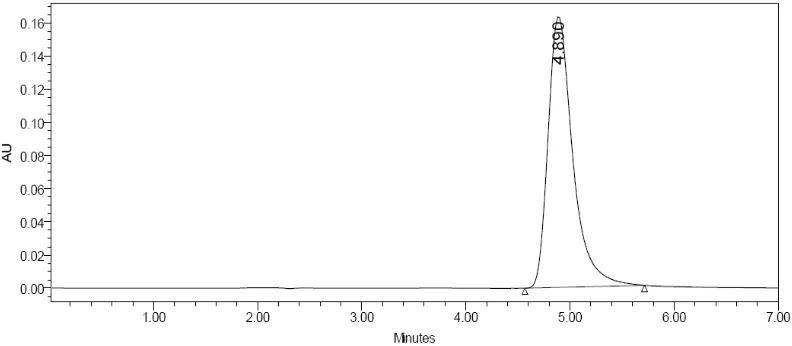
HPLC separation of Raloxifene hydrochloride was carried out on a Xterra C18 column by an isocratic elution with buffer-acetonitrile (60:40 v/v) . The flow rate was constant at 0.8 ml/min and the column temperature was at room temperature (24±1°). The UV wavelength was set at 287 nm. No interference from diluents, impurities, or excipients present in the pharmaceutical formulation was observed at this detection wavelength. Before each run LC column was equilibrated with the mobile phase for about 15 min. A sharp, symmetrical peak was obtained for Raloxifene hydrochloride when analyzed under these conditions. This retention time enable rapid determination of the drug, which is important for routine quality control analysis.
System suitability test was established from five replicate injections of a solution containing Raloxifene hydrochloride 10µg/ml. The percent relative standard deviation (RSD) of the peak area was calculated. The peak tailing for drug was measured. A useful and practical measurement of peak shape, the peak tailing and theoretical plate count was determined. Column plate number was determined using the formula, N = 5.54(t R /w h ) 2 , where w h is the bandwidth at 50% of peak height. The proposed method met these requirements within the United States Pharmacopoeia (USP) accepted limits ( Tailing factor < 1.5, Theoretical plates > 2000) . The stability of Raloxifene hydrochloride in solution was investigated in the method development phase. five solutions containing 10 µg/ml of Raloxifene hydrochloride were tested . The solutions were stable during the investigated time and the RSD was < 1.0% for retention time (min), peak area and height. The solutions were shown to be stable with no significant change in Raloxifene hydrochloride concentration over this period.
Method validation:[17,18,19,20]
Linearity:
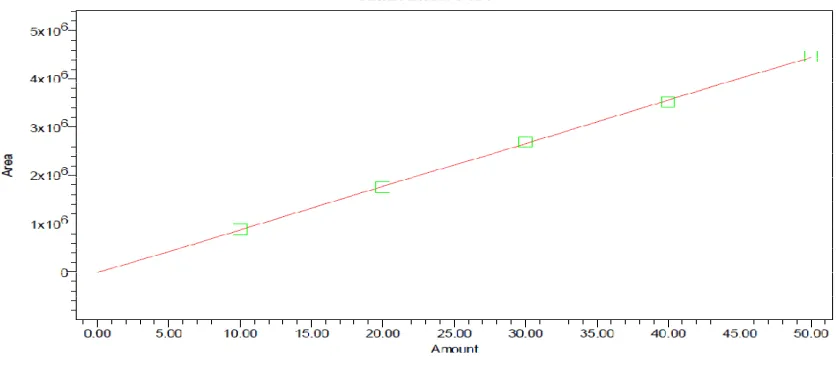
Appropriate amounts of Raloxifene hydrochloride stock solutions were diluted with mobile phase to give concentration of 10, 20,30,40 and 50 µg/ml. Each solution was injected calibration plot was prepared. Linearity was evaluated by linear least-squares regression analysis. Good linearity was observed over the concentration range evaluated (10-50 µg/ml) as shown in the linearity curve in figure-3 . The correlation coefficient was found 0.999.
Precision:
Table 1: Separation characteristics of Raloxifene Hydrochloride analysed under optimized conditions and method validation of Raloxifene Hydrochloride
PARAMETERS LIMIT OBSERVATION
System suitability Theoritical Plates should not less than 2000. Tailing factor should not more than 2.0
Theoritical plates: 2215.8 Tailing factor:1.5 Precision:
A)System Precision B).Method precision
RSD NMT 2.0% RSD NMT 2.0%
0.32 0.03 Linearity Correlation coefficient NLT 0.99 0.999
Accuracy %Recovery range- 98-102 % 99.8%
Robustness(Flow,Mobile phase) System suitability parameters should comply complies
LOD S:N Ratio should be about 3 2.96
LOQ S:N ratio should be about 10 9.96
The system is suitable for tailing factor, theoretical plate, and resolution.
TABLE 2: Recovery studies of Raloxifene Hydrochloride from samples with known concentrations
%Concentration
(at specification Level) Area
Amount Added (µg/ml)
Amount Found
((µg/ml) % Recovery Mean Recovery
50% 1368358 5.0 5.05 101.0%
99.8%
100% 2702064 10.0 9.97 99.7%
150% 3979124 14.9 14.7 14.7%
[image:4.595.98.494.442.615.2]*n=3
Figure 1: Typical LC chromatogram of the Raloxifene hydrochloride sample for the system suitability
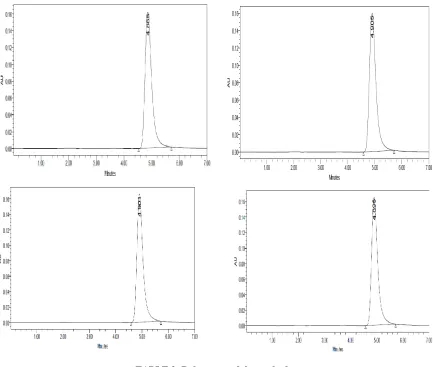
Figure 2: Typical LC chromatograms obtained for precision (a),(b) are for precision (c),(d) are for intermediate precision
TABLE 3: Robustness of the method
conditions Value System suitability Results USP Plate count USP Tailing
Mobile phase (±10%)
50:50 2916 1.3
60:40 2208 1.5
70:30 2697 1.4
Flow rate(ml/min)
0.6 2828 1.5
0.8 2208 1.5
0.4 2661 1.4
Accuracy:
[image:5.595.163.432.532.628.2]Figure 3: The linearity curve for the Raloxifene hydrochloride sample ( 10 to 50µg/ml)
LOD & LOQ:
The limit of detection (LOD) and limit of quantitation (LOQ) tests for the procedure were evaluated by serial dilutions of Raloxifene hydrochloride stock solutions in order to obtain signal-to-noise ratios (s/n) of ≈3:1 and ≈10:1, respectively. The LOD value for Raloxifene hydrochloride was found to be 0.03µg/ml (s/n = 2.96,) and LOQ (n =6) was 0.10 µg/ml (s/n = 9.96) as shown in Table-1
Robustness
Robustness of the method was evaluated by the analysis of Raloxifene hydrochloride under different experimental conditions such as changes in the organic composition of the mobile phase and flow rate. The percentage of methanol in the mobile phase was varied ±10%, the flow rate was varied ±0.2 ml/min. Their effects on the USP plate count, USP tailing at 10%, recovery and repeatability were studied. Deliberate variation of the method conditions had no significant effect on assay data or on chromatographic performance, indicating the robustness of method and its suitability for routine use and transfer to other laboratories. The results from robustness testing are presented in Table-3
CONCLUSION
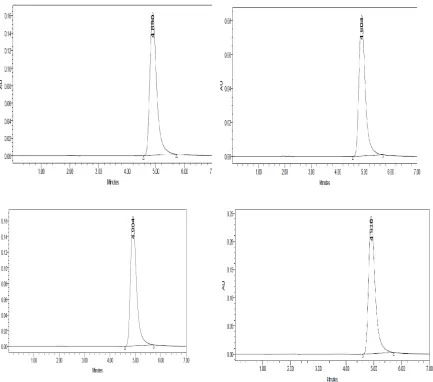
Figure 4: Typical chromatogram of accuracy for standard and sample, (a) standard; (b),(c) and (d) are for sample concentrations of 50%, 100% and 150% respectively
Acknowledgements
We are greatful to G.N.V. Chandra Shekar, Pharma Train, Kukatpally, Hyderabad for authentication of drug and methodology.
REFERENCES
[1] Sean C Sweetman,The complete Drug Reference, Matrindale ,33rd edition, , pharmaceutical press , Royal pharmaceutical society ,2002, page no: 1491.1.
[2] P. Venkata Reddy, B. Sudha Rani,G. Srinu Babu and J. V. L. N. Seshagiri rao, E-Journal of
Chemistry http://www.e-journals.net, January 2006Vol. 3, No.10, pp 60-64.
[3] Kanakapura Basavaiah, Urdigere Rangachar Anil Kumar, Kalsang Tharpa. Acta
pharmaceutica,September-October 2008,Volume 58,Number 3, ,347-356.
[4] Jurij Trontelj Tomaž Vovk, Marija Bogataj and Aleš Mrhar, Pharmacological Research
[5] DC Pavithra, Lakshmi Sivasubramanian, Indian journal of pharmaceutical sciences, 2006 ,Volume : 68 ,Issue : 3, Page : 401-402.
[6] D. Suneetha ,A. Lakshmana Rao, Rasayan.J.Chem, 2010,Vol.3, No.1, 117-121,
[7] Remington, The science and practice of pharmacy, volume I,21st edition, LipincottWilliams & Wilkins publishers, Newyork, 2007 , pg no 621-626.
[8] Skoog, Holler, Nieman, Principles of instrumental analysis, 5th edition, Harcourt college publishers, fortworth, 2004, pg no-725-739
[9] Chatwal G.R. and Anand S.K., Instrumental Methods of Chemical Analysis, HimalayaPublishing House, New Delhi, 2004. Pg no-21-57.
[10]International Conference on Harmonization, "Q2A: Text on Validation of Analytical Procedures," Federal Register 60(40), 11260–11262 (1995).
[11]International Conference on Harmonization, "Q2B: Validation of Analytical Procedures: Methodology; Availability," Federal Register 62(96), 27463–27467 (1997).
[12]Shabir GA, Lough WJ, Shafique AA, Bradshaw TK. J Liq Chromatogr Relat Technol
2007;30:311-33.
[13]Shabir GA, J Cromatogr A 2003;987;57-66.
[14]Guidance for Industry: Analytical Procedures and Methods Validation: Chemistry, Manufacturing and Controls Documentation; Draft Guidance. Rockville, MD. US FDA. 2000. [15]Lloyd R Snyder, Joseph J, Kirkland Joseph, Glash, Chatwal anand. Instrumental analysis.
2007. Pg no-2.624-2.639.
[16]Synder K.L, Krikland J.J and Glajch J.L,Practical HPLC Method Development,2nd Edition,Wiley-Interscience Publication, USA, 1983,Method development-1-10.
[17]Yuri Kazakevin, Rosario Lobrutto,HPLC for pharmaceutical analysis,. Wiley interscience, John wiley & sons inc.New jersey,2007 , Method development-347,method validation-455-490. [18]Bently and Drivers: Text book of pharmaceutical chemistry,8th Edition, oxford university press,London ,1985,method validation -1-3.
[19]David Harvey ,Modern analytical chemistry, Mcgraw hill publishers,Toronto, 2000, Method validation page no: 38-42,47.