APPLYING GA AS A METHOD OF GENERATING CLASS SCHEDULE. A CASE STUDY IN UTHM
WAN ZILLIANI BINTI WAN ISMAIL
This project report is presented as partial fulfillment of the requirements for the award of Master of Electrical Engineering
Faculty of Electrical and Electronics Engineering University of Tun Hussein Onn Malaysia
ABSTRACT
University Class Timetabling Problem (UCTP) is a common problem faced any regular educational institutions. This problem encountered as it has multivariable parameter combinations and multiple constrains. This project focuses on the concept of Genetic Algorithm which is an alternative solution to the class of multi-constrained, NP-hard, combinatorial optimization problems. The parameter involved is time slots, classes, courses, lecturers, distances and constraints among it all. Genetic Algorithm revolves around process operator like evaluation, crossover, selection and mutation. All these process are designed to generate multiple solutions which near to the best solution. However, the perfect solution did not exist.
ABSTRAK
Masalah Jadual Kursus Universiti (UCTP) adalah masalah biasa yang dihadapi oleh mana-mana institusi pendidikan. Maslah ini wujud kerana ianya mempunyai gabungan multipembolehubah dan pelbagai kekangan.Projek ini focus pada konsep Algoritma Genetik yang merupakan alternatif penyelesaian kepada multi-kekangan,”NP-hard” polynomial tidak berketentuan, masalah pengoptimuman kombinatorik. Pembolehubah yang terlibat adalah slot masa,kursus,ruang kelas,subjek,pensyarah,jarak dan kekangan – kekangan sekitar pembolehubah tersebut. Algoritma Genetik melibatkan operator seperti penyilangan, pemilihan dan mutasi. Semua proses ini untuk menjana pilihan penyelesaian terbaik. Namun begitu,penyelesaian sempurna tidak pernah wujud.
CONTENTS
TITLE i
DECLARATION ii
DEDICATION iii
ACKNOWLEDGEMENT iv
ABSTRACT v
ABSTRAK vi
CONTENTS vii
LIST OF TABLES x
LIST OF FIGURES xi
LIST OF ABBREVIATIONS xiii
LIST OF APPENDICES xiv
CHAPTER 1 INTRODUCTION 1
1.1 Overview 1
1.2 Project Description 2
1.3 Project Objectives 3
1.4 Problem statement 3
1.5 Thesis Outline 4
CHAPTER 2 LITERATURE REVIEW 6
2.1 Research Background 6
2.1.1 Genetic Algorithm 6
2.2 Previous Research 12
2.2.1 Mathematical Model 12
2.2.2 Artificial Bee Colony Algorithm 12
2.2.3 Memetic Algorithm 12
2.2.4 Multiswap Algorithm 13
2.2.4 Ant Colony System 13
2.2.4 Immune Network Algorithm 14
2.2.4 Genetic Algorithm 14
2.3 Conclusion 15
CHAPTER 3 METHODOLOGY 16
3.1 Genetic Algorithm 16
3.1.1 The Process 17
3.1.2 The Parameter 18
3.1.3 The Constraints 19
3.1.4 Data Encoding 20
3.1.5 Initial Population 22
3.1.6 Fitness Function 22
3.1.7 Selections 24
3.1.5 Crossover 24
3.1.5 Mutation 25
3.2 Conclusions 26
CHAPTER 4 FINDINGS AND ANALYSIS 27
4.1 Genetic Algorithm 27
4.1.1 Data Encoding 27
4.1.2 Initial Population 29
4.1.3 Fitness Function. 30
4.1.4 Selection 31
4.1.5 Crossover 32
4.1.6 Mutation 33
4.2 The Program 33
4.2.1 Construct Sub Module 35
4.2.2 Initiate Sub Module 36
4.2.3 Algorithm Sub Module 37
4.3 Outputs 38
4.3.1 Performance 38
4.4 Discussions 44
CHAPTER 5 CONCLUSION AND RECCOMMENDATION 45
5.1 Conclusions 45
5.2 Recommendations 46
REFERENCE 47
LIST OF TABLES
TABLE TITLE PAGE
3.1 The gene arrangement 20
3.2 ‘Good’ timetable requirement 23
3.3 Point table 23
4.1 Point schedule 30
LIST OF FIGURES
FIGURE TITLE PAGE
2.1 Binary encoding 7
2.2 Single line crossing 9
2.3 Two line crossing 9
2.4 Mutation 10
2.5 Genetic algorithm cycle 11
3.1 Steps in Ga implementations 17
3.2 Genetic Algorithm cycle 18
3.3 Gene string 21
3.4 Crossover process 24
3.5 Mutation process 25
4.1 Gene string 28
4.2 Gene string alterations 28
4.3 Gene string coding 29
4.4 Fitness evaluation pseudo code. 31
4.5 Arrangement according points 32
4.6 Elite selections 32
4.8 Program flowchart. 34
4.9 Construct flowchart. 35
4.10 Initiate Population Flowchart. 36
4.11 Algorithm Flowchart 38
4.12 Course 1 and 2 output. 39
4.13 Course 3 and 4 output. 39
4.14 Course 1 and 2 output for 100 population 40
4.15 Course 3 and 4 output for 100 population 40
4.16 Course 5 output for 100 population 41
LIST OF ABBREVIATIONS
GA - Genetic Algorithm
LIST OF APPENDICES
APPENDICES TITLE PAGE
CHAPTER I
INTRODUCTION
1.1 Overview
University Class Timetabling Problem (UCTP) is a common problem faced any regular educational institutions. It’s been a difficult task faced by the officer that is responsible for the institution schedules. Timetabling has been difficult even in timetabling exams or courses, much effort is spent producing solutions which are workable and of a high quality[4]. This problem encountered as it has multivariable parameter combinations and multiple constrains. The parameter involved is time slots, classes, courses, lecturers, distances and constraints among it all. Timetabling automating involves combinatorial optimization; time based planning, realizing highly constrained problems and addressing multi-dimensional complexities [1].
become more complicated when there are pre-exquisite courses involves. Courses offered also been influenced by students that is dropping out and other constraint related students that affected the consideration as it is a requirement to fulfilled. Lecturers also have their own constraints where as we known that professors and doctorates have their own researches and task to complete. Maybe there is several time or day that they are not being able to commit for classes. This add up to the number of constrains need to pay attention to assured all errand to be fulfill.
The set of constrains are usually divided into two sets: hard constraints and soft constraints [2]. The hard constraints are the requirements that must be fulfilled and soft constraints are the requirements that are likely to meet.
All these parameters and constrains are highly needs to meet. The constrains will be discuss deeply in the other chapter. Due to all the constrains and unsuitable approach of timetabling, the schedules were clashed and the course time sometimes dropped out from timetables resulting the delay of timetables distributions where the process is really time consuming. Universiti Tun Hussein Onn Malaysia is not excluded from this problem.
1.2 Project Description
1.3 Objective of project
i. To study Genetic Algorithm method in providing alternative solutions for UCTP.
ii. To design a timetable management that processes each of the courses requirement using simple Genetic Algorithm.
iii. To analyze the performance of the timetable management tool performance in term of processing speed for each course.
1.4 Problem statement
University Class Timetabling Problem (UCTP) is a common problem faced any regular educational institutions. This problem encountered as it has multivariable parameter combinations and multiple constrains. All these parameters and constrains are highly needs to meet. Universiti Tun Hussein Onn Malaysia is not excluded from this problem. Classes were clashed and the course time been dropped out from timetables resulting the delay of timetables distributions. Part of this, lecturer requirements, distance between classes, capacity of classes contribute to this problem.
1.5 Scope of project.
i. The study is based on UTHM FKEE UCTP case.
ii. Genetic Algorithm will be used to create the system algorithm.
iii. The parameters in the systems will be modeled in binary representations. iv. The system results will be presented in PHP coding.
v. The system will allocate all courses time in the determined slots. vi. The system will avoid clashes of courses time and room at a time.
1.6 Thesis Outline
CHAPTER II
LITERATURE REVIEW
University Course Timetabling Problem (UCTP) has been studied by a large diverse
method from various researchers. This chapter will acquaint about previous study related to this study. From the difference and the similarities of previous study that in same area of study or related to this study. Most of the study is a hybrid system where main system is combined with one or more systems to optimize the results.
2.1Research Background
2.1.1 Genetic Algorithm.
Some important definitions;
Gene: a gene is a part of solution. It contains some data
Chromosome: a Chromosome or individual is a solution to the given problem composed by genes
Population: set of solutions.
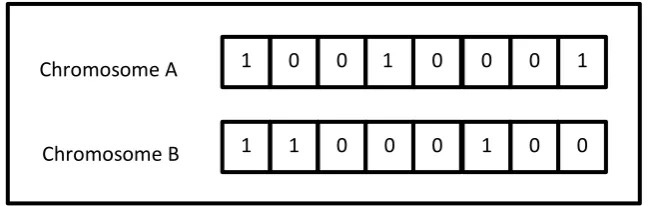
[image:17.595.174.499.422.525.2]Genetics algorithm handles a population of possible solutions. Each solution is represented through a chromosome, which is just an abstract representation. This representation done by a process called Encoding. Encoding is a process of representing individual genes. The process can be formed using bits, numbers, trees, arrays, list or any other objects. The encoding depends on the problem faced. Binary encoding is the common encoding technique used. Each chromosome encodes a binary string where the strings represent some characteristics of the solution. The solution is not necessarily the best solution. The octal and hexadecimal encoding used octal and hexadecimal value respectively to encode the strings.
Figure 2.1: Binary encoding
There are genetics loops over an iteration process to make the population evolve as we can call it Breeding. The iteration consists of following steps:
Selection is process of selecting individual for reproduction. This selection is done randomly with probability depending on the relative fitness of the individuals so that the best ones are often chosen for reproduction than poor ones [3]. Two parents will randomly select and crossed. There are several types of selections;
1 0 0 1 0 0 0 1
1 1 0 0 0 1 0 0
Chromosome A
Roulette wheel selection is a traditional GA selection technique where all the fit individuals will be placed on a slice of roulette wheel according to their fitness size. The wheel will be spun and the selected individual will be in the pool of parents in the next generation. Random selection technique is a technique that randomly selects a parent from the population to next generation pool. Rank selection in the other hands, ranks the population and every chromosome receives fitness from the ranking. Through this, potential parent are selected and a tournament is held to decide which of the individuals will be the parent.
Tournament selection strategy provides selective pressure by holding a tournament competition among individuals. The winners of the tournament which have the highest fitness are then inserted to the next generation pool. The tournament repeated until the mating pool for the new offspring is filled. Elitism is the first best chromosome or the few best chromosomes are copied to the new populations. These individuals are specially selected by their elitism which defined by the selector
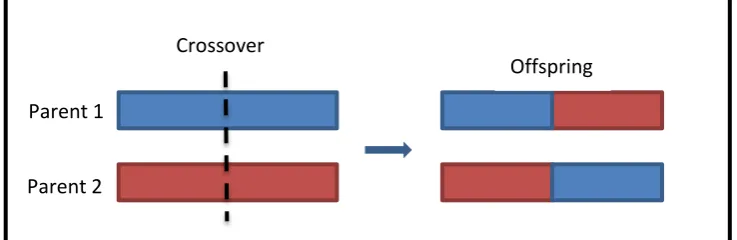
Reproduction is the second step; offspring are bred by the selected individuals. For generating new chromosomes, the algorithm can use both recombination and mutation [3]. Recombination or crossover is the process of taking two parents solutions and producing a child from them. There are several crossover types; Single point crossover is a traditional genetic algorithm operator which the two mating chromosomes are cut once at corresponding points and the cut section exchanged each other. The process is Figure 1.1. Two point crossovers is a traditional genetic algorithm operator which the two mating chromosomes are cut once at corresponding points and the cut section exchanged each other. Same goes Multi-Point crossover where there is N-crossover to performed to the parents.
Figure 2.2: Single line crossing
[image:19.595.154.522.282.411.2]Figure 2.3: Two line crossing
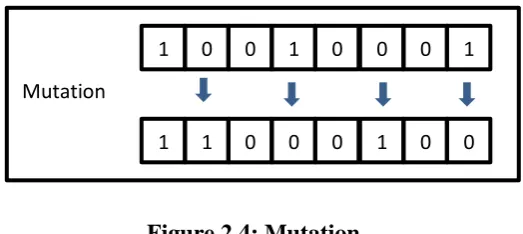
Mutation is the process after the crossover where it changes the value of the bits to maintain genetic diversity in the population. There are many different forms of mutation for the different kind of mutations. The selection of types of mutation depends on types of encoding of the chromosomes. Flipping, interchanging, reversing are types of mutations that suitable for bits mutation.
Parent 2 Parent 1
Crossover
Offspring
Parent 2 Parent 1
Crossove
r Offspri
Figure 2.4: Mutation
Evaluation is the process where the new chromosomes evaluated to see their fitness [3]. The fitness of an individual in genetic algorithm is the value of an objective function for its phenotype. The fitness not only indicates how good the solution is, but also corresponds to how close the chromosomes to the optimal one.
Replacement is the last step where the individual from the old population are killed and replaced by new ones [3]. The parent’s chromosomes and its offspring will be evaluated and not all of them can be back in the pool. There are only two places left by their parent and only two of the fittest can replaced the places. The random replacement technique is a technique where the children will replace two randomly chosen individuals in the populations including their parents. The weak individuals may be introduced in population by this method. Weak parent replacement is a technique where the fitter child will replace weak parent. This technique improves when the crossing of weak and strong parents, where the strong offspring will replace weak parent. Both parent replacements is in the other hand, the offspring just replace both of its parents.
Figure 1.5 shows the cycle the genetic algorithm cycle of process. It starts with initialization of population of chromosomes where all the strings are encoded and then being evaluated for fitness. The chromosomes with the high fitness will be in the pool of next generations. Stopping criterion is to measure whether the evaluation is enough or nearly to the optimal value.
The evaluation will stop if the criterion fits in the optimal value, and if not the chromosomes will be in breeding proses where it will be evaluated, crossover, mutated and selection process to measure fitness to back in the pool of next generation.
1 0 0 1 0 0 0 1
Figure 2.5: Genetic algorithm cycle START
Initiation-selection of the initial population of chromosomes
Evaluation of the fitness chromosomes in the population
Stopping criterion
Presentation of the 'best' chromosomes Selection of
chromosomes
Application of genetic operators
Creation of new population
Stop YES
2.2Previous Research.
2.2.1 Mathematical Model.
In this mathematical model, the optimization process on a set of function of constraints needs to be met. The pattern recognition technology in artificial intelligence is used to aim at this mathematical model to create a new university course timetable system design [7].
2.2.2 Artificial Bee Colony Algorithm.
A hybrid algorithm composed of a heuristic graph node colouring (GNC) algorithm and artificial bee colony (ABC) algorithm to solve course scheduling problem (CSP). It is the first application on course timetabling problem. A basic heuristic algorithm of node colouring problem takes part initially to develop some feasible solutions of CSP. Those feasible solutions correspond to the food sources in ABC algorithm. The ABC is then is used to improve the feasible solutions. The employed and onlooker bees are directed or controlled in specific manner in order to avoid conflicts in the course timetable [8].
2.2.3 Memetic Algorithm
Sadaf N.Jat and Shengxiang Yang [9] proposed Memetic Algorithm (MA) that integrates two local search methods into genetic algorithm for solving UCTP. These two local search methods use their exploitive search ability of genetic algorithm to search on three neighbourhood structures, denotes as N1,N2 and N3.
N2: the neighbourhood defined by an operator that swaps the timeslot of two events.
N3: the neighbourhood define by an operator that permutes three events in three distinct timeslots in one of two possible ways other than the existing permutation of the three events.
The researcher believes that MAs can be improved by applying advanced genetic operators, heuristic and evaluations routines. The inter-relationship of these techniques and proper placement of these techniques in an algorithm may furthermore lead to better results.
2.2.4 MultiSwap Algorithm
Azmi M. et al [10] proposed Multiswap Algorithm combining with the graph colouring heuristic method. It was designed to incorporated the largest weighted degree, backtracking algorithm and local search to satisfy hard constrain and minimize soft constrains violation. This algorithm deal with some operations which randomly shuffled the events in such timeslot to different rooms but this not covers all operations.
2.2.5 Ant Colony System.
Optimization methods can perform best on benchmarking stated. The result was difference when the ACS was combined with other method such as simulated annealing and Tabu Search method [14]. These hybrid systems based on ants probabilistically choose the timeslot for the given course from pre-ordered list of courses. The ants are guided with heuristic and stigmergic information to choose the courses.
2.2.6 Immune Network Algorithm.
Immune Network Algorithm For Course Timetabling (INACT)[15] is an Immune Network Algorithm(AIS) based algorithm inspired by the immune system, has successfully been applied to UCTP optimization. It was an approach uses the natural immune system as a metaphor for solving UCTP. AIS contain features that of recognition that make the cells stimulate or supressed. The stimulation and supressed cells then correspond by the networks cell.
2.2.7 Genetic Algorithm.
There are various types of genetic algorithm applied to UCTP study. There are sub fraction from Genetic Algorithm which is Steady State Genetic Algorithm (SSGA), Enhanced Steady State Genetic Algorithm (ESSGA) and Simple Genetic Algorithm (SGA) [11]. Commonly the studies are integrated with other system like Fuzzy Logic [11], Sequential Local Search [12], Greedy Method [2][5] and Tabu Search [1].
2.3 Conclusion.
CHAPTER III
METHODOLOGY
This chapter explains the method and steps to execute the study. It also show how all steps and process from function until software combined to complete the study. The aim of this project is to apply genetic algorithm and design an application to accommodate the timetable generation base on UTHM FKEE UCTP.
To produce a system and an application, tools are needed to assist the designing process. A suitable tools need to be determined to ease the process of systems and application development. For this research, PHP programming was selected to be the genetic algorithm executor. The PHP is permissive and more convenient to work with because of the research requirements.
3.1 Genetic Algorithm.
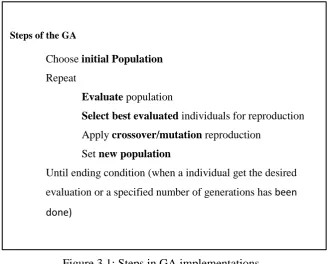
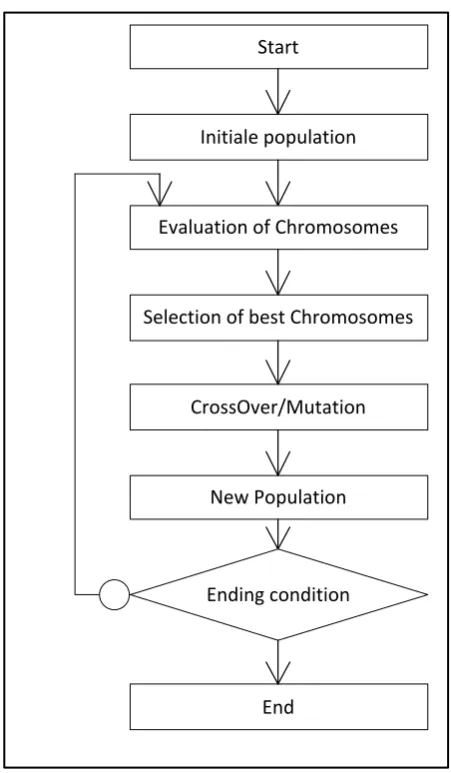
Steps of the GA
Choose initial Population
Repeat
Evaluate population
Select best evaluated individuals for reproduction
Apply crossover/mutation reproduction
Set new population
Until ending condition (when a individual get the desired
evaluation or a specified number of generations has been
done) 3.1.1 The process
[image:27.595.163.491.244.508.2]There are general scheme steps of GA which is getting the population, evaluate the population, selection, crossover /mutation and looping until it reaches the stopping criterion. The processes of the genetic algorithm worked as the following flowchart. These processes are important as it will determine the output of the systems.
Figure 3.2: Genetic algorithm cycle.
3.1.2 The parameters.
There are several parameters to be considered in this program. There are courses, modules, rooms and lecturers. These particular parameters is the main consideration to design the process which every each decision made been made gives huge effect to the results.
Courses in other word should interpret as a group of students who’s given a set of subjects to be complete in certain period of time. These courses are mostly been labeled as a group to ease the management of their timetables. Each course has several modules or subjects in every semester to complete on. Each module has class type distribution such as lecture class, lab session or workshop. The duration of each
Initiale population
Evaluation of Chromosomes
Selection of best Chromosomes
CrossOver/Mutation
New Population
Ending condition
module is important to be scheduled. The FKEE case contributes 40 modules to be process and managed.
In order to make sure all the courses are implemented, class rooms provided must be enough to fulfill these requirements. In the other words, class room availability is the important part which most of the problems came from the classrooms clashes during lecture hour. Class room divided into several category which is lecture room, seminar rooms which accommodate larger size of people, labs. Labs also have several types which are like computer lab, electrical lab, electronic lab and others type of labs to execute the practical session of the modules. All the classrooms have their own time periods which need to be manage in order to maximize the usage. These rooms practically will be use between 8.00 am to 7.00 pm.
Lecturers are capable of teaching multiple subjects therefore they do not only teach one subject. In FKEE UTHM, all lecturers are required to teach electrical subject to their student and after filtering the list of lecturers, there are 80 lecturers available in FKEE at the moment.
3.1.3 The constraints.
The constraints are the rules that lined up to be fulfilled. There are two types of constrains, hard constraints and soft constraints. The hard constrains is the rules must be fulfilled such as below;
A module must take place once a week.
A module cannot be placed in a smaller class than its size. A lecturer must be in one place at a time.
The soft constraints are the constrains that can be violated. It can be satisfied for the best timetables and can be breached if cannot be satisfied. The soft constrains are as below
The lessons per day cannot exceed 6 hours per day.
A module cannot use a too big place than specified to avoid waste of space.
No 3 hours consecutive lesson without a break.
Lesson duration range between 8.00 am to 5.00 pm each day.
3.1.4 Data encoding
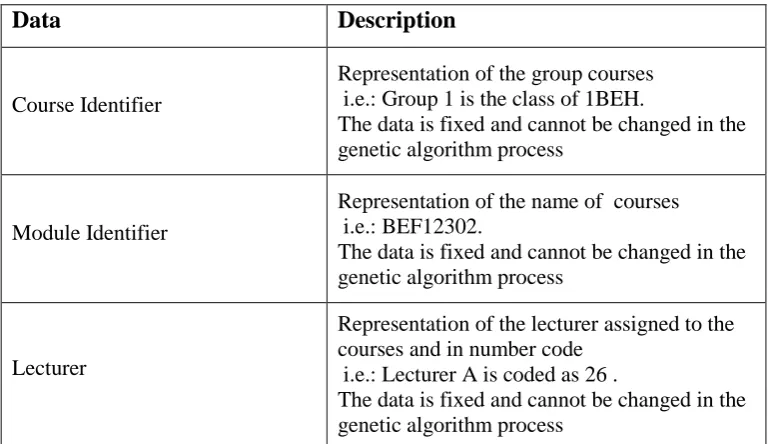
[image:30.595.127.515.515.737.2]Encoding is the first step in Genetic Algorithm. It is to define the data stored in the system and how to encode it. For this case the data was designed to follow the arrangement. Chromosome is an array of timetables for all courses encoded and the genes in the chromosome represent the modules. The following tables are the arrangement of the gene.
Table 3.1: The gene arrangement.
Data Description
Course Identifier
Representation of the group courses i.e.: Group 1 is the class of 1BEH.
The data is fixed and cannot be changed in the genetic algorithm process
Module Identifier
Representation of the name of courses i.e.: BEF12302.
The data is fixed and cannot be changed in the genetic algorithm process
Lecturer
Representation of the lecturer assigned to the courses and in number code
i.e.: Lecturer A is coded as 26 .
Duration
Representation of the courses lesson period i.e.: BEF12302 – 2 hour
The data is fixed and cannot be changed in the genetic algorithm process
Capacity needed
Representation of the number of students in the course.
The data is fixed and cannot be changed in the genetic algorithm process
Module type
Represent the type of the class room for the module
i.e.: BEF12302 – Lecture class
The data is fixed and cannot be changed in the genetic algorithm process
Room type
Represent the type of the class room needed i.e.: BEF12302 – Electronic Lab
The data is fixed and cannot be changed in the genetic algorithm process
Day of the module
Represent the day of the module takes place and may evolve through genetic algorithm process
The data is variable and can be changed in the genetic algorithm process
Hour of the module
Represent the hour of the module start and may evolve through genetic algorithm process The data is variable and can be changed in the genetic algorithm process
Room number
Represent the room of the module take place and may evolve through genetic algorithm process
The data is variable and can be changed in the genetic algorithm process
[image:31.595.126.514.64.537.2]Encoded data strings.
Figure 3.3: Gene strings.
The coded data is 48 bits long which combine the variable and fixed data. The variable data placed at the head of the gene which to ease of identification process while the fixed data placed at the following strings. The day, hour and room are the variable data of the gene while the rest is fixed.
3.1.5 Initial Population.
The next step in GA after encoding is to initiate the population. It is about creating an amount of individuals using hard constrains randomly. Small amount population can give a bad output as the amount of population can get smaller after the invalid chromosomes produced by the evolution get killed. In the other hand, large population gives better results but the system will get slower as more chromosomes need to go through GA process.
3.1.6 Fitness function.
The fitness function is a solution to estimate how ‘good’ the timetable solution generated. The evaluation using constraints listed and divided into two categories. A ‘good’ timetable defined when all hard constraints are fulfilled. Table 4.2 is the listing of constraints for the ‘good’ timetable evaluation. Only the ‘good’ timetables proceed to the next fitness process.
Table 3.2: ‘Good’ timetable requirement.
Constraints Type of constraint
Monday to Friday (1-5) Hard
8.00 AM to 7.00PM Hard
No clashes of modules of a course at the same time Hard
A room for a module at a time Hard
Module fits the room size Soft
No late courses after 5.00pm Soft
Lesson not exceed 6 hour per day Soft
No 3 hours consecutive lesson without break Soft
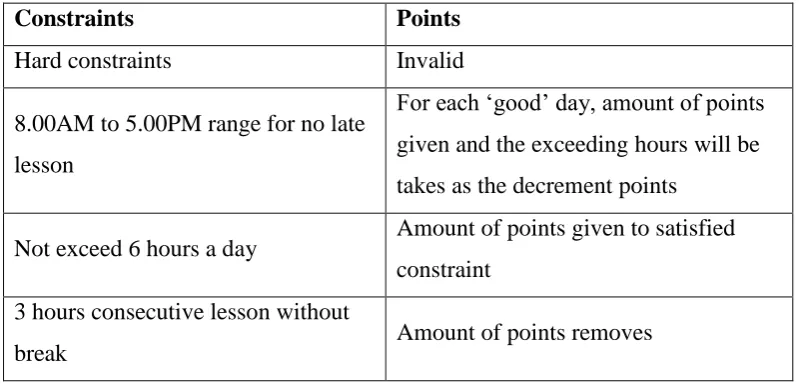
Table 3.3: Point table.
Constraints Points
Hard constraints Invalid
8.00AM to 5.00PM range for no late lesson
For each ‘good’ day, amount of points given and the exceeding hours will be takes as the decrement points
Not exceed 6 hours a day Amount of points given to satisfied constraint
3 hours consecutive lesson without
[image:33.595.133.533.379.574.2]3.1.7 Selections
These chromosomes however need to be filtered to select their ‘elit’ness which gets them to the next population cycle without GA process. This is to the preserve the quality of the timetables generated. The selection made by selecting the highest fitness among them.
3.1.8 Crossover.
The next part of GA process is the crossover. The crossover is the process to create new population based on the initial population. In this case we have two types of encoded data which are variable binary data and fixed binary data. The variable binary data placed at the head of the chromosomes and the following are the fixed binary data. The simple crossover use two chromosomes and permit the new chromosomes. It is applied by splitting the two chromosomes into part in between variable data and fixed data. The Figure 4.4 will assist the process explanation.
Figure 3.4: Crossover process. Simple crossover evolution
Chromosome A:
10111001101110101000101000111/10100100101101010011010001111
Chromosome B:
01101110100110110101000101000/11100110110100100100101010011 Crossover generation:
10111001101110101000101000111/01101110100110110101000101000
10111001101110101000101000111/11100110110100100100101010011
REFERENCES
[1] Egwali A.O.& Imouokhome F.A., 2012. Synthesis-Algo: An Inclusive Timetable Generating Algorithm. African Journal of Computing, pp. 92-100 [2] Guo P., Chen J. & Zhu L., 2011. The Design and Implementation of Timetable
System Based on Genetic Algorithm. International Conference on Mechatronic Science, Electrical Engineering and Computer, pp.1497-1500.
[3] Sivanandam S.N & Deepa S.N., 2008. Introduction To Genetic Algorithm. New York: Springer.
[4] McCollum B. Citing websites. Overview on International Timetabling
Competition. Retrieved May 16, 2013, from
http://www.cs.qub.ac.uk/itc2007/index_files/overview.htm
[5] Chen N., Zhan Z., Zhang J., Liu H.& Liu O., 2010. A genetic algorithm for the Optimization of Admission Scheduling Strategy in Hospitals. Conference Publications of Evolutionary Computation (CEC), IEEE Congress, pp. 427-433 [6] Ren M. & Cheng R., 2000. Genetic Algorithm & Engineering Optimization.
New York: Wiley.
[7] Rui M., Bo L.& Jinyu G., 2010. University Course Timetable System Design and Implementation Based on Mathematical Model. Computer and Automation Engineering, (ICCAE), The 2nd International Conference (Volume: 4), pp. 548-551.
[9] Jat A.N. & Yang S., 2008. A Memetic Algorithm for the University Course Timetabling Problem. Tools with Artificial Intelligence. ICTAI '08. 20th IEEE International Conference (Volume: 1), pp.427-433.
[10] Azmi M., Tajudin A. & Musleh O. 2012. A Multiswap Algorithm for the University Course Timetabling Problem. Computer & Information Science (ICCIS), 2012 International Conference (Volume: 1), pp. 301-306.
[11]AlSharafat W.S. & AlSharafat M.S. 2010. Adaptive Steady State Genetic
Algorithm for Scheduling University Exams. International Conference Networking and Information Technology (ICNIT), pp 70-74.
[12] Abdullah, S. & Turabieh, H. 2008.Generating University Course Timetable Using Genetic Algorithms and Local Search. Convergence and Hybrid Information Technology, 2008. ICCIT '08. Third International Conference (Volume: 1), pp. 254-260
[13] Lutuksin, T. ; Pongcharoen, P. 2010. Best-Worst Ant Colony System Parameter Investigation by Using Experimental Design and Analysis for Course
Timetabling Problem. Computer and Network Technology (ICCNT), 2010 Second International Conference, pp. 467 - 471
[14]Ayob, M.; Jaradat, G. , 2009.Hybrid Ant Colony systems for course timetabling
problems .Conference on Data Mining and Optimization. DMO '09. 2nd , pp. 120 - 126
[15] Malim, M.R. ; Khader, A.T. ; Mustafa, A.2006. An immune- based approach to university course timetabling: Immune network algorithm