International Journal of Emerging Technology and Advanced Engineering
Website: www.ijetae.com (ISSN 2250-2459, ISO 9001:2008 Certified Journal, Volume 2, Issue 12, December 2012)
619
MasPar MP-1: An SIMD Array Processor
P. M. Chawan
1, Jijnasa Patil
2, Radhika Naik
3, Asha Madgundi
4, Nitu Gupta
5 1-5Department of Computer Technology, Veermata Jijabai Technological InstituteMatunga, Mumbai
Abstract— Parallel processors are computers which carry out multiple tasks in parallel. Flynn gave the classification of computer architecture on the basis of multiplicity of instruction and data streams. According this classification Single Instruction Multiple Data (SIMD) processors are the ones which handle same instruction but operate on different data sets. This paper describes the architecture of MasPar MP-1. MP-1 belongs to the category of SIMD array processors. The paper further describes the features of this massively parallel processor along with its major applications.
Keywords—Flynn’s classification, SIMD, MasPar MP-1, XNet, processing element array
I. INTRODUCTION
Computer architectures have been classified by different schemes given by Flynn, Feng, Handler and Shores. Flynn’s classification is based on multiplicity of instruction stream and data stream in a computer system. Feng’s classification is mainly based on serial and parallel processing in the computer system. Handler’s classification is calculated on the basis of degree of parallelism and pipelining in system levels. Shores’s classification is based on constituent element in the system.
Flynn[1][3] classified high speed (parallel) computers into the following four categories based on how the individual processors receive instructions and data: Single instruction stream single data stream (SISD) comprising of conventional serial processors, single instruction stream multiple data stream (SIMD) comprising of the parallel computers, multiple instruction stream single data stream (MISD) comprising of pipelined computers, and multiple instruction stream multiple data stream (MIMD).
SIMD class of processors is a class of parallel computers in Flynn’s Taxonomy which describes computers with multiple processing elements that perform the same operation on multiple data points simultaneously thus exploiting data level parallelism. They are further classified as array processors and vector processors. An array processor has many processor elements operating in parallel on many data elements. They are also referred as a massively parallel processor since they are dependent on the massive size of the data sets to achieve its efficiency.
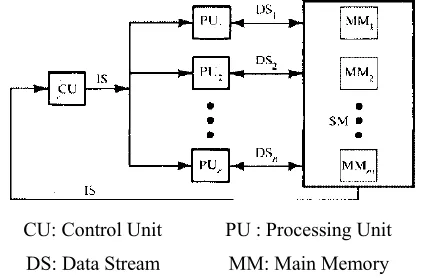
They consist of hundreds to tens of thousands of relatively simple processors operating in parallel. They are famous in parallel processing. The examples of this category available today are Connection machine CM-2 and the MasPar MP-1. The block diagram of an SIMD array processor is shown in Figure 1.
[image:1.612.343.554.307.446.2]CU: Control Unit PU : Processing Unit DS: Data Stream MM: Main Memory
Figure 1: SIMD Array processor
A vector processor has a single processor element that operates in sequence on many data elements. It depends on the same regularity of the action as array processor but on smaller data sets and relies on extreme pipelining and high clock rates to reduce the overall latency of the operation. The block diagram of an SIMD vector processor is shown in Figure 2.
[image:1.612.345.547.550.699.2]International Journal of Emerging Technology and Advanced Engineering
Website: www.ijetae.com (ISSN 2250-2459, ISO 9001:2008 Certified Journal, Volume 2, Issue 12, December 2012)
620 The SIMD array processor consists of multiple processing elements. Each of the processing elements has their private memories and internal register .The common instruction stream is issued by the controller to all the processing elements through the instruction bus. Communications are performed through the interconnection networks. The address of the memory operands is typically the same on all PEs and is usually supplied by the controller. The SIMD model into six subcategories based on the level and kind of autonomy the individual PEs possess in these aspects.[2][4]
Pure SIMD: Machines with no local control.
Activity control: Machines that can participate in a computation step or abstain from it based on a local condition. This is a type of control on instruction selection.
Connection autonomy: Machines that can locally select one among the immediate neighbours as the source or destination of a one-step communication operation. This is a type of control on partner selection in direct communication steps.
Communication autonomy: Machines that can use a local variable as the source or destination address in a general (multi-step) communication operation. This is a type of control on partner selection in general communication steps.
Addressing autonomy: Machines that can use a local variable as the address of an operand in a computation step. This is a type of control on operand selection.
Operation autonomy: Machines that can locally select one of a few operations for execution. This a type of control on instruction selection.
Section II describes the architecture of the Massively Parallel Computer (MasPar MP-1). The next Section III describes the Application and the algorithm of the MasPar MP-1. The Section IV concludes the paper on the MasPar MP-1.
II. MASPAR MP-1ARCHITECTURE
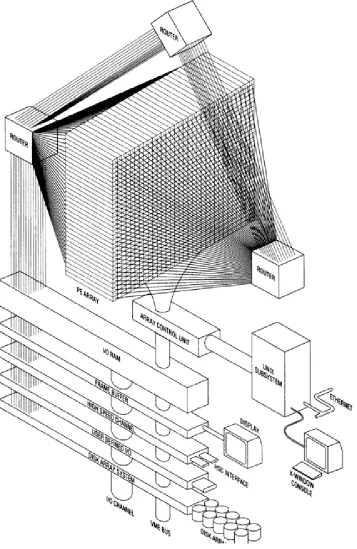
An implemented low cost example of SIMD array processor is a massively parallel computing system developed by the MasPar Computer Corporation. Figure 3 shows the architecture of the MasPar MP-1 with five subsystems [5][6]. These are described below.
A. Array Control Unit:
ACU a custom processor with a microcode implementation of RISC like instruction set controls the PE Array by broadcasting instructions to all the PEs. It performs two primary functions: either PE Array Control or independent program execution. The major characteristics of ACU are as follows:
Harvard style architecture with separate
instructions and data spaces.
32 bit, two address, load /store, simple instruction set. Instructions typically need one or two clock cycles.
4 GB, virtual, instruction address space using 4096 bytes of pages.
B. Processing Element Array (PE Array):
The processor element array is the computational core of the machine. Each PE has on chip register and off chip memory using a basic load/ store instruction style instruction set design. The basic element of PE is as follows:
Integer and Floating point ALU: Both integer and floating point unit share the PE core which is capable of performing all the calculations in a scalar fashion without pipeline latency.
Communication Latency: Three interfaces are provided global router connection, nearest neighbour connection and connection to global ACU signals.
International Journal of Emerging Technology and Advanced Engineering
Website: www.ijetae.com (ISSN 2250-2459, ISO 9001:2008 Certified Journal, Volume 2, Issue 12, December 2012)
[image:3.612.130.487.152.701.2]621
International Journal of Emerging Technology and Advanced Engineering
Website: www.ijetae.com (ISSN 2250-2459, ISO 9001:2008 Certified Journal, Volume 2, Issue 12, December 2012)
622
Main Memory: Each PE has its own private memory with full ECC.
Control Logic: The Control Unit performs two important functions – simple decode of the ACU broadcast instruction and conditional instruction execution. The conditional instruction execution allows the individual processors to decide based on the internal data whether it should execute the current instruction.
C. UNIX Subsystem:
The UNIX subsystem provides the complete network and graphics based software environment in which all the MasPar tools and utilities execute. Part of the application executes as the conventional workstation application while most of the operating system functions are provided by the workstation UNIX software.
D. Communication Mechanism:
The five major communication interfaces are as follows:
Three types of interactions occur between the USS
and the ACU which are supported by the Queues (allows the USS process to quickly interact with the process running on the ACU), shared memory (providing the straight forward mechanism for the process to share the common data structures), DMA (permits fast bulk data transfer without the using the programmed I/O).
XNet communications provides all the PEs with the direct connection to the eight nearest neighbour in the two dimensional mesh.
The global router network permits the random
processor- processor communication using a
circuit switched hierarchical crossbar
communication network.
MP-1 has two global buses of which one is used to
broadcast the instructions and data to all the selected processors by the ACU and the other is used to consolidate the status response from all the processors back to the ACU.
E. Array I/O Subsystems:
All the transactions from I/O RAM to external I/O system can occur asynchronously from PE operations and so it supports high speed performance.MP-1 uses channel style architecture to allow overlapped computation and I/O operations.
III.SOFTWARE SUPPORT FOR MP-1 A. Software Philosophy:
In the past, many computers focused greatly on fast hardware giving minimal importance to software. Such computers are considered raw in today’s world which mainly concentrates on software. Hence the cost of programming becomes a burden. In contrast to this, the MasPar’s computer provides support for existing programming languages. The design of the Array Control Unit makes the software support obvious. As MP-1 is UNIX based, it supports a wide variety of software and services. It uses the front-end UNIX system in support of massively parallel applications [7]. Pre-existing code such as window based interaction code, or network based data access code can continue to run on the MasPar front-end, while only the computational kernel of the application is adapted for parallel execution and migrated to run on data parallel machine. The MP-1 is designed such that the communication between front-end resident segment and parallel segment is through directly mapped hardware queues. This is done without any intervention from the OS and hence the communication is very efficient. Scalar segments of the application can run either on front-end or on ACU.
B. Parallel Virtuality:
Optimized compiler technology and architectural design of MasPar has proved a milestone in the concept of virtuality. Earlier massively parallel machines had physical dimensions of the parallel array clearly visible in the application programs. Lack of virtuality was the reason for effective and flexible programming. The posed a problem especially when the data array size was larger than the physical array size. The MasPar has used the virtuality concept [7] similar to the Cray machines. The PE registers are fully utilized by the compilers by a technique called ―strip mining‖. Here the larger data is divided into multiple strips of data so as to fit in the PE registers. MasPar thus implements virtuality with the support of compiler optimizations rather than as instruction set or architectural feature.
C. Programming Languages: Three languages are supported:[7]
MasPar FORTRAN (MPF)
MasPar C (MPC)
International Journal of Emerging Technology and Advanced Engineering
Website: www.ijetae.com (ISSN 2250-2459, ISO 9001:2008 Certified Journal, Volume 2, Issue 12, December 2012)
623 MPF and MPC generate codes for all parts of the system (front end, ACU and parallel array) from a single program. They provide greatest ability to ignore the details of computer architecture, and deal in a high level application related programming abstraction. MPL only generates code for the parallel subsystems (ACU and PE array). It is used in conjunction with the front-end UNIX programs to form a composite application. MPL is generally used for porting existing applications.
D. Programming environment: The key features are:[7]
Graphical multi-widowed point and select
interface
Modified UNIX object file to permit symbol
access on demand reducing debugger start-up delay on large applications.
Modified UNIX object file to permit incremental delinking and relinking of a single object module which speeds the development cycle of large applications.
Symbolic debugger to permit symbolic debugging
of highly optimized code.
Interactive browsing tools for convenient,
graphical navigation through complex application.
Data inspection tools to examine data structures and arrays graphically.
Machine animation tools that create graphical
depictions of parallel machine operations.
IV.APPLICATIONS
A. General Applications:
Here we discuss in short three applications that offer good-fit problems for MasPar's MP- 1 technology. The three areas discussed only provide a small sample of the applications that are well suited to the MP-1 technology, but serve to show the diversity of applications that benefit from such technology. Other applications areas that have benefited are: Neural Networks, Seismic analysis, Computer vision, Image understanding, Computational Chemistry, Finite Element Analysis (FEA) and Computational Fluid Dynamics (CFD) to name but a few.[8]
1) Signal and image processing:
In terms of real-time signal and image processing MP-1 technology offers an excellent solution: a balance of computing power, communications bandwidth and memory.
Signal and image processing applications demand a wide range of computing solutions. However for the most demanding applications the Engineer must fully utilize the structure of his data and algorithms. Generally such systems and their component algorithms display an embarrassing degree of data parallelism and are very well suited to the MP-l. For example, multi-channel systems, multisensory systems and multi-dimensional systems are all natural candidates to exploit MP- 1 technology. 2) Database analysis:
As the size of databases increase the demand for short response time to queries remains high. Data-parallel computers, such as the MP-1 can search many thousands of records with the same key simultaneously. Peripherals like the MQsPar Parallel disk array further simplify the task of database searching by offering fast access to an NFS mountable UNIX file store.
3) Text and document processing:
In addition to database analysis much interest is now being shown in document processing; both of text files and of images of text samples. Once again the very nature of such problems is data parallel and a good-fit application for MP-1 technology.
B. Application at NASA:
The National Aeronautics and Space Administration (NASA) has a need for high rate data processing. The computational workload of upcoming NASA science missions, especially the ground data processing for the Earth Observing System (EOS), is projected to be quite large (in the 50 to 100 gigaflops range) and correspondingly very expensive to perform using
Conventional supercomputer system [9]. High
performance, general purpose massively parallel computer systems such as the MasPar MP-I are being investigated by NASA as a more cost effective alternative. A group of computational investigators representing many Goddard scientific laboratories has been assembled to test the MP-1 on problems of their own choosing.
These applications are listed below classified according to their scientific listing:[9]
Physical Systems Simulations:
Foliage canopy model
Cellular dynamata
International Journal of Emerging Technology and Advanced Engineering
Website: www.ijetae.com (ISSN 2250-2459, ISO 9001:2008 Certified Journal, Volume 2, Issue 12, December 2012)
624
Finite element simulation
Charged particle transport simulation Algorithms:
Random number generator
Tridiagonal solver
Neural networks
Benchmarks
Bin packing
Matrix inversion
Sorting
Graphics Generation:
Point plotting
Rendering
Image Processing:
Stereo fusion
Nebula gas velocity computation
Image &blurring
Image segmentation
Image compression
Median filter
Image difference metric
Hough transform
New Architecture Research:
Architecture simulation-associative memory
Finite element simulation: The finite element method is frequently used in computational solid mechanics and fluid flow. It simulates a system by discretizing the physical world into a collection of finite elements and processing each element based on its neighboring elements. The system being implemented on the MasPar represents a fluid. The continuous fluid surface is faceted into triangles which are the elements. Nodes are the points where the vertices of the triangles come together.
Tridigonal Solver: A SIMD tridiagonal solver can be implemented on the MasPar using the standard cyclic reduction algorithm. This algorithm is basically a parallel implementation of simple technique of solving equations by using one equation to eliminate a variable in another equation.
Various approaches exist for mapping the problem to a physical array ranging from solving a system in each PE to solving a system across an entire row or column.
Image Blurring: Frequently, images of astronomical objects taken through telescopes are blurred because of imperfections or noise in the optics or sensor instruments.
Mathematically, it is possible to restore these images close to their original clarity if the point spread function (blurring) of the optical detector is accurately known. An implementation of the ―maximum entropy method‖ (MEM) is currently running on the MasPar to deblur images based on an estimate of the point spread function. It is a deconvolution technique that also finds the most probable values for points for which there is no known value.
Point Plotting: In this application, a perspective image is created from hundreds of thousands of data points, allowing a scientist to interactively look at the data from any angle.
C. Image Compression:
A variety of compression techniques, including both split and merge-based vector quantizer, JPEG, and subband coding offer similar image compression performance. Many papers reviewed utilize special purpose hardware or serial algorithms to implement VQ. Compression ratios in the literature range from 4:l to 40:l. The implementations presented here for the MasPar MP-1 [10] demonstrate the feasibility of using a commercially available, massively parallel SIMD machine for codebook generation and encoding and decoding of images. Because of the large number of processors available on the MP-1, and the parallel nature of many parts of the algorithms, the encoding, decoding, and codebook generation execution times obtained are very low. An advantage of using a massively parallel system rather than special purpose hardware is flexibility; e.g., codebook and codeword sizes can be easily changed, and pre- and post-processing routines can be performed using the same system.
The MP-1 is an SIMD mode machine with 16,384 PEs
(processing elements), each consisting of a
processor/memory pair. The ACU (array control unit) broadcasts to the PEs each instruction to be performed. All enabled PEs execute the same instruction at the same time, each on its own local data. A singular variable, which is stored in and manipulated by the ACU, can have only one value at any time. A variable, which is stored in and manipulated by the PEs, has a separate, independent value on each PE. All three phases of the VQ process (codebook generation, encoding, and decoding) were implemented. Timing results are provided for all three phases.
D. Image Segmentation:
International Journal of Emerging Technology and Advanced Engineering
Website: www.ijetae.com (ISSN 2250-2459, ISO 9001:2008 Certified Journal, Volume 2, Issue 12, December 2012)
625 performance. Most of the work in computer vision focuses on images with 2-D data, but pragmatic vision problems require 3-D data which is easily available now.
Three dimensional data may be represented by a 3-D matrix of intensity values, f( i , j, k), where each intensity value represents a property associated with the location ( i , j , k ) . A primary goal (and initial step) of computer vision is to abstract ―relevant’’ information from an image. This may involve a process called segmentation that groups a set of homogeneous pixels into regions. Homogeneity can be defined by different criteria depending upon the image modality; Segmentation thus reduces the information content in the image to the most relevant and by defining some features of the segmented regions, computer vision scientists hope to extract just enough information to characterize those regions. Such an abstraction will be helpful in other higher level tasks like object recognition and visualization.
Two major approaches to segmentation are the region growing ones and the region splitting ones. In region growing, each pixel is considered in relation to its neighbours and pixels that are ―closer‖ in some distance metric are merged. On the other hand, in region splitting, the whole image is initially considered to be one single region and this region is recursively split into smaller regions. Both these approaches are in general amenable to parallel implementation [13].
E. Parallel Sorting:
Let N be the number of keys that have to be sorted, and let P be the number of PES. The method that, for N >> P. Implementations of the deterministic parallel sorting algorithms Bitonic Sort, Odd-Even Merge Sort, and a multidimensional method called FastSort is possible on a Mash MP-1 of moderate size, i. e., consisting of 2048 PEs each with 16KB local memory. The PEs are interconnected as a 32 x 64 torus. These algorithms are oblivious. Note that they do not rely on the representation of the keys.
The problem of sorting a collection of values on a mesh-connected distributed-memory SIMD computer using variants of Batcher's Bitonic sort algorithm is considered for the case where the number of values exceeds the number of processors in the machine [11][12]. In this setting the number of comparisons can be reduced asymptotically if the processors have addressing autonomy (locally indirect addressing), and communication costs can be reduced by judicious domain decomposition. This case can also be implemented on MasPar MP-1.
V. CONCLUSIONS
SIMD array processors operate on single instruction stream and multiple data streams. They are called array processors because they consist of a group of processing elements which operate in parallel. MasPar MP-1 is a low cost example of SIMD array processor. It is a massively parallel computing system developed by the MasPar Computer Corporation. It mainly has applications in the domain of image processing.
REFERENCES
[1] Michael J. Flynn, "Some Computer Organizations and Their Effectiveness". IEEE Transactions on Computers Volume C-21, No 9, Septenber 1972.
[2] Ralph Duncan, "A Survey of Parallel Computer Architectures", IEEE Computer, 1990.
[3] Kai Hwang, Faye A. Briggs, ―Computer Architecture and Parallel Processing‖, McGraw Hill.
[4] Bharat Bhushan Agarwal, Sumit Prakash Tayal, ―Computer Architecture and Parallel Processing‖, Laxmi Publication Ltd.
[5] Tom Blank, ―The MasPar MP-1 Architecture‖, Proceedings of IEEE Compcon Spring 1990, IEEE, February 1990.
[6] John R. Nikolls, ―The Design of the MasPar MP-1: A Cost Effective Massively Parallel Computer‖, Proceedings of IEEE Compcon Spring 1990, IEEE, February 1990.
[7] Peter Christy, ―Software to Support Massively Parallel Computing on the MasPar MP-1‖, Proceedings of IEEE Compcon Spring 1990, IEEE, February 1990.
[8] R. C. Green, ―MasPar’s MP-1 Technology and its Application‖, Proceedings of Parallel Processing: Industrial and Scientific Applications, IEE Colloquium, May 1991.
[9] James R. Fisher, John Dorband, ―Applications of the MasPar MP-1 at NASA/Goddard‖, Proceedings of IEEE Compcon Spring 1991, IEEE, February 1991.
[10]Robert G. Palmer, Jr., Howard Jay Siegel, Janet M. Siegel, and John K. Antonio, ―Implementation of a Tree-Structured Vector Quantizer for Image Compression on the MasPar MP-1 Parallel Machine‖, Parallel and Distributed Systems, 1994 International Conference on Communication.
[11]Klaus Brockmann, Rolf Wanka, ―Efficient Oblivious Parallel Sorting on the MasPar MP-1‖, Proceedings of IEEE ,1996 HICSS-30, Vol. I, pp. 200–208, 1997.
[12]J.F. Prins and J.A. Smith, ―Parallel Sorting of Large Arrays on the MasPar MP-l‖, In Proc. 3rd Symp. on the Frontiers of Massively Parallel Computation 1990.