FOR IMPLEMENTING VALUE MANAGEMENT IN THE
DESIGN OF OFFICE BUILDINGS
QIPING SHEN
A THESIS SUBMITTED TO THE
UNIVERSITY OF SALFORD FOR THE DEGREE OF
DOCTOR OF PHILOSOPHY
FOR IMPLEMENTING VALUE MANAGEMENT IN THE
DESIGN OF OFFICE BUILDINGS
QIPING SHEN
A THESIS SUBMITTED TO THE
UNIVERSITY OF SALFORD FOR THE DEGREE OF
DOCTOR OF PHILOSOPHY
DEPARTMENT OF SURVEYING
UNIVERSITY OF SALFORD
TABLE OF CONTENTS
TABLE OF CONTENTS i
LIST OF TABLES vii
LIST OF ILLUSTRATIONS viii
ACKNOWLEDGEMENTS xi
ABSTRACT xiii
CHAPTER 1. INTRODUCTION 1
1.1 BACKGROUND OF THE RESEARCH 1
1.1.1 The Construction Industry 1
1.1.2 Value Management in the UK Construction Industry 3
1.2 RESEARCH OBJECTIVES, HYPOTHESES AND SCOPE 8
1.2.1 Research Objectives 8
1.2.2 Research Hypotheses 9
1.2.3 Research Scope 10
1.3 METHODOLOGY TOWARDS RESEARCH OBJECTIVES 11
1.4 ORGANISATION OF THE THESIS 14
CHAPTER 2. VALUE MANAGEMENT IN THE CONTEXT OF DESIGN 16
2.1 DESIGN PROCESS AND DESIGN PROBLEMS 16
2.1.1 The Design Process 17
2.1.2 Design Problems 22
2.2.1 Marlcus's Model 24
2.2.2 Hillier and Leaman's Model 27
2.3 VALUE MANAGEMENT AND THE DESIGN PROCESS 30
2.3.1 History and Development 30
2.3.2 Value Management Definitions and Concepts 30
2.3.3 VM Principles and Methodology 34
2.3.3.1 The Functional Approach 34
2.3.3.2 The VM Job Plan 37
2.3.3.3 The Function-Cost Analysis 42
2.3.3.4 The VM Team Approach 43
2.3.3.5 The Environment for Creativity 46
2.3.4 Value Management in The Design Process 46
2.3.5 The Benefits and Limitations of VM 52
2.4 SUMMARY AND CONCLUSIONS OF THIS CHAPTER 54
CHAPTER 3. KNOWLEDGE-BASED SYSTEMS IN BUILDING DESIGN 57
3.1 THE EMERGENCE OF ARTIFICIAL INTELLIGENCE 57
3.2 EXPERT SYSTEMS AS A BRANCH OF ARTIFICIAL INTELLIGENCE 61
3.3 THE CURRENT STATE OF THE ART OF EXPERT SYSTEMS 66
3.3.1 The Roles and Potential Benefits of Expert Systems 68
3.3.2 The Search and Inference Mechanism 70
3.3.3 Knowledge Acquisition Techniques 72
3.3.4 Knowledge Representation Techniques 77
3.3.5 Limitations of Expert Systems 83
3.4.2 Expert Systems in Construction 88
3.4.3 Expert Systems in Value Management 89
3.5 SUMMARY AND CONCLUSIONS OF THE CHAPTER 90
CHAPTER 4. DOMAIN EXPERTISE MODELLING 92
4.1 WHY ICI ENGINEERING DEPARTMENT WAS SELECTED 92
4.2 THE CURRENT PRACTICE OF PROJECT REALISATION IN ICI . . 96
4.2.1 The Conceptual Analysis 96
4.2.2 The Decision-Maldng Process In ICI Building Design 103
4.2.3 The Integration of Conceptual Analysis and Cost Estimation . . 107
4.3 ALLOCATION OF PROJECT COST AGAINST REQUIRED FUNCTIONE08
4.3.1 Difficulties of Functional Cost Allocations 110
4.3.2 Current Approaches of Functional Cost Allocation 111
4.3.3 Functions of Office Buildings and Building Norms 115
4.3.4 Allocations of Extra Project Cost Against Functions 118
4.4 SUMMARY AND CONCLUSIONS OF THE CHAPTER 125
CHAPTER 5. SYSTEM DESIGN AND IMPLEMENTATION 131
5.1 DESIRED CHARACTERISTICS OF THE SYSTEM 131
5.1.1 Scope of The Proposed System 132
5.1.2 Requirements of The Proposed System 135
5.2 DOMAIN SUITABILITY FOR ES DEVELOPMENT 137
5.2.2 Representation of Function Analysis 139
5.2.3 Representation of Function Cost Analysis 141
5.2.4 Representation of Team Approach 142
5.2.5 Representation of Environment for Creativity 143
5.2.6 Conclusions of the Domain Suitability 147
5.3 SYSTEM DEVELOPMENT METHODOLOGY 148
5.3.1 Information Gathering 152
5.3.2 Development of The Skeleton System 153
5.3.3 Further Development Towards a Working System 154
5.4 THE KNOWLEDGE ACQUISITION PROCESS 155
5.5 THE KNOWLEDGE REPRESENTATION PROCESS 157
5.5.1 Software for Expert System Development 157
5.5.2 Selection of Knowledge Representation Languages 161
5.5.2.1 Selection Criteria 161
5.5.2.2 Comparison and Evaluation of Candidates 162
5.5.2.3 Brief Introduction to The Successful Candidate 166
5.6 SUMMARY AND CONCLUSIONS OF THIS CHAPTER 168
CHAPTER 6. AN OVERVIEW OF THE PROPOSED SYSTEM - CAVA 170
6.1 THE OVERALL SYSTEM ARCHITECTURE 170
6.2 STRUCTURE OF THE CONCEPTUAL ANALYSIS MODULE 174
6.2.1 Generation of a Specific Conceptual Functional Diagram 176
6.2.2 Modification of Function and Alternatives Generation 180
6.2.3 Evaluation of Alternative Solutions 190
6.2.5 Knowledge Refinement in the CA Module 196
6.2.6 Integration of the CA Module and the ELSIE Budget Module . 198
6.3 STRUCTURE OF THE VALUE ANALYSIS MODULE 200
6.4 SUMMARY AND CONCLUSIONS OF THIS CHAPTER 211
CHAPTER 7. THE VERIFICATION AND VALIDATION OF CAVA . . 214
7.1 SYSTEM VALIDATION AND VERIFICATION (V&V) 214
7.1.1 Difficulties in System V&V 215
7.1.2 Cited Approaches in System Verification 217
7.1.3 Cited Approaches in System Validation 218
7.2 A PRAGMATIC STRATEGY TOWARDS V&V OF CAVA 225
7.3 APPROACHES TOWARDS THE VERIFICATION OF CAVA 229
7.3.1 Checking for Consistency 229
7.3.2 Checking for Completeness 232
7.4 THE APPROACH TOWARDS THE VALIDATION OF CAVA 237
7.4.1 Validation as a Process of System Implementation 237
7.4.2 Testing Against the Expected Performance Features 239
7.4.3 A Face Validation by an Independent Value Specialist 241
7.4.4 The Sensitivity Analysis of CAVA 242
7.4.5 Robustness Test, Field Test and Module Validation 246
7.5 SUMMARY AND CONCLUSIONS OF THIS CHAPTER 248
CHAPTER 8. CONCLUSIONS AND FUTURE DIRECTIONS 249
8.2 CONCLUSIONS OF THE RESEARCH 252
8.3 FUTURE DIRECTIONS OF THE RESEARCH 257
8.3.1 Expansions for the CA Module 257
8.3.2 Expansions for the VA Module 258
APPENDIX 1. GLOSSARY 261
APPENDIX 2. ABBREVIATIONS USED IN THE THESIS 268
APPENDIX 3. LIST OF FILES USED BY CAVA 269
APPENDIX 4. OBJECTS USED IN THE CA MODULE OF CAVA 272
APPENDIX 5. A TYPICAL CONSULTATION WITH THE CA MODULE 277
LIST OF TABLES
Table 2-1 Major Developments In The History of VM 31
Table 2-2 VM in Major European Countries 32
Table 2-3 Verbs and Nouns for Use and Aesthetic Functions 36
Table 2-4 Methodology of Value Management 41
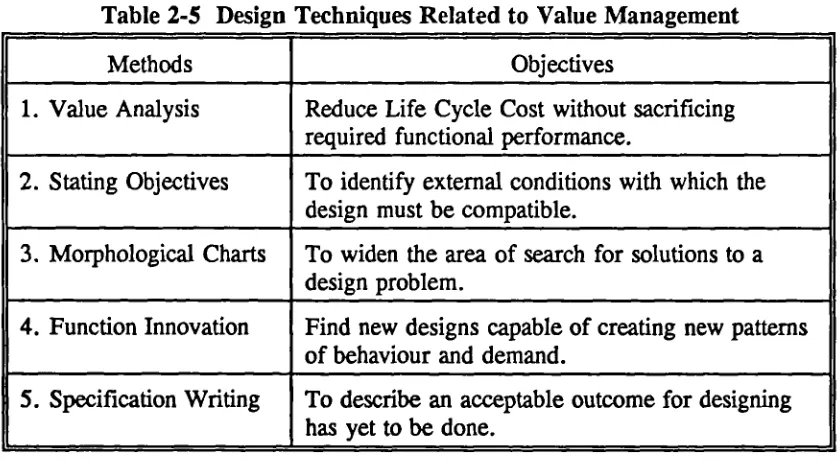
Table 2-5 Design Techniques Related to Value Management 48 Table 3-1 Differences Between ESs and Conventional Programmes 64 Table 3-2 Differences Between DSSs and ESs (After Turban, 1988) . . . 66
Table 4-1 Alternatives for Window Design 117
Table 4-2 The Method for Ranking Building Functions 120 Table 4-3 Assumed Percentages for Allocating Cost to Supporting Functions 120 Table 4-4 Questions Asked by the ELSIE Budget Module (Partial) 123 Table 4-5 Differences Between the Original Design and the Norm Building 126 Table 4-6 Allocations of Extra Costs To Supporting Functions 130 Table 5-1 Functions of Building Elements Represented in Frames 140 Table 5-2 Four Main Families of Techniques for Creativity 146 Table 6-1 A Checklist for Stimulating Creativity 184 Table 6-2 Methods for Creating a Variety of Ideas 185 Table 6-3 Psychological Reasons of Roadblocks 187 Table 6-4 Possible Roadblocks During the CA/VA Study 188
Table 6-5 Function Analysis of Office Complex 207
Table 7-1 Cited Approaches in System Verification 219 Table 7-2 Evaluation Criteria and Their Explanations 221 Table 7-3 Summary of Approaches in V&V of CAVA 229 Table 7-4 A Decision Table for Checking Missing Rules 236 Table 7-5 Questionnaire and Comments from an Independent Expert . . . 243 Table 7-6 Costs of virtual projects when quality requirements change . 245 Table 7-7 Cost differences between initial design and virtual projects . 245 Table 7-8 Sensitivity analysis of functional costs of supporting functions 246
LIST OF ILLUSTRATIONS
Figure 1-1 Actions undertaken in order to achieve research objectives . 13 Figure 1-2 Actions undertaken in order to understand the VM domain . . 14 Figure 1-3 Actions undertaken in order to analyse the VM domain 14 Figure 1-4 Actions undertaken in order to develop a prototype 15
Figure 2-1 Illustration of Decision Sequence 19
Figure 2-2 Markus/Maver's Model of The Design Process 20 Figure 2-3 Lawson's Model of Design Constraints 23
Figure 2-4 Markus's Model of Building & People System 25 Figure 2-5 Hillier and Leaman's Model of Functions of Buildings 28 Figure 2-6 Principles of Value Management Methodology 34 Figure 2-7 Illustration of The 40-Hour Job Plan 39 Figure 2-8 A Recommended Framework for The Design Process 49
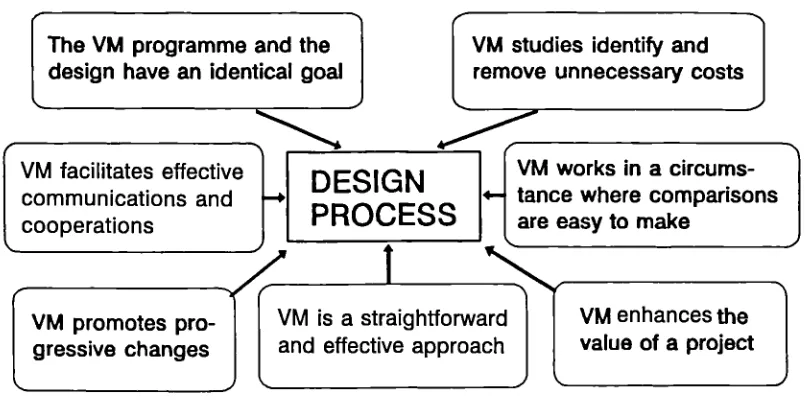
Figure 2-9 Reasons Which Explain Why VM Works 49
Figure 3-3 Figure 3-4 Figure 3-5 Figure 3-6 Figure 3-7 Figure 3-8 Figure 4-1 Figure 4-2 Figure 4-3 Figure 4-4 Figure 4-5 Figure 4-6 Figure 4-7 Figure 4-8 Figure 4-9 Figure 4-10 Figure 4-11 Figure 4-12 Figure 4-13 Figure 4-14 Figure 5-1 Figure 5-2 Figure 5-3 Figure 5-4 Figure 5-5 Figure 5-6
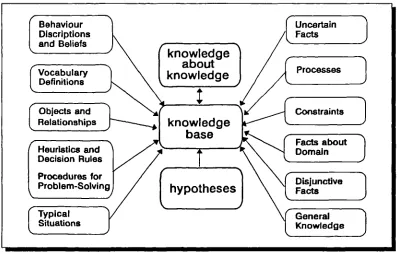
Types of Knowledge in a Knowledge Base (Turban, 1988) . • • 73
Stages of Knowledge Acquisition (Hayes-Roth, 1984) 74
Model of Human Cognitive Structure and ES Architecture . 78
The Representation of a Building in a Semantic Network . . • • 79
Representation of Knowledge and Facts in Frames 81
Case-Based Reasoning Approach to Design 87
Current Process of Project Realisation in ICI 97
The Key Personnel Involved in Project Definitions 100
A Typical Conceptual Functional Diagram for Office Buildings 102
The Decision-Making Process in Building Design in ICI 104
A Model which Integrates the CA and Cost Estimation 109
Functions and Components of An Incandescent Lamp 112
The Deck Section of A Bridge Under Analysis 113
Basic and Supporting Functions of Office Buildings 116
Alternatives and the Norm of Office Plan Shape 118
Elemental Costs of The Initial Design 127
Elemental Costs of The Norm Building 127
Project Costs When Cost Affecting Factors Above Their Norms 128
Allocation of Extra Cost Against Functions 128
Extra Costs for Supporting Functions 129
Rule for the 'VM Job Plan 139
Frame for Building Functions 139
Physical and Functional Attributes of A Pencil 141
Rule for Target HVAC Cost 142
Stages Involved in Creative Thinking 143
Figure 6-1
Figure 6-2
Figure 6-3
Figure 6-4
Figure 6-5
Figure 6-6
Figure 6-7
Figure 6-8
Figure 6-9
Figure 6-10
Figure 6-11
Figure 6-12
Figure 6-13
Figure 6-14
Figure 6-15
Figure 6-16
Figure 6-17
Figure 7-1
Figure 7-2
Figure 8-1
The Potential to Influence Cost Over Project Life Cycle 171
A Blackboard Structure of the Proposed System 173
Structure of the Conceptual Analysis Module 176
The Structural Hierarchy of Functions within CAM 178
Frames for Levell_Functions and Establish_Building 178
The Generic Managerial Rules in Controlling Functions 179
Representation of Functions in the First Level 180
Graphical Presentation of Functional Costs Generated by CAVA 182
Criteria Ranking and Alternative Selection Processes 192
Model of Life Cycle Costing Analysis 194
The LCCA - Operation Cost & Annual Maintenance Cost . . . 195
The LCCA - Maintenance/Replacement/Alteration Cost 195
The LCCA - Net Present Value & Annual Equivalent Value . 196
A Framework for Knowledge Refinement in CAVA 197
Interactions and Difference Between CAVA and ELSIE 199
A Framework of the Value Analysis Module 202
The Inference Net for External Works 204
Approaches in Expert System Validation 220
Sensitivity Analysis of Functional Costs in CAVA 246
ACKNOWLEDGEMENTS
I would like to express my deep gratitude to professor Peter S Brandon for his most appreciated supervision, guidance and encouragement in my research work throughout the research period.
I would like to thank the Education Committee of the Chinese Government and the British Council for their continuing financial support to the study.
Many thanks to John Roberts, Stuart Lord, Wilfred Burgess, Geoff Dalton, Clive Richardson, and Peter Kenedy of the Imperial Chemical Industries Plc for their provision of valuable expertise. Without their cooperation it would not have been possible to undertake this research. My thanks also go to Julia Dale, Bernard Watts, Michael Dallas and other members of the executive committee of the Institute of Value Management for their appreciated help and comments on the research.
I wish to thank Dr Ian Watson and Mr Stephen Tetlow for their comments and constructive criticism on this thesis.
I wish to extend my gratitude to staff of the Department of Civil Engineering, Tsinghua University in P. R. China, especially Professor Qian Lu for their encouragement and support during this research.
Value Management (VM) is an organised effort directed at analyzing the functions
of systems, supplies, equipments and facilities, for the purpose of achieving the
required functions at lowest overall cost, consistent with requirements for
perform-ance, including reliability, delivery, maintainability and human factors. This
structured method can also be successfully used to define the scope of a project. In
the UK, the awareness of the tremendous potential and benefits of applying VM to
construction projects has made some clients eager to apply this technique to their
projects. There are, however, a number of problems which inhibit the use of this
advanced technique in the construction industry. Qualified VM specialists, for
instance, are very scarce within the industry, it is often difficult to find them to
undertake proper VM studies. This research therefore aimed at exploring the
feasibility of building a Knowledge-Based System (KBS) to facilitate VM
implementa-tions in the design stages of a construction project. A demonstration system has been
successfully developed to illustrate the facilities which would be available to potential
users in a fully developed system. A method of allocating project cost against
functions of the project specified by the clients has been developed, which could
expedite the processes of clarifying clients' brief and ensuring good value for money
by cutting unnecessary costs and enhancing required functions. The research has also
explored how KBSs can be effectively applied to "open-ended" decision-making
problems in which new options may be generated during each session with the
system, i.e. the study considered the possibility of letting users extend and customise
the knowledge base. The system has been described as a "satisfactory and very
CHAPTER 1. INTRODUCTION
1.1 BACKGROUND OF THE RESEARCH
1.1.1 The Construction Industry
The construction industry is one of the largest industries in the UK, approaching £48
billion in annual turnover, which represents 10% of the UK Gross Domestic Product
("Building IT 2000", 1990). The industry has experienced many changes in recent
years, from being one employing traditional skills and techniques to one using new
materials and methods in innovative ways. There was a sharp building boom between
1985 and 1990, though the industry is traditionally volatile and is highly influenced
by the overall status of the economy.
Building is distinguished from other forms of construction in satisfying society's
needs for shelter in the form of houses, factories, hospitals, schools, conference
centres, shopping complexes and sports centres. Every building product has a life
cycle, which usually includes feasibility, design, construction and occupancy (Kirk
and Spreckelmeyer, 1988). The feasibility is the starting point of the cycle, during
which investigation to determine the need for a project and its potential for economic
and functional success is undertaken. Building design consists of producing and
communicating information, which interprets the goals and objectives of the clients
formulated during the feasibility stage into a set of instructions, drawings and
specifications to the people who will build the project. The construction stage is the
of the end product after construction, including maintenance and rehabilitation.
As a result of technological developments, uncertain economic conditions, social pressures, and political instability, the construction industry's clients place increasing demands upon the industry in terms of the performance of the project, the capital and running costs, the time required from conception of the project to occupation, and after all the value for money of the project (Walker, 1989). Bennett (1985) also indicates this increasing demand for providing building products which satisfy clients' requirements and with relatively low overall life cycle cost. Buildings, however, are particularly complex entities involving such things as social, physical, aesthetic and environmental factors, some of which contain no reasonable way of measuring the benefit and cost (Brandon, 1984). Building problems are extremely complex and ill-defined, starting in uncertainty and trying to end up with certainty (Happold, 1986). Without proper methodologies and techniques to follow, it is very difficult for the designers to satisfy clients' requirements at lowest overall life cycle cost.
A commonly-used approach towards the above problem is the utilisation of the cost planning and control techniques, of which the elemental cost analysis is an integral component. This approach has been used in the UK for many years and has made an outstanding contribution to the study, forecasting and control of building costs. There are however several basic limitations which inhibit its further developments:
these three aspects is usually in inverse proportion to their relative importance, often being almost entirely concentrated on the third aspect.
(2) By definition, a building element is that part of a building which always performs the same functions irrespective of building type and specifications. Because of the interdependency and indivisibility of some building elements which may combine several functions, nobody has yet produced a set of elements each of which performs a single function and can be easily cost-related (Ferry and Brandon, 1980). This means that it is not possible to compare the cost performance of the same element on two different buildings, nor to compare two different technical solutions concerning one element within one building.
(3) Since the manipulated elemental costs are not really data in any scientific sense, which may bear no relation to fact, it would be a waste of time and money to use sophisticated methods to manipulate inaccurate data. As Ferry and Brandon (1980) stated, such processing is worse than useless, because the processed results are more likely to be accepted by the clients as reliable information and therefore large risks are more likely to be introduced to the unfortunate users.
1.1.2 Value Management in the UK Construction Industry
re-quirements for performance, including reliability, delivery, maintainability and human factors. It has been widely used in the USA, and has made a significant contribution to the provision of cost savings and enhancement of performance in various areas. Based on the results obtained from many construction projects, a 5-20 % reduction in initial and follow-on costs is a reasonable expectation from a formal VM programme, when first applied to any construction project. (Dell'Isola, 1982)
VM is generally recognised and actively used in the member states of the European Community. The European Community's Strategic Programme for Innovation and Technology Transfer (SPRINT) has seen VM as a powerful tool to achieve one of its three objectives, i.e., improving awareness of the innovation mechanism and promoting the convergence of national and community innovation policies (Strub,
1991). Under the SPRINT programme, three European VM conferences have been organised, two VM documents have been produced, and a number of research projects into VM have been funded (Watts, 1992).
According to a recent market survey conducted by the Commission of the European
Community DG XIII (1991), although VM is currently under-utilized in Europe, the
potential demand for VM should almost double in five years to reach 38,000 VM actions in Europe (8675 actions in the UK alone) in 1996, which represents a yearly growth of 13%. The survey also shows that 83% of the VM cases experienced by the interviewed users are considered as a total success, 14% are considered as a half success, and only 3% of the cases are considered as a complete failure. Among those users, 97% of them are planning to use it again in the future.
potential for the applications of VM to the construction processes has already been noticed. The awareness that VM is a systematic method for reducing overall cost without sacrificing the required function makes some clients eager to apply this technique to their projects. There are, however, a number of problems which inhibit VM implementation in the UK construction industry. They include:
1) Qualified VM consultants and VM companies who can provide VM services are so scarce that it is difficult to find suitable VM specialists to undertake VM work when it is required. This view is also reflected in a recent survey conducted by the Commission of the European Community (1991). It revealed that the lack of skilled VM personnel is considered as a main problem inhibiting VM applications both by the VM suppliers and the users; in many cases companies willing to use VM have stated that they will recruit a VM specialist to start a VM programme.
2) As also indicated by the survey stated above, the time required for a VM study is an important reason which restrict the use of VM. This appears especially true in small and medium sized companies where the solving of day-to-day problems has a higher priority than detailing a long or medium term strategy for value enhancement. The formal 40-hour VM job plan is often blamed by the designers, whose criticism says that time delay and work interruption to the design programme and construction can be more costly than potential savings (Kelly and Male, 1988).
experience of VM in advance. This is especially true in small companies which lack the financial capacity to support VM studies and the application of the results (Commission of the European Community, 1991).
4) Although some consultants purport to provide VM services for the construction industry, frequently, VM methodologies were not used properly. Some consultants see VM as purely a cost reduction technique, and they do not analyze the functions of the building and/or elements at all. Kelly and Male (1991) have warned of the danger of organisations leaping on the band-waggon and advertising VM services without possessing the minimum expertise in VM.
5) The time allocated in a 40-hour construction-based workshop is misplaced when compared to Value Management theory, with information assimilation, evaluation, development and presentation taking too high a proportion. The time allocated to functional analysis was too short (Kelly and Male, 1991).
6) Unlike other professions such as architects, structural engineers, and quantity surveyors, VM standards and certifications in the UK have not yet been established. Some designers are therefore critical of the professionalism of the VM team members by saying that: "VM specialists are not professionals", "We do not object to review components by qualified professionals" (Kelly et al, 1988). Government organisations also find it difficult to promote VM to companies, because without an established VM standard it is hard to support VM as a serious and proven method (Commission of the European Community DG XIII, 1991).
a solution to overcome most of the obstacles, especially for the first five problems. Unfortunately, although the use of creative thinking is an essential element of the VM methodology and the VM profession encourages the use of the latest development of technology, the creative use of computers by the profession was quite limited. Until recently, VM studies have been mainly a manual process. As revealed by the recent survey of the European VM market (Commission of the EC, 1991), the majority of VM suppliers do not use any computer software, except some simple "home made software" based on spreadsheet packages, e.g., Lotus and Excel to process data obtained in the VM studies, rather than to monitor the whole programme.
As a result of the increasing enhancement of performance and the continuing decline in price, computers have become useful and affordable tools which are playing a very important role in every sector of our society. On the other hand, the maturity of information technology, particularly Knowledge-Based Systems (CBS), has made some complex computer applications possible. It was these two recent developments which have led to the original idea of building a ICES to improve VM implementation in the building design process.
occupation, maintenance and rehabilitation.
With the assistance and support of a KBS containing domain knowledge and expertise of VM, the time spent on tedious time-consuming calculations can be significantly reduced; the productivity of VM studies might therefore be considerably improved. The participants of the studies could concentrate on more creative issues, and better results could therefore be produced. Hence several roadblocks and drawbacks of VM studies (such as accessibility of the valuable expertise, large amounts of time and money spent on the studies, inadequate use of VM techniques, and misplaced time allocation on each phase during a VM study) could therefore be overcome.
1.2 RESEARCH OBJECTIVES, HYPOTHESES AND SCOPE
Having understood the problems concerning the implementation of VM in the UK construction industry, and the potential of using Knowledge-Based Systems to make scarce VM expertise more widely available, a research project was therefore proposed to explore the feasibility of building a KBS to facilitate VM implementation in the building industry to make scarce VM expertise more widely available.
1.2.1 Research Objectives
The overall objectives of this research were initially set up as: to explore whether a
knowledge-based system could be successfully used in facilitating the implementation
of Value Management in the building industry to make scarce expertise more widely
system with VM domain knowledge and expertise would be developed to illustrate the
types of facilities that will be available in a fully developed system.
The research also attempted to test the adequacy of using ICBS to stimulate creative thinking in the design context, and to explore the possibility of letting users extend and customise the knowledge base (new options may be added during each run of the system), so that the system can be gradually refined through its use.
The best way of achieving these objectives seemed to be a comprehensive theoretical analysis of the VM domain against criteria for successful KBS applications, and an actual implementation of such a system followed by a test of its usefulness and applicability in the real world. As will be discussed in Section 1.3 of this Chapter, a combination of case studies and action research methodologies appeared to be most suitable for this purpose and was therefore adopted in this research.
One of the most important characteristics of the combined methodologies is the involvement of an organisation (Galliers, 1992, Antill, 1985, Wood-Harper, 1985). In order to find an organisation to participate in the research project actively, initial effort of the research was devoted to developing a prototype system. The purposes of developing such a pilot system were twofold: firstly, as a means to demonstrate to various relevant organisations the potential and benefits of using KBSs to make scarce VM expertise more widely available; and secondly, as an initial feasibility study of using KBS to facilitate the implementation of VM in the design of buildings.
completion of an entire design, as specified by the US counterparts).
The prototype system was proved to be very successful in achieving the two purposes stated above. It not only initially demonstrated the feasibility of using KBSs to facilitate the implementation of VM in the construction industry which therefore to a large extent increased the researcher's confidence in the research, but also attracted and maintained the enthusiasm and interest of one of the largest organisations in this country, Imperial Chemical Industries Plc, to participate in the research.
Following the participation of ICI Plc, a subsequent study was undertaken jointly by Mr G C Dalton at Corporate Management Services of ICI Plc and the author from June to September 1989. Several sessions of interviews with various relevant persons (e.g., project engineer, building manager, value specialist, system support manager) were undertaken. The study indicated that there is a potential for capturing and spreading VM experience, and there is a need to undertake further research into the structure underlying VM and its relation to the information requirements of the rest of the project definition and the design process. It proposed that further research could be done by continuing to work with Qiping Shen at Salford University.
The participation of the organisation enhanced the initial prototype system, and broadened the scope of the research to include a new area of VM applications, i.e., the conceptual analysis. As will be discussed late in Chapter 4, the principles followed by a conceptual analysis are virtually the same as value management. Because of its unique characteristics of applying those principles in the conceptual design stage, it has been distinguished from conventional value analysis by the practitioners in the organisation. The author has therefore also adopted the term of CA and distinguished it from traditional VA throughout the research and in this thesis itself.
firstly, office buildings are conventional type of buildings, relatively large amounts of expertise existed in this area; secondly, cost information plays a very important role in both CA and VA, and the budget module of ELSIE (a suite of successful expert systems developed at Salford University) has been widely used in ICI for this purpose, which at that time can only produce cost estimate for office buildings; and finally, because of the limited time of the research, the author can only concentrate on a specific type of buildings. The principles, if proved successful, can be extended in future development to include other types of buildings.
The knowledge and expertise in CA in the proposed system were acquired from a number of experts in ICI Plc (e.g., Mr. Wilfred Burgess, Mr. John Roberts and Mr. Stuart Lord) through an iterative process of knowledge acquisition, implementation, validation and verification, throughout the research project. In addition to the above process of acquiring knowledge (i.e. through interviews), five historical CA studies undertaken in the organisation were examined to understand/familiarise the processes of CA studies and to obtain additional CA-related knowledge and expertise. Although the research was targeted on office buildings and sources of data were mainly collected around this scope, historical information on other types of buildings was also used in the project for the purpose of cross-fertilisation. These were a computing centre, a research laboratory, two chemical plants, and a spillage control project. The inclusion of such information seems to be a useful step towards future expansion of the system to cope with other types of buildings, though it is still too early to say that the system is capable of conducting CA studies on them as well.
electing Developing Software/ Prototype
ardware Seeking Industrial Partners
Participating
VM Studies VM DomainAnalysing
9 performance between initial design and standards, and facilitating the use of VM techniques, methodologies, and the expertise of value specialists to reduce the overall costs without sacrificing its required functions.
As summarised in the diagram below, the entire research is characterised by two distinct stages separated by the participation of ICI Plc: stage 1 - initial experiment, within which a prototype system (focusing on the sketch design stage of an office building project) was developed based on secondary information, i.e., various publications; and stage 2 - action research, within which primary information was used throughout the design and development of the proposed system. The existing prototype (VA module) was improved through subsequent modifications based on the comments made by the practitioners and the utilisation of historical case studies. A brand new module, conceptual analysis, was successfully developed which focuses on the conceptual design stage of an office building project. The broad objectives initially established for the research have also been refined and made more explicit during the second stage of the research project, which exhibited the cyclical feature of action research indicated by researchers (e.g., Susman & Evered, 1978; Wood-Harper, 1985) in the methodological field of action research.
Participation of an organisation Surveying
Literature ValidationSystem VerificationSystem
Set Research Understan Knowledge Knowledge Methodologies VM Domain Acquisition Representation
onsulting Initial Broad ublications Objectives
Stage I - Initial Experiment Stage ll - Action Research
Following the objectives outlined above, the hypotheses of the research are therefore outlined as follows:
1) the total cost of an office building project can be allocated against building
functions required and specified by the clients of the project; a detailed
inforrnation of costs per function would therefore be available.
2) the knowledge and expertise of value specialists in facilitating a VM study .
of office projects can be successfully elicited, modelled and represented in a
knowledge-based system.
3) knowledge-based systems with properly elicited and represented VM domain
knowledge can facilitate VM implementation in the design of office buildings
at early design stages.
The hypotheses were made based on the assumption that VM is a useful tool in supporting building design decision-making by clarifying client's objectives, identifying and removing unnecessary costs whilst maintaining required performance. These hypotheses were tested throughout the development of the proposed system within the research.
1.2.3 Research Scope
research explored the feasibility of using a ICBS to facilitate the implementation of VM in the design of office buildings at early design stages. The reason for choosing office buildings is that they are a conventional type of building, and expertise in undertaking VM studies on office buildings exists in the UK construction industry. The budget module of the ELSIE system, a successful KBS application developed at Salford University (Brandon et al, 1988), has captured the cost-estimating expertise for office buildings, a feature which is essential to the success of VM studies.
Since major design decisions are usually made in the early design stages, research efforts have been mainly devoted to the development of two parallel modules, i.e., the Conceptual Analysis Module (CAM) and the Value Analysis Module (VAM), which comprise the CAVA (CA and VA) system. CAM assists the project designers in clarifying client's requirements in functional terms, and formulating a project definition of an office building project at early concept design stage. Whereas VAM was designed to assist a VM study team in undertaking complete VM study at the sketch design stage of an office project. (Details about the the proposed system
will be introduced in Chapter 6)
1.3 METHODOLOGY TOWARDS RESEARCH OBJECTIVES
authors, e.g., Galliers, 1985, 1992; Anti11, 1985; Wood-Harper, 1985; and JOnsson, 1991. Because of the complexity and the wide coverage of the research, it appeared inappropriate that only one of the approaches should be employed. In order to take the advantages and overcome the shortcomings exhibited by a single approach, the research has adopted two approaches: case studies, and action research.
Case studies are attempts at describing the relationships which exist in reality, usually within a single organisation or organisational grouping (Galliers, 1992). This approach enables the capture of reality in considerably greater detail and the analysis of a considerably greater number of variables, than is possible with most of the other approaches listed above (Galliers, 1992). It has the advantage of obtaining a complete view of the personalised VM domain expertise, which is essential in achieving the research objectives. Since its application is usually restricted to a single event or organisation, the weaknesses of this approach are often cited as the difficulty in acquiring similar data from a statistically meaningful number of similar organisations, and the problems associated with making generalizations from individual case studies. It is however argued by Lawler et al (1985) that single case studies are helpful in developing and refining generalizable concepts and frames of reference.
1--- 1. Survey Relevant Literature
I— 2. Understand the VM Domain I— 3. Analyze the VM Domain
F-
4. Develop a Prototype SystemI--
S. Demonstrate the PrototypeI—
6. Consolidate the PrototypeL.
7. Verify/Validate the Prototype Explore Feasibility of UsingKBSs to Facilitate VM Studies
The main feature of action research is that it is expressly designed to foster learning
about one's practice (learning takes place during the course of the project) and about
alternative ways of constructing it (Rinsson, 1985). As Wood-Harper (1985) argued,
this approach can produce significant insight from investigating real life situations.
It has the advantage of linking theory with practice, for without this link the research
may end up with theoretical discussions and no practical validation and testing of the
research findings. It is therefore one of the few approaches that can be used in the
proposed research to prove hypotheses and to validate the research findings.
To achieve the objectives established for this research effectively, and to test the
hypotheses initiated thoroughly, the above two approaches have been developed into
a detailed research plan, through the use of the systematic function analysis technique
employed in VM studies. Within the plan, the higher level task functions appear on
the left of the diagrams. By asking the question "how" those task functions can be
achieved, task functions at their immediate lower level can be defined. For example,
as shown in Figure 1-1, to achieve the overall objective of "Explore the feasibility
of using ICBSs to facilitate VM studies", functions such as "Survey literature" and
"Develop a prototype system" have to be completed.
Figure 1-1 Actions undertaken in order to achieve research objectives
in Figure 1-2, in order to achieve task "Understand the VM domain", a number of
sub-functions need to be accomplished. They include: understanding approaches of
building design and how VM fit into the design process; exploring techniques used
in obtaining a clear brief from the clients; analysing decisions to be made in the early
design stages; understanding the kinds of guidance a VM consultant can give to a VM
study team; analysing historical VM studies, and finally interviewing experienced VM
consultants in order to acquire human knowledge and expertise. Figure 1-3 and
Figure 1-4 are illustrations of actions to be undertaken in order to achieve the task
functions of analysing the VM domain and developing a prototype system.
1— 2.1 Understand the Design Process I— 2.2 Study VM Books/Reports I— 2.3 Study VM Case Studies
2. Understand the VM Domain
1--
2.4 Attend VM Training/WorkshopsI— 2.5 Analyze VM Studies I— 2.6 Attend VM Conferences 1--- 2.7 Interview VM Consultants
Figure 1-2 Actions undertaken in order to understand the VM domain
1-- 3.1 Analyze VM Concepts/Principles I— 3.2 Establish Criteria for KBS Appls
3. Analyze the VM Domain I— 3.3 Evaluate the VM Domain Criteria
I-- 3.4 Review VM and KBS Literature Figure 1-3 Actions undertaken in order to analyse the VM domain
1.4 ORGANISATION OF THE THESIS
Chapter 1 introduces the background of the research, including research objectives,
4. Develop a Prototype System
r— 4.1 Understand KBS Methodology
F-
4.2 Modelling VM ExpertiseI--
4.3 Analyze 1CBS Approaches in DesignI--
4.4 Select Development Hardware 1---- 4.5 Choose Development SoftwareF-
4.6 Acquire VM ExpertiseI--
4.7 Use Development Methodology I-- 4.8 Represent Knowledge/Expertise Figure 1-4 Actions undertaken in order to develop a prototypeto explaining the current process of design decision making and how VM fits into the
building design process. The basic concepts and principles of Value Management, the
historical and the latest development of this profession in the European Community
are also introduced. Chapter 3 illustrates the current state of the art of Artificial
Intelligence and its applications in the construction industry. Current Al approaches
in building design have been critically analyzed in this chapter. Chapter 4 outlines the
modelling of the expertise in applying VM to the design process in ICI Plc. The
current practice of functional cost allocations is critically analysed and a new
approach, developed during the research, is introduced. Chapter 5 discusses the
domain suitability of applying ICBS to VM in building design, and explains how VM
domain expertise is represented in a knowledge base. The methodology followed to
design and develop the proposed knowledge-based system is also introduced. Chapter
6 describes the generic structure of the system and details of system implementation.
Chapter 7 is dedicated to introducing system performance, verification and validation.
Chapter 8 discusses and concludes the research findings. Directions for future
CHAPTER 2. VALUE MANAGEMENT IN THE CONTEXT OF DESIGN
This chapter examines the relevance of VM to the design process to see whether and how VM can be used to improve the process. It discusses various models of the design process, with particular interests in the functional approaches. The concepts and principles of the VM methodology are addressed and discussed in details in the context of the building design. A conceptual framework, within which VM and other design decision-making techniques can be utilized to produce a better design solution, is presented. Although a knowledge of design theory and the modelling of the design process do not necessarily help a designer in his or her design work, it is essential for the production of design aids.
2.1 THE DESIGN PROCESS AND DESIGN PROBLEMS
Design is a fundamental, purposeful human activity involving functionality, meaning, expression, and aesthetics (Coyne et al, 1990). Our understanding of design as a process and our ability to model it are, however, still very limited (Gero, 1991). The objectives of the research into design are to obtain better understanding of design, and to examine how useful tools such as VM can be used to aid human designers and to develop a computational symbolic model to facilitate the implementation of VM into various stages of the design process.
on design related issues. The following terms were distinguished by Newton (1983),
and it is based on these definitions, the design-related issues are discussed:
• Design Process - a framework within which design decision-maldng is sequenced; • Design Method - a technique selected at particular instances in the design process
to improve the recognition of design problems;
• Design Problem - the context of design, its objectives, constraints, etc..
2.1.1 The Design Process
In the Royal Institute of British Architects' (RIBA) publication "Architectural Practice
and Management Handbook" (1965), the design process is described as follows:
Phase-1 Assimilation - The accumulation and ordering of general information and
information specifically related to the problem in hand;
Phase-2 General Study - The investigation of the nature of the problem and possible
solutions or means of solution;
Phase-3 Development - The development or refinement of one or more of the
tentative solutions isolated in phase-2;
Phase-4 Communication - The communication of one or more solutions to people
inside or outside the design team.
of the design process, and it is too simple to represent the complicated real design process which by all means should have some loops among the different stages.
The detailed map of the design process suggested by the RIBA handbook (as shown below) is also criticised by Lawson (1980). Having made an explicit review of this map, he pointed out that the issues listed in the map are not the design process at all, but the products of the process. In his opinion, the map can be seen as a business transaction, which is useful to both client and designers in informing each other the development of the design, i.e., the progress of the design.
A: Inception A-B Briefing
B: Feasibility
C: Outline Proposal C-D Sketch Design
D: Scheme Design
E: Detail Design E-H Working Drawings
F: Production Information G: Bills of Quantities H: Tender Action
J: Project Planning J-M Site Operations
K: Operations on site L: Completion
M: Feed-back
Analysis
.
t I
t I
Synthesis
t I
designing a delight; 3) Convergence - The stage after the problem has been defined, the variables have been identified and the objectives have been agreed. The designer's aim became that of reducing the secondary uncertainties progressively until only one of the alternatives is left as the final solution to be launched.
This model is similar to a number of researchers's attempts in describing the stages of the design process in the phases of a decision sequence, i.e., analysis, synthesis, and evaluation, as shown in Figure 2-1. According to Asimow (1962), the first task within the process is to diagnose, define, and understand the problem and produce an explicit statement of goals to achieve. The second task involves finding possible solutions. The third task concerns judging the validity of solutions against the goals defined in the first task.
Figure 2-1 Illustration of Decision Sequence
As Page (1963) pointed out, the essential difference between the design process and the decision sequence is that: "the former is a way of structuring the order in which a vast number of decisions may be made". In practice designers go round several times from "analysis" through "synthesis" to "evaluation".
Evaluation
appraisal to decision, and the vertical dimension is used to display all design stages from client brief, through feasibility study, outline proposals, scheme design and detail design, to production information. The shortcomings of this model are that there is only one loop between synthesis and appraisal, and this is not always true. As Page (1963) warned, in the majority of practical design situations, by the time a synthesis has been made, the designer may realise that he/she has forgotten to analyse something else, and go round the cycle and produce a modified synthesis.
FEASIBILITY ANALYSIS SYNTHESIS APPRAISAL DECISION
OUTLINE PROPOSAL
4,
ANALYSIS SYNTHESIS APPRAISAL DECISION
SCHEME DESIGN ANALYSIS SYNTHESIS APPRAISAL DECISION
DETAIL DESIGN ANALYSIS SYNTHESIS APPRAISAL DECISION
PRODUCTION INFORMATION ANALYSIS SYNTHESIS APPRAISAL DECISION
Figure 2-2 Markus/Maver's Model of The Design Process
of the project life cycle.
Based on these assumptions, Kirk defined his two-dimensional approach to design problem-solving. The methodology dimension illustrates the methodology of decision-making within design, and the application dimension represents its applications to the design process, which covers the development life cycle of a project as mentioned above. According to Kirk, the methodology dimension includes three separate activities in decision-making, i.e., the context - a problem exists within a specific context of abstract ideas, human values, information, economic, social and cultural norms; the process - the process of rational decision-making i.e., information and analysis - speculation - evaluation - synthesis - recommendation applied within the context to arrive at an understanding of the nature of the problem. This process is comparable to the decision sequence mentioned earlier, and the product - a product or set of instructions to solve the problem emerges from the process in the form of strategies, plans, specifications or buildings.
It is not difficult to see that ICirk's two-dimensional model is quite similar to the model introduced by Markus and Ma yer, but covers more phases of a project life cycle. The beauty of this model is that it provides a framework within which a number of techniques such as function analysis, group creativity, life cycle costing analysis, decision analysis, post-occupancy evaluation and communication, can be applied to support design decision-making by enriching the process of establishing the measurement scales, generating alternatives, and evaluating design solutions.
unnecessary to define the design process perfectly right. The most important issue is how the design process could be improved and become more effective and efficient, rather than to describe the current design process as accurately as possible in every detail. As Coyne et al (1990) argued, "in modelling the design we do not attempt to say what design is or how human designers do what they do, but rather provide models by which we can explain and perhaps even replicate the certain aspects of design behaviour". The following characteristics of the design process summarized by Lawson (1980) are listed to conclude the discussion:
1) The process is endless.
2) There is no infallibly correct process.
3) The process involves finding and solving problems. 4) Design inevitably involves subjective value judgement. 5) Design is a prescriptive activity, as science is descriptive. 6) Designers work in the context of a need for action.
2.1.2 Design Problems
Design problems are built up of constraints which may come from the constraints' generators (e.g., client's and user's requirements and regulations) internally or externally. Lawson (1980) analysed the constraints and divided them into four groups: 1) Formal, 2) Symbolic, 3) Radical (fundamental), and 4) Practical - those aspects of the total design problems which deal with the reality of producing, making or building the design, the technological problem.
the constraints generators (clients, users, legislators, designers), functions of the design constraints (formal, symbolic, cardinal, practical) and the domains (internal, external) where the design constraints take place, are related to each other.
DOMAINS:
DESIGNERS
GENERATORS:
CONSTRAINTS:
CLIENTS USERS LEGISLATORS
SYMBOUC
INTERNAL FORMAL
EXTERNAL( PRACTICAL
[image:41.595.83.507.172.387.2]FIADICAL
Figure 2-3 Lawson's Model of Design Constraints
According to Lawson (1980), design problems have the following characteristics:
1) Design problems cannot be comprehensively stated.
Both objectives and priorities are quite likely to change during the design process as the solution implications begin to emerge. Thus one should not expect a comprehen-sive and static formulation of design problems. Rather they should be seen as in dynamic tension with design solutions.
2) Design problems require subjective interpretation.
3) Design problems tend to be organised hierarchically.
There is no objective or logical way to determine the right level on which to tackle design problems. The decision remains largely pragmatic, it depends on the power, time and resources available to the designers, but it does seem sensible to begin at as high a level as is reasonable and practicable.
Here Lawson concluded the design problems in a very generic way which provides a guidance to research work on design problems. In the practical design world, many design problems could occur. How to deal with these concrete design problems is one of the most important jobs facing the designers. The function of the design constraints is to ensure the designed system or object performs the functions demanded of it as adequately as possible. VM provides the methods and techniques to ensure the achievement of functions demanded by the user/owner.
2.2 FUNCTIONAL APPROACHES TO BUILDING DESIGN
In the early 1970's, a number of researchers attempted to define buildings in functional terms. They included Markus, Hillier and Leaman.
2.2.1 Markus's Model
(-spatial physical (-. identifi-cation (control) commum-cation informal activity Eg'iorkflov
[
.
construc-tional [services contents _ (- produc-tion adapta-bility morale stability"Organisational System" into "Objective System". A detailed explanation of the five systems are as follows:
BUILDING ENVIRONMENTAL ACTIVITY OBJECTIVES
SYSTEM SYSTEM
SYSTEM SYSTEM
cost of provision
cost of
maintenance cost ofactivity
.\ value of achieving objectives
[image:43.595.98.476.108.455.2]RESOURCES SYSTEM
Figure 2-4 Markus's Model of Building & People System
Activity System: Within the activity system, Markus divided organisational activities
into five groups, they are: a) Work-flow - modifying resources to give rise to a community of greater value; b) Control - coordinating or controlling activity sub-system); c) Communication - the transmission aspect of the activities, including movement of people, things, energy and information; d) Identification - identifying the difference among different objects; and e) Informal activity - miscellaneous activity.
Environmental System: To function properly, the activity system must have an
appropriate environment. The environmental system is therefore established to facilitate the activity system. It consists of a "Spatial" sub-system, including those aspects of the environment related to the dimensional and geometrical properties of spaces and to the spatial relationship between them, and a "Physical" sub-system, including those aspects directly perceived as heat, light, sound, texture and smell.
Building System: The building system includes all those items normally described
in the construction drawings, specifications and bills of quantities and all tangible contents other than the occupants. It has been divided into "Constructional" - all the inert, not directly energy consuming, constructional parts of the building fabric; "Services" - installations concerned with the supply and disposal of water, gas, electricity and fluids and solids for use in the activity system or in the modifications of environmental conditions; and "Contents" - plants, furnishings and finishes.
Resources System: All the sub-systems mentioned above consume resources, so that
the environmental system, the cost of governing the activity system and the cost for achieving the objectives.
Broadbent (1973) viewed this model and pointed out its usefulness: "This classifica-tion is extremely useful within its defined limits, because it leaves out any references to site, adjacent buildings, climate and so on, into which the building may be placed, on the grounds that by definition any system operates within an environment and that the latter therefore needs no further description".
Although Markus's model is not complete, it is the first time in the history of building design that the objectives and functions of buildings have been systematically considered. The model provides a systematic view of the objectives a building should achieve and the functions to be performed by building elements. It would have been better if Markus had divided the environment system into the internal environment, to include spatial and physical environment, and the external environment, to include landscaping, access and parking, and adjacency to other buildings nearby.
One thing the model did not mention is the hidden logic within the structure, i.e., the "Why-How" logic. The whole diagram can be developed either from the far left box - "building system" by asking questions like "Why is this sub-system needed?", or from the far right box - "objective system" by asking questions like "How can the objectives or functions be achieved". As will be explained later, this Why-How logic has been used in VM programmes for many years, and forms the basis of the widely-used FAST (Function Analysis System Technique) diagrams.
MODIFY
CLIMATE
I
4-10
MODIFY
RESOURCES
I
MODIFY
CULTURE
MODIFY
BEHAVIOUR
Hillier and Leaman (1972) developed a different model to describe the functions of a building. They argued that the key idea in the conceptual model of architectural research is the idea of building functions. Within that model, they defined four functions which a building has to perform, they are: (1) Modifying Climate, (2) Modifying Behaviour, (3) Modifying Resources, and (4) Modifying Culture. Figure 2-5 shows how these functions interact with each other.
Figure 2-5 Hillier and Leaman's Model of Functions of Buildings
This model illustrated an important issue which was not included in Markus's model, that is, the "modify culture" function of buildings. In addition, the model has been useful in exposing the argument about which functions should be allowed to dominate in the design process, and why. Within their paper, after analysing and summarising various approaches in architectural research in the practical design world, they concluded that "only the emerging conception, which analyses building functions, can succeed". They proposed that "instead of dividing the problem of building into the contributions of different disciplines, the initial distinction should be between the different functions the building performs".
are, of course, capable of further sub-division. Each function represents one way of thinking about the whole building, not simply about parts of it, or about parts of the human behaviour associated with it. Each represents a comprehensive approach to the building while being concerned with less than the whole building. Examples of research problems have been given against each of the headings. They are:
Modify Climate: How can we minimise energy consumption and maximise comfort by the design of the building envelope? How can we predict and control the micro-climatic effects of different decisions about built form in urban centres?
Modify Behaviour: How can we minimise obsolescence in complex buildings where change of use is rapid because of technological change? How can we develop multi-use buildings in urban centres where land is scarce and public policy is to retain a high level of activity?
Modify Resources: How can we alter capital costs and costs over time in development programmes? What is the relation of different technologies to an overall picture of resource use over time in building?
Modify Culture: What are the general expectations of building form in city centres, why should it be so, and how can we achieve it? How important is the symbolic aspect of housing compared with other aspects?
as they are too broad to guide the designers in solving their actual design problems, they have pointed out a new direction to the researchers and practitioners in the design fields - a direction where the VM programmes can be incorporated into the design process, hence a potential of achieving better value for money is created.
2.3 VALUE MANAGEMENT AND THE DESIGN PROCESS
2.3.1 History and Development
VM was first introduced by Lawrence
D. Miles of General Electric in the 1940s. In
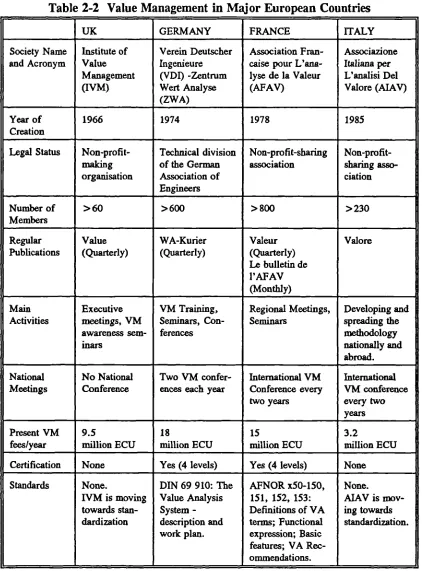
1963 this technique was introduced into construction industry by Dell'Isola. Since then it has been widely used in the USA, and has made great contributions to cost savings and the enhancement of project value. Although not as widely used as in the USA, its value has already been noticed in the UK. Some consultants and construction firms purport to use this technique to serve their clients. The major developments in the history of VM are listed in Table 2-1.VM was introduced in Europe around 1955-1960, and from 1965, its development became more noticeable. VM has now become a common management tool, though it is not used as systematically as in some other countries such as Japan. (Commis-sion of the European Communities, 1990). Table 2-2 shows the current situation of VM in several major European countries.
Table 2-1 Major Developments In The History of Value Management
Year Major Historical Developments
1947 Function Analysis and a VM job plan were first developed by Lawrence D. Miles at General Electric Company of the USA.
1947 Function Analysis was developed and used in the practice of work study by the Imperial Chemical Industries Plc in the UK (Gregory, 1984).
1954 US Department of Defense adopted VM when the Navy's Bureau of Ships set up a formal VM programme.
1959 Society of American Value Engineers established
1962 USA Ministry of Defence set up VM programmes in large scale bidding procedures.
1963 VM was first applied to buildings by Dell'Isola, when he introduced Value Engineering to the Navy's Facilities Engineering Command. The US General Service Administration (GSA) began to use VM shortly thereafter. 1965 FAST was introduced by Charles W. Bytheway of UNIVAC Division of
Sperry Rand Corporation, at the fifth SAVE National Conference. 1966 The Institute of Value Management was established in the UK.
1969 The National Aeronautics and Space Administration (NASA) began formal VM studies and training.
1972 SAVE twelfth annual conference emphasized the application of VM in the construction industry.
1975 The Environmental Protection Agency (EPA) mandated that VM be used during the design of all waste water treatment facilities over $10 million. 1988 RICS published "A Study of Value Management and Quantity Surveying
Practice", by Kelly & Male, which illustrated the practice in North America, and potential of using VM in the UK by the QS profession. 1991 RICS published the second report "The practice of Value Management:
Enhancing Value or Cutting Cost", written by Kelly and Male.
Table 2-2 Value Management in Major European Countries
UK GERMANY FRANCE ITALY
-Society Name and Acronym Institute of Value Management (IVM) Verein Deutscher Ingenieure (VDI) -Zentrum Wert Analyse (ZWA) Association Fran-caise pour L'ana-lyse de la Valeur (AFAV) Associazione Italiana per L'analisi Del Valore (AIAV) Year of Creation
1966 1974 1978 1985
Legal Status
Non-profit-making organisation
Technical division of the German Association of Engineers Non-profit-sharing association Non-profit-sharing asso-ciation -Number of Members
>60 >600 >800 >230
Regular Publications Value (Quarterly) WA-Kurier (Quarterly) Valeur (Quarterly) Le bulletin de l'AFAV (Monthly) Valore Main Activities Executive meetings, VM awareness sem-Mars VM Training, Seminars, Con-ferences Regional Meetings, Seminars Developing and spreading the methodology nationally and abroad. National Meetings No National Conference
Two VM confer-ences each year
International VM Conference every two years International VM conference every two years Present VM fees/year 9.5 million ECU 18 million ECU 15 million ECU 3.2 million ECU
Certification None Yes (4 levels) Yes (4 levels) None
Standards None.
IVM is moving towards stan-dardization
DIN 69 910: The Value Analysis System -description and work plan.
AFNOR x50-150, 151, 152, 153: Definitions of VA terms; Functional expression; Basic features; VA Rec-ommendations.
None.
AIAV is mov-ing towards standardization.
features of VM, such as the concepts of value and functions.
Compared to Miles's definition, this definition added the feature of creativity in VM, but again failed to raise the concept of value enhancement.
The definition given by the Society of American Value Engineers (SAVE) is: "Value Engineering (synonymous with terms value management and value analysis) is a function-oriented, systematic team approach to provide value in a product, system, or service. Often, this improvement is focused on cost reduction, however, other improvement such as customer perceived quality and performance are also paramount in the value equation".
Value Analysis is distinguished from Value Management in several documents published by the European Community (e.g., "Value Analysis Glossary" and "Value Analysis in the European Community - A Tool for Value Management"), where VA is defined as a management technique which analyses, by means of a systematic approach, how to reduce cost whilst talcing into account customer requirements; it not only assesses the degree of innovation desired or allowed for in the product or service, but also covers the implementation and follow-up of solutions proposed and therefore strengthens companies' innovative capacity and competitiveness.
As indicated by the definition given by the SAVE, the terms Value Analysis, Value Management, and Value Engineering are treated as synonymous in this thesis, and wherever possible VM will be used as representative of them. For the purpose of this research, my preferred definition of VM is as follows:
Value Management is an organised function-oriented systematic team approach
Functional
\
Approach
--n \
1
Team
Approach
VM
Job Plan )
Function-Cost
Analysis
Creative
Environment
facilities, for the purpose of enhancing the value of the objects, usually through
achieving the required functions specified by the clients at the lowest possible overall
cost, consistent with requirements for pelfonnance, including reliability, delivery,
maintainability and human factors.
2.3.3 Value Management Principles and Methodology
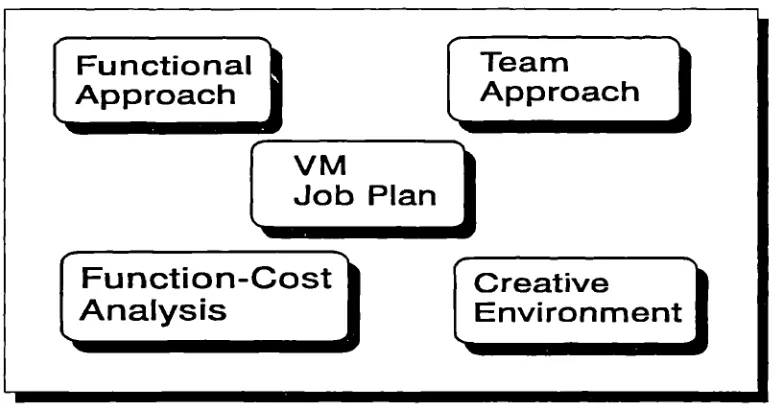
Five principles of VM methodology have been identified; which are essential to the success and advancement of VM studies. As shown in Figure 2-6, they are: VNIfoti plan, functional approach, function-cost analysis, team approach, and environment for creative thinking. There are six simple but fundamental questions to be asked
[image:52.595.96.485.461.665.2]during any VM studies. They are: What is it? What does it do? What must it do? What does it cost? What else would do the job? What would the alternatives cost?
Figure 2-6 Principles of Value Management Methodology