A Monthly Double-Blind Peer Reviewed Refereed Open Access International e-Journal - Included in the International Serial Directories.
International Research Journal of Human Resources & Social Sciences Website: www.aarf.asia. Email: [email protected] , [email protected] Page 49
'A Study of Impact of Resource Conservation Techniques on Farmers'
Dr. Sunil Choudhary* Abstract
The rural livelihood mainly depends upon agriculture, forestry and livestock. Thus, the
sustainability of natural resources is essential for the sustainability of rural livelihoods. This
will reduce poverty, control distress migration and finally result into betterment of quality of
life. This study deals with the assessment of the resource conservation techniques adopted at
government and non-government levels in the villages of Surendranagar district of Gujarat.
The techniques are related with conservation of water for irrigation through construction of
farm ponds, tanks, check dams, anicuts, etc., conservation of soil by constructing stone wring or
farm bunds, conservation of drinking water from roof rain water harvesting tanks and capacity
building of beneficiaries. The study is based upon primary survey done in the villages of Limbdi
and Lakhtartaluka of Surendranagar district. The survey was conducted just after the rainy
season in order to check the efficacy of the schemes.
Introduction
With the process of economic growth, the development practitioners, policy makers,
academician and researchers all over the world are becoming concerned for the management
of natural resources. These natural resources play a crucial role in the generation of sustainable
livelihood especially for those who are directly dependent on agriculture. The agricultural
productivity depends upon the quality of land and water resources available in the region. A
scarcity or depletion of these resources result into drought, lack of soil moisture, soil
erosion, low farm productivity, high cost per hectare of agricultural land, poverty,
dependency on money lenders and finally distress migration.
The Migration Tables, Census of India 2001, shows that out of total rural-out
migration, about 32 percent are cultivators and 30 percent are agricultural labourers. They
work as casual or marginal labourers in farm and non-farm activities outside their village.
This results into various types of social problems like high drop out rate of children, isolation,
insecurity, extra marital affairs, weakening of social bonds, HIV/AIDS, etc.
*
A Monthly Double-Blind Peer Reviewed Refereed Open Access International e-Journal - Included in the International Serial Directories.
International Research Journal of Human Resources & Social Sciences Website: www.aarf.asia. Email: [email protected] , [email protected] Page 50
Besides, a good health, which is considered to be an important indicator of human
development index, directly depends upon the availability of potable drinking water. But due to
depletion of water resources and lack of water supply in rural area, the access to safe drinking
water is becoming a distant dream. It results into women drudgery due to loss of time and
energy in collecting water associated with ill health, epidemic outbreaks and increase in
medical expenses. A human being can become economically productive only if he or she
maintains good health.
Quality of life depends upon various social, economic, geographical, cultural and
political factors. In India, there is lot of diversity in the existence of these factors. As a result,
some regions are highly developed, some are moderately developed and the remaining are
very poorly developed. Much of the population is residing in rural areas of the country with an
average population density of 284 persons per sq. km. Therefore, it is necessary to have a local
development planning which should focus on different issues in an integrated manner taking
into consideration the locally availablefactors. The rural population is basically characterized
by agriculturally dependent, lack of awareness, lack of skill and lack of resources. Along with
the conservation of natural resources, the study also addresses the issues of quality of life.
Study Base
The present paper is an outcome of the experiences achieved from various researches
and evaluation studies conducted during the last five years in Gujarat. Majority of them deal
with the Integrated Rural Development schemes. Besides the field based observations on the
project 'Natural Resource Depletion and Rural-Urban Migration' and the 'Evaluation of
Resource Conservation Techniques adopted in Surendranagar District, Gujarat' were also
taken into consideration. All the pre-, mid-, and post- funding situations are examined
carefully in order to find the impact of resource conservation and income generation policies
at various stages.
The paper deals with the assessment of the measures adopted by government and
non-government organizations for sustainability of natural resources and rural livelihoods.
These measures are as follows:
1. Conservation of water for irrigation through construction of farm ponds, tanks,check
A Monthly Double-Blind Peer Reviewed Refereed Open Access International e-Journal - Included in the International Serial Directories.
International Research Journal of Human Resources & Social Sciences Website: www.aarf.asia. Email: [email protected] , [email protected] Page 51
2. Conservation of soil by constructing stone wring or farm bunds.
3. Conservation of drinking water from roof rain water harvesting tanks.
4. Capacity building of the beneficiaries
Study Area
Surendranagar is located between 22°7' and 23°31' north latitude and 70°57' to 72°11'
east longitude. It has an area of 10489 sq. km and population of 1,515,147 (Census of India,
2001). The density of population is 145 persons per sq. km.
The district is considered to be most vulnerable in terms of resource diversity. The land
is saline, which makes it unfit for agriculture thus reducing income earned from own crop
produce. There is a high degree of disaster proneness (continuous drought). This decreases
the ground water level and makes the land fragile and unfit for supporting vegetation. This
lowers the employment generation capacity of agriculture forcing people to engage in arduous
and hazardous activities.
Agriculture is the primary occupation and is primarily rain-fed. Due to unproductive
land and scarcity of irrigation water, the cropping pattern among the vulnerable groups is
restricted to Kharif crops only. As the crop produced is insufficient, therefore, in order to
sustain a living, the villagers across a majority of districts migrate for labour activities. In
normal and crisis years, the women's participation in livelihood generation is equal to nearly
half of that of men. This has an adverse effect on the socio-economic life of the people.
The health status decreases. The social harmony gets disturbed. There is lack of security and
a high drop out rate of children.
Methodology
The study is conducted in five villages namely Nanikatechi, Fulwadi, Bhagwanpar
of Limbdi block and Vadekhan and Malika of Lakhtar block. It is an evaluation of resource
conservation measures implemented in the study area for poverty reduction and social equity.
An integrated approach was adopted under which the beneficiaries were to be provided with
150 farm ponds, 150 farm bunds, and 150 roof rain water harvesting tanks alongwith
strengthening of the female self-help groups (SHG) and farmers in terms of water
A Monthly Double-Blind Peer Reviewed Refereed Open Access International e-Journal - Included in the International Serial Directories.
International Research Journal of Human Resources & Social Sciences Website: www.aarf.asia. Email: [email protected] , [email protected] Page 52
to involve female SHG members to decide the allocation of assets. This has an advantage that it
builds up the confidence level and empowers the women in decision making. The regular
meetings act as a catalyst.
In order to find the impact of the schemes, the information was collected from those who
have got the assets. The data collection involved the interviews of the beneficiaries and the
physical verification of the assets. About 15 farmer beneficiaries and 10 beneficiaries of roof
rain water harvesting tanks were interviewed with the help of questionnaire. Both close and
open end questions were framed in order to obtain the beneficiaries views. Purposive random
sampling method was adopted. This included those beneficiaries who have got the asset before
the rainy season so that the impact of the policy could be determined. It can also be assumed
that due to heavy rains, some destruction could also have occurred. In order to know the
impact of training programmes, 20 men and 20 women per village were considered for focussed
group discussion.Besides efforts are also made to capture the views of the beneficiaries
regarding the performance of schemes, the use of the assets created and their sustainability and
also their impact on quality of life.The study was conducted after the rainy season so that the
impact of water conservation assets that were created before the rainy season could be visible.
Socio-economic Characteristics of the Study Area
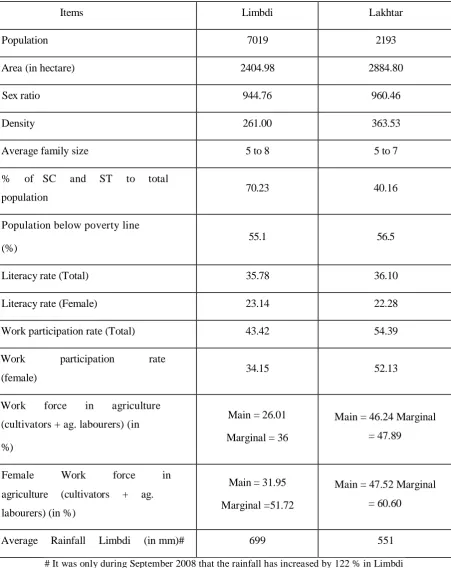
The socio-economic characteristic of the study area (as shown in table - 1) is very poor.
Due to isolation, the basic amenities and infrastructural facilities like bank, potable water
supply, police station and government offices are lacking in these villages. Due to high
poverty, the dependency on money lender is very high. As a result, they are exploited to the
maximum possible extent as they have to cultivate and pay interest as per the wish of the
money lender. The nearest city Surendranagar is ata distance of 75 km. As a result, the
A Monthly Double-Blind Peer Reviewed Refereed Open Access International e-Journal - Included in the International Serial Directories.
[image:5.595.71.523.98.667.2]International Research Journal of Human Resources & Social Sciences Website: www.aarf.asia. Email: [email protected] , [email protected] Page 53
Table -1 : Socio-Economic Characteristics of the Study Area
Items Limbdi Lakhtar
Population 7019 2193
Area (in hectare) 2404.98 2884.80
Sex ratio 944.76 960.46
Density 261.00 363.53
Average family size 5 to 8 5 to 7
% of SC and ST to total
population 70.23 40.16
Population below poverty line
(%)
55.1 56.5
Literacy rate (Total) 35.78 36.10
Literacy rate (Female) 23.14 22.28
Work participation rate (Total) 43.42 54.39
Work participation rate
(female) 34.15 52.13
Work force in agriculture
(cultivators + ag. labourers) (in
%)
Main = 26.01
Marginal = 36
Main = 46.24 Marginal
= 47.89
Female Work force in
agriculture (cultivators + ag.
labourers) (in %)
Main = 31.95
Marginal =51.72
Main = 47.52 Marginal
= 60.60
Average Rainfall Limbdi (in mm)# 699 551
# It was only during September 2008 that the rainfall has increased by 122 % in Limbdi
and 204% in Lakhtar. As per the official records, this has happened after 20 years.
Source : Primary Census Abstract, Census of India, 2001 and State Emergency Operation
A Monthly Double-Blind Peer Reviewed Refereed Open Access International e-Journal - Included in the International Serial Directories.
International Research Journal of Human Resources & Social Sciences Website: www.aarf.asia. Email: [email protected] , [email protected] Page 54
Agricultural Characterisitics
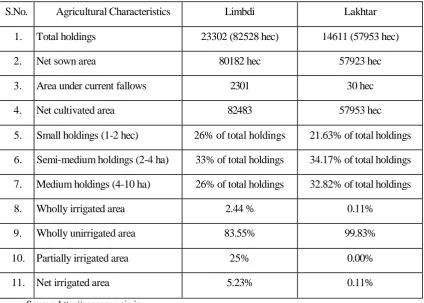
From the agricultural indicators (table -2), it is very clear that the sources of irrigation are
very poor in the study area. About 84 percent and 100 percent of landin Limbdi and Lakhtar
respectively is totally unirrigated. According to Agricultural Census, 2000-01, as a whole,
wells are supporting only 4.98 percent part of irrigated area in Limbdi while it is only 0.11
percent in Lakhtar. The wells are operated through electric or diesel pump sets. The irrigation
by tanks is negligible in both the districts. In Limbdi, the percent of area irrigated by canals is
0.04 percent while it is zero in Lakhtar. The area irrigated by tube wells is also zero in Lakhtar.
The cost of extending the pipe to the nearby pond or river is Rs. 50/- to 150/- per hour
depending upon the availability of water and its demand. This shows that practicing agriculture
is a very costly affair. Due to high level of poverty and lack of skill, there is no other opportunity
[image:6.595.87.512.370.673.2]for the villagers except migration.
Table - 2 : Agricultural Indicators in Limbdi and Lakhtar S.No. Agricultural Characteristics Limbdi Lakhtar
1. Total holdings 23302 (82528 hec) 14611 (57953 hec)
2. Net sown area 80182 hec 57923 hec
3. Area under current fallows 2301 30 hec
4. Net cultivated area 82483 57953 hec
5. Small holdings (1-2 hec) 26% of total holdings 21.63% of total holdings
6. Semi-medium holdings (2-4 ha) 33% of total holdings 34.17% of total holdings
7. Medium holdings (4-10 ha) 26% of total holdings 32.82% of total holdings
8. Wholly irrigated area 2.44 % 0.11%
9. Wholly unirrigated area 83.55% 99.83%
10. Partially irrigated area 25% 0.00%
11. Net irrigated area 5.23% 0.11%
A Monthly Double-Blind Peer Reviewed Refereed Open Access International e-Journal - Included in the International Serial Directories.
International Research Journal of Human Resources & Social Sciences Website: www.aarf.asia. Email: [email protected] , [email protected] Page 55
Findings
Since the population of the selected villages is very poor and unskilled, a mixed
bag of findings was obtained. Lot of limitations were there in the achievement of targets. The
beneficiaries especially the male beneficiaries were least interested in attending the training
programme as they want to devote their time in income earning activities. Due to high
tendency of migration, the construction of farm has also faced problem. Despite, the heavy
rainfall in the month of September, 2008 destroyed about65 percent of the farm assets out of
which 20 percent are fully destroyed. The doubts of the villagers for roof water harvesting
tank was also a constraint. These doubts were - the houses with kutcha roof will get red
coloured water, little space in the house and fear of falling of children or cattle in the tank if
it remains open.
Despite so many ifs and buts, the study has shown certain positive results. These
results are obtained from those who have acquired the assets and whose assets are safe.
I Farm assets
1. The probability of obtaining second crop has increased.
2. Thirty percent of the beneficiaries (whose farm assets are safe) haveshown
positive results in terms of increased productivity of cumin.
3. The decrease in loss of top layer soil and availability of irrigation waterhas given
them good quality crop due to which they have observed 50 to60 percent increase
in income.
4. Since this was the first year of monsoon, the increase in employment couldnot be
observed. But it is expected, that in the near future, the marginaland landless
farmers will be able to get employment within the village.This will stop distress
migration.
5. Dependency on money lenders has decreased by 28 percent. This ismeasured
according to the number of beneficiaries who will not take loanfor the next
season.
A Monthly Double-Blind Peer Reviewed Refereed Open Access International e-Journal - Included in the International Serial Directories.
International Research Journal of Human Resources & Social Sciences Website: www.aarf.asia. Email: [email protected] , [email protected] Page 56
7. As per the beneficiaries, if the climatic conditions could have been normal,their
agricultural produce could have been increased by about 80 percent.If sufficient
water is available, they will cultivate the wheat crop.
8. About 80 percent of the beneficiaries, whose ponds are damaged, are readyto
repair it.
I I Roof rain water harvesting tank
1. Easy access to safe drinking water.
2. The exertion of fetching water from 3 to 4 km distance is decreased.Hundered
percent of the females who have got the roof rain waterharvesting tank have
stopped collecting water. As per their opinion, thewater is sweet in taste, takes less
time for cooking and less fuelconsumption. Time and energy is saved. About 30
percent of the beneficiaries use their saved time in household work and 40 percent
in income earning activities.
3. There is decrease in water-borne diseases like indigestion, diarrhoea,
stomachache, etc. The beneficiaries have observed about 20 percent (=Rs. 300/- to
Rs. 500/- per household) decrease in health expenditure during the first year of
project implementation.
III Capacity building
1. The impact of capacity building is found to be very slow due to patriarchalsociety.
Still it can be said that the decision making role in the allocationof assets have
built confidence among females.
2. Some awareness among the farmers is found for organic farming, dryfarming,
multicrop cultivation, etc.
3. The training programmes for both males and females as per their socio-economic
responsibilities show that the approach is gender sensitive.
Reasons for Limited Benefits of Resource Conservation Measures
All these schemes if considered in isolation were found to have partially fulfilled the
A Monthly Double-Blind Peer Reviewed Refereed Open Access International e-Journal - Included in the International Serial Directories.
International Research Journal of Human Resources & Social Sciences Website: www.aarf.asia. Email: [email protected] , [email protected] Page 57
drawbacks :
1. All these efforts were not made in an integrated manner. Either the
waterconservation structures were created or the soil conservation structures
werecreated.
2. The villagers were not found to be fully aware of the utility of roof waterharvesting
structures. Rather they have taken them for granted.
3. Caste wise differences were observed in the care and maintenance of the roofrain
water harvesting tanks.
4. Serious problem was found in the capacity building of the beneficiaries. Therural
population is generally unaware. Due to poverty, they do not prefer to devote
time for the training programmes. Besides there is high level of distressmigration.
Generally the migration is for the period of eight months. As aresult, the
person who attends the training programmes is different from theperson who is
responsible for the created assets. It seems that only one or twotraining
programme is not sufficient. It is essential that the need should arisefrom the side
of villagers, otherwise the program will not be successful.
Conclusion
The study concludes that conservation of natural resources is essential for sustainable
rural livelihoods. The construction of farm pond and farm bund for soil and water
conservation supports the farm income and the roof rain water harvesting tank for safe
drinking water improves the health status which further increases the efficiency of the person
to work efficiently. Though in the present study, lots of constraints have been imposed by
ignorance of the people and the natural calamity, still some positive signs were observed.
1. For the beneficiaries who have acquired the assets have reported for increasein
productivity, good quality crop, adoption of multicrop farming, decrease
independency on money lender, decrease in cost of irrigation, decrease in
healthexpenditure and water borne diseases. This implies that if the process
iscontinued, the approach will give long term benefits.
2. The water harvesting structures are based upon rural technology and they
A Monthly Double-Blind Peer Reviewed Refereed Open Access International e-Journal - Included in the International Serial Directories.
International Research Journal of Human Resources & Social Sciences Website: www.aarf.asia. Email: [email protected] , [email protected] Page 58
ensures forest protection.
3. The aims of resource conservation and employment generation are compatiblewith the
nation's development policy and Millennium Development Goals(MDG).
4. Besides, the technique gives the ownership right to the asset holder to take hisown
ecision for income generation. There are no conflicts in the use ofwater.
5. The technique is flexible, affordable and cost-efficient which ensures thesustainability
of assets. The demonstration and diffusion effects itself is astimulating agent.
The long term positive effects are decrease in poverty, decrease in children drop out
rate, increase in quality of life, increase in health status, control on distress migration and
environment sustainability. This study could be considered as a model for replication in other
villages which are having high level of poverty, depleted natural resources, disaster proneness
and seasonal migration.
Suggestions
For the effective results from resource conservation techniques in terms of
sustainablelivelihoods, the following suggestions are put forth:
1. Since the rural population is poor and unskilled and live in vulnerableconditions,
there is a need of all round development. Instead of adoptingone or two approaches,
an integrated approach should be adopted in orderto improve the quality of life.
2. Due to the high level of ignorance and isolation of the population, regularsupervision
and follow-up is essential. The training programmes should being such a manner that
the villagers should themselves realize the need ofwater conservation assets. In other
words, so much awareness should becreated that the demand should come from
their side. Then only theywould be able to take care of the assets. The programmes
should also takeinto consideration the availability of beneficiaries.
3. In order to prevent the farm ponds from disaster, some plantation shouldbe done at
the boundary. This would develop a strong bonding between thesoil elements.
A Monthly Double-Blind Peer Reviewed Refereed Open Access International e-Journal - Included in the International Serial Directories.
International Research Journal of Human Resources & Social Sciences Website: www.aarf.asia. Email: [email protected] , [email protected] Page 59
topography of the farm. This will reduce the impact ofnatural calamity.
5. The roof rain water harvesting tanks should be provided with a handpump.This would
remove the fear of falling of children or animal. This wouldalso conserve water for
longer duration as the sunlight will not enter.
6. The exposure trip is essential to clear the doubts of the villagers.
7. The villagers should be guided for care and maintenance of the assets.
References
Agrawal, A and C Gibson. 1999, 'Enchantment and Disenchantment: The Roleof Community in Natural
Resource Conservation', World Development, 27(4)Kumar, M. Dinesh, Ankit Patel, R
RAvindranath and O.P Singh, 2008, :"Chasing a Mirage: Water Harvesting and Artificial
Recharge in NaturallyWater Scarce Regions", Economic and Political Weekly, 30 August.
Loomis, R.S. and D.J. Connor. 1992, Crop Ecology : Productivity andManagement in
Agricultural Systems, New York : Cambridge UniversityPress.
Meeta and Rajivlochan. 2006, 'Why the Farmer Reaps Despair', The IndianExpress, September 26.
Primary Census Abstract, Census of India, 2001
State Emergency Operation Centre (State Control Room), Director of Relief,Revenue Dept.,
Gandhinagar.
The Migration Tables, Census of India 2001
Vanloon, Patil and Hugar. 2005, Agricultural Sustainability - Strategies forAssessment, New Delhi :
Sage Publications
Verma, S.B., M.K. Sharma and N.K. Sharma. 2008. Better Quality of RuralLife, New Delhi :Sarup&
Sons.
Webliography