BIROn - Birkbeck Institutional Research Online
Longo, Matthew R. (2014) The effects of immediate vision on implicit hand
maps. Experimental Brain Research 232 (4), pp. 1241-1247. ISSN
0014-4819.
Downloaded from:
Usage Guidelines:
Please refer to usage guidelines at or alternatively
RUNNING HEAD: Vision and Implicit Hand Maps
The Effects of Immediate Vision on Implicit Hand Maps
Matthew R. Longo
Department of Psychological Sciences, Birkbeck, University of London
Address correspondence to:
Matthew R. Longo
Department of Psychological Sciences
Birkbeck, University of London
Malet Street
London WC1E 7HX
United Kingdom
Abstract
Perceiving the external spatial location of the limbs using position sense requires that
immediate proprioceptive afferent signals be combined with a stored body model specifying
the size and shape of the body. Longo and Haggard (2010) developed a method to isolate and
measure this body model in the case of the hand in which participants judge the perceived
location in external space of several landmarks on their occluded hand. The spatial layout of
judgments of different landmarks is used to construct implicit hand maps, which can then be
compared to actual hand shape. Studies using this paradigm have revealed that the body
model of the hand is massively distorted, in a highly stereotyped way across individuals, with
large underestimation of finger length and overestimation of hand width. Previous studies
using this paradigm have allowed participants to see the locations of their judgments on the
occluding board. Several previous studies have demonstrated that immediate vision, even
when wholly non-informative, can alter processing of somatosensory signals and alter the
reference frame in which they are localised. The present study therefore investigated whether
immediate vision contributes to the distortions of implicit hand maps described previously.
Participants judged the external spatial location of the tips and knuckles of their occluded left
hand either while being able to see where they were pointing (as in previous studies) or while
blindfolded. The characteristic distortions of implicit hand maps reported previously were
clearly apparent in both conditions, demonstrating that the distortions are not an artefact of
immediate vision. However, there were significant differences in the magnitude of distortions
in the two conditions, suggesting that vision may modulate representations of body size and
shape, even when entirely non-informative.
Several classes of afferent signals from the periphery provide information about the
location of the limbs, including receptors in joints signalling flexion or extension, from the
skin signalling stretch, and from muscle spindles signalling contraction or lengthening
(Proske and Gandevia 2012). Each of these signals provides information body posture, that
is, about the relative flexion or extension of each joint. In order to use these proprioceptive
signals for position sense to localise the absolute spatial location of part of the body in
external space, such information about joint angles must be combined with information about
the size and shape of the body segments between joint. Critically, however, no afferent
signals directly specify body size or shape, indicating that this information must come from a
stored body model (Longo et al. 2010).
In a series of recent studies, my colleagues and I have investigated this body model
using a novel ‘psychomorphometric’ method in which participants judge the perceived
location of several landmarks on their occluded hand, and the pattern of responses is used to
construct implicit perceptual maps of hand size and shape (Longo and Haggard 2010, 2012a,
2012b, Longo et al. 2012). In these studies, we have found that the body model of the hand is
massively distorted, in a highly stereotyped way across people. Specifically, there were three
clear patterns of distortions: (1) overestimation of hand width, quantified as the distance
between pairs of knuckles; (2) overall underestimation of finger length, quantified as the
distance between the knuckle and tip of each finger; and (3) a radio-ulnar gradient, with
underestimation of finger length increasing systematically from the thumb to the little finger.
In contrast, explicit estimates of hand shape were approximately veridical (Longo and
Haggard 2010), suggesting that the body model is implicit, and outside of conscious bodily
awareness.
The current paper focuses on one aspect of the procedure used in previous studies
2012), namely the fact that participants have been able to see where they were pointing on
each trial. Vision in this context is uninformative about the location of individual landmarks
(except for a very broad sense in which seeing the boundaries of the occluding board imposes
extreme limits on landmark location). Vision was allowed in these studies to ensure that
participants’ responses were as precise as possible, but was not considered to be an important
contributing factor to the distortions observed. It is important to consider, however, whether
immediate vision might be driving aspects of the results. Two recent studies investigating the
effects of vestibular stimulation on body representation did have participants respond while
blindfolded (Ferrè et al. 2013; Lopez et al. 2012). Ferrè and colleagues reported distortions
similar to those reported by Longo and Haggard (2010). Lopez and colleagues did not report
statistical comparisons of represented and actual hand size (focusing instead on vestibular
stimulation versus sham), but the pattern of their results appears qualitatively consistent with
distortions reported in other studies. In both these studies, participants were blindfolded in all
conditions, making the potential effects of immediate vision impossible to estimate.
Several previous results suggest that vision, even when non-informative, affects
several aspects of somatosensory processing. For example, in the visual enhancement of
touch (Kennett et al. 2001; Cardini et al. 2011) and visual analgesia (Longo et al. 2009;
Mancini et al. 2011) effects, vision of the stimulated body part enhances the spatial acuity of
touch and reduces the perceived intensity of acute pain, respectively, even when completely
non-informative about the stimulation. Those studies are importantly different from the
proprioceptive localisation situation in that they involve vision of the body itself, rather than
just in the direction of the body’s location, but nevertheless show that non-informative vision
can clearly affect somatosensation. Perhaps more directly relevant, Forster and Eimer (2005)
body part. These results clearly show that even when vision provides no actual task-relevant
information, it may nevertheless be modulating somatosensory processing.
Further, numerous studies have suggested that vision can determine the reference
frame for somatosensory perception. For example, Harris and colleagues have argued in a
number of recent papers that tactile information is localised using a gaze-centred frame of
reference (Harrar and Harris 2009, 2010; Pritchett and Harris 2011). Other results have
suggested that when vision is present, kinaesthetic information may be automatically
transformed into a visual reference frame (Darling and Miller 1993). Indeed, recent studies
have shown effects of gaze direction on proprioceptive localisation judgments (Fiehler et al.
2010; Jones and Henriques 2010). Collectively, these results suggest profound interactions
between vision and both somatosensation generally, and proprioception specifically. Thus, it
cannot be assumed that the presence of immediate vision in previous studies of implicit hand
maps has not contributed to the distortions observed.
The present study therefore compared implicit hand maps obtained using the method
of Longo and Haggard (2010) in conditions in which participants could see where they were
pointing on the occluding board (as in previous studies) and while blindfolded. To the extent
that distortions observed in previous studies reflect transformation of proprioceptive
information into a gaze-centred reference frame, they should not appear when participants
respond while blindfolded. In contrast, to the extent that the distortions reflect characteristics
of stable body representations underlying position sense, they should not be dependent on the
presence of immediate vision.
Method
Twelve individuals (eight female) between 19 and 34 years of age from the University
of London community participated for payment. All but one were right handed as assessed by
the Edinburgh Inventory (M: 74.88; range: -100 to +100). Procedures were approved by the
local ethics committee.
Procedures
Procedures were similar to those I have used in previous studies with this paradigm
(e.g., Longo & Haggard, 2010, 2012a, 2012b; Longo et al., 2012). Participants sat with their
left hand lying palm-down on a table, approximately aligned with their body midline.
Participants were asked to sit upright, with their torso up against the edge of the table. The
hand rested flat on the table, with fingers straight. An occluding board (40 x 40 cm) rested on
four pillars (6 cm in height) and covered the hand. A webcam (Creative Live Cam Voice)
suspended approximately 27 cm above the table captured still photographs (1280 x 960
pixels) under control of a custom MATLAB (Mathworks, Natick, MA) script.
In the Sighted condition, participants responded as in my previous studies using this
paradigm, with full vision of the occluding board and the stick they were pointing with. In the
Blindfolded condition, in contrast, participants wore a blindfold so that the task had to be
completed using only haptic feedback.
Participants used a short wooden stick (11.4 cm in length) to indicate the perceived
location of landmarks on their left hand. In my previous studies using this paradigm,
participants used a long (35 cm) baton to point to different landmarks on their hand. Because
participants in this study had to point without visual guidance, a shorter stick was used, so
that participants could more easily feel where the tip was pointing. The tip of the stick
tapered gradually to a point. Participants made judgments about ten different landmarks: the
finger) of each finger. Participants were given verbal instructions on each trial about which
landmark to judge. At the beginning of the experiment, they were instructed that they should
be precise in their responses, avoid ballistic pointing, and avoid strategies such as tracing the
outline of the hand. To ensure that responses on each trial were independent, participants
were asked to move the stick to tap a metal post that rested to the side of the board, within
easy reach of their right hand. The post was used in place of the blue dot used in previous
studies since it could be found even when participants were blindfolded. A photograph of
each response was taken when the participant indicated that they were happy with their
response.
There were four blocks of thirty trials each. Sighted and blindfolded blocks were
counterbalanced in an ABBA fashion, with the first condition counterbalanced across
participants. Each block consisted of three mini-blocks of ten trials each, including one of
each of the ten landmarks in random order. At the beginning and end of each block an image
was taken without the occluding board, which allowed measurement of the true proportions
of the participant’s hand, and confirmation that the hand had not moved during the block. To
facilitate coding, a black dot was made on each of the knuckles with a black pen. A ruler (10
cm in length) was affixed to the table and appeared in the pictures without the occluding
board, allowing conversion between distances in pixels and cm.
Analysis
The camera used a wide-angle (‘fisheye’) lens, which induced some spatial distortion.
This fisheye distortion was corrected using the Panotools plug-in
(http://www.panotools.com/) for Adobe Photoshop CS2. The x-y pixel coordinates of each
landmark on the photographs of the hands and of the corresponding judged locations were
was then calculated. The length of each finger was calculated as the distance between the
knuckle and tip of each finger. Hand width was similarly quantified as the distance between
pairs of knuckles, with the distance between the knuckles of the index and little fingers being
used as an overall measure of hand width. For each distance, percent overestimation was
calculated as 100 x (Judged Length – Actual Length) / Actual Length.
Maps of both actual and judged locations were put into Procrustes alignment using the
CoordGen software, part of the Integrated Morphometric Program (IMP; David Sheets,
Canisius College, http://www.canisius.edu/~sheets/morphsoft.html). Procrustes
superimposition removes differences in location, rotation, and overall size to isolate
differences in shape between configurations of homologous landmarks (Rohlf & Slice, 1990;
Bookstein, 1991).
Because the fingers are articulated and can move independently, we rotated the
fingertips of each map to be in a constant posture, as in our previous study (Longo &
Haggard, 2010). First, we calculated the average angle of each finger relative to the hand in
the photos of each participant’s actual hands, defined as the angle between a line running
through the knuckles of the index and little fingers and another line running through the
knuckle and tip of each finger. These angles were 39.6°, 64.4°, 76.5°, 87.1°, and 108.8°, for
the thumb through little fingers, respectively. Then for each experimental block and for each
participant, the fingertip of each finger was rotated so that the fingers were at those angles
(i.e., hand posture was matched across blocks and across participants).
As there were two experimental blocks for each task, maps from each participant were
first put into Procrustes alignment so that an average map could be calculated for each
participant for both actual location and judgments in each of the two tasks. Then a
second-level generalized Procrustes analysis was conducted putting actual and judged maps from all
Results
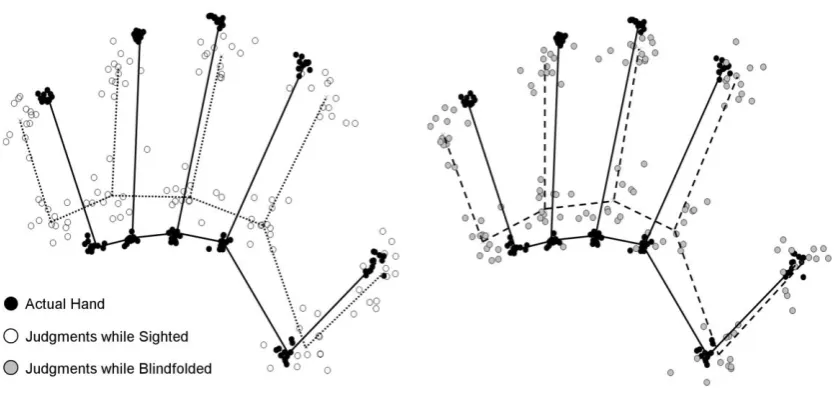
All three of the patterns of distortion I have reported in my previous studies using this
paradigm (Longo & Haggard, 2010, 2012a, 2012b) were investigated here. The left panel of
Figure 1 shows overestimation of finger length. The values are negative, indicating overall
underestimation. Averaging across the five fingers, there was clear underestimation of finger
length in both the sighted (-35.9% underestimation), t(11) = -7.73, p <.0001, and blindfolded
(-22.6% underestimation), t(11) = -3.85, p < .005, conditions. Nevertheless, there was a
significant reduction in the magnitude of underestimation in the blindfolded condition, t(11)
= 2.24, p < .05. There was a modest (but non-significant) positive correlation between the
[image:10.595.78.522.403.626.2]magnitude of underestimation in the two conditions, r(10) = 0.381, n.s.
Figure 1: Left panel: Percent overestimation (i.e., 100*(Judged Length – Actual Length)/Actual Length) for each of the five fingers in the two conditions. Right panel: Percent overestimation for the distance between pairs of knuckles. The distance between the index and little fingers is taken as an overall measure of hand width. Error bars are one S.E.M.
To assess the gradient of underestimation across fingers, least-squares regression was
finger. Consistent with previous findings, there was a clear increase in underestimation from
the thumb to little finger in both the sighted (mean β = 3.9% / finger), t(11) = 2.97, p < .02,
and blindfolded (mean β = 6.2% / finger), t(11) = 4.92, p < .001, conditions. The magnitude
of this gradient was marginally larger in the blindfolded condition, t(11) = 2.01, p = .069.
There was a significant correlation between slopes in the two conditions, r(10) = 0.594, p <
.05.
The right panel of Figure 1 shows overestimation of the distance between pairs of
knuckles. The distance between the knuckles of the index and little fingers was taken as an
overall measure of hand width. There was clear overestimation of hand width in both the
sighted (52.2% overestimation), t(11) = 8.54, p < .0001, and blindfolded (44.3%
overestimation), t(11) = 5.70, p < .0001, conditions. The magnitude of overestimation did not
differ significantly between the two conditions, t(11) = 1.11, n.s. There was a marginally
significant correlation between the magnitude of overestimation in the two conditions, r(10)
[image:11.595.89.509.491.692.2]= 0.508, p = 0.092 (two-tailed).
The overall aspect ratio of the hand was quantified using Napier’s (1980) shape index,
a ratio of hand width to length. Following my previous studies (Longo & Haggard, 2010,
2012b), the distance between the knuckles of the index and little fingers was taken as a
measure of hand width, and the length of the middle finger as a measure of hand length. The
shape index is calculated as: SI = 100 x (width / length). Large shape indices indicate a squat,
wide hand, while small values indicate a thin, slender hand. The shape index was calculated
for each participant for their actual hand, as well as for the hand maps in each condition
(shown in the left 3 bars of Figure 3). The shape indices for hand maps were significantly
greater than for the actual hand in both the sighted (150.8 vs. 58.0), t(11) = 12.04, p < .0001,
and blindfolded (129.6 vs. 58.0), t(11) = 6.87, p < .0001, conditions. The shape indices for
the two experimental conditions did not differ significantly from each other, t(11) = 1.50, n.s.
One interesting difference between the present study and previous studies using the
same paradigm (e.g., Longo & Haggard, 2010, 2012a, 2012b) is the use of a much shorter
stick for responding in this study (11.4 vs. 35.0 cm). In order to investigate any potential
effect of this variable, the right six bars of Figure 3 show the shape indices from six previous
experiments which were similar to the sighted condition of this study except for the length of
the stick. These experiments were: (1) Exp. 1 from Longo and Haggard (2010); (2) the
‘normal’ posture from Exp. 2 from Longo and Haggard (2010); (3) the left hand condition
from Exp. 3 from Longo and Haggard (2010); (4) Exp. 4 from Longo and Haggard (2010);
(5) the dorsum condition from Longo and Haggard (2012a); (6) the ‘localisation’ task from
Longo and Haggard (2012b). As is clear from Figure 3, the shape indices in the present study
are similar to those found in previous studies using a longer baton, suggesting that the length
Figure 3: The three leftmost bars show shape indices (i.e., 100xWidth/Length) for participants’ actual hands and for hand maps in the sighted and blindfolded
conditions. Shape indices were clearly larger for the hand maps than for actual hand shape. For comparison, the rightmost six bars present the same values from six previous experiments using the same paradigm with participants responding using a long baton (35 cm). Error bars are one S.E.M.
Discussion
Similar patterns of distortion of implicit body representations underlying position
sense were found regardless of whether participants had immediate vision while making their
responses or not. Three types of distortions of implicit hand maps were apparent in both
conditions, replicating recent results (Longo and Haggard 2010, 2012a, 2012b, Longo et al.
2012): (1) overall underestimation of finger length, (2) increasing underestimation of length
from thumb to little finger, and (3) overall overestimation of hand width. These results
demonstrate that the patterns of distortion we have previously reported are not dependent on
These results have implications for understanding the origins of the distortions we
have observed. One critical question concerns whether they reflect distortions representations
of the body, per se, or whether they emerge from the manner in which participants are asked
to respond. The present results contribute to a growing body of evidence that the distortions
we have reported show a high level of generality across different modes of response,
reducing the likelihood that they reflect an artefact of any specific mode of response. Similar
distorted maps of the hand are apparent when participants have both visual and
proprioceptive feedback about the location of their responses (Longo & Haggard, 2010; this
study), when they have only proprioceptive feedback about their responding hand (this
study), and when they have only visual feedback about their responses (i.e., they verbally
guided a naïve experimenter who held the baton, Longo et al. 2012). Further, we found
different patterns of distortions for judgments about two sides of a single body part (i.e., the
dorsal and palmar hand surfaces, Longo and Haggard 2012a), though the manner in which
responses were made was identical in both cases. Together, these results suggest that the
measured distortions reflect distorted representations of the body itself, rather than
idiosyncratic aspects of the manner in which participants indicate their judgments.
While qualitatively similar patterns of distortion were observed in both the sighted
and blindfolded conditions, there was evidence that the magnitude of these distortions
differed between them. These results are consistent with the possibility that vision, even
though non-informative about the location of the body, might nevertheless alter
somatosensory processing (cf. Kennett et al. 2001; Forster & Eimer 2005) or change the
reference frame for somatosensory spatial perception (cf. Fiehler et al. 2010; Harrar and
Harris 2009). Immediate vision led to a significant reduction in perceived finger length. The
direction of this effect is consistent with the recent finding that non-informative vision of the
2013). The reason for vision producing reductions in represented body part size in both these
cases are not fully clear. One possibility is that visually-induced reduction may be the
converse of the perceived swelling seen following acute deafferentation (Gandevia and
Phegan 1999) and in chronic pain (Moseley 2005; Pelz et al. 2011). Both deafferentation
(Calford and Tweedale 1991) and chronic pain (Schwenkreis et al. 2003) are known to be
associated with disinhibition of sensorimotor cortex. As suggested by Haggard, Iannetti, and
Longo (2013), by increasing such inhibition (Cardini et al. 2011), vision may produce a
constellation of effects opposite to those seen in chronic pain, including analgesia (Longo et
al. 2009; Mancini et al. 2011), heightened tactile spatial acuity (Kennett et al. 2001; Cardini
et al. 2011), and reduced represented body part size (Longo and Sadibolova 2013; this study).
Such an interpretation treats the blindfolded condition as a baseline, reflecting simply
the absence of vision. Another possibility, however, is that blindfolding may induce rapid
plasticity of somatosensory representations, as has been shown by several previous results
(Facchini and Aglioti 2003; Weisser et al. 2005; Wong et al. 2001; Zubek et al. 1964).
Indeed, Wong and colleagues (2001) reported changes in tactile spatial acuity after periods of
blindfolding as short as 10 minutes, similar to the length of time participants in the present
study were blindfolded during a single block of trials. Thus, it is also possible to consider the
sighted condition as the baseline, and the differences observed in the blindfolded condition as
reflecting short-term plasticity of body representations induced by blindfolding. It is difficult
to see what type of condition would be a true baseline in this context to determine whether
the differences seen between conditions reflect changes induced by immediate vision or
short-term plasticity induced by blindfolding. This is an interesting question for future
References
Abramoff MD, Magelhaes PJ, Ram SJ (2004) Image processing with ImageJ.Biophotonics
Intern 11: 36-42
Bookstein FL (1991) Morphometric tools for landmark data. Cambridge: Cambridge
University Press.
Calford MB, Tweedale R (1991) C-fibres provide a source of masking inhibition to primary
somatosensory cortex. Proc Roy Soc B 243: 269-275
Cardini F, Longo MR, Haggard P (2011) Vision of the body modulates somatosensory
intracortial inhibition. Cereb Cortex 21: 2014-2022
Cardini F, Longo MR, Driver J, Haggard P (2012) Rapid enhancement of touch from non-
informative vision of the hand. Neuropsychologia 50: 1954-1960
Darling WG, Miller GF (1993) Transformations between visual and kinaesthetic coordinate
systems in reaches to remembered object locations and orientations. Exp Brain Res
93: 534-547
Facchini S, Aglioti SM (2003) Short term light deprivation increases tactile spatial acuity in
humans. Neurol 60: 1998-1999
Ferrè ER, Vagnoni E, Haggard P (2013) Vestibular contributions to bodily awareness.
Neuropsychologia 51: 1445-1452
Fiehler K, Rösler F, Henriques DY (2010) Interaction between gaze and visual and
proprioceptive position judgments. Exp Brain Res 203: 485-498
Forster B, Eimer M (2005) Vision and gaze direction modulate tactile processing in
somatosensory cortex: evidence from event-related brain potentials. Exp Brain Res
165: 8-18
Gandevia SC, Phegan CM (1999) Perceptual distortions of the human body image produces
Haggard P, Iannetti GD, Longo MR (2013) Spatial sensory organization and body
representation in pain perception. Curr Biol 23: R164-R176
Harrar V, Harris LR (2009) Eye position affects the perceived position of touch. Exp Brain
Res 198: 403-410
Harrar V, Harris LR (2010) Touch used to guide action is partially coded in a visual reference
frame. Exp Brain Res 203: 615-620
Harrar V, Pritchett LM, Harris LR (2013) Segmented space: Measuring tactile localisation in
body coordinates. Multisens Res 26: 3-18
Jones SA, Henriques DY (2010) Memory for proprioceptive and multisensory targets is
partially coded relative to gaze. Neuropsychologia 48: 3782-3792
Kennett S, Taylor-Clarke M, Haggard P (2001) Noninformative vision improves the spatial
resolution of touch in humans. Curr Biol 11: 1188-1191
Leon-Sarmiento FE, Hernandez HG, Schroeder N (2008) Abnormal tactile discrimination and
somatosensory plasticity in familial primary hyperhidrosis. Neurosci Lett 441:
332-334
Longo MR, Haggard P (2010) An implicit body representation underlying human position
sense. Proc Ntnl Acad Sci USA 107: 11727-11732
Longo MR, Haggard P (2012a) A 2.5-D representation of the human hand. J Exp Psychol:
Human Percept Perform 38: 9-13
Longo MR, Haggard P (2012b) Implicit body representations and the conscious body
image. Acta Psychol 141: 164-168
Longo MR, Sadibolova R (2013) Seeing the body distorts tactile size perception. Cognition
126: 475-481
Longo MR, Azañón E, Haggard P (2010). More than skin deep: Body representation beyond
Longo MR, Betti V, Aglioti SM, Haggard P (2009) Visually induced analgesia: Seeing the
body reduces acute pain. J Neurosci 29: 12125-12130
Longo MR, Long C, Haggard P (2012) Mapping the invisible hand: A body model of a
phantom limb. Psychol Sci 23: 740-742
Lopez C, Schreyer H-M, Preuss N, Mast FW (2012) Vestibular stimulation modifies the body
schema. Neuropsychologia 50: 1830-1837
Mancini F, Longo MR, Kammers MPM, Haggard P (2011) Visual distortion of body size
modulate pain perception. Psychol Sci 22: 325-330
Moseley GL (2005) Distorted body image in complex regional pain syndrome. Neurology 65:
773
Napier J (1980) Hands. Princeton: Princeton University Press.
Pelz E, Seifert F, Lanz S, Müller R, Maihöfner C (2011) Impaired hand size estimation in
CRPS. J Pain 12: 1095-1101
Pritchett LM, Harris LR (2011) Perceived touch location is coded using a gaze signal. Exp
Brain Res 213: 229-234
Proske U, Gandevia SC (2012) The proprioceptive senses: Their roles in signalling body
shape, body position and movement, and muscle force. Physiol Revs 92: 1651-1697
Rholf FJ, Slice DE (1990) Extensions of the Procrustes method for the optimal
superimposition of landmarks. Syst Zool 39: 40-59
Schwenkreis P, Janssen F, Rommel O, Pleger B, Völker B, Hosbach I, Dertwinkel R, Maier
C, Tegenthoff M (2003) Bilateral motor cortex disinhibition in complex regional pain
syndrome (CRPS) type I of the hand. Neurology 61: 515-519
Weisser V, Stilla R, Peltier S, Hu X, Sathian K (2005) Short-term visual deprivation alters
neural processing of tactile form. Exp Brain Res 166: 572-582
enhance passive tactile spatial acuity. PLOS ONE 6: e25277
Zubek JP, Flye J, Aftanas M (1964) Cutaneous sensitivity after prolonged visual deprivation.
Acknowledgments
This research was supported by a grant from the European Research Council