International Journal of Pharmaceutical Sciences and Research 824 IJPSR (2018), Volume 9, Issue 2 (Research Article)
Received on 13 May, 2017; received in revised form, 24 January, 2018; accepted, 28 January, 2018; published 01 February, 2018
FORMULATION DEVELOPMENT OF MICROSPONGE BASED DELAYED RELEASE DOSAGE FORM OF LANSOPRAZOLE
Imran Tadwee *1 and Sadhana Shahi 2
Y. B. Chavan College of Pharmacy 1, Aurangabad - 431003, Maharashtra, India. Government College of Pharmacy 2, Aurangabad - 431005, Maharashtra, India.
ABSTRACT: The aim of study is to develop microsponge based delayed release dosage form, technique used to manufacture microsponge was quasi emulsion diffusion technique. Eudragit L 100 and Eudragit S 100 polymer is used to incorporate lansoprazole in microsponge. Lansoprazole is acid labile drug hence release of lansoprazole was delayed from acid environment. Microsponge contains porous polymeric microspheres, typically 100 - 250 μm in diameter. Compatibility of the drug with adjuncts was studied by DSC. Production yield, loading efficiency, particle size analysis, surface morphology and in-vitro release studies were carried out. Optimized microsponge blended with other diluents and filled in capsules. Blend containing lansoprazole Microsponge were evaluated for SeDeM parameters to check its flow. The microsponge formulation F2 showed delayed release of lansoprazole in buffer stage pH 6.8 bypassing the acidic stage. The result reveals that developed microsponge are cost effective and can be used as a delivery system for acid labile drug lansoprazole to avoid its degradation in acidic media of the stomach. SeDeM technique can be employed for successive prediction powder blend performance.
INTRODUCTION: Lingering the dosage form is a need of a hour in order to achieve specific drug delivery, oral drug delivery still retain more significant route of administration where modified drug release dosage form played a vital role to achieve the target therapeutic action. In this study microsponge based delayed release dosage form is developed. Microsponge is a polymeric system and porous in nature, they vary in size from 10 µm to 200 µm their application and significance is expanding in oral drug delivery system 1.
QUICK RESPONSE CODE
DOI:
10.13040/IJPSR.0975-8232.9(2).824-31
Article can be accessed online on: www.ijpsr.com
DOI link: http://dx.doi.org/10.13040/IJPSR.0975-8232.9(2).824-31
Lansoprazole is proton pump inhibitor and binds to one common distinct site on the alpha subunit of the proton pump which decreases acid release by inhibiting H+, K(+)-adenosine triphosphatase, which is the final step in the secretion of acid 2. Lansoprazole is acid labile drug which undergo changes when comes in contact with acidic media, this degradation lead to lower bio availability and low potency of lansopraozle 3. In order to prevent Lansoprazole degradation in initial acidic media of stomach we intended to develop delayed release dosage form, formulation likely to delay drug release in stomach bypassing acidic media which may result in prevention of drug degradation and maximum drug availability for absorption. By formulating dosage form using microsponges we are eliminating different coatings required to get delayed release action this may contribute to cost-Keywords:
Microsponge, SeDeM, Delayed release, Lansoprazole,
Acid labile, Cost effective Correspondence to Author: Imran Tadwee
Y. B. Chavan College of Pharmacy, Aurangabad - 431003, Maharashtra, India.
effectiveness. Developed optimized microsponges were incorporated in different blend and all blends were treated with SeDeM technique. SeDeM expert system is predictive tool which predict flow performance of the powder or powder blend 4. SeDeM expert system may be coined as time saving as this technique may reduce no of trials. Due to the ability of prediction for deficient part this technique may serve as economic and choice of technique compared to other time consuming conventional trial and error approach or software based prediction model. Marketed formulation of Lansoprazole delayed release capsule was procured and comparatively evaluated with developed formulation for various physical and chemical tests. MATERIALS AND METHODS: Lansoprazole obtained from Wockhardt Pharmaceuticals Ltd., Aurangabad, Eudragit L 100 and Eudragit LS 100 obtained from Evonik as a gift sample similarly all excipient used in the formulation was obtained from their respective vendor as a gift sample. All solvents used are of analytical grade.
Preformulation Studies:
Confirmation and Characterization of API: Procured API was confirmed and characterized using IR, DSC and UV spectroscopy and other tests, values obtained were compared with reported literature value.
Infra-Red Spectrometry (IR): The IR absorbance spectrum of drug was recorded using IR 200 spectrometer (Thermo Electron Corporation) over a range of 500 to 4000 cm-1. The drug sample was directly placed in the sample cell in IR chamber and spectrum was recorded. The obtained graph was interpreted for different functional group.
Differential Scanning Colorimetry (DSC): The thermal behaviour of Lansoprazole was studied using a differential scanning calorimeter Shimadzu Japan (DSC 60) at a heating rate of 20 °C /min. The measurements were performed at a heating range of 50 ° - 225 °C under nitrogen atmospheres.
Melting Point: The melting point determined using melting point apparatus VEEGO Model VMP-D, drug sample placed in the sample collector, heater knob started and observed for reading.
Solubility Study: Determination of solubility of API is an important aspect due to targeting delayed release dosage form also the process aims to involve diffusion method for microsponge preparation hence solubility study was performed in different physiological pH ranges as well as in organic solvents by taking 0.5 mg per ml and similar dilutions for all pH ranges 5.
Excipient Compatibility Study: Compatibility of API with the excipient present in formulation will lead to stable dosage form therefore in order to check the compatibility API and all excipient were mixed in 1:5 ratio together and blend of mixture was kept in stability chamber (HMG India) at condition 40 °C 75% RH, sample withdrawn and compatibility checked using DSC (Differential Scanning Colorimetry).
UV Spectrometry and Method Development: UV spectrometry was performed in order to confirm the received API and to develop analytical method. The ultraviolet absorption spectrum of Lansoprazole was obtained using Shimadzu 1700-PC UV visible spectrophotometer and 1 cm quartz cells, over a wavelength range of 400 to 200 nm in 0.1N HCl solution. The wavelength maxima max was analyzed by using UV Probe software. A stock solution was prepared by weighing 10 mg of Lansoprazole in 100 mL of volumetric flask and dissolved in Distilled Water to obtain a concentration 0.1 mg/mL or 100 µg/mL (stock). Method is successfully developed and validated as per ICH and can be utilized in quality control analysis of lansoprazole from formulation 6.
Development of Lansoprazole Microsponge: Microsponges were prepared using quasi emulsion solvent diffusion technique in which organic phase was prepared by adding drug lansoprazole and polymer Eudragit L 100 and LS 100 in methanol and ethyl acetate as per composition mentioned in Table 1. Aqueous phase was prepared by adding Poly Venyl Alcohol (PVA) in water under stirring to get some degree of elasticity in microsponges. Organic phase is added in aqueous phase slowly and stirring done for 1 h. Dispersion was filtered using Whatman filter paper equipped with vacuum containing assembly and dried at room temperature 7, 14
TABLE: 1 COMPOSITION FOR MICROSPONGE PREPARATION
S. no. Ingredients M1 M2 M3
1 Lansoprazole 30 30 30
2 Eudragit L100 90 45 0
3 Eudragit LS 100 0 45 90
4 Polyvenyl alcohol (PVA) 10 10 10
5 Methanol 75 75 0
6 Ethyl acetate 0 75 75
Total Microsponge weight (solid content in mg)
130 130 130
Evaluation of Microsponges:
Production Yield: Obtained microsponges were checked for production yield, as filtration process involves use of vacuum it was anticipated that production yield may obtain relatively low. Production yield for all batches calculated as below equation 1.
Production yield =
Practicle yield Theorotical yield
…... (1) Determination of Moisture Content (Loss on Drying): Inorganic solvents were used while preparing microsponges, hence it is important to measure any residue after drying. Dried microsponges were kept in halogen moisture analyzer at 100 °C for 20 min and checked for % moisture content present in dried product.
Loading Efficiency: The weighed amount of microsponge were dissolved in methanol and sonicated for 10 min. The drug content was measured spectrophotometrically at 281.8 nm for Lansoprazole, by preparing required dilutions and employing below formula equation 2.
% Loading efficiency =
Actual drug content in microsponges
Theorotical drug content
………… (2) Particle Size of Microsponge: The microsponges were evaluated for the particle size using electronic microscope (Olympus stream industrial micro-scope) was used. The microscope was equipped with the software, Olympus Stream Image Analysis Software version 1.2. Analysis was carried out on the microsponges kept on slide without dispersion.
The average particle size of the microsponges expressed in µm.
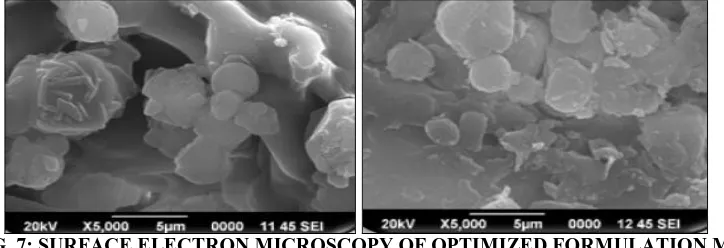
Surface Electron Microscopy (SEM): The morphology of the optimized microsponge (M1) was studied using a scanning electron microscope (JSM 6390 India) operated at an accelerating voltage of 20 kV, 5000X and 5 µm Scale.
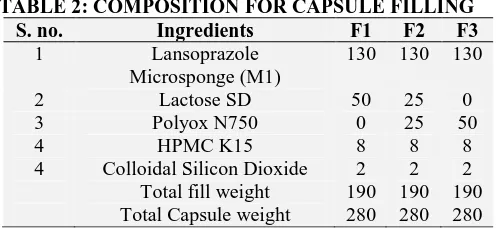
[image:3.612.48.299.77.184.2]Preparation of Ready to Fill Blend: Microsponges giving maximum yield and loading efficiency were selected for further formulation development. Microsponges (M1) was selected and weighed as per their actual weight containing one dose of lansoprazole and mixed with different ingredients shown in composition Table 2. Prepared blend further evaluated for its flow using SeDeM technique and filled in empty hard gelatin capsule shell size ‘0’.
TABLE 2: COMPOSITION FOR CAPSULE FILLING S. no. Ingredients F1 F2 F3
1 Lansoprazole
Microsponge (M1)
130 130 130
2 Lactose SD 50 25 0
3 Polyox N750 0 25 50
4 HPMC K15 8 8 8
4 Colloidal Silicon Dioxide 2 2 2 Total fill weight 190 190 190 Total Capsule weight 280 280 280
Determination of Flow of Blend using SeDeM: To fill the blend in empty capsules it is important to have flow to prepared blend, flow of blend is predicted using 12 parameters of SeDeM Technique employed to determine the flow of blends. Formulation having higher radius value considered as optimized formulation to be consider for capsule filling 8, 9, 10 mention in Table 3.
Physical and Chemical Testing: Filled capsule were evaluated for various in process quality control test viz. weight variation test, disintegration time, locking length etc. and chemical test like assay and in-vitro dissolution test.
Stability: The optimized batch was stored in stability chamber (HMG India) at 40 °C and 75 % RH for 3 month and observed for the, physical appearance, weight variation, disintegration, locking length, particle size, assay and dissolution at 1 month interval.
[image:3.612.315.563.322.436.2]TABLE 3: PARAMETERS OF SeDeM EXPERT SYSTEM ALONG WITH LIMITS AND FACTORS Incidence
factor
Parameter (Symbol)
Unit Equation Limit value
Conversion factor applied
Dimensions Bulk Density (Da) gm/ml Da= P/Va 0-1 10v
Tapped Density (Dc) gm/ml Dc= P/Vc 0-1 10v
Compressibility Interparticle porosity (Ie) - Ie= DC-Da/Dc x Da 0-1.2 10v/1.2
Carr index (Icd) % IC = (Dc-Da/Dc) 0-50 10-(v/5)
Cohesion index (IC) N Experimental 0-200 v/20
Powder Flow Hausner Ration (IH) - IH=Dc/Da 3-0 10-(10v/3)
Angle of repose (α) - Α =tan-1h/r 50-0 10-(v/5)
Flowability (tn) S Experimental 20-0 10-(v/2)
Stability Loss on Drying (% LOD) % Experimental 10-0 10-v
Hygroscopicity (%H) % Experimental 20-0 10-(v/2)
Lubricity Particles ˂50 m (%Pf) % Experimental 50-0 10-(v/5)
Homogeneity index (Iϴ) - Eq. (1) 0-0.02 500v
RESULT AND DISCUSSION:
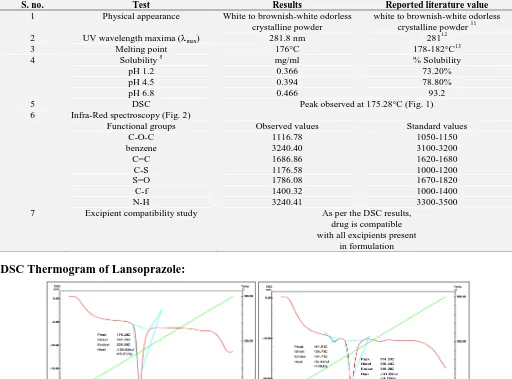
Preformulation Studies: Drug Lansoprazole was confirmed and compared with reported values with literature, the results of UV (max), melting point, DSC, solubility study and excipient compatibility
[image:4.612.48.560.326.705.2]study expressed in Table 4. From the table it can be concluded that chemical received is matches the characteristics with Lansoprazole drug and Lansoprazole is compatible with the excipients intended to use in the formulation.
TABLE 4: RESULTS OF PREFORMULATION STUDIES
S. no. Test Results Reported literature value
1 Physical appearance White to brownish-white odorless crystalline powder
white to brownish-white odorless crystalline powder 11
2 UV wavelength maxima (max) 281.8 nm 281
12
3 Melting point 176°C 178-182°C13
4 Solubility 5 mg/ml % Solubility
pH 1.2 0.366 73.20%
pH 4.5 0.394 78.80%
pH 6.8 0.466 93.2
5 DSC Peak observed at 175.28°C (Fig. 1)
6 Infra-Red spectroscopy (Fig. 2)
Functional groups Observed values Standard values
C-O-C 1116.78 1050-1150
benzene 3240.40 3100-3200
C=C 1686.86 1620-1680
C-S 1176.58 1000-1200
S=O 1786.08 1670-1820
C-f 1400.32 1000-1400
N-H 3240.41 3300-3500
7 Excipient compatibility study As per the DSC results,
drug is compatible with all excipients present
in formulation
DSC Thermogram of Lansoprazole:
FIG. 1: DSC THERMOGRAM OF LANSOPRAZOLE
Infra-Red Spectrometry (IR) of Lansoprazole:
FIG. 2: INFRA-REDSPECTROMETRY (IR) GRAPH OF LANSOPRAZOLE
UV Method Development: Lansoprazole drug showed λmax at 281.6nm. The calibration curve
yielded correlation coefficient (r2) of 0.99732. The regression equation was found to be Y = 0.0057 x -0.02407 with good linearity.
Development of Microsponges: Production yield was found in the range between 85 - 95%. These relatively low values may be due to the use of vacuum during filtration process. Loading efficiency was in the range of 85 - 98%. Moisture content was less than 1% in all formulation, while particle size of microsponges varies from 50 µ to 250 µ, all these values reported in table.
Lansoprazole Microsponge under Electronic Microscope:
M1 M2 M3
FIG 6: MICROSPONGE OF M1, M2 & M3 FORMULATION UNDER ELECTRONIC MICROSCOPE
TABLE 5: EVALUATION OF MICROSPONGES
Surface Electron Microscopy (SEM): The optimized formulation M1 was analyzed by SEM for studying microsponge shape and surface
structure Fig. 7. The microsponges were spherical in shape and possessed a slight rough surface.
Formulation code Production yield (%)* Loading efficiency (%) Moisture content (%) Particle Size (µm)
M1 95.75 ± 1.56 97.90 ± 1.53 0.95 150
M2 92.66 ± 1.96 88.34 ± 2.14 0.90 175
[image:5.612.96.520.258.423.2]M3 88.12 ± 0.87 85.52 ± 2.09 0.95 128
FIG. 4: UV SPECTRUM (λmax) OF
[image:5.612.116.501.456.597.2]LANSOPRAZOLE
[image:5.612.49.557.631.678.2]FIG. 7: SURFACE ELECTRON MICROSCOPY OF OPTIMIZED FORMULATION M1
Preparation of Ready to Fill Blend using SeDeM Method: Microsponge M1 has given satisfactory performance in all the tests therefore microsponge M1 considered to be incorporated in the formulation. 3 different blend was formulated for capsule filling, all 3 different blend were treated
[image:6.612.128.490.55.179.2]with 12 parameters of SeDeM techniques in order to select best suitable blend for capsule filling, result obtained were tabulated in Table 6, Formulation which has given highest average radius value (IPP value) was selected for capsule filling.
TABLE 6: RADIUS VALUES OF ALL 3 FORMULATION BLEND BY SEDEM TECHNIQUE S.
no.
Parameter (Symbol)
Acceptable value Limit
Acceptable Radius Limit
Corresponding Radius (R)
F1 F2 F3
1 Bulk Density (Da) 0-1 0-10 4.55 3.89 3.11
2 Tapped Density (Dc) 0-1 0-10 5.89 5.81 4.95
3 Interparticle porosity (Ie) 0-1.2 0-10 4.18 7.27 7.94
4 Carr index (Icd) 0-50 0-10 5.44 3.33 2.56
5 Cohesion index (IC) 0-200 0-10 6.37 7.84 4.90
6 Hausner Ration (IH) 3-0 0-10 3.53 5.02 4.69
7 Angle of repose (α) 50-0 0-10 1.11 2.85 3.08
8 Flowability (tn) 20-0 0-10 3.00 5.00 4.00
9 Loss on Drying (% LOD) 10-0 0-10 8.08 9.05 8.75
10 Hygroscopicity (%H) 20-0 0-10 7.45 8.10 7.15
11 Particles ˂50 m (%Pf) 50-0 0-10 2.60 8.18 9.36
12 Homogeneity index (Iϴ) 0-0.02 0-10 7.00 9.00 6.50
Average Radius Value (IPP) 4.93 6.27 5.58 *IPP= Parametric profile index
SeDeM Graphs of All Blends:
[image:6.612.46.569.302.467.2]
In Process Quality Control (IPQC) Results:
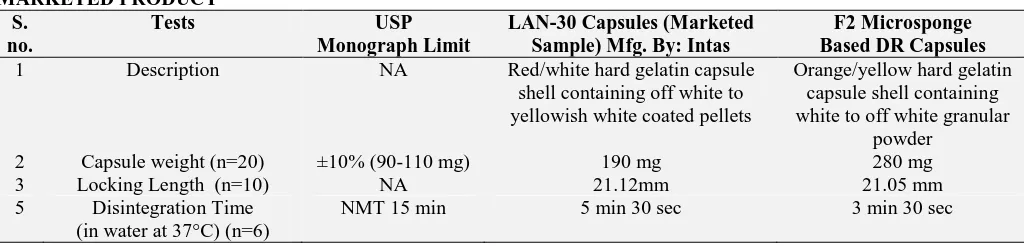
TABLE 7: IN PROCESS AND COMPARATIVE EVALUATION OF OPTIMIZED FORMULATION F1 WITH MARKETED PRODUCT
S. no.
Tests USP
Monograph Limit
LAN-30 Capsules (Marketed Sample) Mfg. By: Intas
F2 Microsponge Based DR Capsules
1 Description NA Red/white hard gelatin capsule
shell containing off white to yellowish white coated pellets
Orange/yellow hard gelatin capsule shell containing white to off white granular
powder
2 Capsule weight (n=20) ±10% (90-110 mg) 190 mg 280 mg
3 Locking Length (n=10) NA 21.12mm 21.05 mm
5 Disintegration Time (in water at 37°C) (n=6)
NMT 15 min 5 min 30 sec 3 min 30 sec
Determination of Assay and Dissolution: Result obtain after evaluation of lansoprazole capsules for assay and dissolution test was tabulated in Table 8.
TABLE 8: ASSAY AND DISSOLUTION VALUES OF OPTIMIZED FORMULATION AND COMPARISON WITH MARKETED PRODUCTS
S. no.
Test Limits Reference Sample
(LAN 30 Capsule)
F2
1 Assay 95-105 100.2 98.5
2 Dissolution Acid Stage
Condition; Media: 0.1N HCl, Volume: 500ml, Apparatus: USP Type II (Paddle),
RPM: 75, Unit = 6
(as per OGD & USP recommendation)
Limit: NMT 10% (Q) of the labelled amount of Lansoprazole is dissolved in 60 min
Time (h) % drug dissolved
5 0 0
10 0 1
30 3 4
45 5 6
60 6 7
3 Dissolution Buffer Stage Limit: NLT 80% (Q) of the labelled amount of
Lansoprazole is dissolved in 60 min Condition; Media: make up to pH 6.8
Volume: 500ml,
Apparatus: USP Type II (Paddle), RPM: 75, Unit = 6
(as per OGD & USP recommendation)
Time (h) % drug dissolved
5 8 12
10 37 48
30 79 85
45 92 95
60 99 101
3 Difference factor (F1) NMT 15 = 8
4 Similarity factor (F2) NLT 50 = 64
Stability Study: Stability studies of the optimized lansoprazole DR Capsules (F2) was carried out at various atmospheric conditions like room temperature, 40 °C/75% RH and 30 °C/65% RH. Even after the period of three month exposure at various atmospheric conditions different stability
[image:7.612.50.562.98.221.2] [image:7.612.50.564.292.539.2]parameters like average weight, Locking length, disintegration time, moisture content, and assay were satisfactory Table 9. Thus, these results confirmed that the optimized lansoprazole DR capsule (F2) was stable enough.
TABLE 9: STABILITY RESULT OF OPTIMIZED FORMULATION F2 Condition Avg. wt (mg)
(N=20)
Locking length (N=10)
DT (Min) (N=6)
Moisture content (LOD % w/w)
Assay (%)
Initial 281.2 21.01 4 1.45 99.5
40 °C/75% RH-1M 280.5 21.06 5 1.60 100.1
40 °C/75% RH-3M 281.6 21.11 4 1.82 99.9
30 °C/ 65% RH-3M 279.5 20.98 3 1.15 99.8
Control room Temperature - 3M
[image:7.612.49.567.294.540.2] [image:7.612.46.567.650.751.2]FIG. 11: COMPARATIVE DISSOLUTION OF LAN 30 VS F2 FORMULATION
CONCLUSION: A stable microsponge based delayed release dosage form is developed for the treatment of stomach acidity, lansoprazole shows promising presence in all aspects like it solubility in intended pH range, compatibility with polymer and other ingredients, and its detectability in different spectroscopic methods. SeDeM expert system has predicted the flow of the blends and provided the best one from the list, in order to fill in the capsule shell.
This developed dosage form may be a cost effective as the numerous coatings involved in the process is reduced and prepared by simple diffusion of drug in polymer by means of microsponge structure. Production yield and Loading efficiency has encouraged for further development. Developed dosage form behaves similar to the marketed formulation in OGD and USP recommended dissolution media. It is recommended to have in-vitro in-vivo correlation using convolution and deconvolution technique for the optimized formulations.
ACKNOWLEDGEMENT: We thank your
Principal Government College of Pharmacy and Y.B. Chavan College of Pharmacy Aurangabad for their support.
CONFLICT OF INTEREST: All authors declare no conflict of interest.
REFERENCES:
1. Ade P, Bhalerao P, Khan A, Shahi SR and Tadwee I: Microsponge drug delivery system: A Review. Int J Parenteral and Dermatology. 2017; 1(1): 35-44.
2. Zimmermann AE and Katona BG: Lansoprazole: a comprehensive review. Pharmacotherapy. 1997; 17(2): 308 - 26.
3. Stedman CAM and Barclay ML: Comparison of the pharmacokinetics, acid suppression and efficacy of proton pump inhibitors. Aliment Pharmacol Ther. 2000; 14: 963-978.
4. Khan A, Iqbal Z, Rehman Z, Nasir F, Khan A, Ismail M, Roohullah A and Mohammad A: Application of SeDeM Expert system in formulation development of effervescent tablets by direct compression. Saudi Pharmaceutical Journal. 2014; 22: 433-444.
5. Bonthagarala and Brahmaiah: Formulation and evalution of lansoprazole delayed release tablets by using press coating technique. Journal of Pharma Research. 2016; 5 (6); 145-150.
6. Tadwee I, Ade P, Bhalerao P, Khan A and Shahi S: Development and validation of UV spectroscopy method for estimation of lansoprazole. World Journal of Pharmaceutical Research. 2017; 6(17): 915-924.
7. Gade R, Makinen A, Aparna A, Krishna, Keerthi B, Murthy TEGK, Rao CB and Depart SN: Design and development of hydroxyzine hydrochloride controlled release tablets based on microsponge technology. Carib. J. Sci Tech. 2013; 1: 172-184.
8. u egre JM, Montoya EG, Lozano PP az JEA, Carreras MR arc a RF, Carmona MM and ic rau JR: SeDeM Diagram: A new expert system for the formulation of drugs in solid form, expert systems for human, materials and automation. ISBN: 2011; 978-953-307-334-7: 17-34. 9. Shahi SR and Tadwee I: SeDeM in preformulation of solid
oral dosage form. A Review Advances in Applied and Pharmaceutical Sciences Journal. 2017; 1(1): 11-17. 10. Shahi S, Chate R, Dube A and Tadwee I: Preformulation
studies for direct compression suitability of polyethylene oxide in development of solid oral dosage form: a graphical representation using SeDeM Diagram. Advances in Applied and Pharmaceutical Sciences Journal 2017; 1(1): 33-39.
11. Drug Label Prevacid at Drugs@ FDA May 2009 (https://www.accessdata.fda.govdrugsatfda_docs/label/200 /021566s005lbl.pdf)
12. Okram ZD, Kanakapura B, Jagannathamurthy RP and Basavaiah VK: Development of a simple UV-spectrophotometric method for the determination of lansoprazole and study of its degradation profile. Quím Nova São Paulo 2012; 35(2): 14.
13. National Center for Biotechnology Information. PubChem Compound Database; CID=3883,
(https://pubchem.ncbi.nlm.nih.gov/compound/3883) 14. Eudragit Literature from Evonik
(http://healthcare.evonik.com/sites/lists/NC/DocumentsHC /Evonik-Eudragit_brochure.pdf)
All © 2013 are reserved by International Journal of Pharmaceutical Sciences and Research. This Journal licensed under a Creative Commons Attribution-NonCommercial-ShareAlike 3.0 Unported License.
This article can be downloaded to ANDROID OS based mobile. Scan QR Code using Code/Bar Scanner from your mobile. (Scanners are available on Google Playstore)
How to cite this article: