ISSN: 1992-8645 www.jatit.org E-ISSN: 1817-3195
207
AGE CLASSIFICATION BASED ON ROTATIONAL
INVARIANT FEATURES
1
P.J.S. KUMAR, 2V. VENKATA KRISHNA, 3Prof. YK SUNDARA KRISHNA
1
Krishna University, Machilipatnam,Andhra Pradesh, India 2
Vidya Jyothi Institute of Technology, Telangana, India 3
Professor in CSE Dept. Krishna University, Machilipatnam, Andhra Pradesh, INDIA E-mail: [email protected],[email protected] , [email protected]
ABSTRACT
Age classification has many useful applications, such as finding lost children, age-based face classification, surveillance monitoring, and face recognition. That’s why automatic age classification has become one of the challenging tasks in recent years and gained lot of attention from the research community. The present research derived a rotational invariant method by considering the rotational invariant local binary pattern (riLBP) that captures the local information of the facial images significantly. On this, shape features are evaluated using textons. On this GLCM features are derived to classify age in to four groups on FG-NET database using various classifiers. The results are compared with other methods and a comparison is made among the various classifiers.
Keywords: Local binary pattern, Textons, Grey level co-occurrence matrix features, Classifiers, FG-NET data base
1. INTRODUCTION
Human face provides a lot of information on behavioral aspects, health, age, mood, gender, emotion, smartness, color and so on. Humans can be easily identified by their face. That’s why facial photographs are used in many public and private sectors for identification purpose. In banking sector they are used on credit, debit cards, pass books and on other important forms. They are used in passports, tax forms, voter, driving and on other licenses in public sectors. That’s why considerable research is progressed in recent years on human faces for various applications. The recent advances in information technology, digital cameras and video cameras increased the demand for automatic applications on human faces. The introduction of surveillance cameras in public places also increased the need for automatic and accurate face recognition methods. The complexity of the face recognition methods can be reduced by placing the human faces according to these age groups in the database. Whenever a query facial image is given then age group of the query image will be estimated and it will be compared with those facial images that falls into the same age group. That’s why age
classification methods play an important role in many applications.
Recognition and classification of images is one of the major interests of many researchers in the Pattern recognition, image processing and computer vision and video processing domains. Shape is one of the significant features of objects and the advantage of shape feature is it is rotationally invariant. That’s why establishing and detection of proper shape features in an image plays a crucial role in image classification and recognition. Shape features can be established properly and significantly on a local window of different dimensions. One of the best ways to obtain local features is by the local binary patter derivation proposed by [33].
ISSN: 1992-8645 www.jatit.org E-ISSN: 1817-3195
208 Deriving significant patterns on textures is one of the interesting and leading topics of research in any classifications and recognition domains. Pattern can provide important and abundance of local texture and shape information. Recently textons[ 13] are proposed to represent patterns of an image. The texton shape feature evaluates the relationship between the values of neighboring pixels. Many researchers showed lot of interest in textons [34, 35].
The initial work on age classification is carried out by Lanitis et al. [37], Kwon et al [36] and Guo et al. [38]. Most of the existing methods fail in estimating accurate age classification especially under controlled settings [4]. Chandra Mohan and Vijaya kumar [39, 40, 41] carried out age classification based on texture and geometric features and they divided age in to five groups. Later vijaya kumar et al. carried our age classification based on pattern trends, texture shape features, and integrated approaches [41, 42]. Several other researchers carried out age classification based on various other methods [6, 7, 8, 15,16] and classified age in to several groups. The present paper establishes a novel method for automatic age classification using a combination of rotational invariant local attributes with shape properties and statistical features. The local attributes are derived from LBP, shape features are extracted from textons and features vectors are evaluated from GLCM features.
The present paper is organized as follows. The section 2 and 3 describes the methodology and results with discussions. The section 4 summarizes the overall conclusions.
.
2. METHODOLOGY
The present paper is a combination of LBP, textons and GLCM features. LBP derives local information of a facial age accurately and that’s why LBP are used. There are several advantages with LBP. LBP is simple to implement, holds local properties significantly, resistant to lighting or brightening effects, only holds the relative intensities, less sensitive to illumination variations, preserves patch-wise location information (thus, LBP is robust to alignment error) and invariant to monotonic grey level transformation. Age classification mainly dependent on pattern changes of a facial skin. These changes in facial skin patterns are effectively captured by textons in the present paper. Textons
represents texture shape primitives, which are located with certain placements rules called Textons are used for various classifications, analysis segmentation and in other issues. Textons are shape features derived on a local neighborhood. The Grey Level Co-occurrence Matrix (GLCM), a second order statistical method, was introduced by Haralick et al. [25] and able to characterize textures based on the spatial relationship between grey tones in an image [30]. Its development was inspired by the conjectured from Julesz [24]. The human face is treated as a texture. Therefore GLCM features are sufficient for a proper analysis and classification of human faces for different applications. The GLCM approach has been used in a number of applications [17, 21, 22, 23, 26, 27, 28, 29, 31].
The following steps emphasis the proposed method.
Step One: Converts the color image into a grey scale image using RGB color space model.
Step Two: Converts the grey level image in to a “rotational invariant Local Binary Pattern (riLBP)” coded image as explained below
2.1 Derivation of riLBP Coded Image
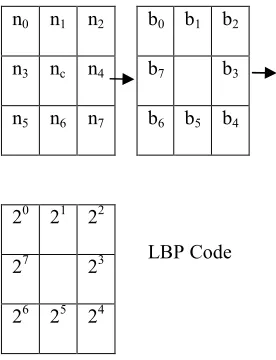
LBP is evaluated on the quantized facial image for obtaining local information in a precise way. LBP is based on the concept of local texture primitives. The basic LBP is derived on a 3 x 3 neighborhood and it is also represented as (P, R) as (8, 1), where P represent the number of neighboring pixels and R represents the radius of the window. Later the LBP is derived on (8,2), (16,1) and (16,2). The neighboring pixels of a 3 x 3 window are denoted in the present paper as {nc, n0, n1… n7}, where nc and n0, n1… n7 represents the intensity values of the centre and neighboring pixel and ni (0≤i≤7). The LBP categorizes the neighboring pixels in to binary values based on the equation (1)
0, ∆ 0
1, ∆ 0 (1) where ∆pi= ni-nc.
For each 3×3 neighborhood, a unique LBP code is derived from the equation (2)
ISSN: 1992-8645 www.jatit.org E-ISSN: 1817-3195
[image:3.612.84.222.179.359.2]209 overlapped manner, the image is converted in to LBP coded image. Thus a single LBP code represents local micro texture information around a pixele by a single integer code LBP. The range of this code will be from 0 to 255 (2P-1).
Figure 1: Representation of LBP.
To reduce or quantize the LBP codes on the image the present paper derived rotational invariant codes of LBP (riLBP) by deriving the minimum LBP code based on circular rotations. By this min (10000011) =131 will become (0000111) = 7. To achieve rotational invariance a unique identifier to each LBP is assigned in the present paper as specified in equation (3).
LBP, x, y" min&ROR)LBP, , i*| i
0,1,2, … , P - 1. (3)
Where LBP, x, y" represents the rotational invariant (ri) LBP code derived on a centre pixel location (x, y) with P neighboring pixels with a radius of r. This generates a total of 36 rotational invariant LBP codes on a (8,1) window instead of 256 LBP codes.
Step Three: Formation of shapes using Textons on riLBP coded image.
2.2 Formation of Shape Primitives using Textons
Textons have become popular and significant because one can obtain a very close relationship using textons on image attributes, such as pattern, shape etc. The textons are defined as a set of blobs or emergent patterns sharing a common property all over the image [9, 10]. The texton -
size, categories, expansion in one orientation and tonal difference between the size of neighbouring pixels, will play a leading role in dealing issues like fine or coarse or shape of textures and also in a pre-attentive discrimination, texture boundaries etc. The present paper utilized all the texton shapes on a 2×2 grid except triangular shapes.
The considered texton patterns will have either two or four pixels of the 2×2 grid with same intensity value. The present paper considered only seven texton patterns on a 2 x 2 grid and they are shown below.
In Figure.2 (a) P1, P2, P3 and P4 denote the pixel intensities. The Figure 2 (b), 2(c) and 2(d), 2(e) form horizontal (HT1, HT2) and vertical (VT1, VT2) textons. The two diagonal textons (Dt1, DT2) are shown in 2.(f) and 2.(g) and the blob texton (BT) is in 2.(h)
P1 P2
P3 P4
(a) (b) (c) (d)
(e) (f) (g) (h)
Figure 2: Seven special types of Textons on riLBP: a) 2×2 grid b) TP1 c) TP2 d) TP3 e) TP4 f) TP5 g) TP6 and h) TP7.
The rotational invariant LBP image of Step 2 generates a grey level image with intensity values from 0 to 35. The present research evaluated the above 7 textons on the rotational invariant LBP of Step 2. The derivation of texton image with the above 7 textons is shown below in Figure 3.
3 1 5 2 1 4 3 1 5 2 1 4 3 0 5 0 0 4 3 2 3 5 6 4 3 2 3 5 6 4 3 0 0 5 0 4 6 5 4 8 7 2 6 5 4 8 7 2 6 0 0 0 0 2 1 6 1 3 2 1 1 6 1 3 2 1 0 6 0 0 2 0 2 2 5 8 7 6 2 2 5 8 7 6 2 2 0 8 0 0 2 2 3 4 8 5 2 2 3 4 8 5 2 2 0 0 8 0
(a) (b) (c)
Figure 3: (a) Original image (b) Textons identification (c) Texton image.
Step Four: On riLBPT image the greyscale co-occurrence matrix (GLCM) in four directions i.e. 0o, 45o, 90o and 135o are evaluated.
n0 n1 n2 b0 b1 b2
n3 nc n4 b7 b3 ×
n5 n6 n7 b6 b5 b4
20 21 22
LBP Code 27 23
[image:3.612.310.527.309.413.2] [image:3.612.306.529.540.629.2]ISSN: 1992-8645 www.jatit.org E-ISSN: 1817-3195
210 Step Five: Feature vectors are evaluated by computing the average values from riLBPT-GLCM features in the above four directions as explained below.
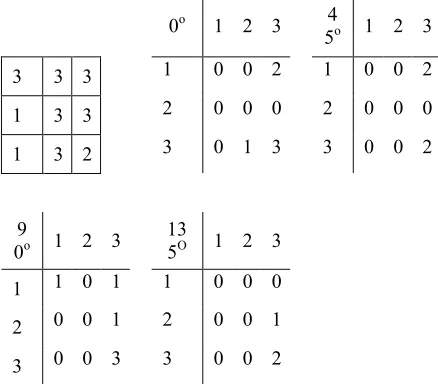
[image:4.612.84.303.201.393.2]The following Figure 4 illustrates the above definitions of a co-occurrence matrix (d=1, θ= 00):
Figure 4: An example of Grey level co-occurrence matrix.
The present paper evaluated only four features on riLBPT-CM namely contrast, correlation, energy and homogeneity as given in Equations from (4) to (7).
Contrast 5 P6
789
,6
i - j"; 4"
The contrast feature is a difference moment of the P matrix and is a standard measurement of the amount of local variations present in an image. The higher the value of contrast are, the sharper the structural variations in the image.
Correlation 5 P6
789
,6
i - μ" j - μ"
σ; 5"
where Pij is the pixel value in position (i,j) of the texture image, N is the number of grey levels in the image, µ is μ ∑789,6 iP6 mean of the texture image and σ; is σ; ∑789,6 P6 i - μ"; variance of the texture image. Correlation is the measure of similarity between two images in comparison.
Energy 5 -ln P6"; 6" 789
,6
Energy measures the number of repeated pairs and also measures uniformity of the normalized matrix.
Homogenity 51 F i - j"P6 ; 7" 789
,6
Homogenity measures the closeness of the distribution of elements in the GLCM to the GLCM diagonal. The converse of homogeneity results in the statement of contrast.
Step Six. Apply classifiers for effective age classification on the feature vectors derived from riLBPT-GLCM.
3. RESULTS AND DISCUSSIONS
The present paper used FG-NET aging database for proper age classification. The FG-NET aging database was generated as part of the project FG-NET (Face and Gesture Recognition Network) [5]. FG-NET was funded by the European Union, Information Society Technologies (IST). The aim of this project is to generate human facial images towards a proper research on these facial images. The FG-NET contains 1002 images from 82 different subjects with ages ranging between new born to 69 years old subjects. However, ages up to 40 years are the most populated in the database. The major appreciation of this database is it is free of charge and can be used for academic research-related activities. That’s why it became popular among research community. The present research classified the human faces in to four age groups i.e. child (less than 10 years), young (10 years to < 30 years), middle aged (30 years to <60 years) and senior citizens from 60 years onwards on the FG-NET database. The present paper initially converted the facial image into riLBP coded image and the seven categories of textons are evaluated on them. On riLBPT image GLCM features i.e. contrast, correlation, energy and homogeneity are evaluated in four directions and for the classification purpose the average value is considered. The present paper initially considered the 600 facial images i.e. 150 images per each age group. The GLCM feature values for these images are stored in a feature database. The present paper used Naïve Bayes, Lib Linear (SVM), Multilayer Perception, LBK and J48 classifiers to test the efficiency of the proposed riLBPT-GLCM method. The proposed method is compared with M. Yazdi et al. method.
0o 1 2 3 4
5o 1 2 3
3 3 3 1 0 0 2 1 0 0 2
1 3 3 2 0 0 0 2 0 0 0
1 3 2 3 0 1 3 3 0 0 2
9
0o 1 2 3 13
5O 1 2 3
1 1 0 1 1 0 0 0
2 0 0 1 2 0 0 1
ISSN: 1992-8645 www.jatit.org E-ISSN: 1817-3195
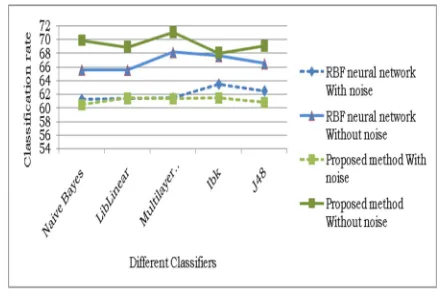
[image:5.612.313.531.40.237.2]211 The present paper carried out experiments in two cases. In case 1, we have inserted the 30 % of impulse noise in the facial images and in case 2 without noise. The Table 1 gives the age classification of the proposed and M.yazdi [32] method with different classifiers. The classification graphs of four different age groups are plotted separately for the both the methods using different classifiers in from Figure 5 to Figure 8. The multi layer perception classifier showed high performance when compared to other classifiers for the both methods. Naïve Bayes stood next to multi layer perception classifier in age classification. The proposed method showed high performance than existing method.
[image:5.612.311.531.279.431.2]Table 1: Age classification rate of RBF neural network and proposed method.
[image:5.612.84.530.299.663.2]Figure 5: Comparison graph for child age classification rate.
Figure 6: Comparison graph for young age classification rate.
Figure 7: Comparison graph for middle age classification rate.
RBF neural network
Proposed method
With noise
Without noise
With noise
Without noise
Naïve Bayes
CHILD 60.16 66.18 61.08 67.72
YOUNG 60.71 66.43 61.33 67.25
MIDDLE 61.73 63.32 61.22 68.26
SENIOR 60.29 65.56 60.46 69.83
Lib Linear
CHILD 61.42 64.88 62.78 67.96
YOUNG 60.33 65.65 64.88 67.95
MIDDLE 60.18 64.51 63.41 67.72
SENIOR 61.38 65.51 61.41 68.92
Multi layer Perce ptron
CHILD 61.37 64.16 64.06 68.91
YOUNG 60.93 65.54 60.44 69.16
MIDDLE 61.61 64.98 64.36 71.95
SENIOR 61.47 68.14 61.31 71.01
Ibk
CHILD 61.22 66.89 62.79 68.8
YOUNG 61.51 64.34 62.24 70.05
MIDDLE 62.47 66.35 62.25 70.01
SENIOR 63.47 67.55 61.45 67.01
J48
CHILD 62.21 66.32 60.6 68.75
YOUNG 60.24 67.54 61.44 68.74
MIDDLE 62.61 67.44 61.51 69.15
[image:5.612.87.304.304.655.2]ISSN: 1992-8645 www.jatit.org E-ISSN: 1817-3195
212
Figure 8: Comparison graph for senior age classification rate.
5. CONCLUSIONS
The proposed method derived shape information based on the local information. The local attributes are captured by LBP and to make the proposed method as rotational invariant. The proposed riLBP is resistant to lighting or brightening effects, less sensitive to illumination variations, preserves patch-wise location information ( thus, LBP is robust to alignment error) and invariant to monotonic grey level transformation of facial images. To derive shape feature effectively and to evaluate the relationship between the values of neighboring pixels textons are derived in the present paper on riLBP coded facial images. For effective age classification the GLCM features are derived on the riLBPT facial image. The present method achieved a significant age classification results by using various machine classifiers. The multi layer perception classifier has shown high classification results over the others.
REFRENCES:
[1] Beck ,J.; Prazdny,K.; and Rosenfeld ,A; A theory of textural segmentation,
Human and Machine Vision. J. Beck, B. Hope,
and R. Rosenfeld, Eds.New York: Academic, 1983, 100.
[2] Burt ,D.; Perrett, D.; Perception of Age in Adult Caucasian Male Faces: Computer Graphic Manipulation of Shape and Colour Information, Proceedings of the Royal Society
of London, 1995,137.
[3]. Chandra Mohan, M.; Vijaya kumar, V.; A new method of face recognition based on texture feature extraction on individual components of face, International journal of signal and image
processing (IJSIP), Vol. 1, No.2, pp. 69-74,
March-2010.
[4] Chen, C. H.; Pau, L. F.; and Wang, P. S. P.; Texture analysis in Handbook of Pattern Recognition and Computer Vision, World
Scientific, 1993, 235.
[5] FG-NET Aging Database.
http://www.fgnet.rsunit.com.
[6] He, X. ; Yan, S.; Hu, Y.; Niyogi, P.; and Zhang, H.; Face recognition using Laplacianfaces, IEEE Trans. Pattern Anal.
Mach. Intell., 27 (3) , 2005, 328-340.
[7] Kotropoulos, C.;, Tefas, A.; and Pitas, I.; Frontal face authentication using morphological elastic graph matching, IEEE
Trans. Image Proc., 9(4), 2000, 555-560.
[8] Lam, K.M.; and Yan, H.; An analytic-to-holistic approach for face recognition based on a single frontal view, IEEE Trans. Pattern
Analysis and Machine Intelligence, 20( 7),
1998, 673-686.
[9] J. Malik, S. Belongie, J. Shi and T. Leung, “Textons, Contours and Regions: Cue Integration in Image Segmentation,” Proc. of Seventh International Conference on Computer
Vision, Kerkyra, Greece, Sept 20-27, 1999, pp.
918-925.
[10] Mao, J.; and Jain, A.K.; Texture classification and segmentation using multiresolution simultaneous autoregressive models, Pattern
Recognition, 25, 1992, 173.
[11] Mark, L.S.; and Todd, J.T.; The perception of growth in three dimensions, Journal of
Perception and Psychophysics, 33(2),
1983,193.
[12] Mark, L.S.; Pittenger, J.B.; Hines, H.; Carello, C.; Shaw, R.E.; and Todd, J.T, Wrinkling and head shape as coordinate sources of age level information, Journal of Perception and
Psychophysics, 27(2), 117-124, 1980.
[13] Julesz B., “A theory of pre-attentive texture discrimination based on first order statistics of textons”, Biol. Cybernet., vol.41,pp:131-138, 1981..
[14] Pittenger, J. B.; Shaw, R.E.; and Mark, L.S.; Perceptual information the age level of faces as a higher order invariant of growth, Journal
of Experimental Psychology,5 (3), 1979, 478.
[15] Sobottka, K.; and Pitas, I.; A novel method for automatic face segmentation, facial feature extraction and tracking, Signal Processing -
Image Comm,12, 1998, 263.
ISSN: 1992-8645 www.jatit.org E-ISSN: 1817-3195
213
of Int. J. Remote Sens., 2boreal forest
ecosystems, 2, 2001, 3895.
[17] G. Venkata Rami Reddy, S.Kezia, V.Vijaya Kumar, Texture synthesis based on image resolution enhancement using wavelet transforms, International journal of computer
science and information security (IJCSIS),Vol.
10, No. 4, pp. 60-64, April-2012, ISSN: 1947-5500.
[18] V. Vijaya Kumar , Jangala. Sasi Kiran ,G.S.Murthy, Pattern based dimensionality reduction model for age classification,
International journal of computer applications
(IJCA), Vol.79, No.13, pp. 14-20, Oct-2013,
ISSN: 0975–8887.
[19] Pullela R Kumar,V.Vijaya Kumar, Rampay.Venkatarao, Age classification based on integrated approach. International journal of image, graphics and signal processing
(IJIGSP), Vol. 6, No. 7, pp. 50-57, May-2014,
ISSN: 2074-9082.
[20] V. Vijaya Kumar, Jangala. Sasi Kiran , V.V. Hari Chandana, An effective age classification using topological features based on compressed and reduced grey level model of the facial skin,
International journal of image, graphics and
signal processing (IJIGSP), , Vol.6,No.1,
pp.9-17,Nov-2013, ISSN: 2074-9082.
[21] V. Vijaya Kumar, Gorti Satyanaraya Murty, PS V V S R Kumar, Classification of facial expressions based on transitions derived from third order neighborhood LBP, Global journal of computer science and technology graphics
& vision (GJCST), Vol.14, N0.1, pp. 1-12,
Jan-2014, ISSN: 0975-4350.
[22] V. Vijaya Kumar,P. Chandra Sekhar Reddy, B. Eswara Reddy, New method for classification of age groups based on texture shape features,
International journal imaging and robotics,
Vol. 15, No.1, 2015, ISSN: 0974-0637. [23] V.Vijaya Kumar, K.Srinivasa Reddy,
V.V.Krishna, Face recognition using prominent LBP model, International journal of applied
engineering research (IJAER), Vol.10, No.2,
pp. 4373-4384, 2015, ISSN: 0973-4562. [24] B. Julesz, “Visual Pattern Discrimination”,
IRE Transactions on Information Theory IT,
Vol. 8, no. 2, pp. 84-92, 1962.
[25] Haralick RM , Shanmugan K and Dinstein I, "Textural features for image classification",
IEEE Trans. Sysr., Man., Cybern., Vol.
SMC-3, no. 6, pp. 610-621, 1973.
[26] L.H. Siew, R.H. Hodgson, and E.J. Wood, ”Texture Measures for Carpet Wear Asessment”, IEEE Trans. on Pattern Analysis
and Machine Intell., Vol. PAMI-10, pp. 92-
105, 1988.
[27] M. Iizulca, ”Quantitative evaluation of similar images with quasi-grey levels”, Computer
Vision, Graphics, and Image Processing, Vol.
38, pp. 342-360, 1987.
[28] M.M. Trivedi, R.M. Haralick, R.W. Conners, and S. Goh, ”Object Detection based on Grey Level Co-occurrence”, Computer Vision,
Graphics, and Image Processing, Vol. 28, pp.
199-219, 1984.
[29] R. W. Conners, M. Trivedi, and C.A. Harlow, “Segmentation of a High Resolution Urban Scene using Texture Operators”, Computer
Vision, Graphics, and Image Processing, Vol.
25, no. 3, pp. 273-310, 1984.
[30] R.F. Walker, “Adaptive Multi-scale Texture Analysis with Application to Automated Cytology”, Ph.D. Thesis, The University of
Queensland, 1997.
[31] R.W. Conners and C.A. Harlow,”A theoretical comparison of texture algorithms”, IEEE Trans. on Pattern Analysis and Machine
Intell., Vol. PAMI-2, pp. 204-222, 1980.
[32] M. Yazdi, S. Mardani-Samani, M. Bordbar, and R. Mobaraki “Age Classification based on RBF Neural Network”, Canadian Journal on
Image Processing and Computer Vision, Vol. 3
No. 2, pages: 38-42, June 2012.
[33] T.Ojala, M. Pietikäinen, and D. Harwood, “A comparative study of texture measures with classification based on featured distributions,”
Pattern Recognition, vol. 29, no. 1, pp. 51-59,
1996.
[34] B.Eswara Reddy, P.Chandra Sekhar Reddy, V.Vijaya Kumar , Texton based shape features on local binary pattern for age classification,
International journal of image, graphics and
signal processing (IJIGSP), Vol. 7,
No.4,pp.54-60, July-2012.
[35] U Ravi Babu, V Vijay Kumar, B Sujatha, Texture classification based on texton features
International journal of image, graphics and
signal processing (IJIGSP), Vol.4, No.8,
pp.36-42, Auguest-2012.
[36] Kwon Y. H. and da Vitoria Lobo N "Age classification from facial images, Int. Computer Vision and Image Understanding,
Vol. 74(l), pp.1-21, 1999.
[37] Lanitis A. , Taylor C. and Cootes T. ―Toward automatic simulation of aging effects on face images, IEEE Transactions on Pattern
Analysis and Machine Intelligence, Vol. 24(4),
ISSN: 1992-8645 www.jatit.org E-ISSN: 1817-3195
214 [38] G. Guo, G. Mu, Y. Fu, and T. Huang. Human
age estimation using bio-inspired features. In
CVPR’09, pages 112–119, 2009.
[39] V. Vijaya Kumar, Jangala. Sasi Kiran, G.S.Murthy,Pattern based dimensionality reduction model for age classification, International journal of computer applications (IJCA), Vol.79, No.13, , Oct-2013, pp. 14-20. [40] Pullela R Kumar, V.Vijaya Kumar,
Rampay.Venkatarao, Age classification based on integrated approach. International journal of image, graphics and signal processing (IJIGSP), Vol. 6, No. 7, May-2014, pp. 50-57. [41] V. Vijaya Kumar, Jangala. Sasi Kiran , V.V.
Hari Chandana, An effective age classification using topological features based on compressed and reduced grey level model of the facial skin, International journal of image, graphics and signal processing (IJIGSP), , Vol.6,No.1,Nov-2013, pp.9-17.