ISSN: 1992-8645 www.jatit.org E-ISSN: 1817-3195
INFORMATION QUALITY, USEFULNESS AND
INFORMATION SATISFACTION IN ISLAMIC E-TOURISM
WEBSITES
1SITI ZAKIAH BT. MELATU SAMSI, 2HASMIDA JAMALUDDIN, 3AZLEEN SHABRINA
MOHD NOOR, 4SITI NURUL HUDA MOHD, 5SALEHA ABDULLAH
1,2,4,5
Multimedia University, Melaka, Malaysia
3
Multimedia University, Cyberjaya, Malaysia
E-mail: [email protected], [email protected], [email protected],
4
[email protected], [email protected]
ABSTRACT
In line with the advancement of internet technology, e-Tourism has become an important platform for promotional, marketing and product development of tourism products and services. It provides a way to perform relevant transactions as well as mechanism to interact with potential tourists. E-Tourism has become popular among Muslim tourists since they are also referring to the websites to search for travelling information. As a Muslim, the travelling information that they seek should comply with the need of the religion such as Halal food, prayer time, religious places etc. However it is still difficult to find a specific and comprehensive website that provide necessary information to the Muslim tourists due to the lacking in the knowledge about information quality. Information quality is an important element in e-commerce which is one of the Information System (IS) success factors dimension based on IS success Model introduced by [1]. Companies that sell products or services online must ensure that the information provided on their website has certain criteria of information quality which may influence the purchasing decision of the customers. 138 respondents amongst Muslim tourists participated in the survey that was conducted both online and offline, which the data was then analyzed using SPSS software. This paper will discuss, (i) The information that is expected by Muslim tourists available on Islamic e-Tourism websites; and (ii) The relationship between information quality with usefulness and information satisfaction. The result has proven that Islamic content, timeliness, legitimacy, relevancy, reliability, Islamic design, consistency, accessibility and security are significant in predicting usefulness whereas for information satisfaction, only relevancy, Islamic design and security and privacy are significant. This study will benefit Islamic e-Tourism businesses, website owners, developers and designers by providing a guideline on the expected information that should be available on the website that serve Muslim tourists and how to make sure that the website fulfill the requirements needed by them.
Keywords: Information Quality, E-Tourism, Islamic E-Tourism, E-Tourism Website,
1.
INTRODUCTIONTourism industry has moved to the new era where tourists are depending more on information posted online rather than traditional travel agents. [2] have stated in their paper that one of the information that is most visited on the internet is tourism information. Many websites focusing on providing travel information are developed and maintained so that they serve the people who are looking for
travel-related information worldwide. In
commerce, it is known as Tourism. [3] defined e-Tourism as transactions that are made online,
including flight, accommodation and room
reservation that require information research.
ISSN: 1992-8645 www.jatit.org E-ISSN: 1817-3195 increasing as reported in [6] which stated that the
internet usage numbers for Middle Eastern countries where majority Muslims stayed from the year 2000 to 2014 have shown a growth rate of up to 3304 percent.
In order to meet the requirements of the Muslim tourists in terms of quality of the information posted on the website, it is very important for the website developers to have the knowledge on the expectation of the tourists themselves. Information quality, on the other hand, should be measured from different perspectives in order to know whether that aspect is critical for the website’s usefulness and Muslim users’ satisfaction.
Thus, Islamic e-Tourism can be defined as tourism websites that provide tourism related information specifically for Muslim tourists such as Muslim friendly travelling packages, travel information to the religious locations such as Makkah and Madinah and other historical places related to Islam. The website must provide information expected by Muslim tourists for example Muslims’ required facilities in non-Muslim countries such as Halal food, Muslim friendly accommodation, prayer time etc.
The literature review section of this paper will explore Islamic e-Tourism concept and information quality with all its dimensions, usefulness and information satisfaction. It will be followed by the elaboration of the research methodology and the last part will explain the results and discussions from the analysis which will highlight the outcomes of the research and its contributions to the area.
2.
LITERATURE REVIEW2.1 Tourism and Islamic Tourism
World Tourism Organization defines tourism as
“Tourism is a social, cultural and economic
phenomenon which entails the movement of people to countries or places outside their usual environment for personal or business/professional
purposes” [7]. Tourism activities include
marketing, promotion, creating tourism products and services that meet tuorists expectations as well as preparing and maintaining the required facilities or infrastructure.
Islamic tourism on the other hand related to the tourism activities related to Muslims. There are a lot of Qur’anic verses mentioning travelling in Islam, which prove that Islam encourages Muslims
to travel in order to achieve physical, social and spiritual goals [8]. [9] outlines that Travelling is
also considered as Sunnah or the way of life
practiced by the Prophet Muhammad S.A.W [10]. Nowadays, Muslims travel from one place to another for various reasons such as holidays,
performing ‘ibadah (worship), to seek education,
career growth, etc. The most important in Islamic tourism is the intention of the tourists to travel is not contrary with Islamic teachings and laws [11]. Islamic Tourism Centre (ITC), an agency under Ministry of Tourism Malaysia defined Islamic Tourism as:
“ any activity, event or experience undertaken in a state of travel that is in accordance of Islam” [12].
It can be concluded that the differences between traditional tourism and Islamic tourism are: (i) the Islamic tourism related activities are related to Muslim communities; (ii) the intention to travel must not contrary with Islamic teachings and laws; (iii) tourism business activities such as marketing, product development, tourism services, tourism infrastructure and facilities development must in line with Islamic teachings.
2.2 Islamic e-Tourism
To deliver required information that is expected by the Islamic tourism tourists or tourists in the era where people are highly dependent on the information technology, tourism websites are the most popular mechanism. Thus, Islamic e-Tourism is using websites as platform to provide Islamic tourism information In order to plan for their travelling, they have to gather and get all the information, where one of the sources is the tourism web pages, i.e. e-Tourism pages.
Tabl1 below shows the examples of Islamic e-Tourism websites that currently active in providing Islamic tourism information.
Table 1 - Examples Of Islamic E-Tourism Websites.
Website URL Information on the
website
www.itc.gov.my Introducing Malaysia as
a Muslim friendly
country and highlights
Muslim related
information such as
ISSN: 1992-8645 www.jatit.org E-ISSN: 1817-3195 Islamic tour packages,
Islamic museum in
Malaysia as well as information for Islamic tourism businesses.
www.halalbooking.com Provides information
and booking facilities for the Muslim tourists
that need
accommodation that
fulfil the following
criteria:
a. Does not serve
alcohol.
b. Separates
swimming pool and facilities for man and woman.
c. Serve only Halal
food.
www.islamichina.com Provides information
related to Islamic
tourism such as Muslim tour packages, Halal restaurants in china,
mosques in China,
prayer time etc.
www.andalusia2u.com Provides information on
Hajj and Umrah
package (travel to
worship the almighty)
and Muslim tour
packages.
2.3 Information Quality
Information is a communication of knowledge which is organized for a purpose, presented in a form that gives it meaning and can lead to increase in understanding any uncertainty. Information can be obtained through various means such as investigation, observation, instruction, reading as well as surfing the Internet. Nowadays, with the rapid growth of the Internet, more people are relying on online information as their reference due to its benefits of convenience in obtaining the necessary information.
In e-Tourism, information is the essential aspect of tourism products where it influences travelling-related decisions [2]. Even though online
information offers people great convenience as wel as a variety of information, they must have great quality of information especially in Islamic Tourism websites. This is because the Islamic e-Tourism websites act as a platform and mechanism to guide Muslim tourists to seek information related to travel around the world without any doubt. The quality of information received from the website depends on the accuracy, relevancy, security, up-to-date and trustworthiness, which come from the right sources.
Quality refers to the value of the content delivered to users. It can be considered to have a quality of information which users are satisfied and confident to use without any hesitation. [13] has mentioned that quality in a product or service is not what the supplier puts in. It is what the customer gets out and is willing to pay for. [14] on the other hand, explained that the quality reflects the intrinsic value of an information resource. Information that is unreliable or impossible to understand is worthless, even if it may otherwise be highly relevant or important.
In the context of information quality, several studies and researchers have emphasized the importance of providing information quality to users. According to [1] [15] information quality is a measure of value perceived by a customer of the output produced by a website. Information characteristics, such as being up-to-date, accurate, useful and complete, together with its presentation, have been viewed as important determinants of perceived information quality.
[16] in their study among virtual community users, used reliability, objectivity, value-added, timeliness, richness and format as the dimensions
of information quality. Meanwhile, [17]
concentrated on three information quality
dimensions derived from the rights. With correct information, they meant the right information in the right condition. With timely information, they meant information received at the right time, to the right receiver and to the right place. Complete information is related to the right quantity. Meanwhile, in Islamic perspective, providing the right sources will increase the belief among users to use the information and meets their expectation.
ISSN: 1992-8645 www.jatit.org E-ISSN: 1817-3195 downloadable audio, video and documents.
However, in the Islamic perspective, for e-Tourism website, the measurement of high quality information depends on the website’s presentation about the accuracy and trustworthiness aboutt the contents of Islamic tourism that perceives usefulness and ease of use. Thus, the quality of a website is often determined by the quality of the information that is used.
In a review about the concept of information quality, [19] in their study have emphasized that information has little value if it has poor reliability and validity. They further discussed accuracy, timeliness and proper formatting as important qualities of information, but without defining the dimensions [20]. Several studies indicate that poor, incomplete, late or missing information is perceived as a most serious quality problem [21], [22], [23]. However, quality of information has been suggested to be one of the most significant factors that explain use of information. By having all of the trustworthiness sources, users possibly can get accurate information before they make a decision which should get them to have a quality outcome. Based on the study conducted by [24], information quality was found to be the mostt significant variable that affects tourists’ confirmation.
Thus, this research defines information quality based on four different dimensions, i.e.; (i) Content; (ii) Format; (iii) Accessibility and; (iv) Security and Privacy.
2.3.1 Content
The content of the website includes Islamic content, accuracy, timeliness, legitimacy, relevancy and reliability of the information on the website.
[25] discussed in their papers that religion has significant influence towards customer behaviour. [26] studied how trust is important in the web environment where the audience of the information has specific characteristics in terms of religion, culture and lifestyle, specifically Muslim web users. It is therefore very crucial to ensure the legitimacy of the information on the website since the website deals with very sensitive information context. A study that was conducted in U.S tourism websites presented consistent findings where the researchers found that presenting information for specific users will be able to build trust between the website and the users [2]. [18] stated that Islamic
[image:4.612.314.528.219.609.2]website contents should not contradict Islamic teachings, values and the principles of Islam or can be defined as legitimacy of the website content. Relevancy, on the other hand, is defined as getting the trust from the customers that the content of the website are authoritative, accurate, useful and current. Table-2 below summarizes the content dimension in this research.
Table 2 - Summary of Content Dimension
Variables Description Sources
Islamic content
Extent to which Islamic website contents provides information needed by Muslim tourists.
[18]
Accuracy Extent to which
information are correct, accurate and valid
[27], [28], [29]
Timeliness Extent to which
information is sufficiently up-to-date
[30], [31], [32]
Legitimacy The extent to
which the Islamic website’s content did not contradict Islamic faith, moral values, and pillars.
[18]
Relevancy Extent to which
information is relevant, appropriate and useful.
[27],[33], [32], [18]
Reliability Extent to which
information is regarded as true, trustworthy and credible
[34], [16], [18]
2.3.2 Format
ISSN: 1992-8645 www.jatit.org E-ISSN: 1817-3195 According to [25], religious symbols or ques that
represent specific religions will impact product evaluation by customers, which includes attitude towards the brand, the attitude towards the products as well as customers’ purchase intention. Putting Islamic elements in advertisements such as Qur’anic verses and Islamic symbols produce a favourable feeling among Muslims towards the products. In the online environment or website, web developers should consider adding Islamic elements and symbols that favour and are consistent with the personality of Muslim customers, which could finally encourage them to visit and make purchasing decision towards the products or services offered.
Islamic identity or anything that symbolizes Islam or Islamic traits, such as content, photos, sounds etc. that represent Islam as well as usability traits are also three important Islamic user interface elements proposed by [26] in their paper. Thus, it is very important for web developers to consider Islamic relevant format for the information in Islamic e-Tourism websites.
[35] named the elements in a website that become the interface between customers and sellers as social presence. It includes the pictures, text, interface elements that encourage interactions in the website. Their studies on two different cultures, i.e. Canadian and Chinese, found that the increase of social presence embedded in the website format will have a positive impact on perceived usefulness. [36], on the other hand, found that user interface quality is an important determinant of customer satisfaction. Table-3 below summarizes the Format dimension and other research that use the same variables in format dimension.
Table 3 - Summary Of Format Dimension.
Variables Description Sources
Design The extent to
which design for ther website is user-friendly and easy to navigate
[37]
Consistency Extent to which
information is presented in the same format and compatible with previous data
[38], [29]
2.3.3 Accessibility
Accessibility is another important factor in information quality which can be defined as the extent to which information is accessible and retrievable to the user. [39] in their paper discussed that the usefulness of a website depends on the functionality and usability. Website functionality refers to the content which includes information quality, website flexibility and accessibility. Accessibility is defined as how fast and easy the website users are able to reach and access the information posted on the website. [40] include accessibility as an Information Quality dimension in their paper which discussed accessibility as how a computer system is able to deliver information that is easy to interpret, understandable, presented concisely and consistently. Accessibility dimension has been used in [37] to explain the extent to which information is available and easily retrievable.
2.3.4 Security
[4]defined security as the ability to protect
information while it is being transmitted and stored. Security of information include whether the information provided by the website users are well protected from unauthorized access, will not be revealed to a third party without consent, and the protection towards online payments made by the customers upon completing a transaction [30]. 2.4 Usefulness
There have been debates about the variables “use” and “usefulness” amongst the researchers. DeLone and McLean proposed use as one of the variables in IS success theory [1]. However, [41] argued that the term usefulness is more meaningful to measure IS success rather than use because even if the system is not being used or used for lesser hours, it does not mean that the system is not useful. [41] idea about usefulness is consistent with perceived usefulness in Technology Acceptance Model (TAM) introduced by Davis in 1989. Perceived usefulness is defined as the extent to which website users feel that they can successfully accomplish their goals by using the website [42]. Therefore, in this research, we use usefulness and study whether information quality in Islamic e-Tourism has a significant relationship with usefulness or not.
ISSN: 1992-8645 www.jatit.org E-ISSN: 1817-3195 increase. [44] measure usefulness by value,
reliability, currency and accuracy of the
information. A study conducted by [24]
investigated the relationship between usefulness and user satisfaction.
2.5 Information Satisfaction
Information satisfaction is defined as the overall satisfaction or dissatisfaction level of the customers or web visitors toward the overall information services on a website [38]. It measures customer’s satisfaction and their emotional reaction to the experience towards overall information provided by particular websites. Many researchers used the term ‘customer satisfaction’ in their research to indicate the satisfaction of the users towards online systems, information system, computer systems, etc. [45], [36], [27]. In this study, therefore, the term information satisfaction is being used since it focuses on the information quality only.
3.
METHODOLOGY3.1 Research Instrument
A survey research questionnaire was used for this study as the main data collection method. The questionnaire was developed and distributed mainly to local and international Muslim tourists in Malaysia who have experience in using Islamic
e-Tourism websites as the population. The
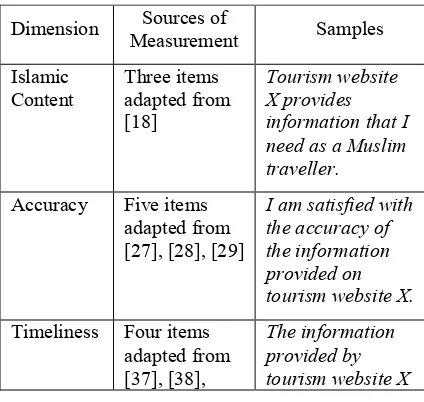
[image:6.612.90.302.539.740.2]measurement used in this study is based on a 5-point Likert scale with scale anchors ranging from ‘1’ (Strongly Disagree) to ‘5’ (Strongly Agree). The measurement of information quality was done as in Table-4.
Table 4 - Measurement Of Information Quality
Dimension Sources of
Measurement Samples
Islamic Content
Three items adapted from [18]
Tourism website X provides information that I need as a Muslim traveller.
Accuracy Five items
adapted from [27], [28], [29]
I am satisfied with the accuracy of the information provided on tourism website X.
Timeliness Four items
adapted from [37], [38],
The information provided by tourism website X
[32]. is kept updated.
Legitimacy Five items adapted from [18].
The services offered in tourism website X are beneficial to Muslim.
Relevancy Five items
adapted from [27], [33], [32] [18].
I found relevant information in tourism website X.
Reliability Four items
adapted from [34], [16], [18].
I feel that tourism website X is reliable.
Islamic Design
Four items adapted from [18].
The information presented in tourism website X portrays the image of Islam.
Consistenc y
Three items adapted from [38], [29].
I feel comfortable with the graphic used, colors and the way
information is arranged on the tourism website X.
Accessibili ty
Three items adapted from [37].
The information in the tourism website X is easily retrievable.
Security Six items
adapted from [29].
Tourism website X protects information against unauthorized access.
3.2 Population and Sample
The data for this study were collected via online surveys and also through personal distribution at different areas of tourist attractions, including at the airport. The questionnaires were conveniently distributed to respondents and 138 were returned. During preliminary data screening, 8 were discarded due to high amount of missing data of more than 50%. As a result, 130 were used as the final sample throughout the data analysis. Data analysis was done using SPSS software where descriptive; and multiple linear regression analysis
ISSN: 1992-8645 www.jatit.org E-ISSN: 1817-3195 conducted to describe the demography of the
respondents that participated in the survey as well as the list of expected information of the Muslim tourists from the Islamic e-Tourism websites. Multiple regression analysis on the other hand was conducted to study the relationship between the independent variables in this study i.e. (i) Islamic Content; (ii) Accuracy; (iii) Timeliness; (iv) Legitimacy; (v) Relevancy; (vi) Reliability; (vii)
Islamic Design; (viii) Consistency; (ix)
Accessibility; and (x) Security and the dependent variables i.e. (i) Usefulness; and (ii) Information Satisfaction.
Participants of this study comprised of 100% Malaysian and female participants make up 64% of the final sample, while the remaining are males. Most of the participants are in the age range of 18 to 29 years old (46%), followed by 30 to 39 years old (39%). More than half of the participants in this study are married (56%), 38% are single and a majority is employed (69 %).
4.
ANALYSIS AND DISCUSSION4.1 Results
Table-5 depicts the frequency and the rank of the expected information from Muslim traveller’s point of view. The most anticipated information that respondents look from a website is particularly on halal foods. For Muslim tourists, to find halal food especially in non-Muslim countries is always their biggest concern, thus, this is the first information that they always look for. Results also showed that, prayer times, mosque location, halal accommodations were among other information that they wish tourism providers provide in their website. Respondents who have chosen others have suggested a few other expectations such as information on culture, tips for Muslim tourists, toilet facilities and cleanliness, security as Muslim tourists, weather, money exchange and halal shopping places.
Table 5 - Information Expected by a Muslim Traveler from Tourism Websites.
Information expected Frequency (N)
1. Halal food 118
2. Prayer times 109
3. The nearest Mosque
location
102
4. Halal accommodation 100
5. Islamic tourism spots 88
6. Kiblah direction 85
7. Islamic entertainment 64
8. Segregated services, e.g
beaches, swimming pools, gymnasium for men and women
61
9. Others 17
Note: Respondents were allowed to choose more than one answer.
To achieve objective 2, a multiple regression analysis was conducted to predict the factors for website usefulness and information satisfaction. Islamic content, accuracy, timeliness, legitimacy, relevancy, reliability, Islamic design, consistency, accessibility and security were set as independent variables. Table-6 and Table-7 present the results for this analysis.
Table 6 - Multiple Linear Regression Analysis for Website Usefulness.
Unstandardized Coefficients
Standard ized Coefficie
nts
t Sig.
B Std.
Error Beta
(Constant) .655 .266 2.46 .015
Islamic Content
.220 .063 .285 3.49 .001**
Accuracy .081 .099 -.086 -.81 .414
Timeliness .086 .096 .098 .89 .370
Legitimacy -.208 .095 -.244 -2.18 .031*
Relevancy .528 .093 .579 5.67 .000**
Reliability .155 .106 -.170 -1.45 .148
Islamic Design
.148 .070 .188 2.11 .036*
Consistency .051 .081 .056 .63 .528
Accessibility .049 .087 -.054 -.55 .580
Security .274 .086 .255 3.19 .002**
a. Dependent Variable: Usefulness
Note: R2= 0.603; Adj. R2= 0.569; F=17.64 ; p= .000
Results showed that Islamic content
ISSN: 1992-8645 www.jatit.org E-ISSN: 1817-3195
influence towards website usefulness and
[image:8.612.88.300.173.384.2]legitimacy was found to have a negative relationship with website usefulness.
Table 7 - Multiple Linear Regression Analysis for Information Satisfaction.
Unstandardized Coefficients
Standard ized Coeffici
ents
t Sig.
B Std. Error Beta
(Constant) .024 .312 0.76 .940
Islamic
Content .140 .074 .153 1.887 .062
Accuracy -.137 .116 -.125 -1.182 .239
Timeliness .207 .113 .200 1.839 .069
Legitimacy .100 .112 -.100 .896 .372
Relevancy .377 .109 .351 3.447 .001**
Reliability -.228 .125 -.212 -1.824 .071
Islamic
Design .189 .082 .203 2.294 .024*
Consistency .083 .095 .077 .869 .387
Accessibility .044 .103 .041 .427 .670
Security .234 .001 .185 2.318 .022*
a. Dependent Variable: Information Satisfaction
Note: R2= 0.605; Adj. R2= 0.571; F=17.74 ; p= .000
Table-7 depicts the results of regression analysis for information satisfaction. It was found that only relevancy (β=.377, t=3.45; p<0.01), Islamic design (β=.189, t=2.29; p<0.05) and Security (β=.234, t=2.318; p<0.05) are significant in predicting information satisfaction, again with relevancy having the highest contribution towards information satisfaction.
5.
DISCUSSIONThis paper aims to achieve two research objectives. The first objective of this paper is to identify the information expected by Muslim tourists on Islamic e-Tourism websites. The six highest expectations by Muslim tourists on the information in the Islamic e-Tourism websites are halal food, prayer times, mosque location, halal accommodation and Kiblah direction. Islamic entertainment and segregated services were the
least expected Islamic e-Tourism website
information by the Muslim tourists.
The second objective is to investigate the relationship between the information quality of Islamic e-Tourism websites with usefulness and information satisfaction. This paper considers
Islamic content, accuracy, timeliness, legitimacy, relevancy and reliability as the elements of content. The Muslim tourists perceived that Islamic content, legitimacy and relevancy were significant content for the usefulness of Islamic e-Tourism websites. However, in the aspect of information satisfaction, only relevancy has a significant relationship. [25] reported similar result on the influence of Islamic content on the usefulness and satisfaction on website information. On top of that, legitimate content developed trust among the Muslim tourist ([26]. Islamic content complies with Islamic faith, moral values and pillars [46]. Nevertheless, the Muslim tourists highly perceived that the information in the Islamic e-Tourism websites should be relevant so that they perceived it as useful and thus achieves information satisfaction.
The finding indicates that legitimacy has a
significant but negative relationship with
usefulness. However, legitimacy did not have a significant relationship on information satisfaction. It shows that although the Muslim tourists agreed that Islamic e-Tourism website is useful with legitimate information, the current state of information in the websites that they used is not fully legitimate. In this paper, the legitimacy of information in the Islamic e-Tourism covers benefits to Muslim tourists, legality, compliance with Islamic principle and clarity of the contract. This indicates that there is a need to improve the aspect of legitimacy since it is significant for useful Islamic e-Tourism websites.
This paper explores the format in the perspective of Islamic design and consistency. Islamic design has a significant relationship with the usefulness of Islamic e-Tourism website and information satisfaction. This is consistent with the study by [26], since Islamic design represents Islamic identity. In this paper, although consistency has a positive relationship with usefulness and information satisfaction, it has no significant relationship with both variables.
On top of that, this paper discovered that the Muslim tourists perceived that the accessibility of information in Islamic e-Tourism has no significant but positive relationship with usefulness and information.
[image:8.612.90.300.175.384.2]ISSN: 1992-8645 www.jatit.org E-ISSN: 1817-3195
6.
CONCLUSIONAs conclusion, this paper proposed that there should be improvements in Islamic e-Tourism websites on the aspects of Islamic content, legitimacy, relevancy, Islamic design and security of the information to remain useful to the Muslim tourists. On the other hand, to achieve information satisfaction, the Islamic e-Tourism websites should improve its information relevancy, consistency and security. On top of information quality, the findings on the information expectations from the Muslim tourists would help Islamic e-Tourism operators in preparing and improving the information in their websites.
The overall contribution of this reserch can be divided towards two main stakeholders of the islamic tourism sector. It can be summarised as follow:
1. Islamic e-Tourism businesses – the findings
of this research can be used as the guideline for the islamic e-Tourism businesses to develop better website which contain information as expected by the tourists and in the format that encourage the tourists to make puchasing decision, increase the stickiness level to the website and increase the number of return customers. It will also help in increasing their internal processing
efficiency, interact effectively with
consumers by building relationships with consumers and partners, save the cost for developing, printing, storing, distributing conventional brochures
2. Muslim tourists - The improvement in
islamic e-Tourism websites will be able to help Muslim tourists in searching the best information for them such as which hotels that having Halal certification in terms of food servicing and accommodation, which travel agencies that provide travel package for Muslim, information of prayer time, articles or events of interest to Muslim, shops and attractions for Muslim and so on.
However, this study only focus on the information quality in IS success Model by [1]. It does not cover other IS success dimensions i.e. system quality and service quality. The future studies could include these two dimensions in order to get more comprehensive perspective about Islamic e-Tourism.
ACKNOWLEDGEMENTS
This research is funded by the Ministry of Higher Education, Malaysia under Fundamental Research Grant Scheme (FRGS) with project ID MMUE/130117.
REFERENCES
[1] W. H. DeLone and E. R. McLean, “The
DeLone and McLean Model of Information
Systems Success : A Ten-Year Update,” J.
Manag. Inf. Syst., vol. 19, no. 4, pp. 9–30,
2003.
[2] Q. Zhou and R. DeSantis, “Usability issues
in city tourism website design: A content
analysis,” in IEEE International
Professional Communication Conference,
2005, pp. 789–796.
[3] G. Büyüközkan and B. Ergün, “Intelligent
system applications in electronic tourism,”
Expert Syst. Appl., vol. 38, no. 6, pp. 6586–
6598, Jun. 2011.
[4] A. Y. Park and U. Gretzel, “Success
Factors for Destination Marketing Web
Sites: A Qualitative Meta-Analysis,” J.
Travel Res., vol. 46, no. 1, pp. 46–63, Aug.
2007.
[5] W. A. R. W. M. Isa, N. L. M. Noor, and S.
Mehad, “Unravel the Drivers for Using Web Information Architecture in Islamic Genre Web: An Exploratory Study on
Muslim Online User,” in 10th MMU
International Symposium on Information
and Communication Technologies
(M2USIC 2007), 2007, no. November, pp.
19–20.
[6] “Internet Users in Middle East and the
World 2014-Q4,” Internet World Stats
Usage and Population Statistics, 2014.
[Online]. Available:
http://www.internetworldstats.com/stats5.ht m. [Accessed: 29-Aug-2015].
[7] “Understanding Tourism: Basic Glossary,”
World Tourism Organization (UNWTO),
2008. [Online]. Available:
http://media.unwto.org/en/content/understa
nding-tourism-basic-glossary. [Accessed:
15-Nov-2013].
[8] H. Zamani-Farahani and J. C. Henderson,
“Islamic tourism and managing tourism development in islamic societies: The cases
of Iran and Saudi Arabia,” Int. J. Tour.
ISSN: 1992-8645 www.jatit.org E-ISSN: 1817-3195
[9] J. C. Henderson, “Chapter 6 Islam and
tourism,” in Tourism in the Muslim World
(Bridging Tourism Theory and Practice).,
N. Scot and J. Jafari, Eds. Emerald Group Publishing Limited, 2010, pp. 75–89.
[10] M. Zain, “Travel the World Muslim Style
(The Sunnah of Travel),” onislam.net,
2014. [Online]. Available:
http://www.onislam.net/english/reading-
islam/living-islam/islam-day-to- day/society/450363-plans-for-pleasing-self-a-god-in-islamic-tourism.html.
[11] S. A. Laderlah, S. A. Rahman, K. Awang,
and Y. C. Man, “A Study on Islamic Tourism : A Malaysian Experience,” in 2011 2nd International Conference on
Humanities, Historical and Social Sciences,
2011, vol. 17, pp. 184–189.
[12] “Islamic Tourism Center,” 2013. .
[13] P. Drucker, Innovation and
entrepreneurship. Harper & Row, 1985.
[14] R. Lachicha, D. Karabeg, and S. Rudan,
“Quality, Relevance and Importance in Information Retrieval with Fuzzy Semantic
Networks,” in 4th International Conference
on Topic Maps Research and Applications,
2008.
[15] P. Bharati and A. Chaudury, “An Empirical
Investigation of Decision-Making
Satisfaction in Web-Based Decision
Support Systems,” Decis. Support Syst.,
vol. 37, no. 2, pp. 187–197, 2004.
[16] Y. Zheng, K. Zhao, and A. Stylianou, “The
impacts of information quality and system quality on users’ continuance intention in information-exchange virtual communities:
An empirical investigation,” Decis. Support
Syst., Nov. 2012.
[17] R. Lindau and K. Lumsden, “Disturbance
Absorption Actions Used in Material Flow Systems - A Pilot Study,” Gothenburg, 1993.
[18] M. Aliyu, M. Mahmud, and A. O. M. Tap,
“Preliminary investigation of Islamic
Websites Design & Content Feature : A heuristic evaluation from user perspective,”
in 2010 International Conference on User
Science Engineering (i-USEr), 2010, pp.
262–267.
[19] C. R. Moberg, B. D. Cutler, A. Gross, and
T. W. Speh, “Identifying Antecedents of
Information Exchange within Supply
Chains,” Int. J. Phys. Ditribution Logist.
Manag., vol. 32, no. 9, pp. 755–770, 2002.
[20] H. Forslund and P. Jonnson, “Chalmers
Publication Library,” Int. J. Oper. Prod.
Manag., vol. 27, no. 1, pp. 90–107, 2007.
[21] L. P. English, Improving Data Warehouse
and Business Information Quality. New
York, NY: Wiley, 1999.
[22] B. Ferguson and J. N. W. Lim, “Incentives
and Clinical Governance - Money
Following Quality?,” J. Manag. Med., vol.
15, pp. 453–487, 2001.
[23] N. Crump, “Managing Professional
Integration in an Acute Hospital - a Socio
Political Analysis,” Int. J. Public Sect.
Manag., vol. 15, no. 2, pp. 107–117, 2002.
[24] N. Chung, H. Lee, S. Jae, and C. Koo,
“Technological Forecasting & Social
Change The in fl uence of tourism website on tourists ’ behavior to determine destination selection : A case study of
creative economy in Korea,” Technol.
Forecast. Soc. Chang., vol. 96, pp. 130–
143, 2015.
[25] A. Naseri and E. Tamam, “Impact of
Islamic Religious Sysmbol in Producing Favorable Attitude toward Advertisement.,”
Public Adm. Soc. Policies Rev., vol. 1, no.
8, pp. 61–77, 2012.
[26] E. N. M. Ibrahim, N. L. M. Noor, and S.
Mehad, “Trust or distrust in the web-mediated information environment (W-MIE): A perspective of online Muslim users,” J. Enterp. Inf. Manag., vol. 22, no. 5, pp. 523–547, 2009.
[27] A. Molla and P. Licker, “E-commerce
systems success: An attempt to extend and respecify the DeLone and McLean model
of IS success,” J. Electron. Commer. Res.,
vol. 2, no. 4, pp. 131–141, 2001.
[28] N.-G. Dragulanescu, “Website Quality
Evaluations: Criteria and Tools,” Int. Inf.
Libr. Rev., vol. 34, no. 3, pp. 247–254,
2002.
[29] W. H. DeLone and E. R. McLean,
“Information Systems Success: The Quest
for the Dependent Variable,” Inf. Syst. Res.,
vol. 3, no. 1, pp. 60–95, Mar. 1992.
[30] C.-I. Ho and Y.-L. Lee, “The development
of an e-travel service quality scale,” Tour.
Manag., no. 28, pp. 1434–1449, 2007.
[31] C. Park and Y. Kim, “The effect of
information satisfaction and relational benefit on consumers’ online shopping site
commitments,” J. Electron. Commer.
Organ., pp. 70–90, 2006.
[32] R. Stockdale and M. M. Borovicka, “Using
ISSN: 1992-8645 www.jatit.org E-ISSN: 1817-3195
websites,” in Information and
Communication Technologies in Tourism,
Springer Vienna, 2006, p. 344.
[33] H. Kim and L. S. Niehm, “The Impact of
Website Quality on Information Quality, Value, and Loyalty Intentions in Apparel
Retailing,” J. Interact. Mark., vol. 23, no. 3,
pp. 221–233, Aug. 2009.
[34] A. Kini and J. Choobineh, “Trust in
Electronic Commerce : Definition and Theoretical Considerations,” vol. 00, no. C, 1998.
[35] K. Hassanein, M. Head, and C. Ju, “A
cross-cultural comparison of the impact of Social Presence on website trust, usefulness
and enjoyment,” International Journal of
Electronic Business, vol. 7, no. 6. p. 625,
2009.
[36] M. I. Eid, “Determinants of E-Commerce
Customer Satisfaction, Trust, and Loyalty in Saudi Arabia,” pp. 78–93, 2007.
[37] M. Jeong and C. U. Lambert, “Adaptation
of an information quality framework to measure customers’ behavioral intentions to
use lodging Web sites,” Int. J. Hosp.
Manag., vol. 20, no. 2, pp. 129–146, Jun.
2001.
[38] C. Park and Y.-G. Kim, “The Effect of
Information Satisfaction and Relational Benefit on Consumers ’ Online Shopping,”
J. Electron. Commer. Organ., 2006.
[39] S. Qi, C. Ip, R. Leung, and R. Law, “A new
framework on website evaluation,” in
Proceedings of the International
Conference on E-Business and
E-Government, ICEE 2010, 2010, pp. 78–81.
[40] Y. W. Lee, D. M. Strong, B. K. Kahn, and
R. Y. Wang, “AIMQ: a methodology for
information quality assessment,” Inf.
Manag., no. 40, pp. 133–146, 2002.
[41] P. Seddon and M.-Y. Kiew, “A partial test
and development of DeLone and McLean’s
model of IS success,” Australas. J. Inf.
Syst., vol. 4, no. 1, pp. 90–109, 1996.
[42] L. C. Schaupp, “Web Site Success:
Antecedents of Web Site Satisfaction and
Re-use,” J. Internet Commer., vol. 9, no. 1,
pp. 42–64, Jun. 2010.
[43] D. Tao, “Understanding intention to use
electronic information resources: A
theoretical extension of the technology
acceptance model (TAM).,” AMIA Annu.
Symp. Proc., no. Figure 2, pp. 717–21, Jan.
2008.
[44] Z. Yang, S. Cai, Z. Zhou, and N. Zhou,
“Development and validation of an
instrument to measure user perceived service quality of information presenting
Web portals,” Inf. Manag., vol. 42, no. 4,
pp. 575–589, May 2005.
[45] H.-F. Lin, “The Impact of Website Quality
Dimensions on Customer Satisfaction in the
B2C E-commerce Context,” Total Qual.
Manag. Bus. Excell., vol. 18, no. 4, pp.
363–378, Jun. 2007.
[46] M. Aliyu and M. Mahmud, “Preliminary
investigation of Islamic Websites Design & Content Feature : A heuristic evaluation
from user perspective,” in 2010
International Conference on User Science
Engineering, 2010, pp. 262–267.
[47] F. Egger, “Affective design of e-commerce
user interfaces: How to maximise perceived
trustworthiness,” in Conference on
Affective Human Factors Design, 2001, pp.
317–324.
[48] H.-F. Lin, “The impact of website quality
dimensions on customer satisfaction in the
B2C e-commerce context,” Total Qual.
Manag. Bus. Excell., vol. 18, no. 4, pp.