EXPERIMENTAL STUDY ON HIGH PERFORMANCE
SELF-COMPACTING CONCRETE USING RECYCLED
AGGREGATE
1M.SEETHAPATHI, 2S.R.R.SENTHILKUMAR, 3K.CHINNARAJU
1Department of Civil Engineering, Tamilnadu College of Engineering, Coimbatore – 641659, India. 2Department of Civil Engineering, Agni College of Technology, Chennai – 603103, India.
3Department of Civil Engineering, Anna University, Chennai – 600025, India.
E-mail: [email protected]
ABSTRACT
In this article, attempt has been made to improve the performance of self compacting concrete using recycled coarse aggregate. Self compacting concrete has significant environmental advantages in compaction to the vibrated concrete. Absence of noise and vibrations during installing provides healthier working environment. In general, there is a scarcity of coarse aggregate throughout the world. Consumption of large amount of coarse aggregate affects the environment. For the purpose of reducing the consumption of coarse aggregate there is a need for an alternative coarse aggregate arises. Recycled aggregates are obtained from the demolition of buildings, culverts and also by-products from the industries. Hence, partial replacement of coarse aggregate by recycled aggregate is researched in this article, in view of consuming the ecological balance. The fresh and hardened properties of Self Compacting Concrete (SCC) using recycled concrete were evaluated. Four series of SCC mixtures were prepared with maximum of 30% of coarse recycled aggregates. The cement content was kept constant for all concrete mixtures. The SCC mixtures were prepared with 0, 10, 20 & 30% of recycled coarse aggregate. The strength test namely, Compressive Strength Test, Split Tensile Strength Test and Flexural Strength Test are carried out in this investigation. To test the characteristics of self compacting concrete, Slump cone test, J – ring test, L – box test were conducted to test the characteristic of SCC. There is an improvement in the strength of self compacting concrete by using recycled coarse aggregate, maximum of 30% is better than concrete with natural aggregates.
Keywords: Self Compacting Concrete, Recycled Coarse Aggregate, Fresh Properties, Mechanical Strength
1. INTRODUCTION
Usage of self compacting concrete has become very widely present and varied in recent years. Self compacting concrete is such that after casting into the formwork does not require vibrating. The filling ability and stability of self compacting concrete in the fresh state can be defined by four characteristics: flow ability, viscosity, passing ability and segregation resistance. The concrete mixture will be classified as a self compacting one, if all the mentioned characteristics are present [1-2]. Recycled aggregates are produced from the re-processing of mineral waste materials, with the largest source of construction and demolition waste. The coarse portion of the recycled aggregates has been used as a replacement of the natural aggregates for concrete production. The potential benefits and drawbacks of using recycled
aggregates are well understood and extensively documented.The use of self compacting concrete has gained a wider acceptance in recent years. The coarse portion of the recycled aggregates is lower than the natural aggregates and the recycled aggregates have a greater water absorption value compared to the natural aggregates. As a result a proper mix design is required for obtaining the desired qualities for concrete made with recycled aggregates [3-5].
without adhered cement mortar may be produced from the concrete crushed by impact crusher. The water absorption and density of recycled aggregates are affected by the adhered cement mortar [7]. In addition, the water absorption of recycled aggregates increases with an increase in strength of concrete from which the recycled coarse aggregates are derived [8].
The recycled coarse aggregates have relatively finer particles than the natural coarse aggregates due to the crushing of old concrete. However, the grading limits of recycled coarse aggregates are within the limits specified by IS: 383 [9] for aggregates of normal concrete. Not much significant difference is observed in compressive strength of recycled coarse aggregate and replacement of coarse aggregate, where as considerable difference is observed in case of split tensile strength and modulus of elasticity values at 50% replacement [10].
In practice the recycled aggregates are obtained from different types of demolished structures. The recycled aggregates were directly supplied by an industrial crushing plant from which building demolition are suitably selected grounds, cleaned and sieved. The properties of recycled aggregates obtained from the structures are varying from structure to structure and properties of recycled aggregate concrete. As there is not much information available on the properties of recycled aggregates and recycled aggregate concrete in India, it is very essential to study the basic properties of recycled coarse aggregates and its use in recycled aggregate concrete.
The aim of this work was to check the possibility of preparing self compacting concrete by using recycled aggregate instead of natural aggregates. From the above literature thoroughly studied and it is found that split tensile strength and strength of concrete value is low compared to normal concrete when the recycled coarse aggregate is replaced upto 50%. In this study the split tensile strength and concrete strength improving methods by using recycled coarse aggregate in self compacting concrete is introduced.
Origin of This Work
The recycling of the construction and demolition waste has been increasing gradually for presuming the depletion of natural resources and thereby protecting the environmental pollution and attaining sustainable development. However, not much information is available for the quality of recycled
aggregate concrete produced from the recycled aggregates in India. Hence, there is a need to generate systematic information in this particular area for coding purpose.
2. EXPERIMENTAL STUDY MATERIALS
2.1 Portland Cement
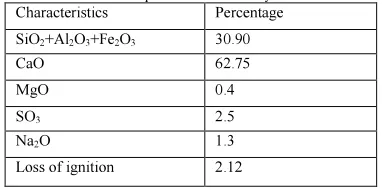
[image:2.595.311.502.303.398.2]Ordinary Portland Cement (OPC) of 53 grade conform to the Bureau of India standard specifications with specific gravity 3.14. The compressive strength of cement obtained at 28 days is 53MPa. The chemical composition of cement is reported in Table 1.
Table 1 Chemical Composition of Ordinary Portland Cement
Characteristics Percentage
SiO2+Al2O3+Fe2O3 30.90
CaO 62.75
MgO 0.4
SO3 2.5
Na2O 1.3
Loss of ignition 2.12
2.2 Natural Coarse Aggregate
The natural coarse aggregate, obtained from the locally available quarries with size in between 10mm to 12mm satisfy the grading requirements of BIS. The specific gravity of 2.67 and fineness modulus 5.51 was used.
2.3 Natural Fine Aggregate
The natural fine an aggregate, obtained from the local river is passed through 4.75 IS sieve. Fine aggregates shall be such that not more than 5 percent shall exceed 5mm in size, not more than 10% shall pass IS sieve No.150, not less than 45% or more than 85% shall pass IS sieve No.1.18mm and not less than 25% or more than 60% shall pass IS sieve No.600 micron. Properties of natural fine and coarse aggregates were arrived and listed in Table 2.
Table 2 Properties of fine and coarse aggregates
Property Fine aggregate Coarse aggregate
Specific gravity 2.62 2.67
Fineness modulus
2.80 5.51
Bulk Density
2.4 Fly Ash
Fly ash is finely divided residue resulting from the combustion of powdered coal and transported by the flue gases and collected by electric precipitator. Fly ash is the most widely used pozzolanic material all over world. ASTM broadly classifies fly ash into two classes, that are, Class F and Class C. In this study Class F fly ash is used.
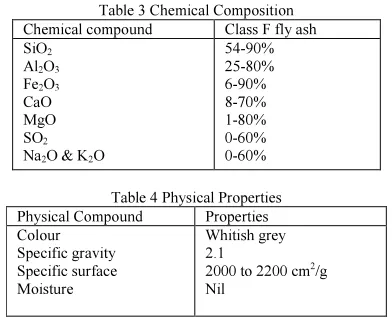
[image:3.595.91.287.317.476.2]The fly ash meets the general requirements of ASTM Class F fly ash that has relatively high CaO content of 8.70% and alkali content (Na2O equivalent) of 0.60% and the specific gravity is 2.1. The chemical composition and physical composition of fly ash used in this study is given in Table 3 and 4.
Table 3 Chemical Composition
Chemical compound Class F fly ash
SiO2
Al2O3
Fe2O3
CaO MgO SO2
Na2O & K2O
54-90% 25-80% 6-90% 8-70% 1-80% 0-60% 0-60%
Table 4 Physical Properties
Physical Compound Properties
Colour Specific gravity Specific surface Moisture
Whitish grey 2.1
2000 to 2200 cm2/g
Nil
2.5 Chemical Admixtures
Chemical admixture is a substance which imparts very high workability with a large decrease in water content (at least 20%) for a given workability. A high range water reducing admixture is also referred as superplasticizer. Each type of superplasticizer has defined ranges for required quantities of concrete mix ingredients, along with corresponding effects. Dosages needed vary by the particular concrete mix and type of super plasticizer used.
A water-reducing admixture, constitute of a Poly Carboxylic Ether (PCE). It is free of chloride and low alkali. In this study Glenium B233is used as super plasticizer for producing SCC. The property of Glenium B233 used in this study is given in Table 5.
Table 5 Properties of Glenium B233 Physical and
Chemical Compound
Properties
Aspect Light brown liquid
Relative density PH
Chloride ion content Solid content Optimum dosage
1.09±0.01 at 25 ̊ C ≥6
<0.2 %
Not less than 30 % by weight
0.5 – 1.5% by weight of cementitious materials
2.6 Viscosity Modifying Agent
The sequence of addition of superplastizer and VMA into concrete mix is very important. If VMA is added before the super plastizer, it swells in water and becomes difficult to flow concrete. To avoid this problem VMA should be added after the super plastizer has come into contact with the cement particles.
[image:3.595.318.492.395.458.2]In this study Glenium Stream 2 admixture was used and it enhanced viscosity, exhibits superior stability and controlled bleeding characteristics, thus increasing resistance to segregation and facilitating placement. The property of Glenium Stream 2 used in this study is given in Table 6.
Table 6 Properties of Glenium Stream 2 Physical and Chemical
Compound
Properties
Aspect Chloride content Optimum dosage
colourless free flowing liquid
<0 .2 % 0.1%
2.7 Recycled Coarse Aggregate
The recycled coarse aggregates were obtained from the demolished building of 10 years old. It was not exposed to any chemicals. The large pieces of slab [free from impurities] are transported to the laboratory and broken into pieces smaller than 20mm and sieved through 12mm. The pieces greater than 20mm are crushed through a crusher to the maximum of 12mm sieve and then both the materials are mixed and sieved again.The property of the recycled coarse aggregate is shown in Table 7.
The density and absorption, the most important properties of recycled aggregates are directly related to the quantity of adhered mortar. The procedure adopted for the production of recycled aggregates in the present study may not truly represent the field conditions. But by adopting the combinations of both manual as well as crusher, the quantity of adhered mortar can be minimized upto certain extent. Therefore this process will improve the quality of recycled aggregates.
Property Recycled coarse aggregate
Specific gravity 2.58
Fineness modulus 6.86
Bulk Density (Kg/m3) 2460
2.8 Mix Proportion
The term Coarse aggregate Replacement Ratio (CRR) is defined as the ratio of weight of recycled
coarse aggregate to the total weight of coarse aggregate used in the mix. In this study, four concrete mixes namely MCRR 0.0, MCRR 0.10, MCRR 0.20, and MCRR 0.30 were used.
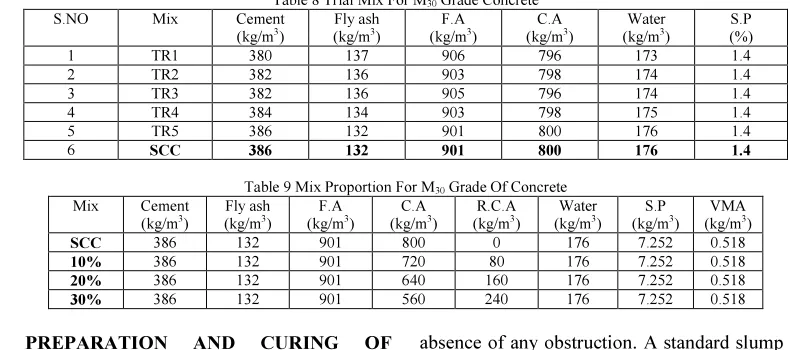
The trial mix details used for M30 grade self
[image:4.595.95.490.255.430.2]compacting concrete with replacement of coarse aggregate by recycled aggregateis shown in Table 8. Mix proportion used for the specimen preparation is shown in Table 9.
Table 8 Trial Mix For M30 Grade Concrete
S.NO Mix Cement
(kg/m3)
Fly ash (kg/m3)
F.A (kg/m3)
C.A (kg/m3)
Water (kg/m3)
S.P (%)
1 TR1 380 137 906 796 173 1.4
2 TR2 382 136 903 798 174 1.4
3 TR3 382 136 905 796 174 1.4
4 TR4 384 134 903 798 175 1.4
5 TR5 386 132 901 800 176 1.4
6 SCC 386 132 901 800 176 1.4
Table 9 Mix Proportion For M30 Grade Of Concrete
Mix Cement
(kg/m3)
Fly ash (kg/m3)
F.A (kg/m3)
C.A (kg/m3)
R.C.A (kg/m3)
Water (kg/m3)
S.P (kg/m3)
VMA (kg/m3)
SCC 386 132 901 800 0 176 7.252 0.518
10% 386 132 901 720 80 176 7.252 0.518
20% 386 132 901 640 160 176 7.252 0.518
30% 386 132 901 560 240 176 7.252 0.518
3. PREPARATION AND CURING OF
SPECIMENS
All the concrete mixtures were mixed for 5mins in a laboratory mixer. Before casting, a variety of tests were conducted on the concrete mixtures to determine their properties at it fresh state including the slump flow, flow time, segregation resistance and wet density. For each concrete mixture, 9 numbers of 150mm cubes were cast for the determination of compressive strength, 9 numbers of 150 ɸ x300mm cylinder were cast for the determination of split tensile strength. Furthermore, 3 numbers of 150mm x 150mm x 700mm prisms were cast for measuring the flexural strength. After casting, all the specimens were covered with plastic sheets in the laboratory at 27 ̊ C until the time of testing.
3.1 Testing Methods
In this experiment, the following test methods are used to characterize the workability properties of self compacting concrete for the final acceptance of the self compacted concrete mix proportions: slump-flow test for flow ability, L-box test and J-ring test for testing passing ability.
The slump flow test was used to evaluate the free deformability and flow ability of the SCC in the
absence of any obstruction. A standard slump cone was used for the test and the concrete was poured in the cone without compaction. The slump flow value is represented by the mean diameter (measured in two perpendicular directions) of concrete testing by using the standard slump cone.
The L-box test was performed; this test has been used to access the flow ability of concrete. During the test, SCC was allowed to flow upon the release of a trap door from the vertical section to the horizontal section via few reinforcement bars of an L shape box. The height of the concrete at the end of the horizontal section was compared to the height of concrete remaining in the vertical section.
The properties of concrete for each mix on various sizes of specimen are conducted at different ages of curing according to the procedures given in Indian Standard Code of practices and ASTM. The details of property, age at test, size of specimens along with test methods are presented in table 10.
4. ANALYSIS OF TEST RESULTS AND DISCUSSION
4.1 For Fresh Concrete
the basic requirements of high flowability and segregation resistance, as specified by guidelines on self compacting concrete by EFNARC, are
satisfied. The workability values are maintained by adding suitable quantities of superplasticizers.
Table 10 Properties of Fresh Self Compacting Concrete
Mix Slump
flow(mm)
EFNARC Guideline
L-box EFNARC
Guideline
J-Ring (secs)
EFNARC Guideline
Min. Max. Min. Max. Min (secs) Max (secs)
SCC 695 650 800 0.89 0.80 1.0 9.8 8 12
RA 10 % 660 650 800 0.84 0.80 1.0 10.5 8 12
RA 20% 640 650 800 0.82 0.80 1.0 10.3 8 12
RA 30% 630 650 800 0.81 0.80 1.0 10.7 8 12
For Hardened Concrete
5. COMPRESSIVE STRENGTH TESTING
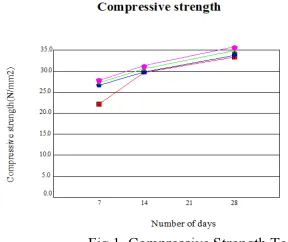
[image:5.595.285.498.173.380.2]A comparative study on properties of a recycled coarse aggregate in self compacting concrete for M30 grade of concrete is studied. Tests of compressive strength, after 7, 14 and 28 days yielded the results are shown in fig (1). All three mixtures quickly gain strength, and after 7 days they achieve more than 90% of the strength they have at the age of 28 days. Compressive strength of recycled coarse aggregate self compacting concrete value is greater than conventional self compacting concrete.
Fig.1. Compressive Strength Test
5.1 Split tensile strength
In this investigation, the Split tensile strength test of self compacting concrete is carried out with 10%, 20%, 30% replacement of recycled aggregate with coarse aggregate for M30 grade of concrete.
The tests are carried out after 28 days of curing. The results are shown in figure (2). All three mixtures quickly gain strength, and after 7 days they achieve more than 90% of the strength at the age of 28 days. Split tensile strength value is gradually increased to the percentage of recycled coarse aggregate replaced in the concrete.
Fig.2. Split Tensile Strength Test
5.2 Flexural strength
[image:5.595.93.237.435.556.2]In this investigation, the flexural strength test of self compacting concrete is carried out with 10%, 20%, 30% replacement of recycled aggregate with coarse aggregate. The tests are carried after 28 days of curing. The results are shown in figure (3). Flexural strength of recycled coarse aggregate self compacting concrete is greater than the conventional self compacting concrete.
Fig.3. Flexural Strength Test
6. ANALYSIS OF TEST RESULT AND DISCUSSION
[image:5.595.306.502.516.645.2]compacting concrete. The tests are carried at 7, 14 & 28 days. It is found that the compressive strength
[image:6.595.111.484.170.221.2]at 28 days has increased upto 7.44% with 30% of recycled aggregate.
Table 11 Percentage Increase In Compressive Strength Of Recycled Coarse Aggregate Scc
Mix % of RCA % Increase in Compressive Strength
7 days 14 days 28 days
SCC 1 10 20.41 0.13 1.83
SCC 2 20 23.35 2.72 4.65
SCC 3 30 26.60 5.20 7.44
In this investigation, the split tensile strength test values are greater than the ordinary self compacting concrete. It is found that the split tensile strength at 28 days has increased upto 18.48% with 30% of
[image:6.595.98.491.291.345.2]recycled aggregate. Percentage increases in split tensile strength of recycled coarse aggregate self compacting concrete is shown in table 12.
Table 12 Percentage Increase In Split Tensile Strength Of Recycled Coarse Aggregate Scc
Mix % of RCA % Increase in Split Tensile Strength
7 days 14 days 28 days
SCC 1 10 2.9 2.22 4.54
SCC 2 20 27.53 37.77 8.33
SCC 3 30 55.07 43.33 18.48
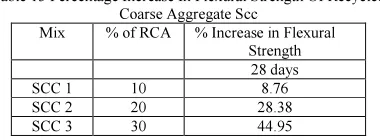
It is observed from the results that the flexural strength increased upto 44.95% with 30% of recycled aggregate tabulated in table 13.
Table 13 Percentage Increase In Flexural Strength Of Recycled Coarse Aggregate Scc
Mix % of RCA % Increase in Flexural
Strength 28 days
SCC 1 10 8.76
SCC 2 20 28.38
SCC 3 30 44.95
CONCLUSION
Studies on different properties of recycled aggregate concrete are carried out in this paper. Based on the results obtained and interpertation the following conclusion are drawn from the study:
The recycled coarse aggregates have relatively fine particles than natural coarse aggregates due to the crushing of old concrete. The surface texture of recycled coarse aggregate is more porous and rough due to the adherence of old porous mortar. This may increase the water demand and reduce the workability.
The details of the various mixes of both normal and recycled aggregate concrete along with the obtained properties of fresh concrete are satisfy the self compacting concrete properties.
The compressive strength at 28days has increased 7.44% increase with 30% replacement of recycled aggregates.
The split tensile strength at 28days has increased 18.48% increase with 30% replacement of recycled aggregates.
The flexural strength at 28days has increased 44.95% increase with 30% replacement of recycled aggregates.
Density of RCA is less than of concrete with natural aggregates. This is an advantage in the design of structures where the light weight concrete is performed.
Overall strength gain rate for recycled aggregate concrete is better than concrete with natural aggregates.
REFERENCES
[1] European Federation for Specialist Construction Chemical and Concrete System (EFNARC).
Specification and guidelines for self compacting
concrete: 2002:32.
[2] Okamura H, Ouchi M. Self compacting concrete. J Advanced Concrete Technology 2003:1(1):5-15.
[3] Poon CS, Kou SC, Lam L. Use of recycled aggregates in moulded concrete bricks and blocks, Constr Build Master 2002:16:281-9. [4] Eguchi K, Teranishi K, Nakagome A,
Kishimoto H, Shinozaki K, Narikawa M. Application of recycled coarse aggregate by mixture to concrete construction. Constr Build Master 2007:21:1542-51.
[5] Evangelista L, de Brito J. Mechanical behaviour of concrete made with fine recycled concrete aggregates. Cement Construction Composite
[image:6.595.95.285.401.471.2][6] Hansen TC, Boegh E (1985) Elasticity and drying shrinkage of recycled aggregate concrete. J ACI 82(5):648-652.
[7] Hansen TC, Narud H (1983) Strength of recycled concrete made from crushed concrete coarse aggregate. Concr Int Des Constr 5(1):79-83.
[8] Padmini AK, Ramamurthy K, Mathews MS (2009). Influence of parent cement concrete on the properties of recycled aggregate. Concrete Construction Build Master 23(2):829-836. [9] Bureau of Indian Standard (1970). Indian
standard specification for coarse and fine aggregates from natural sources for concrete. IS: 383 New Delhi.
[10] M.Chakradhara Rao, S.K. Bhattacharyya, S.V. Barai (2011). Influence of field recycled coarse aggregate on properties of concrete. Materials and structures (44) : 205-220.
[11] H Okamura and M Ouchi. ‘Self Compacting Concrete’. Journal of Advanced Concrete Technology, Japan Concrete Institute, vol 1, 2003.
[12] S Subramanian and Chattopadhyay. “Experiments for Mix Proportioning of Self Compacting Concrete”. Indian Concrete Journal, January 2002, pp 13 – 20.
[13] Lin YH, Tyan YY, Chang TP, Chang CY. An assessment of optimal mixture for concrete made with recycled concrete aggregates. Cem Concr Res 2004:34:1373 – 80.
[14] D Das, V K Gupta and S K Kaushik. “Effect of Maximum Size and Volume of Coarse Aggregate on the Properties of SCC”. The Indian Concrete Journal, vol 80, no 3, March 2006, pp 53 – 56.
[15] Poon CS, Qiao XC, Chan D. The cause and influence of Self Compacting properties of fine recycled concrete aggregates on the properties of unbound sub – base. Waste Manage
2006:26:1166 - 72.
[16] Etxeberria M, Vazquez EA, Barra M. Influence of amount of recycled coarse aggregate and production process on properties of recycled aggregate concrete. Cem Concr Res
2007:37:735 – 42.
[17] Bairagi NK, Vidyadhara HS, Ravande K. Mix design procedure for recycled aggregate concrete. Constr Build Mater 1990:4(4):188 – 93.
[18] Khatib JM. Properties of concrete incorporating fine recycled aggregate. Cem Concr Res 2005:35:763 – 9.
[19] Cassucio M, Torrijios M, Giaccio G, Zerbino R. Failure mechanism of recycled aggregate concrete. Construct Build Mater 2009:1163 - 7. [20] Dr.P.Srinivasa Rao and P.Sravan (2005)
“Relationship between Splitting Tensile and Compressive Strength of Concrete”,
Construction Review Journal June, 39 – 44.