INTRODUCTION
The precise regulation of cell-cell communication through signalling pathways is essential for both embryogenesis and organogenesis. One significant pathway is the evolutionarily conserved Wnt signalling pathway (Janssen et al., 2010), which coordinates crucial cellular processes such as proliferation, polarity, migration, and the determination of cell fate (Habas and Dawid, 2005; Logan and Nusse, 2004; Widelitz, 2005).
The canonical or b-catenin-dependent Wnt pathway is initiated by the binding of the Wnt ligand to transmembrane receptors encoded by the Frizzled gene family. This action causes b-catenin to be stabilised in the cytoplasm and translocated into the nucleus where it activates the transcription of target genes (Bhanot et al., 1996; Cadigan and Nusse, 1997; Chen and Struhl, 1999; Hsieh et al., 1999; Rulifson et al., 2000; Wu et al., 2004; Yang-Snyder et al., 1996). Proteins of the low-density-lipoprotein (LDL) receptor-related (LRP) class act as Wnt co-receptors; in insects, they are represented by the DrosophilaLDL-receptor Arrow (Wehrli et al., 2000) and in vertebrates by LRP5 and LRP6 (Pinson et al., 2000; Tamai et al., 2000).
Vertebrate and arthropod embryos rapidly elongate their body axes during early embryogenesis by adding body segments during a post-blastodermal growth phase. The central tissue controlling axial elongation (AE) is a proliferative zone at the posterior of the
embryo known as the growth zone or, more generally, as the segment addition zone (Janssen et al., 2010). In arthropods, this part of the embryo is defined as the region immediately posterior to the last generated segment, the presegmental region (PSR) and the paddle-shaped posterior growth zone (Martin and Kimelman, 2009; Schröder et al., 2008). In vertebrates, the presomitic mesoderm (PSM) sheds blocks of mesodermal tissue, the somites, under the control of graded fibroblast growth factor (FGF) and Wnt signalling pathways (Aulehla et al., 2008; Dequéant and Pourquié, 2008). In arthropods, key molecules, such as caudal and torso/torsolike, as well as the Wnt ligand Wnt8 and other Wnt pathway members (armadillo/b-catenin, pangolin/TCF and arrow/LRP5/6) are required for setting up the growth zone and maintaining axis elongation (Bolognesi et al., 2008b; Bolognesi et al., 2009; Copf et al., 2004; McGregor et al., 2008; Miyawaki et al., 2004). Body axis elongation cannot be studied in Drosophila because all segments form almost simultaneously (long germ embryogenesis). Recent functional studies have demonstrated the involvement of Tribolium arrowand Tc-Wnt 8/Din axis formation (Bolognesi et al., 2008b; Bolognesi et al., 2009). Because only strong arrowRNAiphenotypes have been analysed, the complex role of the Wnt co-receptor has only been partially resolved. How Triboliumgenerates cellular complexity at the Wnt receptor level is not known.
In this paper, we investigated the role of Wnt receptor genes ( Tc-fz1, Tc-fz2 and Tc-fz4) and the co-receptor gene (Tc-arrow) in different processes of Tribolium embryogenesis. We first characterised Wnt-receptive sites in the Tribolium embryo by analysing the expression patterns of the Wnt receptors. We found that, as in Drosophila(Kennerdell and Carthew, 1998), the Wnt receptors Tc-Fz1 and Tc-Fz2 function redundantly. In Tribolium, they are necessary for the maintenance of a functional growth zone. Development 138, 2793-2805 (2011) doi:10.1242/dev.063644
© 2011. Published by The Company of Biologists Ltd
1Universität Rostock, Institut für Biowissenschaften/Abt. Genetik, D-18059 Rostock,
Germany. 2Interfakultäres Institut für Zellbiologie, Abt. Genetik der Tiere, Auf der
Morgenstelle 28, D-72076 Tübingen, Germany.
*Authors for correspondence ([email protected]; [email protected])
Accepted 6 April 2011 SUMMARY
Short germ embryos elongate their primary body axis by consecutively adding segments from a posteriorly located growth zone. Wnt signalling is required for axis elongation in short germ arthropods, including Tribolium castaneum, but the precise functions of the different Wnt receptors involved in this process are unclear. We analysed the individual and combinatorial functions of the three Wnt receptors, Frizzled-1 (Tc-Fz1), Frizzled-2 (Tc-Fz2) and Frizzled-4 (Tc-Fz4), and their co-receptor Arrow (Tc-Arr) in the beetle Tribolium. Knockdown of gene function and expression analyses revealed that Frizzled-dependent Wnt signalling occurs anteriorly in the growth zone in the presegmental region (PSR). We show that simultaneous functional knockdown of the Wnt receptors Tc-fz1and Tc-fz2via RNAi resulted in collapse of the growth zone and impairment of embryonic axis elongation. Although posterior cells of the growth zone were not completely abolished, Wnt signalling within the PSR controls axial elongation at the level of pair-rule patterning, Wnt5 signalling and FGF signalling. These results identify the PSR in Triboliumas an integral tissue required for the axial elongation process, reminiscent of the presomitic mesoderm in vertebrates. Knockdown of Tc-fz1alone interfered with the formation of the proximo-distal and the dorso-ventral axes during leg development, whereas no effect was observed with single Tc-fz2or Tc-fz4RNAi knockdowns. We identify Tc-Arras an obligatory Wnt co-receptor for axis elongation, leg distalisation and segmentation. We discuss how Wnt signalling is regulated at the receptor and co-receptor levels in a dose-dependent fashion.
KEY WORDS: Wnt signalling, Frizzled receptors, Axis elongation, Short germ embryogenesis, Tribolium
A context-dependent combination of Wnt receptors controls
axis elongation and leg development in a short germ insect
Anke Beermann1,2,*, Romy Prühs1, Rebekka Lutz1,2and Reinhard Schröder1,*
D
E
V
E
LO
P
M
E
N
In Tc-fz-1/2RNAiembryos, axis elongation stops prematurely. In the collapsed growth zone of Tc-fz-1/2RNAiembryos, posterior cells are still present, but the transition from pair-rule to the segmental function of Even-skipped is impaired. Tc-frizzled 1plays a Tc-frizzled 2-independent role in leg formation, whereas Tc-frizzled 4 supports Tc-fz1in leg development and additionally functions in gut development. We identify Tc-Arrow as the obligatory Wnt co-receptor for Wnt-dependent processes, complementing previous studies (Bolognesi et al., 2009). Finally, we discuss the dosage dependency of Wnt receptor-co-receptor interactions in body and leg axis development.
MATERIALS AND METHODS
Gene identification
LRP, frizzled and arrow gene homologues in the Tribolium genome (http://beetlebase.org) (Kim et al., 2010) were identified using BLAST with the Drosophilaprotein sequences. Sequence analysis, sequence alignment and PCR primer design were performed using the programs Edit Seq, MegAlign and Primer Select from the Lasergene DNASTAR package. The phylogenetic relationship of the protein sequences was based on a Clustal-W alignment and analysed with TREE-PUZZLE (Strimmer and von Haeseler, 1996). The trees in Fig. 1 were visualised with TreeView (Page, 1996) and Dendroscope (Huson et al., 2007).
The following amino acid sequences were used for the alignment in Fig. 1 [protein (species) Accession Number (amino acid positions)].
Frizzled-1/7
DmFz1 (Drosophila melanogaster) CAA38458 (1>581); AgFz1 (Anopheles gambiae) XP_317942 (1>181); TcFz1 (Tribolium castaneum) NP_001164247/TC014055 (1>549); NasFz7 (Nasonia vitripennis) XP_001605802 (1>580); DrFz7a (Danio rerio) AAH68322 (1>559); DrFz7b (Danio rerio) NP_739569 (1>557); MmFz7 (Mus musculus) AAH49781 (1>750); XenFz7 (Xenopus laevis) AAF63152 (1>549).
Frizzled-2/5/8
DmFz2 (Drosophila melanogaster) AAC47273 (1>694); TcFz2 (Tribolium castaneum) EFA01325/TC003407 (1>605); DrFz5 (Danio rerio) NP_571209 (1>592); DrFz8 (Danio rerio) NP_570993 (1>579); MmFz5 (Mus musculus) NP_073558 (1>585); MmFz8 (Mus musculus) NP_032084 (1>685); AgFz2 (Anopheles gambiae) XP_311505 (1>687). Frizzled-3
DmFz3 (Drosophila melanogaster) ABW09320 (1>646); NasFz3 (Nasonia vitripennis) XP_001600300 (1>573); AgFz3 (Anopheles gambiae) XP_310970 (1>487).
Frizzled-4
TcFz4 (Tribolium castaneum) EFA09255/TC006527 (1>527); DmFz4 (Drosophila melanogaster) NP_511068 (1>705); AgFz4 (Anopheles gambiae) XP_319612 (1>580); MmFz4 (Mus musculus) NP_032081 (1>537).
Frizzled 9/10
DrFz10 (Danio rerio) AAH76546 (1>580); MmFz9 (Mus musculus) AAB87503 (1>549); MmFz10 (Mus musculus) NP_780493 (1>582). Arrow/LRP5/LRP6
TcArr (Tribolium castaneum) XP_975483/ TC008151 (1>1580); DmArr (Drosophila melanogaster) NP_524737 (1>1678); AgArr (Anopheles gambiae) XP_320740 (1>1619); NasArr (Nasonia vitripennis) XP_001603043 (1>1634); DrLRP5 (Danio rerio) XP_696943 (1>1593); DrLRP6 (Danio rerio) NP_001128156 (1>1620); MmLRP5 (Mus musculus) NP_032539 (1>1614); MmLRP6 (Mus musculus) NP_032540 (1>1613).
LRP4
TcLRP4 (Tribolium castaneum) XP_001814959/ TC007146 (1>2041); DmLRP4 (Drosophila melanogaster) NP_727914 (1>2009); AgLRP4 (Anopheles gambiae) XP_311125 (1>1740); NasLRP4
(Nasonia vitripennis) XP_001605666 (1>2084); DrLRP4 (Danio rerio) XP_697930 (1>1243); MmLRP4 (Mus musculus) EDL27564 (1>1911).
The following gene fragments were cloned and used for in situ hybridisation and dsRNA production: Tc-fz1 (accession number: NM_001170776), an 881-bp fragment corresponding to position 127-1007;
Tc-fz2 (XM_963025/867-bp fragment, position 81-947); Tc-fz4
(XM_962510, 534 bp, position 822-1355), Tc-arrow(XM 970390, 694 bp, position 1712-2413). These fragments show no sequence identity of longer than 19 consecutive nucleotides within the predicted coding region of the
Triboliumgenome that could serve as off-targets in RNA interference. In the case of Tc-fz1, a 21-bp identity exists with a non-coding genomic region. Cross-reactivity of fz1and fz2was not expected because the two genes contain only short sequences of identity (12 bp). This prediction was borne out by the non-overlapping results obtained in the respective single RNAi experiments.
Molecular biology
cDNA was synthesised from total RNA (RNeasy/Qiagen) using random hexamer primers from the Transcriptor First Strand cDNA Synthesis Kit (Roche). PCR fragments were subcloned into the pCR4 vector of the TOPO-TA Cloning Kit (Invitrogen) and sequenced by AGOWA (Berlin). Double-stranded RNA for RNA interference was produced with the MEGAscript in vitro transcription kit (Ambion) and injected into pupae or adults (parental RNAi) at several different concentrations in multiple independent experiments (see Table S1B1-6 in the supplementary material) under standard conditions (Bucher et al., 2002; Schröder et al., 2008).
The parental application of dsRNA results in the knockdown of both the maternal and zygotic transcripts; the effect is most strongly seen in the first egglays from the treated females and diminishes with successive egglays. In this way, a variety of phenotypes (‘phenotypic series’) were achieved, and weaker phenotypes were explained by a lower dose of dsRNA in the respective embryo. The absence of the Tc-fz2-RNA transcript has been confirmed by in situ hybridisation in Tc-fz1/2RNAiembryos (see Fig. S3 in the supplementary material).
All other molecular techniques were performed according to the instructions of the suppliers or following standard protocols (Sambrook et al., 1989).
Analysis of embryos and larvae
Fixation of embryos and cuticle preparations of first instar larvae were performed as previously described (Patel, 1994; Van der Meer, 1977). In situ hybridisation to RNA transcripts was performed as published (Tautz and Pfeifle, 1989). Embryos were embedded in 100% glycerol and photographed on an Axiophot Zeiss microscope. Immunolocalisation studies of the Even-skipped and Engrailed proteins were performed as previously described (Patel et al., 1994) using the respective monoclonal antibodies at a dilution of 1:100 obtained from the Developmental Studies Hybridoma Bank.
Animal husbandry
Wild-type beetles of the San Bernardino strain were reared on whole-wheat flour in a 30°C incubator; the collection of eggs and pupae was performed as previously described (Beermann et al., 2004).
RESULTS
Conservation of Wnt signal perception in Tribolium
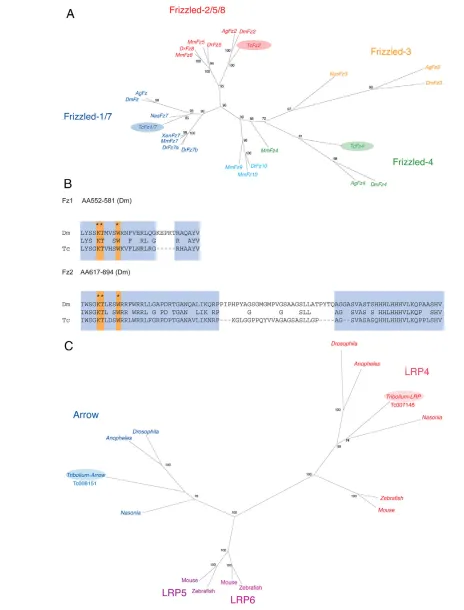
Three frizzled genes and one arrow orthologue coding for Wnt receptors and a Wnt co-receptor, respectively, are present in the Triboliumgenome (Fig. 1). Our phylogenetic analysis grouped the Tc-Frizzled proteins together with other insect and vertebrate Frizzled proteins into three subfamilies (Fig. 1A). Tc-Frizzled-1, the orthologue of DrosophilaFrizzled, clusters with other arthropod Frizzled-1 proteins and vertebrate Frizzled-7 proteins within the Frizzled-1/7 subfamily. The insect Frizzled-2 proteins and the vertebrate Frizzled-5 and Frizzled-8 proteins constitute the Frizzled-
D
E
Fig. 1. Three Frizzled and two Arrow/LRP proteins are encoded in the Triboliumgenome. (A)Phylogenetic analysis places the Tc-Frizzled protein-sequences within three Frizzled classes: 1/7, 2/5/8 and 3/4/9/10. No Triboliumrepresentative of the frizzled-3 gene family was found. (B)Sequence alignment of the C-terminus of the Drosophilaand TriboliumFrizzled-1 and Frizzled-2 proteins. Both TriboliumFz proteins share the specific binding sites for the protein Dishevelled (Wu and Mlodzik, 2008). Blue indicates conserved regions. Orange and asterisks indicate conserved binding sites. Dm, Drosophila melanogaster; Tc, Tribolium castaneum. (C)Phylogenetic analysis of the TriboliumArrow and LRP proteins.
D
E
V
E
LO
P
M
E
N
2/5/8 subfamily. Frizzled-4 together with dipteran and vertebrate Frizzled-4 orthologues and the vertebrate Frizzled-10 proteins represent the third group. The significant amino acids necessary for binding Dishevelled (Umbhauer et al., 2000; Wu and Mlodzik, 2008) are conserved in the Frizzled C-terminal regions (Fig. 1B), reinforcing the classification of the TriboliumFrizzled proteins.
A single TriboliumWnt co-receptor of the
Arrow/LRP class
Within the Tribolium genome, the single orthologue of the Drosophila Wnt co-receptor Arrow is encoded by Tc-arrow (Tc008151). Another gene coding for a protein with the low-density-lipid (LDL) receptor related protein (LRP) motif was identified as the TriboliumLRP4 protein (Tc007146; Fig. 1C).
However, only Tc-Arrow contains the multiple phosphorylation sites for Axin and Gsk3bin its cytoplasmic part, suggesting that Tc-Arrow has a similar functional role as DrosophilaArrow in Wnt signalling (see Fig. S4 in the supplementary material).
Tc-frizzled-2and Tc-frizzled-4, but not Tc-frizzled-1 or Tc-arrow, show distinct temporal and spatial expression patterns
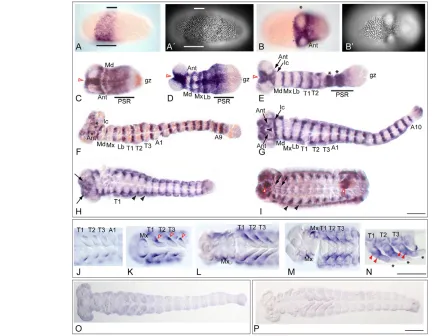
[image:4.612.56.489.224.560.2]Tc-fz-2 expression started at the early blastoderm stage at which point it covered the prospective head region for 53-82% of the egg length (100%=anterior pole). Dorsally, the head-specific domain was narrower than at the ventral side (Fig. 2A,A⬘, bars). When the germ rudiment became visible, a thin line of Tc-fz2-expressing cells marked the dorsal border between the extra-embryonic tissue and
Fig. 2. Tc-frizzled2and Tc-frizzled4show a distinct expression pattern throughout embryonic development whereas Tc-frizzled1and
Tc-arroware ubiquitously expressed.Tc-fz2(A-I), Tc-fz4(J-N), Tc-fz1(O), Tc-arrow(P) in situ hybridisation orTc-fz2and Tc-wgdouble in situ hybridisation (C,F,I) during Triboliumdevelopment. (A,A⬘) Blastoderm formation. Tc-fz2is expressed in the prospective head region (bars). A⬘shows DAPI staining. (B,B⬘) In the germ anlage, Tc-fz2is expressed around the head lobes (asterisk). B⬘shows DAPI staining. (C-E)Segmental stripes form, but in contrast to Tc-wg(red in C), the posterior growth zone (gz) stays free of Tc-fz2expression (blue) at all stages. Tc-fz2covers the presegmental region (PSR, bar), fading towards the posterior (C-E) (Schröder et al., 2008). Anteriorly, Tc-fz2is seen in the prospective clypeolabrum and
stomodeum (open arrowheads). The intercalary segment (Ic, E) appears as well as two broad stripes in the PSR (bar), possibly the future T3 and A1 segments (asterisks). (F)Within the segments, Tc-fz2(blue) is expressed at the segmental border posterior to Tc-wg(red). The labrum is free of Tc-fz2expression. Asterisks indicate antennal segments. (G)Segmental expression of Tc-fz2in the fully elongated embryo. Arrowhead indicates the stomodeum. (H)Germband retraction. Segmental Tc-fz2expression declines, Tc-fz2expression appears in the visceral mesoderm, around the tracheal openings (arrowheads in H,I) and in the brain (arrows). (I)Fully retracted germband. Tc-fz2expression (blue) in the foregut and the hindgut (open arrowheads), in the CNS (arrows) and laterally in the visceral mesoderm (black arrowheads). Tc-fz2is at no time expressed in the legs, in contrast to Tc-wg (red). (J-N)Tc-fz4expression in a proximo-dorsal position during appendage elongation (open red arrowheads in K). Late in embryogenesis (N) Tc-fz4expression extends and marks the putative border of the trochanter (red arrowheads in N). No Tc-fz4expression (black asterisks) is observed in the distal tip. (O,P)Tc-fz1(O) andTc-arrow (P) are ubiquitously expressed (representative stages shown). All views ventral, except A,A’ (lateral) and C,D (dorsal). A1-A10, abdominal segments 1-10; Ant, antennae; gz, growth zone; Lb, labial segment; Ic, intercalary
segment; Md, mandibular segment; Mx, maxillar segment; PSR, presegmental region; T1-T3, thoracic segments 1-3. Scale bars: 100m.
D
E
V
E
LO
P
M
E
N
the embryonic anlage (see Fig. S1 in the supplementary material). By the onset of gastrulation, Tc-fz2 was strongly expressed around the procephalic lobes but excluded from the posterior egg pole (Fig. 2B,B⬘). Once the embryo started to segment, Tc-fz2 transcripts were strongly expressed in the prospective labrum and in the antennal and mandibular segments (Fig. 2C). Posterior to the mandibular stripe and anterior to the posterior growth zone, a broad Tc-fz2 expression domain that faded out towards the posterior covered the presegmental region (PSR). This central Tc-fz2 domain did not overlap with Tc-wingless(Tc-wg) expression at the posterior end of the embryo (Fig. 2C). During AE, the emerging stripe pattern became evident (Fig. 2C-E). Tc-fz2 expression persisted in one (Fig. 2C,D), and later two, broad stripes (Fig. 2E,F) in the PSR until the embryo was fully elongated (Fig. 2F,G). The segmental Tc-fz2stripes were out of register with the Tc-wgstripes (Fig. 2F). In the fully extended germband, Tc-fz2 was expressed in the posterior part of each body segment, mapped by the relative position of Tc-wg(Fig. 2F). In the head, Tc-fz2expression was detected in the clypeolabral region, a region surrounding the stomodeum, and in the antennal and intercalary segments (Fig. 2G). By the time of germband shortening, the segmental pattern of Tc-fz2 expression declined in the epidermis and increased in the visceral mesoderm and the gut anlagen (Fig. 2H,I). In the hindgut, Tc-wg was co-expressed with Tc-fz2, indicating a possible interaction (Fig. 2I).No Tc-fz2expression was observed in the larval legs, the growth zone proper or the most posterior cells (Fig. 2C-E,I).
Tc-fz4 was expressed in a dorso-proximal position in elongating legs in the coxa-trochanter region (Fig. 2J). As the legs continued to grow, this expression domain intensified, spread laterally and extended more distally without reaching the
distal tip (Fig. 2K-M). When the legs had reached their full length, Tc-fz4expression was circumferential in the proximal leg region, encompassing most of the coxal region, the future trochanter and part of the tibiotarsus. Within this expression domain, Tc-fz4expression was modulated: transcripts were more abundant at the sites where the joints of the trochanter will form (Fig. 2N). The head appendages also expressed Tc-fz4in dorso-proximal positions (Fig. 2K-M). In all appendages, the distal tip lacked Tc-fz4expression throughout embryogenesis. By contrast, Tc-fz1 and Tc-arrow were ubiquitously expressed throughout embryogenesis (Fig. 2O,P).
The combined function of Tc-frizzled1and
[image:5.612.54.508.424.636.2]Tc-frizzled2is essential for body axis elongation To elucidate the functions of the different receptors, we depleted Tc-fz1 and Tc-fz2 by parental RNAi. Single Tc-fz2 RNAi knockdown resulted in viable, wild-type progeny. However, double knockdown of Tc-fz1and Tc-fz2resulted in axis elongation defects ranging from mild to severe (Fig. 3). In weakly affected Tc-fz1/2RNAiindividuals, larval cuticles developed only one to two abdominal segments and a remnant of the hindgut. Abdominal segments three to eight and the posterior urogomphi were missing (Fig. 3B,C). The head and the thorax with their associated appendages developed normally. More strongly affected Tc-fz1/2RNAiindividuals displayed defects that affected the thorax and appendages. Nevertheless, the pregnathal region remained only weakly affected (Fig. 3C-E). The most strongly affected cuticles, which resulted from injections of a high dsRNA concentration, were of a spherical shape (Fig. 3D,E), with only a relic of head and thorax.
Fig. 3. Tc-fz1/2-dependent Wnt signalling is required for posterior growth and segmentation. Autofluorescence cuticle preparations with schematics of the corresponding phenotype below. (A)Wild-type-like cuticle. Head with head appendages, thoracic segments 1-3 (T1-3) each with one pair of legs, and eight abdominal segments (A1-8) with urogomphi at abdominal segment 9 (A9). Autofluorescence of the hindgut cuticle can be observed. (B)Weak Tc-fz 1/2RNAiphenotype. Head and thorax with two abdominal segments marked by tracheal openings (arrowheads). A
rudimentary hindgut (asterisk) is visible. (C)Intermediate Tc-fz 1/2RNAiphenotype. Head, thorax with malformed legs and one abdominal segment.
Tracheal openings (arrowheads) indicate the identity of T2 and A1. (D)Stronger Tc-fz 1/2RNAiphenotype. Two thoracic segments with leg rudiments
(asterisks). On the head only the antennal flagellae are missing. (E,F)Strongest Tc-fz 1/2RNAiphenotypes. Head with malformed gnathal appendages
and T1 (gnarled legs, asterisks). A1-A10, abdominal segments 1-10; Ant, antennae; cl, pretarsal claw; cx, coxa; fe, femur; fl, flagella; hg, hindgut; Lb, labial segment; Md, mandibular segment; Mx, maxillar segment; to, tracheal opening; T1-T3, thoracic segments 1-3; tr, trochanter; tt,
tibiotarsus; ug, urogomphi. Red asterisks indicate affected cuticle structures. Scale bar: 100m.
D
E
V
E
LO
P
M
E
N
Pair-rule gene expression is not completely abolished in Tc-fz1/Tc-fz2RNAiembryos
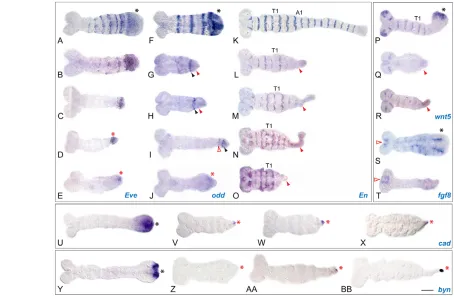
To understand how the Tc-fz1/Tc-fz2RNAi phenotype manifests during embryogenesis, we analysed the expression of marker genes prior to cuticle formation (Fig. 4). The primary pair-rule genes even-skipped and odd-skipped(Choe et al., 2006) are expressed in similar patterns in the posterior growth zone and presegmental region as well as segmental stripes in young wild-type embryos (Fig. 4A,F) (Brown et al., 1997; Choe et al., 2006; Patel et al., 1994).
The phenotypic series of the Tc-fz1/2RNAiknockdown showed an increasing reduction of the growth zone tissue (Fig. 4B-E,G-J). Expression ofTc-Eve protein was ultimately reduced to a few cells at the posterior end, but was not completely abolished (Fig. 4E) as has been described for Tc-torsoRNAiembryos (Schoppmeier and Schröder, 2005) and Tc-arrowRNAi embryos (Bolognesi et al., 2009). Expression of odd-skippedwas reduced to one subterminal stripe (Fig. 4G,H) or was dramatically reduced in intensity but not completely eliminated (Fig. 4J). The segmental marker Engrailed
(Fig. 4K-O) was expressed normally in the remaining head and thoracic segments of older embryos (Fig. 4L-O). The expression of Tc-winglessat the segmental borders of Tc-fz1/2RNAiembryos was weak or absent, but segmental Tc-wgspots indicated the integrity of the remaining individual segments in older embryos (see Fig. S2 in the supplementary material). This finding has also been observed in Tc-arrowRNAiembryos (Bolognesi et al., 2009).
In wild-type embryos (Fig. 4P), Tc-wnt5 was prominently expressed in the posterior growth zone, in segmental stripes during germband elongation and at the tips of appendages. In the head, the transcripts were detected in wedge-shaped domains in the head lobes and in the antennal segment (Fig. 4P). No expression of the ligand Tc-wnt5was seen in Tc-fz1/2RNAiembryos, except for the head-specific domain (Fig. 4Q,R).
[image:6.612.53.507.284.581.2]Residual expression of the Wnt ligand Tc-wnt8in Tc-fz1/2RNAi embryos displaying a strong phenotype (see Fig. S2A-C in the supplementary material) confirmed the presence of the posterior-most cells of the growth zone (see Fig. S2B,C in the supplementary material). In wild-type embryos (see Fig. S2A in the supplementary
Fig. 4. The growth zone collapses in Tc-fz1/2RNAiembryos.Tc-fz1/2RNAiembryos of increasing phenotypic strength analysed for the expression
of marker genes. (A-J)Pair-rule gene product Eve (A-E) and odd-skipped(odd; F-J) expression in wild-type (A, F) and Tc-fz1/2RNAi(B-E,G-J) embryos.
Even in the strongest phenotypes (C-E), a spot of Eve-positive cells is seen at the posterior, or a subterminal stripe of oddexpression develops (red arrowhead in G,H; red asterisk in D,E,J). Both genes show only partial (weak phenotype in B) or no secondary pair-rule pattern. Pair-rule expression is initiated but not transformed into a segmental pattern anterior to the presegmental region (PSR; red asterisk), except for a weak stripe seen in B or I (open arrowhead). (K-O)Expression of the segment polarity gene product Engrailed (En) in wild-type (K) and Tc-fz1/2RNAi(L-O) embryos.
Integrity of segmental borders seems normal anterior to the growth zone rudiment (red arrowhead). Red arrowheads indicate collapsed growth zone. (P-R)Expression of the Wnt ligand Tc-wnt5 in wild-type (P) and Tc-fz1/2RNAi(Q,R) embryos. Stripes in the abdomen and expression domains in
the posterior growth zone are gone (red arrowhead) but head spots and antennal stripes are not affected in the Tc-fz1/2RNAi embryos. (S,T)Fgf
ligand expression in wild-type (S) and Tc-fz1/2RNAi(T) embryos. Tc-fgf8expression at the rims of the future mesoderm and within the segmented
region is abolished but labral-specific domain (arrowhead) is unaffected in Tc-fz1/2RNAi(T) embryos. (U)Tc-caudalexpression at a posterior position
in a wild-type embryo. (V-X)Tc-caudalexpression marks posterior cells in fz1/2RNAiembryos. (Y)Tc-brachyenteron(byn) marks the anlagen of the
hindgut in the wild-type embryo. (Z-BB) Tc-bynexpression is lost in strong fz1/2RNAiembryos (Z) but retained in weaker fz1/2RNAiembryos (AA,BB).
A1, abdominal segment 1; T1, thoracic segment 1. Black asterisks indicate growth zone; red arrowheads indicate collapsed growth zone; red
asterisks indicate affected structures. Scale bar: 100m.
D
E
V
E
LO
P
M
E
N
material), Tc-wnt8 expression is confined to a tiny horseshoe-shaped domain at the very posterior during a short time window extending from early blastoderm to the young embryo with few segments (Bolognesi et al., 2008a).
To test the connection of the Wnt pathway to other signalling pathways possibly involved in setting up segmentation and maintaining the growth zone in Tribolium, we evaluated the expression of Tc-fgf8in Tc-fz1/2-depleted embryos. In vertebrates, Fgf signalling is involved in somitogenesis of the embryo in a graded fashion (Delfini et al., 2005), and in Drosophila it influences the establishment of the germ layers, mesoderm development and cell migration (Klingseisen et al., 2009; McMahon et al., 2010). Although the embryonic FGF signalling sites in Tribolium have been characterised, the functional requirement for individual members of the FGF pathway remains to be shown (Beermann and Schröder, 2008). In young wild-type germ anlage Tc-fgf8is expressed in two small stripes bordering the prospective mesoderm in the growth zone. As the segments formed, transcripts were detected in small segmental blocks on both sides of the midline, potentially the segmental mesoderm, and anteriorly between the head lobes (Fig. 4S). In Tc-fz1/2-depleted embryos, Tc-fgf8expression was completely lost in the posterior region but persisted between the head lobes (Fig. 4T). Thus, posterior and segmental Tc-fgf8expression depends on Tc-fz1/2 -mediated Wnt signalling. This finding provides a connection between the two signalling pathways, placing Wnt signalling upstream of Fgf signalling in segmentation. The existence of posterior cells in Tc-fz1/2RNAi embryos during AE was demonstrated by the expression of the posterior marker gene caudal(Fig. 4V-X), whereas expression of the hindgut marker gene brachyenteron(byn) was seen only in less strongly affected Tc-fz1/2RNAiembryos (Fig. 4AA,BB).
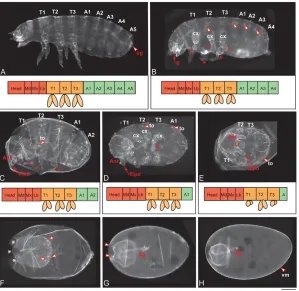
The Wnt co-receptor Tc-Arrow is involved in axis elongation, leg formation and segmentation Knockdown of the Wnt co-receptor Tc-arrowby RNA interference resulted in a spectrum of leg phenotypes ranging from mild to severe (Fig. 5). In addition, embryos with reduced function of Tc-arrowdeveloped consecutively fewer abdominal segments (Fig. 5A-H). Embryos with the mildest phenotype developed abdominal segments A1-5 with flattened urogomphi (Fig. 5A, arrowhead) and exhibited twisted legs. Embryos with a slightly stronger phenotype (Fig. 5B) had only four abdominal segments, and the leg segments distal to the coxa were severely shortened, twisted and fused (stars in Fig. 5B). In intermediate and strong Tc-arrowRNAiphenotypes, the number of abdominal segments and the distal part of the legs were severely reduced or even absent. In the legs, only the proximal coxa (Fig. 5C,D) remained intact (Fig. 5E). The strongest phenotypes were characterised by a complete loss of segmentation, appendages and other cuticular markers (Fig. 5F-H) (Bolognesi et al., 2009).
Tc-Frizzled1 transmits Wnt signalling during appendage differentiation
[image:7.612.52.351.453.744.2]RNAi knockdown of Tc-Fz1function interfered with the formation of the distal leg (Fig. 6A-E). In wild-type insects, the larval leg is stereotypically organised (Beermann et al., 2004) such that the coxa belongs to the body wall proper (Cohen et al., 1993) and is followed distally by the trochanter, the tibiotarsus and the pretarsal claw (Fig. 6A). In weakly affected Tc-fz1RNAi larvae, the leg segments distal to the coxa appeared fused and twisted, giving them a bubbly appearance (Fig. 6D,E), whereas in stronger phenotypes, the segments distal to the coxa were fused into a club-like structure of uncertain composition (Fig. 6C). The most distal structures of the appendages, the pretarsal claw and setae of the antennae, were missing entirely (Fig. 6B,C-E). The coxa stayed
Fig. 5. Wnt co-receptor Arrow processes Wnt signals in axial growth, segmentation and leg formation.
(A,B)Weak Tc-arrowRNAiphenotype. Few abdominal
segments missing, leg defects in B. Arrowheads in B indicate tracheal openings. (C-E)Intermediate Tc-arrowRNAiphenotype. Few segments are developed, legs
show abnormalities. (F-H)Strong Tc-arrowRNAiphenotype..
Cuticle spheres without signs of segmentation, with incomplete anterior head structures (white asterisks in F) and gut-like structure (fg) visible. A-C show a lateral view, D-F a ventral view. In A-E, schematics of the
corresponding phenotypes are shown below. Red asterisks indicate affected cuticle structures. Open arrowheads in F,G indicate bristles. Ant, antennae; cx, coxa; fg, foregut; fl, flagella; Lr, labrum; pd, pedicellus; T1-T3, thoracic segments 1-3; to, tracheal opening; ug, urogomphi; vm, vitelline membrane; A1-A5 abdominal segments 1-5. Scale bar: 100m.
D
E
V
E
LO
P
M
E
N
Fig. 6. Tc-fz1has an exclusive function in appendage differentiation.(A,A⬘) Wild-type larval leg showing coxa (cx), trochanter (tr), femur (fe), tibiotarsus (tt) and pretarsal claw (cl). Schematic of leg parts is shown in A⬘. (B-C⬘) Tc-fz1RNAilarva. Legs have defects of the proximal-distal axis.
(B)Tc-fz1RNAilarva, anterior half. Antennae lack flagellae (red arrowheads). Boxed area in B is enlarged in C and illustrates a severe leg phenotype.
Schematic is shown in C⬘. The coxa are unaffected according to coxa specific bristles cx-1 and cx-2 but femur and tibiotarsus are fused and twisted. There is no distinct identity of leg segments (asterisks and purple colour in C⬘), no pretarsal claw is present and the trochanter is fused to the coxa. (D-E⬘) Weaker Tc-fz1RNAiphenotypes. Schematics of leg phenotypes are shown in C⬘and D⬘. (D,D⬘) Tc-fz1RNAilarva showing ‘non-pareille’
phenotype (Grossmann et al., 2009). Ectopic constriction in the femur, no pretarsal claw according to tibiotarsal bristle markers dla and dlp. Femur bristle markers la and lp are shown. (E,E⬘) Tc-fz1RNAilarva showing a stronger phenotype as in D. Trochanter is not clearly recognisable (blue in E⬘;
‘pearls on a chain’ phenotype) (Grossmann et al., 2009). (F)Tc-wgexpression in wild type in all appendages, reaching in a ventral stripe to the tip of each leg (asterisk). (G)Tc-wgexpression in a Tc-fz1RNAiembryo is restricted to the coxa (red asterisk), appendages are distally fused and twisted (red
asterisk). There is normal Tc-wgexpression in the segments. (H-J)Consecutively older Tc-fz1RNAilegs. Tc-wgexpression remains proximal, restricted
to coxa and never extends into the tips (asterisks). In J, the distal part of the legs shows the most severe defect (asterisks). (K)Tc-wgexpression in wild-type head appendages. Maxillar lobes are present (arrowheads). (L)Tc-wgexpression in Tc-fz1RNAihead appendages. Maxillar palp is missing
(red arrowhead). (M,N)In wild-type legs (ventral and lateral view) Tc-Lim is expressed in three domains: the proximal ring (p, coxa), the median ring (m, femur/tibia) and the distal domain (d). (O,P)Tc-Lim expression in Tc-fz1RNAilegs, ventral and lateral view. Distal domain is missing or only partly
present (red asterisks), the median ring (m) broadens (arrowheads). (Q,R)Tc-dachsousexpression in wild-type appendages. In younger embryos,
dachsousis expressed in a prominent distal domain in all appendages (Q), and later additionally in a proximal ring in the coxa (arrowheads in R). (S-U) Tc-dachsousexpression in Tc-fz1RNAiembryos. Distal expression in the legs is incomplete or missing, only proximal expression remains. (S) Tc-fz1RNAiembryo with leg defects. The distal expression of Tc-dachsousis reduced (asterisk, arrowhead). (T,U)Older Tc-fz1RNAilegs. Only the
proximal expression of Tc-dachsoustogether with a very faint distal domain (arrowheads). Leg segment bristle markers: cx-1, coxa-1; cx-2, coxa-2. A1, abdominal segment 1; Ant, antennae; cl, pretarsal claw; cx, coxa; d, distal ring; dla, distal dorsal anterior; dlp, distal dorsal posterior; fe, femur; la, dorsal anterior; Lb, labial segment; lp, dorsal posterior; Lr, labrum; m, median ring; Md, mandibular segment; Mx, maxillar segment; p, posterior ring; T1-T3, thoracic segments 1-3; tr, trochanter; tt, tibiotarsus. Red asterisks indicate affected structures. Scale bar: 100m.
D
E
V
E
LO
P
M
E
N
intact, as shown by the presence of the coxa-specific bristles cx-1 and cx-2 (Grossmann et al., 2009). Thus, Tc-fz1-dependent Wnt signalling is crucial for appendage elongation, as was previously reported for wingless in Drosophila (Kubota et al., 2003) and Tribolium(Grossmann et al., 2009).
To gain insight into the mechanistic cause of the leg phenotype, we analysed the embryonic Tc-fz1RNAiphenotype using marker genes for the ventral (Tc-wingless; Fig. 6F-L) and the distal leg ( Tc-LIM1 and Tc-dachsous; Fig. 6M-U). In wild-type larvae, Tc-wingless was expressed in a ventral stripe in elongating legs and gnathal appendages (Fig. 6F,K). In Tc-fz1RNAi embryos, Tc-wg expression in the distal parts of the appendages was abolished except for a ventral stripe in the coxa (Fig. 6G-J,L). Abdominal segmentation in Tc-fz1RNAiembryos was normal (Fig. 6G).
The LIM homeobox gene Tc-Lim1 showed three distinct expression domains. The most proximal ring of expression (p in Fig. 6M,N) corresponds to the coxa, the middle ring (m in Fig. 6M,N) to the femur and the most distal ring (d in Fig. 6M,N) to the distal tibiotarsus and the pretarsal claw (Pueyo et al., 2000; Tsuji et al., 2000). Tc-Lim1expression domains serve as markers for proximal, medial and distal positions in the embryonic leg anlage. Tc-dachsousmarks the distal leg during elongation (Fig. 6Q) and is expressed in the coxa at older stages (Fig. 6R).
In Tc-fz1RNAiembryos, both marker genes document the absence of the anlagen for the tibiotarsus and the pretarsal claw. In weaker leg phenotypes, the proximal and medial rings of Tc-Lim1 expression were still present (Fig. 6O); however, only the most proximal ring remained intact in embryos displaying a stronger leg phenotype (Fig. 6P). Here, the distal ring was absent, whereas the middle expression domain was broadened, resulting in a fused and augmented femur (Fig. 6P). In all cases, the distal ends of the remaining legs were bent (Fig. 6O,P,S-U) and malformed.
In Tc-fz1RNAilegs, the distal expression domain of Tc-dachsous was strongly reduced (Fig. 6S) or absent (Fig. 6T,U), consistent with the Tc-fz1RNAicuticle leg phenotypes (Fig. 6B-E). In summary, only the coxa, i.e. the proximal part of the leg, was intact in Tc-fz1RNAiembryos and thus confirms the function of Tc-fz1in distal leg formation.
Tc-frizzled1/4double RNAi enhances the strength
and the frequency of the Tc-fz1leg phenotype and
affects hindgut development
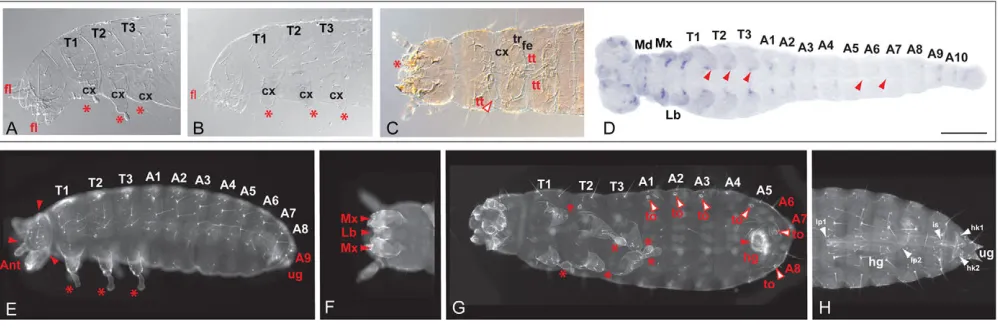
RNAi knockdown of both Tc-fz1and Tc-fz4resulted in a stronger phenotype than those seen in the Tc-fz1single RNAi experiments. Here, in addition to weaker phenotypes that were indistinguishable from those induced by Tc-fz1-RNAi (Fig. 7A), more strongly affected legs presenting only the proximal coxa were observed (Fig. 7B). Moreover, Tc-fz1/4RNAi larvae developed with a malformed hindgut (Fig. 7G). Interestingly, Tc-fz1/4 double knockdown led to a higher percentage of affected embryos (see Table S1 in the supplementary material) than the respective single RNAi knockdowns. In the single Tc-fz4 RNAi knockdown, no specific phenotypes above background levels were seen (see Table S1 in the supplementary material).
DISCUSSION
We have analysed the expression patterns and functions of the genes coding for the Wnt receptors (frizzled 1, 2and 4) and the Wnt co-receptor Tc-arrowduring embryogenesis of the short germ beetle Tribolium. We reveal a redundant and combinatorial code of Wnt receptors and a co-receptor that regulates segmentation, axis elongation, leg formation and gut development in Tribolium.
Wnt receptors and co-receptors in the Tribolium
genome
Whereas mammals possess ten unique Frizzled receptors, only four are present in the genomes of Drosophila, Caenorhabditis elegans and the cnidarian Nematostella (van Amerongen and Nusse, 2009). Triboliumhas three frizzled orthologues, with no orthologue for Drosophila fz3. Thus, the number of Tribolium frizzled genes is not dramatically different from that of other insects or Nematostella, indicating that frizzled1and 2as well as the structurally similar frizzled 3and frizzled4genes constituted a basic Wnt receptor set in the last common ancestor of Nematostellaand insects.
The Triboliumgenome contains two similar genes that code for LRP orthologues. We identified Tc008151 as the single Arrow/LRP5-6 Wnt co-receptor and performed the aforementioned experiments with this gene. The second LDL receptor, TC007146, represents the Tribolium LRP4 orthologue – a putative Wnt antagonist (Fig. 1C). Prior to our analysis, the Tribolium arrow orthologue had been mistakenly assigned to the accession number Xm001814907 (Bolognesi et al., 2009), which actually represents the LRP4orthologue (Fig. 1). As our results on Tc-arrowfunction overlap with those of Bolognesi et al., we presume that their published results do indeed describe the function of the Tribolium Arrow orthologue. Interfering with LRP4 function in Tribolium results in a different phenotype than that shown for Tc-arrowRNAi (R.P. and R.S., unpublished).
Wnt receptors and the co-receptor show specific and ubiquitous expression patterns
In Tribolium, Tc-fz2and Tc-fz4show distinct expression patterns, whereas Tc-fz1and Tc-arroware ubiquitously expressed. Thus, Tc-fz1-mediated Wnt signalling could potentially occur throughout the entire embryo at all stages. Several tissues are marked by the expression of Tc-fz2or Tc-fz4, indicating specific Frizzled-dependent Wnt signalling sites. fz2expression sites are similar in Triboliumand Drosophila in late developmental stages (Bhanot et al., 1996). Exceptional for Triboliumis the strong expression in the head anlage observed at the blastoderm stage. However, no head defect was observed in Tc-fz1/2RNAiembryos. This finding might be explained by a functional redundancy between Fz1, Fz2 and Arrow. We were able to rule out a combined involvement of Tc-fz1 or Tc-fz2 with Arrow in head development because the double RNAi experiments Tc-fz1/arrow and Tc-fz2/arrow did not result in head phenotypes (data not shown).
Functional analysis of the frizzled genes identifies the presegmental region as crucial for axial elongation
The Tc-fz2expression pattern and the Tc-fz1/2 double RNAi phenotype identify the region between the posterior growth zone and the new segments as crucial for axial elongation (AE). This tissue develops in a similar position to the presomitic mesoderm (PSM) in vertebrates and is called the presegmental region (PSR) in Tribolium (Schröder et al., 2008). In both Drosophila and Tribolium, Fz1 and Fz2 function redundantly: in Drosophila during segmentation and in Tribolium within the PSR, the axis elongation phenotype was only seen when Tc-Fz1 and Tc-Fz2 were depleted simultaneously. As Wnt signalling drives segmentation from within the PSR, reception of the Wnt signal in this tissue by the Tc-Fz1 and Tc-Fz2 receptors is necessary for
this process.
D
E
V
E
LO
P
M
E
N
Our marker gene analysis showed that the posterior growth zone is not completely abolished in Tc-fz1/2RNAi embryos, as was previously shown for Tc-arrowRNAi embryos (Bolognesi et al., 2009). The markers Eve, oddand wnt8(Fig. 4, see Fig. S2 in the supplementary material) are still expressed in posterior cells of the growth zone. The persistent expression of the marker gene caudal (Fig. 4V-X) proves the identity of these cells as posterior cells. Because the complete wild-type expression pattern of caudalis not retained in Tc-fz1/2RNAiembryos, the terminal-most tissues could still contribute to axis elongation. The absence of the hindgut marker brachyenteron (Fig. 4Z,AA) in strongly affected Tc-fz1/2RNAiembryos is in accordance with the loss of the hindgut in fz1/2RNAilarval cuticles (Fig. 3B-F). In less strongly affected Tc-fz1/2RNAi embryos, byn expression is still detectable (Fig. 4AA,BB). Our results show that the transition of the pair-rule genes from the primary to the segmental phase (Choe et al., 2006; Patel et al., 1994) depends on Wnt signalling. As a consequence of this loss of Wnt signalling, AE does not occur. In contrast to Tc-wnt8, Tc-wnt5expression is completely abolished in strong Tc-fz1/2RNAi embryos. This finding could be explained by an autoregulatory loop in the PSR involving Frizzled and Wnt5.
Tissue analogy between the PSM of vertebrates and the PSR of insects
In vertebrates, coordinated cell movements in the PSM under the control of FGF signalling are responsible for AE (Bénazéraf et al., 2010). Because signalling pathways are connected to other signalling pathways (van Amerongen and Nusse, 2009), we hypothesised that FGF signalling might be involved in AE in Triboliumas well. Indeed, the prominent wild-type FGF expression domain is missing in Tc-fz1/2RNAiembryos (Fig. 4T), indicating that FGF signalling depends on Wnt signalling in Triboliumand might itself be crucially required for AE. It is striking that in both vertebrates and insects, a tissue immediately posterior to the last somites or segment formed – the PSM and the PSR, respectively – fulfils analogous functions in the axial elongation process.
Tc-fz1single RNAi leads to specific defects in the distal leg
InDrosophilaand Tribolium,wingless is required for segmentation as well as for distalisation and dorso-ventral patterning of the appendages (Cohen and Jürgens, 1989; Grossmann et al., 2009; Ober and Jockusch, 2006). For Tribolium, it was argued that the leg patterning function of wingless is only required during later embryonic stages (Grossmann et al., 2009).
We show that Tc-fz1function is required for both proximo-distal (PD) and dorso-ventral (DV) axis formation in the leg. Because both the PD and the DV leg phenotypes are the result of parental RNAi, we could not verify a distinct time-dependency for Tc-fz1 function. Rather, our data support concentration-dependent regulation of the PD and DV axes during leg development. The Tc-fz1RNAileg phenotype strongly resembles the winglessRNAiphenotypes described for Tribolium (Grossmann et al., 2009) and Drosophila(Diaz-Benjumea and Cohen, 1993; Diaz-Benjumea and Cohen, 1994). Based on bristle mapping, we propose that the best candidate ligand for Tc-Fz1 in appendage formation is Tc-Wnt1.
[image:10.612.58.557.483.647.2]Remarkably, Tc-fz1/2RNAilarvae lacking most of the abdominal segments develop normal legs (Fig. 3B). Here, the reduced Tc-fz1 function seems to be partially compensated. This result is in contrast to Tc-arrowRNAi, in which leg formation is severely affected in larvae with a mild AE defect (Fig. 5B). Why does the knockdown of Tc-fz1in the Tc-fz1/2double RNAi experiment only interfere mildly with leg formation? AE is apparently very sensitive to depletion of Tc-fz1/2function. The dose of dsRNA required for an AE phenotype hardly affects Tc-Fz1-dependent leg patterning at all. Presumably, in the double knockdown embryos, the concentration of Tc-fz1transcripts does not sink below a critical threshold. On the other hand, AE and leg patterning require similar amounts of the co-receptor Arrow. These results support a dosage dependency of Wnt receptors and co-receptors during embryogenesis.
Fig. 7. TcFz4and the enhancement of the TcFz1RNAiphenotype.(A-C)Tc-fz1/4RNAileads to loss of distal leg structures. In weaker phenotypes,
segments of unclear identity adhere to the proximal leg (A); only the coxa is left in strong Tc-fz1/4RNAilarvae (B). Tc-fz1/4RNAilarvae can hatch but
die as L2 larvae (C). (D)Tc-wgexpression is noticeably reduced in the legs and the abdominal segments (arrowheads). (E-G)Additional defects of Tc-fz1/4RNAilarvae. Slight head segmentation defects, missing urogomphi (E), maxillae and labium shortened (F). Hindgut is not elongated and divided
(G). Subtle changes in the shape of the tracheal openings (open arrowheads, G). (H)Wild-type cuticularised hindgut (autofluorescence). Two loops (lp1,2), connected via the intersection (is) with two hooks (hk1, 2) to the outside. This division is absent in Tc-fz1/4RNAilarvae. A1-A10, abdominal
segments 1-10; cx, coxa; fe, femur; fl, flagella; hg, hindgut; Lb, labial segment; Mx, maxillar segment; T1-T3, thoracic segments 1-3; to, tracheal
opening; tr, trochanter; tt, tibiotarsus; ug, urogomphi. Red asterisks mark affected cuticle structures. Scale bar: 100m.
D
E
V
E
LO
P
M
E
N
Tc-fz1functions in the distal leg and in
combination with Tc-fz4in the proximal leg
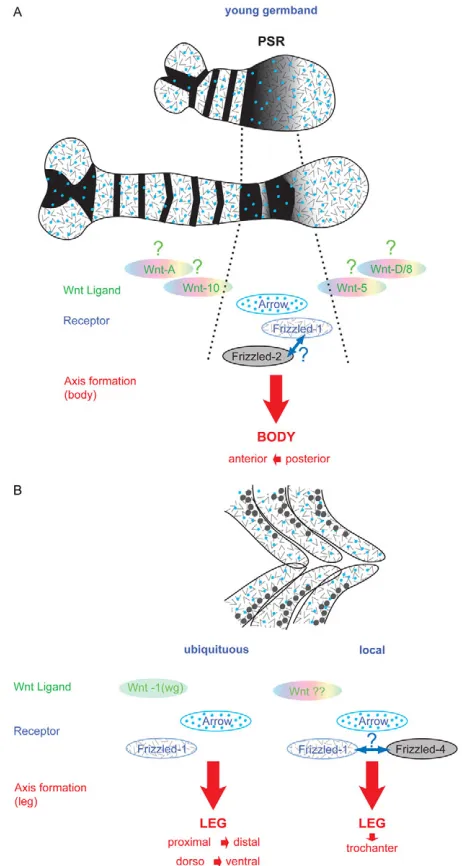
In larvae with weak Tc-fz1RNAi phenotypes, lesions occur in the proximal leg, affecting the joints of the trochanter – sites of Tc-fz4 expression (Fig. 2N) – and leading to a fusion of coxa and trochanter (Fig. 6C,C⬘). Tc-Fz4, therefore, supports Tc-Fz1 in transducing the Wnt signal in the proximal leg (Fig. 8B). This assumption is corroborated by the finding that Tc-fz1/4double RNAi enhances the frequency and the phenotype of this leg phenotype (see Table S1B in the supplementary material and Fig. 7G). However, Tc-Fz4 on its own is dispensable in the leg; Tc-Fz1 appears to be the crucial partner. At present, the precise function of Tc-Fz1/Fz4 in the dorso-proximal leg is speculative. The hypothesised leg differentiation centre at the coxa/trochanter boundary, postulated for Tenebrio(Huét and Lenoir-Rousseaux, 1976), is an intriguing possibility. Larvae with the strongest Tc-fz1RNAiphenotype display loss of distal structures, including the pretarsal claw (Fig. 6C). Because Tc-fz4 is not expressed distal to the tibiotarsal region, Tc-Fz1 seems to be the single primary Wnt transducer in the distal appendage (Fig. 8B). The ligand for this signal is probably distal Wnt1, based on the leg phenotype of wgRNAi larvae (Grossmann et al., 2009). Depending on their conformation, Frizzled receptor proteins have been proposed to signal via different downstream signalling pathways and could thus serve as multifunctional signal transducers depending on, e.g. ligand availability (Carron et al., 2003). In this way, a variety of different biological outcomes can be controlled by a small number of Wnt receptors.
Redundant function of Tc-fz1 andTc-fz4in hindgut
development
Double Tc-fz1/4RNAiembryos reveal an additional function of the two receptors in hindgut formation. Although a normal hindgut develops in the respective single RNAi experiments, the elongation of the gut tubule is impaired in Tc-fz1/4RNAilarvae; only remnants of the hindgut-specific cuticle develop (Fig. 7G). Tc-fz1/4RNAi larvae survive to stage L2 (Fig. 7C) but subsequently die, probably due to a non-functional hindgut and stunted mouth appendages. A similar gut phenotype has been observed in brachyenteronRNAi experiments (Berns et al., 2008) indicating that Tc-bynand Tc-Fz4 might function within the same pathway. Indeed, bynhas been shown to be a target of the Wnt signalling cascade in vertebrates (Arnold et al., 2000; Yamaguchi et al., 1999). Alternatively, elongation of the gut might be achieved via convergent extension under the combined control of Tc-frizzled 1and Tc-frizzled 4, pointing to the involvement of the planar cell polarity pathway.
Surprisingly, winglessexpression in the segments is strongly reduced in Tc-fz1/4RNAi embryos (Fig. 7D). The continued expression of winglessduring segmentation therefore seems to depend on a feedback loop involving both Frizzled1 and Frizzled4. Because the abdominal segments form normally in Tc-fz1/4RNAi embryos (Fig. 7E,G), the loss of winglessexpression does not interfere with segmentation.
Arrow functions as the obligatory Wnt co-receptor The requirement of Tc-Arrow for leg formation, AE and segmentation identifies this protein as an obligatory co-receptor in all these processes. We explain the spectrum of Tc-arrowRNAi phenotypes, ranging from weak to strong (Fig. 5), by the declining amounts of ds-Tc-arrowRNA transferred by the injected mothers to their offspring during successive egglays. This ‘phenotypic series’ might point to a dosage dependency at the level of Wnt
[image:11.612.323.554.60.493.2]reception. In such a scenario, leg formation and AE would be most sensitive to the loss of Tc-Arrow function, whereas segmentation is more robust and only requires low concentrations of Arrow. This
Fig. 8. The ‘combinatorial code’ model.(A)Summary of expression patterns and possible receptor/co-receptor interactions in the presegmental region (PSR) during anterior-posterior axis formation. Tc-fz2expression is shown in black in the segments and in the PSR. Within the PSR, Tc-fz2shows a graded expression fading out towards the posterior. Tc-fz2is always coexpressed with the ubiquitously expressed
Tc-fz1and Tc-arrow(chevrons and blue dots, respectively). In these regions, it is possible that various dimeric forms (homo- or heterodimers) could form. In the young germ anlage, Tc-wnt5
expression is close to the Tc-fz2expression domain (Fig. 4P). Later in embryogenesis, Tc-WntA and Tc-Wnt10 can serve as
additional/alternate ligands for Tc-Fz1 and Tc-Fz2 in the PSR. (B)Summary of expression patterns and possible receptor/co-receptor interactions in the leg during proximo-distal axis formation.
Ubiquitously expressed Tc-Fz1and Tc-Arroware joined in a dorso-proximal position by Tc-Fz4 (black dots). Here, Tc-Fz4 supports Wnt signalling by an as yet unknown Wnt ligand. In more distal and ventral positions, Tc-Fz1 and Tc-Arrow exclusively transduce Wnt1 signalling.
D
E
V
E
LO
P
M
E
N
hypothesis is supported by the higher percentage of weaker Tc-arrowRNAiphenotypes in RNAi experiments with concentrations of 10 ng/l compared with the injection series with 50 ng/l or higher (see Table S1B6 in the supplementary material).
Interestingly, specific defects in the larva were obtained only when the ubiquitously expressed genes Tc-fz1and Tc-arrowwere knocked down, i.e., not when the genes showing distinct expression patterns (Tc-fz2or Tc-fz4) were depleted. The acquisition of new expression domains during evolution can promote the formation of embryonic parts with novel structural and functional aspects. We speculate that such a scenario could apply to the Tc-fz2and Tc-fz4 genes.
Possible Wnt ligand-receptor combinations
Previous studies analysed the function of wingless(Grossmann et al., 2009) and wnt8(Bolognesi et al., 2008b). As no functional data for other Wnt molecules are available, the identities of the Wnt ligands that activate the Frizzled receptors during these embryological processes remain unclear. Our speculations are based on the expression patterns of the different Wnt ligands (Bolognesi et al., 2008a) (see Fig. S5 in the supplementary material) and are summarised in Fig. 8.
Further diversification of signalling outcomes could be achieved by the formation of homo- or heterodimers of Frizzled receptors via their cysteine-rich-domains. Such dimerisation events have been shown to occur in vitro for various vertebrate Frizzled proteins and other G-protein-coupled receptors (Angers et al., 2002; Carron et al., 2003; Dann et al., 2001; Milligan, 2004; Schulte and Bryja, 2007; Stiegler et al., 2009). Whether the Frizzled proteins function as independent monomers, homodimers or heterodimers in Triboliumis unknown. Fz1 and Fz2 in the PSR and Fz1 and Fz4 in the proximal leg could potentially form various receptor combinations (displayed in Fig. 8).
In conclusion, we have shown that a variety of tissue-specific outcomes are guided by a combinatorial code of three Wnt receptors and one Wnt co-receptor in Tribolium. We have identified the presegmental region in the Triboliumembryo as the necessary tissue for axis elongation at the Wnt receptor level and uncovered a network of signalling pathways within the PSR that controls this process. Our findings provide parallels to the involvement of FGF and Wnt signalling in vertebrate development (Dequéant and Pourquié, 2008). Both the FGF and Wnt signalling pathways are involved in axial patterning and serve as crucial regulators of animal embryogenesis. Future work will aim to identify the correct receptor-ligand combinations in the presegmental region and the appendages to disclose the complexity of the Wnt signalling pathway in short germ insects.
Acknowledgements
We gratefully acknowledge Rolf Reuter for continuous and generous support, T. Mader and A. Hlawa for excellent technical assistance, P. Spahn for reading drafts of the manuscript and the German Research Council (DFG) for its long-standing and continuous funding. The Even-skipped (2B8) and the Engrailed (4D9) monoclonal antibodies developed by N. Patel were obtained from the Developmental Studies Hybridoma Bank developed under the auspices of the NICHD and maintained by The University of Iowa, Department of Biological Sciences, Iowa City, IA 52242.
Competing interests statement
The authors declare no competing financial interests.
Supplementary material
Supplementary material for this article is available at
http://dev.biologists.org/lookup/suppl/doi:10.1242/dev.063644/-/DC1
References
Angers, S., Salahpour, A. and Bouvier, M.(2002). Dimerization: an emerging concept for G protein-coupled receptor ontogeny and function. Annu. Rev. Pharmacol. Toxicol.42, 409-435.
Arnold, S. J., Stappert, J., Bauer, A., Kispert, A., Herrmann, B. G. and Kemler, R.(2000). Brachyury is a target gene of the Wnt/beta-catenin signaling pathway.
Mech. Dev.91, 249-258.
Aulehla, A., Wiegraebe, W., Baubet, V., Wahl, M. B., Deng, C., Taketo, M., Lewandoski, M. and Pourquié, O.(2008). A beta-catenin gradient links the clock and wavefront systems in mouse embryo segmentation. Nat. Cell Biol. 10, 186-193.
Beermann, A. and Schröder, R.(2008). Sites of Fgf signalling and perception during embryogenesis of the beetle Tribolium castaneum. Dev. Genes Evol.218, 153-167.
Beermann, A., Aranda, M. and Schröder, R.(2004). The Sp8 zinc-finger transcription factor is involved in allometric growth of the limbs in the beetle
Tribolium castaneum. Development131, 733-742.
Bénazéraf, B., Francois, P., Baker, R. E., Denans, N., Little, C. D. and Pourquié, O.(2010). A random cell motility gradient downstream of FGF controls elongation of an amniote embryo. Nature466, 248-252.
Berns, N., Kusch, T., Schröder, R. and Reuter, R.(2008). Expression, function and regulation of Brachyenteronin the short germ insect Tribolium castaneum.
Dev. Genes Evol.218, 169-179.
Bhanot, P., Brink, M., Samos, C. H., Hsieh, J. C., Wang, Y., Macke, J. P., Andrew, D., Nathans, J. and Nusse, R.(1996). A new member of the frizzled
family from Drosophilafunctions as a Wingless receptor. Nature382, 225-230.
Bolognesi, R., Beermann, A., Farzana, L., Wittkopp, N., Lutz, R., Balavoine, G., Brown, S. J. and Schröder, R.(2008a). TriboliumWnts: evidence for a larger repertoire in insects with overlapping expression patterns that suggest multiple redundant functions in embryogenesis. Dev. Genes Evol.218, 193-202.
Bolognesi, R., Farzana, L., Fischer, T. D. and Brown, S. J.(2008b). Multiple Wnt genes are required for segmentation in the short-germ embryo of Tribolium castaneum.Curr. Biol. 18, 1624-1629.
Bolognesi, R., Fischer, T. D. and Brown, S. J.(2009). Loss of Tc-arrowand canonical Wnt signaling alters posterior morphology and pair-rule gene expression in the short-germ insect, Tribolium castaneum. Dev. Genes Evol.219, 369-375.
Brown, S. J., Parrish, J. K., Beeman, R. W. and Denell, R. E.(1997). Molecular characterization and embryonic expression of the even-skippedortholog of
Tribolium castaneum. Mech. Dev.61, 165-173.
Bucher, G., Scholten, J. and Klingler, M.(2002). Parental RNAi inTribolium
(Coleoptera).Curr. Biol. 12, R85-R86.
Cadigan, K. M. and Nusse, R.(1997). Wnt signaling: a common theme in animal development. Genes Dev.11, 3286-3305.
Carron, C., Pascal, A., Djiane, A., Boucaut, J.-C., Shi, D.-L. and Umbhauer, M.
(2003). Frizzled receptor dimerization is sufficient to activate the Wnt/beta-catenin pathway. J. Cell Sci. 116, 2541-2550.
Chen, C. M. and Struhl, G.(1999). Wingless transduction by the Frizzled and Frizzled2 proteins of Drosophila. Development126, 5441-5452.
Choe, C. P., Miller, S. C. and Brown, S. J.(2006). A pair-rule gene circuit defines segments sequentially in the short-germ insect Tribolium castaneum. Proc. Natl. Acad. Sci. USA 103, 6560-6564.
Cohen, B., Simcox, A. A. and Cohen, S. M.(1993). Allocation of the thoracic imaginal primordia in the Drosophilaembryo. Development117, 597-608.
Cohen, S. M. and Jürgens, G.(1989). Proximal-distal pattern formation in
Drosophila: cell autonomous requirement for Distal-lessgene activity in limb development. EMBO J.8, 2045-2055.
Copf, T., Schröder, R. and Averof, M.(2004). Ancestral role of caudalgenes in axis elongation and segmentation. Proc. Natl. Acad. Sci. USA 101, 17711-17715.
Dann, C. E., Hsieh, J. C., Rattner, A., Sharma, D., Nathans, J. and Leahy, D. J.
(2001). Insights into Wnt binding and signalling from the structures of two Frizzled cysteine-rich domains. Nature412, 86-90.
Delfini, M. C., Dubrulle, J., Malapert, P., Chal, J. and Pourquié, O.(2005). Control of the segmentation process by graded MAPK/ERK activation in the chick embryo. Proc. Natl. Acad. Sci. USA102, 11343-11348.
Dequéant, M.-L. and Pourquié, O.(2008). Segmental patterning of the vertebrate embryonic axis.Nat. Rev. Genet.9, 370-382.
Diaz-Benjumea, F. J. and Cohen, S. M.(1993). Interaction between dorsal and ventral cells in the imaginal disc directs wing development in Drosophila. Cell75, 741-752.
Diaz-Benjumea, F. J. and Cohen, S. M.(1994). winglessacts through the
shaggy/zeste-white 3kinase to direct dorsal-ventral axis formation in the
Drosophilaleg. Development120, 1661-1670.
Grossmann, D., Scholten, J. and Prpic, N. M.(2009). Separable functions of
winglessin distal and ventral patterning of the Triboliumleg. Dev. Genes Evol. 219, 469-479.
Habas, R. and Dawid, I. B.(2005). Dishevelled and Wnt signaling: is the nucleus the final frontier? J. Biol. 4, 2.