ADAPTIVE GENETIC BASED WATER FILLING APPROACH
FOR POWER AND BIT ALLOCATION IN MIMO OFDM
SYSTEMS
1B.SATHISH KUMAR and 2Dr.K.R.SHANKAR KUMAR
1
Assistant Professor, Department of ECE, Sri Ramakrishna Engineering College, Coimbatore-641022, Tamilnadu, India
2
Professor, Department of ECE, Ranganathan Engineering College, Coimbatore-641019, Tamilnadu, India
Email: [email protected]
,
2
ABSTRACT
MIMO is combined with OFDM to develop the performance of wireless transmission systems. Multiple antennas are used together at the transmitting and receiving ends. The performance of an OFDM system is calculated, taking into consideration multipath delay spread, channel noise, Rayleigh fading channel and distortion. In this paper, bits are generated and then mapped with modulation schemes like QPSK, PSK and QAM. After that, the mapped data is separated through blocks of 120 modulated data whereas a training sequence of the data is inserted both at the beginning and ending parts of the block. The equalization is used to find out the variation to the rest of data. For a Multiple-Input and Multiple-Output (MIMO) Orthogonal Frequency-Division Multiplexing (OFDM) system with universal space-time codes and least-squared decoders, this study provides an improved eigenmodes transmission based on to the equivalent channel matrix. Through novel eigenmodes, data symbols encoded by space-time codes can be steered to these eigenmodes analogous to MIMO wireless communication systems with single-carrier transmission. Furthermore, the relations between different code-rate space-time codes, system capacity and number of eigenmodes are measured by numerical simulation. For this, water filling scheme and Adaptive Genetic Algorithm (AGA) is proposed here for bit allocation and determining the optimal transmits powers for orthogonal eigenmodes. Also, for power adaptation two approaches are proposed, primarily the conventional water-filling algorithm and in second technique adaptive Genetic Algorithm is used to choose the optimum power vector. Simulation result shows that the proposed approach provides better results when compared with other existing approaches.
Keywords: Multiple-Input Multiple-Output (MIMO), Orthogonal Frequency Division Multiplexing (OFDM), Power Allocation, Bit Allocation, Water filling, Adaptive Genetic Algorithm
1. INTRODUCTION
The wireless communication system [1-3] coupled with multiple transmit/receive antennas and OFDM, is regard as a hopeful solution for enhancing the data rates of next-generation wireless communication systems operating in frequency-selective fading environments. Channel parameters endow with key information for the operation of wireless systems and require to be estimated accurately. Consequently many training-based MIMO OFDM channel estimation methods have been discussed in [4-5], which could be put into two categories such as frequency domain [6] and time domain [7] approaches. However, for the circumstances with large numbers of users in cellular fast fading channels, there are two complex
problems [8-9] that have to be figured out, i.e., the challenge to build large numbers of orthogonal training sequences and the bandwidth overhead of channel estimation when the length of MIMO OFDM symbols is larger than that of wireless channel delay. Therefore it is essential to find a novel approach to overcome these drawbacks.
OFDM systems can be increased further by adaptively conveying transmitted power to orthogonal eigenmodes according to the “water-filling” rule [11]. At transmitters, the transmitted signals of different carriers are generally eigen beam formed separately to orthogonal modes of spatial channels at every sub-channel in MIMO OFDM systems, which can be produced by spatial filtering based on singular value decomposition (SVD) of channel matrix at transmitters. However, these eigenmodes cannot be used to guide the data symbols encoded by space-time codes, as one space-time codeword is transferred concurrently by multiple carriers, while the eigenmodes are obtained at every carrier. So, when coupled with adaptive power and bit allocation, these eigenmodes have some drawbacks based on their related counterparts of MIMO systems in single-carrier transmission. Therefore, the novel eigenmodes can be employed to steer adaptive power allocation to data symbols and their bit allocations in a MIMO system with single-carrier transmission. For this, a water filling and Adaptive Genetic Algorithm (AGA) is proposed here for determining the optimal transmit powers and bit allocation for orthogonal eigenmodes.
2. LITERATURE SURVEY
In [12] optimal power allocation approaches for a MIMO OFDM based cognitive radio (CR) system were proposed. The proposed power allocation schemes exploit the downlink transmission rate of the CR users under spatial interference constraints, allowing for both the availability and nonexistence of the primary user (PU) Channel State Information (CSI). It is established that the isotropic interference minimization in the nonappearance of PU CSI can be created as a semi-definite program (SDP) while it lessen to linear interference constraints based CR user sum-rate maximization in the existence of PU CSI. Simulation results show that the performance of the proposed schemes.
In [13] a power allocation scheme is presented for MIMO-OFDM systems with CSI on transmitter and receiver area. In the proposed scheme, multi-user power allocation can be decoupled into single user power allocation in the course of space mapping multi-user channel and power allocation can be carry out by spatial-spectral water-filling per user. To covenant with increasing number of system users and fading correlation, scheduling can be used to preserve power allocation gain. The proposed scheme has low complication and can considerably improve system spectral efficiency.
In [14] a Bayesian approach is proposed to transmit prefiltering matrices in closed-loop schemes fit to channel estimation errors. The algorithms are derived for a multiple-input multiple-output (MIMO) orthogonal frequency division multiplexing (OFDM) system. Two dissimilar optimization criteria are examined that, the minimization of the mean square error and the minimization of the bit error rate. In both cases, the transmitter design is based on the singular value decomposition (SVD) of the conditional mean of the channel response is called as channel estimation.
From the survey, it is clearly observed that, hybrid heuristic technique is not been used for bit and power allocation in MIMO OFDM. In recent years, swarm intelligence is observed to provide significant results. Thus, this paper focuses on using the heuristic approach integrated with water filling algorithm.
3. METHODOLOGY
The MIMO OFDM system model designed with universal space-time codes: initially, a universal space-time code can be defined as a rate of T/K MK design scheme over a composite subfield A of the complex field C, whose codeword matrix X is an MK matrix with entries obtained from the K-linear combinations of T data symbols and their conjugates. If a codeword matrix X is correspond to as a column vector by stacking its columns, the column vector can be defined as the linear transform of T data symbols and their respective conjugates, as:
Ф 1
where, vec(.) is the column vector by stacking the columns of a matrix into one column vector, s is a column vector and the transform matrix Φ is point out as the generation matrix of the space-time code design scheme.
codeword, so they receive signals in a MIMO OFDM symbol period can be written as:
, , ,
, 2 Where n=1, ……N, k=1, ……,T
where, y (n,k) is the received data at the kth carrier of the nth receive antenna, H (n,m)(k) represents the fading coefficient at the kth carrier of the spatial channel between the nth receive antenna and the mth transmit antenna, also X(m,k) denotes the element at mth row and kth column of a space-time codeword matrix X, and w(n,k) is the channel noise at the kth carrier for the nth receive antenna.
Substituting the sum term in Eq. 2 by its matrix form, it can be written as:
, , : : ,
, 3 where, x (:, k) is the k-th column of space-time codeword X, H[n,:] (k) is the nth column of the MIMO channel fading coefficient matrix H(k) at k-th carriers, which can be defined as:
1,1 1,2 … … 1, 2,1 2,2 … … 2,
. . , 1
. . , 2
. . . .
… … ,
Let y(n,:) indicate the received signal vector at the nth receive antenna in a MIMO OFDM symbol period, can rephrase (3) into matrix form as:
, : ்
, : 1 , : 2
, :
: ,1 : ,2
.. : , , : ் (4)
where, w(n,:) is the channel white noise related to y(n,:), and vec. Thus, in a MIMO OFDM symbol period, accumulate the received signals from all the receive antennas into a matrix form, can be:
5
Where
1, : , 2, : , … , #, :
1, : , 2, : , … , #, :
And is given by,
1, : , 2, : , … #, : 6
According to Eq. 6, the least squared estimation of s can be achieved as following:
̂ & '
( 7
Where
( & '
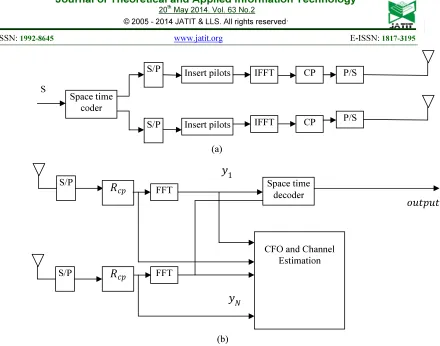
Figure 1: Discrete-Time Equivalent Base-Band Model Of A MIMO OFDM Block Transmission System. (A) Transmitter And (b) Receiver
3.1 A novel eigenmode transmission coupled with space time codes
By singular value decomposition, the eigenmodes hidden in Eq. 8, can be revealed in the same way as their counterparts in single-carrier M IMO systems. Let* Ф, it can be decomposed into orthogonal eigenmodes by singular value decomposition as mentioned below:
* +,- 8
where, U and V represent the unitary matrices corresponds to the left and right eigenvectors of *, in that order, and D is a diagonal matrix, whose elements are the ordered singular values of *, i.e., the corresponding fading coefficients of those orthogonal eigenmodes.
Then, according to Eq. 6 and 8, substituting * by its SVD, can obtain:
+ ,- + 9
Now, let, +, -, + and eqn. (10) can be written as S
′ ,′ ′ 10
Furthermore, it is also equivalent to:
1 ′ 23′ ′ 4 1,2, … 5 ′ ′ 4 5 1, 5 2, … ,
11
where, r and 3are the rank of * and its i
th
singular value, respectively.
As the equivalent channel matrix comprises the generation matrix of space-time codes, the eigenmodes attain by eq.11 can also reflect the equivalent space-time diversity gains of space-time codes. Moreover, these eigenmodes have their own distinctive corresponding relations with the data symbols, excited by one MIMO OFDM symbol. Therefore, based on these eigenmodes and power allocation system, it is simple to establish the modulation series of these data symbols and their transmit power. As a result, when compared with the traditional eigenmodes for different carriers, S
Space time coder
S/P
S/P
Insert pilots
Insert pilots
IFFT
IFFT
CP
CP
P/S
P/S
S/P
S/P
Space time decoder
ܴ
ܴ
FFT
FFT
ݕ
1CFO and Channel Estimation
ݕ
(a)
(b)
adaptive spatial processing could be processed suitably with these novel eigenmodes.
In addition, as the relations among the equivalent channel matrix and the generation matrix of one space-time code, system capacity is considerably affected by the code rate of space-time codes. For one space-time code scheme with a unitary generation matrix, the space-time diversity doesn’t vary the related system capacities with no space-time codes. That is to say, the number of data symbols in the novel eigenmodes is supposed to be identical to that in traditional eigenmodes. As a result, there exists M=2*T/K for space-time codes that could remains the system capacity unchanged, and simply Alamouti space-time code exists for a transmitter with two antennas, when T/K is not more than one. Intended for further space-time codes, system capacity will amplify in inverse proportion to space-time code rates, that is, the larger the transmission rate, the more the system capacity.
Generally, the classical eigenmodes at different carriers for MIMO OFDM systems can be viewed as simple extensions of the eigenmodes in MIMO systems in single-carrier transmission, which is suitable for the analysis of system capacity other than link adaptation techniques. Though, in addition to that the system capacity analysis, the new eigenmode transmission can couple space-time codes and link adaptation techniques. Additionally, the number of novel eigenmodes is only have some degree of limited number of the transmitted data symbols carried by a MIMO OFDM symbol, whereas 6 ∗ 6 eigenmodes have to be disclosed to perform bit and power allocation to data symbols transported in these eigenmodes.
Water-Filling Principle: Water-filling algorithm has been employed for multicarrier loading problems. It is restated here for sake of reference. “Maximize the bit rate 8for the entire
multichannel MIMO-OFDM transmission system; throughout an optimal sharing of the total transmit power PTbetween the N sub-channels, with respect to the constraint that PTis maintained constant.” On the contrary to the proposed system this phenomenon can be written as,
9
:
|<| =; 1 ? 4 ? # 12
Where 9is the transmission power, : is the
noise variance (power) and |<| magnitude
response at subchannel i respectively.
The choice of constant K depends upon application and it is beneath designer control. To be precise, the sum of the transmit power and noise variance (power) scaled by inverse of square of channel (subchannel) magnitude response should be maintained constant for each subchannel.
This can also be written as;
9
1
@#8 =; 1 ? 4 ? # 13
Where
@#8
|<| :
Another contribution of the proposed scheme is that the value of the constant K is calculated systematically and given below while derivation.
= A
1
# @#81
14
Where Ais the average transmit power per
subcarrier and (CNR)i is given in equation 13. The throughput of this loading algorithm will be calculated by equation 14, while the power vector P will be found by water-filling algorithm by means of equation 10.
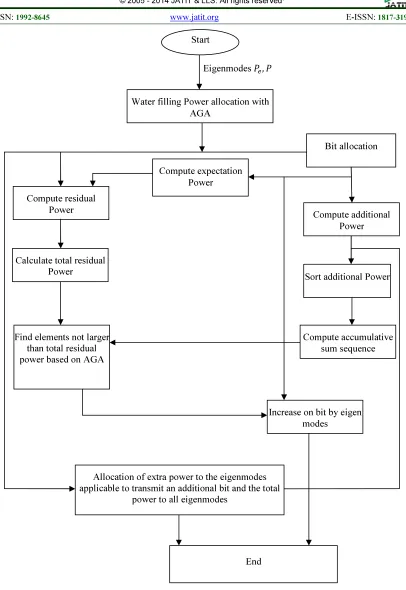
Genetic Algorithm: Genetic Algorithm is a biologically inspired evolutionary algorithm based upon the purpose of “survival of the fittest”. In this system it is proposed for finding the optimum power vector that maximizes the overall throughput of the OFDM System while satisfying the total power constraint, bit allocation and in addition to quality of service (QoS) demand per subcarrier. The proposed power and bit allocation system based on water filling algorithm with Adaptive genetic algorithm is shown in figure 2.
Figure 2: Proposed Power And Bit Allocation System Flow Diagram Start
Water filling Power allocation with AGA
Bit allocation Eigenmodes A, A
Compute additional Power
Sort additional Power
Compute accumulative sum sequence
Increase on bit by eigen modes Compute residual
Power
Calculate total residual Power
Find elements not larger than total residual power based on AGA
Allocation of extra power to the eigenmodes applicable to transmit an additional bit and the total
power to all eigenmodes Compute expectation
Power
The fitness function being applied for sake of finding the fitness of a chromosome (transmit power vector).
So the power vector with the highest fitness (throughput) would be chosen for transmission. The fitness function can be written as
8 # 51
15
# CDE1
68,
1
# 9, ∝, GD
The Genetic Algorithm used in this approach is given below.
Algorithm:
Take the power vector of length N (total no. of subcarriers) with flat power distribution
Obtain the first generation
Find the fitness of the generation by the equation (15)
Sort the chromosomes with respect to their fitness
Create the mating pool
The main advantage of this work is that, genetic algorithm integrated with water filling algorithm would provide global searches from a wide sampling of fitness. This would improve the overall performance of the MIMO-OFDM with less BER.
4. RESULTS AND DISCUSSIONS
The simulation has been carried out to evaluate the performance of the proposed approach. Here, firstly consider a MIMO OFDM system with 2048 carriers at carrier frequency of 4.5 GHz, which has 1 MHz bandwidth and a 1/4 OFDM symbols as guard intervals, which can eliminate inter symbol interference (ISI) caused by frequency selective channels. Under spatially uncorrelated ITU vehicular a channels with Doppler frequencies of 200 Hz, evaluate the system capacities and
throughputs with and without considering space-time codes, respectively. By the reason of terseness, the eigenmodes obtained for the two scenarios are called space-time eigenmodes and carrier eigenmodes, respectively. At transmitter, the water-filling power allocation algorithm [15] is executed to adaptively adjust the transmit powers for all the eigenmodes according to their fading coefficients.
The channel is assumed to be Rayleigh Channel with four multi-paths in experimental results. The proposed system consist of 128 subcarriers, total bandwidth is 1Mhz , number of transmitter antennas N and receiver antennasN present in the
proposed system is 4 and the number of users considered here is 500. Gaussian white noise variance N is 0.5 and BER is 10 .It is assumed
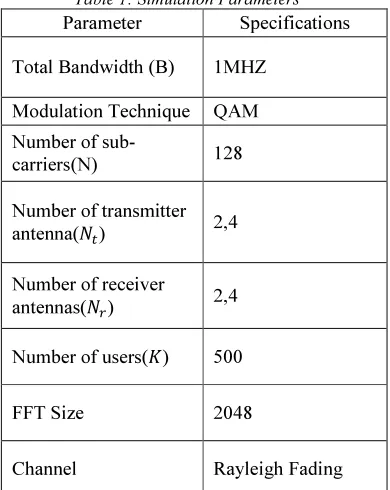
[image:7.595.313.508.380.625.2]that all users require the same service such as File Transfer Protocol (FTP) service. The number of subcarriers allocated to the each user is fixed as 16 in order to obtain high throughput. Simulation parameters are described in Table 1.
Table 1: Simulation Parameters Parameter Specifications
Total Bandwidth (B) 1MHZ
Modulation Technique QAM Number of
sub-carriers(N) 128
Number of transmitter antenna(#)
2,4
Number of receiver antennas(#)
2,4
Number of users(=) 500
FFT Size 2048
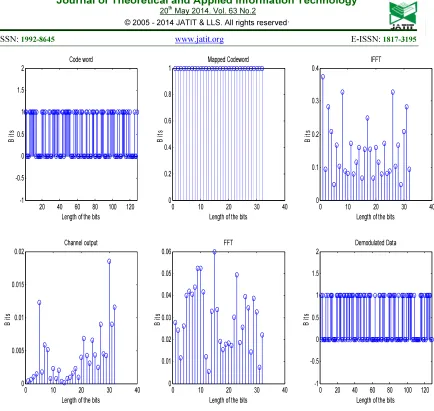
Figure 3: Simulation Results Of Bit Allocation For Number Of Users 20 40 60 80 100 120
-1 -0.5 0 0.5 1 1.5 2
Length of the bits
B
it
s
Code word
0 10 20 30 40 0
0.2 0.4 0.6 0.8 1
Mapped Codeword
Length of the bits
B
it
s
0 10 20 30 40 0
0.1 0.2 0.3 0.4
IFFT
Length of the bits
B
it
s
0 10 20 30 40 0
0.005 0.01 0.015 0.02
Channel output
Length of the bits
B
it
s
0 10 20 30 40 0
0.01 0.02 0.03 0.04 0.05 0.06
FFT
Length of the bits
B
it
s
0 20 40 60 80 100 120 -1
-0.5 0 0.5 1 1.5 2
Demodulated Data
Length of the bits
B
it
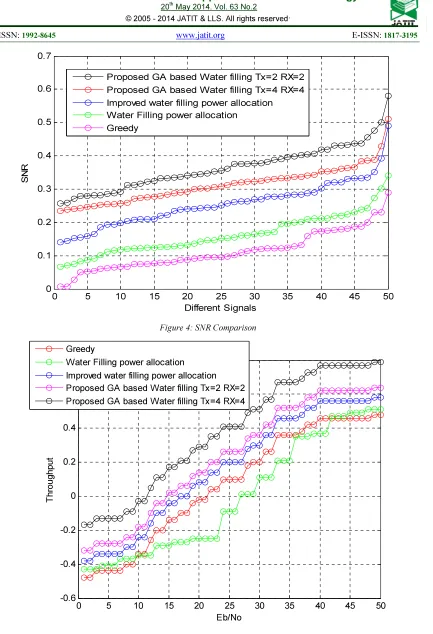
Figure 4: SNR Comparison
Figure 5: Throughput of the MIMO-OFDM
From Figure 4, the water-filling power and bit allocation scheme based on adaptive genetic
algorithm can achieve good results than that the classical water-filling scheme achieves at SNR
0 5 10 15 20 25 30 35 40 45 50
0 0.1 0.2 0.3 0.4 0.5 0.6 0.7
S
N
R
Different Signals
Proposed GA based Water filling Tx=2 RX=2 Proposed GA based Water filling Tx=4 RX=4 Improved water filling power allocation Water Filling power allocation
Greedy
0 5 10 15 20 25 30 35 40 45 50
-0.6 -0.4 -0.2 0 0.2 0.4 0.6 0.8
Eb/No
T
h
ro
u
g
h
p
u
t
Greedy
above 16 dB, as the power allocation strategy is introduced to obtain additional transported bits at a cost of sensibility to noise. From Figure 5, the water-filling power and bit allocation scheme based on adaptive genetic algorithm can achieve good
[image:10.595.117.465.200.472.2]results in throughput value than that the classical water-filling scheme. The throughput of the proposed algorithm is better than the existing algorithm despite of the SNR value is increased.
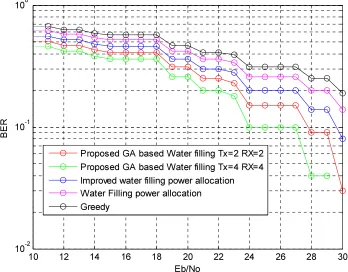
Figure 6: Bit Error Rate Comparison of MIMO-OFDM
At last, for given target BER 10-3, the system average BER curves under different power allocation schemes, are shown in Fig. 6 for the MIMO OFDM systems with the same configuration as showed above. As indicated in Fig. 6, the water-filling scheme based on adaptive genetic algorithm can obtain better system BER performance than greedy algorithm and equal power schemes but inferior to classical water-filling scheme. Hence, the proposed water-filling scheme can work as an alternative scheme of greedy scheme and water-filling algorithm.
5. CONCLUSION AND FUTURE WORKS
In this paper, a water-filling scheme based on genetic algorithm is proposed for determining the optimal transmit powers for orthogonal eigenmodes. Results indicate that the improved water-filling scheme can obtain good tradeoff, with comparison to classical water-filling schemes and
greedy algorithms respectively. Compared with classical water-filling scheme, it can also obtain larger throughputs via residual power and bit allocation. The future work of this research work would to use swarm intelligence based optimization algorithm for bit and power allocation which would improve the overall performance of the system.
REFRENCES
[1] Joselin Retna Kumar G and Shaji KS, “Enhanced Channel Estimation Technique for MIMO-OFDM Based Communications Using Neuro Fuzzy Approach”, International Conference on Conference on Signal Processing Systems (ICSPS 2012), 2012 [2] Fang Ruei-Dar, Ma Hsi-Pin. A DVB-T/H
Baseband Receiver for Mobile Environments. Proceedings of the 2007 WSEAS Int. Conference on Circuits, Systems, Signal and Telecommunications, 2007, pp. 114-118.
10 12 14 16 18 20 22 24 26 28 30 10-2
10-1 100
Eb/No
B
E
R
[3] Hiroki Iwaizumi, Shingo Yoshizawa, and Yoshikazu Miyanaga, “A High-Speed and Low-Energy-Consumption Processor for SVD-MIMO-OFDM Systems”, VLSI Design 2013. [4] Steiner B, Jung P. Optimum and suboptimum
channel estimation for uplink of CDMA mobile radio systems with joint detection. European Trans. Telecommunication Related Technologies, Vol.5, No.1, 2010, pp.39-49. [5] Lu Zhaogan, Wang Liejun, Zhang Taiyi and
Runping Yun, A New Steiner Channel Estimation Method in MIMO OFDM Systems. Information Technology Journal, Vol 6, 2007 pp.1238-1244.
[6] Acar Y, Yildiz H, Cooklev T, Dogan H, “High-performance MIMO OFDM wireless systems with generalized prefix”, In proceeding of: Signal Processing and Communications Applications Conference (SIU), 2013 21st.
[7] Ayad Habib, Khalid El Baamrani and Abdellah Ait Ouahman, “A Low-complexity Power and Bit Allocation Algorithm for Multiuser MIMO-OFDM Systems”, IJCSI International Journal of Computer Science Issues, Vol. 8, Issue 3, May 2011.
[8] Wang Liejun , 2011. An Improved Water-filling Power Allocation Method in MIMO OFDM Systems. Information Technology Journal, Vol 10: 639-647.
[9] M. A. Saeed, N. K. Noordin, B. M. Ali, S. Khatun and M. Ismail, “RLS Channel Estimation and Tracking for MIMO extended IEEE 802.11a WLANs”, IJCSNS International Journal of Computer Science and Network Security, VOL.8 No.2, February 2008
[10] Simone Gabriele, Paolo Di Giamberardino. Communication Constraints for Mobile Sensors Networks. Proceedings of the 11th WSEAS International Conference on SYSTEMS, 2007, pp. 249 - 254.
[11]Barhumi I, Leus G, Moonen M. Optimal training sequences for channel estimation in MIMO OFDM systems in mobile wireless channels. Proceedings of 2002 International
Zurich Seminar on Broadband
Communications, 2002, pp.441-446.
[12]Pratibha and Jagannatham, A.K., “Power allocation for MIMO-OFDM based CR with spatial constraints and CSI uncertainty”, IEEE, 17-20 June 2012
[13]Shiping Duan ; Youyun Xu ; Wentao Song, “Power allocation for MIMO-OFDM systems with multi-user decoupling and scheduling”, IEEE, 7-10 Sept. 2003
[14]Rey F, Lamarca M, Vazquez G, “Robust power allocation algorithms for MIMO OFDM systems with imperfect CSI”, IEEE Transactions on Signal Processing (Impact Factor: 2.81). 04/2005;