429
MIH BASED QOS-AWARE ALGORITHM FOR EFFICIENT
HANDOFF IN WIFI/WIMAX INTEGRATED NETWORKS
1 E.PRINCE EDWARD, 2DR.V.SUMATHY
1Dept. of Electronics, SK Polytechnic College, Research Scholar, Anna University, Coimbatore, India.
2
Associate Professor, Department of ECE, Govt. College of Tech., Coimbatore, India.
E-mail: [email protected], [email protected]
ABSTRACT
In future the wireless networks will be heterogeneous and a mobile user has to roam between different access technologies. Achieving efficient vertical handoff (VHO) with guaranteed Quality of Service (QoS) in such heterogeneous environment still remains as an unsolved issue. VHO occurs when a mobile user changes his point of attachment from one type of wireless access network to another during an active communication session. Several VHO algorithms based on Received Signal strength (RSS), Signal to Interference Noise Ratio (SINR) and bandwidth have been proposed in literature which are inadequate to provide QoS for real-time applications. Hence we propose a Media Independent Handover(MIH) based QoS-aware VHO Decision Algorithm(QAVHA) which measures congestion in the target network in addition to SINR and bandwidth to provide always best connected service with guaranteed QoS. Our algorithm mainly focuses on reducing handoff delay and unnecessary handoffs to provide efficient handoff. We have chosen IEEE 802.11e and IEEE 802.16e heterogeneous environment. We have simulated these scenarios using NS2 and the performance characteristics are studied. When compared with the conventional VHO algorithm our proposed algorithm performs better during vertical handoff from WiFi to WiMax and vice-versa providing guaranteed QoS.
Keywords: WiFi, WiMax Heterogeneous Wireless Networks, Congestion, Vertical Handoff.
1.
INTRODUCTIONNext-generation wireless networks have been envisioned as an Internet Protocol (IP) based infrastructure with the integration of various wireless access networks such as IEEE 802.11, IEEE 802.16, General Packet Radio Service (GPRS), and Universal Mobile Telecommunication Switching (UMTS). One of the most prominent wireless technologies today is Wireless Fidelity (WiFi). But the limited coverage range of WiFi makes it difficult to fulfill the future network’s character of connecting to the network anywhere and anytime. UMTS can offer universal network access but with limited access rate. Worldwide Interoperability for Microwave access (WiMax) is a relatively new standard for wireless communication which can provide high speed internet access in wide area. To put it in brief it provides the speed of WiFi and the coverage of UMTS. A natural trend is to combine WiFi and WiMax [1], [2] to create a complete wireless solution for delivering high speed Internet access to businesses, homes and hot mobile nodes. In recent days mobile devices are equipped with multiple wireless interfaces to access Internet services through different access technologies such
as WiFi , WiMax , 3GPP, 3GPP2.But these wireless interfaces does not provide mechanisms to handoff across heterogeneous networks, i.e., vertical handoff. Conversely, users can not directly handoff between different wireless technology interfaces since the media types are incompatible.
Hence many vertical handoff algorithms based on RSS, SINR and bandwidths have been proposed in literature which are inadequate to provide QoS
for real-time applications in WiFi/WiMax
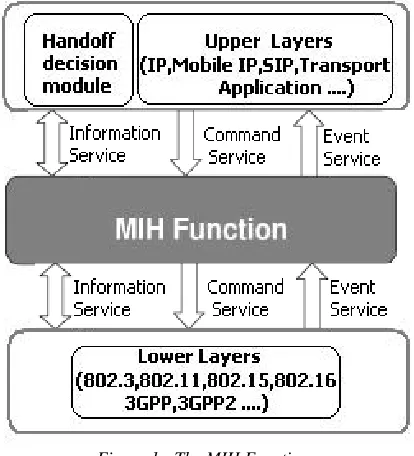
430 MN and network element the MIH Function (MIHF) is a new function model which operates as a shim layer between the Layer 2 and Layer 3 as shown in Fig. 1.MIHF interacts with different MAC layers of heterogeneous networks, manages them through the MIH service access points (MIH LINK SAP), and sends information to the upper layer users (MIH SAP), such as MIP, SIP.
Figure 1: The MIH Function
Media Independent Event Service (MIES) provides various event information corresponding to the dynamic changes in link characteristics, quality and status. Through the MIH SAP the MIH events are sent to upper layers viz. Link Detected, Link Going Down, Link Down and Link UP. Media Independent Command Service (MICS) uses the MIHF primitives to send commands from higher layers (e.g. Policy Engines, Mobility protocols) to lower layers. Some of the MIH Link Commands used in our work are MIH_Get_ inf_Req & Resp, MIH_MN_Candidate_Query _Req & Resp, MIH_HO_Commit_Req &Resp. Media Independent Information Service (MIIS) provides a framework and mechanism for an MIHF entity to discover available neighboring network information within a geographical area to enable the handoff process.
State of the art and related works is presented in section II. The proposed algorithm and the estimation of different performance metrics is explained in section III. The simulation and results of the proposed algorithm is described in section IV followed by conclusion.
2.
RELATED WORKSIn this section we have presented some of the works related to vertical handoff algorithm. Most of these algorithms use available RSS or SINR as handoff metrics to make handoff decision. Vertical hand-off decision algorithms select a best target network based on different metrics viz., network performance, the user’s preference, or both. Using the RSS as the handoff metric [4], it is highly difficult to achieve guaranteed QoS in integrated wireless networks. In order to assure better QoS, the vertical handoff algorithm must have the knowledge about QoS. Authors in [5] have addressed the predicted method for vertical handoff using RSS as the metric, but they have not considered the QoS parameters. Most of the vertical handoff algorithms are based on traditional RSS-based approaches which cannot provide QoS during vertical handoff [4], [5].
431 3. PROPOSED ALGORITHM
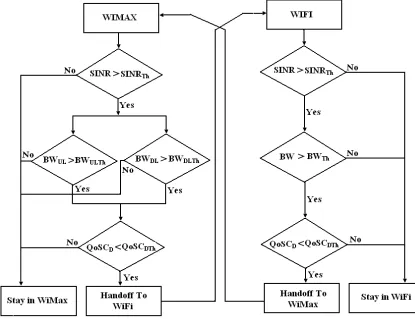
The flow chart of the proposed MIH based QoS aware VHO algorithm(QAVHA) is shown in Fig.2. which makes handoff decision based on the host and available network parameters. The decision function considers SINR, available bandwidth, QoSC delay of the Point of Attachment (PoA) as handoff metrics to implement the decision phase of the VHO.
Step 1: We assume that MN is initially connected to the WiMax Base Station (BS) through interface 1
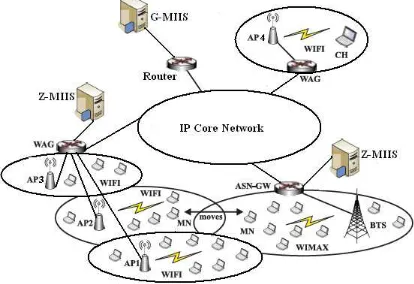
and trying to handoff to the WiFi network as shown in Fig.4. Once it detects new signal from the WiFi network, the interface 2 generates a Link Detected event and it is sent to the MIHF. This information is sent by the MIHF to the MIH User. For optimal target selection in addition to locally available metric like SINR, the handoff module needs other
global information such as the available
[image:3.612.103.518.242.561.2]bandwidth, and QoSC delay parameters about the target network in case of multiple access points present in the MN’s vicinity. Since MN cannot measure such metrics locally, it obtains these
Figure 2:MIH Based QoS Aware Algorithm(Flow Chart)
metrics from the Zone MIIS Server(Z-MIIS) [11] based on MIH procedures. When the MIH User receives the MIH Link detected indication the mobile initiated network assisted handoff (NAHO) is triggered. Immediately the MN sends a MIH_Get_Information_Req message to the Z-MIIS server. The Z-MIIS server database contains the information about the resource availability e.g. the available bandwidth, the SINR ,QoS classes running in each AP and their respective delay in its network. When there is a handoff from or to the
AP occurs, this information is also updated in the Z-MIIS server by the AP.
Step 2: SINR based switching is sufficient for homogeneous networks or in case when the service for the whole network is offered by a single operator. But in case of heterogeneous network environment, networks may come under the control of different operators or may be free access networks such as WiFi. Nowadays for free access or open WiFi networks in public places like restaurants, university, services will be provided by several APs but connected to a single broadband
432 connectivity and good signal strength, when number of users accessing the internet increases in a particular network the traffic increases and becomes a bottle neck. When a MN connects to a busy AP without considering the utilization of it, may cause service degradation due to the possible
congestion. Providing QoS for real-time
applications is very vital because switching to a congested network will lead to degradation in service level. Hence handoff decision based on SINR alone becomes insufficient to provide guaranteed Qos for real-time applications and hence the available bandwidth and QoSC delay also have to be considered in for handoff decision to find out the congestion status of the target AP . Hence the algorithm which runs in the Z-MIIS server initially compares SINR of the target network against a
predefined threshold value denoted by SINRTh . If
the SINR of the target AP is greater than the
SINRTh then it compares the available bandwidth of
the target AP with the threshold BWTh. This is
essential because available bandwidth fluctuates with load on the network making the VHO algorithm unstable. It could happen in some situations that WiMax may have larger available bandwidth than WiFi due to traffic load on WiFi. Step 3: Once the available bandwidth and the SINR of the target AP is greater than the threshold then, on the basis of the service classes and their respective delay in the AP, the algorithm compares the QoSC delay with the threshold value of QoSC
delay denoted by QoSCDTh. Based on the
comparisons the algorithm allocates ranking for all the available APs in the MN’s vicinity .Then the Z-MIIS sends back the list of APs along with their priority ranking list to the MIHF in the MN through the MIH_Get_Information_Resp message. This message is sent back to the MIH user. Now the MIH user sends the MIH_MN_Candid_Query_Req message to the MIHF which forwards this message to the serving BS. Immediately the serving BS starts querying the target network with highest ranking priority asking for the list of resources available based on the information provided by the MN. The candidate network responds the serving BS if it has enough free resources and running the specified QoS classes. Then the serving BS returns
the required information in the
MIH_MN_Candid_Query_Resp message to the MN. At this juncture, the MN based on the information obtained from the Z-MIIS server and the serving BS about the surrounding networks it selects the target network to handoff.
1: Initiate n, SINR, SINRTh, BW, BWTh,
QoSCD, QoSCDTh;
2: Initiate i=0,j=0;
3: If (SINR>=SINRTh && BW>=BWTh)
4: {
5: While i<n do; 6: i ++;
7: if (QoSCD<QoSCDTh)
8: {
9: While I<n do; 10: i ++;
11: While j<i do; 12: j++;
13: if(QoSCD [J]>QoSCD [i ])
14: {
15: temp= QoSCD [i ];
16: QoSCD [i ]= QoSCD [j ];
17: QoSCD [j]=temp;
18: }
19: While i<n do; 20: i ++;
21: While j<i do; 22: j++;
23: { 24: end;
Figure 3: MIH Based QoS Aware Algorithm
3.1 Selecting the best Target PoA
The proposed QAVHA does a priority based ranking as given in Fig.3. which estimates the SINR, bandwidth and QoSC delay of different Access Categories(AC) running in each AP [12]. The processing speed of the four AC queues in each APs will be distinct and the length of the queues will also be varying. After the algorithm estimates the different handoff metrics in each AP, the MN can select the AP with highest SINR, bandwidth and minimum QoSC delay according to the application running on it. The available bandwidth should also be not less than the total throughput of the respective applications. MN moving from WiMax to WiFi has multiple APs in its vicinity as shown in Fig. 4. It is assumed that VO service runs currently in the MN. For example the amount of VoIP packets to be passed out in AP2 is higher than that in AP1. Here the AP1 is selected as the delay of the service class AC_VO is lesser in AP1 than AP2 and also the SINR and Bandwidth of AP1 is above threshold.
433 its traffic condition and the delay of different AC in the Queue to the Z-MIIS server. The algorithm that runs in Z-MIIS server estimate the metrics of the APs in the MN’s geographical area and transmits the ranking list to the MN through the MIH-Get_inf response message. The same is updated in the Local (L-MIIS) and Global (G-MIIS) in a hierarchical manner [11]. The mapping between the QoS class traffic types of WiFi and WiMax networks and their priority list is given in Table 1. The AC_BK has the lowest priority and AC_VO has the highest priority.
Table 1. QoS Class Traffic types mapping
S.NO USER
PRIORITY
802.11E 802.16E
1. 0 AC_VO (Voice) UGS,
eRt-VR
2. 1 AC_VI (Video) Rt-VR
3. 2 AC_BE (Best Effort) BE
4. 3 AC_BK(Background) Nrt-VR
The threshold level for SINR, bandwidth and QoSC delay is fixed based on [13] for real-time services. Data is sent out based on the priority, i.e., from the highest priority to the lowest priority VO, VI, BE and BK.
3.2 Bandwidth Estimation for WiMax
Based on OFDMA, the bandwidth is assigned in the form of data bursts in which a group of slots are included. The BS decides the number of DL and UL slots that is allocated to a station in one frame, and then transmits the resource allocation results through DL-MAP and UL-MAP messages at the start of each DL sub frame. Hence, the MN can easily acquire the usage of WiMax link by grouping the number of allocated slots specified in the
DLMAP/ UL-MAP messages. SDL-Free and SUL-Free
represents the number of unused downlink and
uplink Physical Slots (PSs) within τ, where τ is the
number of Frame allotment time period. Now, the available bandwidth in DL and UL can be estimated by [14]
1
( )
(
, )
( )
UL UL Free UL Slot
BW
t
S
t
τ
t B
t
τ
− −=
−
(1)
1
( )
(
, )
( )
UL UL Free UL Slot
BW
t
S
t
τ
t B
t
τ
− −=
−
(2)
BDL-Slot denotes the number of bits that can be
transmitted in one down link PS and BUL-Slot
denotes the number of bits that can be transmitted in one Up link PS.
3.3 Bandwidth Estimation For WiFi
The time delay DDS during downstream
transmission from an AP is calculated by [15] DDS = DTr + DAck (3)
Where DTr represents the contention and
transmission delay of the data frame and DAck
represents the respective ACK delay.
DTr can be calculated from the beacon delay DB and
the transmission delay of the data frame, and is given by:
DTr = DB + Data/R (4)
Once the data frame is received, the receiver sends an ACK frame after a delay of SIFS. ACK frames are constant in length and are usually sent at the same rate as the data frame. Based on the sender
rate, DAck can be easily determined as:
DAck = SIFS + ACK/R (5)
The potential bandwidth BW from the AP to the MN is calculated by :
BW = DATA/ DDS (6)
4. SIMULATION AND RESULTS
We have used NS2 simulator [17] along with the WiMax module and the MIH (IEEE 802.21) add-ons provided by NIST [18]. We have modeled a 600 × 600 simulation environment with a WiMax BS and 4 WiFi APs. The radius of WiMax network is 500m and that of WiFi network is 100m with an overlapping area as shown in the Fig. 4.
Figure 4: Simulation Network Scenario
434 signalization is used. The approximate transmit rate is taken as 100 packets / second.
In the simulation initially the MN is connected to the WiMax network and communicates with the (Correspondent host) CH through the WiMax network. In the mid of the simulation it starts moving towards the WiFi network and performs handoff to WiFi network. And again after a period of time the MN moves away from WiFi network and handoff to WiMax network. We have considered SINR and Bandwidth based algorithm
as the basic algorithm[9].The performance
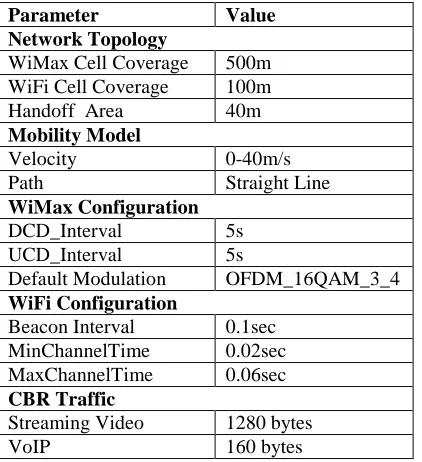
[image:6.612.313.521.123.270.2]evaluation of our scheme is done based on the handoff delay based on QoS Class types, no. of unnecessary handoffs and throughput. The simulation parameters are given in Table 2.
Table 2: Simulation Parameters
Fig. 5. shows the overall throughput at different velocities of the MN.From the simulation result it is seen that an average throughput of 90% is achieved in the proposed algorithm compared to the basic algorithm which provides a throughput of only 72%.This is because in the proposed algorithm the
target network’s congestion status is also
considered in choosing the most suitable network to handoff the connection .This consideration reduces the no. of handoff failures thereby increasing the achievable overall throughput.As the velocity of the MN increases the throughput reduces only by 10% in the proposed algorithm but as high as 28% in the basic algorithm
[image:6.612.86.297.304.535.2]From Fig.6. it is seen that unnecessary handoffs are kept under control based on the proposed algorithm. The unnecessary handoff
Figure 5: Velocity of MN vs Throughput
increases with the increasing velocity of the MN. In the basic algorithm, unnecessary handoffs increase sharply as the velocity increases. The proposed algorithm is able to reduce the unnecessary handoffs up to 67%, even when the velocity of the MN is increased to 40m/sec. The proposed algorithm yields much better performance than the basic algorithm. For MN’s speed with less than 20 m/sec, the proposed algorithm shows an
improvement of 50% and around 67%
improvement at higher velocities.
Figure 6: Velocity of MN vs Unnecessary Handoffs
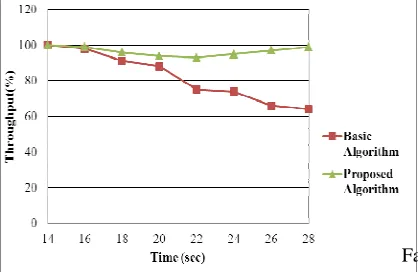
Fig. 7. shows the simulation results of the throughput obtained with the basic algorithm and the proposed algorithm when there are multiple target APs. When there are multiple Aps present in the mobile nodes vicinity the proposed algorithm chooses the best AP based on the available bandwidth and the QoSC delay of the respective QoS class.It chooses the AP having highest available bandwidth with lowest QoSC delay for
the VOIP application. The handoff occurs at 20th
second of the simulation time.The proposed
Parameter Value
Network Topology
WiMax Cell Coverage 500m
WiFi Cell Coverage 100m
Handoff Area 40m
Mobility Model
Velocity 0-40m/s
Path Straight Line
WiMax Configuration
DCD_Interval 5s
UCD_Interval 5s
Default Modulation OFDM_16QAM_3_4
WiFi Configuration
Beacon Interval 0.1sec
MinChannelTime 0.02sec
MaxChannelTime 0.06sec
CBR Traffic
Streaming Video 1280 bytes
[image:6.612.313.522.433.573.2]435 algorithm was able to achieve a throughput of 93% at the time of handoff whereas the basic algorithm could achive only 78% throughput.After handoff the proposed algorithm was able to maintain 99% throughput by choosing the best AP whereas in basic algorithm the throughput drops to 64%. This is because the basic algorithm have choosen to handoff to a congested AP without checking the available bandwidth and QoSC delay based on the application.
Figure 7: Throughput vs simulation time
Fig. 8. shows the simulation results of the handoff delay obtained with the basic algorithm and the proposed algorithm for different QoS class types. The handoff delay incurred by the different QoS class types increases in the basic algorithm based on their priority levels.It takes 154 msec ,198 msec for voice and video traffics respectively for the basic algorithm.For the proposed algorithm it takes 64 msec and 68 msec for voice and video traffics respectively. In the proposed algorithm there is a little variation in the handoff delay for different service class types. This is because the proposed algorithm chooses the target AP with least QoSC delay for the respective QoS class traffic types,whereas in the basic algorithm the traffic has to wait in the APs Queue and get it processed which leads to unnecessary handoff delay.
[image:7.612.90.299.222.358.2]1 - AC_VO (Voice) 2 - AC_VI (Video) Figure 8: Handoff Delay vs QoS Class Types
5. CONCLUSION
QAVHA mainly focuses on reducing the handoff delay, unnecessary handoffs and achieve efficient handoff with guaranteed QoS. The algorithm is tested in IEEE 802.11e and IEEE 802.16e heterogeneous environment. To achieve a
Fa fast and efficient handoff, it is necessary to have interactions with the events from the lower layer. Hence we utilize MIH Event services to reduce the handoff delays. Simulation for these scenarios is done using NS2 and the performance characteristics are studied. When compared with the conventional SINR and bandwidth based VHO algorithm the proposed algorithm performs better during vertical handoff from WiFi to WiMax and vice-versa. It achieves efficient handoff providing guaranteed QoS and suits well for supporting real-time applications to mobile users.
REFERENCES:
[1] Prince Edward.E, Sumathy.V, A survey of
seamless vertical handoff Schemes for WiFi/WiMax heterogeneous networks. IEEE
International Conference on Signal Processing & Communications, pp. 1-5, July
18- 21, 2010, SPCOM 2010.
[2]
Prince Edward. E, Sumathy. V, “ Enhanced
SIP Based Method for Vertical Handoff
Between WiFi and WiMax networks”, 16th
IEEE International Conference on Networks,
pp. 1-5, ICON ‘08,12-14 Dec 2008.
[3] IEEE 802.21/D03.00, "Draft IEEE Standard for Local and Metropolitan Area Networks: Media Independent Handover Services", December 2006.
[4]
M. Liu, Z. Li, X. Guo, and E. Dutkiewicz,
“Performance Analysis and Optimization of
Handoff Algorithms in Heterogeneous
436
Mobile Computing, vol. 7, no. 7, pp. 846-857,
2008.
[5] S.-J. Yoo, D. Cypher, and N. Golmie, ”Predictive link trigger mechanism for seamless handovers in heterogeneous wireless networks,” Wirel. Commun. Mob. Comput., vol. 9, pp. 685-703, 2009.
[6] K. Yang, I. Gondal, B. Qiu and L. S. Dooley, "Combined SINR Based Vertical Handoff
Algorithm for Next Generation
Heterogeneous Wireless Networks",
Globecom 2007, Washington, US, 2007
[7] Suk young L, Kotikalapudi S, K]yungsoo K, Jong Hyup L, Yoon H K, Nada G. “Vertical Handoff Decision Algorithms for Providing
Optimized Performance in Heterogeneous Wireless Networks”, IEEE transactions on
vehicular technology, (2008).
[8] M.J. Kim, S.W. Son, and B.H. Rhee, “QoS
Based Provisioning Vertical Handover
between IEEE 802.11 and 802.16,” Proc. 11th
Int’l Conf. Advanced Comm. Technology (ICACT), pp. 1415-1418, Feb. 2009.
[9] Z. Dai, R. Fracchia, J. Gosteau, P. Pellati, and G. Vivier, “Vertical Handover Criteria and Algorithm in IEEE 802.11 and 802.16 Hybrid Networks,” Proc. IEEE Int’l Conf. Comm.
(ICC), pp. 2480- 2484, May 2008.
[10] Tin-Yu Wu1, Wei-Tsong Lee, Tsung-Han Lin, Wei-Lun Hsu, Kai-Lin Cheng “Using Service Delay for Facilitating Access Point Selection in VANETs”. ,IARIA 2013 pp. 13-19,June 2013.
[11] F´abio Buiati, Luis Javier Garc´ıa Villalba,
Daniel Corujo, Jo˜ao Soares, Susana
Sargento, and Rui L. Aguiar “Hierarchical neighbor Discovery scheme for handover optimization” IEEE Communication Letters, Vol 14,No.11,November 2010.
[12] Wright, D.J., “Maintaining QoS During Handover Among Multiple Wireless Access Technologies,” International Conference on
the Management of Mobile Business, 2007. ICMB 2007. , pp.10-10, July 2007.
[13] Jeffery G. Andrews, Arunabha Gosh, Rias Muhamed, “Fundamentals of WiMAX :
Understanding Broadband Wireless
Networking”, June 2007.
[14] Gu, S, & Wang, J. An enhanced handover target cell selection algorithm for WiMAX network," 15th Asia-Pacific Conference on
Communications (APCC), (2009). , 774-777.
[15] S. Vasudevan et al., “Facilitating Access Point
Selection in IEEE 802.11 Wireless
Networks,” Proc. Internet Measurement
Conf., Usenix Assoc., 2005, pp. 293–298.
[16] F. Zarrar Yousaf, K. Daniel, C. Wietfeld,
"Analyzing the Throughput and QoS Performance of a WiMAX Link in an Urban
Environment”, IN-TECH, 2009, pp.pp.
307-320 (ISBN:978-953-7619-53-4). [17] NS-2. http://www.isi.edu/nsnam/ns/.
[18] IEEE 802.16 AND IEEE 802.21 Simulation Model for NS2