ISSN: 1992-8645 www.jatit.org E-ISSN: 1817-3195
TOWARD THE MATURITY OF SOFTWARE ENGINEERING:
UNIVERSAL, FORMAL, AND MATHEMATICAL
DEFINITION FOR TYPE AND OBJECT AS TWO DISJOINT
BASIC CONCEPTS
1BERNARIDHO I HUTABARAT, 2KETUT E PURNAMA, 3MOCHAMAD HARIADI
1 Student, Department of Electrical Engineering, ITS, Surabaya
2 Lecturer, Department of Electrical Engineering, ITS, Surabaya
3Assoc Prof, Department of Electrical Engineering, ITS, Surabaya
E-mail: [email protected], [email protected] , [email protected]
ABSTRACT
Software engineering has not reached maturity level as classic engineering. Theoretical foundation for software engineering lacks the precision and universal agreement of terms. By contrast, classic engineering are founded on the seven base dimensions that are precise and universally agreed.
This paper aims to bring software engineering into maturity, in terms of the precision of terms by establishing and mathematically defining two basic concepts: type and object. Just like the seven base dimensions in physics be part of theoretical foundation for classic engineering, the two basic concepts type and object are the theoretical foundation for software engineering.
This paper lists twelve problems with current definitions of type and object. The proposed definition and concepts are linguistically tested and mathematically formulated using thirty five formulas. Each concept – type, object – is unique and has single interpretation. This paper shows that class is a derived concept – not a basic concept – and that class can be defined on the proposed disjoint basic concepts: type and object.
Keywords: Type, Object, Conceptual Integrity, Basic Concept, Engineering
1. INTRODUCTION
Engineering books such as [1] excluded Software Engineering as engineering branch. Reference [1] does not write any reasons for rejection, but software engineering lack of well-definedness of something similar to the seven base dimensions is perhaps the primary factor.
Many software engineering books and research papers have been written. Few – if any – attempt to solve the above very important problem. This paper is an attempt to solve the problem.
The authors of this paper examine the problems with the prevalent theory: Object-Orientation. The authors examine the definitions in standards, textbooks, research papers, and webpages about Object-Orientations (or Object-Oriented [2]).
In examining the problems and proposing the solutions, two approaches are used: linguistic and mathematic. It is the linguistic approach that has
not been taken extensively by any previous paper.
Despite the proliferation of mentions about formal approach in software engineering research paper,
informal explanations dominate the research paper,
textbooks, and international standards. It is the
informal text explaining the formal things (e.g., programming-language, equations) that has not been exposed to scrutiny.
Fig 1 shows the total seven base dimensions and several derived dimensions in physics that underlie classic engineering. There are two characteristics worth mentioning. Firstly, the number of base dimensions is fixed; while the number of derived dimensions can vary over time. Secondly, all derived concepts are based on base dimensions.
Having those two properties is the consequence of this paper’s aim. Adjusting to the proposed concepts at hand, the authors aim to establish four basis concepts that are fixed forever. The second similar property is that all derived concepts should always be based on the basic concepts. These two properties are absent in software engineering.
ISSN: 1992-8645 www.jatit.org E-ISSN: 1817-3195
Fig 1 Base-dimensions and Derived-dimensions in Physics, foundation for Classic Engineering
[image:2.612.217.408.438.706.2]ISSN: 1992-8645 www.jatit.org E-ISSN: 1817-3195
This paper is organized as follows. The first section introduces the subject, the problem, and scope of the solution. The second section lists twelve (12) problems in Object-Orientation from research papers, international standards, textbooks, and webpages. The third section describes the solutions: type, object, and their disjointness are mathematically formulated using propositional calculus (set theory). The solution is guided by the paraphrased definition of conceptual integrity. The fourth section applies the proposed theory to solve the problems in the second section. The fifth section presents NUSA programming-language that shows how a non-OOPL can have expressive power of OOPLs (encapsulation, inheritance, polymorphism) without resorting to class. The sixth section compares the old versus new theory. The seventh section concludes the study. Appendix 1 explains the universal definition of class based on Basic Concepts. Appendix 2 explains non-universal definition of class, based on the basic concepts. Appendix 3 proves that class is derived concept, similar to the way of physics.
2. THEORY OF OBJECT-ORIENTATION
2.1 The Informality of Theories
One of weaknesses of OO theory is presented in ref [3]. Bertino and Martino wrote.
Object-Oriented systems can be classified into two main categories: systems supporting the notion of
class and those supporting the notion of type ...
Although there are no clear lines of demarcation between them''
The second example is from Grady Booch, the key author of UML who in ref [4] defines class as
The terms class and type are usually (but not always) interchangeable, a class is slightly different concept than a type, in that it emphasizes the importance of hierarchies of classes.
There are two deficiencies to find in the definition of class:
• It is informal (and consequently imprecise): note the word usually
• It is incorrect. The notion of type hierarchy also exists. The term class hierarchy does not give more emphasis than type hierarchy. The vagueness, the ambiguity, and the lack of well-founded boundaries have given way to the obscurity of definitions. It is up to the individual authors to come up with their opinion regarding the difference between class and type. UML standards [5, 6] do not define what object-orientation is.
2.2 Lack of universality
Definitions of object are ad hoc. We provide four examples among literally thousands of webpages containing the definition of object. Following each sample definition is one or two thought-provoking questions. A webpage from Monash University (www.csse.monash.edu.au/damian/papers/PDF/ cyberdigest.pdf, accessed 2011-07-19) defines
an object is anything that provides a way to locate, access, modify, and secure data.
Fig 3 First Sample Definition of Object
One valid question for the first sample definition is "If a procedure provides a way to locate data, is the procedure an object?''.
The second sample comes from webpage www. wordiq.com/definition/Object-oriented (accessed 2011-07-01). It defines object as
Packaging data and functionality together into units within a running computer program; objects are the basis of modularity and structure in an object-oriented computer program.
Fig 4 Second Sample Definition of Object
One valid question for the second definition is: "has there been no modular program before Object-Oriented Programming Languages were made?'' The webpage does not answer the question.
The third sample comes from SAP - a giant software corporation. Authorized personnels in http://help.sap.com/saphelp/nw2004s/helpdata/en/ c3/225b5654f411d19... (accessed 2011-07-19) define object as
These objects are first defined by their character and their properties which are represented by their internal structure and their attributes (data).
Fig 5 Third Sample Definition of Object
Two valid questions for the second definition are "What is the character of an object?'' and "Why do other authors not define that 'character of an object defines the object'?''
The fourth example of webpage defining the object is www.slideshare.net/rickogden/beginners- guide-to-object-orientation (accessed 2011-07-19).
An object is created by creating a new instance of a class. Objects of the same class have exactly the same functionality, but the properties within the object are what makes them different.
ISSN: 1992-8645 www.jatit.org E-ISSN: 1817-3195
That definition is keyword dependent, being dependent on the usage of keyword class. One valid question is "Oracle Corp claims that Oracle PL/SQL is object-oriented, and Borland claims that Turbo Pascal 5.5 up to Turbo Pascal 7.0 is object-oriented; but those programming-languages do not have class. Does the author mean that Oracle PL/SQL and Turbo Pascal are not object-oriented language just because they do not have any classes?'' Referring to three previous examples, the webpage does not answer those questions.
In several previous paragraphs the authors above mentioned webpages written by both academics and giant corporations. The ad hoc definitions they have given do not match the expectation of high degree of precision and trustworthiness of writings.
2.3 Redundancy of the term object and instance Object and instance are redundant in OO literature. The fourth sample definition in sec II.B “Lack-of-universality” serves as an example, yet this problem is not limited to including the webpages not trusted by academic community. International standards suffer the same problem. C++ standard [7] sec 1.9 contains these two statements:
An instance of each object with automatic storage duration (3.7.2) is associated with each entry into its block. Such an object exists and retains its last-stored value during the execution of the block and while the block is suspended (by a call of a function or receipt of a signal)
Fig 7 Fifth Sample Definition of Object
Here is another example from research paper [8]. The term instance is redundant.
An object is an instance of a class.
Fig 8 Sixth Sample Definition of Object
2.4 Redundancy of the term object and instance This is the consequence of the absence of formal differences among class and type. Here is an example copied from http://www.delphibasics.co. uk/Article.asp? Name=OO.
We have defined a class called TSimple as a new
data type.
Fig 9 Sample Sentence Containing Redundant Terms: Class and Data Type
The redundancy is also present in the C++ Standard [7]. The initial sentence of chap 9 (titled
"Class'') in the standard equates class to type. Class is redundant.
A class is a type.
Fig 10 Sample sentence containing redundant terms: class and type
The redundancy is present in subsec 4.2.16 of Java standard [9] that is boxed in Fig 11. It shows the redundancy and vagueness.
We often use the term type to refer to either a class or an interface.
Fig 11 Sample Sentence Containing Redundant Terms: Type, Class, and Interface; with No Clear Boundaries
Redundancy also happens in relation to the way both terms are used. Here is an example taken from a research paper [10].
"Generics for the Masses" (GM) and "Scrap your Boilerplate" (SYB) are generic programming approaches based on some ingenious applications of Haskell type classes.
Fig 12 Sample Sentence Containing Term that is Unnecessarily Long: Type Class
Reference [11] is a paper about Java type qualifier. One statement contains redundancy regarding class and type (see Fig 13).
For any class C, a reference of type readonly C may not be used to modify the object it refers to, which is a particularly useful annotation for method arguments and results.
Fig 13 Another Sample Sentence Containing Redundant Terms: Class and Type
Reference [12] is a research paper titled "Typeless programming'' which contains this boxed sentence below with the word "type".
The term Vector< super Vector< extends List<Integer>> is for example a correct type in Java 5.0.
Fig 14 A Sample Sentence Containing the Term Type
Yet the source-code that follows contains the word "class'' instead of type. The code explaining that statement starts with this line (note the word class instead of type).
class Matrix extends Vector<Vector
<Integer> >
Fig 15 A Source-code Containing the Word Class, Inconsistent with the Sentence Preceding It.
ISSN: 1992-8645 www.jatit.org E-ISSN: 1817-3195
[image:5.612.158.517.57.297.2]taken from [13] sec 3. The author speaks about type; however, the third entry contains class.
Fig 16 Redundancy of Terms: the Heading and Human Language Sentences are Inconsistent with the Mathematical Formula
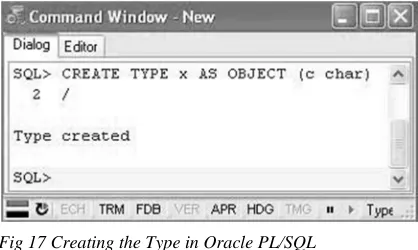
[image:5.612.91.300.314.439.2]2.5 Conceptual disintegrity: type equals object Type should not be equal to object, and vice versa. Oracle PL/SQL equates type with object as pictured in Fig 17. PL/SQL programming-language creators confused object with type.
Fig 17 Creating the Type in Oracle PL/SQL
We test our hypothesis by creating an object. If object = type, then the contents of metadata-view
user_objects and user_types will be the same.
But fig 18 shows the contents are different. Hence: The concept of type looks to be equal to the
concept of object, but
The concept of type is different from that of object (hence a contradiction, a conceptual disintegrity).
The differences are not precisely formulated.
Similar disintegrity takes place in subsection 8.2.1 of C# Standard [14] which contains this entry for object. The header says Type but the entry says object. C# standard committee equates type with object (see Table II).
Reference [15] also mistook object with type. In one of the definition the author wrote "objects are
implementations of abstract data types."
Fig 18 Incorrectness of Type = Object; Type ≠ Object.
2.6 Conceptual disintegrity: class equals object Similar mistake and problem appear in Java standard [9] sec 4.3.2; asserting that "The class Object is a superclass (8.1.4) of all other classes''. Object is said to be equal to class. Table II tabulates partial content of C# standard [14] subsection 8.2.1 that shows the essentially same mistake.
Table II. Class equals Object
Type Description Example object The ultimate base type
of all other types
object o = null;
2.7 Conceptual disintegrity: object equals intermediate-code
The disintegrity of concepts becomes evident. We start with the notion of object code. The object code means intermediate code in the code translation textbooks such as [16]. The intermediate code is the result of the compilation of source code.
According to [17] there are two possible definitions for object:
• object = intermediate code
• object code = intermediate code
Both equations are proved to be false, shown below through modus Tollens. The modus is formalized as follows:
if p then q ~q then ~p
ISSN: 1992-8645 www.jatit.org E-ISSN: 1817-3195
Let us assign that object is the outcome of compilation process to p and object is intermediate code to q. To show the imprecision in IEEE definition, we must show that ~q holds. Consequently, ~p holds too. While the ~q is read as object it is NOT intermediate code. It is the fact that object is not intermediate code. We can then conclude that object is NOT the outcome of compilation process.
2.8 Incorrect semantics
Theories within Object-Orientation literature can be semantically incorrect. The repetition of words is evident from the IEEE definition and some other example texts in the standard. We explore the second possibility of equality in the previous section: object = intermediate code. If that equality holds, the second equality cannot hold. Linguistically, the two equalities must be presented like the ones below.
• object = intermediate code
• object code = intermediate code code
Notice the repetition of the word code. Fig 21 shows another example exhibiting similar problem. A possible improvement is done by writing two equalities for IEEE Standard Glossary of Software Engineering Terminology which are shown below:
• object = intermediate
• object code = intermediate code
The last proposed equation is free from the repeated words problem. But the equality of object = intermediate is in conflict with any English dictionary [18]. No English dictionary equates object with intermediate or intermediate code.
Incorrect semantics is also shown through substitutions test [19]. Let us take one example from Java standard [9].
4.3.1 An object is a class instance or an array. 4.3.2 A Class object exists for each reference type.
Fig 20 Two sentences that will be tested for semantics correctness
If the semantics is correct, the semantics of this statement below should be correct. We substitute object with 'class instance'.
A Class class instance exists for each reference
type.
Fig 21 Example of Incorrect Semantics Found through Words Substitution
However, the sentence is semantically incorrect due to the double word 'Class class'. Applying the substitution test for the entire text of the standard will result in more occurences of semantic error.
2.9 Confusing word order
The following boxed text is contained in subsection 17.1.2.1 of C# Standard [14]. Note there are two phrases in which the difference is only on the word order: class object versus object class.
Except for class object, every class has exactly one direct base class. The object class has no direct base class and is the ultimate base class of all other classes.
Fig 22 Confusing Word Order
2.10Difficult to understand concepts
We argue that the concept like instance is hard to understand. Consequently, the concepts such as 'instance variables' are even harder to understand. Reference [20] mentioned the difficulty in explaining the concept of instance.
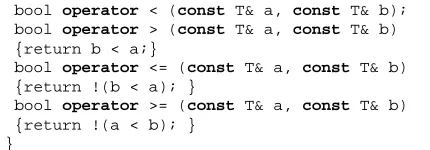
Järvi, Marcus, and Smith have offered strikingly different programming concepts that are limited to C++ (one of Object-Oriented programming-languages). They created a class named concept, like this one from ref [21].
concept LessThanComparable<typename T> {
bool operator < (const T& a, const T& b); bool operator > (const T& a, const T& b) {return b < a;}
bool operator <= (const T& a, const T& b) {return !(b < a); }
bool operator >= (const T& a, const T& b) {return !(a < b); }
[image:6.612.311.526.468.543.2]}
Fig 23 The Class Implemented as Concept
2.11Difficult to understand concepts
ISSN: 1992-8645 www.jatit.org E-ISSN: 1817-3195
2.12No concept is defined
Some research papers (e.g. [26]) do not define any concept). The authors in [26] attempted to explain Object-Orientation using logic. There is no definition of object, type, class, methods, and the usual terms in Object-Orientation. The author of [27] refers properties in C# as syntactic sugar. If property is a syntactic sugar, it deserves neither a notion of Basic Concept nor definition.
3. PROPOSED SOLUTIONS
3.1 Integrity: irreducibility and unity
Brooks in [28, 29] has written about conceptual integrity but he does not define it. References [28, 29] only wrote "Conceptual integrity is the most
important consideration in system design''.
We define conceptual integrity as the integrity of
concepts, and consequently include the unity of
concepts. The unity of concepts precludes the
redundancy of concepts. The system that lacks
conceptual integrity has conceptual disintegrity. As the systems lack the unity of concepts, it embodies redundant and incoherent concepts.
References [28, 29] wrote "It is better to have a
system that omit certain anomalous features and improvements, but it still reflects one set of better ideas, than to have one that contains many good, yet providing uncoordinated ideas''. If we remove
"good but'' from the original sentence; and replace
features, improvements, and ideas with concepts
we get this slightly paraphrased sentence:
It is better to have a system omit certain anomalous concepts, but to reflect one set of good concepts, than to have one that contains many uncoordinated concepts.
Fig 24 Proposed Theory About the System Having Conceptual Integrity
That statement will be the basis of this paper. We hypothesize that class and instance are anomalous and redundant concepts. We hypothesize that object is also an anomalous concept in Object-Oriented literature, but not anomalous if defined precisely. We propose a precise definition for the object concept in this paper.
3.2 Unique Basic Concepts and Their Informal definitions
We introduce four basic concepts along with their informal definitions: VOTO, abbreviation for
Value Operation Type Object in [30]. Our proposed basic concepts are similar to the four core concepts proposed in [23]. We use 'object' (instead of variable AS in [23]) because
(1) Not all objects are variables; some objects are constants [30].
(2) Even further, not all objects are value-assignable [30].
Some objects cannot be assigned to values; hence some objects are neither constants nor variables. A good informal definition of object can be found in C standard [31] that in sec 3.14 defines object as:
region of data storage in the execution environment, the contents of which can represent values.
The following subsections contain informal definitions for basic concepts that were partially written in ref [30].
3.2.1 Type
Type is defined as follows:
• Types are first categorized into metatypes (MT) and nonmetatypes (NMTs)
• A type may or may not have identity.
• TypeCategories := {General-types, Special-types}
• General-types contain values.
• Special-types contain no values.
• General-types := {Basic-types, Record-types, Collection-types}
• SpecialTypes := {void, Module, Program}
3.2.2 Object
Object is defined as follows:
• An object has identity.
• An object is of some type.
• Objects of Special-types cannot have value
• Objects of types are General-objects
• Objects of types are Special-objects
• General-objects have value
• Special-objects do not have value
3.2.3 Disjointness of types and objects
ISSN: 1992-8645 www.jatit.org E-ISSN: 1817-3195
• Object is not type.
• Type is not object.
Therefore
The concepts of object and type are disjoint (see Fig 25).
Individual objects are disjoint from individual types.
Fig. 25 Type and Object are Disjoint Concepts
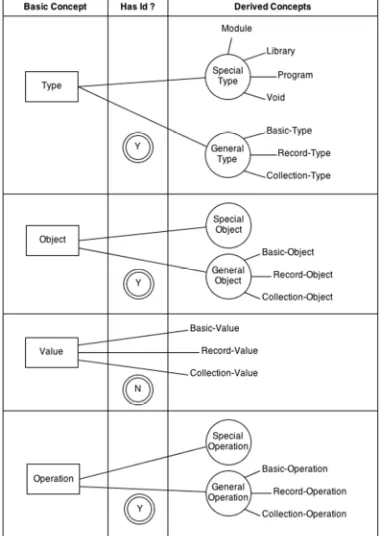
3.3 Categorization of Basic Concepts into Basic, Collection, and Record
The author of [30] proposed orthogonal categorization toward basic concepts that implied the presence of twelve derived concepts (Fig. 26):
• Basic-type
• Basic-object
• Basic-value
• Basic-operation
• Record-type
• Record-object
• Record-value
• Record-operation
• Collection-type
• Collection-object
• Collection-value
• Collection-operation
[image:8.612.88.534.74.743.2]Those derived concepts will prove to be sufficient and useful for the rewritten theories and sentences in section 4.
Fig 26 Formal Definition for Basic Concepts; Fulfill the Principle of Irreducibility and Conceptual Integrity.
3.4 Unique Basic Concepts and Their Formal definitions
The concepts are formal if they only have one interpretation.
Basic_Concepts := {Value, Operation, Type, Object} (1)
∀ Ci∈ Basic_Concepts (unique(Ci)) (1)
The basic concepts of programming introduced here have two important properties:
• Formal (Hence there is no usually, like the one in Booch).
• Nonredundant (type only, no redundancy with other concept like class). (2)
3.4.1 Type
These are the itemized definitions for type.
• ∀ t ∈Types HasId(t) ^ HasNoId(t) (3)
• Types = MetaType ∪ NonMetaTypes (4)
• Metatype ∩ NonMetaTypes = ∅ (5)
• NonMetaTypes = GeneralTypes ∪
SpecialTypes (6)
• ∀ t ∈ General-types SetOfValues(t) ≠∅ (7)
• ∀ t ∈ Special-types SetOfValues(t) = ∅ (8)
• General-types = Basic-types ∪ Record-types
∪ Collection-types (9)
• Basic-types ∩ Record-types = ∅ (10)
• Basic-types ∩ Collection-types = ∅ (11)
• Record-types ∩ Collection-types = ∅ (12)
3.4.2 Object
These are the itemized definitions for object.
• ∀ o ∈ Objects (has_id (o)) (13)
• ∀ o ∈ Objects ∃ t ∈ Types (IsOfType (o, t)) (14)
• Objects = SpecialObjects ∪ GeneralObjects (15)
• SpecialObjects ∩ GeneralObjects = ∅ (16)
• GeneralObjects = Basic-objects ∪ Record-objects ∪ Collection-objects (17)
• Basic-objects ∩ Record-objects = ∅ (18)
• Basic-objects ∩ Collection-objects = ∅ (19)
• Record-objects ∩ Collection-objects = ∅ (20)
3.4.3 Disjointness of types and objects The disjointness is formulated as follows:
• ∀ t ∈ Types ∀ o ∈ Objects (o ≠ t) (21)
• Types ∩ Objects = ∅ (22)
• ∀ t ∈ Types unqouted (lowercase(id(t))) ≠
object (23)
U: Universe of (basic) concepts [simplified by excluding two others: value, operation] type object
Basic-type Basic-object
Record-type Record-object Collection-type Collection-object
Collection-value Basic-value
Record-value
Basic- operation
Collection- operation
ISSN: 1992-8645 www.jatit.org E-ISSN: 1817-3195
• ∀ o ∈ Objects unqouted (lowercase(id(o))) ≠
type (24)
3.4.4 Category Relation
The category is defined as a relation that is transitive. The relation is denoted by symbol ≼. The words denoting the operands to the operation ≼ is singular. The application of the category relation to types is listed below:
• Metatype ≼ Type (25)
• NonMetaType ≼ Type (26)
• General-type ≼ NonMetaType (27)
• Special-type ≼ NonMetaType (28)
• Basic-type ≼ General-type (29)
• Record-type ≼ General-type (30)
• Collection-type ≼ General-type (31)
The transitivity makes for these relations for types
• General-type ≼ Type (through
NonMetatype) (27a)
• Special-type ≼ Type (through NonMetatype)
(28a)
• Basic-type ≼ Type (through General-type and NonMetaType) (29a)
• Record-type ≼ Type (through General-type and NonMetaType) (30a)
• Collection-type ≼ Type (through General-type and NonMetaType) (31a)
Formulas #4 through #12 are partially captured in the six formulations below
• A general-type is a type
• A special-type is a type
• A basic-type is a type
• A record-type is a type
• A collection-type is a type
Concerning object and value we can write
• General-object ≼ Object (32)
• ∀ GO ∈ General-objects, has_value (GO)
(33)
Proof:
∀ o ∈ Objects ∃ t ∈ Types (IsOfType (o, t)) (14)
∀ t ∈ General-types SetOfValues(t) ≠∅ (7)
3.5 Hypothesis: equivalent synonyms
In this section we list synonyms of one word in
[image:9.612.310.461.159.286.2]original text. The presence of multiple equivalent terms is due to the careless wording in textbooks and international standards.
Table III Equivalent Synonyms
No Original Equivalent 1 Class Type 2 Class record-type 3 Class Record 4 Instance Object 5 Subclass derived-type 6 Property Value 7 Property Operation 8 Member Column 9 Variable Object
[image:9.612.97.521.347.636.2]3.6 Hypothesis: essetially equivalent phrases It is impossible to list all equivalent phrases. Sample equivalent phrases are listed in Table IV.
Table IV Equivalent Phrases
No Original Equivalent
1 data type Type 2 data type record-type 3 class type record-type 4 base class base-type 5 sub object Column 6 Subobject Column 7 member subobject Column 8 data member Column 9 function member Operation
Object-Orientation Proposed theory
Fig 27 Object-Orientation is Theory with Highly Redundant Terms. Proposed Theory Contains No Redundancy
Fig 27 and fig 28 summarize the comparison of theories in graphical way (sec 6 details the comparison of theories). While there are derived terms (like record-type) in the proposed theory, the most important concepts are type and object.
type class interface class type class object object class
object instance
ISSN: 1992-8645 www.jatit.org E-ISSN: 1817-3195
[image:10.612.90.301.74.225.2]Range Domain
Fig 28 Partial Mapping of Terms; Graphical Version of Table II and Table III
3.7 Scope of the solutions
Literatures about Object-Orientation often relate class and object with method. Method is operation. The first author of this paper explained methods in [32], contrasted Module-based Encapsulation versus Type-based Encapsulation in [33], and related module to namespace in [34]. Methods have also been explained in the light of orthogonality in [35]. NUSA is a programming-language that adopts specific approach of Module-based Encapsulation. In that approach, type cannot contain operation or operator [33]. This approach is also adopted by TTM in Other Orthogonal Very Strong Suggestion number 2 “Types and operators unbundled'' [36].
Solving the problems listed in the previous section is a prerequisite requirement before solving the problems of defining methods in the precise way. All of these mount to the decision of excluding the treatment of methods (in Object-Orientation folklore) in this paper.
3.8 Column and Arity
In this paper, the term column is used instead of field, attribute, and data member. A column is an object, but an object is not necessarily a column.
A C++ source-code below shows that object1 is a column, and necessarily an object. On the other and, object2 is an object; but not a column.
typedef struct Type1 {
public: char object1;}} };
void main() {
struct Type1 Object2;}} Object2.object1 = 'y'; // there are two objects }
We denote the number of columns in record-type as well as record-object using the function Arity.
• ∀ RT ∈ Record-types Arity(RT) ≥ 0 (34)
• ∀ RO ∈ Record-objects Arity(RO) ≥ 0 (35)
3.9 Hypothesis on some common conventions Programmers and authors have some conventions on writing the source-code. Some of the conventions are prefixing the type name with T (for Type) or C for (Class). Programming library Turbo Vision from Borland use prefix T. Microsoft in its .NET programming library use prefix C (msdn.microsoft.com/en-us/library/20t753se.aspx , accessed 2012-05-03, is an example).
4. RESULTS (PROVING THE SOLUTIONS)
4. 1 Replacing instance by object
We take an example repeated from sec II.B and name it as Sentences 1a to serve as an example how we can make better explanation.
An object is created by creating a new instance of a class. Objects of the same class have exactly the same functionality, but the properties within the objects are what make them different.
The following Sentences 1b are the result of replacing instance by object, with the mapping #4 in Table II.
An object is created by creating a new object of a class. Objects of the same class have exactly the same functionality, but the properties within the
objects are what make them different.
The mapping shows there is no new information in the first sentence "An object is created by creating a new object''. It is redundant.
4. 2 Replacing class by type
We start this section by improving the rewritten sentences in the previous section. We apply mapping #2 in Table II: replace class by type for all rewritten sentences within this subsection.
Sentences 1c are the result of the first rewrite.
An object is created by creating a new object of a
type. Objects of the same type have exactly the
same functionality, but the properties within the
objects are what make them different.
The rewritten text is clearer. The concepts are becoming integrated without redundancy. Here is • class
• class type • data type • object class
• object • instance
• type • record • record-type
ISSN: 1992-8645 www.jatit.org E-ISSN: 1817-3195
another example, Sentence 2a, that is copied from www.delphibasics.co.uk/Article.asp? Name=OO.
We have defined a class called TSimple as a new data type.
We use mapping #2 in Table II to replace class by type. Sentence 2b is the result having the conceptual integrity.
We have defined a type called TSimple as a new data type.
We refer to the sentence below as Sentence 3a. It is written in Sec 9.2 of C++ standard.
A class definition introduces a new type.
This is Sentence 3b obtained by replacing class with type, and introduces with defines.
A type definition defines a new type.
4. 3 Using equivalent synonyms
We start this section by improving the rewritten
Sentences 1c in the previous section. We replace
properties with values using the mapping #6 in Table II. The result is Sentences 1d below.
An object is created by creating a new object of a
type. Objects of the same type have exactly the
same functionality, but the values within the objects are what make them different.
Sometimes replacing the words by means of equivalent phrases is better. Using the mapping #3 in Table III we replace data type in Sentence 2b with record-type. The result is Sentence 2c below.
We have defined a type called TSimple as a new
record-type.
The resulting text will be compared against the improvement of source-code in sec 4.6. In the subsequent sentences, we cover the more complex sentences.
The next sentence is taken from point 1 within Chap 9 (chapter about Classes) in C++ Standard [7]. We call it Sentence 4a.
An object of a class consists of a (possibly empty) sequence of members and base class
objects.
We use the mapping #2 in Table II to replace class by record-type, mapping #6 in the same table to replace member with column, and replace one of the word object with column. We add - after the
word base and remove the space before the word type (the word type that substitutes the word class). The result is Sentence 4b.
An object of a record-type consists of a (possibly empty) sequence of columns and base-type
columns.
In the conversion of two subsequent original sentences, we replace class with record-type (mapping #2 in Table II). The original sentences are taken from chapter 3 point 3 in C++ standard [7]. We call the first one as Sentence 5a (see below).
Note: class objects can be assigned, passed as arguments to functions, and returned by functions.
We rewrite the previous sentence by replacing class with record-type. The result is Sentence 5b.
Note: record-type objects can be assigned, passed as arguments to functions, and returned by functions.
This is another sentence from the C++ standard [7] chapter 9 and the same point (3). We call it
Sentence 6a.
(except objects of classes for which copying has been restricted; see 12.8).
We apply the same mapping to replace class with record-type. The result is Sentence 6b below.
(except objects of record-types for which copying has been restricted; see 12.8).
4. 4 Using equivalent phrases
The rewriting of sentences can be complex. In this section we convert the phrases of sentences. Point 3 in chap 9 of the C++ standard [7] is written as what we call Sentence 7a below.
Complete objects and member subobjects of a class type shall have nonzero size.
We apply the mapping #3 (class type with record-type) and mapping #7 (replace member subobject with column) for rewriting; both are from Table III. The result is Sentence 7b below.
Complete objects and columns of a record-type shall have nonzero size.
In which they can be rewritten as two sentences
Sentence 7c and Sentence 7d to make explanation
more explicit about C++.
ISSN: 1992-8645 www.jatit.org E-ISSN: 1817-3195
nonzero size. Columns of a record-type shall have nonzero size.
Similar rewriting (replacing class type with record-type, mapping #3 in Table III) can be applied to another sentence within C++ standard. This is the Point 4 in chap 9 of the C++ Standard. We call it Sentence 8a.
Note: aggregates of class type are described in 8.5.1.
Using the mapping #3 in Table III (replace class type with record–type) we obtain Sentence 8b.
Note: aggregates of record–type are described in 8.5.1.
The next example for this subsection comes from point 4 of chap 9 of C++ standard which we refer to as Sentence 9a. POD is short for Plain Old Data. That term is unnecessary.
A POD-struct is an aggregate class that has no non-static data members of type non-POD-struct, non-POD-union (or array of such types) or reference, and has no user-declared copy assignment operator and no user-declared destructor.
We rewrite Sentence 9a by replacing POD-struct with struct, class with record-type, non-static with dynamic, data member with column, reference with address, and operator with operation. The result is
Sentence 9b below.
A struct is an aggregate record-type that has no
dynamic columns of type non-struct, non-union
(or array of such types) or address, and has no defined copy assignment operation and no user-defined destructor.
4. 5 Paraphrasing
Rethinking further, Sentence 9b can be improved by paraphrasing to be Sentence 9c below. C++ has two record-type-qualifiers: struct and class. The
word aggregate is not needed.
A record-type with qualifier struct has no
dynamic columns of type non-struct, non-struct-union (or array of such types) or address; and has
no user-defined copy assignment operation and no
user-defined destructor.
Other paraphrasing techniques that results in better explanation are discussed in the following
two subsections.
4.5.1 Changing the word order
The words constituting phrases 'record-type objects' are paraphrased into 'objects of record-type'. We apply the rule to rewrite the end of
Sentence 4b ('record-type objects') to be 'objects of
record-type' in Sentence 4c below.
An object of a record-type consists of a (possibly empty) sequence of columns and base-type
columns.
We can apply a similar rule to rewrite Sentence
5b to be Sentence 5c below.
Note: objects of record-type can be assigned, passed as operands to functions, and returned by functions.
4.5.2 Changing "objects of <x-type>" into “x-objects”
Objects of record-type can be paraphrased into record-objects. This paraphrasing technique allows us to rewrite Sentence 5c into Sentence 5d below.
Note: record-objects can be assigned, passed as operands to functions, and returned by functions.
Finally, we can also paraphrase Sentence 6b into
Sentence 6c below.
(except record-objects for which copying has been restricted; see 12.8).
4. 6 Removing unnecessary phrases or sentences The further result from the proposed theory is that we can remove unnecessary phrases or sentences. Sentence 3b can be removed altogether from the (C++) standard.
4. 7 Reversing the conventions, applying the theory to source-code
We apply the refinement of the theory to the refinement of source-code. We start with the theory reformulated as Sentence 2c in sec 4.3.
We have defined a type called TSimple as a new
record-type.
Secondly, we check the correctness of theory (rewritten sentences) to the accompanying source-code. Here is the code obtained from www. delphibasics.co.uk/Article.asp? Name=OO.
ISSN: 1992-8645 www.jatit.org E-ISSN: 1817-3195
simpleCount : Byte;
property count : Byte read simpleCount; procedure SetCount (count : Byte); end;
The proposed theory matches the source-code. We apply the replacement of text according to the proposed theory.
• replace the word class with record-type in the comment
• replace the word class with record (because record is record-type) in Line 2
• replace the word property with function
• replace type name TSimple with Simple (reverse the conventions, drop the prefix T from type-name)
In addition we replace = by := as assignment operation. Delphi uses the symbol = inconsistenly, it can mean comparison-operation and assignment-operation. The result of converted source-code is as follows:
type (* Define a simple record–type *) Simple := record
simpleCount : Byte;
function count : Byte read simpleCount; procedure SetCount (count : Byte); end;
The converted source-code is no longer a Delphi source-code. But the source-code reflects the good theory. The source-code can now be explained with integrated concepts, not by disintegrated concepts.
This is the refined explanation for the source-code called Sentence 2d, in which the type-name TSimple has been replaced by Simple.
We have defined a type called Simple as a new
record-type.
5. APPLICATIONS IN NUSA
PROGRAMMING-LANGUAGE
5.1 NUSA: language that conforms to the proposed theory
The theory that underlies NUSA programming-language conforms to the proposed theory and conceptual integrity. There is no concept of class, data member, property, and instance in NUSA. The original source-code inside sec 4.6 that is written in Delphi can be rewritten in NUSA as follows:
type Simple := Thing + record { word count; };
word count (Simple self) { return (self.Count); }
void SetCount (Simple& self; word count) { self.Count := count; }
That source-code can be explained and theorized without involving the concepts of class, data member, property, and instance. Sentence 2e below (rewritten from Sentence 2d) theorizes the source-code concisely.
We have defined a new record-type called Simple.
5.2 Type, object, name for metatype and types NUSA uses type for the name of metatype.
There is only one metatype in NUSA. The name of objects cannot intersect with the name of types. NUSA adheres to the formulas #1 through #33.
By conforming to formula #23 and #24 NUSA avoids two problems: confusing type with object, confusing phrases class object versus object class.
In NUSA the system-defined root record-type is named Thing, not object. It removes the
possibility of mistaking type with object. Table IV explains Thing in NUSA. The explanation can be
[image:13.612.312.527.415.455.2]compared to the theories contained in subsec 8.2.1 of C# standard and subsec 4.3.2 of Java standard.
Table IV Partial table of types in NUSA
Type Description Example
Thing Root system-defined base record-type for other record-record-types
Thing Object1;
The design also removes the confusing terms. In sec 2.9 we show example of confusing word order in C# standard. In this section we show how the confusion can be removed.
Except for type Thing, every record-type has exactly one direct base-type. The type Thing has no direct base-type and is the ultimate base-type of all other record-types.
5.3 Support for inheritance and polymorphism NUSA is similar to Tutorial D [23] in terms of unbundling the operations. The most significant difference between the two is the explicit notion of module and modular programming [32]. Unbundling the operations from record-types does not prohibit the support of polymorphism, due to the usage of namespace within NUSA [34].
ISSN: 1992-8645 www.jatit.org E-ISSN: 1817-3195
an overview of how NUSA handles polymorphism related to the inheritance.
Program Demo; // inheritance, polymorphism type Type1 := Thing +
Record { boolean column1; }; type Type2 := Type1 +
Record { char column2; };
void operation1 (Type1 this)
// polymorphic operation, accepts operand { // whose type is derived from Type1 writeline (this.column1);
}
void main () {
Type2 Object2;
// call the polymorphic operation operation1 (Object2);
}
6. COMPARISON OF THEORIES
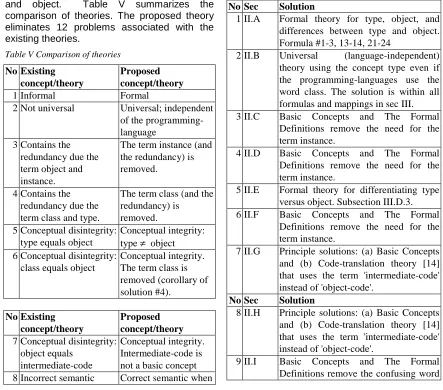
[image:14.612.81.531.63.290.2]In this section we compare the existing theories versus the proposed theory for type and object. Table V summarizes the comparison of theories. The proposed theory eliminates 12 problems associated with the existing theories.
Table V Comparison of theories
No Existing concept/theory
Proposed concept/theory 1 Informal Formal
2 Not universal Universal; independent of the programming-language
3 Contains the redundancy due the term object and instance.
The term instance (and the redundancy) is removed.
4 Contains the redundancy due the term class and type.
The term class (and the redundancy) is
removed. 5 Conceptual disintegrity:
type equals object
Conceptual integrity: type ≠ object 6 Conceptual disintegrity:
class equals object
Conceptual integrity. The term class is removed (corollary of solution #4).
No Existing concept/theory
Proposed concept/theory 7 Conceptual disintegrity:
object equals intermediate-code
Conceptual integrity. Intermediate-code is not a basic concept 8 Incorrect semantic Correct semantic when
when we apply the substitution principle.
we apply the
substitution principle. 9 Confusing word order
(e.g., of class object and object class)
No confusing word order
10 Difficult to understand concepts (e.g., the term /concept instance)
No difficult to understand concepts (e.g., instance and class are eliminated) 11 Everything is an object. Not everything is an
object (see the 4 basic concepts).
12 No concept is defined (due to informality, #1)
All concepts (type and object) are defined.
[image:14.612.85.528.346.736.2]The following table summarizes the sections introducing the problems with existing theories and the solutions. We use the abbreviation sec to refer to subsection.
Table VI Solutions (and formulas) for the problems
No Sec Solution
1 II.A Formal theory for type, object, and differences between type and object. Formula #1-3, 13-14, 21-24
2 II.B Universal (language-independent) theory using the concept type even if the programming-languages use the word class. The solution is within all formulas and mappings in sec III. 3 II.C Basic Concepts and The Formal
Definitions remove the need for the term instance.
4 II.D Basic Concepts and The Formal Definitions remove the need for the term instance.
5 II.E Formal theory for differentiating type versus object. Subsection III.D.3. 6 II.F Basic Concepts and The Formal
Definitions remove the need for the term instance.
7 II.G Principle solutions: (a) Basic Concepts and (b) Code-translation theory [14] that uses the term 'intermediate-code' instead of 'object-code'.
No Sec Solution
8 II.H Principle solutions: (a) Basic Concepts and (b) Code-translation theory [14] that uses the term 'intermediate-code' instead of 'object-code'.
ISSN: 1992-8645 www.jatit.org E-ISSN: 1817-3195
order, especially subsection III.D.1. Additional solution can be inferred from section IV.B.
10 II.J Basic Concepts and The Formal Definitions remove the need for the term instance.
11 II.K Formal theory for type and the formal differences between type and object prove not everything is an object. 12 II.L Basic Concepts and The Formal
Definitions.
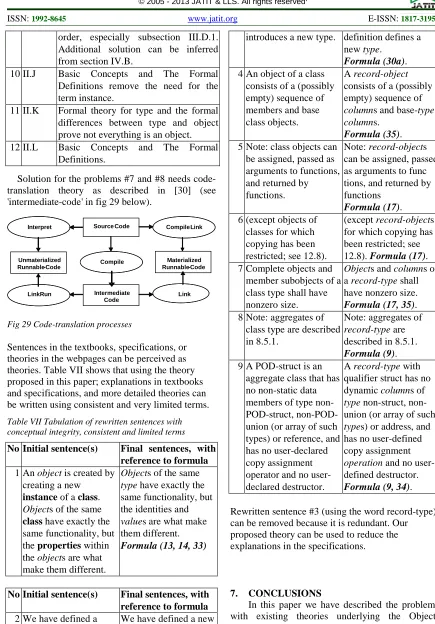
[image:15.612.83.518.63.687.2]Solution for the problems #7 and #8 needs code-translation theory as described in [30] (see 'intermediate-code' in fig 29 below).
Fig 29 Code-translation processes
[image:15.612.88.301.504.726.2]Sentences in the textbooks, specifications, or theories in the webpages can be perceived as theories. Table VII shows that using the theory proposed in this paper; explanations in textbooks and specifications, and more detailed theories can be written using consistent and very limited terms.
Table VII Tabulation of rewritten sentences with conceptual integrity, consistent and limited terms
No Initial sentence(s) Final sentences, with reference to formula 1 An object is created by
creating a new instance of a class.
Objects of the same
class have exactly the same functionality, but the properties within the objects are what make them different.
Objects of the same type have exactly the
same functionality, but the identities and
values are what make
them different.
Formula (13, 14, 33)
No Initial sentence(s) Final sentences, with reference to formula 2 We have defined a
class called TSimple as a new data type.
We have defined a new
record-type called
Simple. Formula (9). 3 A class definition A record-type
introduces a new type. definition defines a new type.
Formula (30a).
4 An object of a class consists of a (possibly empty) sequence of members and base class objects.
A record-object consists of a (possibly empty) sequence of
columns and base-type columns.
Formula (35).
5 Note: class objects can be assigned, passed as arguments to functions, and returned by functions.
Note: record-objects can be assigned, passed as arguments to func tions, and returned by functions
Formula (17).
6 (except objects of classes for which copying has been restricted; see 12.8).
(except record-objects for which copying has been restricted; see 12.8). Formula (17). 7 Complete objects and
member subobjects of a class type shall have nonzero size.
Objects and columns of
a record-type shall have nonzero size.
Formula (17, 35).
8 Note: aggregates of class type are described in 8.5.1.
Note: aggregates of
record-type are
described in 8.5.1.
Formula (9).
9 A POD-struct is an aggregate class that has no non-static data members of type struct, non-POD-union (or array of such types) or reference, and has no user-declared copy assignment operator and no user-declared destructor.
A record-type with qualifier struct has no dynamic columns of
type struct,
non-union (or array of such
types) or address, and
has no user-defined copy assignment
operation and no
user-defined destructor.
Formula (9, 34).
Rewritten sentence #3 (using the word record-type) can be removed because it is redundant. Our proposed theory can be used to reduce the explanations in the specifications.
7. CONCLUSIONS
In this paper we have described the problems with existing theories underlying the Object-Oriented Programming. Existing theories lack conceptual integrity among the concepts of type, object, instance, and class. Class and instance are Compile Link
Interpret SourceCode
Unmaterialized Runnable-Code
Materialized Runnable-Code
LinkRun Intermediate Link
ISSN: 1992-8645 www.jatit.org E-ISSN: 1817-3195
redundant and anomalous concepts (the two appendices offer proper explanation of class).
This paper proves that the concept of object and type can be mathematically formulated. Prior to this paper, the concept of type and object are not formulated formally and uniquely. To the best of the authors' knowledge, the mathematical formula for type and object are either informal, or formal but redundant with the term class and instance.
We have proposed a theory that fulfills the conceptual integrity principle. There is neither redundant nor isolated concept. We focus on informal and formal definition of the concepts of type and object. Both concepts are disjoint, shown through 35 mathematical formulas.
To aid understanding of the proposed theory, NUSA programming-language is designed and its code-translators are created. NUSA is not an OOPL, but a general-purpose with conceptual integrity; providing encapsulation, inheritance, and polymorphism without resorting to class. Class is not required for encapsulation, inheritance, and polymorphism. Class is not a basic concept.
The independence of basic concepts formulation can be used to increase the maturity level of software engineering. One day all software engineers understand “Concepts Every Software Engineer should know”. The concepts will be few, universally agreed, matematically and linguistically precise, integrated, and comprehensible like the concepts in physics.
APPENDIX 1: CLASS AS RECORD-TYPE FOR DYNAMICALLY-ALLOCATED OBJECTS While there are thousands of OOPLs, from the memory-allocation perspective there are essentially two allocation strategies: static and dynamic. C# and Java require record-objects to be dynamically allocated. The term reference type is added for class, introducing more difficulty.
The term may seem to invalidate the concept of record-value, as can be seen in [27]. But here we prove that the dynamic allocation like in C# and Java does not invalidate the concept of record-value. The operational-semantic of
an_object := type_name (arguments_list) ;
is
for all columns in an_object an_object.columns[i] := columns[i] (type_name (actual_operands_list))
Mathematically we write:
∀ Columns[i]∈ Columns
An_object.Columns[i] := type_id (arg1 [, argk]) [i]
That the record-object (An_object) is a dynamically-allocated object does not change the fact that the value of argi is assigned to Columns[i]. Thus, the concept of class in C# and Java is correctly referred to as record-type.
APPENDIX 2: CLASS AS MODULE
In C#, Java, and similar programming-languages, class is mapped not only to record-type but also a module. Thus, M is a name for record-type and module-object.
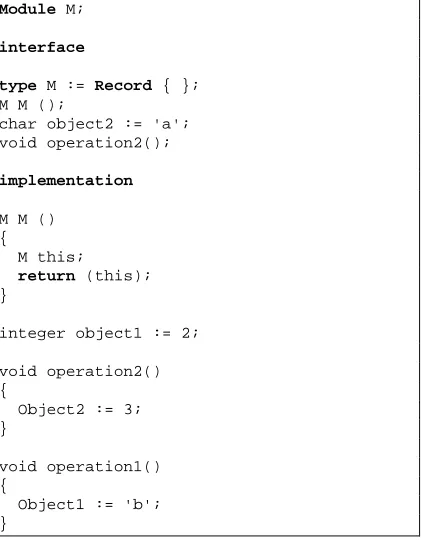
NUSA helps understanding class as module. Fig 30 shows the translated source-code in NUSA.
Module M;
interface
type M := Record { }; M M ();
char object2 := 'a'; void operation2();
implementation
M M () {
M this; return (this); }
integer object1 := 2;
void operation2() {
Object2 := 3; }
void operation1() {
[image:16.612.314.525.303.575.2]Object1 := 'b'; }
Fig 30 Equivalent source-code in NUSA
Classes in C# and Java are both record-types and modules. This still confirms the theory that the common denominator for class is: record-type. Classes in other OOPLs (notably C++) are not modules.
APPENDIX 3: MODELING CLASS AS
DERIVED CONCEPTS
ISSN: 1992-8645 www.jatit.org E-ISSN: 1817-3195
[image:17.612.93.525.69.732.2]physics. All derived dimensions must be based on base dimension(s).
Table VIII. Partial list of base dimensions and derived dimensions in physics; for various classic engineering
Base dimension Derived dimension Length (L)
Time (T)
Area (L2) Speed (L1T-1)
Table IX tabulates class as derived concept, not a basic one; based on the explanation in Appendix 1 and Appendix 2. Class in C++, Delphi, and alike belong to the class as T1 (merely as record type). Class in C#, Java, and alike belong to the class as T1 Ob1; a class is a type as well as an object (of type module).
Table IX. Partial list of basic concept and derived concept for software engineering
Basic concept Derived concept Type (T)
Object (Ob)
Class (T1) Class (T1Ob1)
ACKNOWLEDGMENT
The first author thanks The Ministry of Communication and Information of Indonesia for financial support in the making of NUSA code-translator.
REFERENCES:
[1] Saeed Moaveni. Engineering Fundamentals:
An Introduction to Engineering, 2nd ed, Thomson Engineering. 2005.
[2] ISO. ISO/IEC 2382-15:1999 Information
technology -- Vocabulary -- Part 15: Programming languages. ISO. 1999.
[3] Elisa Bertino, Lorenzo Martino.
Object-Oriented Database Systems: Concepts and Architectures. Addison Wesley, 1993.
[4] Grady Booch et al. Object-Oriented Analysis
and Design. 3rd edition. Addison Wesley, 2007.
[5] OMG. OMG Unified Modeling Language
Infrastructure. Object Management Group.
2011.
[6] OMG. OMG Unified Modeling Language
Superstructure. Object Management Group.
2011.
[7] ISO. ISO/IEC 14882:2003 Programming
Languages -- C++. ISO. 2003.
[8] Twan Basten, Wil M. P. van der Aalst. “Inheritance of behavior”, in The Journal of
Logic and Algebraic Programming. Elsevier.
2001.
[9] James Gosling, Bill Joy, Guy Steele, Gilad Bracha, Alex Buckley. The Java Language
Specification. Oracle Corp. 2012.
[10] Martin Sulzmann, Meng Wang. “Modular
Generic Programming with Extensible
Superclasses”, in ACM SIGPLAN, September
16. 2006.
[11] David Greenfieldboyce and Jeffrey S. Foster. “Type Qualifier Inference for Java”, in
OOPSLA October 2007 pp 21-25. ACM
978-1-59593-786-5/07/0010. 2007.
[12] Martin Plümicke. “Typeless programming in
Java 5.0 with wildcards”, in Proceedings of the 5th international symposium on Principles and practice of programming in Java. ACM
pp 73-82. 2007.
[13] Norbert Schirmer. “Analysing the Java
Package/Access Concepts in Isabelle/HOL”,
in Concurrency and Computation: Practice
and Experience. 2003; 0:1-10. John Wiley &
Sons. 2003.
[14] ECMA International. ECMA-334 Standard.
C# Language Specification. 2006.
[15] Antero Taivalsaari. “On the notion of Object”, in Journal of Systems Software; Vol 21:3-13 pp 3-16; 1993.
[16] Alfred V. Aho et al. Compilers: Principles,
Techniques, and Tools, 2nd edition. Addison-Wesley, 2006.
[17] IEEE. IEEE Standard Glossary of Software
Engineering Terminology. IEEE. 1990.
[18] Oxford. Oxford American English Dictionary. Oxford. 2005.
[19] Geoffrey Leech, Margaret Deuchar, Robert Hoogenraad. English Grammar for Today. MacMillan. 1982.
[20] Josë de Oliveira Guimaräes. ”The Green
language type system”, in Computer
Languages, Systems & Structures. Elsevier.
2009.
[21] Jaakko Järvi, Mat Marcus, Jacob N. Smith. “Programming with C++ concepts”, in
Science of Computer Programming. 2009.01.
Elsevier. 2009.
[22] Adele Goldberg, David Robson. Smalltalk-80:
The Language and Its Implementation.
Addison-Wesley. 1983.
[23] C. J. Date, Hugh Darwen. The Third
Manifesto: Foundation for Object/Relational Databases, 1998.
[24] Haibin Zhu, MengChu Zhou. Methodology
First and Language Second: A Way to Teach Object-Oriented Programming, in OOPSLA 2003, October 26-30. ACM
ISSN: 1992-8645 www.jatit.org E-ISSN: 1817-3195
[25] Adele Goldberg, Alan Kay. Smalltalk-72
Instruction Manual. Xerox Palo Alto Research
Center. 1972.
[26] Derek Rayside, Gerard T. Campbell. “An
Aristotelian Understanding of
Object-Oriented Programming”, in OOPSLA 2000, 10/00. 2000 ACM ISBN
1-58113-200-x/00/0010. 2000.
[27] Nicu G. Fruja. ”Towards proving type safety
of C#”, in Computer Languages, Systems & Structures. Elsevier. 2009.
[28] Frederick P. Brooks. The Mythical Man
Month. Addison Wesley. 1975.
[29] Frederick P. Brooks. The Mythical Man
Month, 2nd edition, Addison Wesley. 1995. [30] Bernaridho I. Hutabarat. Programming
Concepts: with NUSA
Programming-language. Ma Chung Press. 2010.
[31] ISO. ISO/IEC 9899:1999 Programming Languages --C. ISO. 1999.
[32] Bernaridho I. Hutabarat. Modular Programming: A Revolutionary Approach. Ma
Chung Press. 2010.
[33] Bernaridho I. Hutabarat, Mochamad Hariadi, Ketut E. Purnama, and Mauridhi H. Purnomo. “Module, Modular Programming, and Module-based Encapsulation: Critiques and Solutions”; in The 5th International Conference on Information & Communication Technology and Systems (ICTS). pp 233-240.
ISSN 2085-1944. 2009.
[34] Bernaridho I. Hutabarat, Lucky Irawan. ”Simple and Universal Theory of Namespace
and Its Relationship to Repetition using For(): How it affects the design of NUSA
programming-language”; in Journal of
Computer Science, pp 167-176. ISSN
1412-9523. University of Pelita Harapan. 2011. [35] Bernaridho I. Hutabarat, Mochamad Hariadi,
Ketut E. Purnama, and Mauridhi H. Purnomo. “NUSA (Neat Uniform Simple Architecture):
A Highly Orthogonal Programming
Language”, in Proceedings of the World Congress on Engineering and Computer Science 2011 Vol I WCECS 2011, October
19-21, 2011, San Francisco, USA. 2011. [36] Hugh Darwen. The Third Manifesto, ACM