A PREDICTIVE TRUST MODEL FOR E-COMMERCE
APPLICATIONS
1USHA DEVI G, 2SUTANU NANDI, 3ANUSHA K, 4RAJYALAKSHMI GV
School of Information Technology and Engineering VIT University, Vellore-632014, Tamil Nadu, India
E-mail: 1 [email protected] , [email protected]3,[email protected],
ABSTRACT
E-business systems are growing exponentially in present days. Trust is essential for e-business systems and it is a part of modern e-commerce system. In this paper, we proposed a new algorithm to predict the trust value which is a transaction based feedback of peers for e-commerce applications. Before interacting with an unknown peer, it is rational to doubt its trustworthiness. Therefore, it makes the new transaction more secure by enabling trust evaluation prior to interacting with an unknown peer. A peer to peer e–commerce needs reputation for the knowledge of other peers.
Keywords - Predictive Trust, Malicious Peer, Reliable Peer, Feedback Score.
1. INTRODUCTION
Since there is an increasing development of e-commerce, the management of affair with bar gainers have tremendously increased. Thus online trust has become a dreadful issue. As the transaction over the internet is uncertain and is not familiar, the transactions have to bear with the high degree of risk. These might lead to a situation in which the information can be exploited. For example, the seller knows the quality of the cell phone, while buyer does not know the quality. The seller might take an advantage and claim for higher price because of higher quality. In a custom transaction, there is a belief that “seeing is believing”. This is not in the case of online transactions. There is no kind of mutual relationship among the partners and therefore developing strategy of establishing trust is of prime importance. There are many companies like Amazon, eBay, which provides a platform for e-transactions. The Company must have an efficient system to find trusty who can exchange goods with confidence. Trust is very important and as it provides buyers with lot of expectation to satisfy the transaction relationship. There is a challenge in order to build P-2-P trust as it help us to bear the spiteful behaviour of peers such as furnishing false information about other peers. We can embody different issues as they differ in different communities and transactions. Further, it does not depend on the factors for building trust; it concentrates on implementing
those factors in the trust model.The current trust models have the following drawbacks:
• Orthodox trust model do not have an ability to bear with spiteful behaviours such as flattering on exaggerated praise and publicity for promotional and defamatory attack.
• Most of the traditional trusts give importance to file sharing. Very less amount of work has done in establishing trusts in e-commerce applications [1].
• The existing trust model takes into account only for long term behaviour of an entity and it does not acclimatized to the dynamic behaviour.
This paper presents a new trust model based on the customer feedback.
2. RELATED WORK
March’s trust model, the eBay feedback system is to be improved for negative trust values. Hong Zhang et al [1] proposed an improved algorithm for eBay trust model and also present a Client to Client (C2C) auction trust model with five effective parameters. Liang et al [2] have published a trust model based on short time trust worthiness and it is combined with traditional reputation to evaluate the trust value. Song et al [1] presents a trust model based on fuzzy logic inferences and it gives incomplete information in peer trust reports.
3. PROPOSED TRUST MODEL
Our current trust model has the following basic principles:
• The trustworthiness value does not depend on a particular customer feedback.
• The feedback of the average customer value is taken into consideration and it enhances slowly.
• It is independent of time and it automatically upgrade based on the present condition of the product.
We do not consider the feedback of all customers. Instead, recent 30 customer’s feedback is considered for the trust calculation.
3.1 Basic Predictive Trust Parameters
3.1.1 Feedback
To design a trust model, the feedbacks of customers are taken into consideration for calculating the trust. For each product, it is to
maintain two tables: Negative Feedback table and Positive Feedback table. If the feedback of a new customer is below the threshold value then the calculation is carried out in the following way:
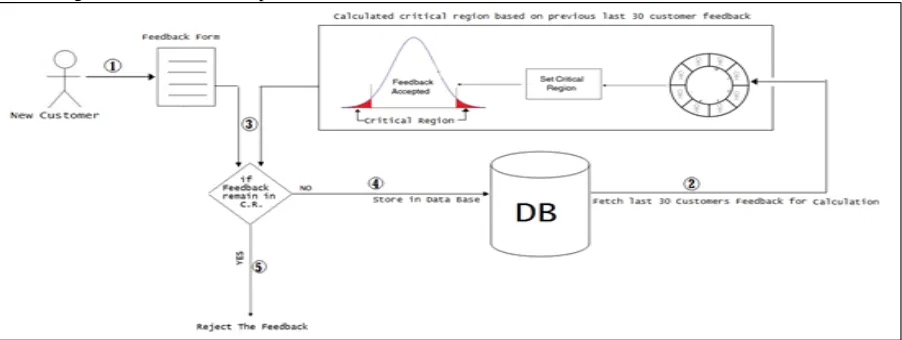
• Recent 30 negative feedbacks are fetched from the database and set a critical region • If the new negative feedback falls within the
critical region then reject the new feedback value else store the feedback value into the negative feedback table of the database. If the feedback of the new customer is above the threshold value then the following calculation is carried out:
• Recent 30 positive feedbacks are fetched from the database and set a critical region • If the new positive feedback falls within the
critical region reject the new feedback value else store it into the positive feedback table of the database.
3.1.2 Reliability of valuator
To consider the value of customer feedback, the trust parameter is the important one. If the new customer feedback is outside the critical region then this value is highly reliable and the evaluation is trustworthy.
3.1.3 Malicious Peer
[image:2.612.92.543.508.678.2]If the new customer feedback value is within the critical region then the trust value is less reliable and it is considered as malicious or fraud feedback. These feedback values are not stored in the database.
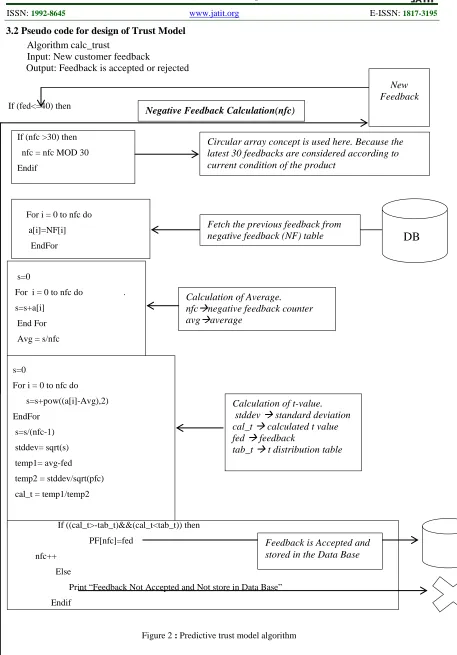
3.2 Pseudo code for design of Trust Model
Algorithm calc_trust
Input: New customer feedback
Output: Feedback is accepted or rejected
If (fed<=40) then
If (nfc >30) then
nfc = nfc MOD 30
Endif
For i = 0 to nfc do
a[i]=NF[i]
EndFor
s=0
For i = 0 to nfc do .
s=s+a[i]
End For
Avg = s/nfc
s=0
For i = 0 to nfc do
s=s+pow((a[i]-Avg),2)
EndFor
s=s/(nfc-1)
stddev= sqrt(s)
temp1= avg-fed
temp2 = stddev/sqrt(pfc)
cal_t = temp1/temp2
If ((cal_t>-tab_t)&&(cal_t<tab_t)) then
PF[nfc]=fed
nfc++
Else
Print “Feedback Not Accepted and Not store in Data Base”
[image:3.612.84.541.69.724.2]Endif
Figure 2 : Predictive trust model algorithm
New Feedback
DB
DB
Fetch the previous feedback from negative feedback (NF) table
Circular array concept is used here. Because the latest 30 feedbacks are considered according to current condition of the product
Calculation of Average.
nfcnegative feedback counter
avgaverage
Calculation of t-value.
stddev standard deviation
cal_t calculated t value
fed feedback
tab_t t distribution table
Else
If (pfc >30) then
pfc = pfc MOD 30
Endif
For i = 0 to pfc do
a[i]=PF[i]
EndFor
s=0
For i = 0 to pfc do .
s=s+a[i]
End For
Avg = s/pfc
s=0
For i = 0 to pfc do
s=s+pow((a[i]-Avg),2)
EndFor
s=s/(pfc-1)
stddev= sqrt(s)
temp1= avg-fed
temp2 = stddev/sqrt(pfc)
cal_t = temp1/temp2
If ((cal_t>-tab_t)&&(cal_t<tab_t)) then
PF[pfc]=fed
pfc++
Else
Print “Feedback Not Accepted and Not stored in Data Base”
Endif
[image:4.612.85.562.60.726.2]
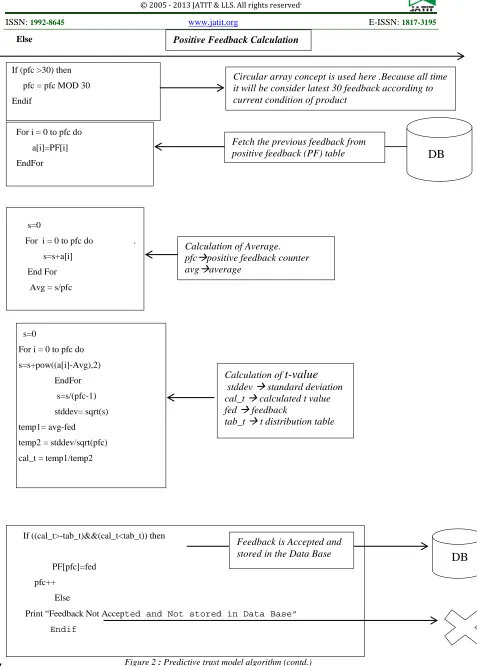
Figure 2 : Predictive trust model algorithm (contd.)
DB
DB
Fetch the previous feedback from positive feedback (PF) table
Circular array concept is used here .Because all time it will be consider latest 30 feedback according to current condition of product
Calculation of Average.
pfcpositive feedback counter
avgaverage
Calculation of t-value
stddev standard deviation
cal_t calculated t value
fed feedback
tab_t t distribution table
4. RESULTS AND DISCUSSION
[image:5.612.325.502.110.210.2]The Predictive trust model algorithm is implemented and evaluated based on the performance of feedback of customers. For the evaluation, recent 10 customer’s feedback are considered.
Figure 3 Recent 10 Customer’s Feedback In The Database
From the Figure 3, the average of these feedbacks is 23 and the standard deviation is 8.0277.
Table 1: Negative feedback calculation
Table 1 shows the new feedback values (17,29) are rejected based on recent 10 customer’s feedback and new feedback values (18,19,20,21,22,23,24,25,26,27,28) are accepted.
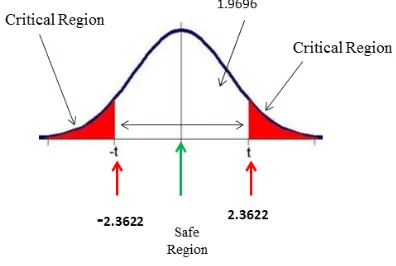
Figure 4 : Critical Region Of The Graph
From Figure 4, it is found that the new feedback value (here 17) is in critical region and it is rejected.
Figure 5 : Critical Region Of The Graph
From the above graph it is shown that new feedback value(here 18) remain in safe region.So new feedback value is accepted.
[image:5.612.330.528.303.436.2]
Figure 6:Snapshot Of Our Predictive Trust Model
New customer Feedback Value
Calculation Value (Cal_t)
Table
Value(Tab_t) Accept/Reject
17 2.3635 2.3622 Rejected
18 1.9696 2.3622 Accepted
19 1.5756 2.3622 Accepted
20 1.1817 2.3622 Accepted
21 0.7878 2.3622 Accepted
22 0.3939 2.3622 Accepted
23 0.0000 2.3622 Accepted
24 -0.3939 -2.3622 Accepted
25 -0.7878 -2.3622 Accepted
26 -1.1817 -2.3622 Accepted
27 -1.5756 -2.3622 Accepted
28 -1.9696 -2.3622 Accepted
29 -2.3635 -2.3622 Rejected
[image:5.612.97.306.382.587.2] [image:5.612.345.545.526.658.2]5. CONCLUSION
In this paper, we have introduced a new algorithm for predictive trust model for e-commerce applications. This algorithm is more effective for detecting the malicious peer based on previous customer’s feedbacks. The performance of Model is measured based on statistical Hypothesis and it gives better results. The advantage of this proposed algorithm is trust value always depends on current condition of the product.
REFERENCES:
[1] Dauw-Song Zhu ; O'Neal, G.S. ; Zui-Chih Lee ;Yen-Hsun Chen,”The Effect of Trust and Perceived Risk on Consumers' Online Purchase Intention”, International Conference on Computational Science and Engineering, pp.771 – 776, 2009.
[2] JunfengTian
,
JuanLi ,”A Trust Domain-Based Resource Selection Model for Multi-Agent”, Second International Symposium on Electronic Commerce and Security, ISECS '09, Vol.1, pp. 280 – 286, 2009. [3] Young Ae Kim, Minh-Tam Le, LauwH.W., Ee-PengLim, HaifengLiu, Srivastava J. , ”Building a web of trust without explicit trust ratings”, IEEE 24th International Conference on Data Engineering Workshop ICDEW2008, pp.531 – 536, 2008.
[4] Ping Dong ; Hongchao Wang
,
HongkZhang, "Probability
based trust management model for
distributed e-commerce”, IEEE International Conference on Network Infrastructure and Digital Content, IC-NIDC2009, pp.419 – 423, 2009.
[5] Guo, YanHong ; Guishi Deng ; Guangqian Zhang; Chunyu Luo , “Using Case-Based Reasoning and Social Trust to Improve the Performance of Recommender System in
E-Commerce”, Second International
Conference on Innovative Computing, Information and Control, ICICIC'07, 2007. [6] Cheng Su,Hong Zhang and Fang-ming Bi,
“A P2P-based Trust Model for E-Commerce”, IEEE (ICEBE’06’), 2006. [7] Li Xiong ,Ling Liu. “Peer Trust: Supporting
Reputation-Based Trust for Peer-to-Peer Electronic Commnities”, IEEE Conference on E-Commerce (CEC’03), 2003.
[8] Z. Despotovic , K. Aberer,” P2P Reputation Management: Probabilistic Estimation vs. Social Networks”, Journal of Computer Networks, Vol.50, Issue 4, Elsevier, pp.485-500,2006.
[9] Z. Despotovic , K. Aberer. “Probabilistic Prediction of Peers' Performances in P2P Networks”, International Journal of Engineering Applications of Artificial Intelligence, Vol.18, Issue 7, Elsevier, pp.771-780, 2005.
[10] Piao C. H., Han X. F., Wu H., “Research on e-commerce transactionnetworks using multi-agent modelling and open applicationprogramming interface,” Enterprise Information Systems, Vol.4(3), 2010, pp.329-353, 2010.
[11] Gray E., Seigneur J.M., Chen Y., Jensen C., “Trust propagation in small worlds,” Computer Science, pp.239–254, 2003. [12] Piao C. H., Han X. F., Zhang S. R.,
“Multi-Agent Modeling and Analysis for E-Commerce Transaction Network Based on CAS Theory”, IEEE International Conference on e-Business Engineering, IEEE Computer Society, Macau, 2009 [13] E.Sathiyamoorthy, N.Ch.S.N Iyengar and
V.Ramachandran”, “Mobile Agent Based Trust Management Framework using Fuzzy Logic in B2C E-Business Environment”, International Journal of Computer Theory and Engineering, Vol.2, No.2, 2010.
[14] Wanging, QiuJing, “A
Mathematical Trust Model in
E-Commerce”, International Conference on Multimedia and Ubiquitous Engineering, pp.644 – 649, 2007.