ISSN: 1992-8645 www.jatit.org E-ISSN: 1817-3195
A NEW HYBRID MODEL FOR ELECTRONIC RECORD
MANAGEMENT
1
MARIAM AFSHAR, 2KAMSURIAH AHMAD
1
Faculty of Information Science and Technology, National University of Malaysia 2
Assoc. Prof., Faculty of Information Science and Technology, National University of Malaysia
E-mail: [email protected], [email protected]
ABSTRACT
In a daily activity of an organisation, thousands of electronic record (e-records) are created. Managing this massive amount of e-records is a challenging task for system managers. Organisations, according to legal and financial administrative procedures or regulations, keep the e-records for a certain period of time and after that, they will be transferred or destroyed. Thus, there is an urgency to manage these e-records during their lifecycle. Public agencies need a framework to manage the e-records throughout their full life span. Effective and efficient aging of the e-records throughout their full life span ensure stockholders and organisations benefit and protect their rights, facilitate decision making and support daily activity of the organisations. This paper proposes a hybrid model for managing e-records throughout their full lifecycle. Output from this study will help users of electronic records to manage the records from the time of their creation to disposal.
Keywords: E-Record, Life Cycle Model, Hybrid Model, Continuum Model, E- Record Management.
1.
INTRODUCTIONResult of using Information Communication Technology (ICT) in organisations’ activities is the production of e-records. These e-records facilitate decision making, formulating policies and support daily activities. Therefore, e-records management is one of the critical issues for public agencies. On the other hand, due to reducing public access to entitlements, erosion of right, increasing in operating cost, gaps in memory, and reducing government effectiveness; it is necessary for government and public agencies to manage e-records during their full life span [1]. Managing sensitive information throughout their lifecycle has become significantly critical. In addition, there is also a need to maintain digital assets for access and editing over their full lifecycle [2], hence any actions in the public sector must be based on a long term vision. One of the important issues for effective managing of recorded information is its lifecycle concept [3]. Conversely, it was discovered through a survey for Cohasset that implementing a retention period for e-records proves to be challenging for an organisation [4]. Only 65% of organisations implemented the retention of e-records. This survey also showed that disposition or deletion process for all types of electronically stored information (ESI) is more “manual” rather than “semi-automatic” or “automatic. Lifecycle
concept is an important issue for effective managing recorded information [3]. Scholars argued that, in managing records, a framework is a necessary component [5].
The outcome of this study will help users and record managers to manage massive amount of e-records from the day the e-records are created until they are disposed. The objective of this paper is to propose a new hybrid model for managing e-records and identifying the phases of lifecycle model. Section 2 discusses on the background and design of the hybrid model and its phases. Section 3 presents concludes this paper.
2.
BACKGROUNDThere are two well-known theoretical models that describe the lifecycle of records, which are the lifecycle model and the continuum model [6].
2.1 Life cycle model
ISSN: 1992-8645 www.jatit.org E-ISSN: 1817-3195 non-current phase, records are destroyed or
transferred to archives. The archives manage all the records for non-current phase [7]. Different scholars divided the life span of record to various numbers of stages or phases; from three to ten stages. The various numbers of stages have been studied and reviewed by scholars [3]. Authors in [3] asserted that varied interpretation of the record’s life cycle specifies that records management, the discipline governing records matters are changing and the lifecycle model is not able to address needs of electronic environment. In addition, it is necessary to use another approach for managing
electronic records.Fig 1 illustrates the process that
[image:2.612.95.302.278.500.2]records go through in their life cycle.
Figure 1: Life Cycle Model [8]
The benefits of the lifecycle concept are as follows:
• Useful framework in practice [7]
• Useful and helpful way to look at records
management and can be used by professional in other disciplines [9]
There are also drawbacks to the life cycle model; which are as follows:
• It does not consider design stage of record
management system [10]
• Unsatisfactory in a changing technological
environment [3]
Despite of the weakness of lifecycle model, this theory is still alive and being widely used as it is a very practical theory to manage records [6] [7] [11] [12].
2.1.1 Continuum model
The continuum model is developed in 1990 by Lan McLean where he pointed out that record keeping is an ongoing process and cannot be separated [10]. In the continuum model, a record is a part of business process. This process starts with record’s creation and the element passes to another stage of its existence [13]. The aim of this theory is to provide a model with which to understand records and record keeping processes, regardless of
form and of situation [14] [15] [16]. Records are
not categorized under current, semi-current and non-current phases in Upward’s model and the work of archivist and record manager is integrated [13] [17]. This model pointed that life cycle theory did not have integration of record and archives management [10]. Fig 2 shows record continuum theory with 4 concentric circles, and not the linear, separate stages. The four levels of perspectives are:
Dimension 1 – create:
All business activities happen at this stage. Records that document the action, the trace, representation of action become evidences. Then the records proceed to the next stage of capturing dimension.
Dimension 2 – capture:
The documenting process involves managing all relevant transactions and records. At this stage, the records are evidences of action which can be distributed to others and assessed, understood by others who undertake the business activities.
Dimension 3 – organize:
Management activities like preserving and using records, describing archives are carried out in this stage.
Dimension 4 – pluralize:
Disposal of records happens at this level. The records can be destroyed or archived. Preserving and using the archives are the responsibilities of archive managers [13] [10] [18].
In this model there are four axes of major record management themes: transactional, identity, evidential and record keeping. In addition there are four circles under dimension of continuum: create, capture, organize and pluralize. As highlighted before, there is no separate stage for this continuum model. The benefits of record continuum theory are [20]:
ISSN: 1992-8645 www.jatit.org E-ISSN: 1817-3195 • Facilitate disposal of records that are no longer
required;
• Organize records in efficient way for ease of
used.
• Reed argued that continuum theory has a focus
[image:3.612.91.293.199.369.2]on the records’ processes and activities, thus proves to be an enhancement to the record management process [18] [21].
Figure 2: Continuum model source [19]
Under this theory, time is not vital in managing record. The records have two forms: current or historical from the beginning of their creation. Record management is a continuous process and element passes from one stage to another seamlessly [13].
On the other hand, the continuum model should be considered as a strategy in electronic environment. This is because the paper records do exist due to existing demands in practical environment [11]. Moss [22] asserted that the continuum model in UK is not well received as in Australia; and he proposed more studies to be conducted in the continuum model in effort to avoid confusion between life cycle and continuum model. Thus, it is advisable to use the continuum model cautiously for effective record management. Moreover the continuum model is influenced by culture [6]. Due to such argument from Upward, the continuum model cannot be considered as a shift in paradigm of record management. To be exact, it is fit to be called as cultural shift in the management due to postmodernism. The model is however still vital as it focuses on culture effect on the record management and defines the “one size fits all” concept. Thus, the cultures in record
management should take into account the environment in which records are created and used [6]. Xiaomi [23] lists the differences between the record life cycle model and continuum model.
2.1.2 The hybrid model
A hybrid model is proposed to overcome the weakness of the lifecycle model and use the
benefits of the continuum model [6]. A hybrid
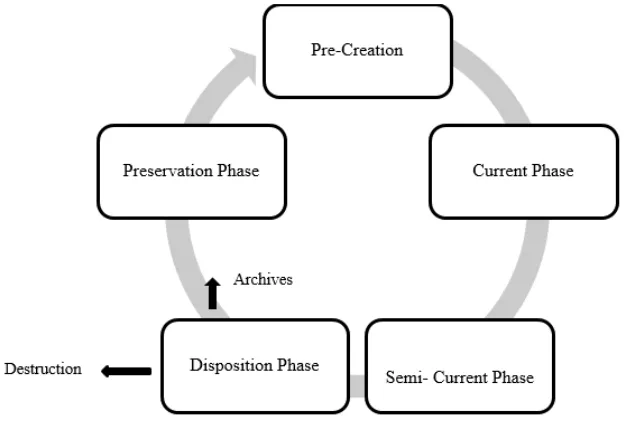
system is a combination of two or more approaches to record management. The limitations of one record management strategy can complement the strength of another strategy [16] [24]. The basis of the hybrid model is the life cycle model and pre-natal phase of the continuum model. The pre-pre-natal phase is considered as the approach to participatory design. The current phase is about creating or capturing record and usually applied in daily activity of organizations. In the semi-current stage, records are transferred to storage as they are seldom used in daily activities of organization. At the last stage of non-active phase, records reach the finishing line of their life. Most records are usually destroyed and only a small number of records are kept due to their value for organization [25]. The proposed hybrid model is successful to overcome the problems related to design phase of record mangment but still there is remaining issue. This model is not able to addresss the requirements related to preservation of electronic form of record. Fig 3 illustrates the hybrid model that is proposed by [6].
Taking into account all findings of other scholars, and the life cycle and continuum models, this study has combined the record in pre-creation stage [3] and maintenance and preservation stage of third dimension in the continuum model [15] with lifecycle model in order to come up with a new
hybrid model. A hybrid model is developed
according to the fact that authors in [16] assert that a hybrid model provides a cost effective approach for manamgent of records in organizations. As it is flexible enough in dynamic and technology-based
enterprise system. During the precreation phase,
ISSN: 1992-8645 www.jatit.org E-ISSN: 1817-3195
Figure 3: The hybrid model [6]
Records managers and archivists appraise records and decide on what records would support the functions of an organisation during the records keeping system design. This phase is also known as “Prenatal Phase” [22], and is used in the hybrid model [6].
Preservation of records provides an opportunity for secondary used [14]. There is another challenge that should be considered while dealing with e-records. It is “digital obsolescence”, a result of digital continuity and due to the technology obsolescence. It is possible that e-records become unusable and render them inaccessible [14]. Preservation is defined as a collection of process and activities to stabilise and protect record against any deterioration or destruction [26]. The record
management actions which relate to the
maintenance and preservation of records are presented in the third dimension of the continuum model [15]. So, it seems necessary that these two phases (pre-creation and preservation) be combined to the lifecycle model to enhance its capability to support digital continuity and security consideration. The phases of the proposed model are as follows:
1. Pre-creation phase: This phase is preparation
phase, where the main activity is to consider issues related to the design of electronic record
management system. [27] [28] [29] and [30]
recommend that a file classification schema should be developed before creation of records. In addition they assert to identify the last destiny of record categories before their creation. The details of these processes are listed as follow:
Identification of Record disposal is defined as the
process of determining the ultimate destiny of records [28]. All of the stakeholders must be presented in determining the retention period. What are put under consideration in retention period of record would be the use of records, legal and administrative requirements for maintaining the records, their relation with other system and the
frequency of usage [31].
Papering file Classification scheme: file
classification scheme is a tool that identifies categories for business activities and records, then group them into files for simple access, control and description. The classification scheme makes the titling, retrieval, maintenance and disposition processes easier than before and it is a vital item for any record management programme [32].
2. Current phase: In this phase all issues related to
electronic records creation or receipt, capture, registeration and storage must be taken into account. The main processes are related to the record creation or recieve, registration and storage. The records are created or received by staff in result of daily activity of organization. Once the record is created it should be registed as a proff of creation or receipt and apporporaite metadata should be attached to record regardless of its format, then the record should be stored in system according to its format. These processes are describe in following pragraph in great details.
Create: refers to original record created and
documented by users, and Receive: refers to pre-existing record collected from other sources (e.g. repository of organization). The most vital activities at this phase focus on ensuring that all records are supplemented by sufficient descriptive, structural, administrative and technical metadata; ideally, received records should already have these requirements [27] [33].
Registration: offers the evidence that a record has
been created or captured into the records system. It contains the important metadata such as title, name of sender or creator, subject, date, time of registration and a unique identifier. If the classification scheme for records is available in organization, the record is classified and the classification is registered too [27] [34].
Storage: Records should be kept on media which
ISSN: 1992-8645 www.jatit.org E-ISSN: 1817-3195 Storage conditions should be such that records are
protected against unauthorised access, theft and untimely destruction by man or nature [34]. Various long term actions can be applied that ensure records remain secured, may also be associated with this phase: refreshing the media, checking for fixity, making backup copies, maintaining the storage hardware and so on [33].
3. Semi current phase: During this phase,
records are not required for day to day activity of organisation but there is a need to keep them available for legal or financial reasons, so records are stored in a record centre. In other words, the main activity in this phase is transferring records to
record centre for effective accessibility and space
management purposes. When records are
transferred from one record system to another the transfer should be carried out in a way that record remains reliable for future access [27] [35].
4. Dispostion phase: During this phase, retention
period of electronic record is terminated and there is no need for records to be kept in record centre any more. Therefore, records will be transferred or destroyed based on their disposal schedule The process aims to identify records that have reached their disposition date. In the disposition process, the records are either destroyed or archived into storage. After the retention period, records with secondary values are kept in archives permanently. The decision about last density of record is based
on two factors: type of record asset involved and the purpose for which record was created [3] [6]. The records that are transferred to new custody or owner should remain accessible to users [31].
5. Preservation Phase: Issues related to long
[image:5.612.165.478.474.689.2]term preservation of e-records should be considered at this stage to ensure that Electronic records are accessible as long as they are required while they are stored in organization’s repository. The record preservation helps in continuous decision making process and provides support for precedent activities and historical values for future users. In order to preserve the records effectively, the records must be stored, handled, consulted or shown in a damage-free context [26]. This phase involves different range of activities such as registering semantic and structural metadata, cataloguing, quality control, generating fixity data, classifying, and so on. In case of any failure of quality control checks, the record is returned to the originator for additional assessment. Enhancement in the quality of the record (e.g. corrections to record transfer procedures, improved metadata, repackaging of data) and reselection, or disposition are results of further appraisal of originator. Migration to a different format either normalization or within the system, it may requires for some record to reduce risks arising from hardware or obsolescence [33]. Fig 3 illustrates the schema of the proposed lifecycle model.
ISSN: 1992-8645 www.jatit.org E-ISSN: 1817-3195 As proof of concept a prototype based on the
proposed hybrid, lifecycle model is developed. Emanating from fulfilling this purpose is one of the contributions of this study; which is verifying the ability of proposed hybrid lifecycle model to be implemented in the real environment and to check whether the proposed hybrid model can support the management for full lifecycle of e-records. The study is used by Ministry of Communication and Information Technology (MCIT) in Afghanistan as a case study. The study established that the proposed framework can be implemented to organizations. The implementability of lifecycle model was coroborrated by interviewing the experts in the field. The findings of the current study could help Afghanistan develops or modifies record lifecycle model based on the experiences of the developed countries, thereby the country can address the issues of record management.
6. CONCLUSION
This paper discusses the proposed new hybrid model for managing e-records throughout their full lifecycle. This hybrid model is combination of two well-known frameworks. The proposed lifecycle model is a new hybrid model that will ensure that some of the important activities for managing e-records such as system design and issues related to preservation and maintenance of digital object would be considered.
ACKNOWLEDGEMENT
The authors would like to thank to Faculty of Information Science and Technology, Universiti Kebangsaan Malaysia by giving the authors an opportunity to conduct this research. This research is funded by Universiti Kebangsaan Malaysia under
Exploratory Research Grant Scheme
ERGS/1/2013/ICT07/UKM/02/1.
REFRENCES
[1] J. Wamukoya and S M. Mutula, “E-record management and governance in east and
southern Africa”, Malaysian Journal of Library
& Information Science, Vol. 10, No 2, 2005, pp. 67-83.
[2] B. Lundell and J. Gamalielsson, “Towards a sustainable Swedish e-government practice: observation from unlocking digital assets”, Proc. IFIP e-Government Conference 2011
(EGOV 2011). Delft, the Netherlands. 28
August–2 September 2011
[3] Z. Yusof and R. Chell, “The Records Lifecycle: An Inadequate Concept for Technology-
Generated Records”, Information Development,
Vol. 16, No. 3, 2000, pp. 135-141.
[4] R. Williams, and L J. Ashley, “Electronic records management survey call for sustainable
capabilities”. White paper. Cohasset ARMA
International Electronic Records Management Survey. 2009.
[5] C. Okello-Obura, “Records and Archives Legal
and Policy Frameworks in Uganda”. Library
Philosophy and Practice. 2011
[6] B. Chachage, and P, Ngulube, “Management of business records in Tanzania: an exploratory
case study of selected companies”, South
African journal of information management. Vol. 8, No. 3, 2006.
[7] G. Shepherd and Yeo, Managing Records: A Handbook of Principles and Practice. London. Facet. p.9. 2003.
[8] The Ohio University. Record lifecycle. 2014.
(Online)
http://library.osu.edu/projects-
initiatives/osu-records-management/records-management-overview/records-lifecyle/ (1
March 2014)
[9] E, Gordon, J. Hoke and CRM. Records lifecycle: a cradle to grave metaphor. An ARMA international publication information
management, 2011, (Online)
http://content.arma.org/IMM/Libraries/SeptOct _2011_PDFs/IMM_0911_RIM_fundamentals_r ecords_life_cycle.sflb.ashx (4 September 2014) [10] F. Upward, “Modelling the continuum as
paradigm shift in recordkeeping and archiving processes, and beyond – a personal reflection”. Records Management Journal. Vol. 10, No. 3, 2000, pp. 115-139.
[11] M.S. Ngoepe, An exploration of records management trends in the South African public sector: a case study of the department of provincial and local government. [MA thesis]. University of South Africa. 2008
[12]P.A.E. Akashah, S. Rizal, K. Jusoff and E. Christon, “Electronic document management
system”. World Applied Sciences Journal 12
(Special Issue on Computer Applications &
Knowledge Management), 2011, pp. 55-58.
[13]S. McKemmish, “Yesterday, today and
ISSN: 1992-8645 www.jatit.org E-ISSN: 1817-3195 [14]David. Luyombya, Framework for Effective
Public Digital Records Management in Uganda, [PhD thesis]. 2010. University College London. [15]P. Svard, The interface between enterprise
content management and records management in changing organization. [Ph.D. dissertation]. 2011. Mid Sweden University.
[16]R. David, P. Ngulube and A. Dube, “A cost benefit analysis of document management strategies used at a financial institution in
Zimbabwe: A case study”. SA Journal of
Information Management, Vol. 15, No. 2, 2013,
10 pages.
[17]B.N. Hague and B.D. Loader, “Digital
democracy: An introduction. Digital
Democracy: Discourse and Decision-Making in the Information Age”. Psychology Press 1999. London: Routledge.
[18]B. Reed, “Reading the records continuum:
Interpretations and explorations”. Archives and
Manuscripts, Vol. 33, No.10, 2005, pp. 19-43. [19]S. McKemmish, “Teaching recordkeeping and
archiving continuum style”, Archival Science,
Vol.6, No. 2, 2001, pp. 219–230.
[20] National Archives of Australia. Guidelines for creating, managing and preserving digital
records. 2004 (online):
http://mayaarbinaginting.weebly.com/uploads/1 /0/6/1/10612501/digital_recordkeeping.pdf. (4 January 2015)
[21]International Records Management Trust
(IRMT). The E-records Readiness Tool.
London: IRMT. 2004, (Online)
http://apps.nationalarchives.gov.uk/rmcas/docu mentation/eRecordsReadinessTool_v2_Dec200 4.pdf (20 September 2014)
[22]S. Flynn, “The records continuum model in the context and its implications for archival practices”. Journal of the Society of Archivists. Vol. 22, No. 1, 2001, pp.79-93.
[23]A. Xiaomi, “An integrated approach to records
management”. The information management
journal, Vol. 37, No. 4, 2003, pp. 24-30. [24]P. Ngulube, “Cost analysis and the effective
management of records throughout their life
cycle”. South Africa Archives Journal. Vol. 44,
2011, pp. 1–21.
[25]S. Higgins, “The DCC Curation Lifecycle
model”. The International Journal of Digital
Curation, Vol. 3, No.1, 2008, pp134-140. [26]P.X. Coetzer, The status of record management
at the University of Zululand. [MA thesis]. 2012. University of Zululand.
[27] International Standards Organization (ISO). ISO 154891, Information and documentation -records management Part 1: General. 2001. Geneva: International Standards Organization.
[28]European Communities. “MoReq2
specification model requirements for the management of digital records”. 2008.
[29]Linh Thuy. Nguyen, Paula. Swatman and Scott. Salzman, “EDRMS implementation in the
Australian public sector”. In ACIS 2009:
evolving boundaries and new frontiers: defining the IS discipline: proceeding of 20th
Australasian Conference on Information
Systems, 2009, pp.915-928.
[30]Queensland State archives. Guideline for the
planning of an electronic document and record management system version 1.1. 2010. (Online)
http://www.archives.qld.gov.au/recordkeeping/
grkdownloads/documents/edrms.pdf. (4
January 2015).
[31]International Standards Organization (ISO). ISO 154892, Information and documentation -records management Part 2: Guidelines. 2001. [32] Ch. Dowland, “Records management policy”. University of Portsmouth. November
2010. (Online)
http://www.port.ac.uk/accesstoinformation/poli cies/humanresources/filetodownload,73541,en. PDF (1 November 2014).
[33] Alexander. Ball, “Review of data management
life cycle model”, 2012.
[34]Johanna. Gunnlaugsdottir, “An international
standard on records management: an
opportunity for librarians”, Libri 52, No.4, pp. 231–240.
[35]National Archive of Malaysia. “Electronic record management and archives management
policy, guidelines on electronic record
![Figure 1: Life Cycle Model [8]](https://thumb-us.123doks.com/thumbv2/123dok_us/8909685.958627/2.612.95.302.278.500/figure-life-cycle-model.webp)
![Figure 2: Continuum model source [19]](https://thumb-us.123doks.com/thumbv2/123dok_us/8909685.958627/3.612.91.293.199.369/figure-continuum-model-source.webp)
![Figure 3: The hybrid model [6]](https://thumb-us.123doks.com/thumbv2/123dok_us/8909685.958627/4.612.85.519.72.179/figure-the-hybrid-model.webp)