SEARCH SPACE OPTIMIZATION AND FALSE ALARM
REJECTION FACE DETECTION FRAMEWORK
1ALI SHARIFARA, 2MOHD SHAFRY MOHD RAHIM, 3 HAMED SAYYADI, 4
FARHAD NAVABIFAR
1,2
, Department of Computer Graphics and Multimedia, Faculty of Computing University Technology Malaysia (UTM).81310 Skudai Johor, Malaysia.
3
Department of Computer Systems and Communications, Faculty of Computing University Technology Malaysia (UTM), 81310 Skudai Johor, Malaysia.
4
Department of Computer Engineering Mobarakeh Branch-Islamic Azad University, Mobarakeh, Esfahan, Iran.
E-mail: [email protected], [email protected], [email protected],
4
ABSTRACT
One of the main challenging issues in computer vision is automatic detection and recognition of object classes. In particular, the detection of the class of human faces is a challenging issue, which makes special attention due to the large number of its practical applications, which use face detection as the main and primary step such as face recognition, video surveillance systems, etc. The main aim of face detection is locating human face in images or videos regardless of variations, which are associated to the face detection problem including pose, illumination, and occlusion. The present research distinguishes by two main contributions, which aims to cope with the problem of face detection to locate faces in different poses precisely. The first contribution is the segmentation of face images, based on skin color, which allows discarding the background regions of image quickly. The process aims to decrease the search space and reduce the computation time for feature extraction process. The Second contribution is applying a validation phase in order to reject false alarms. In this phase, the algorithm uses the enhanced local binary pattern and Support Vector Machine (SVM) to extract features of face and classification the features, respectively. In the proposed framework, the intra-class variability of faces is accomplished in a learning module. The learning module used enhanced Haar-like features in order to extract features from human face.
Keywords: Automatic Face Detection, False Alarm Rejection, local binary pattern, Image Search Space Reduction, Face Recognition, Face Processing.
1. INTRODUCTION
Over the last decades, human face detection has been researched widely due to the recent advances of its applications such as video surveillance system, security access control, information retrieval in many unstructured multimedia database, and advanced Human Computer Interaction (HCI). In addition, most of the biometric and HCI applications include computing some analysis on human faces such as in face alignment, recognition, verification, and authentication purposes [4]. Indeed, human face must be detected before any such analysis can occur in these images [3]. In other words, face detection is one of the most important steps in many image-processing applications, especially in face recognition and summarization of
video-surveillance, systems due to they have to locate face first to recognize and summarize information about the given frame in real-time applications. However, human face detection from input image is a challenging issue due to the high degree of spatial variability in location, pose (frontal, profile, rotated), and scale.
systems as the second stage can be applied to [image:2.612.91.295.105.214.2]
identify the face from the video.
Figure 1: Capturing a face from a surveillance video. (a) Surveillance system, (b) Detected facial region [17].
The main aim of face detection is to detect and locate the places in the given image or video frame which consist of human face. Furthermore, feature extraction is responsible to detect the presence of features in human face such as nose, eyes, ears, mouth etc. This step is widely used in most of the face detection approaches especially for those which work based on the features of the face. In fact, face recognition systems include a database, which compares the detected face and the faces in database. The process continues until to find an occurrence of matching. In addition, facial expression, occlusion, and lighting conditions can change the overall appearance of face and can effect on the mentioned applications.
2. RELATED WORKS
There are many researches which have been done in order to improve the performance of face detection systems under mentioned challenges and they have aimed to improve one specific problem in the face detection and they are not able detect face in other images which contain other challenging issues [6]. For example, several studies in face detection are proposed to detect faces under different illumination conditions, but the same algorithm is not be able to detect face under different poses or the false positive/negative rate is high under the other mentioned challenging issues. Although, many methods have been proposed by scholars aim to improve the performance of face detection, but none of them can solve all the problems and challenges in face detection in a single algorithm. Moreover, Omaima [9] has presented recently result of some face detection systems and it is reported a detection rate is vary between 77.9% and 97.3%, which the false positive rate is between 0.5% and 5%. In addition, it is concluded that face detection systems still needed to be improved.
Wang and Li (2008) suggested discriminant characteristics for multi-view eye and face detection. In order to improve the performance of detecting various face views, recursive nonparametric discriminant analysis (RNDA) method was presented. The RDNA characteristics include to contributions. Firstly, their nearest neighbors are found in a transformed feature space that has lower dimensionality in comparison to the original data space. This process saves some searching time and requires a smaller number of training samples in order to locate the nearest neighbors. Secondly, a recursive strategy is suggested to refine the NNs estimation and to combine the features of RDNA. Moreover, by applying Adaboost, they created a multi-view face detector. The mentioned detector that is based on RDNA characteristics delivered higher detection rate in comparison to the Haar-like features.
Jun and Kim have developed a face detection system via applying local gradient pattern (LGP) and accumulation of evidence. They indicated that LGB has more discrimination power than the similar features do, such as the local binary pattern (LBP) in representing histograms of the face and non-face. They have claimed that the number of false positives have been dropped by applying this approach. In addition, the experimental results done on the CMU+MIT database, which indicated that the rate for face detection improved around 5-27 percent better than previous works [5].
Brubaker et al. described several experiences in order to show the influence of cascade learning, feature filtering and stronger weak hypothesis on the face detection performance. They represented a new cascade training algorithm which was based on probabilistic prediction of the cascade`s performance. Their results indicated that not only various boosting methods like Realboost, Adaboost and Gentleboost possess little on the performance of detection but also applying techniques of feature filtering like slow filters or fast filters are somehow useless. They understood that understanding the stronger wear hypotheses like the combination of Viola-Jones characteristics into CART trees could considerably improve the performance [1].
reaching to high speed in training and testing task.
The method used nested cascade of a number of boosted classifiers in order to train rectangle and LBP characteristics with the aim of reducing training time by applying bootstrap procedure. The experimental results indicated that applying LBP features does not have any impact on performance in comparison to the rectangular features, but it is able of improving the training time. The reported results of the CMU-MIT, BioID, UCHFACE and FERET databases revealed that the suggested method achieved proper performance in comparison to previous studies.
3. PROPOSED METHOD
3.1 Skin Color Segmentation
Detecting objects based on the color of the skin has primary role in most of the image processing applications like hand tracking, face detection, content-based image retrieval systems, gesture analysis and domains of human computer interaction. Because of robustness of skin color detection, which is usually working against scaling, rotation and partial occlusion, it has received a lot of attention in most of the object detection fields. Although people from different races have different skin color, various studies prove that major difference lies largely between their intensity rather than their chrominance. The first step for modelling of the skin color is selecting the sort of color space. In order to model the system of color detection, numerous color spaces have been offered by the researchers [6, 16] Kjeldsen and Kender suggested a Non-parametric approach against applying HSC color space to distinguish regions from backgrounds.
Most of the face detection approaches use the sliding window-based methods involving number of classifiers to precisely search for the position of the face in an input image. In addition, the process usually takes so much time to extract features from the sliding windows and subsequently it causes to have high computational overload [10]. In order to reduce the search space, several pre-processing methods are investigated with the aim of the reducing search space and shrinking the area of images which only faces are located.
In order to locate face region in the input image or video frame, the entire pixel values in the input must be verified, due to it is difficult to find out where faces located in images and how many human faces there are exist. In addition, the total region search approach is not practical due to its high computation time and can add more overload
on the face detection system. In the past, several searchers are done based on random search method and the search points were randomly selected. However, the average computation time of the random search method improved, but the search speed was tightly based on the random numbers. In addition, the method was not robust; due to the random method is a blind method and does not take advantage of any information such as skin color or edges, which obtained in the search points.
The main purpose of skin color classification is verifying whether the given pixel is human skin color or not [2]. On the other hand, this kind of classification methods has difficulties with variety of skin colors as well as differentiating between skin color and background. In addition, illumination is another important factor that can effect on the result of skin color classification. Moreover, people have different skin colors and it gets more apparent when it comes to dealing with different races. In addition, this difference has more effect on the intensity than chrominance [7]. Hence, the chrominance invariance of the skin makes it achievable to apply a consistent color segmentation scheme. Therefore, applying skin pixel properties for the purpose of segmentation in face detection techniques can make smaller search space for further processing and subsequently can decrease its computation time. Also, a color space can be defined as a mathematical illustration of set of colors. However, since most of the devices generate RGB information, all of them can be converted to other color spaces for further processing.
3.2 Segmentation of the Space
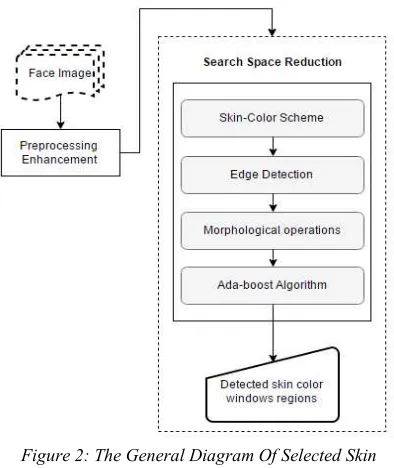
The general diagram of selection of skin color [image:4.612.95.292.186.420.2]
is shown in Figure 2. The first stage uses the skin-color scheme for extracting skin-like regions. The second step aims to enhance candidate regions by applying morphological operations. Finally, the last step applies Adaboost based algorithm in order to extract features from the selected regions.
Figure 2: The General Diagram Of Selected Skin Regions.
The color information is normally applied for region rather than segmentation of edge. Furthermore, using skin color detection in the detection phase has some advantages. For examples, the skin color is robust toward the position and shape invariance. In addition, for this method, it is very important to use a precise color space model. There are several color spaces including RGB, YCbCr, XYZ, UVW, LHC, HSI, YIQ, HSV, etc. [13].
Segmentation is the process of the partitioning an input image into several regions which are known as windows. In the next phases of face detection, the partitioned windows are used in order to obtain features from selected regions and the classifier aids to differentiate between face and non-face objects. Therefore, an accurate segmentation process is considered as a crucial step, which affects the efficiency of detection and localization of multiple faces in an input image. In addition, there are several approaches to obtain the segmented regions in face detection. In this study, a skin segmentation based approach is used in order to help to identify the probable regions, which contain the faces, as all skin-segmented regions are
not face regions and aims to reduce the search space. In addition, segmentation of an input image based on skin chromaticity uses several color spaces, which have different results in identifying even pseudo skin like regions as skin regions. Therefore, the pseudo skin regions will be eliminated in the next stage. Figure 3 illustrates the segmentation process that consists of face objects and non-face objects.
Figure 3: Sample Segmentation Of An Input Image. (A) Input Image (B) Skin Color Segmentation (C) Selected
Skin-Color Regions.
3.3 Morphological Operations
Morphological operation aims to simplify image information at the same time as keeping their essential shape characteristics and it can discard irrelevancies from image [11]. Hence, in order to have better preparation of the selected face region, it is suitable to apply the morphological operations on the result of the prior step. Morphological operations can help to eliminate the holes, which have been formed in some parts of face (eye, mouth, and nose can) in the skin color segments.
[image:4.612.315.521.207.346.2]Figure 4: Morphological Processing On The Segmented Image.
[image:5.612.320.537.387.439.2]The result of this step is the binary image from the skin-color segmentation of the last stage. Initially, morphological opening operator is used in order to eliminate extremely tiny objects from the image, while keeping the shape and size of large objects in the image. The description of a morphological opening of an image is an erosion operation that is completed after the dilation operation and both of them use similar structural elements. For this purpose, the circular structural element considered with radius 1. Next, the operation of filling holes is completed to preserve and maintain the face parts together, and this is applied before the second larger opening operation due to avoiding to have output from the image contains spaces, and holes in the faces. Finally, the morphological opening operation is completed to eliminate the small to medium objects, which are extremely much smaller than a face. For this purpose, a circular structural element with a radius of six is considered. Figure 5 depicts the results of applying the morphological operations on the results of skin color segmentation.
Figure 5: The Morphological Operations On The Segmented Region. (A) The Binary-Segmented Image, (B) The Result Of Binary Image, (C) The Output Result.
Input image scanning for face candidate searching is performed by means of a window-sliding method applied at a different image scales. Consequently, face objects can be detected at a different image resolutions and locations.
There are several factors, which explain the scanning technique, and a balance between the face detection resolution and speed of algorithm must be
considered including block size, moving scan step, and down-sampling rate. The block size is a rectangular or square block that determines the resolution of the face detection. In addition, moving scan step is the number of pixels that sets the window-sliding step to obtain each next block to be analyzed. Finally, the downscale rate is used for scaling technique to determine all of the locations and faces with different scales.
3.4 Local Binary Pattern (LBP)
[image:5.612.324.495.522.670.2]LBP is a well-organized texture operator that assigns labels to the pixels of an image by thresholding the neighborhood of each pixel and the result will be considered as a binary number. LBP aims to extract the local texture information from gray-scale images. The circular zero and one resulting values can be obtained in both clockwise and anticlockwise. In this study, we start from the top left neighbor to read the binary result in clockwise direction. Figure 6 also illustrates how the binary values are obtained from the image.
Figure 6: Example Of LBP Labeling.
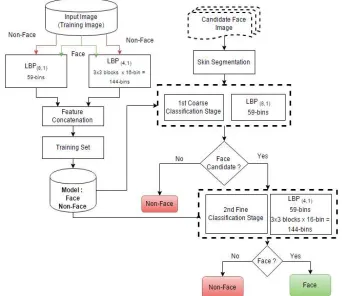
The feature extraction based on the LBP is considered as two main stages including Coarse Stage Features Extraction and Fine Stage Features Extraction as can be seen from Figure 7.
[image:5.612.107.282.538.593.2]2.4.1 Coarse Stage Feature Extraction
[image:6.612.327.508.74.155.2]The first stage confirms whether the global image appearance can be a face candidate. Therefore, (LBP, u2, 8, 1) is extracted from the whole image obtaining a 59-bin labels histogram to have a precise explanation of the global image. Figure 8 depicts (LBP, u2, 8, 1)
.
Figure 8:(LBP, u2, 8, 1) Operator.
2.4.2 Fine Stage Features Extraction
Only the candidate faces, which passed the previous step, will be verified by means of a fine second stage that examines the spatial allocation of texture descriptors. For this reason, (LBP,u2,8,1) is applied to obtain entire 16×16 pixel image and 14×14 result images. After that, the result will be divided into 3×3 block of size 6×6 with 2 pixel overlapping. To make it clear, Figure 9 illustrates the process, which the first 6×6 pixel block indicated with gray color, and the rest of overlapping blocks are represented with red color lines.
Figure 9: Fine Stage - 3×3 Blocks Division With Two Pixels Overlapping.
By using 3x3 blocks division for each block, will have a brief description of the local region by means of its 16-bin labels histogram. Consequently, an amount of 144 (3x3 x 16-bin) features vector is gained from the second fine stage. In addition, a different weight can be applied to each region in the classification stage in order to highlight most significant face regions. In training stage, these two resulting labels histograms are concatenated in an enhanced feature vector, resulting in a face representation histogram of:
bin bin
bin bin
x blocks x
bin+(33 16_ )=59_ +144_ =203− _
59
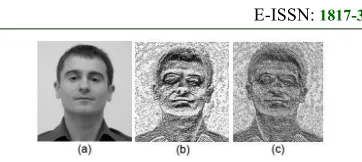
Figure 10 also depicts the result of applying LBP in first Coarse and second fine stages.
Figure 10: Example Of Image Labeling, (A) Original Image (B) 1st Stage (C) Labels Image Rescaled To 0 ...
255.
As illustrated in Figure 10, the contours of the facial features (mouth, eyes nose, ears, lips, etc.) are noticeably highlighted. In first stage labels image, contours are robustly highlighted and gives a superb overview of the image face object, which is helpful to distinguish between face and non-face images in first fast stage. Furthermore, in the second stage labels image, local texture information has more detailed which is helpful for final stage decision where the selected object is face or not.
2.4.3 SVM Face Detection Classification:
LBP is computed at each iteration, LBPx, from the sub-window and feed to the SVM classifier to classify the objects and decide if it is a face object or not. The classifier determines on the being face object of the sub-window according to the sign of the following Equation.
) ) , ( (
) (
1
1
∑
=
+ =
i
ti x i
iyK LBP LBP b
a sign LBP f
(1)
Where,
• LBPti is the LBP representation of the training
sample ti.
• yi is 1 or -1 depending on whether ti is a
positive or negative sample (face or non-face). • l is the number of samples.
• b is a scalar(bias).
• K is the second degree polynomial kernel function defined by:
K
(
LBP
x,
LBP
ti)
(
1
LBP
x.
LBP
ti)
2
=
+
• ai are the parameters of the SVM classifier, recovered by solving the following quadratic programming problem:
(
,)
)2 1 (
1 ,
1
∑
∑
= =
− l j i
tj ti j i j i l
i
i aa yy KLBP LBP a
Max
= ≤ ≤
∑
=l i
i i
iy a C
a to Subject
1
0 , 0 :
(3)
Where, C is constrain violation during the training process which is fixed to five. The cost of constrain violation during the training process, C, has to be empirically calculated and controls the balance between training errors and model complexity. If C considered as a large number, then the system may over fit and if it is too small, then it may under fit.
4. EXPERIMENTAL RESULTS
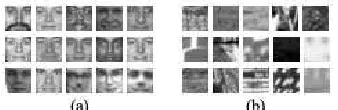
[image:7.612.373.478.190.252.2]The standard face databases consist of a large number of images, which includes several variations. Since the human face is a non-rigid object, a large number of factors such as pose, lighting condition, facial expression and occlusion can affect the appearance of the human face. Therefore, various face detection databases are prepared in order to consider the changes of one or more mentioned factors. Moreover, in order to evaluate existing approaches, the common databases and the accessibility of public face databases are necessary. Hence, three benchmark databases are used for comparison purposes in this research including MIT CBCL Face Database, CMU Face Database (Frontal and Profile), Caltech 10000 Web Faces, and GTAV Dataset. Figure 11 depicts several sample of the training data in MIT face database, which consist of face and non-face pattern images.
Figure 11: Examples Of The Training Data MIT CBCL Face Images. (A). Face-Pattern Images (B).
Nonface-Pattern Images.
4.1 Preprocessing Result
Noise removal is a significant phase of the image processing to improve the quality of a input image. In other words, noise in input image plays crucial role in reducing the details of the image. In this stage, several filters and adjustments are performed to enhance the image quality before starting the detection algorithm. The preprocessing step consists of resolution reduction, median filtering , and histogram equalization.
Resolution reduction is applied on the input image in order to reduce the dimensionality of the
[image:7.612.110.279.492.547.2]input images that can help to increase the computation time without losing too much information. The examination are performed on the Caltech 10000 dataset images within 5 different resolutions, starting from 640×480 pixels and then decreasing the image size 2, 4, 8 and 12 times. Figure 12 depicts an impact of the image resolution on the face detection process.
Figure 12: Sample Of Face Detection In Image With Low Resolution Of 54 ×40 Taken From Caltech 10000
Database.
As a result, it can be inferred that the deduction of the image resolution even by 4 times does not affect the face detection process. The result shows that if the resolution deduction applied 8 times on the image, the detection rate would be decreased around 10% to 20%.
The proposed skin-color segmentation method is applied on 250 color images from Caltech 10000 face image database under different illuminations and with persons with different skins and races. Furthermore, the method proves that can eliminate about 69% of all the pixels in the images with preserving the face region. Our experimental results show that the method does not eliminate all the regions that do not contain skin, but it may can reduce the search space by 69% with only four comparisons per pixel. Although, this stage may take a bit time to be completed, but in real time situations the overall computation time is decreased due to less amount of search space which will be remained for the next stages of proposed face detection method. Figure 13 depicts the result of edge detection using Sobel edge detection, which is applied as one part of segmentation process.
[image:7.612.313.518.585.707.2][image:8.612.333.496.92.211.2]
In order to compare the proposed skin segmentation process with the existing methods, there is a distinct lack of infrastructure when it comes to the datasets which used by contributions made to the field of skin segmentation. Therefore, a couple of existing methods have been implemented, and their performances analyzed by using a subset of images from identical images which are used to evaluate the performance of proposed method. Table 1 shows the experiment results in aspect of optimization of search space of proposed skin color segmentation and a selected recent skin-color segmentation method.
Table 1: Comparisons Of Segmentation Result.
# Number
of Pixels Proposed Segmenta tion (%) Ghimire and Lee (2013) Ghazali et al. (2012)
1 63648 84.23 82.45 83.41
2 261370 73.45 72.34 72.7
3 222300 57.11 61.01 59.32
4 78961 63.58 62.34 61.38
5 83300 71.02 58.23 62.34
6 171500 56.34 58.22 57.93
7 188856 69.71 61.83 60.35
8 786432 70.12 65.34 70.24
9 145985 62.19 61.20 59.68
10 50700 78.91 74.24 73.25
Average ~68.66 ~65.72 ~66.06
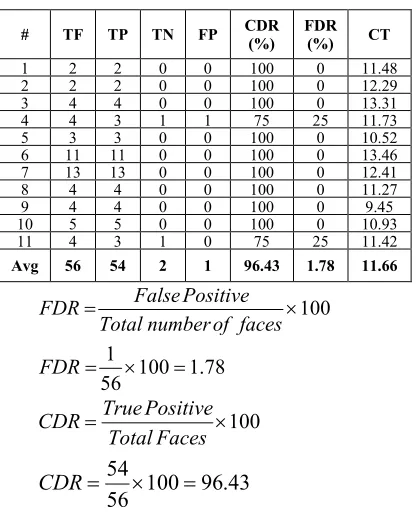
[image:8.612.97.293.272.403.2]The results of face detection framework are provided based on several metrics. The experimental results of proposed framework have performed on 250 images from Caltech 10000 web face dataset. Table 2 shows the experimental result of proposed face detection framework without validation module on the selected images and similarly, Table 3 provides the results of full framework with validation module in aspect of total face, true positive, true negative, false positive, correct detection rate, false detection rate , and computation time.
Table 2: Face Detection Result Without Validation.
# TF TP FP CDR
(%)
FDR
(%) CT
1 2 2 1 100 50.0 10.38
2 2 2 0 100 0 11.01
3 4 4 1 100 25.0 12.21
4 4 3 1 75 25.0 10.82
5 3 3 1 100 33.33 10.01
6 11 11 1 100 9.09 12.16
7 13 13 1 100 7.69 11.62
8 4 4 0 100 0 10.07
9 4 4 0 100 0 8.25
10 5 5 0 100 0 9.33
11 4 3 0 75 0 10.28
Avg. 56 54 6 96.42 10.71 10.55
100
×
=
faces
of
number
Total
Positive
False
FDR
71
.
10
100
56
6
×
=
=
FDR
100 × = Faces Total Positive True CDR42
.
96
100
56
54
=
×
=
CDR
As can be seen from the result, the correct detection rate and false detection rates are 96.42 and 10.71, respectively. Similarly, the same implementation is performed with validation and Table 3 has shown the results of proposed face detection which validation stage is considered.
Table 3: Face Detection Result With Validation.
# TF TP TN FP CDR
(%) FDR
(%) CT
1 2 2 0 0 100 0 11.48
2 2 2 0 0 100 0 12.29
3 4 4 0 0 100 0 13.31
4 4 3 1 1 75 25 11.73
5 3 3 0 0 100 0 10.52
6 11 11 0 0 100 0 13.46
7 13 13 0 0 100 0 12.41
8 4 4 0 0 100 0 11.27
9 4 4 0 0 100 0 9.45
10 5 5 0 0 100 0 10.93
11 4 3 1 0 75 25 11.42
Avg 56 54 2 1 96.43 1.78 11.66
100 × = faces of number Total Positive False FDR 78 . 1 100 56 1 = × = FDR 100 × = Faces Total Positive True CDR
43
.
96
100
56
54
×
=
=
CDR
As can be inferred from Table 3, the face detection results show 96.43 correct detection rate, and 1.78% false detection rate and the average for computation time is 11.66 milliseconds for 56 face images. Also, from the results can be inferred that the detection rate is constant in both evaluations (with validation and without validation stage), but the false detection rate is decreased noticeably from 10.71% to 1.78.
[image:8.612.315.523.319.577.2]Table 4: Detection Rates Of Various Numbers Of False Positives On The MIT+CMU Test Set Containing 130
Images And 507 Faces.
Framework
False Detection
10 50 78 167
Viola-Jones
(2001) 76.1% 91.4% 92.1% 93.9%
Viola-Jones
(voting) 81.1% 92.1% 93.1% 93.7%
Rowley-Baluja-Kanade 83.2% - - 90.1%
Roth-Yang-Ahuja - - 94.8% -
Proposed
Method 94.56% 97.27 97.39 97.78
4.2 Detection Result
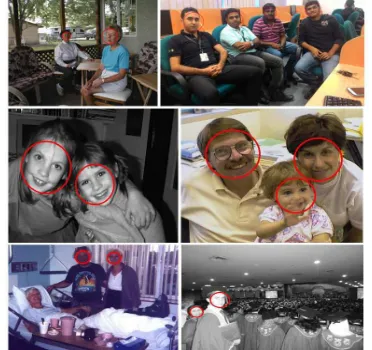
The proposed face detection framework has been implemented and the results of this framework is illustrated on several face databases including CMU-MIT, Caltech, and personal images as they are illustrated in Figure 14.
Figure 14: Result Of Proposed Face Detection On A Caltech 10000 Face Database (Frontal-View And
Profile), CMU-MIT, And Personal Images.
5. CONCLUSION
The proposed face detection system consists of three main modules including pre-processing, face detection, and validation. The pre-processing module aims to make the image ready before entering in face detection system in order to decreasing the image size, enhancing the image quality, removing noise, and segmentation based on the skin color and edges of face(s) in input images. In the second stage, by using haar-like algorithms the features of input image will be extracted base on the windows which consists of human face and
Adaboost algorithm start training the face and non-face images which we have already given. The result of second stages will contain of nominate human face images. In other words, the result of this part after classification may not be with 100% accuracy and some false positives may be selected wrongly. To avoid this kind of false alarms we have come up with evaluation module. In the last module, the input is candidate face images, which needed to be verified. Hence, another face detection system is deployed in order to extract feature by using ExLBP algorithm and using SVM classifier to classify in the face and non-face images. Finally, the selected face by the verification until will be bounded throughout the input image.
Although the present research aimed to propose a framework with 100% accuracy, there are some limitations, which still have not solved. Some enhancements toward the face detection problem to make better and more precise face detection for future researchers in this area are suggested as following:
Feature detection/extraction is one of the main parts of the face detection system to obtain all of the face(s) in images with the mentioned variations. A good feature extraction also can decrease the number of false negatives..
The proposed method has been applied on the standard image databases and the method can be extended for real-time purposes, which can capture practical images/video frame via surveillance system.
ACKNOWLEDGMENT
This research was funded by the Universiti Teknologi Malaysia through Research University Grant (RUG)and manage by Research Management Centre, Universiti Teknologi Malaysia under Vot No. Q.J130000.2528.09H69.
REFERECNES:
[1] Brubaker, S. C., Wu, J., Sun, J., Mullin, M. D. and Rehg, J. M. (2008). On the design of cascades of boosted ensembles for face detection. International journal of computer vision. 77(3), 65-86.
[image:9.612.101.287.365.540.2][3] Hemalatha, G., Sumathi C. P. (2014). A Study
of Techniques for Facial Detection and Expression Classification. International Journal of Computer Science & Engineering Survey (IJCSES). 5(2), 27-37.
[4] Jaimes, A. and Sebe, N. (2007). Multimodal human–computer interaction: A survey. Computer Vision and Image Understanding. 108(1–2), 116-134.
[5] Jun, B. and Kim, D. (2012). Robust face detection using local gradient patterns and evidence accumulation. Pattern Recognition. 45(9), 3304-3316.
[6] Kakumanu, P., Makrogiannis, S., and Bourbakis, N. (2007). A survey of skin-color modeling and detection methods. Pattern Recognition. 40(3), 1106-1122.
[7] Lakshmi, H.C.V., PatilKulakarni, S. (2010). Segmentation Algorithm for Multiple Face Detection for Color Images with Skin Tone Regions. International Conference on Signal Acquisition and Processing, ICSAP '10. 9-10 February. Bangalore: IEEE, 162-166.
[8] Lin, .C. (2007). Face detection in complicated backgrounds and different illumination conditions by using YCbCr color space and neural network .National Taipei University, Taipei 10433, Taiwan, ROC. 28(16), 2190– 2200.
[9] Omaima, N. A. A. (2014). Review of face detection systems based artificial neural networks algorithms. The International Journal of Multimedia & Its Applications (IJMA), 6(1), 1-16.
[10] Sathyanarayana, S., Satzoda, R. K., Sathyanarayana S., Thambipillai, S. (2014). Springer Berlin Heidelberg, Block-Based Search Space Reduction Technique for Face Detection Using Shoulder and Head Curve. Image and Video Technology Lecture Notes in Computer Science. 8333, 385-396.
[11] Upraity, H., Arya, K.V. (2014). Efficient face recognition using morphological operations. Industrial and Information Systems (ICIIS), 2014 9th International Conference. 15-17 December. Gwalior, 1-6.
[12] Verschae, R., Ruiz-del-Solar, J. and Correa, M. (2008). A unified learning framework for object detection and classification using nested cascades of boosted classifiers. Machine Vision and Applications. 19(2), 85-103. [13] Wang, X., Chen, X., and Li, H. (2009). Fast
and Robust Face Detection with Skin Color Mixture Models and Asymmetric AdaBoost.
Pattern Recognition and Computer Vision. 7496 (18), 74-96.
[14] Wang, X., Xu, H., Wang, H., and Li, H. (2008). Robust real-time face detection with skin color detection and the modified census transform. Information and Automation. 2008. ICIA 2008. 20-23 June. Changsha: IEEE, 590-595.
[15] Xiaoning, L., Guohua, G., Xiaofeng, W. (2010). Automatically face detection based on BP neural network and Bayesian decision. Natural Computation (ICNC), 2010 Sixth International Conference. 10-12 August. Yantai, Shandong: IEEE, 1590-1594.
[16] Yang, M.H., Kriegman D., Ahuja, N. (2002). Detecting faces in images: A survey. IEEE Transactions on Pattern Analysis and Machine Intelligence. January 2002, 34–58.
![Figure 1: Capturing a face from a surveillance video. (a) Surveillance system, (b) Detected facial region [17]](https://thumb-us.123doks.com/thumbv2/123dok_us/8910035.958799/2.612.91.295.105.214/figure-capturing-surveillance-video-surveillance-detected-facial-region.webp)