http://www.scirp.org/journal/jss ISSN Online: 2327-5960
ISSN Print: 2327-5952
DOI: 10.4236/jss.2018.63001 Mar. 13, 2018 1 Open Journal of Social Sciences
Optimal Selection of Overseas Oil Development
Projects of Sinopec Based on a Multi-Objective
Programming Model
*
Haijun Fan
1, Xueqian Zhu
2, Guangchao Li
2, Yumei Fan
21China University of Petroleum, Qingdao, China
2Sinopec Institute of Petroleum Exploitation and Development, Beijing, China
Abstract
With the continuous low oil price, the national oil companies in China are under the pressure of lowering the development cost and improving their in-vestment efficiency of their overseas inin-vestments. Optimal methods are needed in screening the overseas assets within the constraint of investment. This paper presents a multi-objective integer programming model for the op-timal selection of overseas oil development projects for Sinopec based on the economic evaluation of various projects in different countries and regions. Combination of economic parameters and practical constraints are discussed and presented in the mathematical models. Application of the model shows its advantages over the traditional screening and ranking methods.
Keywords
Oil Development Project, Optimal Selection, Sinopec, Multi-Objective Model
1. Introduction
In recent years as one of the major Chinese NOCs, China Petroleum & Chemical Corporation (Sinopec) have emerged as significant players in global mergers and acquisitions in upstream oil and natural gas for the need of domestic economic development. After years of expanding and diversifying its overseas reserves, Sinopec has made significant improvement in its overseas production levels. In 2016, Sinopec spent USD 29.39 billion approximately for the assets outside Chi-na, with more than half located in the Middle East and Africa. All of overseas reserves are under the management of Sinopec International Petroleum
Explora-*Sponsored by China National Science and Technology Major Project (2016ZX05033005-008). How to cite this paper: Fan, H.J., Zhu,
X.Q., Li, G.C. and Fan, Y.M. (2018) Optim-al Selection of Overseas Oil Development Projects of Sinopec Based on a Mul-ti-Objective Programming Model. Open Journal of Social Sciences, 6, 1-11.
https://doi.org/10.4236/jss.2018.63001
DOI: 10.4236/jss.2018.63001 2 Open Journal of Social Sciences
tion and Development Corporation (“SIPC”), a wholly-owned subsidiary of Si-nopec Group, which specialized in overseas oil and gas investment and opera-tions. Under the pressure of low oil price, SIPC is seeking to reduce overseas in-vestment and improve the management efficiency of overseas assets by lowering non-efficient overseas output, driving down operational costs of overseas oil and gas production and slashing management fees.
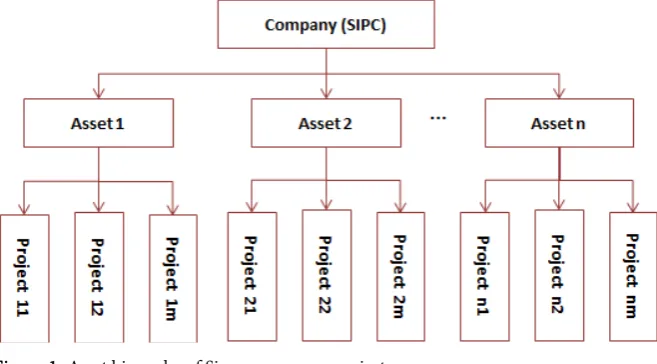
The management of overseas projects of Sinopec is under a three-level struc-ture, Company-Asset-Project, as in Figure 1. SIPC is on the top and has the final decision. Each asset under the SIPC owns different projects with different con-tracts, components, life time, or even different oil prices, all evaluated with cash flow model. The objectives of SIPC to reduce the expense and improve invest-ment efficiency are realized by expanding or keeping good project and cutting or suspending the poor projects. This cannot be reached simply by selecting projects according to the economic indexes, such as NPV or PIR. Mean while at different level there are also other requirements or limitations, for instance SIPC may not want to abandon a whole asset or in one asset some existing projects should be kept because of mutual obligations. So in this paper a multi-objective programming model is presented considering all of the requirements and obli-gations under some limitation of capital expenditure or oil production.
2. Literature Review
Aronofsky (1983) [1] summarized the use of linear programming (LP) and Mixed Linear Programming (MIP) in the optimization of oilfield development, especially the combination of LP with reservoir simulation.
Modern portfolio theory [2] was introduced into petroleum ventures by many researchers [3] [4] [6] [7]. Hightower (1991) adopted a modified Markowitz portfolio model utilizing the semi-variance risk parameter to meet the invest-ment objectives and information limitations characteristic of the oil industry.
[image:2.595.210.539.536.718.2]Campbell (1999) [5] reviewed the limitation of traditional discounted cash flow (DCF) analysis and present two new approaches to measuring value for long-term
DOI: 10.4236/jss.2018.63001 3 Open Journal of Social Sciences
and strategic projects, called Strategic Diversification Value (SDV) and Venture Capitalist Value (VCV) respectively. The SDV implies a changing discount rate after the discounted payback is reached. With VCV, the emphasis shifts to mea-suring the cash flow through an amortization schedule for returning investment capital rather than focusing on discounting.
L. G. Chron (2004) [6] describes the application of dynamic programming techniques and the concepts of Markov chains to modeling projects within an investment opportunity portfolio. By dividing the investment opportunity set as exploration portfolio and development portfolio he treat the assets in the portfo-lio as dynamic opportunities requiring irregularly timed investments and yield-ing rewardyield-ing on multiple dimensions.
Rasey (2005) [7] presents a portfolio optimization method using visualization which gives the decision maker new abilities to manage a portfolio of investment opportunities instead of building LP models. Morteza (2010) [8] provides a simple approach to assess alternative projects and help the decision maker to select the best one for National Iranian Oil Company by using six criteria of comparing investment alternatives as criteria in an AHP and fuzzy TOPSIS techniques.
Zhong [9] use Data Envelopment Analysis (DEA) to present a method to de-termine the optimal scale of productivity construction investment in unit pro-duction. He established an optimal model with net present value (NPV) as ob-jective function and constraints including investment, reserve/production ratio, production and some equality constraints.
Tang et al. (2017) [10] analyzed investment opportunity of an oil field project located in Kazakhstan by combining discounted cash flow method and the tri-nomial tree model of real option approach (ROA) considering uncertainties such as oil price, exchange rate and political environment.
The Sinopec overseas development projects in different countries and regions are under different reservoir types, lifetime, different operators and even differ-ent production share contracts. Not all of the projects are conducted probabilis-tic assessments or EMV evaluation based on some mathemaprobabilis-tical methods such as Monte Carlo. The normally adopted oilfield asset management theory that involves reservoir simulation and implementation of development plan is hardly used either when there is no reliable detailed geological model available, on the other hand it is time-consuming and unnecessary to involve the well location and control strategies for projects selection. So based on the current determinis-tic economic evaluation of different projects and other available project infor-mation, we present a multi-objective programming model for the optimal selec-tion of overseas projects.
3. Theoretical Model
DOI: 10.4236/jss.2018.63001 4 Open Journal of Social Sciences
not means the value of decision variables should be 0 or 1. So it is actually a 0 - 1 Knapsack Problem or a general Integer Programming (IP) Problem.
The general mathematical expression of multi-objective linear programming model can be written as (1),
maxZ=Cx
s.t. 0 Ax b x ≤ ≥
(1)
in which
1 2
( , , , n)T
x= x x x , ( ,1 2, , )
T r
Z= z z z , A=(aij m n) ×
, C=(cij r n)× ,
1 2
( , , , )T m
b= b b b
If the value of decision variable x can only be 0 or 1, it is also called a 0 - 1 programming problem.
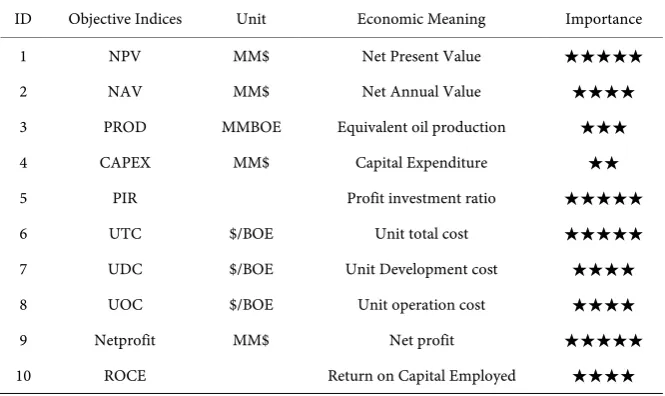
As mentioned in the introduction, in the three-level management structure of Sinopec overseas investments, all of the projects in each asset are economically evaluated based on cash flow model. All of the economic parameters are known for each project. Ten economic indices have been selected as the combination of objective function as list in Table 1.
The objective function in the model is a combination of the above economic parameters at different weights. For instance, if we take NPV,PIR and UOC as multi-objective function, the model can be expressed as:
(
)
(
)
(
)
{
1 2 3}
1 1
j
n m
ij ij ij
ij ij ij
j i
Max w NPV x w PIR x w UOC x
= =
+ −
∑∑
(2)
where
(
NPV)
ij is the normalized NPV of Project i in Asset j, [image:4.595.207.540.521.719.2](
PIR)
ij is the normalized PIR of Project i in Asset j,Table 1. Economic parameters used as objectives.
ID Objective Indices Unit Economic Meaning Importance
1 NPV MM$ Net Present Value ★★★★★
2 NAV MM$ Net Annual Value ★★★★
3 PROD MMBOE Equivalent oil production ★★★
4 CAPEX MM$ Capital Expenditure ★★
5 PIR Profit investment ratio ★★★★★
6 UTC $/BOE Unit total cost ★★★★★
7 UDC $/BOE Unit Development cost ★★★★
8 UOC $/BOE Unit operation cost ★★★★
9 Netprofit MM$ Net profit ★★★★★
DOI: 10.4236/jss.2018.63001 5 Open Journal of Social Sciences
(
UOC)
ij is the normalized UOC of Project i in Asset j,1, 2, 3
w w w is the weight for objective NPV, PIR and UOC.
ij
x is the decision variable, the value is 0 or 1, which mean rejected or selected
respectively.
In the ten objectives, for a determined selection of projects, the ROCE can be expressed as:
(
)
(
)
1 1 1 1 Profit ROCE Capex j j n m ij ij j i n m ij ij j i x x = = = = =∑∑
∑∑
(3)
So if ROCE is included in the objective function, it will become a nonlinear integer programming problem.
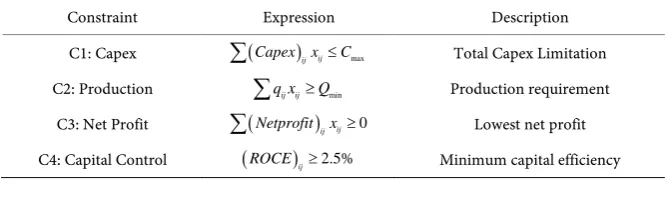
[image:5.595.206.539.633.734.2]To realize the goals of keeping good projects, cutting or suspending the poor projects, the first constraint is investment limit. An appropriate Capex limitation should be given for the whole company (SIPC) or for an individual asset. Other constraints may include the oil production should be greater than some required value, the net profit should be positive or the ROCE should be great than some value to maintain a minimum capital efficiency. The main constraints are list in Table 2.
It should also be noticed that if ROCE is included in constraints, it will be-come a nonlinear integer programming problem. Nonlinear algorithm such as Genetic Algorithm may be needed in solving the problem.
In order to avoid cutting all of the projects in one asset, the following option can be given in the model.
(
)
1
0 1, 2, ,
j
n
ij i
x j m
=
> =
∑
(4)To gain better access to crucial technical and managerial know-how in areas in which Sinopec are relatively inexperienced, the company would like to keep a proportion of unconventional oil and gas assets in the total investments. This constraint can be expressed as:
( )
1 1 1 1 j j n m ij j i unconv n m ij j iH x x b x = = = = ≥
∑∑
∑∑
(5)
Table 2. Main constraints in the optimization model.
Constraint Expression Description
C1: Capex
∑
(Capex)ijxij≤Cmax Total Capex LimitationC2: Production
∑
q xij ij≥Qmin Production requirementC3: Net Profit
∑
(Netprofit)ijxij≥0 Lowest net profitDOI: 10.4236/jss.2018.63001 6 Open Journal of Social Sciences
where
( )
10
if x is unconventional reservoir H x
if x is conventional reservoir
=
unconv
b is the proportion of unconventional oil and gas in company’s long-term
plan.
In order to use linear integer programming algorithm to solve this problem, Equation (5) can be linearized as following:
( )
1 1 0 j n m unconv ij j ib H x x
= =
− ≤
∑∑
(6)
For a single project in an asset, it may be evaluated based on different scena-rios such as different development plans or oil price levels. Only one can be chosen among these evaluation schemes with different economic performances. This constraint is easily written as:
3 1 1 ijl l x = ≤
∑
(7)where l represents different evaluation scheme, 1≤ ≤l 3.
Through different combination of objectives and constraints, more than 300 mathematical models can be presented. A model library was constructed in the software with different models which can give various model combination based on the selection of model and constraints and the necessary input values by the user. The mixed integer programming algorithm and genetic algorithm are used to solve this problem depending on the model is linear or not or if equality con-straints exist in this problem. Software is developed with functions like dealing with data file, automatic algorithm selecting based on the nature of the model.
4. Applications
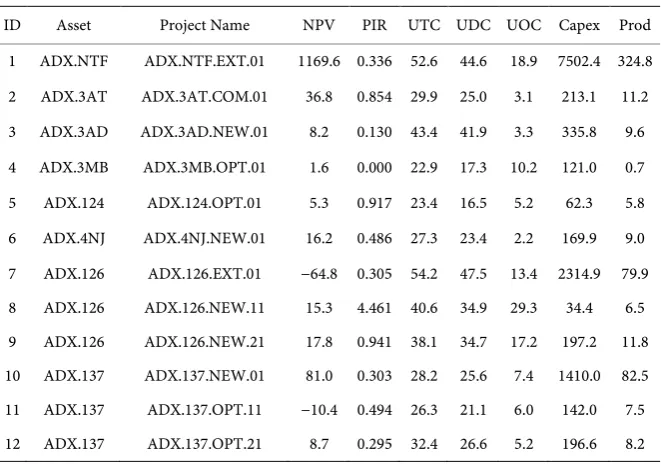
The linear integer programing model is conducted for the optimization of 256 overseas projects of SIPC. The typical information of each project is summarized in two tables. Table 3 is the basic information of the project including name, code, contract/block, category et al. Table 4 is the economic evaluation output of each projects.
Normally all the economic evaluation reports and data are stored in MS Excel files. The software developed here can selectively read all the necessary data from these files when they are ready. After that the user need to input all the objectives and constraints and choose some particular options as shown in Figure 2.
DOI: 10.4236/jss.2018.63001 7 Open Journal of Social Sciences Table 3. Project basic information.
No. Parameter Value
A1 Project Name Lula
A2 Project code (optional) PGB.LUL.COM.030
A3 Contract/Block BM-S-11
A4 Project category Committed
A5 Project maturity type Pre-gate 3 (FID)
A6 Level of Political Risk Level 4 of 5
A7 Level of Reserve Level 2 of 3
A8 Operator Non operated units
A9 Working interest (WI) 3%
Table 4. Project economic evaluation output.
ID Asset Project Name NPV PIR UTC UDC UOC Capex Prod
1 ADX.NTF ADX.NTF.EXT.01 1169.6 0.336 52.6 44.6 18.9 7502.4 324.8 2 ADX.3AT ADX.3AT.COM.01 36.8 0.854 29.9 25.0 3.1 213.1 11.2 3 ADX.3AD ADX.3AD.NEW.01 8.2 0.130 43.4 41.9 3.3 335.8 9.6 4 ADX.3MB ADX.3MB.OPT.01 1.6 0.000 22.9 17.3 10.2 121.0 0.7 5 ADX.124 ADX.124.OPT.01 5.3 0.917 23.4 16.5 5.2 62.3 5.8 6 ADX.4NJ ADX.4NJ.NEW.01 16.2 0.486 27.3 23.4 2.2 169.9 9.0 7 ADX.126 ADX.126.EXT.01 −64.8 0.305 54.2 47.5 13.4 2314.9 79.9 8 ADX.126 ADX.126.NEW.11 15.3 4.461 40.6 34.9 29.3 34.4 6.5 9 ADX.126 ADX.126.NEW.21 17.8 0.941 38.1 34.7 17.2 197.2 11.8 10 ADX.137 ADX.137.NEW.01 81.0 0.303 28.2 25.6 7.4 1410.0 82.5 11 ADX.137 ADX.137.OPT.11 −10.4 0.494 26.3 21.1 6.0 142.0 7.5 12 ADX.137 ADX.137.OPT.21 8.7 0.295 32.4 26.6 5.2 196.6 8.2
(For saving space and data safety, only 12 projects are listed).
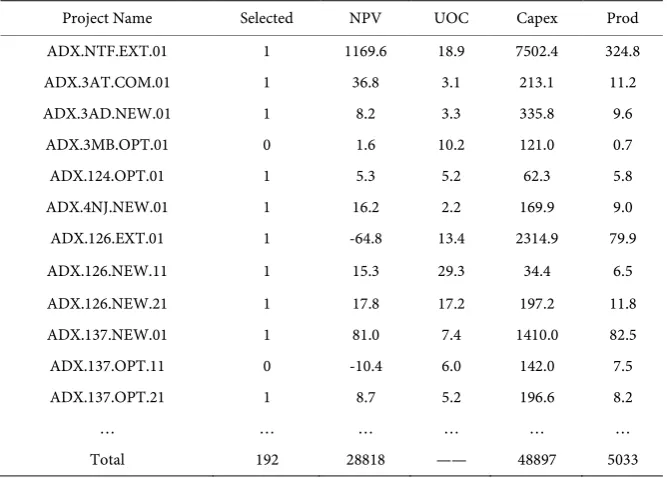
The optimization result in Table 5 shows that 192 projects are selected finally among the total 256 projects. The projects with lower efficiency are removed. And we can find from Table 5 that project ADX.126.EXT.01 with a negative NPV is preserved in the optimization, the reason is that the option “Keep Exist-ing Project” is selected before optimization. So we must note that this is a very strong constraint if it must be claimed by the company’s decision-makers.
[image:7.595.208.539.302.534.2]DOI: 10.4236/jss.2018.63001 8 Open Journal of Social Sciences Figure 2. The optimizaiton software main interface.
Table 5. Project optimization result.
Project Name Selected NPV UOC Capex Prod
ADX.NTF.EXT.01 1 1169.6 18.9 7502.4 324.8
ADX.3AT.COM.01 1 36.8 3.1 213.1 11.2
ADX.3AD.NEW.01 1 8.2 3.3 335.8 9.6
ADX.3MB.OPT.01 0 1.6 10.2 121.0 0.7
ADX.124.OPT.01 1 5.3 5.2 62.3 5.8
ADX.4NJ.NEW.01 1 16.2 2.2 169.9 9.0
ADX.126.EXT.01 1 -64.8 13.4 2314.9 79.9
ADX.126.NEW.11 1 15.3 29.3 34.4 6.5
ADX.126.NEW.21 1 17.8 17.2 197.2 11.8
ADX.137.NEW.01 1 81.0 7.4 1410.0 82.5
ADX.137.OPT.11 0 -10.4 6.0 142.0 7.5
ADX.137.OPT.21 1 8.7 5.2 196.6 8.2
… … … …
Total 192 28818 —— 48897 5033
[image:8.595.207.541.324.563.2]DOI: 10.4236/jss.2018.63001 9 Open Journal of Social Sciences Figure 3. Production profile before and after optimization.
Figure 4. Economic parameters before and after optimization.
Figure 5. Efficient frontier of the optimization groups.
1 2 3
a price reserve politic
[image:9.595.231.521.470.667.2]DOI: 10.4236/jss.2018.63001 10 Open Journal of Social Sciences
Equation (9) indicates the overall risk is a combination of risk from oil price, reserve and politics, K1, K2, K3 are different weights, K1+K2+K3 =1. The
effi-cient frontier analysis for different combination schemes is shown in Figure 5.
5. Conclusion
The optimal selection of overseas development projects are realized by a mixed integer programming model which based on the available cash flow model eval-uation of different projects and assets. Combinations of economic parameters are analyzed and described during the construction of the multi-objective ma-thematical model. Some practical considerations such as the preservation of ex-isting project or the dependency of assets have great influence on the optimiza-tion result. The software developed can give the decision-makers more opoptimiza-tions in deciding the combination of objectives and constraints, on which the model structure and algorithm will be automatically matched.
Acknowledgements
Funding for this work was supported by China National Science and Technology Major Project (2016ZX05033005-008). The authors would like to thank overseas research center of Sinopec Institute of Petroleum Exploitation and Development for the case study development.
References
[1] Aronofsky, J. (1983) Optimization Method in Oil and Gas Development. SPE 12295. [2] Markowitz, H. (1952) Portfolio Selection. Journal of France, 7, 77-91.
[3] Hightower, M.L. and David, A. (1991) Portfolio Modeling: A Technique for Sophis-ticated Oil and Gas Investors. SPE Hydrocarbon Economics and Evaluation Sympo-sium,Dallas, TX, 11-12 April 1991, SPE-22016-MS.
https://doi.org/10.2118/22016-MS
[4] Orman, M.M. and Duggan, T.E. (1999) Applying Modern Portfolio Theory to Up-stream Investment Decision Making. Journal of Petroleum Technology, 51, 50-53.
https://doi.org/10.2118/54774-JPT
[5] Campbell, J.M. and Campbell, R.A. (1999) Measuring Strategic Investment Value.
SPE Annual Technical Conference and Exhibition, Houston, TX, 3-6 October 1999, SPE-56453-MS. https://doi.org/10.2118/56453-MS
[6] Chron, L.G. (2004) Portfolio Management Framework for Multistage Investments.
SPE Annual Technical Conference and Exhibition, Houston, TX, 26-29 September 2004, SPE-90700-MS.https://doi.org/10.2118/90700-MS
[7] Rasey, S.M. (2005) Visualization and Interactive Filtering of Strategy Driven Portfo-lios as an Alternative to LP Optimization. SPE Hydrocarbon Economics and Evalua-tion Symposium, Dallas, TX, 3-5 April 2005, SPE-94676-MS.
https://doi.org/10.2118/94676-MS
[8] Morteza, P.A. (2010) Project Selection for Oil-Fields Development by Using the AHP and Fuzzy TOPSIS Methods. Expert Systems with Applications, 37, 6218-6224.
https://doi.org/10.1016/j.eswa.2010.02.103
DOI: 10.4236/jss.2018.63001 11 Open Journal of Social Sciences https://doi.org/10.1016/j.petlm.2016.04.004