The study of technology acceptance for e-wallets
application of clinic fees payment
Yi-Horng Lai
Department of Health Care Administration, Oriental Institute of Technology, Taipei, Chinese Taipei; [email protected]
Received 31 August 2012; revised 7 October 2012; accepted 17 October 2012
ABSTRACT
The purpose of this study was to investigate the demand of application of e-wallet in domestic retail industry by examining the needs of adop-tion of small amount paying method and the reasons for customers’ using of IC stored value card in this industry and aimed at providing suggestions on the e-development of small amount paying methods for domestic retail and banking industries. This study was developed in a way that the model constructs in TAM were adapted to the context of using e-wallets for clinic fees. Scale items on the survey include those measuring perceived usefulness, per-ceived ease of use, a user's attitude toward us-ing and intention. The questionnaire contains no identifying information about the individual par-ticipants. A total of 320 Taipei City Hospital pa-tients’ feedbacks were collected. Results indi-cate most of the relationships in the pro-posed model are statistically significant and in the predicted directions. Each observed variables influence with two ways: direct effect and inrect effect, and the total effect is the sum of di-rect effect and indidi-rect effect. The Main effect of most of these observed variables is direct effect, but the information technology experience with the perceived usefulness. In this study, it could be finding that the perceived usefulness, the perceiver ease of use is positively associated with users’ attitude toward using, and the per-ceiver ease of use is positively associated with the perceived usefulness. It means the useful and easily operation of payment clinic fees with e-wallet products (such as Taipei Easy Card) is very important for the users. Besides, the easier for e-wallet using, the more people think it is usefulness. This suggestion is the same as the point at issue of Davis [1]. The users’ attitude toward using is positively associated with the
intention using.
Keywords:E-Wallets; Clinic Fees; Information Technology Experience
1. INTRODUCTION
In recent years, the development and commercial ap-plication of e-wallets have shown promising growth in the industries of transportation, telecommunication, etc. As for in the retail industry, paying by cash is still the dominant method, especially in the convenience stores, huge quantity of transactions with small amount makes payment via credit card or cash card inconvenient. The application of paying via low-cost IC card with the aims of security and convenience will bring great benefit to the business and the customers alike.
The purpose of this study was to investigate the de-mand of application of e-wallet in domestic retail indus-try by examining the needs of adoption of small amount paying method and the reasons for customers’ using of IC stored value card in this industry and aimed at pro-viding suggestions on the e-development of small amount paying methods for domestic retail and banking industries.
The report starts with the introduction to easy card with credit option and the commercial applications of IC card, and then goes on to the research of demands of customers, retail industry and baking sector. Finally the report leads to the results of the questionnaire investigat-ing the effects of variables of population poll and life style on the adoption of easy card/e-money.
1.1. An E-Wallet: Taipei Easy Card
and cardholder can pay with it.
Taipei Easy Card is an e-wallet that provided by Easy Card Corporation. It is a non-contact multi-function electronic ticket integration of the payment of the Taipei mass rapid transit system, buses, parking, and authorized stores. Users pass the card over the sensor area to make a transaction, avoiding hassles with finding correct change. As value can be added to the card at any time, there is no need to repeatedly purchasing new cards. Taipei Easy Card can be used for years and its ultimate aim is to al-low people to travel throughout Taiwan with only one card.
People to hospitals for treatment, has a money card chargeback equipment at direct induction debit, to com-plete the registration fees and medical expenses to pay, eliminating the need for site preparation cash or ex-change the inconvenience of looking for ex-change after August, 2008. The object of this study is finding the in-fluence of the active of using Easy Card for clinic fees.
1.2. The Technology Acceptance Model
Based on the theory of reasoned actions (TRA) [3], TAM addresses factors influencing a user’s attitude to-ward using (ATT) and intention to use technology [1]. TAM has been widely adopted in studies exploring technology acceptance due to its parsimonious nature and highly reliable constructs. Examples include studies testing user acceptance of word processors [1], spread-sheet applications [4], email [5], and websites [6].
TAM considers perceived usefulness (PU) and per-ceived ease of use (PE) as two major factors influencing a user’s attitude toward using technology (ATT). The former refers to the perceived effectiveness of improving the user’s performance, while the latter refers to how effortless a user perceives using the technology to be. Prior research has found that PE mostly influences atti-tude and intention indirectly through PU [7]. Perceived usefulness and user attitude in turn influence intention to use, which predicts actual usage of technology. Treating the application of e-wallets as a new technology is used in Hospital in Hong Kong. This paper proposes that the same relationships from TAM hold in relation to pay clinic fees with Taipei Easy Card.
H1: PE is positively associated with ATT. H2: PU is positively associated with ATT. H3: PE is positively associated with PU. H4: ATT is positively associated with Intention. H5: PU is positively associated with Intention.
1.3. Personal Prior Experience
Experience was not explicitly included in the original TAM. Davis [3] and consumer behavior researchers has studied the relationship between a person’s experiences
and his or her behavior. Experience, which is the result of acquiring and processing stimulation over time, is one factor that determines how much exposure to a particular stimulus a person accepts.
Peter and Olson point out that “Personal experience of a given object affects a person’s behavior” [8]. They found that the more positive a person’s experience about an object is, the more positive beliefs he or she will hold about it. As a result, the more positive beliefs a person has, the more positive attitude this will create. On the other hand, according to the user behavior literature, be-liefs and attitudes are principally created based on a per-son’s personal experience of a given object.
Prior information technology experience (TE) influ- ences the attitude and performance of using technical devices [9]. Generally, it has found that experts show a superior performance with respect to the utilization of technology. This finding is rather trivial as long as the relationship between computer experience, technology acceptance, and performance is not completely clari- fied.
Thompson, Higgins, and Howell [10] argued that within the context of information technology, both self-reported computer skill and length of use should be measured because they represent distinct dimensions of general computer experience. As a reflection of self- reported computer skill, computer self-efficacy measures the level of confidence that a user has when working with new software packages. On the other hand, the length of computer experience is an objective measure of a user’s computer experience. More computer experience usually implies greater exposure to different types of applications and higher level of familiarity with various software packages. Although computer expertise and its effect on performance has been studied thoroughly [9], the underlying concept of expertise and its measurement are not exactly defined yet. This expectation leads to the hypothesis:
H6: TE is positively associated with PU. H7: TE is positively associated with PE.
2. METHOD
With PE, PU and related propositions integrated, Fig-ure 1 summarizes the research framework of this study in a TAM model in which perceived ease of use, per-ceived usefulness, information technology experience and medical treatment experience positively influence users’ attitude and intentions.
2.1. Methodology
TE
PU Intention
ATT PE
H4 H5
H2
H1 H3
H6
H7
PU1 PU2 PU3 PU4 PU5 PU6
TE1
TE2
TE3
TE4
TE5
TE6
PE1 PE2 PE3 PE4 PE5 PE6
INT1
INT2
INT3
ATT1
ATT2
ATT3
[image:3.595.96.506.84.298.2]ATT4
Figure 1. The research framework.
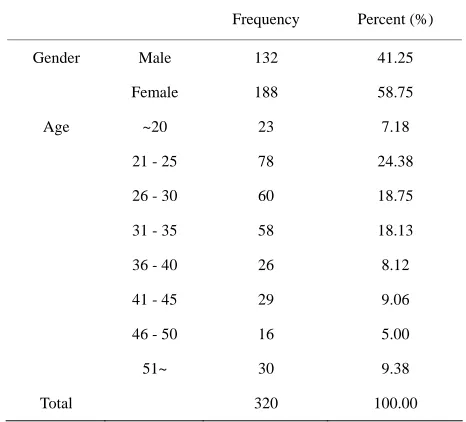
Table 1. Data summarize. clinic fees in November and December in 2011. There
320 Taipei City Hospital patients in the research data.
Frequency Percent (%)
Gender Male 132 41.25
Female 188 58.75
Age ~20 23 7.18
21 - 25 78 24.38
26 - 30 60 18.75
31 - 35 58 18.13
36 - 40 26 8.12
41 - 45 29 9.06
46 - 50 16 5.00
51~ 30 9.38
Total 320 100.00
This study was developed in a way that the model constructs in TAM were adapted to the context of using e-wallets for clinic fees. Scale items on the survey in-clude those measuring perceived usefulness (PU), per-ceived ease of use (PE), a user’s attitude toward using (ATT) and intention. The questionnaire contains no iden-tifying information about the individual participants. A total of 320 Taipei City Hospital patients’ feedbacks were collected. Some basic demographic information is collected, indicating approximately 188 females (58.75%) and 132 males (41.25%) in the sample population, most of them are 21 - 35 years old, and there are 196 patients in this age Interval (See Table 1).
The questionnaires of perceived usefulness (PU) are as follow:
1) I can easily complete the payment of clinic fees with Taipei Easy Card.
2) I can make the efficient completion of the payment
of clinic fee with Taipei Easy Card. Card to pay clinic fees.
3) Remember how to use the Taipei Easy Card to pay clinic fees is easy for me.
3) Taipei Easy Card to satisfy payment of the demand for clinic fees.
4) It is easy to understand the process of how to pay clinic fees with Taipei Easy Card.
4) Taipei Easy Card makes rapid completion of the payment of clinic fees.
5) The process of the payment of the clinic fee with Taipei Easy Card, the staff gave the relevant assistance. 5) Taipei Easy Card can reduce the time I wait for the
payment of medical fees.
6) On the whole, it is very easy to use the Taipei Easy Card to pay clinic fees for me.
6) Taipei Easy Card makes the payment of medical expenses easier.
The questionnaires of the user’s attitude toward using (ATT) are as follow:
The questionnaires of perceived easiness of use (PE) are as follow:
1) It is a good idea that the pay clinic fees with Taipei Easy Card.
1) When I pay the clinic fee with an error occurs, I can easily corrected it.
[image:3.595.306.539.340.551.2]Taipei Easy Card.
3) It is good that pay clinic fees with Taipei Easy Card.
4) Overall, pay clinic fees with Taipei Easy Card is a positive attitude for me.
The questionnaires of Intention (INT) are as follow: 1) If I have a chance, I would pay the clinic fees with Taipei Easy Card.
2) The future I will likely pay the clinic fees with Taipei Easy Card.
3) I would pay the clinic fees with Taipei Easy Card more again.
The questionnaires of prior information technology experience (TE) are as follow:
1) I often use the word processing software (such as MS-Word).
2) I often use digital computing software (such as MS-Excel).
3) I often use presentation software (Such as MS-PowerPoint).
4) I can quickly find the information that I need on the network.
5) I often read the news and information on the Inter-net.
6) I often e-mail.
There are 5 parts in the research questionnaire with 5 scales (Likert scale). The questionnaire of PU, PE, ATT, Intention and IFE in this study are modified from David’s study [3]. All variables exhibit a high level of reliability with the Cronbach’s alpha values (Table 2) exceeding the recommended 0.6 [11]
2.2. Model Testing
The structural model is investigated using Mplus 6.1. Path analysis is performed on the model using standard-ized maximum likelihood estimation. The path analytic method offers the advantage of testing the overall model fit with multiple endogenous variables as in the model as well as individual a priori hypotheses.
The likelihood ratio chi-square test assesses the overall model fit. Chi-square per degree of freedom (CMIN/DF), the relative Chi-square, is 2.964, satisfying the recom-
Table 2. Scale reliability.
Scale N of Items Cornbach’s Alpha
PU 6 0.954
PE 6 0.893
ATT 4 0.964
Intention 3 0.949
TE 6 0.947
mend <5 criterion for a good fit. The root mean square error of approximation (RMSEA) is 0.078, and it is smaller than 0.08. The CFI is 0.936 and TLI is 0.929, and they are all larger than 0.9. The SRMR is 0.07, and it is smaller than 0.08. Thus the overall model has a good fit.
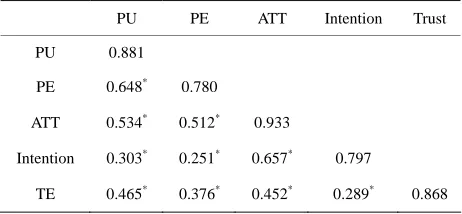
The results of correlation coefficient was as Table 3. It could be found that square of AVE are between 0.933 to 0.780. They are large than other ration in the table.
3. RESULTS
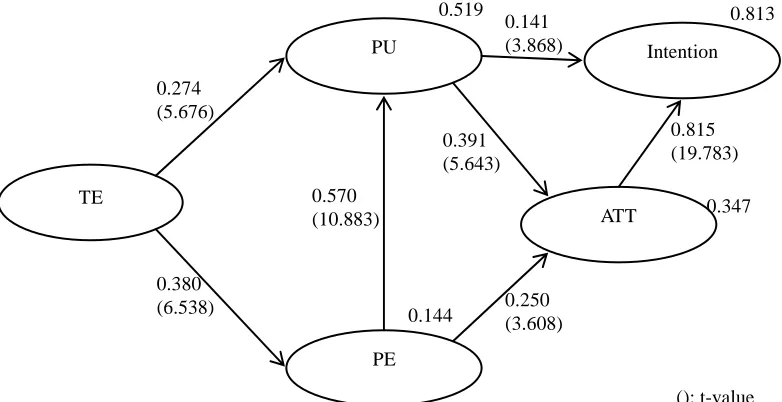
[image:4.595.308.539.617.724.2]Correlations among the variables are illustrated in Figure 2. This model explains 81.3% of the variance in attitude and 34.7% of the variance in intention. The kur-tosis index of this model is 130.407, and it is below 650 (the units of observer variables the units of observer variables+2) [12]. So it is follow the multivariate rule.
Results indicate most of the relationships in the pro-posed model are statistically significant and in the pre-dicted directions. Each observed variables influence with two ways: direct effect and indirect effect, and the total effect is the sum of direct effect and indirect effect. The Main effect of most of these observed variables is direct effect, but the information technology experience with the perceived usefulness. Seven hypotheses are sup-ported at p < 0.05. Table 4 is the results of hypothesis testing.
4. CONCLUSIONS
Findings of this study provide evidence that TAM is an applicable model in examining factors influencing users' attitudes of using new technology and behavioral inten-tions in relation to pay clinic fees with e-wallet, such as Taipei Easy Card.
[image:4.595.56.283.621.734.2]In this study, it could be finding that the perceived usefulness, the perceiver ease of use is positively associ-ated with users’ attitude toward using, and the perceiver ease of use is positively associated with the perceived usefulness. It means the useful and easily operation of payment clinic fees with e-wallet products (such as Taipei Easy Card) is very important for the users. Be-
Table 3. Results of correlation coefficient.
PU PE ATT Intention Trust
PU 0.881
PE 0.648* 0.780
ATT 0.534* 0.512* 0.933
Intention 0.303* 0.251* 0.657* 0.797
TE 0.465* 0.376* 0.452* 0.289* 0.868
*
TE
PU Intention
ATT
PE 0.570 (10.883)
0.141 (3.868)
0.391 (5.643)
0.250 (3.608) 0.380
(6.538) 0.274 (5.676)
0.815 (19.783)
(): t-value 0.347
0.813 0.519
[image:5.595.103.494.87.288.2]0.144
Figure 2. Structural model with inter-construct correlations.
Table 4. Results of hypothesis testing.
Path Direct effect (p-value) Indirect effect (p-value) Total effect Support
H1 PU ATT. 0.391
(<0.000) - 0.391 Yes
H2 PE ATT. 0.250
(<0.000)
0.223
(<0.000) 0.473 Yes
H3 PE PU. 0.570
(<0.000) - 0.570 Yes
H4 ATT Intention. 0.815
(<0.000) - 0.815 Yes
H5 PU Intention. 0.141
(<0.000)
0.319
(<0.000) 0.460 Yes
H6 TE PU. 0.274
(<0.000)
0.491
(<0.000) 0.491 Yes
H7 TE PE. (<0.000) 0.380 - 0.380 Yes
sides, the easier for e-wallet using, the more people think it is usefulness. This suggestion is the same as the point at issue of Davis [3]. The users’ attitude toward using is positively associated with the intention using.
For the personal prior experience, the information technology experience is positively associated with per-ceived usefulness and the perceiver ease of use, these results are the same as Davids [3].
REFERENCES
[1] Davis, F.D., Bagozzi, R.P. and Warshaw, P.R. (1989) User acceptance of computer technology: Comparison of two theoretical models. Management Science, 35, 982-1003.
doi:10.1287/mnsc.35.8.982
[2] Bank for International Settlements (1996) Implication for central banks of the development of electronic money.
[3] Ajzen, I. and Fishbein, M. (1980) Understanding attitudes
and predicting social behavior. Prentice-Hall, Englewood Cliffs.
[4] Mathieson, K. (1991) Predicting user intentions: Com- paring the technology acceptance model with the theory of planned behavior. Information Systems Research, 2, 173-191.
[5] Szajna, B. (1996) Empirical evaluation of the revised technology acceptance model. Management Science, 42, 85-92.doi:10.1287/mnsc.42.1.85
[6] Gefen, D., Karahanna, E. and Straub, D.W. (2003) Trust and TAM in online shopping: An integrated model. MIS Quarterly, 27, 51-90.
[7] Hu, L.T. and Bentler, P.M. (1999) Cutoff criteria for fit indexes in covariance structure analysis: Conventional criteria versus new alternatives. Structural Equation Mo- deling, 6, 1-55.doi:10.1080/10705519909540118 [8] Peter, P.J. and Olson, J.C. (1990) Consumer behavior and
[image:5.595.68.532.334.507.2][9] Downing, R.E., Moore, J.L. and Brown, S.W. (2005) The effects and interaction of spatial visualization and domain expertise on information seeking. Computers in Human Behavior, 21, 195-209.doi:10.1016/j.chb.2004.03.040 [10] Thompson, R.L., Higgins, C.A. and Howell, J.M. (1994)
Personal computing: Towards a conceptual model of utilization. MIS Quarterly, 15, 125-142.
doi:10.2307/249443
[11] Nunnally, J.C. (1978) Psychometric theory. McGraw Hill, New York.