ORIGINAL RESEARCH
BRAIN
4D Digital Subtraction Angiography: Implementation and
Demonstration of Feasibility
B. Davis, K. Royalty, M. Kowarschik, C. Rohkohl, E. Oberstar, B. Aagaard-Kienitz, D. Niemann, O. Ozkan, C. Strother, and C. Mistretta
ABSTRACT
BACKGROUND AND PURPOSE: Conventional 3D-DSA volumes are reconstructed from a series of projections containing temporal information. It was our purpose to develop a technique which would generate fully time-resolved 3D-DSA vascular volumes having better spatial and temporal resolution than that which is available with CT or MR angiography.
MATERIALS AND METHODS: After a single contrast injection, projections from the mask and fill rotation are subtracted to create a series of vascular projections. With the use of these projections, a conventional conebeam CT reconstruction is generated (conventional 3D-DSA). This is used to constrain the reconstruction of individual 3D temporal volumes, which incorporate temporal information from the acquired projections (4D-DSA).
RESULTS:Typically, 30 temporal volumes per second are generated with the use of currently available flat detector systems, a factor of ⬃200 increase over that achievable with the use of multiple gantry rotations. Dynamic displays of the reconstructed volumes are viewable from any angle. Good results have been obtained by using both intra-arterial and intravenous injections.
CONCLUSIONS: It is feasible to generate time-resolved 3D-DSA vascular volumes with the use of commercially available flat detector angiographic systems and clinically practical injection protocols. The spatial resolution and signal-to-noise ratio of the time frames are largely determined by that of the conventional 3D-DSA constraining image and not by that of the projections used to generate the 3D reconstruction. The spatial resolution and temporal resolution exceed that of CTA and MRA, and the small vessel contrast is increased relative to that of conventional 2D-DSA due to the use of maximum intensity projections.
ABBREVIATIONS:II⫽image intensifier; IA⫽intra-arterial; TOA⫽time of arrival
I
n 1980, when DSA was introduced,1-3it was originally hopedthat intravenous x-ray angiography would be feasible. How-ever, the inability to clearly visualize vascular structures caused by vessel overlap as well as limited signal-to-noise ratio due to then available contrast medium and the image intensifier (II) detector technology quickly led to the adaption of techniques by use of small intra-arterial (IA) contrast injections in combination with the newly available real-time digital imaging capabilities. This ca-pability greatly facilitated the development of the minimally inva-sive procedures by using x-ray angiography and the field of inter-ventional radiology in general.
The feasibility of obtaining rotational volume acquisitions by us-ing a C-arm angiographic system equipped with an II was initially simulated in 1988 and then by use of an II-based apparatus, imple-mented in 1996 by Ning and Kruger.4,5In 1997, Fahrig et al6,7
ex-tended this work showing both in vitro and in vivo results. These systems, as well as currently used systems with flat detectors, allow creation of 1 3D-DSA volume per gantry rotation. Since the intro-duction of commercial angiographic systems and software suitable for performing 3D-DSA in 1999, the assessment of vasculature in interventional x-ray suites has been done by using the combination of 3D-DSA volume reconstructions (non–time-resolved) and mul-tiple conventional 2D-DSA acquisitions. Mulmul-tiple 2D acquisitions have been necessary because of 1) the need to visualize the sequences of vascular filling and 2) the inability to clearly see anatomic details on the 3D reconstructions because of the resulting overlap of arterial and, in some instances, venous structures. The need to obtain mul-tiple 2D temporal series at the desired view angle obviously contrib-utes significantly to the radiation exposure and contrast medium dose associated with these examinations.
Received August 29, 2012; accepted after revision December 21.
From the University of Wisconsin School of Medicine and Public Health (B.D., E.O., B.A.-K., D.N, O.O., C.S., C.M.), Madison, Wisconsin; Siemens AG (K.R.), Healthcare Sector, Hoffman Estates, Illinois; and Siemens (M.K., C.R.), Research Collaborations, AX, Forchheim, Germany.
Please address correspondence to Charles Strother, MD, Department of Radiol-ogy, University of Wisconsin School of Medicine and Public Health, 600 North Highland Ave, Madison, WI 53792; e-mail: [email protected].
The method that we describe involves the use of a 3D-DSA vascular volume as a constraining image. The proposed recon-struction method uses all, or most of, the projections obtained after a rotational acquisition done before (mask run) and after (fill run) the injection of contrast medium. This constraining volume is combined with the acquired projections to form a time-series of 3D volumes (4D-DSA). The 3D-DSA depicts an average of the vascular opacification present during the rotational acquisition. Each of the individual projections used to form the standard 3D-DSA volume contains temporal information. Although it must be understood that a CT volume cannot be reconstructed from a single projection, we do not propose a new 3D-DSA volume re-construction technique. We have developed algorithms that per-mit 3D-DSA time-resolved volumes (4D-DSA) to be generated by use of the constraining volume and single x-ray projections. Rather than 1 vascular volume per gantry rotation, this technique typically generates 30 time-resolved 3D-DSA volumes per second (by use of a currently available flat detector angiographic system), a rate⬃200 times faster than could be achieved by use of sequen-tial gantry rotations, and at the same contrast and x-ray dose as used to obtain 1 standard 3D-DSA volume.
This capability allows for the viewing of the vasculature in a dy-namic display, at any angle, for all time points at any desired angle. This largely eliminates the problem of vessel overlap. The availability of a “library” of time-resolved 3D timeframes thus facilitates diagno-sis by providing the ability to view the anatomy not only in any de-sired view but also to do this at any dede-sired phase of vascular filling, thus eliminating any confusion that might occur as the result of vas-cular overlap. An additional benefit is that it provides a library of vascular roadmaps at any stage of vascular filling for use in endovas-cular therapeutic procedures.
The purpose of the work was to in-vestigate the feasibility of reconstruct-ing time-resolved 3D vascular vol-umes (4D-DSA) from conventional 3D-DSA acquisitions.
MATERIALS AND METHODS
Data Acquisition
All images were acquired by use of either a biplane Artis dBA system or an Artis Zeego flat detector angiographic system (Siemens, Erlangen, Germany). All hu-man and animal studies were performed under institutionally approved institu-tional review board and/or Animal Care and Use Committee protocols. Rota-tional images for subtracted 3D recon-structions were obtained by use of 5-, 8-, or 10-second acquisitions to capture the full cycle of contrast inflow and wash-out. To obtain a sufficient number of consistent projections for an accurate 3D reconstruction and to capture inflow and washout, the rotational acquisition must be long enough to follow a bolus through the vasculature. This may be achieved by use of either multiple C-arm rotations or by use of C-arm rotations of an appropriate duration, for example, 5, 8, or 10 seconds. It seems likely that, depending on the dynamics of the circulation, that is, fast or slow, there will be particular acquisition protocols that are optimal for particular conditions, for example, a 5-second acquisition for evaluation of a patient with an aneu-rysm at the circle of Willis or a fast-flow carotid cavernous fistula or an 8- or 10-second acquisition for a patient with occlusive disease in which filling occurs by collaterals. More experience is required before definite recommendations can be given regarding choice of an optimal acquisition protocol. Intravenous studies were performed after injection of iohexol (300 mg I/mL) into a peripheral vein at the rate of 4 mL/s over 8 –10 seconds followed by a 10-mL saline chase injected at the same rate. Intra-arterial studies were obtained by use of injection of 5– 8 mL iohexol.
Image Processing and Reconstruction Process
Four-dimensional DSA reconstruction uses multiplicative pro-jection processing to generate a series of time-resolved 3D vol-umes (4D-DSA) by embedding the time-resolved data from the standard projections of a rotational acquisition. Before back pro-jection, the individual projections from the acquisition are spa-tially convolved to increase the SNR. They therefore form a low spatial frequency mask that basically enhances portions of the 3D constraining image that are present at each point in time. After a normalization step, this mask then provides proper projection weighting. As a result of the convolution process, the SNR of the individual timeframes is limited by the constraining image SNR ratio and not by the SNR of the individual projections. When the single projections are back-projected into the 3D volume, there is a tendency for the projection values from overlapping vessels to
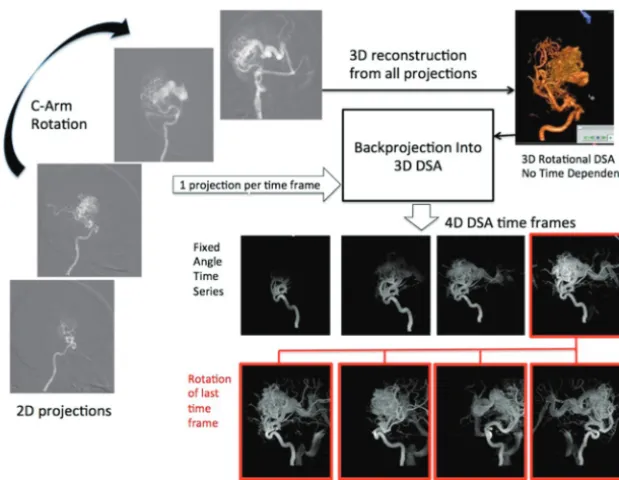
[image:2.594.62.372.46.286.2]cause the deposition of erroneous signal (an opacity shadow from opacified vessel to nonopacified vessel) into vessels in the 3D vol-ume. To reduce this effect, for each timeframe, an angular (tem-poral) search is performed, looking for a range of time before and after the frame that is being projected. After this search, the min-imum signal for each voxel is assumed to be due to the ray with the minimum degree of overlap; that value is then assigned to the timeframe being processed. For voxels requiring an angle other than the current angle as a result of the search, the temporal res-olution is lower than the typical 30/s rate, as data from a different timeframe are substituted. The frequency of this depends on the sparsity of the vessel configuration. However, overall volume frame rates of 6 frames/s are typical. Figure 1 illustrates the steps in this process. Any of the time-resolved 3D timeframes (3D vol-umes) can be rotated for viewing at whatever angle the user thinks gives the clearest depiction of the relevant vasculature. These 3D timeframes can be viewed with playback speed re-duced or increased, paused, or replayed as desired. The user
interface provides for interactive 4D viewing of the 3D tempo-ral volume timeframes and provides for a true interactive 4D viewing experience of the contrast-enhanced perfusion of a vascular network.
Estimate of Relative SNR
The SNR values for the acquired projections, for 3D-DSA and for 4D-DSA, were estimated by placing regions of interest in the im-ages. Because variations of the signal selected by the maximum intensity projection process can contribute to the standard de-viation in a region of interest, the statistical variations in the 4D-DSA image were measured from the difference between 2 successive 4D-DSA frames that were rotated to the same posi-tion. In the 3D-DSA, these variations were very small, so no subtraction was performed. It was not possible to subtract se-quential acquired projections because they are not 3D-rotat-able and cannot be registered for subtraction. Thus, the pres-ence of these potential signal variations in the acquired
[image:3.594.56.532.47.454.2]projection region of interest could have decreased the mea-sured SNR shown in Fig 2.
Simulation of Flow Information From 4D-DSA
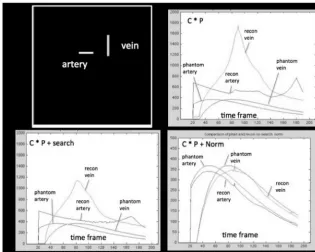
A digital phantom was constructed to simulate the various steps in signal curve generation. The phantom consisted of a vein and an artery running perpendicular to the vein. Each was assigned ve-nous and arterial␥-variate time dependences. A 4D-DSA recon-struction was performed with the use of a constraining volume obtained from the reconstruction of the known vessel distribu-tion. Signal curves were then generated from 2 selected regions of interest for different versions of the 4D-DSA reconstruction algorithm.
Quantitative Color-Coded 4D-DSA
Previous work has shown the ability to create color-coded para-metric images from 2D-DSA series.8,9Because the basic 4D-DSA
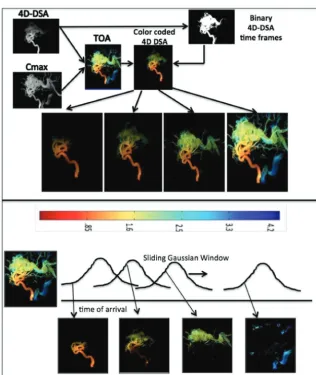
images contain signal that is proportional to the contrast (iodine) concentration as a function of time, it is possible to also view these series as a color-coded display showing contrast time of arrival (TOA) in each pixel. TOA maps were created by first forming a volume showing the highest contrast concentration, that is, vessel opacification that occurred during the rotational acquisition (Cmax) and noting the time to reach Cmax/4 on a per-voxel basis. Color-coded 4D-DSA images were obtained by multiplying TOA maps by a binarized version of the 4D-DSA MIP timeframes.
A method for displaying regions of vascular anatomy with increasing times of the contrast bolus arrival can be achieved by multiplying the TOA im-age by a sliding window that sequen-tially reveals pixels within a TOA range defined by the window. We refer to this as a bolus arrival mode. For the results illustrating this capability, we used a Gaussian display window with full width at half maximum of 20 4D-DSA timeframes.
RESULTS
Simulation of Reconstruction Elements
The angular search results in some dis-tortion of the signal waveforms. When it is desired to generate quantitative signal curves, the effect of this can be limited because it is possible to omit points from the waveform for which the search re-sulted in the choice of a projection that is too remote (in time) from the current frame. The signal curve then can be in-terpolated by use of points for which the search resulted in a suitable temporal displacement, for example, below a cho-sen threshold.
For the purpose of generating signal curves that correspond exactly to the signal curves in the acquired projec-tions, it is possible to modify the basic reconstruction algorithm to include a binary version of the constraining image. In this case, the projection values are directly deposited in the 3D vascular space and will reproduce the signal curves provided by the pro-jections. This series of 3D volumes does not accurately represent the actual opacification of the vascular network because of vessel overlap and the use of the back-projection step used to create these volumes. However, for the purpose of generating individual voxel signal curves, there are several characteristics of the 4D-DSA reconstruction algorithm that affect the resultant curves that aim to correct the vessel overlap problem inherent in the 3D timeframe volumes. This is demonstrated in the simulations per-formed with the digital phantom.
As shown in Fig 3, after the basic back-projection step when the projections are multiplied by a binary constraining image (up-per right), there are signal peaks caused by the alignment of the vessels with the projection direction. When these are present, they can occasionally give the impression of reversed flow. These peaks are somewhat reduced when the angular search is added to the reconstruction (Fig 3, lower left panel). Better results are obtained when the projections are normalized by dividing them by an esti-mate of the number of aligned voxels along the individual rays, obtained from the constraining image (Fig 3, lower right panel). These normalizing projection images (1 per projection) are cre-ated by forward projections of the thresholded and binarized
[image:4.594.56.372.47.299.2]straining image. With the use of this method, the similarity of the reconstructed signal curves to those of the input signal curves is satisfactory. This technique effectively helps to weight deposition of the attenuation coefficient in voxels along a ray, resulting in
more accurate 4D-DSA raw 3D tempo-ral volume when a normalized projec-tion is back-projected.
Anatomic Display
[image:5.594.56.534.44.346.2]Imparting temporal resolution to an al-ready reconstructed 3D vascular volume requires far fewer multiplicative projec-tions than if the goal were to reconstruct a vascular (anatomic) volume itself by summing a limited number of projec-tions. In our technique, the anatomic structures in those voxels have already been reconstructed. Time dependence can then be effectively performed with the use of a small number of multiplica-tive projections.10,11
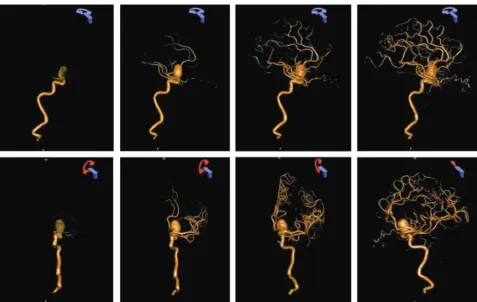
Figure 4 shows a series of 4D-DSA arterial phase images from a study per-formed for evaluation of an unruptured aneurysm. These illustrate the ability to view the time-resolved 4D series from any desired viewing angle. This ability to retrospectively view a dynamic angio-graphic sequence from any arbitrary view angle can potentially result in a significant reduction in radiation exposure because, in our experience, to obtain optimal views, it is not unusual to re-quire multiple 2D acquisitions even when performing a
“tar-FIG 4.Four-dimensional DSA reconstruction from a 3D-DSA reconstruction performed for evaluation of an unruptured paraclinoid aneurysm. An IA injection of contrast was used for this examination. Thetop rowshows selected timeframes viewed at the rate of 6 frames per second at a fixed viewing angle. Thebottom rowshows the same timeframes viewed at 4 different angles, which would have not been obtainable in a biplane acquisition because of the mechanical inability to position the A-plane gantry (red icon).
[image:5.594.55.376.401.579.2]geted” (single vessel) diagnostic examination. This ability also re-moves the need to obtain extreme cranial-caudal views that require passing x-rays through a highly attenuating path. With 4D-DSA, such views can be achieved with the use of a reconstruc-tion acquired from data acquired such that rays traverse a much less attenuating trajectory.
Our initial efforts to use intravenous injections of contrast in con-junction with DSA were hampered by the overlap of vascular struc-tures on the 2D images. With 4D-DSA, this limitation is largely over-come because optimal views, which avoid overlap, can be chosen and viewed at any stage of vascular filling (any view angle at any timeframe and any timeframe at any view angle). This is illustrated in Fig 5, in which the course of the right internal carotid artery can be clearly seen in the early arterial phase 4D-DSA timeframe.
SNR and Vessel Profiles
Figure 2 shows a comparison of SNR values measured in the re-gions of interest indicated by the yellow arrows. The apparent
SNR of the acquired projection may have been decreased because of ana-tomic variations during gantry rotation. Also shown are normalized vessel pro-files along the red lines indicated. The profile across these 2 arteries on the ac-quired projection is noisy. Determina-tion of the exact 4D-DSA spatial resolu-tion requires more careful experiments with the use of well-defined phantoms. These studies are ongoing.
Figure 6 illustrates the ability to col-or-code a 4D-DSA image such that quantitative information about blood flow can be extracted. This example shows a 4D reconstruction of a study performed for evaluation of an AVM.
DISCUSSION
In this report, we have demonstrated the feasibility of generating time-resolved 3D-DSA vascular volumes with the use of commercially available flat detector angiographic systems and clinically practical injection protocols. A review of other angiographic methods (both time-resolved and non–time-time-resolved) indi-cates that 4D-DSA can provide spatial and temporal resolution that exceeds that of these competing techniques, for example, MRA and CTA. In particular, 4D-DSA thus provides a new imaging technique with spatial and temporal res-olution exceeding competing time-re-solved angiographic techniques. Figure 7 shows the relative voxel volume and frame duration for existing time-re-solved angiographic methods. We em-phasize that this was a feasibility study with implementation of the technique with the use of a prototype environment. Studies to understand the trade-offs of various acquisition and injection protocols are underway. Full understanding and optimization of these proto-cols will require significantly more experience and use of the technology.
Validation studies will be required to establish the recon-structed matrix size and radiation dose that would be required to provide the highest-resolution 4D-DSA volumes. It is interesting to note that despite recent research developments in MR, the dominant commercial method is still time-resolved imaging of contrast kinetics (TRICKS), which has spatial and temporal reso-lution 2 orders of magnitude below that of 4D-DSA.12
The availability of 4D-DSA provides the user with a technique that, from a single contrast injection and rotational acquisition (provided an acceptable constraining volume can be obtained), provides a library of time-resolved images that may be viewed from any desired angle at any time during contrast filling and
[image:6.594.56.373.43.418.2]emptying. Although conventional 3D-DSA reconstructions are viewable at any angle, they do not allow viewing of the vasculature during different stages of filling and emptying, for example, a pure arterial phase or pure venous phase. Because 4D-DSA allows this, it should, in our opinion, allow the performance of many proce-dures requiring the use of x-ray angiography with significantly less x-ray exposure and contrast medium dose because it would reduce the need to obtain multiple 2D-DSA acquisitions. We also believe that because the time-resolved volume viewable from any angle at any time will largely eliminate the impact of vascular overlap, that 4D-DSA will provide a method that will again make the use of intravenous injections for angiographic studies an at-tractive alternative to conventional IA studies, thus potentially increasing the safety (less invasive) and efficacy (obtaining images of all relevant vasculature with a single injection and acquisition) of interventional and diagnostic procedures.
It should be emphasized that 4D-DSA is a purely angiographic technique and as such only indirectly provides perfusion infor-mation, that is, it provides information about blood flow to tissue. This is because it is not possible to reconstruct the tissue sur-rounding vessels from only a single projection. Although the con-straining volume is reconstructed from a large number of projec-tions, the tissue perfusion represented by that volume is an average, over time, and thus cannot provide dynamic perfusion information. It is possible, however, that 4D-DSA could provide valuable arterial input function information for alternate schemes of measuring perfusion with a C-arm angiographic system.13
All of the images shown in this report were reconstructed ret-rospectively and were not available at the time of the actual exam-inations. The reconstruction time per 4D-DSA frame is presently
less than 1 second. Clinical validation of the anatomic and temporal accuracy as well as documentation regarding the value of the technique in reducing pro-cedure times, x-ray exposure, and con-trast medium dose will start once the technique is developed to a point at which it may be transferred to a clinical angiographic system.
Four-dimensional DSA will ultimately be used along with 4D fluoroscopy, a tech-nique that will provide real-time fluoro-scopic roadmap views from any arbitrary direction without a need for gantry move-ment. Together, 4D-DSA and 4D fluo-roscopy should increase diagnostic ca-pabilities and improve the safety and efficacy of endovascular interventions.
CONCLUSIONS
It is feasible to generate time-resolved 3D-DSA vascular volumes with the use of commercially available flat detector angiographic systems and clinically practical injection protocols. The spatial resolution and SNR of the timeframes are largely determined by that of the conventional 3D-DSA constraining im-age and not by that of the projections used to generate the 3D reconstruction. The voxel volume and temporal resolution are theoretically almost 10 times that of CTA and MRA, and the small-vessel contrast is increased relative to that of conventional 2D-DSA as the result of the ability to use MIP renderings. The availability of 4D-DSA should greatly reduce the need to acquire multiple 2D series during examinations. The availability of 4D-DSA volumes viewable from any angle at any time completes the transition of DSA to a full 4D angiographic technique.12,13
ACKNOWLEDGMENTS
We dedicate this work to the memory of our colleague Dr Jan Bose, who recently passed away. Although Jan was not an au-thor of this manuscript, his insights and guidance were invalu-able as we worked to bring this technology from a concept to a reality. Jan was a dear friend and colleague; his memory will never leave us.
Disclosures: Brian Davis—RELATED: Grant:Siemens Medical Sponsored Research Grant;*Support for Travel to Meetings for the Study or Other Purposes: Sie-mens Medical Sponsored Research Grant;*OTHER RELATIONSHIPS:We have a sponsored research agreement between UW Madison and Siemens Medical. Kevin Royalty—RELATED: Grant:Siemens Medical Solutions, USA,* Comments: Project was at least partially funded by Siemens Medical Solutions, USA; UNRE-LATED: Employment:Siemens Medical Solutions, USA, Comments: Full-time em-ployee of Siemens Medical Solutions, USA;OTHER RELATIONSHIPS:I am also a graduate student at the University of Wisconsin (Department of BioMedical Engineering). Markus Kowarschik—UNRELATED: Employment: Full-time em-ployee at Siemens Healthcare, Comments: Part of this research was funded by Siemens Healthcare. Erick Oberstar—RELATED: Grant:Siemen’s Medical Spon-sored Research Grant;*Support for Travel to Meetings for the Study or Other Purposes:Siemens Medical Sponsored Research Grant;*OTHER RELATIONSHIPS: We have a sponsored research agreement between UW Madison and Siemens FIG 7. Relative spatial and temporal resolution for competing time-resolved angiography
[image:7.594.60.369.50.288.2]Medical. David Niemann—RELATED:Siemens Healthcare,* Comments: Master Research Agreement between University of Wisconsin and Siemens Health Care. Charles Strother—RELATED: Grant:Siemens Healthcare* Comments: Sponsored research agreement between Siemens HealthCare and UW Madison;Support for Travel to Meetings for the Study or Other Purposes:Siemens Healthcare* Com-ments: Money for travel to scientific meetings included in budget of research grant;OTHER:License of Intellectual Property;UNRELATED: Consultancy: Sie-mens Healthcare, Comments: I am an unpaid advisor;Grants/Grants Pending: Siemens Healthcare;*Patents (planned, pending or issued):Siemens Healthcare, Comments: License of IP. Charles Mistretta—RELATED: Grant:Siemens Imaging Solutions,* Comments: Siemens/UW sponsored research grant;Support for Travel to Meetings for the Study or Other Purposes:The Siemens grant provides some travel money;UNRELATED: Patents (planned, pending or issued):Siemens has been licensed to develop 4D-DSA (*money paid to institution).
REFERENCES
1. Mistretta CA, Kruger RA, Houk TL, et al.Computerized fluoroscopy techniques for noninvasive cardiovascular imaging: SPIE.Appl Opt Instr Med1978;152:65–71
2. Kruger RA, Mistretta CA, Houk TL, et al.Computerized fluoroscopy in real time for noninvasive visualization of the cardiovascular system: preliminary studies.Radiology1979;130:49 –57
3. Strother CM, Sackett JF, Crummy AB, et al.Clinical applications of computerized fluoroscopy: the extracranial carotid arteries. Radi-ology1980;136:781– 83
4. Ning R, Kruger RA.Computer simulation of image intensifier-based computed tomography detector: vascular application.Med Phys1988;15:188 –92
5. Ning R, Kruger RA.Image intensifier-based computed tomography volume scanner for angiography.Acad Radiol1996;3:344 –50 6. Fahrig R, Fox AJ, Lownie S, et al.Use of a C-arm system to generate
true three-dimensional computed rotational angiograms:
prelimi-nary in vitro and in vivo results. AJNR Am J Neuroradiol 1997;18:1507–14
7. Fahrig R, Moreau M, Holdsworth DW.Three-dimensional com-puted tomographic reconstruction using a C-arm mounted XRII: correction of image intensifier distortion. Med Phys 1997;24: 1097–106
8. Strother CM, Bender F, Deuerling-Zheng Y, et al.Parametric color coding of digital subtraction angiography.AJNR Am J Neuroradiol 2010;31:919 –24
9. Lin CJ, Hung SC, Guo WY, et al.Monitoring peri-therapeutic cere-bral circulation time: a feasibility study using color-coded quanti-tative DSA in patients with steno-occlusive arterial disease.AJNR Am J Neuroradiol2012;33:1685–90
10. Mistretta CA, Oberstar E, Davis B, et al. 4D-DSA and 4D fluoroscopy: preliminary implementation.Proceedings of SPIE Con-ference on Medical Imaging.San Diego, California, February 2010 11. Davis B, Kowarschik M, Royalty K, et al.Progress in 4D digital
sub-traction angiography implementation: technical aspects.Presented at Annual Meeting of the American Society of Neuroradiology,New York. April 23–26, 2012
12. Wu Y, Johnson K, Kecskemeti SR, et al.Time resolved contrast en-hanced intracranial MRA using a single-dose delivered as sequen-tial injections and highly constrained projection reconstruction (HYPR CE).Magn Reson Med2011;65:536 – 63
13. Ganguly A, Fieselmann A, Marks M, et al.Cerebral CT perfu-sion using an interventional C-arm imaging system: cerebral blood flow measurements. AJNR Am J Neuroradiol 2011;32: 1525–31