Modelling large scale enterprises : A distributed simulation
approach.
WICKRAMARACHCHI, A.P.R.
Available from Sheffield Hallam University Research Archive (SHURA) at:
http://shura.shu.ac.uk/20530/
This document is the author deposited version. You are advised to consult the
publisher's version if you wish to cite from it.
Published version
WICKRAMARACHCHI, A.P.R. (2004). Modelling large scale enterprises : A
distributed simulation approach. Doctoral, Sheffield Hallam University (United
Kingdom)..
Copyright and re-use policy
See
http://shura.shu.ac.uk/information.html
Sheffield Hallam University Research Archive
Fines are charged at
5 0 p
per hour
0 A SEP 2907,
sm
ProQuest Number: 10701177
All rights reserved
INFORMATION TO ALL USERS
The quality of this reproduction is dependent upon the quality of the copy submitted.
In the unlikely event that the author did not send a com plete manuscript and there are missing pages, these will be noted. Also, if material had to be removed,
a note will indicate the deletion.
uest
ProQuest 10701177
Published by ProQuest LLC(2017). Copyright of the Dissertation is held by the Author.
All rights reserved.
This work is protected against unauthorized copying under Title 17, United States C ode Microform Edition © ProQuest LLC.
ProQuest LLC.
789 East Eisenhower Parkway P.O. Box 1346
Modelling large scale enterprises: A
distributed simulation approach
A.P.R. Wickramarachchi.
A thesis is submitted in partial fulfilment of the
requirements of Sheffield Hallam University for the degree
Abstract
Distributed simulation provides an alternative solution when today’s highly complicated systems including manufacturing are to be simulated. Complexities involved in implementation, the need for more expertise, high development cost and long implementation time etc. along with a lack of guidelines for developing distributed simulation, and the complexity o f tools and techniques used to implement schemes, resulted in the lack o f acceptance for distributed simulation among the general simulation community. In order to address some o f these issues, a new approach is proposed for modelling and simulating large scale enterprises using distributed simulation. The proposed approach which includes a comprehensive methodology for distributed enterprise simulation, developed by combining activities required for traditional sequential simulation with additional activities required for distributed simulation.
Acknowledgement
I would like to express my deepest gratitude and appreciation to my director of studies, Dr Sameh M. Saad for his support, guidance and constructive criticism. My appreciation also extended to Professor Terrence Perera for his support and assistance.
Table of contents
1. Introduction 1
1.1 Introduction ... 2
1.2 Rationale ... 3
1.3 Objectives of the research ... 4
1.4 Expected contribution from the research ... 5
1.5 Structure of the thesis ... 5
2. Parallel and distributed simulation 8 2.1 Introduction ... 9
2.2 Basic concepts in simulation ... 11
2.2.1 Terminology for simulation ... 11
2.2.2 Deterministic and stochastic models ... 11
2.2.3 Continuous and discrete models ... 12
2.3 Discrete event simulation ... 12
2.4 Sequential simulation ... 14
2.4.1 Short comings of sequential simulation ... 14
2.4.2 Alternatives for sequential simulation ... 16
2.5 Parallel and distributed simulation ... 18
2.6 Distributed simulation ... 20
2.7 Enterprise simulation ... 22
2.8 Limitations o f parallel and distributed simulation ... 23
3. The proposed methodology for distributed enterprise simulation 26 3.1 Introduction ... 27
3.2 Sequential simulation methodologies ... 28
3.2.1 Methodology proposed by Robinson (1994) 28
3.2.2 Key activities o f Shannon (1998) 29
3.2.3 Methodology proposed by Balci (1990) 30
3.2.5 Methodology proposed by Banks et al. (2000) 32
3.3 Additional activities for parallel and distributed simulation ... 35
3.4 The proposed methodology for distributed enterprise simulation ... 37
3.4.1 Problem identification and identification of objectives ... 38
3.4.2 The simulation strategy selection (SimSS) process ... 38
3.4.3 Data collection ... 39
3.4.4 Construction of the conceptual model ... 39
3.4.5 Verification and validation ... 40
3.4.6 Partitioning and mapping ... 41
3.4.7 Synchronisation protocols and networking issues ... 42
3.4.8 Construction of computer simulation model ... 42
3.4.9 Experimentation ... 43
3.4.10 Output analysis ... 44
3.4.11 Implementation and further work ... 44
4. The simulation strategy selection (SimSS) process 46 4.1 Introduction ... 48
4.2 Analytic hierarchy process (AHP) ... 49
4.3 Simulation strategy selection (SimSS) process ... 53
4.3.1 Criterion for SimSS process ... 54
4.3.2 Illustration of SimSS process ... 56
5. Conceptual modelling, model partitioning and mapping for 64 distributed enterprise simulation 5.1 Introduction ... 66
5.2 Conceptual model ... 67
5.3 Modelling approaches ... 69
5.3.1 Incremental modelling approach ... 69
5.3.2 Hierarchical modelling approach ... 70
5.4 Modelling tools ... 72
5.4.1 Diagrammatic modelling ... 72
5.4.3 Modelling methods ... ... 78
5.5 Model partitioning and mapping approaches ... 79
5.6 Proposed approach for model representation, model partitioning and mapping ... 80
6. The proposed synchronisation mechanism for distributed enterprise simulation 86 6.1 Introduction ... ... 88
6.2 Computer networks ... 90
6.2.1 Network topologies ... 90
6.3.2 Network protocols ... 92
6.3 Synchronization ... ... 92
6.3.1 Synchronous systems ... 93
6.3.2 Asynchronous systems ... 93
6.3.2.1 Conservative synchronization ... 93
6.3.2.2 Optimistic synchronization ... 95
6.3.2.3 Conservative vs. Optimistic approaches ... 95
6.4 The proposed synchronization approach ... 96
6.4.1 An approximate synchronization mechanism for distributed enterprise simulations ... 97
6.4.2 Illustrating the approximate synchronization mechanism 103 7. Implementation of the Distributed enterprise simulation 106 7.1 Introduction ... 108
7.2 Distributed manufacturing ... 109
7.3 Middleware ... I l l 7.3.1 Forms of middleware ... 112
7.3.2 Well known middleware architectures ... 113
7.4 Simulation software ... 117
7.5 Application program interface (API) ... 117
7.6 Hypothetical case study ... 119
7.7 Implementation ... 123
7.8 Output from distributed enterprise simulation ... 130
7.9 Validation of the distributed enterprise simulation model ... 132
7.9.1 Validation of the message passing mechanism ... 132
7.9.2 Validation of the synchronization mechanism ... 133
8. Discussion, conclusion and suggestion for further work 138 8.1 Introduction ... 139
8.2 Discussion ... 140
8.2.1 Proposed methodology for distributed enterprise simulation ... 140
8.2.2 Simulation strategy selection (SimSS) process ... 141
8.2.3 Model representation, partitioning and mapping ... 142
8.2.4 Approximate synchronization mechanism ... 143
8.2.5 Implementation approach ... 145
8.3 Conclusions ... 147
8.4 Suggestions for further work ... 148
Publications made from the thesis
Saad S. M., T. Perera and R. Wickramarachchi. 2002. A new methodology for parallel and distributed simulation, proceedings o f the 2002 International Conference on Responsive Manufacturing.
Saad S. M., T. Perera and R. Wickramarachchi. 2002. A strategy selection approach in parallel and distributed simulation environment, International Journal o f Advance Manufacturing Systems. Vol 6, No.2
Saad, S. M., T. Perera, and R. Wickramarachchi. 2003. Simulation of distributed manufacturing enterprises: A new approach. Proceedings o f 2003 Winter Simulation Conference, 1167-1172
Saad, S. M., T. Perera, and R. Wickramarachchi. 2003, A simplified approach for modelling and simulating large scale enterprises, European Simulation Symposium
Saad, S. M., T. Perera, and R. Wickramarachchi. 2004, A simplified approach to develop distributed manufacturing simulations, 2nd International Conference on Manufacturing Research (ICMR 2004)
Chapter 1
Introduction
Chapter 1 - Introduction
1.1 Introduction
Simulation is one of the most powerful tools available to decision makers responsible for the design and operation of many diverse areas of applications. The system under study can be anything from aerodynamic properties o f a new aircraft under development to intricacies of protein folding into a complex three dimensional shape. However, the size and complexity o f many o f today’s simulation models place severe demands on the computational resources required. Many researchers have concluded that the traditional sequential simulation has reached its limit in simulating highly complicated and large applications. Distributed simulation (along with parallel simulation) provides an alternative solution when today’s highly complex systems are to be simulated by decomposing a simulation model into a number of sub-models and executing them in parallel. Furthermore, a parallel or distributed simulation model is more realistic and natural for many real world applications. Distributed simulation provides a means of executing simulation models scattered over a building, a campus, a city, a country or even the world. It is the only solution available when simulation models need to exist in different places due to various reasons such as security concerns about the confidentiality of information contained in simulation models, simultaneous access to executing simulation models for users in different locations etc. Distributed simulation plays an important role in enterprise simulation. Enterprise simulation refers to a dynamic model or simulation which is constructed with a top-down perspective and is intended to provide an overall view of the workings of an enterprise. In fact, an enterprise simulation model becomes a distributed simulation model when there are two or more simulation models o f the enterprise executed in a network. Therefore the term ‘distributed simulation’ instead of ‘enterprise simulation’ will be used in the thesis for literature or applications are common to both types of simulations.
This research presents a comprehensive approach for modelling large scale enterprises through distributed simulation. Although the proposed approach focuses on enterprise simulation, it can be employed to develop general distributed simulation models as well.
Chapter 1 - Introduction
The objective o f this chapter is to provide an introduction to the thesis. The next section explains the rationale for the research. Objectives o f the research and contributions made by the research are presented in sections 1.3 and 1.4 respectively. The last section provides the structure of the thesis. The chapter ends with a summary.
1.2 Rationale
Chapter 1 - Introduction
Fujimoto (1993b) concluded that (parallel and) distributed simulation thrives only if the parallel and distributed research community makes the transition process easier for the discrete event community. Turner (1998) noted that, it is generally recognised that the future success of parallel and distributed simulation depends on the extent to which it is possible to reduce the effort and expertise required to develop simulations. This requires simple tools such as user friendly simulation software packages, popular programming languages as well as modelling methodologies that guide parallel and distributed simulation users.
Simulation methodology plays a crucial part in any simulation project, particularly in distributed simulation due to its complex nature. Abrams (1993) highlighted the importance o f modelling for parallel and distributed simulation and noted that model design and program design are not independent tasks. Page and Nance (1994) noted that the importance and role of the conceptual framework within the model development process has had little recognition in the parallel and distributed simulation community. Simulation modelling methodologies have been investigated for more than four decades. Different authors have presented a number o f methodologies over this period. However, almost all o f these were focused on sequential simulation and not on distributed simulation (or parallel simulation either). Therefore it is desirable to investigate methodologies for distributed simulation as this form of simulation is much more complex than traditional sequential simulation. The highly complex nature of this type of simulation calls for more attention into the distributed simulation model development process. Furthermore, less complicated approaches for implementing distributed simulation could play a significant role in addressing some o f the previously highlighted issues.
1.3 Objectives of the research
• Present a new methodology for distributed simulation in order to develop large scale enterprise simulation models.
• Simplify the implementation process of distributed enterprise simulation. • Implement the proposed methodology for distributed simulation using widely
available, popular, and cost effective tools and technologies.
Chapter 1 - Introduction
1.4 Expected contribution from the research
• A new methodology for distributed enterprise simulation (Chapter 3). • A process for determining an appropriate simulation strategy (Chapter 4). • A simplified approach for partitioning enterprise models (Chapter 5). • An approximate synchronization mechanism for enterprise simulation
(Chapter 6).
• An approach to implementation o f enterprise simulation models using cost effective, widely used and popular simulation software, middleware and programming language (Chapter 7).
It should be noted that in this thesis the term parallel and distributed simulation will be used instead of distributed simulation as most of the concepts discussed are also relevant to parallel and distributed simulation.
Since different topics are covered in different chapters of the thesis, it was decided not to include a separate literature review chapter. Instead, the background literature relating to different chapters was included within the individual chapters in order to enhance the logical organization of materials presented in the thesis.
1.5 Structure of the thesis Chapter 1 - Introduction
Provides a rationale for the research carried out, objectives of the research and contributions made by research.
Chapter 2 - Parallel and distributed simulation
Chapter 1 - Introduction
Chapter 3 - The new proposed methodology for distributed enterprise simulation
The research carried out for the thesis revolved around the methodology for distributed enterprise simulation. This chapter explains how the proposed methodology developed by combining activities required for sequential simulation with additional activities required for distributed simulation. It presents the literature relating to sequential simulation methodologies, and additional activities needed for distributed simulation before presenting the new methodology. Then it briefly describes stages o f the proposed methodology. Subsequent chapters elaborate the key stages of the proposed methodology.
Chapter 4 - The simulation strategy selection (SimSS) process
This chapter provides the user with the SimSS process for determining the most appropriate simulation strategy out of parallel simulation, sequential simulation and distributed simulation. The analytical hierarchy process (AHP) based SimSS process concludes that there is no one best simulation strategy for all situations and the appropriate simulation strategy depends on the situation. Before presenting the SimSS process, the chapter presents literature on the AHP.
Chapter 5 - Conceptual modelling, model partitioning and mapping for distributed enterprise simulations
This chapter briefly discusses literature on modelling methodologies, modelling tools, partitioning and mapping approaches. A simplified approach is proposed for development of the conceptual model for enterprises, partitioning the conceptual model and mapping of the partitioned logical processes.
Chapter 6 - The proposed synchronization mechanism for distributed enterprise simulation
Synchronisation is one of the most important issues to be addressed when developing distributed simulations. The literature relating to synchronisation is presented before proposing an approximate synchronisation approach for distributed simulation. In addition, the literature on networking issues is also discussed briefly in his chapter as distributed enterprise simulation relies on networking infrastructure.
Chapter 1 - Introduction
Chapter 7 - Construction of the distributed enterprise simulation model
This chapter describes the approach employed to implement the enterprise simulation using widely available, popular and cost effective technologies and tools. Microsoft Message Queue (MSMQ), Arena and Visual Basic for Applications (VBA) were used as the message passing middleware to connect simulation models, simulation software to build simulation models and VBA to write an interface between MSMQ and Arena respectively. A hypothetical case study is presented to illustrate the implementation process. The chapter also provides a brief discussion o f middleware, which is used to communicate between distributed simulation models.
Chapter 8 - Discussion, conclusion and recommendations for further work
The chapter discusses the proposed approaches presented in previous chapters including benefits and shortcomings. Suggestions are also made for improving the work carried out and further work that can be carried out is also included in this chapter.
Summary
Chapter 2
Parallel and distributed simulation
This chapter presents an introduction to the general concepts of simulation and to parallel and distributed simulation. Although the research focused on distributed simulation and in particular distributed enterprise simulation, most of the issues involved are also common to parallel simulation. One notable exception is the location where partitioned model components reside. The literature also uses the term ‘parallel and distributed simulation’ to refer to distributed simulation. The chapter includes basic concepts in simulation, introductions to sequential simulation, parallel and distributed simulation, distributed simulation, and enterprise simulation which is an application o f distributed simulation. A brief discussion of limitations o f parallel and distributed simulation which provided a motivation for this research is also presented in this chapter.
Chapter 2 - Parallel and distributed simulation
2.1 Introduction
Since the beginning of civilization, people have tried to understand the principles and systems of the environment. An essential tool to this endeavour has been the development of models. In order to model a system, it is necessary to understand the concept of a system and the system constraints. A system is defined as a group of objects that are joined together in some interactions or interdependence toward an accomplishment of some purpose. A system is often affected by changes occurring outside o f the system. Such changes are said to occur in the system environment. Depending on the purpose of the study, it has to be decided on the boundary between the modelled system and its environment.
A model is a representation of the construction and working of some systems of interest, and is similar to but simpler than the system it represents (Maria, 1997). A model should be a close approximation to the real system and incorporate most of its salient features. However, it should not be so complex that it is impossible to understand and experiment with it.
A model:
• Acts as a communication vehicle, making available a description o f the behaviour of a system.
• Enables users to gain insight and understanding regarding the behaviour o f a system.
• Provides means for the analysis and the evaluation of the system as well as the prediction of its future behaviour.
Chapter 2 - Parallel and distributed simulation
simulation model or simply as a simulation model. The complexity of organized enterprises has enhanced the attractiveness of computer simulation as a problem solving and design tool, and many contemporary systems could only be understood and manipulated using computer modelling and simulation techniques. Shannon (1998) also mentioned that it is one of the most powerful tools available to decision makers responsible for the design and operation of complex processes and systems. Law and Kelton (1991) noted that as a technique, simulation is one of the most widely used in Operations Research and Management Science.
Simulation has a long history and has been used since around 3000 BC, when the Chinese war games Wei-Hei were developed. The history of computer based simulation dates back to 1950s (Pidd, 1994) and many fields now rely on extensive use of simulation to test new ideas and options. The gaming industry is exploding with virtual reality and interactive simulations based futuristic games. Interactive simulators have been used for pilot training for years and are increasingly being used for training on advanced equipment. A wide range of simulation applications is available to users in the manufacturing industry. The field of simulation will continue to grow and the technology will move from the domain of more expensive and complex industrial, defence and gaming systems to many aspects of our lives (Jain, 1999). Furthermore, recent technological advances have enabled simulation to be utilized in contexts barely conceivable only a few years ago. Simulation models are now executed not only as conventional ‘sequential simulation’, but also executed on distributed networks and multiprocessors.
The objective of this chapter is to present an introduction to parallel and distributed simulation, and the foundations of it. The next section describes basic concepts in simulation. Discrete event simulation, on which parallel and distributed simulation is based, is discussed in section 1.3. Section 1.4 presents sequential simulation, limitations of sequential simulation and alternatives to sequential simulation. An introduction to parallel and distributed simulation is provided in section 1.5. The next section describes distributed simulation, and enterprise simulation which is an application o f distributed simulation. The last
Chapter 2 - Parallel and distributed simulation
section of the chapter presents a brief discussion of limitations of parallel and distributed simulation. The chapter ends with a summary.
2.2 Basic concepts in simulation 2.2.1 Terminology for simulation Entity:
Attributes:
System:
Model:
System state:
Set:
Event: Resources:
Activity:
Delay:
These descriptions are based on Banks et al. (1996), Carson (1992) and Ingalls
(2002).
2.2.2 Deterministic and stochastic models
If a simulation model does not contain any probabilistic or random components, it is called a deterministic model. In deterministic models, the output is determined
Any object or component that requires explicit representation in the model. Entities cause changes in the state of the simulation. Attributes are characteristics of a given entity which are unique to that entity. They are critical to the understanding o f the performance and function of entities in the simulation.
A collection of entities that interact together over time to accomplish one or more goals.
An abstract representation of a system, usually containing logical and/ or mathematical relationships which describe a system in terms of state, entities and their attributes, sets, events, activities, and delays.
A collection of variables that contains all the information necessary to describe the system at any time.
A collection of (permanently or temporarily) associated entities, ordered in some logical fashion.
An instantaneous occurrence that changes the state o f a system, a resource is a type o f entity that provides service to other entities.
An activity is a definite duration of time that is explicitly defined by the modeller.
Chapter 2 - Parallel and distributed simulation
once the set of input quantities and relationships in the model have been specified. However, events in most of the real world systems occur randomly. Therefore these systems must be modelled as having at least some random input components. This type of simulation model is known as a stochastic simulation model.
2.2.3 Continuous and discrete models
If the state of the system does not change but remains stable over time (i.e. the system is in an equilibrium state), the system is characterized as a static system. Systems with dynamic behaviour (i.e. systems whose state change over time) are typically classified either as continuous or discrete systems. In continuous systems, state changes occur continuously over time. In discrete systems, state changes are assumed to take place only at a set of discrete instants in time rather than continuously. But in reality, very few real world systems are likely to be entirely discrete or continuous. However, by selecting a certain scope of the respective simulation task one type usually dominates this subsystem (Korn et al.,
1999).
2.3 Discrete event simulation
Two types of discrete event simulations emerged that could be distinguished with respect to the way simulation time is progressed (Ferscha and Tripathi, 1994). In time driven discrete event simulation, simulated time is advanced in time steps of constant units. With this type of simulation observation of the simulated dynamic system is ‘discretised’ by unitary time intervals. Event driven discrete simulation ‘discretised’ the observations o f the simulated system at event occurrence instants. This type o f simulation is generally referred to as discrete event simulation.
The behaviour of discrete event dynamic systems can not easily be described by partial differential equations. Several mathematical notations and techniques have been developed to allow the mathematical modelling of discrete event systems including Markov processes, Petri nets, Queuing theory and Finite state mechanics. However, mathematical models are often unable to capture the dynamic behaviour and other important aspects of the system in sufficient detail. Moreover, for most real discrete event systems, mathematical models have no
Chapter 2 - Parallel and distributed simulation
simple and practical, analytical or numerical solutions (Theodoropoulos, 1995). In these situations, simulation modelling and analysis may be the most appropriate alternative for assessing performance of such complex systems (Davis, 1999).
Discrete event simulation has several advantages over mathematical modelling and prototyping (Carson, 1992; Korn, 1999; Shannon, 1992; Shannon, 1998; Thesen and Travis, 1990) including:
• It facilitates the testing and evaluation of systems where the system does not exist. In such cases mathematical modelling is almost impossible, and prototyping is expensive and time consuming. It is generally easier, faster and cheaper to design, build and implement a simulation model.
• Provides higher degree of flexibility than prototypes, as it can be easily modified. Thus it makes possible for efficient experimentation with new situations, providing answers to “what-if’ type questions which would otherwise be too time consuming and expensive to contemplate. As a result, it can reduce both system development time and costs.
• Allows the representation of the system at any level o f detail sufficient to meet the objectives of the designer by supporting hierarchical design approaches. • Facilitates the study of dynamic behaviour of systems by allowing the
manipulation of time. Time could be compressed or expanded thus providing a rapid view at long time horizons in the past or future of the system under consideration.
• Enhances designers’ understanding of the system since the process of discrete event simulation model building requires a detailed description of the system.
Discrete event simulation is based on following building blocks (Pidd, 1994): • Individual entities
Chapter 2 - Parallel and distributed simulation
• Discrete events
Each entity’s behaviour is modelled as a sequence of events, where an event is a point of time at which the entity changes its state. The flow o f simulation time in a discrete event simulation is not smooth. As it moves from one event time to another, time intervals may be irregular. A simulation event may be viewed as modelling an event in the physical system, which causes a state transition to take place.
• Stochastic behaviour
The intervals between events are not always predictable.
2.4 Sequential simulation
In sequential simulation, events are simulated in the order of times at which they occur. Typically a sequential discrete event simulation utilizes three main elements:
• Global clock
Keep track of the progress of the simulation in terms o f logical or simulated time.
• State variables
Describe the state of the simulation at any particular point in simulated time. • Event list
Contains all events which have been scheduled but have not yet occurred.
Each scheduled event is assigned a timestamp, which indicates the point in simulated time at which the event occurs. Simulation o f an event may change the event list by scheduling or cancelling pending events. Simulation is carried out by repeatedly removing the next event from the event list, advancing the simulation clock to the time at which the next event is scheduled to occur, and simulating the next event.
2.4.1. Shortcomings of sequential simulation
Simulation o f a discrete event system may have a number of objectives to achieve, such as understanding the behaviour of the system, estimating the average performance measures and guiding the selection o f design parameters (Righter
Chapter 2 - Parallel and distributed simulation
and Walrand, 1989). However, any simulation tool will be of limited value if it is complicated and difficult to develop and if a simulation takes a very long time to complete. Unfortunately, simulations of large-scale systems are very complicated to develop and take a long time to complete thus greatly restricting the number and scale of experiments that can be performed. Although the speed o f sequential processors increases every year, the complexity of the systems also increases every year. Many o f today’s simulation models place severe demands on the computational resources required (Turner, 1998). Kim et al. (1997) and Fujimoto (1998) noted that simulation of large, complex systems remains a major stumbling block due to its prohibitive computational costs. Complex simulations are slow to develop and slow to run (Carothers, 1999; Righter and Walrand, 1989). The following points summarize problems associated with traditional sequential simulation.
• Complexity of systems
As mentioned above, simulation models of complex systems are also complex. One solution for complex systems is to model the system at a higher level of abstraction in order to reduce details. Most of the time this is not considered a satisfactory approach as it does not allow the user to incorporate the required details and may end up with an over-simplified version of the system to be investigated. Complex sequential simulation models are difficult to develop and most of the times are unacceptably slow when executing.
• Computational resources
Generally, complex sequential simulations are slow to run due to their requirements for more resources in terms of more processing power, more memory, and more disk space. If the sequential simulation is executed in a single computer, resources available for the simulation are restricted to the resources available in a single machine. However, for a complex simulation model resources available in a single computer may not be adequate and an obvious means of obtaining a faster simulation is to dedicate more resources to it.
• Parallelism
Chapter 2 - Parallel and distributed simulation
parallelism in the system could be exploited, thus improving the efficiency of the simulation. However, sequential simulation models could not exploit this inherent parallelism as they execute events one after another.
Pham et al. (1998) pointed out that the systems we desire to simulate today are so complex that the tasks of executing these simulation models are often beyond the capability o f sequential simulators and in many cases sequential simulation has now reached its limits.
2.4.2. Alternatives to sequential simulation
Although the sequential approach to discrete event simulation is based on a very efficient algorithm, it has been unable to provide a satisfactory means of simulating large and complex systems (Calinescu, 1996). In order to overcome this limitation, parallel approaches to discrete event simulation have been considered since the early 1980’s by decomposing a simulation for processing on multiple processors. Some o f these approaches that were cited in the literature are outlined below (Calinescu, 1996; Hamilton et al., 1997; Koh et al., 1996; Lin,
1993; Righter and Walrand, 1989; Vee and Hsu, 1999). • Parallelizing compilers
In this approach, Parallelizing compilers are used to exploit the parallelism available in a given sequential simulation program. It requires no changes in the code for sequential simulation, and thus is readily applicable to many existing sequential simulation programs. However, since the compiler completely ignores the structure of the problem, the parallelism exploited is quite limited. The program may have to be rewritten to exploit more parallelism of the underlying problem.
• Replicated trials (Parallel Independent replicated Simulation - PIRS)
Under this approach, a number of sequential simulations is run independently on the same number of processors, and their results are averaged in the end. Since no coordination is required among the trials, high efficiency could be expected. However, the parameters of all simulation runs must be decided before any run takes place and this does not encourage interactive decision making. In addition, the computational resources available in computers may
Chapter 2 - Parallel and distributed simulation
impose a severe restriction on the size and complexity of simulations that could be executed this way.
• Distributed functions
With this approach, the essential subtasks o f a simulation are assigned to a number of processors. The subtasks may include random number generation, event set processing, file manipulation, statistics collection etc. This approach requires minimum changes in the code for sequential simulation. However, since the number o f such subtasks is limited, not much parallelism could be exploited. Furthermore, the workload among the processors is also difficult to balance.
• Distributed events (with central event list)
Under this approach, a processor which becomes available continues to process the event with the earliest timestamp in a global event list. The global event list may be maintained either in a distributed manner or by a particular processor. To avoid errors of timing, each processor has to ensure that the event with earliest timestamp in the list will not be cancelled by some events currently processed by other processors. It also has to ensure that processing this event with other events currently being processed by other processors is consistant with the semantics of the system being simulated. This requires knowledge of the simulation model, which may not be extracted easily. The global event list can become a bottleneck if many processors are involved in the simulation.
• Distributed model components
Chapter 2 - Parallel and distributed simulation
Among these approaches the distributed model component approach shows the greatest potential and is considered the most promising approach for performing discrete event simulation in parallel (Hamilton et al., 1997; Righter and Walrand, 1989). Since the event list is also decomposed into individual ones, the event list would not become a bottleneck as in the distributed events approach and a higher degree of parallelism is expected since this approach encourages concurrent processing o f events with different timestamps (Vee and Hsu, 1999). This approach is generally known as parallel and distributed simulation.
2.5 Parallel and distributed simulation
The field of computer simulation is still growing. As technology develops, old forms of simulations are made faster, and new branches of simulation emerge. This involves taking existing simulation concepts and blending these concepts with those outside of the simulation discipline (Fishwick, 1994). Parallel and distributed simulation combines parallel and distributed computing technologies from computer science with simulation concepts. Pasquini and Rego (1998) pointed that it offers great promise for meeting the simulation needs of developers of increasingly complex systems.
The idea of parallel and distributed simulation was first proposed by K.M. Chandy and R.E. Bryant independently. Papers presented by Chandy and Misra in 1979 and Bryant in 1977 contained basic ideas of parallel simulation, the problem of deadlock and schemes for deadlock resolution, detection and recovery (Overeinder et al., 1991). Jefferson (1985) proposed an alternative scheme for parallel and distributed simulation.
In this thesis the terms parallel simulation and distributed simulation are defined as follows: Parallel discrete event simulation (simply parallel simulation) is concerned with the execution of simulation programs on multiprocessor computing platforms. Distributed simulation is concerned with the execution of simulation on geographically distributed computers interconnected via a Local Area network (LAN) and/or Wide Area Network (WAN) (Fujimoto, 2001). Generally, the term parallel and distributed simulation is used to refer to either or both of parallel simulation and distributed simulations.
Chapter 2 - Parallel and distributed simulation
Parallel and distributed simulation offers a radically different approach to simulation. In parallel and distributed simulation the system under investigation is partitioned into a number of sub systems. If the system under investigation is a physical system, then the system being simulated is known as the physical system and is considered as a collection o f physical processes. In parallel and distributed simulation, physical processes are represented by logical processes (LPs). Hence parallel and distributed simulation could be viewed as a collection of LPs that communicate with each other by passing of timestamped messages. When compared to sequential simulation, it is more complex and requires more expertise of modellers and programmers. Furthermore, a global clock and a global event list do not exist in a parallel or distributed simulation system. However, individual LPs can be considered as sequential simulations with local state variables, a virtual clock and an event list (Mehl, and Hammes, 1993). Bagrodia (1996) also viewed parallel and distributed simulation as a collection of sequential discrete- event simulation models, which communicate with each other using timestamped messages. Since LPs are executed in parallel, their simulation time may advance asynchronously. Thus, a LP may not always receive messages with increasing timestamps. However, in order to simulate a physical system correctly, each LP has to process its incoming messages in its global timestamped order (Cai and Teo, 1999). A synchronized simulation system makes sure that each LP is processing arriving messages in their timestamped order and not in their real time arriving order. This requirement is referred to as the local causality constraint (Fujimoto, 1999). Synchronization mechanisms should allow parallel and distributed simulation to extract maximum possible parallelism and minimize the associated overheads (Sanchez et al., 1996). As synchronization is one o f the main issues in parallel and distributed simulation, a more detailed discussion of synchronization will be presented in chapter 6.
Chapter 2 - Parallel and distributed simulation
parallelism in real world systems. Dado et al. (1993) also noted that the need for performance, natural concurrency and impact on parallel computation has caused a growing interest in (parallel or) distributed execution of single discrete event simulation. Another potential benefit o f utilizing multiple processors is increased tolerance to failures. If one processor fails, it may be possible for other processors to continue the simulation provided that critical elements do not reside on the failed processor (Fujimoto, 1999). Moreover, many researchers agree that a parallel or distributed model is more realistic and natural for many real world applications (Bass, 1999). Davis (1999) mentioned distributed simulation as one area that should provide significant opportunity for further development and application into this millennium. Pidd et al. (1999) predicted that in the future distributed simulation can be evolved into component-based simulation on the web.
As noted earlier, distributed simulations are implemented on workstations connected through a LAN or wide area network WAN. However, LAN based machines have greater communication latencies, although this is gradually being decreased with new networking technologies. WAN based machines experience the highest communication latencies. Communication latency is important, since it is one factor that dictates the efficiency o f the simulation system. LAN and WAN based systems often contain computers from different manufacturers. On the other hand, multiprocessor systems are relatively expensive when compared to LAN or WAN based systems. Hence, the use o f networked workstations interconnected through LAN/ WAN has been evolving into a popular and effective platform for concurrent execution of simulation models.
2.6 Distributed simulation
Although, parallel computers are much more widely available than was the case a decade ago, they are far from universal and, their use is not straightforward and may require yet more specialist knowledge (Cassel an'd Pidd, 2001). The proliferation of inexpensive and powerful workstations has continued at a rapid rate in the last few years. In recent years the use of networked workstations for distributed applications is gaining popularity (Ikonen and Porras, 1998). The cost of this method can be kept down, as most of the equipment is already available.
Chapter 2 - Parallel and distributed simulation
The low cost of equipment and incremental scalability are the other main advantages o f using a distributed system. Generally, most of the time workstations are used for small tasks or they are idle and these idle cycles could be utilized to run parallel application on networks of workstations. The network o f workstations can be considered as a parallel computer, or ‘hypercomputer’, whose performance is similar to that of a parallel machine but is achieved at much lower cost (Cabillic and Puaut 1997). Furthermore, network computing environments retain their ability to serve as a general purpose computing platform and run commercially available software products. Fujimoto (1999) presented several reasons that encourage distributing the execution of simulation across multiple computers. • Reduced execution time
Execution time could be reduced by subdividing a large simulation into many sub-models that can execute concurrently. This is possible due to availability of more computational resources and exploitation o f parallelism inherent to most of the real world systems. However, it must be noted that parallel simulation reduces execution time further with its low communication latencies.
• Geographic distribution
Executing the simulation program on a set of geographically distributed computers enables creation o f a virtual single simulation program of which components are distributed across different physical sites. Allowing the user to keep sub-models of the simulation where they belong may alleviate security concerns about leaking o f sensitive information and simplify the sub-model maintenance process.
• Ability to connect computers from different manufacturers.
Unlike in parallel computers which use processors from the same manufacturer, distributed simulation allows connecting o f different computers from different manufacturers. This also helps to keep costs at lower level.
Chapter 2 - Parallel and distributed simulation
execution speed of the distributed simulation model. Although the networked workstations will be slower than dedicated machines, they may be fast enough and may require much less specialist expertise to put them to use, at a fraction o f a cost of the price needed for a dedicated parallel processing computer (Cassel and Pidd, 2001). Thus, investigating the use of distributed simulation using standard networking technologies seems to make much sense.
The research was focused on enterprise simulation. However, as noted in the previous chapter enterprise simulation model becomes a distributed simulation model when simulation models of two or more enterprises are linked together and executed in distributed environment.
2.7 Enterprise simulation
Historically, discrete-event simulation has been view as a standalone project based technology. However, as technology advances at rapid pace, it is envisioned that the next wave of simulation applications may bring simulation to a higher level of applicability in the business application arena. Mastaglio (1999) highlighted simulating business enterprises as the next major application approach to use simulation technology effectively. Enterprise simulation which is considered as an important application o f distributed simulation does so by promising to extend the benefits o f simulation modelling and analysis as it is performed today. Moreover, advances in distributed simulation concepts and networking technology can provide much needed push to enterprise simulation by serving as enablers. The success of enterprise simulation in simulating war games back in 1990 proved its role in analyzing the behaviour of complex systems, which by definition are comprised of a number of independent systems.
Although the term enterprise simulation or something similar is being used with ever-increasing frequency, the field lacks a clear definition and discussion o f the theoretical basis for what is meant by the term. Enterprise simulation can be viewed as a simulation, which is constructed with a top-down perspective and is intended to provide an overall conceptual view of the workings of the enterprise (Mastaglio, 1999; Meilke, 1999). It provides decision-makers a virtual environment in which they can quickly, economically, and safely test and improve
Chapter 2 - Parallel and distributed simulation
their understanding and expertise about the environment. For this purpose, different functions in an enterprise should be identified, modelled and integrated together to run as a single simulation system with distributed simulation technologies. Datar (2000) noted that an enterprise simulation model becomes a distributed simulation model when there are two or more simulation models o f the enterprise in the network. If the enterprise consists of more than one organization, the use of geographically distributed enterprise simulation allows each partner to hide any proprietary information in the implementation of the individual simulation. Furthermore, it also allows simulation of multiple systems at different degrees of abstraction level, to link simulation models built using different simulation software, to take advantage of additional computing power, simultaneous access to executing simulation models for users in different locations, to reuse of existing simulation modes with little modifications etc. (Gan et. al., 2000; McLean and Riddick, 2000; Taylor et. al., 2001; Venkateswaran et. al., 2001).
2.8 Limitations of parallel and distributed simulation
Chapter 2 - Parallel and distributed simulation
contains much intrinsic parallelism, translating this into concurrent execution of the simulator has proven to be challenging (Fujimoto, 1993). Pancake (1996) also noted that, although parallelism is an intuitive and appealing concept, in practice parallelism carries a high price tag. Parallel programming involves a steep learning curve and is also effort intensive.
Following are some of the reasons cited in the literature which contributed to lack of success o f parallel and distributed simulation commercially (Bagrodia, 1996; Ferscha et al., 2001; Fujimoto, 1993).
• The confluence of the parallel and distributed simulation strategy, the execution platform and the simulation model on performance is not properly understood.
• The interweaving o f simulation model, platform and strategy attributes and their impact on overall simulation performance is overwhelmingly complex. • The preference among optimistic and conservative synchronization protocols,
given simulation model and platform attributes, is neither conclusive nor can protocol optimizations establish a general rule of superiority.
• The potential performance gain which can be achieved through the use of shared memory multiprocessors, distributed memory multiprocessors or network of workstations is not conclusive. Neither fast processors (on their own) nor fast communication (on its own) can guarantee performance gain. • The relation of development cost, performance gain and utility o f parallel and
distributed simulation is not well understood. Moreover, the utility aspect has almost always been excluded from parallel and distributed simulation research work.
• Simulation codes must be developed by computer programmers whose expertise lies in parallel and/or distributed computing and not in simulation modelling, while the simulation model must be developed by simulation practitioners whose expertise lies in simulation modelling and not in computer programming. Although this is common to any form of simulation, distributed simulations are especially affected due to the fact that more expertise is required to implement a distributed simulation
Chapter 2 - Parallel and distributed simulation
• The focus o f much parallel and distributed simulation research remains on the design of a parallel simulation model rather than on the design of a discrete event simulation model for which parallelization can be explored as one execution option.
Parallel arid distributed simulation represents a trade-off to the user: the carrot is reduced execution time, but the stick is the effort required to modify, or perhaps even rewrite, the simulation program to effectively exploit concurrency, not to mention the time required to obtain the necessary expertise to accomplish this task (Fujimoto, 1999). Many users avoid parallel and distributed simulation because it is difficult to specify a large and complicated model using existing tools available in this type of simulation. Very few attempts have been made by commercial companies to experiment with parallel and distributed simulation, not to mention deploying simulations in the companies (Low et al., 1999). Furthermore, existing literature on parallel and distributed simulation is justifiably viewed from the outside as having little relevance to industrial simulation (Nicol and Heidelberger,
1995).
Summary
Chapter 3
The proposed methodology for distributed
enterprise simulation
Parallel and distributed simulation provides an attractive alternative to sequential simulation when simulating large, complex or geographically distributed systems. However, it was highlighted in the previous chapter that distributed simulation is still not widely used apart from military applications. Absence o f a proper methodology to develop distributed simulation, complexity o f it, requirements of more expertise etc. were cited in the literature as reasons for lack of popularity among the general simulation community. This chapter proposes a new methodology for distributed enterprise simulation by incorporating additional activities needed for distributed simulation into activities required to carry out a sequential simulation. As noted in a previous chapter, an enterprise simulation becomes a distributed simulation when more than one enterprise simulation models are executed in a distributed manner. Therefore the methodology for distributed enterprise simulation also can be viewed as a methodology for distributed simulation.
Chapter 3 - The proposed methodology fo r distributed enterprise simulation
3.1 Introduction
Chapter 3 - The proposed methodology fo r distributed enterprise simulation
Key activities of a sequential simulation
o
\ Additional activities
for a distributed simulation
Methodology for distributed enterprise
simulation
\ )
Figure 3.1 - Approach employed to develop the proposed methodology
The objective o f this chapter is to present a new methodology for distributed enterprise simulation. The next section presents the literature on sequential simulation methodologies. Additional activities required for distributed simulation are discussed in section 3.3. The proposed new methodology for distributed enterprise simulation is presented in section 3.4. The last section briefly describes the stages of the proposed methodology. The chapter ends with a summary.
3.2 Sequential simulation methodologies
Methodologies for conducting a simulation have been proposed by a number of authors since early days of the technology. Whilst they do not always share the same terminology, analysis suggests that key activities are common to all. In order to identify the key activities required to conduct a successful simulation, a few well recognized methodologies were selected and analysed.
3.2.1 Methodology proposed by Robinson (1994)
Robinson (1994) presented a simple methodology which consists o f 4 main phases (figure 3.2). Both forward and backward arrows on sides have been used to illustrate the iterative nature of the simulation project.
Model building and testing
Project completion Problem definition
Experimentation
Figure 3.2 - Methodology proposed by Robinson (1994)
Chapter 3 - The proposed methodology fo r distributed enterprise simulation
The four main phases of the methodology consist of a number of sub activities
Problem identification & setting of objectives Definition of experimental factors and reports Determination of the scope and level of the model Collection and analysis o f data
Providing project specifications Model building and testing Structuring of the model
Model building and verification Model validation
Experimentation Performing experiments
Analysis of results and conclusions Project completion Communication of results
Completing the documentation Reviewing the project
Further work
3.2.2 Key activities of Shannon (1998)
Shannon (1998) listed followings as activities required to complete a simulation successfully.
Problem definition Project planning System definition
Conceptual model formulation Preliminary experimental design Input data preparation
Model translation
Verification and validation Final experimental design Experimentation
Analysis and interpretation Implementation
including,
Chapter 3 - The proposed methodology fo r distributed enterprise simulation
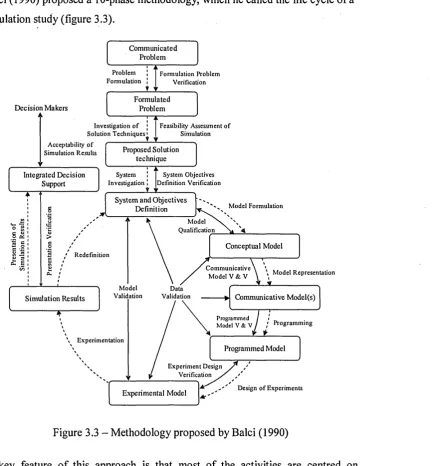
3.2.3 Methodology proposed by Balci (1990)
Balci (1990) proposed a 10-phase methodology, which he called the life cycle of a simulation study (figure 3.3).
Communicated Problem
Problem
Formulation Formulation Problem Verification
Formulated Problem Decision Makers
Investigation o f
Solution Techniques Feasibility Assessment o f Simulation Acceptability o f
Simulation Results Proposed Solution
technique Integrated Decision
Support
System Objectives D efinition Verification System
Investigation
System and Objectives
Definition M odel Formulation
M odel Qualification
S U,
Conceptual Model
Redefinition
Communicative
M odel V & V M odel Representation M odel
Validation ValidationData Communicative Model(s)
Simulation Results
Programmed
Model V & V < Programm ing Experimentation
Programmed Model
Experim ent Design Verification /
Design o f Experiments
[image:41.616.107.540.82.549.2]Experimental Model
Figure 3.3 - Methodology proposed by Balci (1990)
A key feature of this approach is that most of the activities are centred on verification and validation. In addition to activities involved in the simulation project, Balci (1990) also included the outcome of each activity in the methodology. Key activities of the methodology are shown below.
Problem formulation
Investigation of alternative solution techniques System investigation
Model formulation Model representation
Chapter 3 - The proposed methodology fo r distributed enterprise simulation
Programming
Design of experiments Experimentation Redefinition (of model)
Verification and Validation are applied to all phases
3.2.4 Methodology proposed by Law and Kelton (1991)
A 10 step simulation methodology proposed by Law and Kelton (1991) is shown in figure 3.4.
Formulate prob stu
iem and plan the dy
* ---Collect data & define model
Construct computer program and verify
Making pilot runs
Design experiments
T
Make production runs j
Analyze output data
I
[image:42.615.151.440.235.574.2]Document, present and implement the resultd
Figure 3.4 - Methodology proposed by Law and Kelton (1991)
Key activities of this methodology include:
Problem formulation and planning of the simulation study Data collection and definition of the conceptual model Validation of conceptual model
Chapter 3 — The proposed methodology fo r distributed enterprise simulation
Making pilot runs Validation
Design of experiments Making production runs Analyzing output data
Documentation, presentation and implementation of the results
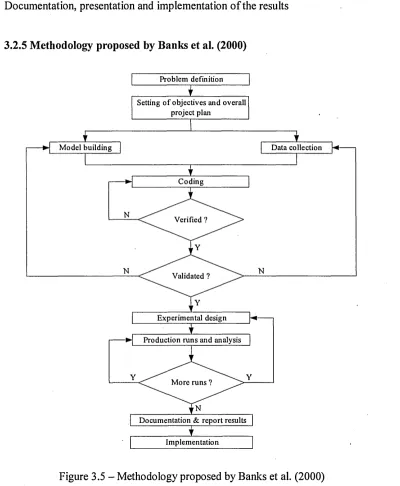
3.2.5 Methodology proposed by Banks et al. (2000)
Verified ?
Validated ?
Production runs and analysis
More runs ?
M odel building Data collection
Coding
Experimental design Problem definition
Documentation & report results
Implementation Setting o f objectives and overall
[image:43.615.86.486.154.640.2]project plan
Figure 3.5 - Methodology proposed by Banks et al. (2000)
Chapter 3 - The proposed methodology fo r distributed enterprise simulation
Methodology proposed by Banks et al. (2000) consists of following steps. Problem formulation
Setting of objectives and overall project plan Data collection
Model building Coding
Verification Validation
Experimental design
Production runs and analysis Need for more runs?
Documentation and reporting of results Implementation
In addition, a number o f authors including Lilegdon (1996), Maria (1997), Nordgren (1995), Sadoun (2000), Sargent (1994) also presented activities required for successful sequential simulation.
Chapter 3 - The proposed methodology fo r distributed enterprise simulation
On the other hand, Law and Kelton (1991) proposed verification and validation to be done after completion of key activities such as formulation of the conceptual model and conversion of the conceptual model into a computer simulation model. Balci (1990) proposed to conduct verification and validation throughout the model development process.
Having analyzed above simulation methodologies, the following activities were identified as key activities required to conduct a simulation.
• Problem definition and identification of objectives • Data collection
• Construction of conceptual model • Verification and validation
• Construction of computer simulation model • Experimentation
• Output analysis
• Implementation and further work
Problem identification and identification of objectives was selected as the first stage of the distributed simulation. This stage includes problem definition (Robinson, 1994; Shannon, 1998), problem formulation (Balci, 1990; Banks et al., 2000), project planning, system definition (Shannon, 1998), setting o f objectives (Banks et al., 2000). Data collection was selected as the next activity assuming that in order to construct the conceptual model data has to be collected beforehand. Preliminary experimental design (Shannon, 1998) is also included into this stage as it contains identification of input data, statistical distributions that represent data etc. Construction of the simulation model is presented in all the above mentioned sequential simulation methodologies as a separate activity except in the methodology presented by Law and Kelton (1991), where data collection and defining a conceptual model were incorporated into a single stage. However, Balci (1990) presented this stage as two separate stages, namely: model formulation and model representation. Verification and validation were proposed to be carried out at different levels after completing important stages of the simulation project such as completion of the conceptual model, partitioning o f the
Chapter 3 - The proposed methodology fo r distributed enterprise simulation
conceptual model into logical processes and transformation of logical processes into computer simulation models. Design o f experiments (Balci, 1990; Law and Kelton, 1991), experimental design (Banks et al., 2000), final experimental design (Shannon, 1998), experimentation (Balci, 1990; Shannon, 1998), production runs (Banks et al., 2000; Law and Kelton, 1991), additional runs (Banks et al., 2000) were included in the experimentation stage of the proposed methodology. Output analysis stage includes simulation results (Balci, 1990), analysis o f output data (Law and Kelton, 1991), analysis and interpretation (Shannon, 1998), and results analysis (Banks et al., 2000). Implementation and further work consists of project completion (Robinson, 1994), redefinition of the model (Balci, 1990); document, present and implement the results (Banks et al., 2000; Law and Kelton, 1990), and implementation (Shannon, 1998).
3.3 Additional activities for parallel and distributed simulation
The major difference between sequential simulation and distributed simulation is the number of processors (in workstations) used to execute the simulation. Sequential simulation executes as a single model in a single processor. In distributed simulation the entire model is partitioned into logical processes and executed in more than one workstation in a distributed environment. For the purpose of executing a simulation as a distributed simulation, in addition to the key activities mentioned above, the following activities are also required to be carried out. These activities were identified by analysing the literature on parallel and distributed simulation.
• Partitioning of the entire model into logical processes
• Deciding on synchronization protocols and networking aspects • Assigning of logical processes to different processors
Chapter 3 - The proposed methodology fo r distributed enterprise simulation
decision on whether or not to use distributed simulation. Therefore it was decided to incorporate an additional activity which guides users to identify an appropriate simulation strategy out of sequential simulation, parallel simulation or distributed simulation.
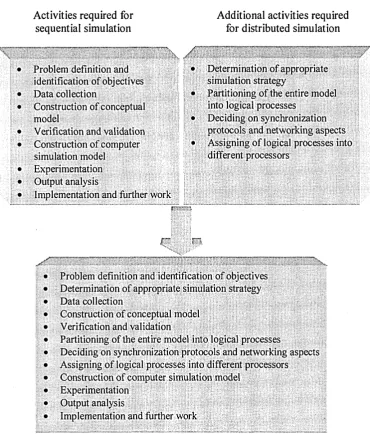
Figure 3.6 shows activities required for a distributed simulation by combining above mentioned additional activities into activities required for sequential simulation.
Activities required for sequential simulation
• Problem definition and • identification of objectives
• Data collection •
• Construction of conceptual
model •
• Verification and validation
• Construction of computer • simulation model
• Experimentation • Output analysis
• Implementation and further work
lilill:;::*,
• Problem definition and identification of objectives • Determination of appropriate simulation strategy • Data collection
• Construction of conceptual model • Verification and validation
• Partitioning of the entire model into logical processes
• Deciding on synchronization protocols and networking aspects • Assigning of logical processes into different processors • Construction of computer simulation model
• Experimentation • Output analysis
[image:47.615.95.466.224.659.2]• Implementation and further work
Figure 3.6 - Activities required for a distributed simulation including distributed enterprise simulation
Additional activities required for distributed simulation
Determination of appropriate simulation strategy
Partitioning of the entire model into logical processes
Chapter 3 — The proposed methodology fo r distributed enterprise simulation
Based on the activities identified in figure 3.6, the new proposed methodology for distributed enterprise simulation is presented in the next section.
3.4 The proposed methodology for distributed enterprise simulation
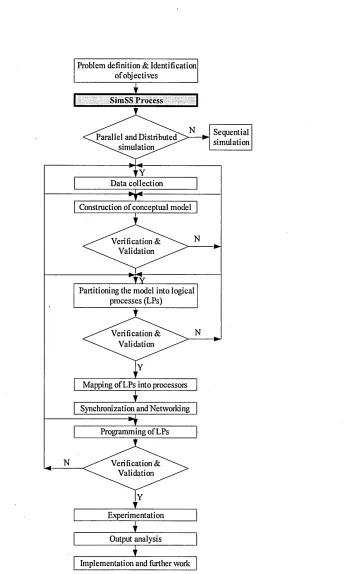
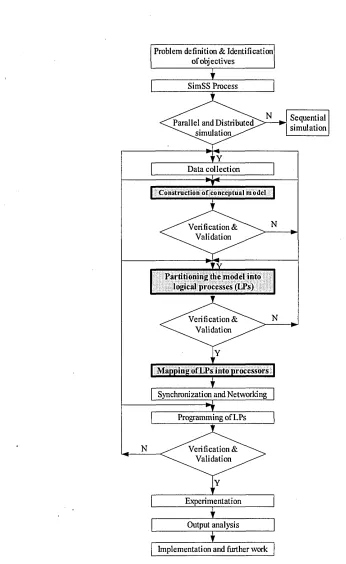
The proposed methodology is shown in figure 3.7 and stages of the methodology are described in the following sections. Key additional activities required for a distributed simulation with proposed implementation approaches are presented in the next three chapters of the thesis.
Problem definition & Identification o f objectives SimSS Process
Sequential simulation Parallel and Distributed
^''-'-^simulation
Data collection Construction o f conceptual model]
Verification & Validation
Partitioning the model into logical processes (LPs)
Verification & Validation <