HONOURS RESEARCH PROJECT REPORT
CLASS CONSTRUCTION AND STUDENT ALLOCATION
by
Dennis P. Chang
TABLE OF CONTENTS
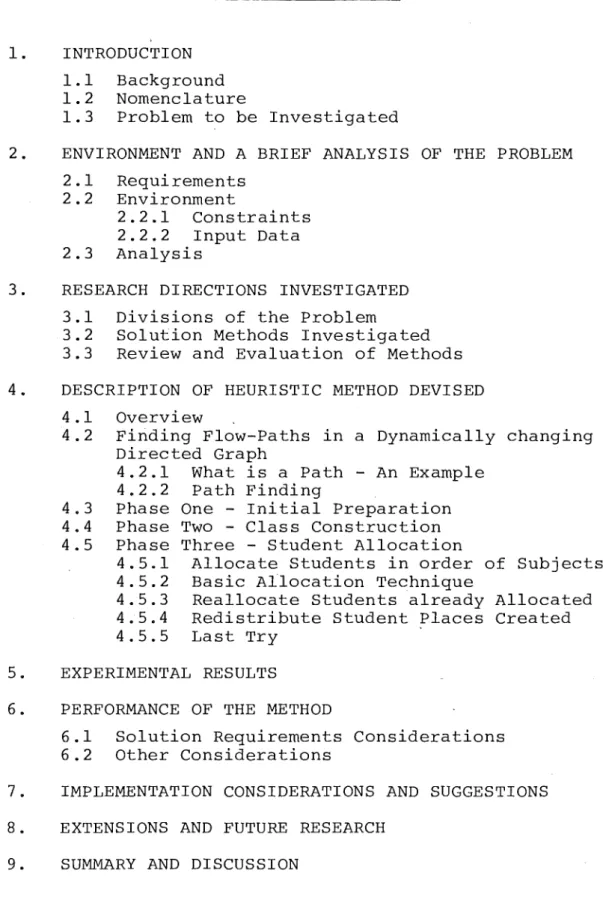
1. INTRODUCTION 1.1 Background 1.2 Nomenclature
1.3 Problem to be Investigated
2. ENVIRONMENT AND A BRIEF ANALYSIS OF THE PROBLEM 2.1 Requirements
2.2 Environment
2.2.1 Constraints 2.2.2 Input Data 2.3 Analysis
3. RESEARCH DIRECTIONS INVESTIGATED 3.1 Divisions of the Problem
3.2 Solution Methods Investigated 3.3 Review and Evaluation of Methods 4. DESCRIPTION OF HEURISTIC METHOD DEVISED
4.1 Overview
4.2 Finding Flow-Paths in a Dynamically changing Directed Graph
4.2.1 What is a Path -An Example 4.2.2 Path Finding
4.3 Phase One- Initial Preparation 4.4 Phase Two -Class Construction 4.5 Phase Three -Student Allocation
4.5.1 Allocate Students in order of Subjects 4.5.2 Basic Allocation Technique
4.5.3 Reallocate Students already Allocated 4.5.4 Redistribute Student Places Created 4.5.5 Last Try
5. EXPERIMENTAL RESULTS
6. PERFORMANCE OF THE METHOD
6.1 Solution Requirements Considerations 6.2 Other Considerations
7. IMPLEMENTATION CONSIDERATIONS AND SUGGESTIONS 8. EXTENSIONS AND FUTURE RESEARCH
9. SUMMARY AND DISCUSSION
ACKNOWLEDGEMENT APPENDICES
REFERENCES
1. INTRODUCTION 1.1 BACKGROUND
- 1
-Each year in every secondary school, days or even weeks are spent in constructing a school timetable. At present, this is done by senior staff (whose time could be better spent on something else) , since timetable construction requires knowledge, and authority to make decisions, that only they have.
1.2 NOMENCLATURE
In timetabler's parlance, 'block' s either to a set of classes, all of which always occur at the same time, or to a set of periods during which such a block of classes occurs. For example,
If Mr. Smith is taking 5B2 English in iods 2, 7, 14 and 20 then if Mr. Brown is taking 7Bl Mathematics in period 2 then he will also be taking that same class in period 7, 14 · and 20.
A timetable which exhibits such feature is said to be 'blocked'.
blocked.
The senior timetables of schools are frequently
1.3 PROBLEM TO BE INVESTIGATED The timetabler's problems are
1. which p~riods should occur in which block 2. which subjects should occur in which block
3. to which classes should each student be located
- 2
- 3
-2. ENVIRONMENT AND A BRIEF ANALYSIS OF THE PROBLEM 2.1 REQUIREMENTS
The problem of class construction and student allocation is to be investigated with a view to constructing a program that will, at least in part, meet the following requirements:-1. as many student choices as possible are satisfied.
2. constraints imposed by availability of specialist rooms etc are not exceeded.
3 • the numbe,r of classes created is, as minimised.
as possible
4. subject to one to three above, classes are reasonably
homogeneous with respect to ability level and/or background.
2.2 ENVIRONMENT 2.2.1 CONSTRAINTS
1.
(i) (ii) (iii) 2.
The constraints imposed on the problem are Bas constraints
For each subject the following will be limited: number of students allowed per class
number of classes allowed in each block total number of classes allowed
Constraints
Because of limited resources of specialist rooms and number teachers available, a limit may also be imposed on the number of classes for a group of subjects in any
- 4
-A subject may belong to as many group constraints as desired. The limit on the number of classes allowed for each
subject can be viewed as a group constraint imposed on all blocks for a subject.
2.2.2 INPUT DATA
The number of blocks, the subjects applied by each student, the basic constraints and the group constraints, if any, are to be supplied by the user.
It will be assumed that the number of subjects to be taken by each student is the.same as the number of blocks. This may require the invention of filler subjects, e.g. study.
2.3 ANALYSIS
The problem grows exponentially with the number of students. Assuming 6 blocks, the first subject can be allocated to any of the 6 blocks, the second subject can be allocated
- 5
-3. RESEARCH DIRECTIONS INVESTIGATED 3.1 DIVISIONS OF THE PROBLEM
The problem of class construction and student allocation can be viewed as two separate problems: (i) class construction,
(ii) student allocation. The constraints for the class construction problem are the basic and group constraints
specified in section 2.1.1 while any feasible solution obtained is used as the basis for the student allocation problem.
But a feasible solution obtained for .the class construction problem, when used as basis for the student allocation problem, may preclude the existence of a feasible solution to the student allocation problem (see fig. 1). Thus, i t is important to be able to find a feasible solution to the class construction problem quickly in which case optimality can be ignored.
- 6
-UNIVERSAL SET of all possible class configurations
set of feasible class
configurations for the class construction problem under basic and group constraints
set of class configurations under which at least one feasible solution to the student allocation problem exists
- 7
-3.2 SOLUTION METHODS INVESTIGATED
Linear Programming (reference 1 - 3)
The problem of class construction can be formulated as a linear programming problem (Appendix B) . It has been shown by Hacijan (Ref. 3) that a polynomial algorithm exists for linear programming, but since the solution obtained using linear programming techniques is not necessarily integral and we cannot have a non-integral number of classes, linear programming is of little value to us.
Integer Programming (reference 1, 4 - 7)
Using the same formulation as linear programming (Appendix B), with the additional condition that all variables are to take integral values, we can solve the class construction
problem using integer programming. A solution method for the student allocation problem can then be based on the solution obtained for the class construction problem using integer programming.
Performance figures contained in Geoffrian and Marsten (Ref. 6) for various integer programming algorithms gave an indication of the amount of computing time required for our problem. For a class construction problem with 50 subjects and 6 blocks would take 20 minutes computing time on an
- 8
-a good method to use to solve the cl-ass construction problem. Trauth and Wool (Ref. 7) contains results of testing 29 integer linear programming problems using 4 different computer codes.
In theory, every integer linear programming problem can be solved. That is, there are procedures which can be used that will lead to a solution of the problem with only a finite number of computations involved. In practice, however, several factors limit the use of these procedures. One factor is the time invloved in obtaining a solution. Also, i t is necessary to consider the round-off errors and machine size in determining whether a problem can be solved. This is complicated further by the fact that problems which are extremely difficult or impossible to solve using a given integer linear programming code, may be much more easily solved u ng another code. In general, there is no way to predict such an occurrence. Woolsey (Ref. 8) gave potential users of integer programming some disconcerting advice: "to reconsider carefully before using any integer programming code". Four real examples are cited.
We can use integer programming to solve the class
construction problem, and if the problem is feasible, obtain a class configuration with the minimum number of classes created.
Zero-One Linear Programming (Reference 1, 4 - 8)
9
linear formulation.
Zero-One linear programming can be used to formulate the student allocation problem (Appendix C) , provided a solution to the class construction problem has been found using some other methods (e.g. integer programming, heuri methods) .
Because of excess computing time and storage require-ments i t is only practical to use zero-one linear programming
to solve small to medium sized problems (e.g. a few hundred zero-one variables) . Some heuristic zero-one programming methods seem more attractive.
He uris Zero-One (Reference 9 - 11)
Zanakis (Ref. 9) examines the performance of 3 heuristic methods when applied to zero-one problems. The general
result is encouraging: best results obtained with 1000 zero-one variables is 360 seconds CPU time on an IBM 360/75; the results obtained all 1 within 5% of the optimal solution while taking only a small fraction of the time required by the IBM/MPSX code.
Because of the size of our problem, even this favourable result does not mean i t can be applied to our problem. Using the formulae supplied by Zanakis, we find that the estimated computing time required for a problem with 36,000 0-1 variables
-10-General Heuristic Methods
No tailor-made heuristic method has been found the class construction and student allocation problem.
3.3 REVIEW AND EVALUATION OF METHODS
In Sectiori 3.1 we examined methods which show some
promise towards solving our problem. Linear programming is of little use because the solution is not necessarily integral, however i t can be used to find a starting point, when using integer programming or heuristic methods, to reduce the computational time required. Integer programming can be u to obtain a solution to the class construction problem. Zero-one linear programming has no practical value because of the size of our problem. Heuristic zero-one programming sho.ws slightly more promise but is still impractical because of excessive computing time and storage required.
Since what constitutes optimality is often unc , only a feasible solution is required.· Even though this will
11
-4. DESCRIPTION OF HEURISTIC METHOD DEVISED 4.1 OVERVIEW
To utilize the special properties (basic and group
constraints, and blocked structure) of the problem, an attempt has been made to design and implement a heuristic method for the class construction and student allocation problem.
The method consists of three phases. Together, phases one and two attempt to obtain a feasible solution to the class construction problem, all constraints being satisfied.
Phase 3 attempts to allocate students to the classes created by phase 2. It is recognised that a complete solution is most unlikely to be found because of the large
number of possible ways to allocate students and impracticality of determining whether a feasible solution exists until one has been found.
12
-4.2 FINDING FLOW-PATHS IN A DYNAMICALLY CHANGING DIRECTED GRAPH
4.2.1 WHAT IS A PATH AN EXAMPLE
Consider the situation of two warehouses (Wl and W2) which can store 2 different types of commodities (Cl and C2), each type of commodity takes the same storage space. Each warehouse can store a maximum of 24 units of commodities,
and there is also a limit on the number of each type of commodity that can be stored, the two limits must add up to no less than 24. The total number of commodities to be stored in both warehouses is the same as the total capacity of the two warehouses.
Given the following information, how do we assign the commodities using some systematic procedure?
Cl C2
Total 22 26
Wl Limit 16 18
W2 Limit 12 16
(i) We start off by assigning as much Cl to Wl as we can, which is 16, there are now 6 Cl left. We now assign as much Cl to W2 as we can, which is the minimum of what is left of Cl and what W2 can take under the Cl storage limit and total warehouse capacity. This gives us 6. Now we try to assign C2 to Wl. Since Wl has already got 16 units of Cl, i t can only take 8 units of C2. This will leave 18 units of C2 left to be assigned to W2. But even though W2 can still take (24-6)=18 units of commodity, i t can only take a maximum of 16 units of C2. After assigning 16 units C2 to W2 we
Cl C2
Yet to be Assigned
0 ( 22)
2 ( 2 6)
13
-Wl
16 ( 16) 8 ( 18) 24
W2
6 ( 12) 16 (16)
22
We quickly realise that we need just shift 2 units of Cl from Wl to W2 and assign 2 more units of C2 to Wl.
we do this systematically?
But how can
We have 2 units of C2 yet to be assigned. Is there any warehouse that can still take some more C2? Yes, Wl. But since Wl has already got 24 units of commodities, we must shift some Cl out of Wl if any more C2 is to be assigned to Wl. Now, which warehouse can still take some more Cl?
Since W2 can still take some more commodities (not full). we need not shift out anything. So we will assign 2 more units of C2 to Wl, shift 2 units of Cl to W2 and all is well. Thus, a path is found (un-closed).
Cl 0(22) C2 0{26)
Wl 14 (16) 10 (18)
W2 8 ( 12) 16 (16)
{ii) If we need to reduce Cl held at W2, we cannot because there is no remaining storage capacity left for other types of commodities (in this case C2). In this case, we say that closed path can be found for Cl originating from W2. But if we want to reduce stock for C2 at W2, then a closed path can be found: reduce C2 at W2, increase C2 at Wl, reduce Cl at Wl and increase Cl at W2. The maximum flow that can
4. 2. 2 Cl C2
Wl
10 (16)
14 ( 18)
PATH FINDING
14
-W2
12 (12)
12 (16)
The example given in 4.2.1 is a scaled down version of what is done in phase 1 and 2 of the heuristic method. Types of commodities correspond to subjects, warehouses to blocks, unassigned commodities in a commodity type to unsatisfied demand for a subject, J::otal c:apacity for a warehouse to the total number of students (all of whom must be having a class
in every block) and the limit of e.ach commodity type in
warehouses corresponds to the number of students allowed
in each class for a subject multiplied by the number of classes allowed for each block (subject-block constraint).
What we must also take into account when deriving a feasible solution for the class construction problem is (i) the limit on the number of classes allowed for each subject
(an increase/decrease in the number classes created for
a block will decrease/increase the number of classes that s 1 can be created in other blocks for the same subject) .
(ii) if group constraints are also imposed on the subject in the block in which the number of c sses has been changed,
this change will have an effect on all other subjects restricted by the same group constraint.
15
-All of these do not change the method used to find paths but they do call for a more sophisticated method of altering the capacities of each subject in each block; a more complicated algorithm is also used to select the best path and the
maximum flow.
We can picture this as a graph using nodes for blocks; each code having as many layers as there are subjects. For each layer there is a directed edge from the node (if i t has places created in it) to nodes with capacity to take more places in that subject. A node is often both an originating and destination node in a particular layer. The originating node and destination node of an edge must be different.
In practice, because of their highly dynamic nature, the edges are not stored. Instead, six tables are used
to keep track of the complete status of the class construction and student allocation process. Briefly, the information available for each subject in each block is:
1. number of students allocated (only used in Phase 3) 2. number of student places created
3. number of classes created
4 . number of student places that can ll be created without creating a new class
5. number of student places that must be removed to abolish one class
16
-Note: A new class is created only if the previous class created in that subject is full.
The number of c sses created (Table 3) includes last class created which may not be full. The number of student places that must be removed to abolish one class
(Table 5) is the same as the number of student places created in the last class crea If more than one class needs to be abolished, a number of student places equal to the number of students allowed per class for the subject must be removed for every additional class to be abolished. The number of student places that can still be created without creating a new class (Table 4) is the number of student places we can still create in the last class created before that class is full, (this is zero if the class is full).
Tables 3, 4 and 5 can be constructed from the number of students allowed per c ss and Table 2 (which contains the number student places created for each subject in each block, which is also the number of student places that can be removed) . In phase 3, the difference of Table 2 and 1 must be taken
because in path finding we can only shift student places not already allocated.
The capacity table (Table 6) indicates the number of classes that can still be created for each subject in the block (while still satisfying all constraints) or the number of classes of each subject in the block that have been
created in excess of block capacity. A change in
- 17
-all other subjects in the same block and constraint groups. So, if a block in a subject has not yet satisfied all the con-straints, the number of classes created in other blocks in
the subject and subjects in the same block and group constraints may also have to be reduced before the constraints can be
satisfied. Similarly, the number of classes that can still be created in a block may be reduced because new classes have been created in other blocks in the same subject or in the same block for different subjects which are under the same group constraints.
From Tables 4, 5, 6 and the number of students allowed per class we can calculate the capacity of a block in a subject in units of n~mbers of student places created.
This is needed by the path-finding procedure to compute the maximum number of student places we can flow through a partic-ular path.
A path is found by matching the outlets from one block with inlets of blocks not already in the path and then looking for outlets in the latter. This process continues until
either an unfilled block (for Phase 1) or a closed path is found {Phase 2 and 3). Except for the starting block (which will have only one outlet) all other blocks on the path
could have more than one outlet. A 6:/Idthfirst)search is conducted after which several paths of the same length may have been found. The maximum length possible is the same as the total number of blocks.
- 18
-4.3 PHASE ONE INITIAL PREPARATION
Phase 1 attempts to fill up all blocks and satisfy demand for all subjects. Only the limit on the number of classes for each subject in each block is observed. (See part (i) of example in section 4.2.1)
The larger the number of group constraints imposed
on a subject in a block, the .higher the probability that the
-~apacity of other subjects in the same group constraints and other blocks in the same subject will be reduced if classes are created for the subject in the block. In the
wo~st case, no capacity will remain for any other blocks in the same subject or other subjects in same group con To minimize .the impact, a table containing the number of group constraints on each subject for each block is setup. Student places are created starting with
subject~blocks with the minimum number of group constraints and proceeding to subject-blocks with the highest number of group constraints. This is done to reduce the amount of reassigning of student places required in Phase 2 if not all constraints are satisfied after Phase 1.
The lowing procedure is performed for subject-blocks on which the same number of group constraints are imposed.
The subjects are processed sequentially while the blocks for each subject are processed serially-randomly; that is, the starting block is picked randomly and the blocks ar~
19
-of group constraints we are dealing with, we assign as much of the remaining demand for the subject as possible without over-filling the block.
After this, the tables mentioned in Section 4.2 are made. If there is any unsatisfied demand we will search for paths from each of the subjects with remaining demand to unfilled blocks. A path table will be created if paths exist. If there is a choice of path, then the path with the largest flow is selected (to minimize the number of times the path table has to be constructed) . Paths containing subject-blocks with an excess of classes will always be selected before paths which do not contain such subject-blocks.
- 20
-4.4 PHASE TWO CLASS CONSTRUCTION
In this phase, the number of classes in subject~blocks
with an excess of classes is reduced. Since over-creation of classes can be the result of over-creation of classes in the subject and/or over-creation of classes in a constraint group to which the subject-block belongs, we may find that in some cases classes of other blocks or subjects will also need to be reduced for the constraints to be satisfied. Similarly, a reduction in the number of classes created in one block
may make i t unnecessary to reduce the number of classes created in other blocks or subjects. The Path-finding technique is used to resolve these problems.
- 21
-4.5 PHASE THREE STUDENT ALLOCATION
Given a class configuration supplied by phase 2, phase 3 will attempt to allocate students using the following tech-niques.
4.5.1 ALLOCATE STUDENTS IN ORDER OF SUBJECTS
Suppose 6th form Economics is taught only in Block B in a timetable with only 3 blocks, then students taking 6th form Economics must have Economics in Block B. Consequently the possible choices of blocks for other subjects are limited. For example, if English is available only at Blocks A and B
then students taking Economics all have to take English in Block A. We need to allocate these students first to avoid other students taking up the spaces in Block A English
required by those taking 6th form Economics.
In general, students taking subjects which have fewer choices of blocks are allocated first.
4.5.2 BASIC ALLOCATION TECHNIQUE
For each student to be allocated, the subject with fewest choices of blocks, and blocks with choices of subjects are allocated first. For example,
Blocks Bl B2 B3 B4
Subjects
Sl 1 1
S2 1 1 1
S3 1 1
- 22
-Since only 82 can be allocated to Bl we will allocate 82 to Bl st (note: A for Allocated).
Bl B2 B3 B4
81 1 1
82 A
83 1 1
84 1 1
Since 82 has been allocated to Bl i t cannot also be allocated to other blocks.
Now only 84 can be allocated to B4.
Bl B2 B3 B4
81 1 1
82 A
83 1 1
84 A
- 23
-4. 5. 3 REALLOCATE STUDENTS ALREADY ALLOCATED
If we cannot allocate a student using the basic technique
described in Section 4.5.2 then students already allocated
are searched to see if any one of them can be reallocated
so as to free a place for the unallocated student.
In the previous example, say John takes 6th form Economics,
English and German. We must allocate Economics to Block B
and English to Block A. Suppose we find we are unable to
allocate German to Block C. This maybe because there
never was a German class created in Block C, in which case
there is nothing we can do at this stage. On the other hand,
if there are student places created for German in Block C
but they have all bee~ allocated, clearly, there must be
student places available in some other block, otherwise total
demand will exceed the total number of student places created
which cannot be the case i f a feasible class configuration
has been found in Phase 2. We now look for a student who
takes German in Block C and is able to take German in some
other block and take some other subject in Block C. If
such a student is found, the subjects are exchanged and a
vacancy will be created in Block C for German which will be
24
-4.5.4 REDISTRIBUTE STUDENT PLACES CREATED
If a student cannot be allocated using the reallocation scheme, we will attempt to redistribute the created student places using path-finding techniques. That is, to modify, within the constraints, the class configuration provided by Phase 2 in the hope of creating an additional student place in the block to which a subject cannot be allocated.
If this also fails we will put the student on a
"difficult list" waiting to be allocated with the last attempt at the end.
4.5.5 LAST TRY
Until now, we have only allocated students to student places created and ignored the fact that there may be classes in which more student places could be created because of
remaining capacity. We have also assumed that all student places created will eventually be taken up. This is done to try to keep the final class configuration a student allocation as close as possible to the class configuration provided by Phase.2. Now, however, we check whether we would allocate any of the "difficult" students by using such remaining capacity. Note that this will not involve b~eaking
any constraints - i t is a matter of using the difference between the number of students we originally ted to
- 25
-5. EXPERIMENTAL RESULTS
The test data used are from the 1977 5th Form timetable from Linwood High School, Christchurch. The characteristics of each trial are shown by the following:
1. number of blocks 2. number of students
3. number of group constraints
4. supply ratio: average over subjects of the supply to demand ratio
5. block ratio: average over subjects of the number of blocks in which classes can be created to toal number
blocks
6. class ratio: average over subjects of the ratio of the sum of number of classes allowed in individual blocks to total .number of classes allowed in -individual blocks to total number of classes allowed in the subject.
The original student population is 369, a sample of 99
students was taken. There are six blocks, no group constraints and most students also take th.e subject "study". The results are shown in Table 1. The value in bracket supply
ratio is the supply ratio with out the subject "study". \J,
The trials were ran on a B6700 computer.
The computing time us in Phase 1 increased only slightly while total computing time increased more than linearly with the increase of problem size. The computing time increases with decrease in success rate (Trials 1, 2, 3 and 4) . Low success rate seems to correlate with high class ratio (Trials 1, 2, and 3) while the decrease in supply
- 26
-the success rate.
The reallocation technique is more useful with difficult problems (Trials 2, 3 and 5) while the redistribution technique has no success. No last attempt was needed for Trials 1
and 4 which had a 100% success rate.
In general, a tight constraint and good class
1.
RESULTS
(..OM FVTl.N(t l'l.ME PPITH
No.4
STVDEf'l'1SNo. o~ No. o~ BLOCK SJPPL) CLASS No. o~ SVC.GE:SS (. S &C.Ot.J.'l>S ) FJ.ND'l.N4' PILLOCA TE 1) VSJ..Nq CALLS
IR1.f-'\L
G-Roup
1<-P.Tl-0 srui£NT5 RATE-STUDENTS RAT~O f\P\11.0 1.N
C.ONST- ~LLO- PHFfE_ PHI\SE PHASE: PHP\SES REPIL- RSD1S- LAS\
1\A"l.NTS C.ATED
( %)
~LOCAT.ION TR:t.BU'fld' A--rru-\fT
1 .2- 3 Af'ID
.2.
I 99 0 0.433 1.5og 1.015 C'j'} loo /.3 0 :;;2,3 -5 I 0 0 (I. OS"S)
2. 9~ 0 0.450 I. 30'8 1.25"0
Cf6
( I.OSS)
cr:r.o
I.(. 0 f;.92&
2. 0 33
qg
0 o.t,<p. /.3og .2.2..60<1.2
Cf.2. ~ 1.~8.4
$36
0 3ti.OSS) 0
4 /00 0 0.433 I.S26 1.015 too
(t .281) laO 1.4- 0 ;>., "T 4 I 0 0
5 36S 0 0.433 1.3c2
b
( 1.013) 1.07'5
351
'r1.2
1.6
0 /c;.).. 2..4 0 2.b
36~ 0 0.433- 28
-6. PERFORMANCE OF THE METHOD
6.1 SOLUTION REQUIREMENTS CONSIDERATIONS
Let us examine the performance and capability of the heuristic method under the four requirements the project is trying to achieve.
1. As student choices as ssible are satisfied. The result obtained for the largest problem tested has a success rate of over 97% using as input data a class
configuration that is known to have a feasible solution. A sea down version had a success rate of 100%. The results seem encouraging, but given a set of input data for which we do not know whether any solution exists, i t would be difficu~t to judge the solution obtained. For example, a success rate of only 50% for a given problem could indicate unstableness of the heuristic method, with varying performance depending on the problem since perhaps a much higher success rate could be obtained using exhaustive enumeration; but if the best that the data would allow even to an omniscient timetabler is a 51% success rate, then the heuristic method has done very well indeed.
No attempt has been made in this project to investigate intensively the stableness of the heuristic method and the characteristics of the problem that are likely to give a better/poorer performance.
2. Constraints the availabili ialist
rooms etc are not exc
These constraints are contained in basic and group
- 29
-construction process finds a feasible solution. If a
feasible solution exists for the class construction problem it will always be found.
3 . The number of classes created is ssible minimised
This requirement not achieved by the heuristic method.· Integer programming could be used to solve the class construc-tion problem while minimising the number of classes created.
However, because of numerous other reasons outside the environment of the problem, a class configuration with the number of classes minimised may not be acceptable to the timetabler who may wish to make various changes to i t . The heuristic method can be used efficiently and interactively by the timet~bler to make his/her changes. This is done by manipulating the constraints imposed on the problem:
reducing or preventing any further creation of classes by tightening the existing constraints or imposing new ones, introducing new classes by relaxing or removing constraints and so on. In this way, the experience and knowledge of the timetabler can be used ef tively in making a class config-uration that is feasible under all constraints imposed on the problem, acceptable to the timetabler and optimised with
- 30
-4. Classes are reasonably homogeneous with respect to ability level and/or background
No effort has been made in the heuristic method to
achieve this requirement because no information is available in the input data. Section 8 contains suggestions on
modifications and additions that can be made to the existing heuristic method to meet this requirement in part.
6.2 OTHER CONSIDERATIONS
For the heuristic method to be of any practical value, the following must be considered:
1. Ability to be implemented
The heuristic method represented has been successfu~ly
implemented on a Burroughs B6700. Section 7 contains suggestions and considerations for implementation on mini
I
micro-computers.2. Time Requirement
When run on B6700, about 10 seconds of computing time was used to obtain a solution to a problem with 100 students, while 23 seconds of computing time were used to obtain a
solution to a problem with 365 students, a growth rate of less than linear.
It is hard to estimate the amount of computing time required on mini
I
micro-computers since i t will very much depend on the type of machine used, the amount of main store available and file access times. But judging from the31
-7. IMPLEMENTATION CONSIDERATIONS AND SUGGESTIONS 7.1
The heuristic method described in Section 4 can be implemented in two separate stages: one for the class
construction process and the other for the student allocation process.
The information that needs to be passed between stages is the table containing the number of student places created. The table containing the number of students already allocated will also need to be passed from stage two to stage three. All other tables can be constructed from these tables and
the input data which will be stored as a file.
If main storage permits, the basic and group constraints should be in main store for all three stages. The routines· to read files into main store and to set up initially all tables required can be discarded once they are used so they would not take up valuable space in main store when the computations start. These routines will be used by both
stages.
Stage 1 consists of Phase 1 and Phase 2 of the heuristic method. Its function is to derive a sible class config-uration if one exists or to inform the timetabler if a solution cannot be found. The procedures included are: the
path-finding procedure, and control procedu~es for Phases 1 and 2. The student allocation process is performed in the second stage. Because both path-finding procedures and Phase 3
- 32
-implemented in two separate prog~ams. Program 1 will allocate students using the basic allocation technique and the
reallocation technique, while the redistribution technique and final allocation technique will be implemented in the second program.
This means that the redistribution technique will be used to allocate studenrnnot so far allocated only after all
students have been processed by the basic and reallocation technique. If this also fails, a last attempt will be made to allocate those students not yet allocated using the technique described in Section 4.5.5.
7. 2 '
If possible, the file containing the subjects applied for each student should be brought into main store to save file access time. The program implemented on the B6700 using the heuristic method described requires only one word for each subject applied and an additional word to say how many subjects have been allocated for each student. If byte
- 33
-8. EXTENSION AND FUTURE RESEARCH
Extensions that can be-made to improve the performance
of the heuristic method are discussed under each requirement.
Requirement 1
(i) An improvement that can be made to the student allocation
technique is in the method used in the basic allocation
technique (Section 4.5.2). Instead of allocating all
subjects ~ student applied for we could allocate only those subjects where only one choice of block remains and allocate
subjects to blocks to which only one subject can be allocated
(see example in Section 4.5.2). In this way, only the
critical subjects for each student are allocated while no
allocations are made for subjects with more than one choice
of block. This will give those students who can only take
those subjects in certain blocks the first chance to be
allocated.
Each time a reduction of available blocks occurs in a
subject, students taking that subject should be scanned to
see whether any further choices are forced.
This improvement will nearly double the record size for
each student since we now must keep track of which subjects
have been allocated and to which blocks they have been
allocated.
(ii) At present, we have no means of deciding when a class
configuration is better than others. It may be that a set
of criteria can be devised to avoid class configurations
that are likely to give a poor allocation success rate.
34
-number of classes that should be alloc to each block for set of students to be allocated. A pre-processor to order students taking into account not only subject ability and background but also the class configuration provided
by the class construction process may produce useful improvements.
2
This requirement has already been met completely. irement 3
Some optimising code (e.g. existing integer programmlng code) can be included in Phase 2 to minimise the number of classes creaied.
irement 4
In addition to what has been mentioned in Section 6 about mixing the order of students in the input data we can have a separate process after student allocation process to reallocate students so that blocks in the same subject are reasonably homogeneous with respect to ability level and/or background.
- 35
-9. SUMMARY AND DISCUSSION
The class construction and student allocation problem is essentially two separate problems to be solved under the same constraints.
The class construction problem can be solved using integer programming to minimise the number of ses created or by using Phase 1 and Phase 2 of the described heuristic method to find a feasible solution. The heuristic method would be much faster (4 seconds vs 20 minutes} but human assistance is most likely to be required to obtain an acceptable class configuration. On the other hand, a class configuration with the minimum number classes created obtained using
integer programming m'ay not be acceptable for reasons that lie outside the environment of the problem (e.g. psychological consi tions, staff preferences or past experience leading to feelings that i t wouldn't work}. It is best to use
integer programming to obtain an optimal solution (i.e. number of classes created is minimised} and if this is not acceptable then the heuristic method can be used to obtain an acceptable class configuration using the optimal solution as the starting configuration.
The only practical method for allocating students is the student allocation process (Phase 3} of the described heuristic method. It does not take too much computing time
(23 seconds CPU on B6700 for 365 students} and the result obtained is quite acceptable (6 out of 365 students unable to be allocated, a success rate of over 98%.} These are the best results obtained and were produced from input data
- 36
-ACKNOWLEDGEMENT
Special acknowledgement is given to Mr. R. Harries, my Project Supervisor, for his assistance, guidance and
infinite patience. The valuable opinions of Dr. D.G. McNickle, Dr. L.R. Foulds and Mr. F.T. Baird also
acknowledged.
37
-APPENDIX A
SYMBOLS USED 1. Constants
B number of blocks S number of subjects P number of students
Symbols used in basic constraints:
~. number of students allowed per class for subject j
·~
s.
~ number of classes allowed for(studen~ 1 / I "(> (' \7 \.-\_ b} ~
bij : number of classes allowed for ~udent i in block j
Symbols used in group constraints:
G. . number of classes allowed for the ith group constraint
~]
in block j
2. Variables
d· ~ number of students wanting to do subject i
c ..
~] number of classes constructed subject i in block jX ••
~] number of students assigned to subject i in block j
Aij number of students allocated to subject j in block j
3. Sets
Vi
set of subjects taken by student iQij set of subjects in the ith group constraint of block j
Note:
- 38
-APPENDIX B
Formulat for the Class Construction Problem
Basic ~onstraints 1 ~ i ~
s
c''
~] ~ b . ' ~]B
L:
c.'
~]<
si
B
L: C ij) 9.-i ? d i
s
L: ( ciJ 9.-i) ;;::. P
i=l
Group Constraints
where Objective Function:
I
,
To minmize the
1\
s
number B
of classes created g
=
L: L:j=l
c ..
- 39
-APPENDIX C
Zero-One Linear Formulation For Student Allocation Problem I
Given A Constructed Class Table
Let P .. k be a 0-1 variable indicating whether student i
~] .·
is taking jth subject (j £Vi) in block k.
[o
for no, 1 for yes.]Xjk are the number of students assigned to subject i in block k. This is given as inputs to the problem.
1 ~ i ~ p 1 < k ·~ B
1. Each student must be allocated one and only one subject in any one block.
2.
E Pijk
=
1j£Vi .
B
E
Pijk=
1
k=l
We must satisfy the c class table
p
E
i=l
B
E Pijk < Xjk
k=l
s constraints impo by the
- 40
-APPENDIX D
- 41
-MAIN
READ-.__ _ _ _ -.; TABLES
PHASF.:1
t---""""PHAS£2
L---...!PHASE3
''FIN DIN
INDOUT
SELIN
ELOUT
AD~ATH
42
-
FIND-PATH
SEL-FLOW
D-UBALTN
ADCLS
AD-GROUP
· CALSBK
t . - - - 1 PHASE 1
~-ot----1 PHASE2
. - 43
-SHIFT
TEST--DEMAND
MAKE-ALTNTA
MAKECL-ASS'rAB
MAKE-CLSfLP\q
TEST-PUP
LP611R'(
1 - - ... PUTPUP
--- --- CALSBK
REAS-SIGN .
MAKE-CONFIG
ASN-BLOCK
ASN-SUBJECT
- 44
-REFERENCES
General Research Text
1. Daellenback, H.G., and J.A. George
Introduction to Operations Research Techniques Allyn 'and Bacon, 1978
Good introductory book, give excellent treatment a wide range of topics with examples.
2. Daellenback, H.G., and E.J. Bell User's Guide to Linear ·Programming Prentice-Hall, 1970
Elementary; contain a listing of a linear program
computer code with input/output and sensitivity analysis (LPGOGO)
Linear Method
See ref. 1 & 2
3. Hacijan, L.G •
. A Polynomial Algorithm in Linear Programming Soviet Math. Doklady, Vol. 20 (1979), No. 1 Integer Programming
4 .
5.
6 .
Plane, D.R:, and C. McMillan
Discrete Optimization Prentice-Hall, 1971
This book is a good place to start a more detailed study of integer programming without complicated mathematics. Contain computer codes for implicit enumeration of 0-1 proble, linear programming and a cutting plane algorithm.
1\
\01'-Greengerg, N.
Integer Programming Academic Press, 1971
Intermediate to advance text. T~e theory is tempered with good applications and examples.
Geoffrion, A.M., and R.E. Marsten
Integer Programming Algorithms: A Framework and State-of-the-art. Survey
Management Science, Vol. 18, No. 9, May 1972, pp. 465-491 A good survey of integer techniques. Contain a l i s t of exten ve references.
7. Trauth, C.A. JR, and R.E. Woolsey
Integer Linear Programming: A Study In Computational Efficiency Management Science., Vol. 15 May 1969
45
-References Continued
8. Woolsey, R.E.D.
A Candle to Saint Jude, Or Four Real World Applications of Integer Programming
Interface, Vol. 2, No. 2, Feb 1972, pp. 20-27
The article gives potential users of integer programming some rather disconcerting advice to reconsider carefully before using any integer programming code.
Zero-One Linear
See ref. 1, 4-7
Heuristic Zero-One Linear 9. Zanakis, Stelios H.
Heuristic 0-1 Linear Programming:
An Experimental Comparison of Three Methods.
Managment Science, Vol. 24, No. 1, September 1977, pp. 91-104
.This paper an excellent and detailed examination of the performance of three heuristic methods (Senju-Toyoda, Kochenbe , and Hillier) WDen applied to the 0-1 linear programming problem.
10. Toyoda, Yoshiaki
A Simplified Algorithm for Obtaining Approximate Solution to Zero-One Programming problems.
Management Science, Vol. 21, No. 12, August 1975, pp.l417-1427
Toyoda's original paper on his heuristic method. Contain a description of the method and experimental results.
11. Kochenberger, G.A.
A Heuristic for General Integer Programming