On Accelerated MHD Flows of Second Grade
Fluid in a Porous Medium and Rotating Frame
Faisal Salah, Zainal Abdul Aziz, and Dennis Ling Chuan Ching
Abstract—The rotating magnetohydrodynamics (MHD) flow of a second grade fluid due to an accelerated plate is examined. Modified Darcy’s law is used to formulate the physical problem in a porous space. Two cases of interest namely constant and variable accelerated MHD flows are addressed. Fourier sine transform technique is adopted to solve analytically the resulting problems. Finally, from the exact solutions the implied effects of emerging flow parameters on the velocity field are displayed and discussed.
Index Terms—Accelerated MHD flows, second grade fluid, porous medium, rotating frame, Fourier sine transform, exact solution
I. INTRODUCTION
T
HE studies of non-Newtonian fluids have received con-siderable attention because of numerous applications in industry, geophysics and engineering. Some investigations are notably important in industries related to paper, food stuff, personal care products, textile coating and suspension solutions [1]. A large class of real fluids does not exhibit the linear relationship between stress and rate of strain as Newtonian fluid does. Due to the non-linear dependence, the analysis of the behavior of fluid motion of non-Newtonian fluids tends to be much more complicated and subtle in comparison with that of Newtonian fluids.Unlike the Newtonian fluids, one cannot recommend a single constitutive relationship between stress and shear rate which exhibits all the characteristics of non-Newtonian flu-ids. Hence many empirical or semi-empirical expressions of non - Newtonian fluids are presented. The non - Newtonian fluids have been mainly classified under the differential, rate and integrals types. The second grade fluids are the subclass of non - Newtonian fluids and are the simplest subclass of differential type fluids which can show the normal stress effects [2]. It was employed to study various problems due to their relatively simple structure. Moreover, one can reasonably hope to obtain exact solutions from this type of second grade fluid. This motivates us to choose the second grade model in this study. The exact solutions are important as these provide standard for checking the accuracies of many approximate solutions which can be numerical or empirical. They can also be used as tests for verifying numerical schemes that are developed for studying more complex flow problems [3]–[5].
Manuscript received April 15, 2013; revised June 20, 2013. This research is partially funded by MOHE FRGS Vote no. 78675 and UTM RUG Vot. No.05J13.
F. Salah and Z. Abdul Aziz are with the Centre for Industrial and Applied Mathematics, Department of Mathematical Sciences, Fac-ulty of Science, Universiti Teknologi Malaysia, 81310 Malaysia. e-mail: [email protected], [email protected]
Dennis is with Universiti Teknologi PETRONAS. email:[email protected].
In general, the governing equation of unidirectional flow of second grade fluid is third order which is more than the second order Navier - Stokes equation. Further, the order of equation in second grade fluid is reduced when higher order non-linearities are ignored, which is not possible in the Navier - Stokes equations. In view of such interesting features, several researchers have discussed the flows of second grade fluid in different configurations (for instance see studies [6]–[11]). There are available few attempts [12]– [20] in which the flows of non - Newtonian fluids have been investigated in a rotating frame.
To the best of our knowledge no literature exists in which accelerated MHD flows of non - Newtonian fluids in rotating frame and porous space have been studied. Therefore the objective of this work is to investigate the rotating and accelerated magnetohydrodynamic (MHD) flows in a second grade fluid filling up the porous space. The analysis has been performed for the two cases (a) constant accelerated MHD flow and (b) variable accelerated MHD flow. In addition the graphical results are plotted and discussed.
II. PROBLEMFORMULATION
Let us consider a Cartesian coordinate system(x, y, z). We consider a fluid saturated porous half space bounded by an infinite accelerated plate atz= 0(z−axis is taken normal to the plate). The whole system is rotating uniformly with a constant angular velocity Ω about the z− axis, (refer to Figure 1.0). The porous space is described by the modified Darcy’s law. A constant magnetic field B◦ acts in the z−
direction. The applied and induced magnetic fields are chosen to be zero.
The unsteady flow in a porous medium is governed by the following equations of motion and continuity:
ρ
"
∂ ~V ∂t + (
~
V .∇)V~ + 2Ω×V~ + Ω×(Ω×r)
#
=−∇p+div ~S+J~×B~ +R,~ (1)
div ~V = 0. (2)
In the above equationsV~ = (u, υ, w)is the velocity filed, ~
J is the current density, B~ =B◦+b is the total magnetic
field, B◦ andb are the applied and induced magnetic fields
respectively, ρ is the fluid density and R~ is the Darcy resistance.
For small magnetic Reynolds number, the Lorentz force ~
J×B~ becomesσV~ ×B~×B~ when imposed and induced electric fields are negligible and only the applied magnetic fieldB~0 contributes to the current densityJ~=σ
~ V ×B~; σ is the electrical conductivity of the fluid. In view of these considerations the Lorentz force due to magnetic field becomesJ~×B~ =σ ~B20V~ .
IAENG International Journal of Applied Mathematics, 43:3, IJAM_43_3_03
For the second grade fluid we have the extra stress tensor ~
S given in [4] as
~
S=µ ~A1+α1A~2+α2A~21 (3)
where µ is the dynamic viscosity and αi (i= 1,2) are material constants satisfying α1≥0, α1+α2 = 0, A~1 and
~
A2 are the first two Rivlin - Eriksen tensors and the velocity
field is assumed in the form
~
V = (u(z, t), υ(z, t), w(z, t)) (4)
On the basis of Oldroyd constitutive equation, the follow-ing law describfollow-ing both relaxation and retardation phenom-ena in an unbounded porous medium has been suggested by Tan and Masuoka [9]:
1 +λ1
∂ ∂t
∇p=−µ
k
1 +λ2
∂ ∂t
~
VD (5)
In the above equation (5), λ1 and λ2 are the relaxation
and retardation times respectively, k is the permeability, ~
VD=φ~V is the Darcian velocity and φ is the porosity. For the second grade fluidλ1= 0, then equation (5) takes
the form
∇p=−µφ
k
1 +λ2
∂ ∂t
~
V (6)
Note that equation (5) reduces into the classical Darcy’s law for λ1 = 0 and λ2 = 0 . Since the pressure gradient in
equation (6) can also be interpreted as a measure of the resistance to flow in the bulk of the porous medium andRis a measure of the flow resistance offered by the solid matrix. ThereforeRcan be inferred from equation (6) to satisfy the following equation:
~
R=−µφ
k
1 +α1 µ ∂ ∂t ~ V (7)
Equation (7) is a measure of flow resistance for the second grade fluid. In view of equations (2) and (4), it turns out that w = 0 for the rigid plate. Upon making use of this result in conjunction with equation (4) and assuming the modified pressure gradient equal to zero, equations (1), (3) and (7) lead to equations in [4],
ρ
∂u
∂t −2Ωυ
= µ∂
2u
∂z2 +α1
∂3u
∂z2∂t
−σB2◦u−µφ
k
1 +α1 µ ∂ ∂t u(8) ρ ∂υ
∂t + 2Ωu
= µ∂
2υ
∂z2 +α1
∂3υ ∂z2∂t
−σB2◦υ−µφ
k
1 +α1 µ
∂ ∂t
υ(9)
The initial and boundary conditions are subjected to con-stantly accelerated MHD flow and are given as follows
u=υ= 0 ,when t= 0, z >0, (10)
u(0, t) =At, υ(0, t) = 0 for t >0, (11)
u, ∂u ∂z, υ,
∂υ
∂z →0, as z→ ∞, t >0 (12)
whereAhas dimension of TL2.
III. EXACTSOLUTION FORCONSTANTACCELERATED
MHD FLOW
Making use of the following expression
F =u+iυ, (13)
and defining
ξ=Z
A
ν2
13 , τ=t
A2
ν
13
, G= F
(νA)13 ,
P = 1 +α1φν µk , M =
σBo2 ρ
ν
A2
13
, ω= Ων 1 3
A23
! , 1 B = φ k ν2 A 23
, c= 2iω+M+1 B, α=
α1 ρ ν A 23 , (14)
we arrive at
P∂G(ξ, τ)
∂τ +cG(ξ, τ) =
1 +α ∂ ∂τ
∂2G(ξ, τ)
∂ξ2 (15)
G(0, τ) =τ, τ >0, (16)
G(ξ,0) = 0, ξ >0, (17)
G(ξ, τ), ∂G(ξ, τ)
∂ξ →0 as ξ→ ∞; τ >0. (18)
Taking the Fourier sine transform, the above problem takes the form
P+αη2∂Gs(η, τ)
∂τ +
c+η2
Gs(η, τ)
=
r
2
πη[τ+α] ; η, τ >0, (19)
Gs(η,0) = 0, η >0, (20)
in which Gs(η, τ) indicates the Fourier sine transform of G(ξ, τ).
The above system is satisfied by the following relation
Gs(η, τ) =
r
2 π
η
(c+η2)2 ∗
"
τ c+η2+ (αc−P) + (P−αc)e
−(c+η2)τ
(P+αη2)
#
. (21)
Fourier inversion of equation (21) yields
G(ξ, τ) = τ e−ξ
√
c−2 (P−cα)
π ∗ ∞ Z 0
1−e
−(c+η2)τ
(P+αη2)
(c+η2)2
ηsin(ξη)dη. (22)
Equation (22) represents the exact solution for the constant accelerated MHD flow of second grade fluid in a porous medium and rotating frame.
For hydrodynamic second grade fluid in a non - porous medium and non-rotational, one has , c = 0 and therefore equation (22) reduces to
G(ξ, τ) =τ−2P
π ∞ Z 0
1−e
−η2τ
(P+αη2)
η3
sin(ξη)dη. (23)
IAENG International Journal of Applied Mathematics, 43:3, IJAM_43_3_03
The velocity field G(ξ, τ) , as given by equation (23), is equivalently of the form to that obtained by Fetecau et al. (2007, Eq. (23) ) For a magnetohydrodynamic Newtonian fluid (i.e.α= 0) in a porous space, equation (22) reduces to
G(ξ, τ) = τ−2
π
∞
Z
0
"
1−e−η2τ η3
#
sin(ξη)dη.
= 4τ i2Erf c
ξ
2√τ
(24)
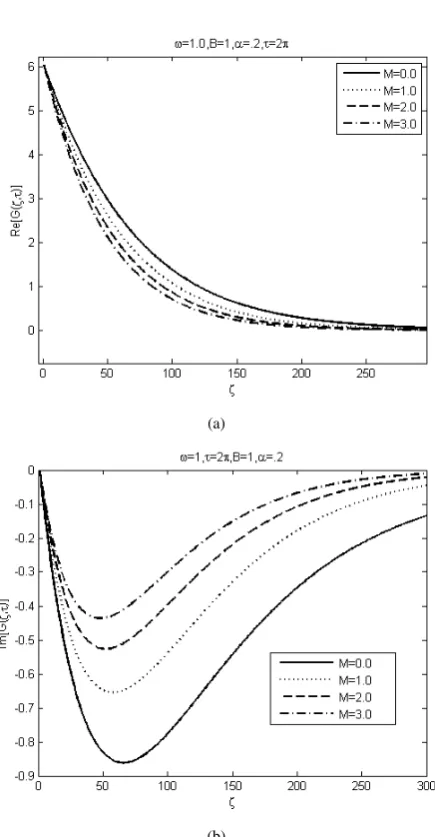
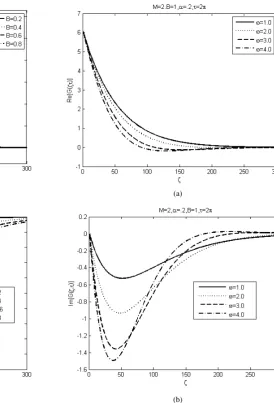
In order to address the influence of several pertinent parameters on the dimensionless velocity field components, graphical illustrations in the Figures 2 to 5 are presented for the constant accelerated MHD flows generated by a plate. The panels (a) and (b) in each plot represent the real and imaginary parts of the derived velocity field respectively.
IV. EXACTSOLUTION FORVARIABLEACCELERATED
MHD FLOW
The problem here is described by equations (8 -10), (12) and the boundary conditions
u=υ= 0 at t= 0, z >0,
u(0, t) =<t2, υ(0, t) = 0; t >0. (25)
where<has dimension of TL3.
We now introduce the following quantities
ζ=z
<
ν3
15 , δ=t
<2
ν
15
, S= F
(ν2<)15 ,
P = 1 + α1φν µk , ∈=
α1
ρ
ν <3
25
, H= σB 2 o ρ ν < 15 ,
ψ= Ων 1 5
<25
! , 1 L = φ k ν <2 25
, D= 2iψ+H+1 L. (26)
The dimensionless flow problem then takes the following form,
P∂S(ζ, δ)
∂δ +DS(ζ, δ)
=
1+∈ ∂
∂δ
∂2S(ζ, δ)
∂ζ2 ; ζ, δ >0,(27)
S(0, δ) =δ2, δ >0, (28)
S(ζ,0) = 0, ξ >0 (29)
S(ζ, δ), ∂S(ζ, δ)
∂ζ →0, as ζ→ ∞;δ >0. (30)
Adopting the solution procedures of the previous section we directly write the exact solution the variable accelerated MHD flow of second grade fluid in a porous medium and rotating frame as
S(ζ, δ) = 2δ 2
π
Z ∞
0
ηsin(ζη) D+η2 dη
+4 (∈D−P)δ π
Z ∞
0
ηsin(ζη)dη
(D+η2)2
−4 (∈D−P)
π
Z ∞
0
P+∈η2
×
1−e−
D+η2
P+∈η2
δ
ηsin(ζη)dη
(D+η2)3 (31)
or on the another form the solution (31) becomes
S(ζ, δ)
= δ2e−ζ
√
D+
(∈D−P)δ √
D ζ
e−ζ
√
D−4 (P− ∈D) π × ∞ Z 0
P+∈η2
1−e
−(D+η2)δ
(P+∈η2)
!
(D+η2)3 ηsin(ζη)dη
(32)
For hydrodynamic second grade fluid in a non - porous medium and non- rotational one hasD = 0, and therefore equation (31) reduces to
S(ζ, δ) =δ2−4P δ
π
∞
Z
0
sin(ζη)dη η3
+4P π
∞
Z
0
P+∈η2
1−e−
η2
P+∈η2
δsin(ζη)dη η5 (33)
For Newtonian magnetohydrodynamic fluid (i.e.∈= 0,P = 1 ) in a porous space, equation (32) reduces then to
S(ζ, δ) = δ2e−(
√
D)ζ−4δ π
∞
Z
0
ηsin(ζη)
(D+η2)2dη
+4 π ∞ Z 0 h
1−e(D+η2)δiηsin(ζη) (D+η2)3dη(34)
For hydrodynamic viscous fluid in a non - porous medium and non- rotational one has,D = 0 and therefore equation (34) reduces to
S(ζ, δ) = δ2−4δ
π
∞
Z
0
sin(ζη) η3 dη
+4 π ∞ Z 0 h
1−eη2δisin(ζη) η5 dη
= 32δ2i4Erf c
ζ
2√δ
(35)
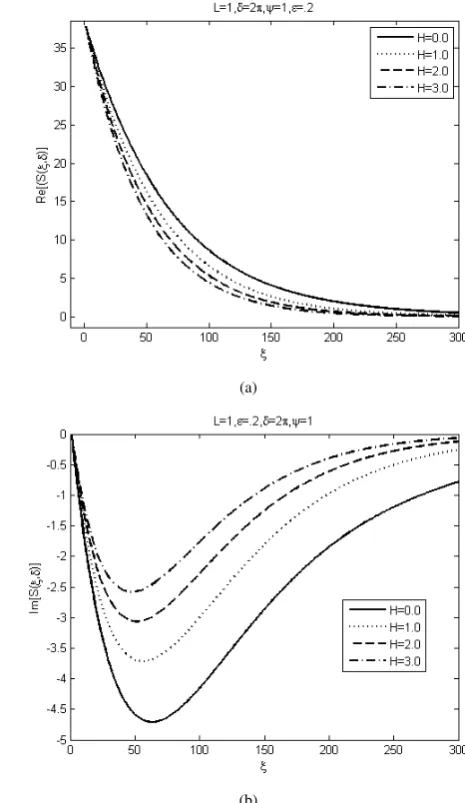
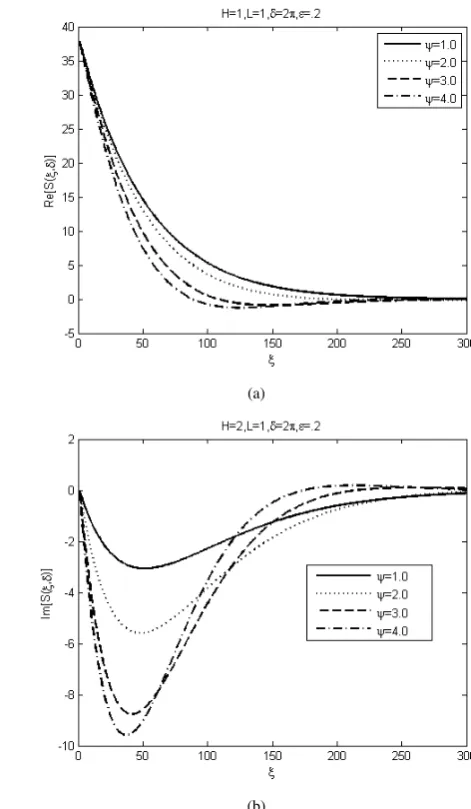
In order to see the effects of several relevant parameters on the dimensionless velocity field components, some graphical illustrations in the Figures 6 to 9 are presented for the vari-able accelerated MHD flows generated by a plate. The panels (a) and (b) in each plot represent the real and imaginary parts of the derived velocity field respectively.
V. DISCUSSION OF THERESULTS
The aim of this section is to address the influence of several pertinent parameters on the dimensionless velocity field components. Graphical illustrations are presented for the two situations namely constant and variable accelerated MHD flows generated by a plate. The panels (a) and (b) in each plot represent the real and imaginary parts of the derived velocity profile respectively.
In order to analyze the whole situation, we have drawn the Figures 2 to 9. It should be pointed out that the result of velocity profile for constant accelerated plate has been
IAENG International Journal of Applied Mathematics, 43:3, IJAM_43_3_03
shown in the Figures 2 to 5. Furthermore, the flow induced by variable accelerated plate has been sketched in the Figures 6 to 9.
The velocity field components versusξhave been plotted in Figure 2 when different values of αare accounted for. It is concluded that the real part of velocity profile increases when there is an increase inα(for example in the physical process involving stress thickening). Further, the magnitude of imaginary part of velocity profile decreases when α increases. Plots in figure 3 indicate the behaviour of M (physical process relating to action of the Lorentz force) on the velocity field components versus ξ. It is noted that the real part of velocity profile is a decreasing function of M whiles the magnitude of the imaginary part increases with large values of M . A comparative study of Figures 3 and 4 yields an opposite features associated with M and B on the real and imaginary parts of the velocity profile. Plots in Figure 5 characterize the influence of rotational parameterω on the real and imaginary parts of velocity profile. Panel (a) in this Figures shows that Re (G(ξ, τ)) decreases when large values ofω are taken into account. However, the imaginary part of velocity profile in panel (b) first decreases and then increases. Moreover, it is found that variations of all these parameters in variable accelerated MHD flow i.e. in Figures 6 to 9 are similar to that of constant accelerated MHD flow presented in the Figures 2 to 5 in a qualitative manner.
VI. CONCLUSIONS
In this article, the unsteady rotating flow engendered by an accelerated plate has been studied in the presence of an applied magnetic field. From the presented analysis, the main observations are described as below:
• The variation ofαon the magnitude of real and imag-inary parts of velocity profile is different.
• Effect of M on the magnitudes of real and imaginary components of velocity profile is quite the opposite.
• The flow characteristics subject to M and B on the velocity profile components leads to an opposite effects.
• The results corresponding to viscous fluid can be ob-tained by choosingα= 0.
ACKNOWLEDGMENT
Faisal is thankful to the University of Kordofan for re-search leave of absence and Universiti Teknologi Malaysia for the postdoctoral scheme.
REFERENCES
[1] Y. ZHAOSHENG AND L. JIANZHONG. Numerical research on the coherent structure in the viscoelastic second-order mixing layers.
Applied Mathematics and Mechanics, vol. 19 (1996), no. 8, pp. 717– 723.
[2] M. HUSSAIN, T. HAYAT, S. ASGHAR ANDC. FETECAU. Oscillatory flows of second grade fluid in a porous space.Nonlinear Analysis: Real World Applications, vol. 11 (2010), no. 4, pp. 2403–2414.
[3] M. KHAN, E. NAHEED, C. FETECAU ANDT. HAYAT. Exact solutions of starting flows for second grade fluid in porous medium.International Journal of Nonlinear Mechanics, vol. 43 (2008), no. 9, pp. 868–879. [4] T. HAYAT, C. FETECAU ANDM. SAJID. Analytic solution for MHD
transient rotating flow of a second grade fluid in a porous space.
Nonlinear Analysis: Real World Applications, vol. 9 (2008), no. 4, pp. 1619–1627.
[5] F. SALAH, Z.A. AZIZ ANDL. DENNIS. New exact solutions for MHD Transient Rotating flow of a Second grade fluid in a porous medium.
Journal of Applied Mathematics,DOI:10.1155/2011/823034.
[6] C. FETECAU, T. HAYAT, M. KHAN, F. CORINA. Unsteady flow of an Oldroyd-B fluid induced by the impulsive motion of a plate between two side walls perpendicular to the plate. Acta Mech., vol. (), no. , pp. –.
[7] C. FETECAU, T. HAYAT, J. ZIEREP, M. SAJID. Energetic balance for the Rayleigh- Stokes problem of an Oldroyd-B fluid. Nonlinear Analysis: Real World Applications. Nonlinear Analysis: Real World Applications, vol. 12 (2011), no. 1, pp. 1–3.
[8] F. SALAH, Z.A. AZIZ AND L. DENNIS. New exact solution for Rayleigh - Stokes problem of Maxwell fluid in a porous medium and rotating frame. Results in Physics, vol. 1 (2011), no. 1, pp. 9–12. [9] W.C. TAN, T. MASUOKA. Stokes’ first problem for a second grade fluid
in a porous half space with heated boundary. International Journal of Nonlinear Mechanics, vol. 40 (2005), no. 4, pp. 512–522.
[10] K.R. RAJAGOPAL, A.S. GUPTA. On a class of exact solutions to the equations of motion of a second grade fluid. International journal of Engineering Science, vol. 19 (1981), no. 7, pp. 1009–1014.
[11] M.E. ERDOGAN, C.E. IMRAK. On unsteady unidirectional flows of a second grade fluid. International Journal of Nonlinear Mechanics, vol. 40 (2005), no. 10, pp. 1238–1251.
[12] C. FETECAU, T. HAYAT, C. FETECAU, N. ALI. Unsteady flow of a second grade fluid between two side walls perpendicular to a plate.
Nonlinear Analysis: Real World Applications, vol. 9 (2008), no. 3, pp. 1236–1252.
[13] F. SALAH, Z.A. AZIZ ANDL. DENNIS. Accelerated flow of magneto hydrodynamic (MHD) second grade fluid over an oscillating plate in a porous medium and rotating frame. International Journal of the Physical Sciences, vol. 6 (2011), no. 36, pp. 8027–8035.
[14] C. FETECAU, C. FETECAU. Starting solutions for unsteady uni-directional flows of a second grade fluid. International journal of Engineering Science, vol. 43 (2005), no. 10, pp. 781–789.
[15] P. PURI. Rotating flow of an elastico - viscous fluid on an oscillating plate.ZAMM -Journal of Applied Mathematics and Mechanics, vol. 54 (1974), no. 10, pp. 743–745.
[16] T. HAYAT, K. HUTTER, S. ASGHAR, A.M. SIDDIQUI. MHD flows of an Oldroyd - B fluid.Mathematical and. Computer Modelling, vol. 36 (2002), no. 9, pp. 987–995.
[17] T. HAYATT, S. NADEEM, S. ASGHAR, A.M. SIDDIQUI. Fluctuating flow of a third order fluid on a porous plate in a rotating medium.
International Journal of Nonlinear Mechanics, vol. 36 (2001), no. 6, pp. 901–916.
[18] C. FETECAU, C. SHARAT, K.R. RAJAGOPAL. A note on the flow induced by a constantly accelerating plate in an Oldroyd-B fluid.
Applied Mathematical Modelling, vol. 31 (2007), no. 4, pp. 647–654. [19] Y. LIU, L. ZHENG, X. ZHANG, F. ZONG. The Oscillating Flows
and Heat Transfer of a Generalized Oldroyd-B Fluid in Magnetic Field.
IAENG International Journal of Applied Mathematics, vol. 40, no. 4, IJAM 40408.
[20] F. SALAH, Z.A. AZIZ, L. DENNIS. On Accelerated Flow for MHD Generalized Burgers’ Fluid in a Porous Medium and Rotating Frame.
IAENG International Journal of Applied Mathematics, vol. 41 (2011), no. 3, pp. 199–205.
[21] IS. GRANDSHTEYN, IM. RYZHIK. Tables of Integrals, Series and Products.5th ed. Academic Press, New York, vol. 5 (1994).
APPENDIX
In order to obtain Equation (32) from Equation (31), we use the result in this work (Grandshteyn and Ryzhik, 1994):
• ∞
R
0 sin(ax)
x dx= π
2
• ∞
R
0
xsin(ax)
β2+x2 dx= π
2e
−aβ,(a >0,Reβ >0)
• ∞
R
0
xsin(ax) (β2+x2)2dx=
π
4βae
−aβ,(a >0, β >0)
IAENG International Journal of Applied Mathematics, 43:3, IJAM_43_3_03
Fig. 1. Graphical representation of the physical problem for second grade fluid in a rotating frame.
(a)
[image:5.595.321.539.186.605.2](b)
Fig. 2. Velocity profiles for different values ofα .
(a)
(b)
Fig. 3. Velocity profiles for different values ofM .
IAENG International Journal of Applied Mathematics, 43:3, IJAM_43_3_03
[image:5.595.62.533.250.749.2](a)
[image:6.595.251.526.204.608.2](b)
Fig. 4. Velocity profiles for different values ofB .
(a)
[image:6.595.61.290.207.607.2](b)
Fig. 5. Velocity profiles for different values ofω .
IAENG International Journal of Applied Mathematics, 43:3, IJAM_43_3_03
(a)
[image:7.595.64.287.199.608.2](b)
Fig. 6. Velocity profiles for different values of .
(a)
(b)
Fig. 7. Velocity profiles for different values ofH .
IAENG International Journal of Applied Mathematics, 43:3, IJAM_43_3_03
[image:7.595.305.538.204.606.2](a)
[image:8.595.301.537.201.606.2](b)
Fig. 8. Velocity profiles for different values ofL .
(a)
[image:8.595.63.287.207.603.2](b)
Fig. 9. Velocity profiles for different values ofψ .