Digital Game-based Learning for
Early Childhood
A State of the Art Report
Author: Neil Peirce
Copyright
Table of Contents
Table of Figures ... 3
1 Executive Summary ... 4
2 Introduction ... 5
2.1 Scope of this Report ... 5
2.2 Structure of this Report ... 6
3 The Pedagogy and Design of Games for Early Childhood ... 7
3.1 Content Areas Most Suited to Game-based Learning ... 9
3.1.1 Cognitive Development ... 10
3.1.2 Psychomotor Development ... 14
3.1.3 Social-Emotional Development ... 15
3.1.4 Psychosexual Development ... 17
3.1.5 Mapping Developmental Stages to Age ... 18
3.2 Appropriate Gaming Strategies ... 20
3.2.1 Developmental Design Considerations ... 20
3.3 Underpinning Pedagogies ... 22
4 Evidence of Effectiveness and Impact of Game-Based Learning ... 24
4.1 Academic Research Survey ... 24
4.2 Learning Performance... 27
4.2.1 Phonological Awareness ... 27
4.2.2 Differentiation of Thematic and Taxonomic Relationships ... 28
4.2.3 Memory Enhancement Strategies ... 29
4.2.4 Motor Skills and Coordination ... 30
4.2.5 Mathematical Development ... 31
5 Cost-Effectiveness ... 33
6 Summary ... 36
Table of Figures
Figure 1. Tablet-based Game by Sesame Workshop ... 5
Figure 2. Forms of Play in Early Childhood (Kernan, 2007) ... 8
Figure 3. Proposed Taxonomy of Children's Play (Hutt et al., 1989) ... 9
Figure 4. Mapping Early Childhood Learning Themes to Development Types ... 10
Figure 5. Piaget's Stages of Cognitive Development (Gage & Berliner, 1998) ... 10
Figure 6. Team Umizoomi Math: Zoom into Numbers by MTV Networks ... 12
Figure 7. Count Me To Sheep by Sesame Workshop ... 12
Figure 8. Checkout Cookie by Sesame Workshop ... 13
Figure 9. Letter Factory Game by LeapFrog Enterprises ... 13
Figure 10. Psychomotor Developmental Stages (Gallahue & Ozmun, 2006). ... 14
Figure 11. The Tiggly Game ... 15
Figure 12. Erikson's Stages of Personality (Erikson, 1980) ... 16
Figure 13. The Scout and Friends...and You! Game by LeapFrog Enterprises ... 17
Figure 14. The Choo-Choo Choices Game by TVOKids ... 17
Figure 15. Mapping of Developmental Stages to Age ... 19
Figure 16. Intuitive and Unintuitive Tablet Touch Gestures ... 21
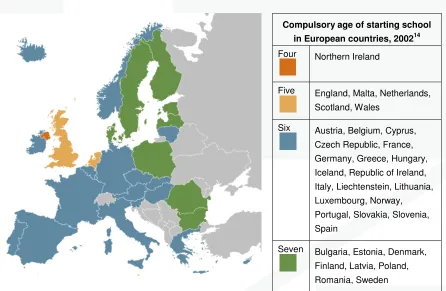
Figure 17. Map of Europe Showing Compulsory School Starting Ages ... 22
Figure 18. Challenges of Pedagogical Approaches to Early Childhood Games ... 23
Figure 19. Breakdown of Sector Specific Academic Research Papers ... 25
Figure 20. Early Childhood Game-based Learning Challenges ... 26
Figure 21. Representation of the Phonological Structure of the Word ‘basket’. (Gillon, 2004) ... 27
Figure 22. Phonological Awareness Vocabulary Game (Segers & Verhoeven, 2002) ... 28
Figure 23. Phonological Awareness Colouring Game (Segers & Verhoeven, 2002) ... 28
Figure 24. Progressive Stages of Taxonomic Learning ... 29
Figure 25. Example Game for Hierarchical Taxonomic Classification (Sung et al., 2008) ... 29
Figure 26. Physical Farm Game Characters (Marco et al., 2009) ... 30
Figure 27. Virtual Representation of Tangible Toys (Marco et al., 2009) ... 30
Figure 28. Number Pictures Game to Make Designs from a Number of Shapes. (Sarama & Clements, 2004) ... 31
Figure 29. Double Trouble Game to Practice Counting Chocolate Chips. (Sarama & Clements, 2004) ... 32
Figure 30. Technical Advantages and Disadvantages to Developing Games for Early Childhood ... 33
Figure 31. Target Age for the Top Earning Educational Apps in the Apple AppStore, 2009 vs 2011 (Shuler, Levine, & Ree, 2012) ... 34
Figure 32. Cost Breakdown of Top iOS Apps for Children 2011 (Shuler et al., 2012) ... 34
Figure 33. Top Eight Educational iOS App Publishers 2011 (Shuler et al., 2012) ... 35
Figure 34. The Nabi 2 Tablet ... 36
1 Executive Summary
The use of digital game-based learning for early childhood is growing rapidly with technological enhancement, but without the academic research to determine its effectiveness. Despite the challenges of designing developmentally appropriate games with sound pedagogical bases, games are being published at an unprecedented rate, albeit with little or no scientific study on their impact and effectiveness. The key findings of this report are summarised below.
Developmental appropriateness is the key factor influencing game design for this age group, with consideration needed for cognitive, psychomotor, and socio-emotional development The emergence of intuitive touch-based phones and tablets has considerably increased the
viability of game-based learning for early childhood
There is a rapidly increasing number of educational games targeting this age group, however, there is a notable lack of evidence to support their effectiveness
Despite the wealth of academic research being conducted into game-based learning only a fraction targets games for early childhood (6% of 995 papers surveyed)
The effectiveness of games for this age group has been shown in areas such as phonological awareness, differentiating thematic and taxonomic relationships, memory enhancement, motor skills and coordination, and mathematical development
There is an on-going debate as to whether young children should be exposed to ICT as it can arguably detract from fundamental psychomotor and socio-emotional development
2 Introduction
The last decade has seen a phenomenal growth in digital game-based learning. As a core constituent of the serious games movement, educational video games present the prospect of combining learning with the inherently motivating medium of games. The burgeoning growth of the entertainment games industry and the increasing prevalence of smart phones and tablet computers have shifted the expectations of learners. As a result, learning environments that are highly interactive and visually stimulating are now increasingly desirable.
To date, commercially successful educational games have focused on the K-121, higher education, corporate, and military markets. However, the increasing pervasiveness of computers and mobile digital devices within homes, has opened a new market for game-based learning. The growth of haptic2 interfaces is also exposing these young learners to more intuitive interactions with computers (Figure 1). This report presents the current state of early childhood digital game-based learning from both an academic research perspective and the instances of commercially available games.
Figure 1. Tablet-based Game by Sesame Workshop3
2.1 Scope of this Report
This report relates to the use of digital game-based learning for children aged 3-6 years. The use of the term ‘early childhood’ describes children of this age group although it can be defined as being as broad as birth to 8 years (UNESCO, 2012) or as narrowly as 2-5 years (Gallahue & Ozmun, 2006). The use of terms such as kindergarten, pre-kindergarten, and preschool are avoided as their definitions vary geographically. Examples of the variability of these terms can be found in (Sharp, 2002) with specific examples including the definition of kindergarten in the US (5-6 years) compared
1
Kindergarten to 12th Grade, the school system in the USA covering 5-18 year olds
2
haptic, adj. Of, pertaining to, or relating to the sense of touch or tactile sensations. Source: OED
3
with Germany (3-6 years), and the definition of preschool in Ireland (under 4 years) compared with Sweden (under 7 years).
The intended audience for this report is commercial organisations that are developing, or are intending to develop, educational games for the 3-6 year old market.
2.2 Structure of this Report
This report is broken into three key sections relating to game-based learning for early childhood. In section one, the pedagogy and design of games for this age group is considered. The content areas suitable for games are examined as well as the appropriate gaming strategies and underpinning pedagogies employed. Examples of developmentally appropriate games are also provided.
In section two, the evidence of the effectiveness and impact of games for early childhood is presented. This section begins with an overview of the academic research undertaken in this area, its prevalence, and the challenges faced. This section also reports on the effectiveness of the games surveyed in terms of learning performance.
3 The Pedagogy and Design of Games for Early Childhood
Contemporary approaches to game-based learning consider the matching of learning content and game genres (Prensky, 2001), the learning principles that games incorporate (Gee, 2004), the design of educational games and simulations (Aldrich, 2004), the effectiveness, sources, and institutional usage of games (Van Eck, 2006), and the design of meaningful play in games (Salen & Zimmerman, 2003). However, these approaches have predominantly focused on the schools, higher education, corporate, and military sectors.
The design and pedagogy of games for early childhood presents unique challenges not relevant to other sectors. The predominant and overarching challenge being the developmental level of learners in this age group. The developmental level of learners impacts both the pedagogical approaches that can be used as well as the learning tasks that can reasonably be presented. When considering developmental levels it is important to consider both the innate variability of development between individuals, and also the multiple types of development including cognitive, psychomotor, emotional/social, and psychosexual. To further compound this challenge the types of development can have strong interdependencies such as where psychomotor development can impact social and cognitive development, e.g. muscle development affecting speech and consequent social engagement.
In light of the significance of developmental level on learning, the use of developmentally appropriate practice across all early childhood education is advocated (Bredekamp & Copple, 2009; NAEYC & Fred Rogers Centre, 2012; NAEYC, 2009; Verenikina & Harris, 2003). As part of the argument for developmentally appropriate learning, there is an increasing shift away from the curricularisation of early childhood learning and support for increase play-based learning (Hirsh-Pasek, Golinkoff, Berk, & Singer, 2008; NCCA4, 2004).
The significance of play in learning is strongly supported by established pedagogical theory (Hutt, Tyler, Hutt, & Christopherson, 1989; Piaget, 1962; Vygotsky, 1978). Although play and games in adulthood are used for enjoyment, exercise, and escapism, in early childhood it has many other distinct purposes. A list proposed in (NCCA, 2004) states that play can enable children to:
Develop imagination and creativity Develop an ability to manage emotions Develop as thinkers
Develop physically Develop language
Learn to use symbols by laying the foundations for becoming proficient users of various symbolic systems, including literary and numerical systems
Develop social skills, and to develop morally and spiritually
Another interpretation of play in early childhood is to consider it from the perspective of there being different forms of play, each of which has distinct learning benefits. This approach was taken by (Kernan, 2007) and is summarised in Figure 2.
4
Exploratory play: using physical skills and sensations to learn about materials and their properties, what they feel like and what can be done with them.
Constructive play: the manipulation of objects and materials to build or create something using natural or manufactured materials such as blocks, playdough, junk and collage materials, sand and water. Involves creating, recognising and solving problems.
Creative play: using open-ended materials such as art materials and natural materials in ways that encourage fluency, flexibility, originality, imagination, embellishment and making novel connections.
Pretend, fantasy and socio-dramatic play: includes: role play, pretending with objects, pretend actions and situations, persistence within the imaginary play frame to create a play episode or event. When it involves interaction and verbal communication with one or more play partners regarding the play event it is termed socio-dramatic play (Monighan Nourot, 2006).
Physical locomotor play: activities that involve all kinds of physical movement for their own sake and enjoyment. In this type of play a range of fine or gross motor skills are practised and mastered.
Language or word play: unrehearsed and spontaneous manipulation of sounds, and words often with rhythmic and repetitive elements. As children get older, this kind of play often incorporates rhyme, word play and humour.
Figure 2. Forms of Play in Early Childhood (Kernan, 2007)
An alternative yet complementary approach to classifying play in early childhood was proposed by (Hutt et al., 1989). This approach resulted in the taxonomy of children’s play shown in Figure 3 below, whereby the constituents of play and its importance to learning is evident.
The distinction between play and games is indicated below in Figure 3 whereby games are a form of play with rules. Of the many definitions of what a game is, that offered by (Salen & Zimmerman, 2003) below covers the key constituents of conflict, rules, and goals.
“A game is a system in which players engage in an artificial conflict, defined by rules, that
Figure 3. Proposed Taxonomy of Children's Play (Hutt et al., 1989)
Although the definition of a game is clear, how the conflict, rules, and goals are manifested to leverage the benefits of play, are not. Play in early childhood is known to perform an important role in learning. It is significant in cognitive, psychomotor, emotional, social, and psychosexual development, as is considered in the following sections. However, the transition of these play benefits to digital game-based learning presents questions as to the content areas addressed, appropriate gaming strategies employed, and the underpinning pedagogies applied. In the following sections these questions are addressed with particular reference to the impact of developmental level on the pedagogy and design of educational games.
3.1 Content Areas Most Suited to Game-based Learning
Learning Themes Development Types
o Communication o Exploring and thinking o Wellbeing
o Identity and belonging
}
}
Cognitive & Psychomotor
Emotional/Social & Psychosexual
Figure 4. Mapping Early Childhood Learning Themes to Development Types
The following subsections explore each of the developmental types and give examples of learning games that are relevant and developmentally appropriate.
3.1.1 Cognitive Development
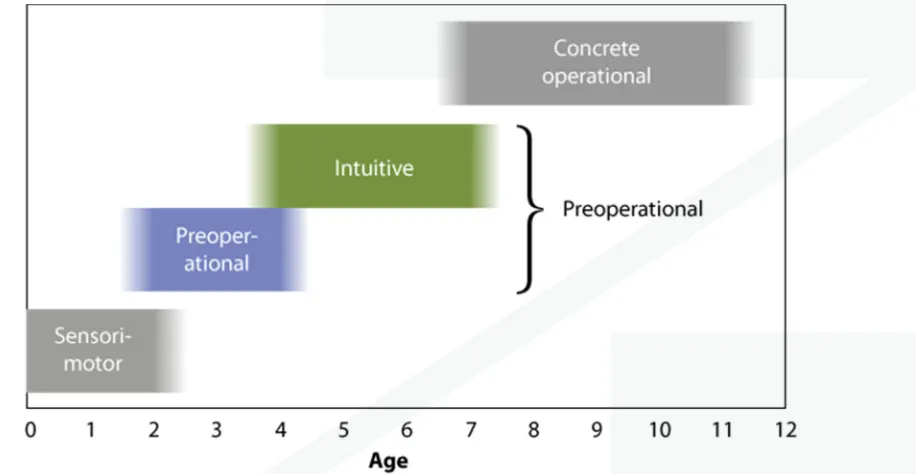
[image:11.595.87.545.387.624.2]The cognitive development theories of children in early childhood, has long been based around the work of Jean Piaget and his constructivist theories (Piaget, 1962; Singer & Revenson, 1997). As a key component of Piaget’s work he identified that children progress through a series of cognitive development stages as they mature. Of significance in early childhood learning is the preoperational stage which consists of a preoperational and intuitive sub-stages, as is shown in Figure 5 below.
Figure 5. Piaget's Stages of Cognitive Development (Gage & Berliner, 1998)
The cognitive development of a child through the preoperational stage results in profound changes. Throughout this stage the child develops away from egocentricity and an inability to think logically, towards more social and collaborative learning. The inquisitive nature of the child at this age is a strong driving force.
The challenge of using games with children of this age is that there are limitations to what they can understand and to the complexity of tasks that they can achieve. By examining how a child is changing cognitively at this age, it is possible to design games with interfaces that are understandable, and with learning content that is developmentally appropriate.
3.1.1.1 Preoperational sub-stage
The characteristics of a child in the pre-operational sub-stage include:
They use language to help develop concepts
Their egocentric view of the world makes them often incapable of alternative perspectives They need extensive experience to understand complex relational terms
They can classify objects based on a single evident feature, e.g. colour, material
There is difficulty with understanding multi-dimensional differences, e.g. green circles and green triangles are not the same just because they are green
They are able to collect items based on a criterion (even a shifting one)
They can arrange objects in a series yet cannot draw inferences between non-adjacent objects
They have limited transitive inference, e.g. if A > B and B > C then A > C
3.1.1.2 Intuitive sub-stage
The intuitive sub-stage is so called as the child begins to be able to draw conclusions “based on vague impressions and perceptual judgements” (Gage & Berliner, 1998) that are not put into words. For example, objects can be ‘intuitively’ grouped, but the reason for the grouping is not always consciously known. The characteristics of this stage include:
Ability to form classes or categories of objects (not necessarily aware of them) Understand logical relationships of increasing complexity
Able to work with the idea of a number
By age 7 they are able to react to symbol systems and to overcome their intuitive impressions The principle of conservation is understood. That is, something stays the same regardless of it changing shape. The conservation of mass is typically mastered first and the conservation of volume mastered last
Further insights into the cognitive development within this age group are offered by (Gallahue & Ozmun, 2006). These include:
Increased ability to express thoughts and ideas verbally
Imagination enables imitation of actions and symbols (but the accuracy and proper sequencing is of little concern to the child)
The “how” and “why” of the child’s actions are learned through almost constant play There is a transition from self-satisfying behaviour to fundamental socialised behaviours
3.1.1.3 Example Games
mathematics games is Team Umizoomi Math: Zoom into Numbers5 published by Nickelodeon as part of MTV Networks. This game shown in Figure 6 is an iPad game marketed as suitable for children aged 4+. It covers number identification, counting, number comparison, and addition/subtraction.
Figure 6. Team Umizoomi Math: Zoom into Numbers by MTV Networks
Another notable mathematics game for a slightly younger audience is Count Me To Sheep6, a Flash- based online game for 3+ year olds. The game shown below in Figure 7 covers basic counting and is available from the Sesame Workshop, the non-profit organisation behind the Sesame Street TV show. The game features lots of verbalised commands, prompts during pauses, and a simple intuitive interface.
Figure 7. Count Me To Sheep by Sesame Workshop
5
https://itunes.apple.com/us/app/team-umizoomi-math-zoom-into/id477561655?mt=8
6
[image:13.595.78.501.471.736.2]Games are also available for this age group covering the identification of patterns, a developmentally appropriate activity. The Checkout Cookie7 game is an example of such a game for children aged 4+ years. This game, shown below in Figure 8, is also released by Sesame Workshop and demonstrates several of their game design principles such as limited pauses in game actions.
Figure 8. Checkout Cookie by Sesame Workshop
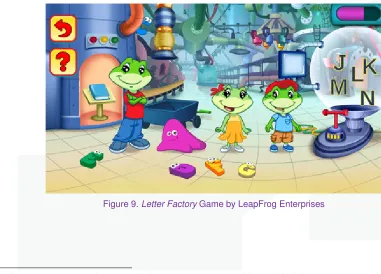
In the area of language learning a notable example is the Letter Factory8 game released for the LeapPad9 tablet, a device designed specifically for children. This game as shown below in Figure 9, is suitable for 3-5 year olds and focuses on phonic awareness and helps children to identify letter names and sounds. The touch-based interface for this game is intuitive for this age group as opposed to the abstract interfaces of a mouse or keyboard.
Figure 9. Letter Factory Game by LeapFrog Enterprises
7
http://www.sesamestreet.org/games#media/game_7380c2a5-163c-11dd-98c7-b9f43dcf5330
8
https://ie.appcenter.leapfrog.com/storefront/leappad-explorer/letter-factory/prod58111-96914.html
9
[image:14.595.84.465.470.744.2]3.1.2 Psychomotor Development
[image:15.595.103.535.236.479.2]The growth of children between the ages of 3 and 6 represents a profound progression in psychomotor development. During this period children develop considerably in terms of rhythmic coordination, efficient movement, balance and strength. The work of (Gallahue & Ozmun, 2006) clearly places the children of this age in the Fundamental Movement Stage as shown below in Figure 10.
Figure 10. Psychomotor Developmental Stages (Gallahue & Ozmun, 2006).
The Fundamental Movement Stage is characterised by increased control in discrete, serial, and continuous movements. Actions such as running, jumping, throwing, catching, beam walking, and one-foot balance, are all developed during this stage. Although most of these abilities will develop naturally through maturation of the child, the environment and experiences of the child also play a role in developing these skills. To fully attain these skills by age 5-6 the majority of children will require opportunities for practice, encouragement, and instruction. Maturation alone is not sufficient to attain these skills.
The use of digital games to support psychomotor development has been limited to date in part due to the necessity of physical activity to progress development. The use of digital games with this age group has been criticised as they can result in more sedentary activity and detract from essential psychomotor development (Alliance for Childhood, 2000), as is discussed in section 4 of this report. However, awareness of psychomotor development can influence the design of appropriate interfaces for this age group in other developmental areas.
3.1.2.1 Example Games
[image:16.595.162.547.297.546.2]Although most games for psychomotor development involve physical gross-motor activity, such as hopscotch and egg races, there are games that aid in fine motor skill development. The Tiggly10 game is one such example that combines tactile toys with the rich visuals possible on an iPad. This game is targeted at children aged 18 months – 3 years and is shown below in Figure 11.
Figure 11. The Tiggly Game
3.1.3 Social-Emotional Development
The social and emotional development of young children is predominantly progressed through interactions with their parents, siblings, broader family, and peers. The work of Erik Erikson (Erikson, 1980) considered socio-emotional development to consist of eight stages of development, with each stage being associated with a psychosocial crisis that consists of two conflicting forces. The stages of most relevance to early childhood are that of Autonomy and Initiative as is illustrated in Figure 12 below.
10
Figure 12. Erikson's Stages of Personality (Erikson, 1980)
Within the Autonomy stage the crisis consists of Autonomy vs. Shame, Doubt. At this stage basic trust has developed in the child and there begins a preoccupation with physical abilities. This is most notable in potty training where the control they achieve gives them a sense of autonomy, yet when accidents occur they can experience shame and doubt.
As the child matures into the Initiative stage they develop ambition and independence, however, this is accompanied with the crisis of Initiative vs. Guilt. The development of conscience is a key feature of this stage and is the evident source of guilt as a result of their actions. At this age there is also a desire to collaborate on tasks, and to achieve a sense of equality in the worth of their contribution. It is noted by (Erikson, 1980) that there is a significant need for social activities at this age, either with peers or competent adults. In particular it is noted that play can not only benefit from, but actually need adult guidance at this age.
The socio-emotional development of a child can influence game design through consideration of the role of the parents in games, the desire for social and collaborative games in the initiative stage, and the reward to establish self-worth in the initiative stage. The importance of the role of adults in childhood play is further emphasised in the key principles on the context for early childhood learning as proposed in (NCCA, 2004), namely:
Children learn through action and interaction with others
The adult is central in supporting children to learn through quality interactions Parents/guardians play a key role in supporting their children’s early learning
Effective communication between parents/guardians and child-minders/practitioners enhances children’s learning
Play is a powerful context for learning
The play environment—whether outdoor or indoor—warrants careful consideration to support both relationships and play as key contexts for learning
3.1.3.1 Example Games
Although social-emotional development is largely addressed through interaction with parents, family, and peers, there are a number of games available that target specific developmental aspects. The
Scout and Friends…and You!11 game from LeapFrog Enterprises aims to help build social skills
11
through exploring emotions and feelings. Example screenshots from the game are shown below in Figure 13. The game is available for 3-5 year olds on the LeapPad tablet.
Figure 13. The Scout and Friends...and You! Game by LeapFrog Enterprises
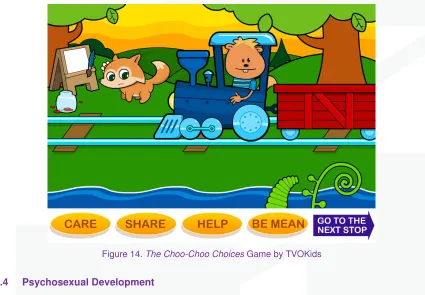
The Choo-Choo Choices12 game by TVOKids13 aims to help children learn about caring, sharing, and
[image:18.595.86.511.400.695.2]helping. This flash game is available freely online and is suitable for 2-5 year olds. The game as shown in Figure 14 below requires adult supervision as some of the game controls are textual.
Figure 14. The Choo-Choo Choices Game by TVOKids
3.1.4 Psychosexual Development
The research into the psychosexual development of children in early childhood is dominated by the work of Sigmund Freud (Freud, 1970) and his work on the psychosexual stages of development. Of
12
http://www.tvokids.com/games/choochoochoices
13
relevance to this report is the Phallic stage that is said to occur in 3-6 year olds. This stage is focused on resolving reproductive issues with the child becoming more aware of their own bodies, particularly their genitalia. During this stage the child also becomes aware of the differences between boys and girls and the genders of their parents. This stage of development is also associated with the Oedipus complex among boys. Although psychosexual development is an important part of a child’s development it has limited relevance to game-based learning. The majority of developmental issues encountered are resolved through physical self-exploration and the input from parents and care givers. No incidences of commercial games addressing psychosexual development were found within the scope of this report.
3.1.5 Mapping Developmental Stages to Age
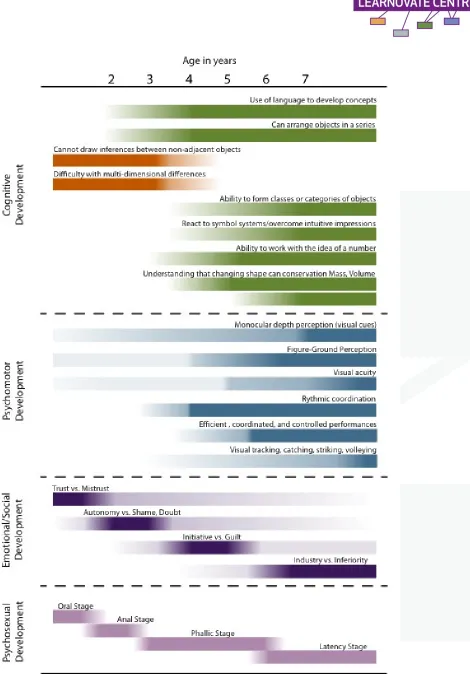
The four developmental types addressed in the preceding sections not only indicate what are appropriate content areas for a child to be learning, but also what types of learning tasks they are developmentally able to engage with. The choice of any learning content must consider the holistic developmental level of the child. The graphic presented in Figure 15 below illustrates the complexity of designing developmentally appropriate learning content for early childhood. Within this graphic the cognitive development is based on the work of Jean Piaget (Piaget, 1962; Singer & Revenson, 1997), the psychomotor development on the work of (Gallahue & Ozmun, 2006), the emotional and social development on the work of (Erikson, 1980), and the psychosexual development on the work of (Freud, 1970).
3.2 Appropriate Gaming Strategies
The impact of developmental level on gaming strategies for early childhood cannot be underestimated. As has been highlighted in the preceding section, the age of the child can impact what they cognitively can understand, what they can physically achieve, and what they are socially interested in engaging with.
Whereas a great deal of work has been done on the design of educational games for school age learners, teens, and adults (Aldrich, 2004; Gibson, Aldrich, & Prensky, 2007; Prensky, 2001; Van Eck, 2007) many of the gaming strategies are not appropriate or applicable for early childhood learners. It should also be considered that games themselves, as opposed to play, are only applicable after sufficient behavioural development.
“a child first becomes able to subordinate her behavior to rules in group play and only later
does voluntary self-regulation of behavior arise as an internal function.”
“The development from games with an overt imaginary situation and covert rules to games
with overt rules and a covert imaginary situation outlines the evolution of children’s play.” (Vygotsky,
1978)
Moreover, the attention spans and physical endurance of young children limits the duration and long term goals that can be reasonably achieved.
“Children are not driven by long-term goals like adults, but interested in here and now
questions, and the concrete rather than the abstract is always in the mind of the child.” (Samuelsson
& Carlsson, 2008)
3.2.1 Developmental Design Considerations
Based on the developmental stages detailed in the previous sections the design of games for this age group should also consider the following:
Cognitive considerations
o Simplified interfaces with little or no use of text in interface components
o Visual symbols should be used with caution as they require interpretation; this
interpretation is also culturally dependent
o The role of the parent in play is significant and should be accommodated (NCCA,
2004)
o The use of language should be encouraged to discuss problems
o The use of overly complex tasks can cause children to revert to simpler thinking
strategies (Gage & Berliner, 1998)
o The pace of development is not uniform across all children and is affected by
experience, culture, and heredity Socio-emotional considerations
o The egocentric nature of children at this age limits their ability to understand
alternative perspectives
o The use of competition for motivation has limited relevance the younger children o Children aged 2 and 4 are seen as being irregular in behaviour, whereas those aged
3 and 5 are stable and conformant (Gallahue & Ozmun, 2006) Psychomotor considerations:
o Fine motor skills and hand-eye coordination are still developing and should be
considered in interface design
o Eyes are generally not ready for extended periods of close work due to
farsightedness (Gallahue & Ozmun, 2006)
o The body builds of boys and girls are similar and with no readily observable structural
differences
o Perceptual-motor abilities are rapidly developing, but confusion often exists in body,
directional, temporal, and spatial awareness
The research conducted by the Sesame Workshop outlines best practices for the design of touch tablet experiences for preschool children (Sesame Workshop, 2012). With the intuitive haptic nature of tablets, and the growing prevalence of Android and iOS devices, this is a fast growing ecosystem for early childhood games. The following best practices shown in Figure 16 consider both cognitive and psychomotor development and are relevant for any game for this age group.
Most Intuitive Touch Gestures Least Intuitive Touch Gestures
Tap (provided feedback is immediate and evident)
Pinch
Draw/move finger Tilt/Shake
Swipe (provided visual indications of where to swipe are provided)
Multi-Touch
Slide (provided the slider is very visually explicit)
Flick/Fling
[image:22.595.134.556.387.579.2]Double Tap
Figure 16. Intuitive and Unintuitive Tablet Touch Gestures
Further considerations from (Sesame Workshop, 2012) for the design of tablet-based games include:
Assume that the children can’t read, any text to be read will need adult assistance Make gameplay goals visually explicit
Avoid scrolling content if possible, if necessary use horizontal scrolling as it’s more intuitive Touch hotspots should be large and well isolated to cater for developing fine motor skills Preschool-aged children tend to hold a tablet in landscape view
Avoid placing active icons on the bottom edge of the screen, the weight of the tablet often causes children to rest their wrist on the bottom edge
3.3 Underpinning Pedagogies
The pedagogy underpinning early childhood learning is unusual as it is both widely researched and yet disparately applied, if at all. The nature of early childhood education disposes it to be largely outside of a formal setting, with intermittent curricula, and applied by diverse means. The diversity of school starting ages across Europe as shown below in Figure 17 illustrates the prevalence of preschool education in 3-6 year old children across Europe. Within individual countries there is a variety of preschool care available to parents. In the case of the UK it was found in (Sharp, 2002; Siraj-Blatchford, 1999) that there was a variety of care ranging from nurseries, day care centres, playgroups, home care, and Montessori schools, and moreover the diversity of care impacted on childhood development.
Compulsory age of starting school in European countries, 200214
Four Northern Ireland
Five England, Malta, Netherlands,
Scotland, Wales
Six Austria, Belgium, Cyprus,
Czech Republic, France, Germany, Greece, Hungary, Iceland, Republic of Ireland, Italy, Liechtenstein, Lithuania, Luxembourg, Norway, Portugal, Slovakia, Slovenia, Spain
Seven Bulgaria, Estonia, Denmark,
[image:23.595.77.523.267.558.2]Finland, Latvia, Poland, Romania, Sweden
Figure 17. Map of Europe Showing Compulsory School Starting Ages15
In considering the use of pedagogy for games in early childhood, we must first look what pedagogies are applied in general across early childhood learning. The most commonly applied pedagogies are Piaget’s constructivism and Vygotsky’s Zone of Proximal Development (Siraj-Blatchford, 1999). In the view of Piaget, a child constructs their knowledge through their experiences with their motivation coming from their natural curiosity, but they are also influenced by the adults and peers around them. Moreover, the co-operative social interaction between children and between children and adults, promotes cognitive, affective, and moral development. The Zone of Proximal Development (ZPD) as proposed by Vygotsky (Vygotsky, 1978), is the distance between an individual’s actual developmental
14
Source: European Commission. EURYDICE and EUROSTAT, in (Sharp, 2002)
15
level and that which they can achieve through problem solving under adult guidance or collaboration with more capable peers.
“The aims of teaching, from this perspective, are to assist children within this zone, and to provide the support and encouragement they require to perform successfully in areas that would
otherwise be beyond them” (Siraj-Blatchford, 1999)
A common application of constructivist and discovery learning can be found in the Montessori method (Montessori, 1912). However, as with many pedagogical approaches, it is either infeasible or inappropriate to be applied to digital game-based learning. As is shown in Figure 18 below there are numerous challenges in the selection of an appropriate pedagogy for early childhood games.
Pedagogical Approach to Early Childhood Learning
Challenges for Early Childhood Games
Montessori Method (Montessori, 1912)
Typically applied in a physical environment and advocates freedom to choose activities, be they physical or intellectual. Discovery Learning
(Leutner, 1993)
Limitations of children being able to clearly state what they want, and where they want to go.
Problem-based Learning
(Savery & Duffy, 1995). Requires social negotiation that may be beyond this developmental level. Situated Cognition
(Brown, Collins, & Duguid, 1989)
Requires an authentic context for learning that would be challenging to realise digitally, however the context needs only to be “coherent, meaningful, and purposeful” (Brown et al., 1989).
Experiential Learning (Kolb, 1984)
[image:24.595.74.522.285.540.2]Reflective observation and abstract conceptualisation as required by this pedagogy are not realistic tasks for this age group.
Figure 18. Challenges of Pedagogical Approaches to Early Childhood Games
4 Evidence of Effectiveness and Impact of Game-Based
Learning
The effectiveness of game-based learning for early childhood is both a divisive topic and an under researched area of academic study. The use of games, and more broadly ICT, for early childhood learning has received considerable criticism. It has been argued that ICT for such young learners detracts from essential social, emotional and psychomotor development (Alliance for Childhood, 2000). Moreover, there are issues with ICT having inappropriate physical and cognitive ergonomics for young children, as well as cognitive effort being applied to learning computer interaction as opposed to developmental tasks (Plowman & Stephen, 2003). However, as also noted by (Plowman & Stephen, 2003) there is little evidence to support these supposed ill effects.
The limited evidence of ill effects cannot be taken as a promotion for the use of such games. It is however, an indicator of the general lack of research being conducted in this area. As well as a general lack of research into games for early childhood (Plowman & Stephen, 2005), there are limited instances of appropriate cognitive development games for this age group (Sung, Chang, & Lee, 2008), and theoretical and empirical support is lacking for the use of software for early childhood learning (Sarama & Clements, 2002). In light of the commonly referenced lack of research in this area, a state of the art survey was conducted for this report into game-based learning in early childhood. The results of this survey are presented in the following section.
4.1 Academic Research Survey
The prevalence of general game-based learning research has grown significantly in the past decade. This growth is in part due to increasing familiarity and access to entertainment games. This continuing growth has led to over 67% of US households playing video games regularly (Entertainment Software Association, 2010). However, the prevalence of research into the design and effectiveness of educational games is not uniform across all sectors and age groups. In particular there is a noticeable lack of research on educational games for early childhood.
In order to ascertain the extent of research being undertaken in this area, a state of the art survey was conducted across the two most prominent game-based learning journals and conferences. The survey conducted for this report covered the following publications:
Journal: LNCS Transactions on Edutainment16 (2008-2012), 183 papers Journal: Simulation and Gaming17 (2005-2012), 312 papers
Conference: Digital Games and Intelligent Toy Enhanced Learning18 (2007,2008,2010,2012), 302 papers
Conference: European Conference on Game-Based Learning19 (2009-2012), 198 papers
The survey first classified the papers into two categories, those papers that had a clearly defined target sector and those papers that were not specific or considered not relevant. The sector-specific category was further broken into the following sub-categories:
16
Published by Springer, http://www.springer.com/computer/lncs/transactions+edutainment
17
Published by SAGE Journals, http://sag.sagepub.com/
18
Published by the IEEE, http://ieeexplore.ieee.org/xpl/mostRecentIssue.jsp?punumber=6184370
19
Early Childhood
Primary School (US 1st-6th Grade) Secondary School (US 7th- 12th Grade)
Third Level (Undergraduate College/University) Fourth Level (Postgraduate College/University) Corporate Training (including medical CPD) Military Training
Other (including remedial games for behavioural, social, and disability issues; informal games, games for awareness of policy, government, politics, and NGOs)
The non-sector category consisted of papers covering purely theoretical concepts, editorials, autobiographies, reviews, purely technical aspects, and non-game related articles.
[image:26.595.89.526.376.610.2]In total 995 papers were surveyed with 504 papers being identified as sector-specific. The results of classifying these papers into the above sub-categories are presented below in Figure 19. It should be noted that papers were assigned to multiple sub-categories where the research was relevant across multiple sectors.
Figure 19. Breakdown of Sector Specific Academic Research Papers
As can be clearly seen above the incidence of research into games for early childhood is limited with only 3% (16 papers) of the papers surveyed being relevant. Although there is research relevant to this sector being conducted in other sectors (such as in the Primary sector), it often addresses content areas or learning strategies that are beyond the developmental level of many children in early childhood. Examples of this are prevalent in games for the Primary school sector that often address mathematical and literacy tasks that are beyond the typical early childhood learner.
0% 10% 20% 30% 40% 50% 60% 70% 80% 90% 100%
Trans. on
Edutainment
Sim and
Gaming
ECGBL
DIGITEL
Overall
P e rc e n ta g e o f p a p e rs b y s e ct o r Publication Source
Breakdown of sector-specific research papers
(excl. theoretical and technical papers)
Other
In light of the limited research conducted in established game-based learning publications, the evidence of the effectiveness of games was drawn from a broader pool of publications. The diversity of the publications is one of the challenges of ascertaining the effectiveness of games for early childhood. In addition to the above surveyed journals and conferences, relevant papers were found in the following publications:
Journal of Computer Assisted Learning
Computers & Education
American Journal of Public Health
Reading and Writing: An
Interdisciplinary Journal
British Journal of Educational
Technology
Human Computer Interaction
Personal and Ubiquitous Computing
Journal of Applied Developmental
Psychology
Reading Research Quarterly
Childhood Education
European Journal of Psychology of
Education
Journal of Experimental Child Psychology
Journal of Educational Computing
Research
Child Psychology & Psychiatry Review
International Online Conference on
Second and Foreign Language Teaching and Research
Journal of Research in Mathematics
Education
As well as the fragmented nature of the literature there are further challenges that have limited the research in this area. These challenges are summarised below in Figure 20.
Technical
•
Use of devices designed for adults (size of
mouse, keyboard, etc.)
•
Touch screens not sensitive to small fingers
(Marco, Cerezo, Baldassarri, Mazzone, & Read,
2009)
Early-childhood
Game-based
Learning
Challenges
Pragmatic•
Largely anecdotal and qualitative feedback
•
Limited feedback possible from young children
(verbal, written) (Florou, Mavroudi, Haidi,
Gouscos, & Meimaris, 2001)
•
Lack of standardised curricula
•
Need for interface conventions to be learnt
(Plowman & Stephen, 2005)
Ethical
•
Access to children for evaluations
•
Time spent in stationary play as opposed to
physically active play (Alliance for Childhood,
2000)
•
Limited research on the benefits over traditional
[image:27.595.73.513.451.734.2]approaches
4.2 Learning Performance
4.2.1 Phonological Awareness
[image:28.595.134.531.261.479.2]Despite the limited research being conducted in games for early childhood there have been a number of notable academic papers that have shown positive effects where appropriate strategies are employed. One of the research areas that has shown significant learning performance is phonological awareness. The term phonological awareness “refers to an individual’s awareness of the sound structure, or phonological structure, of a spoken word” (Gillon, 2004). An example of separating a word into its phonological components is given below in Figure 21.
Figure 21. Representation of the Phonological Structure of the Word ‘basket’. (Gillon, 2004)
The importance of phonological awareness in early childhood is significant as it has been described as the best single predictor of reading performance (Gillon, 2004), which in turn impacts success and progress in primary education.
The work of (Lundberg, Frost, & Petersen, 1988) demonstrated the use of non-digital games and exercises to enhance phonological awareness amongst 235 preschool children. The study conducted over eight months showed a tangible benefit for the children in subsequent years in both their reading and spelling.
Figure 22. Phonological Awareness Vocabulary Game (Segers & Verhoeven, 2002)
Figure 23. Phonological Awareness Colouring Game (Segers & Verhoeven, 2002)
4.2.2 Differentiation of Thematic and Taxonomic Relationships
[image:29.595.146.452.384.626.2]that children allocate to objects, which in turn influences the efficiency of their problem solving (Sung et al., 2008).
[image:30.595.90.500.252.329.2]The work of (Sung et al., 2008) showed empirical evidence of improved hierarchical taxonomic classification using game-based learning with a group of 60 children aged 3-5 years. However, no improvement of perceptual learning was observed despite it being anticipated. This research used a progressive series of games as illustrated in Figure 24 below to ensure concepts were acquired in order of their complexity.
Figure 24. Progressive Stages of Taxonomic Learning
An example of one of the hierarchical taxonomic classification games based around a farm, is shown in Figure 25 below.
Figure 25. Example Game for Hierarchical Taxonomic Classification (Sung et al., 2008)
4.2.3 Memory Enhancement Strategies
[image:30.595.156.457.381.605.2]such require greater effort. This extra effort required may have a potentially negative impact on learning, evidently simpler interfaces and game mechanics are necessary for this age group.
4.2.4 Motor Skills and Coordination
[image:31.595.144.447.286.459.2]The development of motor skills and coordination is predominantly achieved through maturation, with experience and practice needed to achieve the maximum potential development level (Gallahue & Ozmun, 2006). The work of (Marco, Cerezo, & Baldassarri, 2012; Marco et al., 2009) aimed to aid in this experience and practice through the use of an augmented reality video game. Through the use of physical game characters (Figure 26) the child can become familiar with manipulating and coordinating hand-eye movements to play the game displayed on an adjacent screen (Figure 27).
[image:31.595.162.429.486.662.2]Figure 26. Physical Farm Game Characters (Marco et al., 2009)
Figure 27. Virtual Representation of Tangible Toys (Marco et al., 2009)
repeated certain other tasks. These interaction differences are attributed to the difference in developmental level between the children, and also the different evaluation environments, one a noisy nursery and the other a quiet primary school library.
The physical design of the game intentionally caters for the limited fine motor skills of the children with large tactile toys. The table top design also enables social play amongst multiple children, which is known to have benefits in terms of the development of social skills and interactions.
4.2.5 Mathematical Development
The area of mathematical development in early childhood is of significant importance to a child’s progress in primary and post-primary education. As a part of a child’s cognitive development basic mathematical skills such as small number counting and addition are appropriate for 4-6 year olds (Sarama & Clements, 2004). The extensive research conducted by (D. H. Clements & Sarama, 2008; Douglas H Clements & Sarama, 2007; Sarama & Clements, 2002) in the Building Blocks program, made extensive use of educational games. The games in question focused on:
Spatial and geometric competencies and concepts Numeric and quantitative concepts
[image:32.595.161.441.469.674.2]The first focus area, addressed the often neglected mathematics of the composition and decomposition of two-dimensional figures as is shown in Figure 28 below. The second focus area addressed simple numeric skills such as non-verbal addition, small number addition, and ‘counting on’ (Sarama & Clements, 2004) as is shown in Figure 29 below.
Figure 29. Double Trouble Game to Practice Counting Chocolate Chips. (Sarama & Clements, 2004)
The evaluation of the Building Blocks program was undertaken in New York state and consisted of 253 children aged 4-5 years completing 10 minutes of computer-based activities twice per week (D. H. Clements & Sarama, 2008). As well as the computer activities and games, the Building Blocks program consists of printed material and lessons that were conducted in the classroom. The evaluations of this program showed significant benefits in preschool mathematics compared to a control group, and positive but not statistically significant results when compared to an alternative curriculum, the Preschool Mathematics Curriculum (Klein, Starkey, & Ramirez, 2002; Starkey, Klein, & Wakeley, 2004). The use of a blended learning approach as well as the intentional focus on developmentally appropriate learning content (Sarama & Clements, 2002) has shown clear benefits in this research, and may present a viable approach for the design of early childhood games. Press
coverage of the Building Blocks program can be found at:
5 Cost-Effectiveness
The cost-effectiveness of games for early learning is influenced by both the development cost of the games and the potential revenue that can be generated from these games. In considering the development cost of these games there are several advantages and disadvantages to this market due to what is developmentally appropriate for this age group. These advantages and disadvantages are outlined below in Figure 30.
Advantages Disadvantages
The attention span of young children is relatively short and limits the duration of games
User interfaces need to be simple with large areas for interaction
Storylines need to be short and explicit if used at all
The use of 3D graphics should be limited due to developing visual systems
Complex AI is unnecessary Complex game controls are
unnecessary and inappropriate Simple learning activities are
appropriate
The use of (potentially costly) spoken voice is necessary for instructions as text is inappropriate
Interfaces need to be highly intuitive with user testing desirable
Immediate feedback from actions is desirable
Touch-based interfaces using tablets are more intuitive
Common symbols, iconography, visual metaphors, and interface component may be unfamiliar
Load times need to be low due to short attention spans
[image:34.595.97.526.250.488.2]Logistical and ethical challenges of conducting user trials
Figure 30. Technical Advantages and Disadvantages to Developing Games for Early Childhood
Despite the noted disadvantages above the relative short duration of these games, with simple storylines, and simple learning activities can make them quick to develop and at a relatively low cost. The use of authoring tools such as Adobe Flash Professional20 and game engines such as Unity21 can also reduce development costs and allow publishers to target multiple game platforms such as web-based, iOS, and Android.
Figure 31. Target Age for the Top Earning Educational Apps in the Apple AppStore, 2009 vs 2011 (Shuler, Levine, & Ree, 2012)
Figure 32. Cost Breakdown of Top iOS Apps for Children 2011 (Shuler et al., 2012)
Although games form a portion of these educational apps, the exact proportion is difficult to ascertain due to educational games being split across the Games and Education categories on the Apple AppStore. However, the analysis of the top app publishers (Figure 33) reveals a number of educational game publishers specialising in early childhood games such as Duck Duck Moose22, Dan Russell-Pinson23, ABCya.com24, and 22learn LLC25. Evidently, the market for educational early childhood games is both strong and competitive.
A further result from the analysis of publishers showed that 89 of the 109 publishers (82%) releasing games in 2011 were new to the top app listing since 2009. This indicates that there is considerable scope for new publishers seeking to claim some of this market share.
22
http://www.duckduckmoose.com
23
http://dan-russell-pinson.com/my-games/
24
http://www.abcya.com/
25
http://www.22learn.com
88%
10%
2%
Cost Breakdown of Top 200 iOS Apps for
Children 2011
[image:35.595.202.549.370.525.2]Publisher Number of Apps
Duck Duck Moose 10 Dan Russell-Pinson 8
ABCya.com 6
Kids Place 6
22learn LLC 5
[image:36.595.202.393.117.273.2]Grasshopper Apps 5 Vito Technology Inc. 5
Figure 33. Top Eight Educational iOS App Publishers 2011 (Shuler et al., 2012)
6 Summary
[image:37.595.85.510.227.428.2]The advent of tablet computers has reduced the cognitive and psychomotor challenges of young children using computers. Products such as the Nabi 2 tablet (Figure 34) and the LeapPad 2 (Figure 35) are ergonomically tailored for this age group, and present developmentally appropriate applications.
Figure 34. The Nabi 2 Tablet
Figure 35. The LeapPad 2 Tablet
However, the games sold to these devices and on iOS and Android tablets have little evidence to support their effectiveness beyond anecdotal evidence given by parents and care-givers.
Although there is a limited amount of academic research in this area, there is evidence of the benefits of specifically designed games, notably in the areas of phonological awareness, differentiating relationships, memory enhancement, coordinated motor skills, and mathematical development. However, these benefits have only been evaluated over several months in a structured preschool environment. The impact of such games being played intermittently in an informal setting is an area of open research.
Despite the lack of evidence to support the effectiveness of most games published for this age group, the market is rapidly expanding and features both large and small game publishers. By combining a sound pedagogical basis with focused learning content this emerging market can be cost-effective for educational game publishers.
7 Bibliography
Aldrich, C. (2004). Simulations and the future of learning: an innovative (and perhaps revolutionary)
approach to e-learning (p. 282). John Wiley and Sons. Retrieved from
http://books.google.com/books?id=3kldMjjtKVwC&pgis=1
Alliance for Childhood. (2000). Fool’s Gold: A Critical Look at Computers in Childhood. (Colleen Cordes & Edward Miller, Eds.). College Park, Maryland: Alliance for Childhood. Retrieved from http://www.eric.ed.gov/ERICWebPortal/search/detailmini.jsp?_nfpb=true&_&ERICExtSearch_Se archValue_0=ED445803&ERICExtSearch_SearchType_0=no&accno=ED445803
Bredekamp, S., & Copple, C. (2009). Developmentally Appropriate Practice in Early Childhood
Programs Serving Children from Birth through Age 8. (S. Bredekamp, Ed.)Young Children (p.
352). National Association for the Education of Young Children. Retrieved from http://www.naeyc.org/store/node/162
Brown, J. S., Collins, A., & Duguid, P. (1989). Situated Cognition and the Culture of Learning.
Educational Researcher, 18(1), 32 – 42. Retrieved from http://www.jstor.org/stable/1176008
Clements, D. H., & Sarama, J. (2008). Experimental Evaluation of the Effects of a Research-Based Preschool Mathematics Curriculum. American Educational Research Journal, 45(2), 443–494. doi:10.3102/0002831207312908
Clements, Douglas H, & Sarama, J. (2007). Effects of a preschool mathematics curriculum: Summative research on the Building Blocks project. Journal for Research in Mathematics
Education, 38(2), 136–163. doi:10.2307/30034954
Entertainment Software Association. (2010). 2010 Essential Facts about the Computer and Video
Game Industry. Retrieved from
http://www.theesa.com/facts/pdfs/ESA_Essential_Facts_2010.PDF
Erikson, E. H. (1980). Identity and the Life Cycle. Psyche (Vol. 7). New York, London: W. W. Norton & Company, Inc. Retrieved from
http://books.google.ie/books/about/Identity_and_the_life_cycle.html?id=Ok5qAAAAMAAJ&redir_ esc=y
Florou, D., Mavroudi, C., Haidi, I., Gouscos, D., & Meimaris, M. (2001). Animating DGBL in Pre-School , Primary and Special Education : Three Case Studies. (M. Pivec, Ed.)Proceedings of the
3rd European Conference on Games Based Learning, 124–134.
Freud, S. (1970). Three essays on the theory of sexuality. (J. Strachey, Ed.)The standard edition of
the complete psychological works of Sigmund Freud (Vol. 7). London: Hogarth Press. Retrieved
from http://books.google.com/books?id=oPkEnUtWGXkC&pgis=1
Gage, N. L., & Berliner, D. C. (1998). Educational Psychology (6th ed.). Boston/New York: Houghton Mifflin Company.
Gallahue, D. L., & Ozmun, J. C. (2006). Understanding Motor Development: Infants, Children,
Adolescents, Adults (Sixth.). New York: McGraw-Hill.
Gibson, D., Aldrich, C., & Prensky, M. (2007). Games and Simulations in Online Learning: Research
and Development Frameworks. Information Science Pub. Retrieved from
http://books.google.com/books?hl=en&lr=&ie=UTF-8&id=6EMOFjbABbQC&oi=fnd&pg=PR6&dq=Games+and+Simulations+in+On line+Learning:+Research+and+Development+Frameworks&ots=dyH5mAcQaP&sig=U8 8xTY1JJlzTNU6sapUQxhykSNo
Gillon, G. T. (2004). Phonological Awareness: From Research to Practice. New York: The Guilford Press. Retrieved from
http://books.google.ie/books?id=PvM_zdY4I3kC&printsec=frontcover&source=gbs_ge_summary _r&cad=0#v=onepage&q&f=false
Hirsh-Pasek, K., Golinkoff, R. M., Berk, L. E., & Singer, D. (2008). A Mandate for Playful Learning in
Preschool: Applying the Scientific Evidence. Oxford University Press. Retrieved from
http://books.google.com/books?hl=en&lr=&id=46RlpHiOjuAC&pgis=1
Hutt, S. J., Tyler, S., Hutt, C., & Christopherson, H. (1989). Play, Exploration and Learning: a Natural
History of the Pre-School. London and New York: Routledge.
Kernan, M. (2007). Play as a context for Early Learning and Development. Dublin: NCCA. Retrieved from
http://www.ncca.ie/en/Curriculum_and_Assessment/Early_Childhood_and_Primary_Education/E arly_Childhood_Education/How_Aistear_was_developed/Research_Papers/Play_paper.pdf Klein, A., Starkey, P., & Ramirez, A. (2002). Pre-K Mathematics Curriculum. Glendale, IL: Scott
Foresman.
Kolb, D. A. (1984). Experiential learning: Experience as the source of learning and development. London: Prentice-Hall.
Leutner, D. (1993). Guided discovery learning with computer-based simulation games: Effects of adaptive and non-adaptive instructional support. Learning and Instruction, 3(2), 113–132. doi:10.1016/0959-4752(93)90011-N
Lundberg, I., Frost, J., & Petersen, O.-P. (1988). Effects of an extensive program for stimulating phonological awareness in preschool children. Reading Research Quarterly, 23(3), 263–284. doi:10.1598/RRQ.23.3.1
Marco, J., Cerezo, E., & Baldassarri, S. (2012). Bringing tabletop technology to all: evaluating a tangible farm game with kindergarten and special needs children. Personal and Ubiquitous
Computing, 1–15. doi:10.1007/s00779-012-0522-5
Marco, J., Cerezo, E., Baldassarri, S., Mazzone, E., & Read, J. C. (2009). Bringing tabletop technologies to kindergarten children. HCI 2009 (pp. 103–111). Retrieved from http://dl.acm.org/citation.cfm?id=1671011.1671023
Monighan Nourot, P. (2006). Sociodramatic play pretending together. In D. P. Fromberg & D. Bergen (Eds.), Play from birth to twelve: contexts perspectives, and meanings (2nd ed.). New York: Routledge.
Montessori, M. (1912). The Montessori method : scientific pedagogy as applied to child education in
NAEYC. (2009). Position Statement: Developmentally Appropriate Practice in Early Childhood
Programs Serving Children from Birth through Age 8. Retrieved from
http://www.naeyc.org/files/naeyc/file/positions/position statement Web.pdf
NAEYC, & Fred Rogers Centre. (2012). Technology and Interactive Media as Tools in Early
Childhood Programs Serving Children from Birth through Age 8. Children. Saint Vincent College, Latrobe. Retrieved from http://www.naeyc.org/positionstatements
NCCA. (2004). Towards a Framework for Early Learning: A Consultative Document. Dublin. Retrieved from
http://www.ncca.ie/en/Curriculum_and_Assessment/Early_Childhood_and_Primary_Education/E arly_Childhood_Education/How_Aistear_was_developed/Consultation/Towards_a_FW_for_Earl y_Learning_document.pdf
Online Publishers Association, & Frank N. Magid Associates Inc. (2012). A Portrait of Today’s Tablet
User Wave II. New York. Retrieved from
http://onlinepubs.ehclients.com/images/pdf/MMF-OPA_--_Portrait_of_Tablet_User-Wave_2_--_Jun12_(Public).pdf
Oyen, A.-S., & Bebko, J. M. (1996). The Effects of Computer Games and Lesson Contexts on Children’s Mnemonic Strategies. Journal of Experimental Child Psychology, 62(2), 173–189. doi:10.1006/jecp.1996.0027
Piaget, J. (1962). Play, dreams, and imitation in childhood. Morton ibrary (Vol. 24, pp. 316–339). Norton. Retrieved from http://www.psych.utoronto.ca/users/peterson/Psy2302011/03Piaget.pdf Plowman, L., & Stephen, C. (2003). A “benign addition”? Research on ICT and pre-school children.
Journal of Computer Assisted Learning, 19(2), 149–164. doi:10.1046/j.0266-4909.2003.00016.x
Plowman, L., & Stephen, C. (2005). Children, play, and computers in pre-school education. British
Journal of Educational Technology, 36(2), 145–157. doi:10.1111/j.1467-8535.2005.00449.x
Prensky, M. (2001). Digital Game-Based Learning. Paragon House, St. Paul, Minnesota, USA. Retrieved from http://portal.acm.org/citation.cfm?id=950566.950596
Salen, K., & Zimmerman, E. (2003). Rules of play: game design fundamentals. MIT Press. Retrieved from http://www.mitpressjournals.org/doi/abs/10.1162/leon.2004.37.5.414
Samuelsson, I. P., & Carlsson, M. A. (2008). The Playing Learning Child: Towards a pedagogy of early childhood. Scandinavian Journal of Educational Research, 52(6), 623–641.
doi:10.1080/00313830802497265
Sarama, J., & Clements, D. H. (2002). Building Blocks for Young Children’s Mathematical
Development. Journal of Educational Computing Research, 27(1), 93–110. doi:10.2190/F85E-QQXB-UAX4-BMBJ
Sarama, J., & Clements, D. H. (2004). Building Blocks for early childhood mathematics. Early
Childhood Research Quarterly, 19(1), 181–189. doi:10.1016/j.ecresq.2004.01.014
Savery, J. R., & Duffy, T. M. (1995). Problem Based Learning: An instructional model and its constructivist framework. Educational Technology, (35), 31–38.
Segers, E., & Verhoeven, L. (2002). Multimedia support of early literacy learning. Computers &
Segers, E., & Verhoeven, L. (2005). Long-term effects of computer training of phonological awareness in kindergarten. Journal of Computer Assisted Learning, 21(1), 17–27. doi:10.1111/j.1365-2729.2005.00107.x
Sesame Workshop. (2012). Best Practices : Designing Touch Tablet Experiences for Preschoolers. Retrieved from http://www.sesameworkshop.org/our-blog/2012/12/17/sesames-best-practices-guide-for-childrens-app-development/
Sharp, C. (2002). School Starting Age : European Policy and Recent Research. LGA Seminar “When
Should our Children Start School?” London: National Foundation for Educational Research.
Retrieved from http://www.emie.co.uk/nfer/publications/44414/44414.pdf
Shuler, C., Levine, Z., & Ree, J. (2012). iLearn II: An Analysis of the Education Category of Apple’s
App Store. Retrieved from
http://www.joanganzcooneycenter.org/publication/ilearn-ii-an-analysis-of-the-education-category-on-apples-app-store/
Singer, D. G., & Revenson, T. A. (1997). A Piaget Primer: How a Child Thinks. Revised Edition.
Madison, CT: International Universities Press, Inc. Retrieved from
http://www.eric.ed.gov/ERICWebPortal/search/detailmini.jsp?_nfpb=true&_&ERICExtSearch_Se archValue_0=ED417826&ERICExtSearch_SearchType_0=no&accno=ED417826
Siraj-Blatchford, I. (1999). Early Childhood Pedagogy: Practice, Principles and Research.
Understanding Pedagogy and its Impact on Learning (pp. 20–45). London: Paul Chapman
Publishing Ltd. Retrieved from
http://books.google.ie/books?hl=en&lr=&id=W1_UmO2tNYYC&oi=fnd&pg=PA20&dq=childhood
+pedagogy&ots=BAU5bre4yV&sig=EaahPI-cplYyUoiw0WT8NAqSPoo&redir_esc=y#v=onepage&q=childhood pedagogy&f=false Starkey, P., Klein, A., & Wakeley, A. (2004). Enhancing young children’s mathematical knowledge
through a pre-kindergarten mathematics intervention. Early Childhood Research Quarterly,
19(1), 99–120. doi:10.1016/j.ecresq.2004.01.002
Sung, Y.-T., Chang, K.-E., & Lee, M.-D. (2008). Designing multimedia games for young children’s taxonomic concept development. Computers & Education, 50(3), 1037–1051.
doi:10.1016/j.compedu.2006.07.011
UNESCO. (2012). Early Childhood Care and Education. Retrieved December 15, 2012, from http://www.unesco.org/new/en/education/themes/strengthening-education-systems/early-childhood/
Van Eck, R. (2006). Digital Game-Based Learning: It’s Not Just the Digital Natives Who Are Restless.
EDUCAUSE Review, 41(2).
Van Eck, R. (2007). Building Artificially Intelligent Learning Games. In D. Gibson, C. Aldrich, & M. Prensky (Eds.), Games and simulations in online learning: research and development
frameworks (pp. 271–307). Information Science Pub. Retrieved from
http://books.google.com/books?id=6EMOFjbABbQC
Verenikina, I., & Harris, P. (2003). Child’s Play : Computer Games, Theories of Play and Children’s Development. Young Children, 3, 99–106. Retrieved from
Vygotsky, L. S. (1978). Mind in society: The development of higher psych