Proceedings of ACL 2018, Student Research Workshop, pages 99–104 99
BCSAT : A Benchmark Corpus for Sentiment Analysis in Telugu Using
Word-level Annotations
Sreekavitha Parupalli, Vijjini Anvesh Rao and Radhika Mamidi
Language Technologies Research Center (LTRC) International Institute of Information Technology, Hyderabad
{sreekavitha.parupalli, vijjinianvesh.rao}@research.iiit.ac.in
Abstract
The presented work aims at generating a systematically annotated corpus that can support the enhancement of senti-ment analysis tasks in Telugu using word-level sentiment annotations. From On-toSenseNet, we extracted 11,000 adjec-tives, 253 adverbs, 8483 verbs and sen-timent annotation is being done by lan-guage experts. We discuss the methodol-ogy followed for the polarity annotations and validate the developed resource. This work aims at developing a benchmark cor-pus, as an extension to SentiWordNet, and baseline accuracy for a model where lex-eme annotations are applied for sentiment predictions. The fundamental aim of this paper is to validate and study the possi-bility of utilizing machine learning algo-rithms, word-level sentiment annotations in the task of automated sentiment identifi-cation. Furthermore, accuracy is improved by annotating the bi-grams extracted from the target corpus.
1 Introduction
Sentiment analysis deals with the task of determin-ing the polarity of text. To distdetermin-inguish positive and negative opinions in simple texts such as re-views, blogs, and news articles, sentiment analysis (or opinion mining) is used. Over time, it evolved from focusing on explicit opinion expressions to addressing a type of opinion inference which is a result of opinions expressed towards events having positive or negative effects on entities.
There are three ways in which one can perform sentiment analysis : document-level, sentence-level, entity or word-level. These determine the
polarity value considering the whole document, sentence-wise polarity, word-wise in some given text respectively (Naidu et al.,2017). Despite ex-tensive research, the existing solutions and sys-tems have a lot of scope for improvement, to meet the standards of the end users. The main prob-lem arises while cataloging the possibly infinite set of conceptual rules that operate behind the an-alyzing the hidden polarity of the text (Das and Bandyopadhyay,2011). In this paper, we perform a word-level sentiment annotation to validate the usage of such techniques for improving sentiment analysis task. Furthermore, we use word embed-dings of the word-level sentiment annotated lexi-con to predict the sentiment label of a document. We experiment with various machine learning al-gorithms to analyze the affect of word-level sen-timent annotations on (document-level) sensen-timent analysis.
The paper is organized as follows. In section2
we discuss the previous works in the field of sen-timent analysis, existing resources for Telugu and specific advances that are made in Telugu. Section
3describes our corpus and annotation scheme. 4
section describes several experiments that are car-ried out and the accuracies obtained. We also ex-plain the results in detail in4.3. Section5 show-cases our conclusions and section 6 shows the scope for future work.
2 Related Work
• Sentiment Analysis: Several ap-proaches have been proposed to capture the sentiment in the text where each approach ad-dresses the issue at different levels of granu-larity. Some researchers have proposed meth-ods for document-level sentiment classifica-tion (Pang et al., 2002;Turney and Littman,
often impossible to infer the sentiment ex-pressed about any particular entity, because a document may convey different opinions for different entities. Hence, when we con-sider the tasks of opinion mining where the sole aim is to capture the sentiment polari-ties about entipolari-ties, such as products in prod-uct reviews, it has been shown that sentence-level and phrase-sentence-level analysis lead to a per-formance gain (Wilson et al.,2005;Choi and Wiebe, 2014). In the context of Indian lan-guages, (Das et al.,2012) proposes an alter-nate way to build the resources for multilin-gual affect analysis where translations into Telugu are done using WordNet.
• SentiWordNet : (Das and Bandyopad-hyay,2010) proposes multiple computational techniques like, WordNet based, dictionary based, corpus based and generative ap-proaches to generate Telugu SentiWordNet. (Das and Bandyopadhyay,2011) proposes a tool Dr Sentiment where it automatically cre-ates the PsychoSentiWordNet which is an ex-tension of SentiWordNet that presently holds human psychological knowledge on a few as-pects along with sentiment knowledge.
• Advances in Telugu: (Naidu et al.,
2017) utilizes Telugu SentiWordNet on the news corpus to perform the task of Senti-ment Analysis. (Mukku and Mamidi,2017) developed a polarity annotated corpus where positive, negative, neutral polarities are as-signed to 5410 sentences in the corpus col-lected from several sources. They developed a gold standard annotated corpus of Telugu sentences aimed at improving sentiment anal-ysis in Telugu. To minimize the dependence of machine learning(ML) approaches for sen-timent analysis on abundance of corpus, this paper proposes a novel method to learn rep-resentations of resource-poor languages by training them jointly with resource-rich lan-guages using a siamese network (Choudhary et al., 2018a). A novel approach to clas-sify sentences into their corresponding sen-timent using contrastive learning is proposed by (Choudhary et al., 2018b) which utilizes the shared parameters of siamese networks.
(Gangula and Mamidi, 2018) and (Mukku and Mamidi, 2017) are the only reported
works for Telugu sentiment analysis using sentence-level annotations who developed annotated corpora. Ours is the first of it’s kind NLP research which uses sentiment an-notation of bi-grams for sentiment analysis (opinion mining).
3 Building the Benchmark Corpus
Lexicons play an important role in sentiment anal-ysis. Having annotated lexicon is key to carry out sentiment analysis efficiently. The primary task in sentiment analysis is to identify the polarity of text in any given document. The polarity may be either positive, negative or neutral (Naidu et al., 2017). Sentiment is a property of human intelligence and is not entirely based on the features of a language. Thus, peoples involvement is required to capture the sentiment (Das and Bandyopadhyay, 2011). Having said this, we establish that annotated lex-icons are of immense importance in any language for sentiment analysis (a.k.a opinion mining).
For our experiments, we utilize the reviews dataset from Sentiraama 1 corpus. It contains 668 reviews in total for 267 movies, 201 prod-ucts and 200 books. Product reviews has 101 pos-itive and 100 negative entries; movie reviews has 136 positive and 132 negative reviews; book re-views data has 100 positive and 100 negative en-tries. Since the obtained corpus is only annotated with document-level sentiment labels, we perform the word-level sentiment annotation manually.
3.1 Annotation Procedure
In this paper, sentiment polarities are classified into 4 labels : positive, negative, neutral and am-biguous. Positive and negative labels are given in case of positive and negative sentiments in the word respectively. Ambiguous label is given to words which acquire sentiment based on the words it is used along with or it’s position in a sentence. Neutral label is given when the word has no senti-ment in it. However, neutral and ambiguous sen-timent labels are of no significant use for the task of sentiment analysis. Henceforth, those labels are ignored in our experiments.
Sentiment annotations are performed on two different kinds of data. Table1showcases the dis-tribution of sentiment labels at the word-level.
1https://ltrc.iiit.ac.in/showfile.php?
• Unigrams: We obtain 7,663 words from Telugu SentiWordNet2 resource to calculate the base-line accuracy of any word-level sen-timent annotated model. These words are al-ready annotated for sentiment/polarity. How-ever, it doesn’t provide extensive coverage of Telugu. Later on, we discover a newly de-veloped large resource of Telugu words by (Parupalli and Singh, 2018), OntoSenseNet, which has a collection of 21,000 words (ad-jectives+verbs+adverbs). We perform the task of word-level sentiment annotation on the words obtained from this resource and we refer to these annotated words as unigrams throughout this paper. Language experts who performed the annotations are given some guidelines to follow. Experts are implored to look at the word, it’s gloss and then de-cide which one of the four sentiment labels is more apt for a given word. Aforementioned word-level sentiment annotation is an attempt to improve the coverage of SentiWordNet.
• Bigrams: Furthermore, sentiment cannot always be captured in a single word.This pa-per aims to check if bigram annotation is a suitable approach for improving the effi-ciency of sentiment analysis. To validate the hypothesis, we extract bigrams, which oc-curred at least more than once, only from the target corpus - Sentiraama dataset de-veloped by (Gangula and Mamidi, 2018). For example, consider the bigram (’DhokA’, ’ledu’). The words individually mean ‘hur-dle (DhokA)’, ‘no (ledu)’. Thus, in word-level annotation task they would be given a negative label. However, the bigram means there is ‘nothing that can stop’ which invokes a positive sentiment. Such occurrences are quite common in the text, especially reviews, which lead us to believe that bigram polar-ity has potential to enhance sentiment anal-ysis, opinion mining. The usage of this de-veloped resource in experiments performed is explained in section4.
3.2 Validation
Annotations are done by 2 native speakers of Tel-ugu. If the annotators aren’t able to decide which
2http://amitavadas.com/sentiwordnet.
php
label to assign, they are advised to tag it as uncer-tain. In case of a disagreement, the label given by the annotator with more experience is given pri-ority. Validation of the developed resource is done using Cohen’s Kappa (Cohen,1968). By consider-ing the uncertain cases as borderline cases (where at least one annotator tagged the word as uncer-tain), Kappa value is seen as 0.91. This shows almost perfect agreement and this proves the con-sistency in annotation task. This is especially high because when both the annotators are uncertain, we did a iteration to finalize the tag. Such re-iterative task is done for about 2,400 words during the development of our resource.
4 Experiments and Results
In this section we will analyze and observe how word-level polarity affects overall sentiment of the text through majority polling approach and ma-chine learning based classification approaches.
4.1 Majority Polling Approach
A simple intuitive approach to identify the senti-ment label of the text is to calculate the sum of positive(+1) and negative(-1) polarity values in it. If the sum is positive, it shows that number of pos-itive words have outnumbered the number of neg-ative words thus resulting in a positive sentiment on the whole. Otherwise, the polarity of the text is negative. Cases where the sum equals to 0 are ig-nored. Following are the word-level polarities we consider for positive and negative labels:
• Unigram: We use the annotated unigram data that is discussed in3. For each review, we consider the unigram labels to carry the majority polling approach.
• Bigram: The extracted bigrams are anno-tated for positive and negative polarity. Ini-tially, we divide our data into training and testing sets in 7:3 ratio. We only consider the annotated bigrams from the training corpus to predict the sentiment polarity of reviews in the test data.
Resource Positive Negative Neutral Ambiguous Total SentiWordNet3 2135 4076 359 1093 7663 Dictionary (Parupalli and Singh,2018) 3080 4232 3391 10199 20896
[image:4.595.71.510.62.121.2]Bigrams 1978 1762 8990 1996 14826
Table 1: Distribution of Sentiment Labels in Several Resources
Furthermore, as Telugu is agglutinative in na-ture (Pingali and Varma, 2006), we experiment with the above mentioned approaches after per-forming morphological segmentation provided by Indic NLP library4. Morphological segmentation is performed on the original reviews data and n-grams (positive and negative labels) to see if we could get more accurate sentiment prediction of the reviews due to increment in the coverage.
4.2 Machine Learning Based Classification Approach
In this section, we perform document-level senti-ment analysis task with word embedding models, specifically Word2Vec. We utilize a Word2Vec model that is trained on corpus consisting of scrapped data from Telugu websites, with 270 mil-lion non-unique tokens on the whole. Further-more, to obtain vectors for each review, we take word vector of every word in the review and calcu-late their average to get a single document vector.
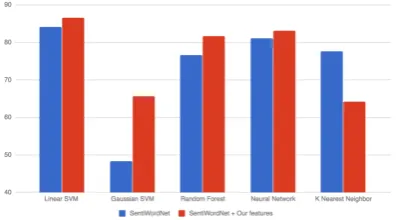
Figure 1: Comparative analysis of percentage ac-curacies produced by various classifiers
Though traditional vector-based word represen-tations help us accomplish various natural lan-guage processing tasks, they often lack informa-tion related to sentiment analysis. Thus, we aim to enrich the Word2Vec vectors obtained from cor-pus by incorporating word-level polarity features. We do this by adding the features we propose in4.1 to the original averaged Word2Vec vector,
4http://anoopkunchukuttan.github.io/
indic_nlp_library/
which is expected to increase the accuracy of po-larity prediction. The additional features we added
are: positive unigrams (number of positive
po-larity unigrams in the review),negative unigrams
(number of negative polarity unigrams in the re-view),positive bigrams(number of positive polar-ity bigrams in the review),negative bigrams (num-ber of negative polarity bigrams in the review). We partition these document vectors into training and testing sets to develop various classifier mod-els. In this paper, we have implemented 5 classi-fiers, namely, Linear SVM, Gaussian SVM, Ran-dom Forest, Neural Network, K Nearest Neigh-bor (KNN). Percentage accuracies are illustrated along with the improvement in accuracies after ad-dition of our proposed features in Figure1and re-sults are discussed in4.3.
4.3 Results
In this section, we showcase and analyze the re-sults of the two experiments we have done in sec-tion4.
4.3.1 Majority Polling Approach :
[image:4.595.83.282.461.571.2]SentiWordNet Our resource Bigram Uni+Bigrams Before Segmentation 61.86 62.84 78.97 55.44
[image:5.595.103.491.62.133.2]Unclassified reviews 23/201 14/201 108/201 10/201 After Segmentation 60.23 58.29 49.46 57.89 Unclassified reviews 20/201 18/201 36/201 8/201
Table 2: Comparison of accuracies obtained through majority polling on different resources.
4.3.2 Machine Learning Based Classification Approach:
This approach shows that across all the classifiers, addition of word-level polarity features improves the process of classification. Therefore, classi-fiers can predict document-level sentiment polar-ity with better accuracies. Hence, our hypothe-sis is validated once again. Accuracies doesn’t improve significantly over the baseline value but show a small increment always. KNN classifier shows a huge drop in accuracy after inclusion of the new features proposed. This is observed be-cause KNN assumes all features to hold equal importance for classification. Hence, KNN fails to ignore the noisy features which explains the drop. Random forest and neural network classi-fiers don’t show significant learning from the pro-posed features. Finally, we observe that linear SVM classifier works best to identify the polar-ity of a text for our features indicating linear sep-arability of the data. This also explains the bad performance of Gaussian SVM. Linear SVM pro-duces an accuracy of 84.08% when SentiWord-Net words alone are used as a feature, which can be considered as the baseline accuracy. It gives an accuracy of 83.44% ,84.34% and 86.57% for unigrams, bigrams and unigrams+bigrams respec-tively as features of Linear SVM classifier.
5 Conclusions
In this paper, efforts are made to develop an an-notated corpus of 21,000 words to enrich Telugu SentiWordNet. This is a work in progress. We perform annotations of 14,000 bigrams that are extracted from target corpus to validate their im-portance. This is a first-of-it’s-kind approach in Telugu to enhance sentiment analysis. Manual an-notations done show perfect agreement which val-idates the developed resource. Furthermore, we provide a justification to why word-level senti-ment annotation of bigrams enhances sentisenti-ment analysis though an intuitive majority polling
ap-proach, by using several ML classifiers. The re-sults are analyzed for further insights.
6 Future Work
We extract bigrams only from the target corpus because we wanted to mainly validate the impor-tance of bigrams in sentiment analysis. However, attempts should be made to enhance the Senti-WordNet with, at least, some most occurring bi-grams in Telugu. We hope this corpus can serve as a basis for more work to be done in the area of sentiment analysis for Telugu. A continuation to this paper could be handling the enrichment of adjectives and adverbs available in OntoSenseNet for Telugu.
6.1 Crowd sourcing
We can develop a crowd sourcing platform where the annotations can be done by several language experts instead of a few. This helps in the annota-tion of large corpora. We aim to develop a crowd sourcing model for the same in near future. This would be of immense help in annotation of 21,000 unigrams extracted from the dictionary developed by (Parupalli and Singh,2018).
7 Acknowledgements
References
Yoonjung Choi and Janyce Wiebe. 2014. +/-effectwordnet: Sense-level lexicon acquisition for opinion inference. InProceedings of the 2014 Con-ference on Empirical Methods in Natural Language Processing (EMNLP), pages 1181–1191.
Nurendra Choudhary, Rajat Singh, Ishita Bindlish, and Manish Shrivastava. 2018a. Emotions are univer-sal: Learning sentiment based representations of resource-poor languages using siamese networks.
arXiv preprint arXiv:1804.00805.
Nurendra Choudhary, Rajat Singh, Ishita Bindlish, and Manish Shrivastava. 2018b. Sentiment analysis of code-mixed languages leveraging resource rich lan-guages. arXiv preprint arXiv:1804.00806.
Jacob Cohen. 1968. Weighted kappa: Nominal scale agreement provision for scaled disagreement or par-tial credit.Psychological bulletin, 70(4):213.
Amitava Das and Sivaji Bandyopadhyay. 2010. Sen-tiwordnet for indian languages. InProceedings of the Eighth Workshop on Asian Language Resouces, pages 56–63.
Amitava Das and Sivaji Bandyopadhyay. 2011. Dr sen-timent knows everything! In Proceedings of the 49th annual meeting of the association for compu-tational linguistics: human language technologies: systems demonstrations, pages 50–55. Association for Computational Linguistics.
Dipankar Das, Soujanya Poria, Chandra Mohan Dasari, and Sivaji Bandyopadhyay. 2012. Building re-sources for multilingual affect analysis–a case study on hindi, bengali and telugu. In Workshop Pro-gramme, page 54.
Rama Rohit Reddy Gangula and Radhika Mamidi. 2018. Resource creation towards automated senti-ment analysis in telugu (a low resource language) and integrating multiple domain sources to enhance sentiment prediction. InProceedings of the Eleventh International Conference on Language Resources and Evaluation (LREC 2018), Paris, France. Euro-pean Language Resources Association (ELRA).
Sandeep Sricharan Mukku and Radhika Mamidi. 2017. Actsa: Annotated corpus for telugu sentiment anal-ysis. In Proceedings of the First Workshop on Building Linguistically Generalizable NLP Systems, pages 54–58.
Reddy Naidu, Santosh Kumar Bharti, Korra Sathya Babu, and Ramesh Kumar Mohapatra. 2017. Sen-timent analysis using telugu sentiwordnet.
Bo Pang, Lillian Lee, and Shivakumar Vaithyanathan. 2002. Thumbs up?: sentiment classification using machine learning techniques. InProceedings of the ACL-02 conference on Empirical methods in natural language processing-Volume 10, pages 79–86. As-sociation for Computational Linguistics.
Sreekavitha Parupalli and Navjyoti Singh. 2018. En-richment of ontosensenet: Adding a sense-annotated telugu lexicon.arXiv preprint arXiv:1804.02186.
Prasad Pingali and Vasudeva Varma. 2006. Hindi and telugu to english cross language information re-trieval at clef 2006. InCLEF (Working Notes).
Peter D Turney and Michael L Littman. 2003. Mea-suring praise and criticism: Inference of semantic orientation from association. ACM Transactions on Information Systems (TOIS), 21(4):315–346.