A Multi-View Sentiment Corpus
Debora Nozza Elisabetta Fersini Enza Messina University of Milano-Bicocca,
Viale Sarca 336, 20126, Milan, Italy
{debora.nozza, fersini, messina}@disco.unimib.it
Abstract
Sentiment Analysis is a broad task that in-volves the analysis of various aspect of the natural language text. However, most of the approaches in the state of the art usu-ally investigate independently each aspect, i.e. Subjectivity Classification, Sentiment Polarity Classification, Emotion Recogni-tion, Irony Detection. In this paper we present a Multi-View Sentiment Corpus (MVSC), which comprises 3000 English microblog posts related themovie domain. Three independent annotators manually labelled MVSC, following a broad anno-tation schema about different aspects that can be grasped from natural language text coming from social networks. The con-tribution is therefore a corpus that com-prises five different views for each mes-sage, i.e. subjective/objective, sentiment polarity, implicit/explicit, irony, emotion. In order to allow a more detailed investi-gation on the human labelling behaviour, we provide the annotations of each human annotator involved.
1 Introduction
The exploitation of user-generated content on the Web, and in particular on the social media plat-forms, has brought to a huge interest on Opin-ion Mining and Sentiment Analysis. Both Natural Language Processing (NLP) communities and cor-porations are continuously investigating on more accurate automatic approaches that can manage large quantity of noisy natural language texts, in order to extract opinions and emotions towards a topic. The data are usually collected from Twitter, the most popular microblogging platform. In this particular environment, the posts, called tweets,
are constrained to a maximum number of char-acters. This constraint, in addition to the social media context, leads to a specific language rich of synthetic expressions that allow the users to ex-press their ideas or what happens to them in a short but intense way.
However, the application of automatic senti-ment classification approaches, in particular when dealing with noisy texts, is subjected to the pres-ence of sufficiently manually annotated dataset to perform the training. The majority of the corpora available in the literature are focused on only one (or at most two) aspects related to Sentiment Anal-ysis, i.e. Subjectivity, Polarity, Emotion, Irony.
In this paper we propose a Multi-View Senti-ment Corpus1, manually labelled by three inde-pendent annotators, that makes possible to study Sentiment Analysis by considering several aspects of the natural language text: subjective/objective, sentiment polarity, implicit/explicit, irony and emotion.
2 State of the Art
The work of Go et al. (2009) was the first at-tempt to address the creation of a sentiment cor-pus in a microblog environment. Their approach, introduced in (Read, 2005), consisted to filter all the posts containing emoticons and subsequently label each post with the polarity class provided by them. For example, :) in a tweet indicates that the tweet contains positive sentiment and :( indicates that the tweet contains negative senti-ment. The same procedure was also applied in (Pak and Paroubek, 2010), differently from the aforementioned works they introduced the class of objective posts, retrieved from Twitter accounts of popular newspapers and magazines. Davidov et
1The proposed corpus is available at
www.mind.disco.unimib.it
al. (2010) maintained the idea of distant supervi-sion by combining 15 common emoticons and 50 sentiment-driven hashtags for automatic labelling. However, an intervention of human experts was needed to annotate the sentiment of frequent tags. Kouloumpis et al. (2011) extended their work in order to perform a 3-way polarity classification (positive, negative and neutral) on the Edinburgh Twitter corpus (Petrovi´c et al., 2010).
Mohammad (2012) and Wang et al. (2012) ap-plied the same distant supervision approach for the construction of a large corpus for emotion classification. They collect the data retrieving tweets by considering as keywords a predefined list of emotion hashtags. In (Mohammad, 2012), the authors used the Ekman’s six basic emotions (#anger, #disgust, #fear, #joy, #sadness, and #sur-prise), while in (Wang et al., 2012) the authors ex-panded this list by including both basic and sec-ondary emotions and their lexical variants, for a total of 131 keywords.
Hashtags have also been used to create datasets for irony detection purposes. The work of Reyes et al. (2013) proposed a corpus of 40000 tweets, 10000 ironic and 30000 non ironic tweets respec-tively retrieved with the hashtags #irony for the former and #education, #humor, #politics for the latter.
However, each of these resources have been created either fully automatically or in a semi-supervised way based on the assumption that sin-gle words and symbols are representative of the whole document. Moreover, the use of hashtags and emoticons for exploiting distant-supervision approaches can definitely create a bias towards posts that do not use these forms of expression to communicate opinions and emotions. Adopt-ing a manual annotation approach is crucial for dealing with these issues and obtaining high qual-ity labelling. In this direction the SemEval cor-pora (Nakov et al., 2013; Rosenthal et al., 2014; Nakov et al., 2016) have provided a fundamental contribution. These datasets have been labelled by taking advantage of crowdsourcing platforms, such as Amazon Mechanical Turk and Crowd-Flower. Although the size of these corpora is very high (around 15-20K posts), Mozetiˇc et al. (2016) overly exceeded these dimensions propos-ing a set of over 1.6 million sentiment labelled tweets. This corpus, that is the largest manually-labelled dataset reported in the literature, was
an-notated in 13 European languages.
Regarding emotion classification, Roberts et al. (2012) introduced a corpus of tweets manually la-belled with the Ekman’s six basic emotions and love. In (Liew et al., 2016), the authors extended their work by considering a fine-grained set of emotion categories to better capture the richness of expressed emotions.
The only manually-annotated corpus on irony detection was proposed by (Gianti et al., 2012). They studied the use of this particular device on Italian tweets, focusing on the political domain.
In this paper, we present a Multi-View Senti-ment Corpus (MSVC) on English microblog posts that differs from the state of the art corpora for several reasons:
• The proposed corpus is the first benchmark that collects implicit or explicit opinions. This contribution will allow researchers to develop sentiment analysis approaches able to model opinions not directly expressed. • The corpus provides different annotations
si-multaneously: subjectivity/objectivity, polar-ity, implicitness/explicitness, emotion, irony. This characteristic allows researchers to per-form wide-ranging studies on the users’ opin-ions, instead of considering each of this view as independent from the others.
• The corpus will show the label provided by each annotator, instead of producing a fi-nal label obtained by a majority voting rule. Given the different expertise of the annotators involved, a detailed investigation on single behaviours can be performed to improve the knowledge about the annotation procedures. • This is the first corpus that explicitly
la-bels emojis. We aim to prove that the role of the emojis is strictly related to the con-text where they appear: their contribution in terms of conveyed sentiment (or conveyed topic) strictly depends on the domain where they are used.
3 Annotation Procedure
views. Moreover, we present the characteristics of the annotators in order to have more insights on their behaviour.
3.1 Annotation of Subjectivity/Objectivity
Given a postpabout a given topict, its subjectiv-ity or objectivsubjectiv-ity can be defined as follows (Liu, 2012):
Definition 1. Anobjectivepostpopresents some
factual information about the world, while a sub-jectivepost ps expresses some personal feelings,
views, or beliefs.
In microblogs contexts the recognition of objec-tive posts can be easily misled by the presence of hashtags and other linguistic artefacts that aim to show the post as more appealing. The reported examples are very similar, despite they belong to different classes:
[Objective] “Tonight@CinemaX #SuicideSquad!! Come to see #HarleyQuinn :)”
[Subjective] “-1 to #Deadpool...that’s tomorrow!!!! I can’t waiit!”
3.2 Annotation of polarity
Given a subjective postpsthat expresses an
opin-ion about a topic t, we want to determine its polarity between positive, negative and neutral classes. While the definition of positive and neg-ative classes is commonly clear, the neutral label is differently treated in the state of the art. As in Pang and Lee (2008), we use neutral only in the sense of a sentiment that lies between positive and negative.
Posts that express a sentiment about specific as-pects of a given topic t, such as actors, scenes, commercials for a film are considered part of the topic. Moreover, it is important to understand what is the target of the opinion, because it can lead to completely different interpretations.
[Positive] “Best Joker EVER!! #suicidesquad”
[Negative] “Deadpool is so childish! I slept during the movie”
[Neutral] “Good movie,@VancityReynolds worst actor ever #deadpool”(neutral - mixed sentiment)
[Neutral] “I love my boyfriend! We are watching deadpool tonight”(positive about the boyfriend - neutral about the film)
3.3 Annotation of explicit/implicit opinion
Given a subjective postpsthat expresses an
opin-ion about a topict, we can define its implicitness or explicitness as follows (Liu, 2012):
Definition 2. An explicit opinion is a subjective statement that gives an opinion.
Definition 3. Animplicit (or implied) opinionis an objective statement that implies an opinion. Such an objective statement usually expresses a desirable or undesirable fact.
The detection of an implicit opinion can be complex because it does not rely on specific words (e.g. amazing, awful), as in the following exam-ples:
[Explicit - Positive] “Suicide Squad is a great movie and an awesome cast”
[Implicit - Positive] “I’ve already watched Deadpool three times this month”
[Implicit - Negative] “I went out the cinema after 15 min-utes #suicidesquad”
3.4 Annotation of Irony
Given a subjective postpsthat expresses an
opin-ion about a topic t, the presence of irony can be detected focusing on the definition given by Wil-son and Sperber (2007):
Definition 4. Ironyis basically a communicative act that expresses the opposite of what is literally said.
Irony is one of the most difficult figurative lan-guage to comprehend, and a person can perceive it differently depending on several factors (e.g. cul-ture, language).
[Ironic] “Hey@20thcenturyfox remember when you didn’t want anything to do with #Deadpool and now it’s your biggest opening weekend ever?”
3.5 Annotation of Emotion
A postpabout the topictcan be associated to an emotionecorresponding to the eight Plutchik pri-mary emotions (shown in Figure 1): anger, antic-ipation, joy, trust, fear, surprise, sadness and dis-gust. We provide an example for each emotion. [Anger] “ #Deadpool I wasted time and money grrrrrrrr” [Anticipation] “Can’t wait to see Deadpool”
[Joy] “Deadpool was A-M- A-Z- I-N- G” [Trust] “Best movie ever #Deadpool! Trust me!”
[Surprise] “Much to my surprise, I actually liked Dead-pool.”
[Sadness] “i finally got to watch deadpool and im so sad this is so boring”
[Disgust] “Deadpool is everything I hate about our century combined in the trashiest movie possible.”
Figure 1: Plutchik’s wheel of emotions.
3.6 Annotation of Emojis
Given a post p related to a specific topic t, each emoji (if present) has been labelled as positive, negative,neutralortopic-relatedaccording to the context where it has been used. We provide an ex-ample for each label.
3.7 Annotators
The complete set of posts has been labelled by three different annotators. Each annotator is a very proficient English speaker and he/she has a dif-ferent level of NLP background and topic knowl-edge from the others. We distinguish these two types of knowledge because they are equally im-portant and necessary for annotating a dataset, es-pecially in a movie domain. A topic expert can be very confident on understanding the meaning of the text, but without any NLP knowledge he/she would not be able to perform a confident anno-tation, especially when dealing with the implic-itness/explicitness and subjectivity/objectivity la-bels. On the other hand, being only a NLP expert
is not sufficient when in the text subtle and sophis-ticated references to the topic are present, resulting in an incorrect annotation because of an improper understanding.
The first annotator A1 is a NLP expert while
he/she is not very confident on the topic selected, the second annotator A2 has a good expertise in
NLP and a good knowledge about the topic, the third annotator A3is a beginner in the field of NLP
but he/she is competent on the topic.
4 Dataset
The data has been retrieved by monitoring differ-ent keywords on the Twitter microblogging plat-form related to two popular movies:Deadpooland Suicide Squad. This choice was motivated by the intention to increase the number of opinionated posts and therefore to have a variety of aspects to be analysed. Also, both the movies were massive blockbuster successes with popular actors and this led to a very wide and diverse audience.
This case study is experimentally convenient for our purposes because it represents a domain where people are more willing to express opinions, so that the final corpus will have a variety of opinion-ated tweets expressed in diverse ways. The collec-tion of the data has been performed in the narrow days of the release date, Deadpool18thFebruary
2016 and Suicide Squad1thAugust 2016.
After the streaming collection phase, we fil-ter out the non-English tweets, duplicates and retweets resulting in a dataset of millions of posts. Then, we randomly sampled 3000 tweets equally distributed between the topics, maintaining the original daily distribution. This sample has been manually annotated, obtaining a final corpus com-posed of 1500 posts about Deadpool and 1500 posts aboutSuicide Squad.
per-forming aspect-based sentiment analysis.
Regarding emojis, the most frequent ones are (as expected) sentiment-driven, i.e. joy, heart eyes, sob.
5 Annotation Evaluations
[image:5.595.341.490.151.219.2]The annotation of emotions, sentiment and other emotional aspects in a microblog message is not an easy task, and strongly depends on subjective judgement of human annotators. Annotators can disagree between themselves, and sometimes an individual cannot be consistent with her/himself. The disagreement depends on the complexity of the annotation task, the use of complex language (e.g., slang), or simply on the poor annotator work.
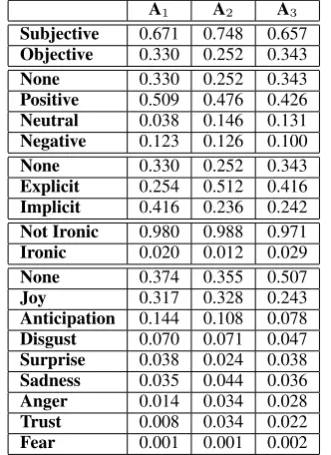
Table 1: Label distribution per annotator A1 A2 A3 Subjective 0.671 0.748 0.657 Objective 0.330 0.252 0.343 None 0.330 0.252 0.343 Positive 0.509 0.476 0.426 Neutral 0.038 0.146 0.131 Negative 0.123 0.126 0.100 None 0.330 0.252 0.343 Explicit 0.254 0.512 0.416 Implicit 0.416 0.236 0.242 Not Ironic 0.980 0.988 0.971 Ironic 0.020 0.012 0.029 None 0.374 0.355 0.507
Joy 0.317 0.328 0.243
Anticipation 0.144 0.108 0.078 Disgust 0.070 0.071 0.047 Surprise 0.038 0.024 0.038 Sadness 0.035 0.044 0.036 Anger 0.014 0.034 0.028 Trust 0.008 0.034 0.022 Fear 0.001 0.001 0.002
In Table 1, we report some statistics that sum-marize behaviours of the involved annotators. By analysing the distributions, we can observe differ-ent attitudes: A1 is inclined to label more posts as
positive against the neutral ones; A2 shows a
pre-disposition to identify a high number of explicit expressions; A3has a low sensibility to capture the
emotions behind the text. Moreover, we can high-light a balanced distribution for implicit/explicit opinions.
For those tweets encoding one of the eight emo-tions, there is a predominance of the joy label. Concerning the remaining classes the distributions are skewed towards a specific label, i.e. Subjec-tive, Positive and Not Ironic.
[image:5.595.99.265.318.546.2]An analogous consideration can be drawn for the emojii distribution (see Table 2). It turns out that most of the emojis are positive, especially the most popular ones and their presence provide an insight of the human emotional perceptions.
Table 2: Emojii distribution A1 A2 A3 Topic 0.141 0.129 0.095 Positive 0.559 0.601 0.593 Negative 0.141 0.187 0.173 Neutral 0.160 0.083 0.139
By a detailed analysis of the emoji annotations, it emerges that the role of the emojis is closely re-lated to the context where they appear: their tribution in terms of conveyed sentiment (or con-veyed topic) strictly depends on the domain where they are used. In Table 3, we report a compari-son between the label distribution of two emojis in our corpus and the corresponding distribution in a state of the art emoji sentiment lexicon (Novak et al., 2015).
In the proposed corpus, thefireemoji has been mainly labelled as positive because it represents the word “hot”, whose meaning is intended as something beautiful and trendy. However, in the emojii sentiment lexicon the same emoji primarily corresponds to a neutral sentiment. Similar con-siderations can be drawn for the pistol emoji: in our corpus it represents the topic underlying the two movies, while in the state of the art lexicon it is frequently used to denote a negative sentiment orientation. As conclusion, any emoji should be not considered as independent on the context and therefore evaluated according to its semantic.
5.1 Agreement Measures
The kappa coefficient (Cohen, 1960) is the most used statistic for measuring the degree of reliabil-ity between annotators. The need for consistency among annotators immediately arises due to the
Table 3: Emoji label distribution
Multi-View Sentiment Corpus
Topic 0.127 0.476 Negative 0.079 0.143 Neutral 0.111 0.190 Positive 0.683 0.190 Emoji Sentiment
Ranking (Novak et al., 2015)
[image:5.595.306.532.660.762.2]Table 4: Inter-agreement (PABAK-OS)
Subjective/Objective Sentiment Polarity Implicit/Explicit Irony Emotion
A1vsA2 0.606 0.598 0.354 0.949 0.590
A2vsA3 0.670 0.596 0.476 0.923 0.601
A1vsA3 0.592 0.585 0.416 0.912 0.551
Table 5: Self-agreement (PABAK-OS)
Subjective/Objective Sentiment Polarity Implicit/Explicit Irony Emotion
A1 0.920 0.920 0.640 1.000 0.820
A2 0.878 0.867 0.670 0.960 0.865
A3 1.000 0.920 0.850 0.878 0.820
variability among human perceptions. This inter-agreementmeasure can be summarized as:
k=observed agreement1−chance agreement−chanche agreement (1)
However, considering only this statistic is not appropriate when the prevalence of a given re-sponse is very high or very low in a specific class. In this case, the value of kappa may indicate a low level of reliability even with a high observed pro-portion of agreement. In order to address these imbalances caused by differences in prevalence and bias, Byrt et al. (1993) introduced a different version of the kappa coefficient called prevalence-adjusted bias-prevalence-adjusted kappa (PABAK). The esti-mation of PABAK depends solely on the observed proportion of agreement between annotators:
P ABAK = 2·observed agreement−1 (2)
A more reliable measure for estimating the agree-ment among annotators is PABAK-OS (Parker et al., 2011), which controls for chance agreement. PABAK-OS aims to avoid the peculiar, unintuitive results sometimes obtained from Cohen’s Kappa, especially related to skewed annotations (preva-lence of a given label).
We report in Table 4, the inter-agreement be-tween couples of annotators distinguished for each label. We can easily note that the highest agree-ment is related to the irony/not-irony labelling. This is due to the predominance of non-ironic messages identified by all the annotators. Thus, we perform a detailed analysis on the disagree-ment between each couple of annotators regard-ing only the ironic messages. From the results, reported in Table 6, we can confirm that A1 and
A2 annotators are more willing to interpret irony
similarly (as already stated in Table 4).
Concerning the implicit/explicit labels, the inter-agreement measure highlights the difficulties
Table 6: Count of disagreement on the irony label Disagreement (irony)
A1vsA2 76 A2vsA3 114 A1vsA3 132
encountered by the annotators to distinguish “ob-jective statements” (see Definition 1) from “objec-tive statements that imply an opinion” (see Defi-nition 3). Regarding the remaining labels, we can assert that there is a moderate agreement between the labellers. An analogous conclusion can be de-rived for the consensus about the emoji annotation, where the inter-agreement is 0.731 forA1 vsA2,
0.771 forA2vsA3, and 0.647 forA1 vsA3.
When dealing with complex annotations, the perception of the same annotator on the same post can change over time, resulting in inconsistent la-belling. In order to estimate the uncertainty of the annotation of each labeller, we sampled a portion of tweets to be annotated twice by the same an-notator. We report in Table 5 theself-agreement
measure, that is a valid index to quantify the qual-ity of the labelling procedure. The resulting statis-tics show that there is a high self-agreement for al-most all the labels. The annotators can be consid-ered moderately reliable for implicit/explicit anno-tations and very accurate for the remaining labels.
6 Conclusion
advan-tage of the complete label set given by the annota-tors to investigate their behaviours and the under-lying annotation procedures. We finally provided some interesting conclusions related to the use of emojis, highlighting that their role is strictly re-lated to the context where they appear. As future work, we aim at defining novel machine learning models able to simultaneously take advantage of the multiple views available. Moreover, an anno-tation scheme at a fine-grained level will be inves-tigated.
References
Ted Byrt, Janet Bishop, and John B. Carlin. 1993. Bias, prevalence and kappa. Journal of Clinical Epi-demiology, 46(5):423–429.
Jacob Cohen. 1960. A Coefficient of Agreement for Nominal Scales. Educational and Psychological Measurement, 20(1):37–46.
Dmitry Davidov, Oren Tsur, and Ari Rappoport. 2010. Enhanced sentiment learning using twitter hashtags and smileys. In Proceedings of the 23rd Inter-national Conference on Computational Linguistics: Posters, pages 241–249. Association for Computa-tional Linguistics.
Andrea Gianti, Cristina Bosco, Viviana Patti, Andrea Bolioli, and Luigi Di Caro. 2012. Annotating irony in a novel italian corpus for sentiment analysis. In Proceedings of the 4th Workshop on Corpora for Research on Emotion Sentiment and Social Signals, pages 1–7.
Alec Go, Lei Huang, and Richa Bhayani. 2009. Twit-ter sentiment analysis. Final Projects from CS224N for Spring 2008/2009 at The Stanford Natural Lan-guage Processing Group.
Efthymios Kouloumpis, Theresa Wilson, and Johanna D. Moore. 2011. Twitter sentiment analysis: The good the bad and the omg!. Proceedings of the 5th International AAAI Conference on Weblogs and So-cial Media, 11:538–541.
Jasy Suet Yan Liew, Howard R. Turtle, and Eliza-beth D. Liddy. 2016. Emotweet-28: A fine-grained emotion corpus for sentiment analysis. In Proceed-ings of the 10th International Conference on Lan-guage Resources and Evaluation. European Lan-guage Resources Association (ELRA).
Bing Liu. 2012. Sentiment analysis and opinion min-ing. Synthesis Lectures on Human Language Tech-nologies, 5(1):1–167.
Saif M. Mohammad. 2012. #emotional tweets. In Proceedings of the 1st Joint Conference on Lexical and Computational Semantics - Volume 1: Proceed-ings of the Main Conference and the Shared Task,
and Volume 2: Proceedings of the 6th International Workshop on Semantic Evaluation, pages 246–255. Association for Computational Linguistics.
Igor Mozeti, Miha Grar, and Jasmina Smailovi. 2016. Multilingual twitter sentiment classification: The role of human annotators.PLOS ONE, 11(5):1–26.
Preslav Nakov, Sara Rosenthal, Zornitsa Kozareva, Alan Ritter, and Theresa Wilson. 2013. Semeval-2013 task 2: Sentiment analysis in twitter. Proceed-ings of the 7th International Workshop on Semantic Evaluation, pages 312–320.
Preslav Nakov, Alan Ritter, Sara Rosenthal, Fabrizio Sebastiani, and Veselin Stoyanov. 2016. Semeval-2016 task 4: Sentiment analysis in twitter. In Proceedings of the 10th International Workshop on Semantic Evaluation, pages 1–18. Association for Computational Linguistics.
Petra Kralj Novak, Jasmina Smailovi´c, Borut Sluban, and Igor Mozetiˇc. 2015. Sentiment of emojis. PLOS ONE, 10(12):1–22.
Alexander Pak and Patrick Paroubek. 2010. Twitter as a corpus for sentiment analysis and opinion mining. InProceedings of the 7th International Conference on Language Resources and Evaluation. European Language Resources Association.
Bo Pang and Lillian Lee. 2008. Opinion mining and sentiment analysis. Foundations and Trends in In-formation Retrieval, 2(1-2):1–135.
Richard I. Parker, Kimberly J. Vannest, and John L. Davis. 2011. Effect size in single-case research: A review of nine nonoverlap techniques. Behavior Modification, 35(4):303–322.
Saˇsa Petrovi´c, Miles Osborne, and Victor Lavrenko. 2010. The edinburgh twitter corpus. InProceedings of the NAACL HLT 2010 Workshop on Computa-tional Linguistics in a World of Social Media, pages 25–26. Association for Computational Linguistics.
Jonathon Read. 2005. Using emoticons to reduce de-pendency in machine learning techniques for senti-ment classification. InProceedings of the ACL Stu-dent Research Workshop, pages 43–48. Association for Computational Linguistics.
Antonio Reyes, Paolo Rosso, and Tony Veale. 2013. A multidimensional approach for detecting irony in twitter. Language Resources and Evaluation, 47(1):239–268.
Sara Rosenthal, Alan Ritter, Preslav Nakov, and Veselin Stoyanov. 2014. Semeval-2014 task 9: Sen-timent analysis in twitter. In Proceedings of the 8th International Workshop on Semantic Evaluation, pages 73–80. Association for Computational Lin-guistics and Dublin City University.