Detecting Mild Cognitive Impairment
by Exploiting Linguistic Information from Transcripts
Veronika Vincze1,2, G´abor Gosztolya1,2, L´aszl´o T´oth1, Ildik´o Hoffmann3,4, Gr´eta Szatl´oczki5, Zolt´an B´anr´eti4, Magdolna P´ak´aski5 and J´anos K´alm´an5
1MTA-SZTE Research Group for Artificial Intelligence 2 University of Szeged, Institute of Informatics 3University of Szeged, Department of Linguistics
4Research Institute of Linguistics, Hungarian Academy of Sciences 5University of Szeged, Department of Psychiatry
Abstract
Here we seek to automatically identify Hungarian patients suffering from mild cognitive impairment (MCI) based on linguistic features collected from their speech transcripts. Our system uses ma-chine learning techniques and is based on several linguistic features like characteris-tics of spontaneous speech as well as fea-tures exploiting morphological and syn-tactic parsing. Our results suggest that it is primarily morphological and speech-based features that help distinguish MCI patients from healthy controls.
1 Background
Mild cognitive impairment (MCI) is a heteroge-neous set of symptoms that are essential in the early detection of Alzheimer’s Disease (AD) (Ne-gash et al., 2007). Symptoms such as language dysfunctions may occur even nine years before the actual diagnosis (APA, 2000). Thus, the language use of the patient may often indicate MCI well be-fore the clinical diagnosis of dementia.
MCI is known to influence the (spontaneous) speech of the patient via three main aspects. First, verbal fluency declines, which results in longer hesitations and a lower speech rate (Roark et al., 2011). Second, the lexical frequency of words and part-of-speech tags may also change significantly as the patient has problems with finding words (Croot et al., 2000). Third, the emotional respon-siveness of the patient was also observed to change in many cases (Lopez-de Ipi˜na et al., 2015).
For many patients, MCI is never recognized as in the early stage of the disease it is not trivial even for experts to detect cognitive impairment: according to Boise et al. (2004), up to 50% of MCI
patients are never diagnosed with MCI. Although there are well known tests such as the Mini Men-tal Test, they are usually not sensitive enough to reliably filter out MCI in its early stage. Tests on linguistic memory prove more efficient in detect-ing MCI, but they tend to yield a relatively high number of false positive diagnoses (Roark et al., 2011).
Although language abilities are impaired from an early stage of the disease, evaluating the lan-guage capacities of the patients has only received marginal attention when diagnosing AD (Bayles, 1982). However, if diagnosed early, a proper med-ical treatment may delay the occurrence of other (more severe) symptoms of dementia to the latest extent possible (K´alm´an et al., 2013).
Here we seek to automatically identify Hungar-ian patients suffering from mild cognitive impair-ment based on their speech transcripts. Our sys-tem uses machine learning techniques and is based on several features like linguistic characteristics of spontaneous speech as well as features exploiting morphological and syntactic parsing.
Recently, several studies have reported results on identifying different types of dementia with NLP and speech recognition techniques. For in-stance, automatic speech recognition tools were employed in detecting aphasia (Fraser et al., 2013b; Fraser et al., 2014; Fraser et al., 2013a) and mild cognitive impairment (Lehr et al., 2012), and Alzheimer’s Disease (Baldas et al., 2010; Satt et al., 2014). Jarrold et al. (2014) distinguished four types of dementia on the basis of spontaneous speech samples. Lexical analysis of spontaneous speech may also indicate different types of demen-tia (Bucks et al., 2000; Holmes and Singh, 1996) and may be exploited in the automatic detection of patients suffering from dementia (Thomas et al.,
2005). As for analyzing written language, changes in the writing style of people may also refer to de-mentia (Garrard et al., 2005; Hirst and Wei Feng, 2012; Le et al., 2011).
Concerning the automatic detection of MCI in Hungarian subjects, T´oth et al. (2015) experi-mented with speech recognition techniques. How-ever, to the best of our knowledge, this is the first attempt to identify MCI on the basis of written texts, i.e. speech transcripts for Hungarian.
In the long run, we would like to develop a sys-tem that can automatically detect linguistic symp-toms of MCI in its early stage, so that the per-son can get medical treatment as early as possible. It should be noted, however, that our goal cannot be an official diagnosis as diagnosing patients re-quires medical experience. All we can do is imple-ment a test supported by methods used in artificial intelligence, which indicates whether the patient is at risk and if so, s/he can turn to medical experts who will provide the clinical diagnosis.
2 Data
In our experiments1, two short animated films
were presented to the patients at the memory am-bulance of the University of Szeged. Patients were asked to talk about the first film then about their previous day, and lastly, about the second film. Their speech productions were recorded and tran-scribed by linguists, who explicitly marked speech phenomena like hesitations and pauses in the tran-scripts. These transcripts formed the basis of our experiments, i.e. we exploited only written infor-mation.
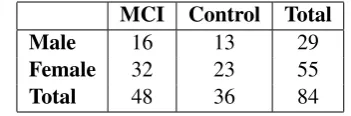
All of our 84 subjects were native speakers of Hungarian, a morphologically rich language. For each person, a clinical diagnosis was at our dis-posal, i.e. it was clinically proved whether the pa-tient suffers from MCI or not. On the basis of these data, subjects were classified as either MCI patient or healthy control at the university memorial. Ta-ble 1 shows data on the subjects’ gender and di-agnosis while Table 2 shows the mean values for age and education (in terms of years attended at school).
Speech transcripts reflect several characteristics of spontaneous speech. On the one hand, they con-tain several forms of hesitations and silent pauses, 1Our experiments conform to all operative rules and re-strictions on data collection, anonymization and publication according to the requirements in the European Union.
MCI Control Total
Male 16 13 29
Female 32 23 55
Total 48 36 84
Table 1: Subjects’ gender and diagnosis.
MCI Control Significance
age 73.08 69.28 0.0124
[image:2.595.326.502.62.120.2]education 11.42 12.47
Table 2: Mean values of demographic features and level of statistical significance in terms of p-value.
which are also marked in the transcripts, on the other hand, they abound in phenomena typical of spontaneous Hungarian speech such as phonolog-ical deletion (mer instead of the standard form mert “because” or ement instead of the standard
formelment“(he) left”) and lengthening (ut´anna
instead of the standard formut´ana“then”). There are duplications (ez ezt “this this-ACC”) and ne-ologisms created by the speaker (feltk´ava, which probably meansf˝ott k´av´e“boiled coffee”).
Fillers also deserve special attention when studying transcripts. Besides hesitations, we treated words and phrases referring to some kind of uncertainty together with indefinite pronouns as fillers such as ilyen“such”, olyan “such”, iz´e “thing, gadget”, ´es azt´an “and then”, valamilyen “some kind of”,valahogy“somehow”,valamerre “somewhere”2. Thus, MCI patients often seem to
substitute content words with fillers or indefinite pronouns, moreover, they also appear to use lots of paraphrases, which also indicate uncertainty just
likeegy ilyen bagolyszer˝us´ega such owl-likeness
“something similar to an owl” oraz olyan d´elel˝ott voltthat such morning was “that happened some time in the morning”.
3 Experiments
In order to determine the status of the subjects, we experimented with machine learning tools. The task was regarded as binary classification, i.e. sub-jects were classified as either an MCI patient or a healthy control, on the basis of a feature set de-rived from their transcripts.
(Zsibrita et al., 2013). For classification, we ex-ploited morphological, syntactic and semantic fea-tures extracted from the output of magyarlanc.
Each person was asked to recall three differ-ent stories. As MCI is strongly related to mem-ory deficit, we believe that the order of the tasks might also influence performance, hence we opted for processing each transcript separately. Thus, for each person, features to be discussed below were calculated separately for the three transcripts and all of them were exploited in the system.
3.1 Feature set
In our experiments, we employed features of spon-taneous speech and morphological and semantic features derived from the transcripts and their au-tomatic linguistic analyses. When defining our features, we took into account the fact that the speech of MCI patients may contain more pauses and hesitations than that of healthy controls (T´oth et al., 2015) and they are also supposed to have a restricted vocabulary due to cognitive deficit, which may affect the choice of words and the fre-quency of parts of speech (Croot et al., 2000) and might even yield neologisms. We also made use of demographic features that were at our disposal. Our feature set contained the following features: Spontaneous speech based features:
number of filled and silent pauses; number and rate of hesitations compared to the number of to-kens; number of pauses that follow an article and precede content words as this might reflect that MCI patients may have difficulties with finding the appropriate content words; number of lengthened sounds (which we considered as a special form of hesitation).
Morphological features:
number of tokens and words; number and rate of distinct lemmas; number of punctuation marks; number and rate of nouns, verbs, adjectives, pro-nouns and conjunctions; number of first person singular verbs as it might also be indicative how often the patient reflects to him/herself; number and rate of unanalyzed words, i.e. those with an “unknown” POS tag, which might indicate neolo-gisms created by the speaker on the spot.
Semantic features:
number and rate of fillers and uncertain words compared to the number of all tokens; number and rate of words/phrases related to memory ac-tivity (e.g.nem eml´ekszemnot remember-1SG “I
can’t remember”) as they directly signal prob-lems with memory and recall; number of nega-tion words; number and rate of content words and function words; number of thematic words related to the content of the films, based on manually con-structed lists.
Demographic features: gender; age; education.
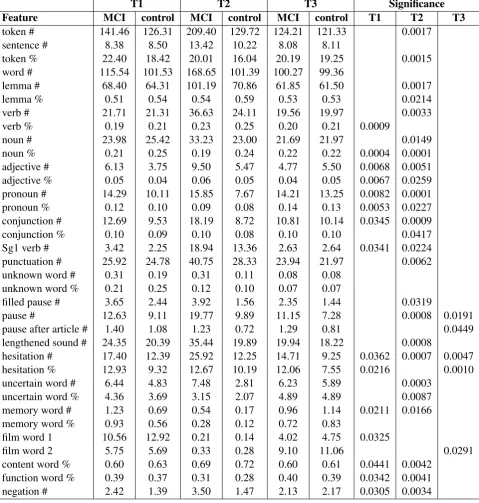
The mean values for each feature are reported in Table 3.
3.2 Statistical analysis of features
In order to reveal which features can most effec-tively distinguish healthy controls from MCI pa-tients, we carried out a statistical analysis of the data (t-tests for each feature and transcript). For most of the features, significant differences were found between the two groups – p-values are listed in Table 3. The age of the patients also indicates significant differences: people who were at least 71 years old were more probable to suffer from MCI than those who were younger at the time of the experiment (p = 0.0124).
According to the data, each group of features has a significant effect in distinguishing controls and MCI patients. It is shown that it is mostly the second transcript (the one including the narratives about the subjects’ previous days) where signif-icant differences may be found among MCI pa-tients and the control group. However, significant differences exist for the other two types of texts as well.
3.3 Machine learning experiments
To automatically identify MCI patients, we ex-ploited machine learning techniques, i.e. sup-port vector machines (SVM) (Cortes and Vapnik, 1995) with the default settings of Weka (Hall et al., 2009) and due to the small size of the dataset, we applied leave-one-out cross validation. As a base-line, majority labeling was used. For the evalua-tion, the accuracy, precision, recall and F-measure metrics were utilized.
T1 T2 T3 Significance
Feature MCI control MCI control MCI control T1 T2 T3
token # 141.46 126.31 209.40 129.72 124.21 121.33 0.0017
sentence # 8.38 8.50 13.42 10.22 8.08 8.11
token % 22.40 18.42 20.01 16.04 20.19 19.25 0.0015
word # 115.54 101.53 168.65 101.39 100.27 99.36
lemma # 68.40 64.31 101.19 70.86 61.85 61.50 0.0017
lemma % 0.51 0.54 0.54 0.59 0.53 0.53 0.0214
verb # 21.71 21.31 36.63 24.11 19.56 19.97 0.0033
verb % 0.19 0.21 0.23 0.25 0.20 0.21 0.0009
noun # 23.98 25.42 33.23 23.00 21.69 21.97 0.0149
noun % 0.21 0.25 0.19 0.24 0.22 0.22 0.0004 0.0001
adjective # 6.13 3.75 9.50 5.47 4.77 5.50 0.0068 0.0051
adjective % 0.05 0.04 0.06 0.05 0.04 0.05 0.0067 0.0259
pronoun # 14.29 10.11 15.85 7.67 14.21 13.25 0.0082 0.0001
pronoun % 0.12 0.10 0.09 0.08 0.14 0.13 0.0053 0.0227
conjunction # 12.69 9.53 18.19 8.72 10.81 10.14 0.0345 0.0009
conjunction % 0.10 0.09 0.10 0.08 0.10 0.10 0.0417
Sg1 verb # 3.42 2.25 18.94 13.36 2.63 2.64 0.0341 0.0224
punctuation # 25.92 24.78 40.75 28.33 23.94 21.97 0.0062
unknown word # 0.31 0.19 0.31 0.11 0.08 0.08
unknown word % 0.21 0.25 0.12 0.10 0.07 0.07
filled pause # 3.65 2.44 3.92 1.56 2.35 1.44 0.0319
pause # 12.63 9.11 19.77 9.89 11.15 7.28 0.0008 0.0191
pause after article # 1.40 1.08 1.23 0.72 1.29 0.81 0.0449
lengthened sound # 24.35 20.39 35.44 19.89 19.94 18.22 0.0008
hesitation # 17.40 12.39 25.92 12.25 14.71 9.25 0.0362 0.0007 0.0047
hesitation % 12.93 9.32 12.67 10.19 12.06 7.55 0.0216 0.0010
uncertain word # 6.44 4.83 7.48 2.81 6.23 5.89 0.0003
uncertain word % 4.36 3.69 3.15 2.07 4.89 4.89 0.0087
memory word # 1.23 0.69 0.54 0.17 0.96 1.14 0.0211 0.0166
memory word % 0.93 0.56 0.28 0.12 0.72 0.83
film word 1 10.56 12.92 0.21 0.14 4.02 4.75 0.0325
film word 2 5.75 5.69 0.33 0.28 9.10 11.06 0.0291
content word % 0.60 0.63 0.69 0.72 0.60 0.61 0.0441 0.0042
function word % 0.39 0.37 0.31 0.28 0.40 0.39 0.0342 0.0041
[image:4.595.76.556.147.651.2]negation # 2.42 1.39 3.50 1.47 2.13 2.17 0.0305 0.0034
MCI Control Total
Features P R F P R F P R F %
[image:5.595.116.484.61.194.2]all included 72.0 75.0 73.5 64.7 61.1 62.9 68.9 69.0 68.9 69.1 w/o semantic 75.0 81.3 78.0 71.9 63.9 67.6 73.7 73.8 73.6 73.8 +3.0 +6.3 +4.5 +7.2 +2.8 +4.7 +4.8 +4.8 +4.7 +4.7 w/o demographic 70.0 72.9 71.4 61.8 58.3 60.0 66.5 66.7 66.5 66.7 -2.0 -2.1 -2.1 -2.9 -2.8 -2.9 -2.4 -2.3 -2.4 -2.4 w/o speech-based 70.8 70.8 70.8 61.1 61.1 61.1 66.7 66.7 66.7 66.7 -1.2 -4.2 -2.7 -3.6 0.0 -1.8 -2.2 -2.3 -2.2 -2.4 w/o morphological 72.3 70.8 71.6 62.2 63.9 63.0 68.0 67.9 67.9 67.9 +0.3 -4.2 -1.9 -2.5 +2.8 +0.1 -0.9 -1.1 -1.0 -1.2 only significant 81.4 72.9 76.9 68.3 77.8 72.7 75.8 75.0 75.1 75.0 +9.4 -2.1 +3.4 +3.6 +16.7 +9.8 +6.9 +6.0 +6.2 +5.9
Table 4: Results and differences. MCI: mild cognitive impairment, P: precision, R: recall, F: F-measure, %: accuracy.
4 Results and Discussion
Using all the features, our system managed to achieve an accuracy score of 69.1%, that is, 58 out of the 84 patients were correctly diagnosed. 12 patients were falsely diagnosed as healthy and 14 controls were falsely labeled as MCI patients. Our results outperformed the baseline (57.14% in terms of accuracy). The system got a high recall value for MCI patients (75.0) but a lower one for controls (61.1), which is encouraging in the light of the fact that our main goal is to identify the widest possible range of potential MCI patients, who can turn to clinical experts to find out what their clinical diagnosis is.
We also experimented with using only features that displayed statistically significant differences among controls and MCI patients (see Table 3). Somewhat surprisingly, an accuracy of 75% could be achieved in this way, which indicates that some of our original features are superfluous and just confused the system, and this result needs further investigation.
An ablation study was also carried out to an-alyze the added value of each feature group. Speech-based, demographic and morphological features unequivocally contributed to perfor-mance. However, the effect of semantic features seems less obvious as they harm performance taken as a whole but some individual semantic fea-tures are useful for the system, as shown by the re-sults achieved with just using significant features.
When investigating the errors made by our sys-tem, we found that MCI patients that spoke only a few short sentences were often classified as healthy controls. They had a lower number and rate of hesitations and pauses, moreover, their vocabulary contained fewer fillers and uncertain
words, and these features resemble those typical of healthy controls. What is more, healthy sub-jects who talked more also hesitated more, which might be indicative of MCI. Furthermore, their use of pronouns and conjunctions was also more sim-ilar to those of MCI patients, hence the system falsely predicted a positive diagnosis for them.
Due to the specific characteristics of the data and the complexity of data collection – which requires clinical experiments – our dataset can be expanded only step by step. However, we found statistically significant differences among MCI patients and healthy controls concerning sev-eral linguistic and speech-based features even in our small dataset, which may be beneficial for our future experiments and might be also exploited by those who study spontaneous speech.
5 Conclusions
In this study, we introduced our system that au-tomatically detects Hungarian patients suffering from mild cognitive impairment on the basis of their speech transcripts. The system is based on features derived from morphological and syntactic analysis as well as characteristics of spontaneous speech. Both statistical and machine learning re-sults revealed that morphological and spontaneous speech-based features have an essential role in dis-tinguishing MCI patients from healthy controls.
References
APA. 2000. DSM-IV-TR. American Psychiatric
Asso-ciation.
Vassilis Baldas, Charalampos Lampiris, Christos N. Capsalis, and Dimitrios Koutsouris. 2010. Early Di-agnosis of Alzheimer’s Type Dementia Using Con-tinuous Speech Recognition. In James C. Lin and
Konstantina S. Nikita, editors, MobiHealth,
vol-ume 55 of Lecture Notes of the Institute for
Com-puter Sciences, Social Informatics and Telecommu-nications Engineering, pages 105–110. Springer. Kathryn A Bayles. 1982. Language function in senile
dementia.Brain and Language, 16(2):265–280.
Linda Boise, Margaret B Neal, and Jeffrey Kaye. 2004. Dementia assessment in primary care: Results from
a study in three managed care systems. The
Jour-nals of Gerontology Series A: Biological Sciences and Medical Sciences, 59(6):M621–M626.
R.S. Bucks, S. Singh, J.M. Cuerden, and G.K. Wilcock.
2000. Analysis of spontaneous, conversational
speech in dementia of alzheimer type: evaluation of an objective technique for analysing lexical
perfor-mance.Aphasiology, 14(1):71–91.
Corinna Cortes and Vladimir Vapnik. 1995.
Support-vector networks. Machine Learning, 20(3):273–
297.
Karen Croot, John R. Hodges, John Xuereb, and Kara-lyn Patterson. 2000. Phonological and articulatory impairment in alzheimer’s disease: A case series.
Brain and Language, 75(2):277 – 309.
Kathleen Fraser, Frank Rudzicz, Naida Graham, and Elizabeth Rochon. 2013a. Automatic speech recog-nition in the diagnosis of primary progressive apha-sia. Proceedings of the Fourth Workshop on Speech and Language Processing for Assistive Technolo-gies, pages 47–54.
Kathleen C. Fraser, Frank Rudzicz, and Elizabeth Ro-chon. 2013b. Using text and acoustic features to di-agnose progressive aphasia and its subtypes. In Fr-dric Bimbot, Christophe Cerisara, Ccile Fougeron, Guillaume Gravier, Lori Lamel, Franois Pellegrino,
and Pascal Perrier, editors, INTERSPEECH, pages
2177–2181. ISCA.
Kathleen C Fraser, Jed A Meltzer, Naida L Graham, Carol Leonard, Graeme Hirst, Sandra E Black, and Elizabeth Rochon. 2014. Automated classification of primary progressive aphasia subtypes from narra-tive speech transcripts. Cortex, 55:43–60.
Peter Garrard, Lisa M Maloney, John R Hodges, and Karalyn Patterson. 2005. The effects of very early Alzheimer’s disease on the characteristics of writing
by a renowned author. Brain, 128(2):250–260.
Mark Hall, Eibe Frank, Geoffrey Holmes, Bernhard Pfahringer, Peter Reutemann, and Ian H. Witten.
2009. The WEKA data mining software: an update.
SIGKDD Explorations, 11(1):10–18.
Graeme Hirst and Vanessa Wei Feng. 2012. Changes in style in authors with Alzheimer’s disease. English Studies, 93(3):357–370.
David I. Holmes and Sameer Singh. 1996. A stylomet-ric analysis of conversational speech of aphasic pa-tients. Literary and Linguistic Computing, 11:133– 140.
William Jarrold, Bart Peintner, David Wilkins, Dimitra Vergryi, Colleen Richey, Maria L. Gorno-Tempini, and Jennifer Ogar. 2014. Aided diagnosis of dementia type through computer-based analysis of
spontaneous speech. In Proceedings of the
Work-shop on Computational Linguistics and Clinical Psychology: From Linguistic Signal to Clinical Re-ality, pages 27–37, Baltimore, Maryland, USA, June. Association for Computational Linguistics. J´anos K´alm´an, Magdolna P´ak´aski, Ildik´o Hoffmann,
Gergely Dr´otos, Gy¨ongyi Darvas, Krisztina Boda, Tam´as Bencsik, Aliz Gyimesi, Zs´ofia Guly´as, Mag-dolna B´alint, Gr´eta Szatl´oczki, and Edina Papp. 2013. Early mental test – developing a screening test for mild cognitive impairment. Ideggy´ogy´aszati szemle, 66(1-2):43–52.
Xuan Le, Ian Lancashire, Graeme Hirst, and Regina Jokel. 2011. Longitudinal detection of dementia through lexical and syntactic changes in writing: a case study of three British novelists. Literary and Linguistic Computing, 26(4):435–461.
Maider Lehr, Emily Tucker Prud’hommeaux, Izhak Shafran, and Brian Roark. 2012. Fully automated neuropsychological assessment for detecting mild
cognitive impairment. In INTERSPEECH, pages
1039–1042. ISCA.
Karmele Lopez-de Ipi˜na, Jes´us B Alonso, Jordi Sol´e-Casals, Nora Barroso, Patricia Henriquez, Mar-cos Faundez-Zanuy, Carlos M Travieso, Miriam Ecay-Torres, Pablo Martinez-Lage, and Harkaitz
Eguiraun. 2015. On automatic diagnosis of
alzheimers disease based on spontaneous speech
analysis and emotional temperature. Cognitive
Computation, 7(1):44–55.
Selam Negash, Lindsay E Petersen, Yonas E Geda, David S Knopman, Bradley F Boeve, Glenn E Smith, Robert J Ivnik, Darlene V Howard, James H Howard Jr, and Ronald C Petersen. 2007. Ef-fects of ApoE genotype and Mild Cognitive
Impair-ment on implicit learning. Neurobiology of Aging,
28(6):885–893.
Brian Roark, Margaret Mitchell, John-Paul Hosom, Kristy Hollingshead, and Jeffrey Kaye. 2011. Spo-ken language derived measures for detecting mild
cognitive impairment. IEEE Transactions on
Aharon Satt, Ron Hoory, Alexandra K¨onig, Pauline Aalten, and Philippe H. Robert. 2014. Speech-based automatic and robust detection of very early
dementia. In15th Annual Conference of the
Inter-national Speech Communication Association, pages 2538–2542.
Calvin Thomas, Vlado Keˇselj, Nick Cercone, Kenneth Rockwood, and Elissa Asp. 2005. Automatic de-tection and rating of dementia of Alzheimer type through lexical analysis of spontaneous speech. In
Mechatronics and Automation, 2005 IEEE Inter-national Conference, volume 3, pages 1569–1574. IEEE.
L´aszl´o T´oth, G´abor Gosztolya, Veronika Vincze, Ildik´o Hoffmann, Gr´eta Szatl´oczki, Edit Bir´o, Fruzsina Zsura, Magdolna P´ak´aski, and J´anos K´alm´an. 2015. Automatic detection of mild cognitive impairment
from spontaneous speech using ASR. In 16th
An-nual Conference of the International Speech Com-munication Association, pages 2694–2698.
Veronika Vincze. 2013. Weasels, Hedges and Pea-cocks: Discourse-level Uncertainty in Wikipedia Articles. In Proceedings of the Sixth International Joint Conference on Natural Language Processing, pages 383–391, Nagoya, Japan, October. Asian Fed-eration of Natural Language Processing.
J´anos Zsibrita, Veronika Vincze, and Rich´ard Farkas. 2013. magyarlanc: A toolkit for morphological and
dependency parsing of Hungarian. InProceedings