Block Cipher Piccolo
Kitae Jeong
Center for Information Security Technologies(CIST), Korea University, Korea
Abstract. Piccolo is a 64-bit block cipher suitable for the constrained environments such as wireless sensor network environments. In this pa-per, we propose differential fault analysis on Piccolo. Based on a random byte fault model, our attack can recover the secret key of Piccolo-80 by using an exhaustive search of 224 and six random byte fault injections on average. It can be simulated on a general PC within a few seconds. In the case of Piccolo-128, we require an exhaustive search of 240 and eight random byte fault injections on average. This attack can be simu-lated on a general PC within one day. These results are the first known side-channel attack results on them.
Keywords: Block cipher, Piccolo, Differential fault analysis.
1
Introduction
Recently, the research on ultra-lightweight block ciphers suitable for the efficient implementation in constrained hardware environments such as RFID tags and sensor nodes has been studied. As a result, KATAN/KTANTAN [2], PRINTci-pher [7], LED [4] and Piccolo [9] were proposed.
Differential fault analysis (DFA), one of the side channel attacks, was first proposed by Biham and Shamir on DES in 1997 [1]. This attack exploits faults within the computation of a cryptographic algorithm to reveal the secret infor-mation. So far, DFAs on many block ciphers such as AES [10], ARIA [8], SEED [6], CLEFIA [3] and LED [5] have been proposed. It means that DFA poses a major threat to the security on block ciphers.
In this paper, we propose a differential fault analysis on Piccolo. Our attack is based on the random byte fault model. To recover the secret key of Piccolo-80, it is assumed that several random byte faults are injected to the input register of round 23. Thus, the number of possible fault positions is 8. We can compute the exact fault position by checking the corresponding ciphertext differences. As simulation results, this attack requires an exhaustive search of 224 and six random byte faults on average. It can be simulated on a general PC within a few seconds. Similarly, we can the secret key of Piccolo-128 with an exhaustive search of 240 and eight random byte fault injections on average. As simulation results, this attack can be simulated on a general PC within one day. These results are the first known side-channel attack results on them.
This paper is organized as follows. In Section 2, we briefly introduce the structure of Piccolo. Our attacks on Piccolo-80/128 are presented in Section 3 and Section 4, respectively. Finally, we give our conclusion in Section 5.
2
Description of Piccolo
In this section, we briefly present the structures of Piccolo-80 and Piccolo-128. Throughout this paper, the following notations are used.
– P= (P0, P1, P2, P3): a 64-bit plaintext.
– C= (C0, C1, C2, C3): a 64-bit ciphertext.
– Ir= (Ir,0, Ir,1, Ir,2, Ir,3): a 64-bit input value of roundr.
– (rk2r, rk2r+1): a round key of roundr.
– (wk0, wk1, wk2, wk3): a whitening key.
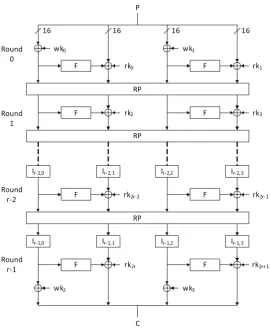
Piccolo-80/128 is a 64-bit block cipher and supports 80- and 128-bit secret keys. As shown in Figure 1, the structure of Piccolo-80/128 is a variant of gen-eralized Feistel network. Here, the number of roundsr is 25 for Piccolo-80 and 31 for Piccolo-128. First, with a 64-bit plaintext P = (P0, P1, P2, P3) and a prewhitening key (wk0, wk1), the input valueI0= (I0,0, I0,1, I0,2, I0,3) of round 0 is computed as follows.
I0,0=P0⊕wk0, I0,1=P1, I0,2=P2⊕wk1, I0,3=P3.
To generateIi+1fromIi(i= 0,· · ·, r−2), each round is made up of a function
wk0
F rk0
RP P
16 16
wk1
F rk1
16 16
F rk2 F rk3
RP Round
0
Round 1
F rk2r-2 F rk2r-1
RP Round
r-2
Ir-2,0 Ir-2, 1 Ir-2,2 Ir-2, 3
F rk2r F rk2r+1
Round r-1
Ir-1,0 Ir-1, 1 Ir-1,2 Ir-1, 3
wk2 wk3
C
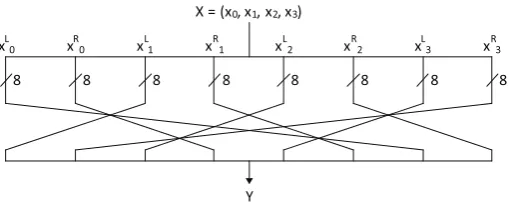
3, a round permutationRP takes a 64-bit input valueX = (x0, x1, x2, x3) and generates a 64-bit output value Y = (y0, y1, y2, y3). Here, a 16-bitxi is divided into (xL
i, xRi ).
S
S
S
S 4
16
M 4
4
4
S
S
S
S
Fig. 2.F function of Piccolo.
xL0 x
R 0
8
X = (x0, x1, x2, x3)
Y
8 8 8 8 8 8 8
xL1 x
R
1 x
L
2 x
R
2 x
L
3 x
R 3
Fig. 3.Round permutationRP of Piccolo.
A 64-bit ciphertextC= (C0, C1, C2, C3) is generated as follows.
C0=Ir−1,0⊕wk2, C1=F(Ir−1,0)⊕Ir−1,1⊕rk2r,
C2=Ir−1,2⊕wk3, C3=F(Ir−1,2)⊕Ir−1,3⊕rk2r+1.
The keyschedule of Piccolo-80 is simple. First, the 80-bit secret key K is computed as follows. Here,kj= (kLj, k
R
j) (j = 0,1,2,3,4).
K= (k0, k1, k2, k3, k4).
Four whitening keys (wk0, wk1, wk2, wk3) and 25 round keys (rk2i, rk2i+1) are generated as follows (i= 0,1,· · ·,24). Here, (con80
– Whitening key
wk0=k0L∥k R
1, wk1=k1L∥k R 0,
wk2=k4L∥k R
3, wk3=k3L∥k R 4.
– Round key
(rk2i, rk2i+1) = (con802i, con 80 2i+1)⊕
(k2, k3),(i mod 5)≡0 or 2, (k0, k1),(i mod 5)≡1 or 4, (k4, k4),(i mod 5)≡3.
Table 1.The partial secret key used in each round key
Piccolo-80 Piccolo-128 RoundiPartial secret key RoundiPartial secret key
0 (k2, k3) 0 (k2, k3) 1 (k0, k1) 1 (k4, k5)
.
.. ... ... ...
22 (k2, k3) 28 (k0, k7) 23 (k4, k4) 29 (k6, k3) 24 (k0, k1) 30 (k2, k5)
Table 1 presents the partial secret key used in each round key. For example, the round key (rk48, rk49) of round 24 includes the partial secret key (k0, k1).
The keyschedule of Piccolo-128 is similar to that of Piccolo-80. By using the 128-bit secret keyK = (k0, k1,· · ·, k7), four whitening keys and 31 round keys are generated as follows (See Table 1).
– Whitening key
wk0=k0L∥k R
1, wk1=k1L∥k R 0,
wk2=k4L∥k R
7, wk3=k7L∥k R 4.
– Round key (i= 0,1,· · ·,61) • if ((i+ 2) mod 8≡0) then
(k0, k1, k2, k3, k4, k5, k6, k7) = (k2, k1, k6, k7, k0, k3, k4, k5). • rki=k(i+2) mod 8⊕con128i .
3
DFA on Piccolo-80
– The attacker has the capability to choose one plaintext to encrypt and obtain the corresponding right/faulty ciphertexts.
– The attacker can induce random byte faults to the input register of round 23.
– The location and value of faults are both unknown.
3.1 Computation of the exact fault position
First, we present the method to compute the exact fault position by using the difference between right/faulty ciphertext pairs (C, C∗). According to our fault assumption, a random byte fault can be induced to the input byte registerI23j,i
of round 23 (i= 0,1,2,3 andj =L, R). Thus, the number of all possible fault positions is 8. For the simplicity of notations, we denote each case byEj23,i. For example,E23L,0 means an event that a random byte fault is injected toI23L,0.
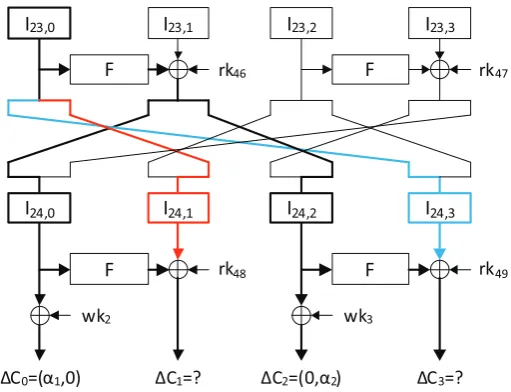
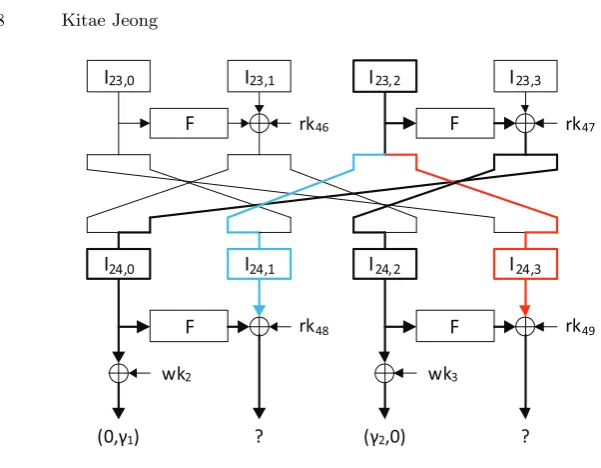
E23,0 We assume that a random byte fault was injected to I23,0, that is an event EL23,0 or E23R,0 was occurred. Fig. 4 presents the differential propagation under this assumption. In this figure, blue lines mean an event EL
23,0 and red lines mean an eventER
23,0.
F rk46 F
F rk48 F rk49
I23,0 I23,1 I23,2 I23,3
rk47
I24,0 I24,1 I24,2 I24,3
wk2 wk3
ΔC0=(α1,0) ΔC1=? ΔC2=(0,α2) ΔC3=?
Fig. 4.EventE23,0.
UnderE23,0, the difference∆I23,0forI23,0 has the pattern of (α,0) or (0, α). Here, α means a nonzero byte value. Then, according to the property of F
(β̸= 0, γ̸= 0). As shown in Fig. 4, we cannot distinguishEL
23,0andE23R,0. Under two events, the difference∆C between right/faulty ciphertext pairs (C, C∗) has the following pattern. Here,α1andα2are nonzero byte values and ‘?’ means an unknown byte value.
– E23,0:∆C= (α1∥0, ?∥?, 0∥α2, ?∥?).
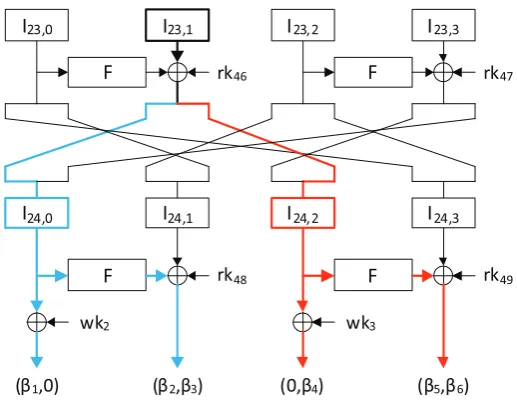
E23L,1 and E23R,1 It is assumed that a random byte fault was injected to I23,1, that is an event EL
23,1 or E23R,1 was occurred. Fig. 5 presents the differential propagation under this assumption. In this figure, blue lines mean an event
EL
23,1and red lines mean an eventE23R,1.
F
F
F
F
I
23,0I
23,1I
23,2I
23,3I
24,0I
24,1I
24,2I
24,3rk46 rk47
wk2 wk3
(β1,0) (β2,β3) (0,β4) (β5,β6)
rk48 rk49
Fig. 5.EventE23,1.
As depicted in Fig. 5, we can distinguishEL
23,1 and E23R,1. In each case, the ciphertext difference has the following pattern. Here, βj means a nonzero byte value (j= 1,· · ·,6).
– EL
23,1:∆C= (β1∥0, β2∥β3, 0∥0, 0∥0).
– ER
23,1:∆C= (0∥0, 0∥0, 0∥β4, β5∥β6).
E23,2 It is assumed that an eventEL23,2orE23R,2was occurred. That is, a random byte fault was injected toI23,2. Fig. 6 presents the differential propagation under this assumption. In this figure, blue lines mean an eventEL
23,2and red lines mean an eventER
F
F
F
F
I
23,0I
23,1I
23,2I
23,3I
24,0I
24,1I
24,2I
24,3rk46 rk47
wk2 wk3
rk48 rk49
(γ2,0)
?
(0,γ1) ?
Fig. 6.EventE23,2.
As depicted in Fig. 6, we cannot distinguish EL
23,2 and E23R,2 similarly to
E23,0. In this case, the ciphertext difference has the following pattern. Here,γ1 andγ2 mean nonzero byte value and ‘?’ means an unknown byte value..
– E23,2:∆C= (0∥γ1, ?∥?, γ2∥0, ?∥?).
E23L,3 and E23R,3 We assume that an event EL23,3 orE23R,3 was occurred. Fig. 7 presents the differential propagation under this assumption. In this figure, blue lines mean an eventEL
23,3and red lines mean an eventER23,3. As depicted in Fig. 7, we can distinguishEL
23,3 andE23R,3 similarly toE23,1. In each case, the ciphertext difference has the following pattern. Here,δj means a nonzero byte value (j= 1,· · ·,6).
– EL
23,3:∆C= (0∥0, 0∥0, δ4∥0, δ5∥δ6).
– ER
23,3:∆C= (0∥γ1, γ2∥γ3, 0∥0, 0∥0).
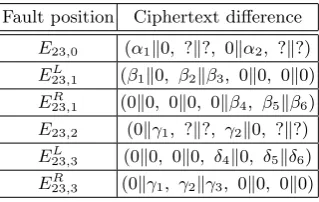
Under the above events, the ciphertext differences are summarized in Table 2. We can compute the exact fault position by using Table 2.
3.2 Computation of the secret key under each event
F
F
F
F
I
23,0I
23,1I
23,2I
23,3I
24,0I
24,1I
24,2I
24,3rk46 rk47
wk2 wk3
rk48 rk49
(0,δ1) (δ2,δ3) (δ4,0) (δ5,δ6)
Fig. 7.EventE23,3.
Table 2.Ciphertext differences for the positions of fault injections
Fault position Ciphertext difference E23,0 (α1∥0, ?∥?, 0∥α2, ?∥?) EL
23,1 (β1∥0, β2∥β3, 0∥0, 0∥0) ER
23,1 (0∥0, 0∥0, 0∥β4, β5∥β6) E23,2 (0∥γ1, ?∥?, γ2∥0, ?∥?) EL23,3 (0∥0, 0∥0, δ4∥0, δ5∥δ6) ER
E23,0 UnderE23,0, we can obtain 216 candidates of 48-bit (kR0, k1L, k3, k4). The attack procedure is as follows.
1. Guess 16-bitwk2 (
=kL 4∥k3R
)
and compute the output difference of the leftF
function in round 24 (see Fig. 4). Then check that the 8 most significant bits of this value are equal to the 8 most significant bits of∆C1. The probability passing this test is 2−8. Thus, we can obtain 28 candidates of(kR3, k4L). 2. Guess 16-bitwk3
( =kL
3∥kR4 )
and compute the output difference of the right
F function in round 24 (see Fig. 4). Then check that the 8 least significant bits of this value are equal to the 8 least significant bits of∆C3. Since the filtering probability is 2−8, we can compute 28candidates of(kL
3, kR4 )
. 3. Guess the 8 least significant bits ofrk48
( =con80
48⊕k0 )
and the 8 most signif-icant bits ofrk49
(
=con80 49⊕k1
)
. By using 216candidates of (k
3, k4) passing Step 1 and Step 2, check that the guessed value satisfy the input/output differences of the left F function in round 23 (see Fig. 4). The probability passing this test is 2−16, we can get 216candidates of (kR
0, kL1, k3, k4). With the above attack procedure, we can obtain 216 candidates of 48-bit (kR
0, k1L, k3, k4) by using one random byte fault.
EL
23,1 and E
R
23,1 Under E
L
23,1 or E23R,1, we can get the right (kR3, k4L) (under
EL
23,1) or (k3L, kR4) (underE23R,1), respectively. The attack procure is as follows.
– EL23,1
• Guess 16-bit wk2 (
=kL 4∥k3R
)
and compute the output difference of the left F function in round 24 (see Fig. 5). Then check that this value is equal to ∆C1. The probability passing this test is 2−16. Thus, we can obtain the right(kR
3, kL4 )
.
– ER23,1
• Guess 16-bit wk3 (
=kL 3∥k4R
)
and compute the output difference of the rightF function in round 24 (see Fig. 5). Then check that this value is equal to∆C3. Since the filtering probability is 2−16, we can compute the right(kL
3, kR4 )
.
E23,2 From the following attack procedure, we can obtain 216 candidates of
48-bit (kL
0, kR1, k3, k4) by using one random byte fault. 1. Guess 16-bitwk2
(
=kL4∥k3R)and compute the output difference of the leftF
function in round 24 (see Fig. 6). Then check that the 8 least significant bits of this value are equal to the 8 least significant bits of∆C1. The probability passing this test is 2−8. Thus, we can obtain 28 candidates of(kR3, k4L
) . 2. Guess 16-bitwk3
( =kL
3∥kR4 )
and compute the output difference of the right
F function in round 24 (see Fig. 6). Then check that the 8 most significant bits of this value are equal to the 8 most significant bits of∆C3. Since the filtering probability is 2−8, we can compute 28candidates of(kL
3, kR4 )
3. Guess the 8 most significant bits ofrk48 (
=con80 48⊕k0
)
and the 8 least signif-icant bits ofrk49
(
=con8049⊕k1 )
. By using 216candidates of (k3, k4) passing Step 1 and Step 2, check that the guessed value satisfy the input/output differences of the rightF function in round 23 (see Fig. 6). The probability passing this test is 2−16, we can get 216candidates of (k0L, kR1, k3, k4).
EL
23,3 and E
R
23,3 Finally, under E
L
23,3 or E23R,3, we can get the right (kL3, kR4) (under E23L,3) or (kR3, kL4) (under E23R,3), respectively. The attack procure is as follows.
– EL 23,3
• Guess 16-bit wk3 (
=kL3∥k4R)and compute the output difference of the rightF function in round 24 (see Fig. 7). Then check that this value is equal to∆C3. Since the filtering probability is 2−16, we can compute the right(kL3∥k4R
) .
– ER 23,3
• Guess 16-bit wk2 (
=kL 4∥k3R
)
and compute the output difference of the left F function in round 24 (see Fig. 7). Then check that this value is equal to ∆C1. The probability passing this test is 2−16. Thus, we can obtain the right(kR
3∥k4L )
.
3.3 DFA on Piccolo-80
Now, we are ready to propose DFA on Piccolo-80. Our attack consists of the following two substpes: we first compute the exact fault position by using the ciphertext difference, and then the partial secret key of Piccolo-80 is obtained according to the computed fault position.
The attack procedure on Piccolo-80 is as follows.
1. [Collection of right ciphertext] Choose a plaintext P and obtain the corresponding right ciphertextC= (C0, C1, C2, C3).
2. [Collection of faulty ciphertext] After inducing an i-th random byte fault to the input registerI23 = (I23,0, I23,1, I23,2, I23,3) of round 23, obtain the corresponding faulty ciphertextCi∗= (Ci∗
0 , C1i∗, C2i∗, C3i∗) (i= 1,· · ·, n). 3. [Computation of fault positions]Compute ∆Ci by using (C, Ci∗) and
then compute the exact fault positions from Table 2.
4. [Computation of candidates of (k0, k1, k3, k4)]According to fault posi-tions computed in Step 3, compute candidates of (k0, k1, k3, k4) by using the method in Section 3.2.
5. [Recovery of the80-bit secret key] Guess 16-bitk2 for each candidate of (k0, k1, k3, k4) and then recover the 80-bit secret key by using one trial encryption.
We simulated our attack on a general PC 10,000 times. As simulation results, we can obtain about 28candidates of (k
(k0, k1, k2, k3, k4). Since the filtering probability is 2−64, the expected number of wrong secret keys passing our attack algorithm is 2−40(= 224·2−64). It means that the possibility that a wrong key can pass our attack algorithm is very low. As simulation results, we can always recover the 80-bit secret key of Piccolo-80 within a few seconds by using six fault injections on average.
4
DFA on Piccolo-128
In this section, we propose DFA on Piccolo-128. Our attack on Piccolo-128 is similar to that on Piccolo-80. Our fault assumption is as follows.
– The attacker has the capability to choose one plaintext to encrypt and obtain the corresponding right/faulty ciphertexts.
– The attacker can induce random byte faults to the input register of round 28 and 29, respectively.
– The location and value of faults are both unknown.
4.1 The main idea
We first recover the right wk2(= kL4∥k7R) and wk3(= kL7∥kR4) by injecting the input register of round 29. The attack procedure of this step is similar to that on Piccolo-80. In detail, under eventsE29,0,E29,1,E29,2ande29,3, we compute them. Note that we compute only (wk2, wk3). As simulation results, we can always obtain the right (wk2, wk3) by using only two random fault injections. Note that our attack on Piccolo-80 can compute about 28 candidates of (k
0, k1, k3, k4) by using six fault injections on average.
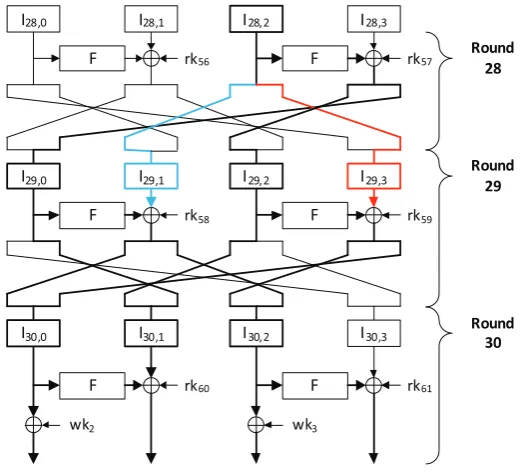
Second, we assume that random byte faults are injected to the input register of round 28, that isE28,0,E28,1,E28,2andE28,3. Thus, the number of all possible fault positions is 8. By using the recovered (wk2, wk3) in the previous step, we can distinguish them. According to each fault position, we can compute candidates of the partial secret key similarly to DFA on Piccolo-80.
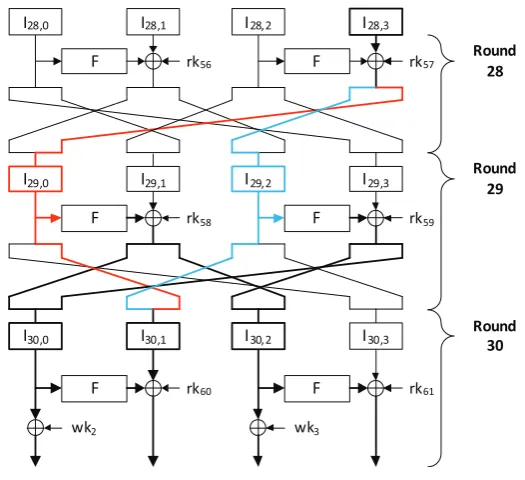
4.2 E28,0
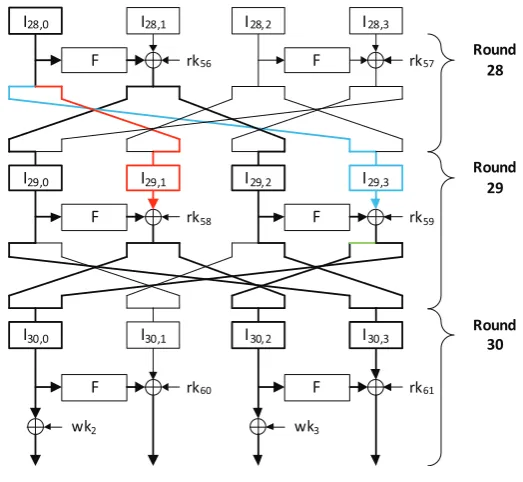
It is assumed that we know the right (wk2, wk3). Under E28L,0 or ER28,0, the differential propagation is depicted in Fig. 8. In this figure, blue lines mean an event EL
28,0 and red lines mean an eventE28R,0.
Since we know (wk2, wk3), we can compute the input difference (∆I30,0,
∆I30,1, ∆I30,2, ∆I30,3) of round 30. As shown in Fig. 8, we cannot distinguish
E28L,0 and E28R,0. Under two events, (∆I30,1, ∆I30,3) has the following pattern. Here, α1 andα2 are nonzero byte values.
– E28,0: (∆I30,1, ∆I30,3) = (0∥0, α1∥α2).
Under E28,0, we can obtain 216 candidates of 48-bit (
k2, kL3, k5, kR6 )
F rk56 F rk57
Round 28
F F
Round 29
F F
Round 30
I29,0 I29,1 I29, 2 I29,3
I30,0 I30,1 I30, 2 I30,3
I28,0 I28,1 I28, 2 I28,3
wk2 wk3
rk60 rk61
rk58 rk59
Fig. 8.EventE28,0.
1. Guess 16-bit (rkR
60(= k2R⊕con12860 R), rkL61(= kL5 ⊕con12861 L)) and compute the output difference of the left F function of round 29 (see Fig. 8). Then check that the 8 most significant bits of this value are equal to∆I30L,0. The probability passing this test is 2−8. Thus, we can obtain 28 candidates of (
k2R, kL5 )
.
2. Guess 16-bit (rkL
60(= k2L⊕con12860 L), rk61R(= kR5 ⊕con12861 R)) and compute the output difference of the rightF function of round 29 (see Fig. 8). Then check that the 8 least significant bits of this value are equal to∆IR
30,0. The probability passing this test is 2−8. Thus, we can obtain 28 candidates of (
kL 2, kR5
) .
3. Guess 16-bit (rkR
58(= k6R⊕con12858 R), rkL59(= kL3 ⊕con12859 L)) and compute the output difference of the leftF function of round 28 for each candidate of (k2, k5) (see Fig. 8). Then check that this value is equal to ∆I30,3. The probability passing this test is 2−16. Thus, we can obtain 216 candidates of (
k2, k3L, k5, k6R )
.
4.3 EL
28,1 and E
R 28,1
It is assumed that we know the right (wk2, wk3). Under E28L,1 or ER28,1, the differential propagation is shown in Fig. 9. In this figure, blue lines mean an eventEL
event, (∆I30,1, ∆I30,3) has the following pattern. Here,β1 and β2 are nonzero byte values.
– EL
28,1: (∆I30,1, ∆I30,3) = (0∥0, β1∥0).
– ER
28,1: (∆I30,1, ∆I30,3) = (0∥0, 0∥β2).
F F Round
28
F F
Round 29
F F
Round 30
I29,0 I29,1 I29, 2 I29,3
I30,0 I30,1 I30, 2 I30,3
I28,0 I28,1 I28, 2 I28,3
wk2 wk3
rk60 rk61
rk58 rk59
rk56 rk57
Fig. 9.EventE28,1.
UnderEL
28,1orE28R,1, we can get the right (kR2, k5L) (underE28L,1) or (kL2, kR5) (underE28R,1), respectively. The attack procure is as follows.
– EL 28,1
• Guess 16-bit (rkR
60(=kR2 ⊕con12860 R), rkL61(=kL5⊕con12861 L)) and compute the output difference of the leftF function of round 29 (see Fig. 9). Then check that this value is equal to (∆IL
30,0∥∆I30R,2). The probability passing this test is 2−16. Thus, we can obtain the right(kR
2, kL5 )
.
– ER28,1
• Guess 16-bit (rkL60(=kL2⊕con12860L), rkR61(=kR5 ⊕con12861 R)) and compute the output difference of the right F function of round 29 (see Fig. 9). Then check that this value is equal to (∆IL
30,2∥∆I30R,0). The probability passing this test is 2−16. Thus, we can obtain the right(kL
2, kR5 )
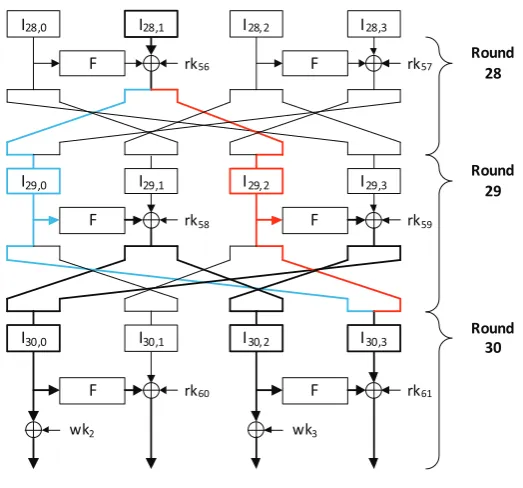
4.4 E28,2
It is assumed that we know the right (wk2, wk3). Under E28L,2 or E R 28,2, the differential propagation is shown in Fig. 10. In this figure, blue lines mean an eventE28L,2and red lines mean an eventE28R,2. As depicted in Fig. 10, we cannot distinguishEL
28,2andE28R,2similarly toE28,0. Under each event, (∆I30,1, ∆I30,3) has the following pattern. Here,γ1 andγ2are nonzero byte values.
– E28,2: (∆I30,1, ∆I30,3) = (γ1∥γ2, 0∥0).
F F Round
28
F F
Round 29
F F
Round 30
I29,0 I29,1 I29, 2 I29,3
I30,0 I30,1 I30, 2 I30,3
I28,0 I28,1 I28, 2 I28,3
wk2 wk3
rk60 rk61
rk58 rk59
rk56 rk57
Fig. 10.EventE28,2.
From the following attack procedure, we can obtain 216 candidates of 48-bit (k2, kR3, k5, kL6) by using one random byte fault.
1. Guess 16-bit (rkR
60(= k2R⊕con12860 R), rkL61(= kL5 ⊕con12861 L)) and compute the output difference of the leftF function of round 29 (see Fig. 10). Then check that the 8 least significant bits of this value are equal to∆IR
30,2. The probability passing this test is 2−8. Thus, we can obtain 28 candidates of (
kR 2, kL5
) .
2. Guess 16-bit (rkL
60(=kL2⊕con12860 L), rkR61(=kR5 ⊕con12861 R)) and compute the output difference of the right F function of round 29 (see Fig. 10). Then check that the 8 most significant bits of this value are equal to∆IL
probability passing this test is 2−8. Thus, we can obtain 28 candidates of (
kL 2, kR5
) .
3. Guess 16-bit (rk58L(= k6L⊕con12858 L), rk59R(= kR3 ⊕con12859 R)) and compute the output difference of the rightF function of round 28 for each candidate of (k2, k5) (see Fig. 10). Then check that this value is equal to∆I30,1. The probability passing this test is 2−16. Thus, we can obtain 216 candidates of (
k2, k3R, k5, k6L )
.
4.5 EL
28,3 and E
R 28,3
It is assumed that we know the right (wk2, wk3). Under E28L,3 or ER28,3, the differential propagation is shown in Fig. 11. In this figure, blue lines mean an eventEL
28,3and red lines mean an eventE28R,3. As depicted in Fig. 11, under each event, (∆I30,1, ∆I30,3) has the following pattern. Here,δ1andδ2are nonzero byte values.
– EL28,3: (∆I30,1, ∆I30,3) = (δ1∥0, 0∥0).
– ER
28,3: (∆I30,1, ∆I30,3) = (0∥δ2, 0∥0).
F F Round
28
F F
Round 29
F F
Round 30
I29,0 I29,1 I29, 2 I29,3
I30,0 I30,1 I30, 2 I30,3
I28,0 I28,1 I28, 2 I28,3
wk2 wk3
rk60 rk61
rk58 rk59
rk56 rk57
Fig. 11.EventE28,3.
UnderEL
28,3orE28R,3, we can get the right (kL2, k5R) (underE28L,3) or (kR2, kL5) (underER
– EL 28,3
• Guess 16-bit (rkL60(=kL2⊕con12860L), rkR61(=kR5 ⊕con12861 R)) and compute the output difference of the right F function of round 29 (see Fig. 11). Then check that this value is equal to (∆I30L,2∥∆I30R,0). The probability passing this test is 2−16. Thus, we can obtain the right(kL2, kR5
) .
– ER 28,3
• Guess 16-bit (rkR60(=kR2 ⊕con12860 R), rkL61(=kL5⊕con12861 L)) and compute the output difference of the left F function of round 29 (see Fig. 11). Then check that this value is equal to (∆IL
30,0∥∆I30R,2). The probability passing this test is 2−16. Thus, we can obtain the right(kR
2, k5L )
. Under the above events, (∆I30,1, ∆I30,3) are summarized in Table 3. Since we know (wk2, wk3), we can compute the exact fault position by using Table 3.
Table 3.Ciphertext differences for the positions of fault injections
Fault position (∆I30,1, ∆I30,3) E28,0 (0∥0, α1∥α2) EL28,1 (0∥0, β1∥0) ER
28,1 (0∥0, 0∥β2) E28,2 (γ1∥γ2, 0∥0) EL28,3 (δ1∥0, 0∥0) ER
28,3 (0∥δ2, 0∥0)
4.6 DFA on Piccolo-128
The attack procedure on Piccolo-128 is as follows.
1. [Collection of right ciphertext] Choose a plaintext P and obtain the corresponding right ciphertextC= (C0, C1, C2, C3).
2. [Collection of faulty ciphertext] After inducing an i-th random byte fault to the input registerI29 = (I29,0, I29,1, I29,2, I29,3) of round 29, obtain the corresponding faulty ciphertextCi∗= (Ci∗
0 , C1i∗, C2i∗, C3i∗) (i= 1,· · ·, n). 3. [Recovery of(wk2, wk3)]Recover the right (wk2, wk3) under eventsE29,0,
E29,1,E29,2 and E29,3 similarly toE23,0, E23,1, E23,2 andE23,3 in DFA on Piccolo-80.
4. [Collection of faulty ciphertext] After inducing an i-th random byte fault to the input registerI28 = (I28,0, I28,1, I28,2, I28,3) of round 28, obtain the corresponding faulty ciphertextCi∗= (Ci∗
6. [Recovery of the128-bit secret key]Guess 32-bit (k0, k1) for each candi-date of (k2, k3, k4, k5, k6, k7) and then recover the 128-bit secret key by using one trial encryption.
We simulated our attack on a general PC 10,000 times. As simulation results, we can obtain about 28candidates of (k
0, k1, k3, k4) by using eight fault injections on average. Thus, we do an exhaustive search for 240(= 28·232) candidates of (k0, k1, k2, k3, k4, k5, k6, k7). Since the filtering probability is 2−64, the expected number of wrong secret keys passing our attack algorithm is 2−24(= 240·2−64). It means that the possibility that a wrong key can pass our attack algorithm is very low. As simulation results, we can always recover the 128-bit secret key of Piccolo-128 within one day by using eight fault injections on average.
5
Conclusion
In this paper, we have presented DFA on Piccolo. Our attack on Piccolo-80 is executed within a few seconds by using six random byte faults. And our attack on Piccolo-128 needs eight random byte faults and is executed within one day. They are first known side-channel attack results on Piccolo.
References
1. E. Biham and A. Shamir, Differential fault analysis of secret key cryptosystems, Crypto 1997, LNCS 1294, pp. 513-525, Springer, 1997.
2. C. Canni`ere, O. Dunkelman and M. Kneˇzevu´c,KATAN and KTANTAN - a family of small and efficient hardware-oriented block ciphers, CHES 2009, LNCS 5747, pp. 272-288, Springer, 2009.
3. H. Chen, W. Wu and D. Feng,Differential fault analysis on CLEFIA, ICICS 2007, LNCS 4861, pp. 284-295, Springer, 2007.
4. J. Guo, T. Peyrin, A. Poschmann and M. Robshaw,The LED Block Cipher, CHES 2011, LNCS 6917, pp. 326-341, Springer, 2011.
5. K. Jeong and C. Lee, Differential Fault Analysis on Block Cipher LED-64, Fu-ture Information Technology, Application, and Service, LNEE 164, pp. 747-755, Springer, 2012.
6. K. Jeong, Y. Lee, J. Sung and S. Hong,Differential fault analysis on block cipher SEED, Mathematical and Computer Modelling, Vol. 55, Issues 1-2, pp. 26-34, Elsevier, 2012.
7. L. Knudsen, G. Leander, A. Poschmann and M. Robshaw,PRINTcipher: a block cipher for IC-printing, CHES 2010, LNCS 6225, pp. 16-32, Springer, 2010. 8. W. Li, D. Gu and J. Li,Differential fault analysis on the ARIA algorithm,
Infor-mation Sciences, Vol. 178, Issue 19, pp. 3727-3737, Elsevier, 2008.
9. K. Shibutani, T. Isobe, H. Hiwatari, A. Mitsuda, T. Akishita and T. Shirai,Piccolo: an ultra-lightweight blockcipher, CHES 2011, LNCS 6917, pp. 342-357, Springer, 2011.
10. M. Tunstall, D. Mukhopadhyay and S. Ali, Differential fault analysis of the ad-vanced encryption standard using a single fault, WISTP 2011, LNCS 6633, pp. 224-233, Springer, 2011.