Learning Cross-lingual Word Embeddings via Matrix Co-factorization
Tianze Shi Zhiyuan Liu Yang Liu Maosong Sun State Key Laboratory of Intelligent Technology and Systems Tsinghua National Laboratory for Information Science and Technology
Department of Computer Science and Technology Tsinghua University, Beijing 100084, China
{liuzy, liuyang2011, sms}@tsinghua.edu.cn
Abstract
A joint-space model for cross-lingual distributed representations generalizes language-invariant semantic features. In this paper, we present a matrix co-factorization framework for learning
cross-lingual word embeddings. We
explicitly define monolingual training objectives in the form of matrix de-composition, and induce cross-lingual constraints for simultaneously factorizing monolingual matrices. The cross-lingual constraints can be derived from parallel corpora, with or without word alignments. Empirical results on a task of cross-lingual document classification show that our method is effective to encode cross-lingual knowledge as constraints for cross-lingual word embeddings.
1 Introduction
Word embeddings allow one to represent words in a continuous vector space, which characterizes the lexico-semanic relations among words. In many NLP tasks, they prove to be high-quality features, successful applications of which include language modelling (Bengio et al., 2003), sentiment analy-sis (Socher et al., 2011) and word sense discrimi-nation (Huang et al., 2012).
Like words having synonyms in the same guage, there are also word pairs across lan-guages which share resembling semantic proper-ties. Mikolov et al. (2013a) observed a strong similarity of the geometric arrangements of cor-responding concepts between the vector spaces of different languages, and suggested that a cross-lingual mapping between the two vector spaces is technically plausible. In the meantime, the joint-space models for cross-lingual word embeddings are very desirable, as language-invariant seman-tic features can be generalized to make it easy to
transfer models across languages. This is espe-cially important for those low-resource languages, where it allows one to develop accurate word rep-resentations of one language by exploiting the abundant textual resources in another language, e.g., English, which has a high resource density. The joint-space models are not only technically plausible, but also useful for cross-lingual model transfer. Further, studies have shown that using cross-lingual correlation can improve the quality of word representations trained solely with mono-lingual corpora (Faruqui and Dyer, 2014).
Defining a cross-lingual learning objective is crucial at the core of the joint-space model. Her-mann and Blunsom (2014) and Chandar A P et al. (2014) tried to calculate parallel sentence (or document) representations and to minimize the differences between the semantically equivalen-t pairs. These meequivalen-thods are useful in capequivalen-turing semantic information carried by high-level units (such as phrases and beyond) and usually do not rely on word alignments. However, they suffer from reduced accuracy for representing rare to-kens, whose semantic information may not be well generalized. In these cases, finer-grained informa-tion at lexical level, such as aligned word pairs, dictionaries, and word translation probabilities, is considered to be helpful.
Koˇcisk`y et al. (2014) integrated word aligning process and word embedding in machine transla-tion models. This method makes full use of paral-lel corpora and produces high-quality word align-ments. However, it is unable to exploit the richer monolingual corpora. On the other hand, Zou et al. (2013) and Faruqui and Dyer (2014) learnt word embeddings of different languages in separate s-paces with monolingual corpora and projected the embeddings into a joint space, but they can only capture linear transformation.
In this paper, we address the above challenges with a framework of matrix co-factorization. We
simultaneously learn word embeddings in multi-ple languages via matrix factorization, with in-duced constraints to assure cross-lingual seman-tic relations. It provides the flexibility of con-structing learning objectives from separate mono-lingual and cross-mono-lingual corpora. Intricate rela-tions across languages, rather than simple linear projections, are automatically captured. Addition-ally, our method is efficient as it learns from global statistics. The cross-lingual constraints can be de-rived both with or without word alignments, given that there is a valid measure of cross-lingual co-occurrences or similarities.
We test the performance in a task of cross-lingual document classification. Empirical result-s and a viresult-sualization of the joint result-semantic result-space demonstrate the validity of our model.
2 Framework
Without loss of generality, here we only consider bilingual embedding learning of the two languages
l1 and l2. Given monolingual corpora Dli and
sentence-aligned parallel data Dbi, our task is to
find word embedding matrices of the size|Vli|×d where each line corresponds to the embedding of a single word. We also define vocabularies of con-textsUliand we learn context embedding matrices Cliof the size|Uli| ×dat the same time.1
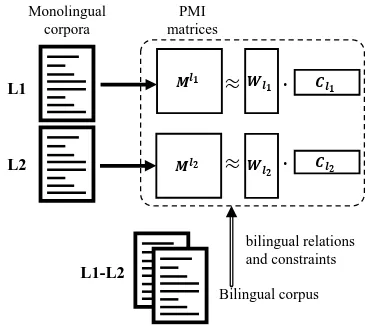
These matrices are obtained by simultaneous matrix factorization of the monolingual word-context PMI (point-wise mutual information) ma-tricesMli. During monolingual factorization, we put a cross-lingual constraint (cost) on it, ensuring cross-lingual semantic relations. We formalize the global loss function as
Ltotal= X
i∈{1,2}
ωi·Lmono(Wli, Cli)
+ωc·Lcross(Wl1, Cl1, Wl2, Cl2),
(1)
where Lmono and Lcross are the monolingual and
cross-lingual objectives respectively. ωi and ωc
weigh the contribution of the different parts to the total objective. An overview of our algorithm is illustrated in Figure 1.
3 Monolingual Objective
Our monolingual objective follows the GloVe model (Pennington et al., 2014), which learns from global word co-occurrence statistics. For a word-context pair(j, k)in language li, we try to
1In this paper, we letUli=Vli.
Monolingual corpora
L1
L2
Bilingual corpus
𝑾𝒍𝟏 ⋅ 𝑪𝒍𝟏
𝑪𝒍𝟐
⋅
bilingual relations and constraints
𝑴𝒍𝟏
𝑾𝒍𝟐
𝑴𝒍𝟐
≈
≈
PMI matrices
[image:2.595.323.506.60.223.2]L1-L2
Figure 1: The framework of cross-lingual word embedding via matrix co-factorization.
minimize the difference between the dot produc-t of produc-the embeddingswli
j ·clki and their PMI value
Mli
jk. Mjkli =
Xjkli·P
j,kXjkli
P
jXjkli·
P
kXjkli
, where Xli is the matrix of word-context co-occurrence counts. As Pennington et al. (2014), we add separate terms
bli
wj, blcik for each word and context to absorb the effect of any possible word-specific biases. We al-so add an additional matrix bias bli for the ease of sharing embeddings among matrices. The loss function is written as the sum of the weighted square error,
Lli
mono=
X
j,k f(Xli
jk)
wli
j ·clki+blwij +blcik+bli−Mjkli 2
,
(2) where we choose the same weighting function as the GloVe model to place less confidence on those word-context pairs with rare occurrences,
f(x) =
(
(x/xmax)α ifx < xmax
1 otherwise . (3)
Notice that we only have to optimize thoseXli
jk 6= 0, which can be solved efficiently since the matrix of co-occurrence counts is usually sparse.
4 Cross-lingual Objectives
As the most important part in our model, the cross-lingual objective describes the cross-cross-lingual word relations and sets constraints when we factorize monolingual co-occurrence matrices. It can be de-rived from either cross-lingual co-occurrences or similarities between cross-lingual word pairs. 4.1 Cross-lingual Contexts
words in similar contexts into similar embeddings. It is natural to further extend this idea to define cross-lingual contexts, for which we have multi-ple choices.
For the definition of cross-lingual contexts, we have multiple choices. A straightforward option is to count all the word co-occurrences in aligned sentence pairs, which is equivalent to a uniform word alignment model adopted by Gouws et al. (2015). For the sentence-aligned bilingual corpus
Dbi = {(Sl1, Sl2)}, where eachSli is a monolin-gual sentence, we count the co-occurrences as
Xbi
jk =
X
(Sl1,Sl2)∈Dbi
#(j, Sl1)×#(k, Sl2), (4)
where Xbi is the matrix of cross-lingual
co-occurrence counts, and #(j, S) is a function counting the number ofj’s in the sequenceS. We then use a similar loss function as Equation 2, with the exception that we optimize for the dot product-s of wl1j ·wkl2. This method works without word alignments and we denote it as CLC-WA (Cross-lingual context without word alignments).
We can also leverage word alignments and de-fine CLC+WA (Cross-lingual context with word alignments). The idea is to count those word-s co-occurring withk as the context ofj, where
k ∈ Vl2 is the translationally equivalent word
of j ∈ Vl1. An example is shown in Figure 2.
CLC+WA is expected to contain more precise in-formation than CLC-WA, and we will compare the two definitions in the following experiments.
Once we have counted the co-occurrences, a na¨ıve solution is to concatenate the bilingual vo-cabularies and perform matrix factorization as a whole. To induce additional flexibility, such as separate weighting, we divide the matrix into three parts. It is also more reasonable to calculate PMI values without mixing the monolingual and bilin-gual corpora.
4.2 Cross-lingual Similarities
An alternative way to set cross-lingual constraints is to minimize the distances between similar word pairs. Here the semantic similarities can be mea-sured by equivalence in translation, sim(j, k), which is produced by a machine translation sys-tem. In this paper, we use the translation proba-bilities produced by a machine translation system. Minimizing the distances of related words in the two languages weighted by their similarities gives us the cross-lingual objective
… we must do all we can, not just to …
… wir alles daran setzen müssen, nicht nur …
[image:3.595.322.511.180.326.2]Figure 2: An example of CLC+WA, where we show the cross-lingual context of the German word “m¨ussen” in the dashed box.
Table 1: Accuracy for cross-lingual classification.
Model en→de de→en
Machine translation 68.1 67.4
Majority class 46.8 46.8
Klementiev et al. 77.6 71.1
BiCVM 83.7 71.4
BAE 91.8 74.2
BilBOWA 86.5 75.0
CLC-WA 91.3 77.2
CLC+WA 90.0 75.0
CLSim 92.7 80.2
Lcross=
X
j∈Vl1,k∈Vl2
sim(j, k)·distance(wl1
j, wlk2), (5)
wherewjl1 andwl2k are the embeddings ofjandk
inl1 andl2 respectively. In this paper, we choose
the distance function to be the Euclidean distance, distance(wl1j , wl2k) = ||wjl1 −wl2k||2. Notice that
similar to the monolingual objective, we may op-timize for only those sim(j, k) 6= 0, which is ef-ficient as the matrix of translation probabilities or dictionary is sparse. We call this method CLSim.
5 Experiments
To evaluate the quality of the relatedness between words in different languages, we induce the task of cross-lingual document classification for the English-German language pair, where a classifier is trained in one language and later used to classi-fy documents in another. We exactly replicated the experiment settings of Klementiev et al. (2012). 5.1 Data and Training
For optimizing the monolingual objectives, We used exactly the same subset of RCV1/RCV2 cor-pora (Lewis et al., 2004) as by Klementiev et al. (2012), which were sampled to balance the num-ber of tokens between languages. Our preprocess-ing strategy followed Chandar A P et al. (2014), where we lowercased all words, removed punctu-ations and used the same vocabularies (|Ven| =
0.5 0.55 0.6 0.65 0.7 0.75 0.8 0.85 0.9 0.95
1 10 100
A
cc
uray
Weight of cross-lingual objective en→de de→en
(a)
0.3 0.4 0.5 0.6 0.7 0.8 0.9
1 10 100
A
cc
uray
Percentage of RCV used for training (%) en→de de→en
(b)
0.5 0.55 0.6 0.65 0.7 0.75 0.8 0.85 0.9 0.95
1 10 100
A
cc
uray
Percentage of Europarl used for training (%) en→de de→en
[image:4.595.95.510.72.195.2](c)
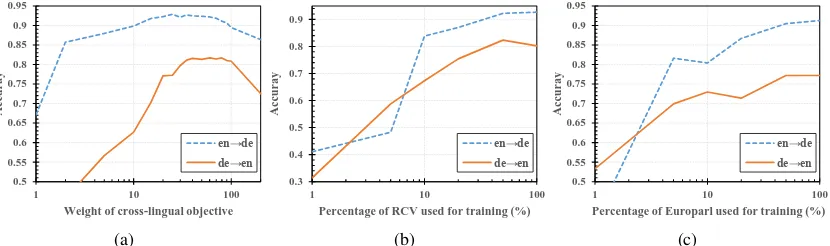
Figure 3: Cross-lingual document classification accuracy, with (a) varying weighting of cross-lingual objective (b) varying size of training monolingual corpora, and (c) varying size of training bilingual corpus.
word co-occurrences, we use a decreasing weight-ing function as Pennweight-ington et al. (2014), whered -word-apart word pairs contribute 1/dto the total count. We used a symmetric window size of 10 words for all our experiments.
The cross-lingual constraints were derived us-ing the English and German sections of the Eu-roparl v7 parallel corpus (Koehn, 2005), which were similarly preprocessed. For CLC+WA and CLSim, we obtained word alignments and trans-lation probabilities with SyMGIZA++ (Junczys-Dowmunt and Szał, 2012). We did not use Eu-roparl for monolingual training.
The documents for classification were ran-domly selected by Klementiev et al. (2012) from those in RCV1/RCV2 that are assigned to only one single topic among the four:
CCAT(Corporate/Industrial),ECAT(Economics),
GCAT (Government/Social), and MCAT
(Market-s). 1,000/5,000 documents in each language were used as a train/test set and we kept another 1,000 documents as a development set for hyperparame-ter tuning. Each document was represented as an idf-weighted average embedding of all its tokens, and a multi-class document classifier was trained for 10 epochs with an averaged perceptron algo-rithm as by Klementiev et al. (2012). A classifier trained with English documents is used to classify German documents and vice versa.
We trained our models using stochastic gradient descent. We run 50 iterations for all of our exper-iments and the dimensionality of the embeddings is 40. We setxmaxto be 100 for cross-lingual
co-occurrences and 30 for monolingual ones, while
α is fixed to 3/4. Other parameters are chosen according to the performance on the development set.
5.2 Results
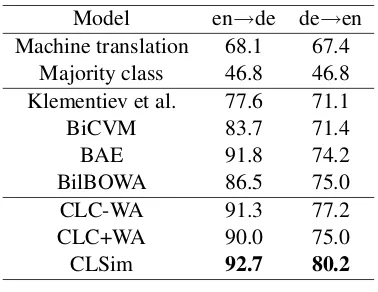
We present the empirical results on the task of cross-lingual document classification in Table 1, where the performance of our models is compared with some baselines and previous work. The effec-t of weigheffec-ting beeffec-tween pareffec-ts of effec-the effec-toeffec-tal objeceffec-tive and the amount of training data on the quality of the embeddings is demonstrated in Figure 3.
The baseline systems areMajority classwhere test documents are simply classified as the class
with the most training samples, and Machine
translationwhere a phrased-based machine trans-lation system is used to translate test documents into the same language as the training documents. We also summarize the classification accuracy reported in some previous work, including Multi-task learning (Klementiev et al., 2012), Bilingual compositional vector model (BiCVM) (Herman-n a(Herman-nd Blu(Herman-nsom, 2014), Bili(Herman-ngual autoe(Herman-ncoder for bags-of-words (BAE) (Chandar A P et al., 2014), and BilBOWA (Gouws et al., 2015). A more re-cent work of Soyer et al. (2015) developed a com-positional approach and reported an accuracy of 90.8% (en→de) and 80.1% (de→en) when using full RCV and Europarl corpora.
Our method outperforms the previous work and we observe improvements when we exploit word translation probabilities (CLSim) over the mod-el without word-levmod-el information (CLC-WA).
The best result is achieved with CLSim. It
development company business finance
cathedral towers
wisdom learning physician consultant
industrie branche
wirtschaft bank nationalpark
weisheit
theorie methoden arzt doktor
English
[image:5.595.81.284.63.184.2]German
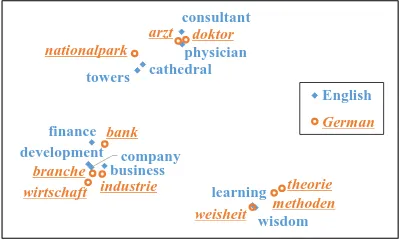
Figure 4: A visualization of the joint vector space.
5.3 Visualization
Figure 4 gives a visualization of some selected words using t-SNE (Van der Maaten and Hin-ton, 2008) where we observe the topical nature of word embeddings. Regardless of their source lan-guages, words sharing a common topic, e.g. econ-omy, are closely aligned with each other, revealing the semantic validity of the joint vector space.
6 Related Work
Matrix factorization has been successfully applied to learn word representations, which use several low-rank matrices to approximate the original ma-trix with extracted statistical information, usually word co-occurrence counts or PMI. Singular value decomposition (SVD) (Eckart and Young, 1936), SVD-based latent semantic analysis (LSA) (Lan-dauer et al., 1998), latent semantic indexing (LSI) (Deerwester et al., 1990), and the more recently-proposed global vectors for word representation (GloVe) (Pennington et al., 2014) find their wide applications in the area of NLP and information retrieval (Berry et al., 1995). Additionally, there is evidence that some neural-network-based models, such as Skip-gram (Mikolov et al., 2013b) which exhibits state-of-the-art performance, are also im-plicitly factorizing a PMI-based matrix (Levy and Goldberg, 2014). The strategy for matrix factor-ization in this paper, as Pennington et al. (2014), is in a stochastic fashion, which better handles un-observed data and allows one to weigh samples ac-cording to their importance and confidence.
Joint matrix factorization allows one to decom-pose matrices with some correlational constraints. Collective matrix factorization has been develope-d to handevelope-dle pairwise relations (Singh andevelope-d Gordevelope-don, 2008). Chang et al. (2013) generalized LSA to Multi-Relational LSA, which constructs a 3-way tensor to combine the multiple relations between
words. While matrix factorization is widely used in recommender systems, matrix co-factorization helps to handle multiple aspects of the data and improves in predicting individual decisions (Hong et al., 2013). Multiple sources of information, such as content and linkage, can also be connected with matrix co-factorization to derive high-quality webpage representations (Zhu et al., 2007). The advantage of this approach is that it automatical-ly finds optimal parameters to optimize both sin-gle matrix factorization and relational alignments, which avoids manually defining a projection ma-trix or transfer function. To the best of our knowl-edge, we are the first to introduce this technique to learn cross-lingual word embeddings.
7 Conclusions
In this paper, we introduced a framework of matrix co-factorization to learn cross-lingual word em-beddings. It is capable of capturing the lexico-semantic similarities of different languages in a unified vector space, where the embeddings are jointly learnt instead of projected from separate vector spaces. The overall objective is divided into monolingual parts and a cross-lingual one, which enables one to use different weighting and learn-ing strategies, and to develop models either with or without word alignments. Exploiting global context and similarity information instead of local ones, our proposed models are computationally ef-ficient and effective.
With matrix co-factorization, it allows one to integrate external information, such as syntactic contexts and morphology, which is not discussed in this paper. Its application in statistical ma-chine translation and cross-lingual model transfer remains to be explored. Learning multiple em-beddings per word and compositional emem-beddings with matrix factorization are also interesting fu-ture directions.
Acknowledgments
References
Yoshua Bengio, R´ejean Ducharme, Pascal Vincent, and Christian Janvin. 2003. A neural probabilistic lan-guage model.JMLR, 3:1137–1155.
Michael W Berry, Susan T Dumais, and Gavin W O’Brien. 1995. Using linear algebra for intelligent information retrieval. SIAM review, 37(4):573–595. Sarath Chandar A P, Stanislas Lauly, Hugo Larochelle, Mitesh Khapra, Balaraman Ravindran, Vikas C Raykar, and Amrita Saha. 2014. An autoencoder approach to learning bilingual word representations. InProceedings of NIPS, pages 1853–1861.
Kai-Wei Chang, Wen-tau Yih, and Christopher Meek. 2013. Multi-relational latent semantic analysis. In Proceedings of EMNLP, pages 1602–1612.
Scott C. Deerwester, Susan T Dumais, Thomas K. Lan-dauer, George W. Furnas, and Richard A. Harshman. 1990. Indexing by latent semantic analysis. JAsIs, 41(6):391–407.
Carl Eckart and Gale Young. 1936. The approximation of one matrix by another of lower rank. Psychome-trika, 1(3):211–218.
Manaal Faruqui and Chris Dyer. 2014. Improving vector space word representations using multilingual correlation. In Proceedings of EACL, pages 462– 471.
Stephan Gouws, Yoshua Bengio, and Greg Corrado. 2015. Bilbowa: Fast bilingual distributed represen-tations without word alignments. In ICML, pages 748–756.
Zellig S Harris. 1954. Distributional structure. Word, 10(23):146–162.
Karl Moritz Hermann and Phil Blunsom. 2014. Multi-lingual models for compositional distributed seman-tics. InProceedings of ACL, pages 58–68. ACL. Liangjie Hong, Aziz S Doumith, and Brian D Davison.
2013. Co-factorization machines: modeling user in-terests and predicting individual decisions in twitter. InProceedings of WSDM, pages 557–566. ACM. Eric H Huang, Richard Socher, Christopher D
Man-ning, and Andrew Y Ng. 2012. Improving word representations via global context and multiple word prototypes. InProceedings of ACL, pages 873–882. ACL.
Marcin Junczys-Dowmunt and Arkadiusz Szał. 2012. Symgiza++: symmetrized word alignment model-s for model-statimodel-stical machine tranmodel-slation. In Security and Intelligent Information Systems, pages 379–390. Springer.
Alexandre Klementiev, Ivan Titov, and Binod Bhat-tarai. 2012. Inducing crosslingual distributed rep-resentations of words. InProceedings of COLING. ICCL.
Tom´aˇs Koˇcisk`y, Karl Moritz Hermann, and Phil Blun-som. 2014. Learning bilingual word representations by marginalizing alignments. InProceedings of A-CL, pages 224–229. ACL.
Philipp Koehn. 2005. Europarl: A parallel corpus for statistical machine translation. InMT summit, vol-ume 5, pages 79–86.
Thomas K Landauer, Peter W Foltz, and Darrell La-ham. 1998. An introduction to latent semantic anal-ysis. Discourse processes, 25(2-3):259–284. Omer Levy and Yoav Goldberg. 2014. Neural word
embedding as implicit matrix factorization. In Pro-ceedings of NIPS, pages 2177–2185.
David D Lewis, Yiming Yang, Tony G Rose, and Fan Li. 2004. Rcv1: A new benchmark collection for text categorization research.JMLR, 5:361–397. Tomas Mikolov, Quoc V Le, and Ilya Sutskever.
2013a. Exploiting similarities among languages for machine translation. arXiv:1309.4168.
Tomas Mikolov, Ilya Sutskever, Kai Chen, Greg S Cor-rado, and Jeff Dean. 2013b. Distributed representa-tions of words and phrases and their compositional-ity. InProceedings of NIPS, pages 3111–3119. Jeffrey Pennington, Richard Socher, and Christopher D
Manning. 2014. Glove: Global vectors for word representation. pages 1532–1543.
Ajit P Singh and Geoffrey J Gordon. 2008. Relational learning via collective matrix factorization. In Pro-ceedings of SIGKDD, pages 650–658. ACM. Richard Socher, Jeffrey Pennington, Eric H Huang,
Andrew Y Ng, and Christopher D Manning. 2011. Semi-supervised recursive autoencoders for predict-ing sentiment distributions. In Proceedings of EMNLP, pages 151–161. ACL.
Hubert Soyer, Pontus Stenetorp, and Akiko Aizawa. 2015. Leveraging monolingual data for crosslingual compositional word representations. InProceedings of ICLR.
Laurens Van der Maaten and Geoffrey Hinton. 2008. Visualizing data using t-sne. JMLR, 9:2579–2605. Shenghuo Zhu, Kai Yu, Yun Chi, and Yihong Gong.
2007. Combining content and link for classification using matrix factorization. InProceedings of SIGIR, pages 487–494. ACM.