Proceedings of the 57th Annual Meeting of the Association for Computational Linguistics, pages 2860–2871 2860
Open Domain Event Extraction Using Neural Latent Variable Models
Xiao Liu1,2 and Heyan Huang1,2 and Yue Zhang3,4∗
1School of Computer Science and Technology, Beijing Institute of Technology 2Zhejiang Lab, China
{xiaoliu,hhy63}@bit.edu.cn
3School of Engineering, Westlake University
4Institute of Advanced Technology, Westlake Institute for Advanced Study
Abstract
We consider open domain event extraction, the task of extracting unconstraint types of events from news clusters. A novel latent variable neural model is constructed, which is scalable to very large corpus. A dataset is collected and manually annotated, with task-specific evalua-tion metrics being designed. Results show that the proposed unsupervised model gives better performance compared to the state-of-the-art method for event schema induction.
1 Introduction
Extracting events from news text has received much research attention. The task typically con-sists of two subtasks, namely schema induction, which is to extract event templates that specify argument slots for given event types (Chambers,
2013;Cheung et al., 2013; Nguyen et al., 2015;
Sha et al., 2016; Huang et al., 2016;Ahn, 2017;
Yuan et al., 2018), and event extraction, which is
to identify events with filled slots from a piece of news (Nguyen et al., 2016b;Sha et al., 2018;
Liu et al., 2018a; Chen et al., 2018, 2015; Feng
et al., 2016; Nguyen and Grishman, 2016; Liu
et al.,2018b). Previous work focuses on
extract-ing events from sextract-ingle news documents accordextract-ing to a set of pre-specified event types, such as arson, attack or earthquakes.
While useful for tracking highly specific types of events from news, the above setting can be rel-atively less useful for decision making in secu-rity and financial markets, which can require com-prehensive knowledge on broad-coverage, fine-grained and dynamically-evolving event cate-gories. In addition, given the fact that different news agencies can report the same events, redun-dancy can be leveraged for better event extrac-tion. In this paper, we investigate open domain
∗
Corresponding author.
MUC 4 ODEE
Document
News ReportNews
ReportNews Report News Cluster
Trigger raise
Agent UnitedHealth sharesUnitedHealth,
Patient better-than-expected profits,2018 forecast, the insurance business
Time the third quarter
Variation 28%
Unconstrained Types of Open Doamin Events with Their Own Schemas
Trigger report
Agent the largest U.S. health insurerUnitedHealth Group,
Patient third-quarter earningsbetter-than-expected
Time Tuesday
Trigger predict
Agent UnitedHealth Group
Patient Medicare growth
Type
Perpetrator
Instrument
Target
Victim
[image:1.595.310.523.222.390.2]Four Types of Events with Fixed Slots: Arson, Attack, Bombing and Kidnapping
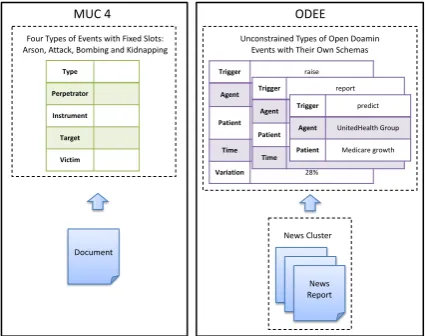
Figure 1: Comparison between MUC 4 and ODEE.
event extraction(ODEE), which is to extract un-constraint types of events and induce universal event schemas from clusters of news reports.
As shown in Figure 1, compared with tradi-tional event extraction task exemplified by MUC
4 (Sundheim,1992), the task of ODEE poses
ad-ditional challenges to modeling, which have not been considered in traditional methods. First, more than one event can be extracted from a news cluster, where events can be flexible in having varying numbers of slots in the open domain, and slots can be flexible without identical distributions regardless of the event type, which has been as-sumed by previous work on schema induction. Second, mentions of the same entities from differ-ent reports in a news cluster should be taken into account for improved performance.
We build an unsupervised generative model to address these challenges. While previous work on generative schema induction (Chambers,2013;
Cheung et al., 2013; Nguyen et al., 2015) relies
is designed, with a latent event type vector for each news cluster from a global parameterized normal distribution, and textual redundancy features for entities. Our model takes advantage of contextu-alized pre-trained language model (ELMo,Peters
et al.(2018)) and scalable neural variational
infer-ence (Srivastava and Sutton,2017).
To evaluate model performance, we collect and annotate a large-scale dataset from Google Busi-ness News1with diverse event types and explain-able event schemas. In addition to the standard metrics for schema matching, we adaptslot coher-encebased on NPMI (Lau et al.,2014) for quan-titatively measuring the intrinsic qualities of slots and schemas, which are inherently clusters.
Results show that our neural latent variable model outperforms state-of-the-art event schema induction methods. In addition, redundancy is highly useful for improving open domain event extraction. Visualizations of learned parameters show that our model can give reasonable latent event types. To our knowledge, we are the first to use neural latent variable model for inducing event schemas and extracting events. We release our code and dataset at https://github.com/
lx865712528/ACL2019-ODEE.
2 Related Work
The most popular schema induction and event ex-traction task setting is MUC 4, in which four event types - Arson, Attack, Bombing and Kidnapping
- and four slots -Perpetrator, Instrument, Target
and Victim - are defined. We compare the task settings of MUC 4 and ODEE in Figure 1. For MUC 4, the inputs are single news documents, and the output belongs to four types of events with schemas consisting of fixed slots. For ODEE, in contrast, the inputs are news clusters rather than the individual news, and the output is uncon-strained types of open domain events and unique schemas with various slot combinations.
Event Schema Induction seminal work stud-ies patterns (Shinyama and Sekine, 2006;
Fila-tova et al., 2006; Qiu et al., 2008) and event
chains (Chambers and Jurafsky, 2011) for tem-plate induction. For MUC 4, the current dominant methods include probabilistic generative methods
(Chambers, 2013; Cheung et al., 2013; Nguyen
et al., 2015) that jointly model predicate and
ar-1https://news.google.com/?hl=en-US&gl=
US&ceid=US:en, crawled from Oct. 2018 to Jan. 2019.
gument assignment, and ad-hoc clustering algo-rithms for inducing slots (Sha et al.,2016;Huang
et al.,2016;Ahn,2017;Yuan et al.,2018). These
methods all rely on hand-crafted discrete features without fully model the textual redundancy. There are also works on modeling event schemas and scripts using neural language models (Modi and
Titov, 2014; Rudinger et al., 2015; Pichotta and
Mooney,2016), but they do not explore neural
la-tent variables and redundancy.
Event Extraction work typically assumes that event schemas are given, recognizing event trig-gers and their corresponding arguments. This can be regarded as a subtask of ODEE. Existing work exploits sentence-level (McClosky et al.,2011;Li
et al., 2013; Liu et al., 2016;Yang and Mitchell,
2016) and document-level statistics (Liao and
Gr-ishman, 2010b; Ji and Grishman, 2008; Hong
et al.,2011;Reichart and Barzilay, 2012). There
has also been work using RNNs (Nguyen et al.,
2016b;Sha et al., 2018;Liu et al., 2018a; Chen
et al.,2018), CNNs (Chen et al.,2015;Feng et al.,
2016; Nguyen and Grishman, 2016) and GCNs
(Liu et al.,2018b) to represent sentences of events.
Event extraction has been treated as a supervised or semi-supervised (Liao and Grishman, 2010a;
Huang and Riloff,2012) task. In contrast, ODEE
is a fully unsupervised setting.
Event Discovery in Tweet Streams extracts news-worthy clusters of words, segments and frames. Both supervised and unsupervised meth-ods have been used. The former (Sakaki et al.,
2010;Benson et al.,2011) are typically designed
to monitor certain event types, while the lat-ter cluslat-ter features according to their burstiness
(Becker et al., 2011; Cui et al., 2012; Li et al.,
2012;Ritter et al., 2012; Qin et al., 2013; Ifrim
et al., 2014;McMinn and Jose, 2015; Qin et al.,
2017). This line of work is similar to our work in using information redundancy, but different be-cause we focus on formal news texts and induce structural event schemas.
First Story Detection (FSD) systems aim to identify news articles that discuss events not re-ported before. Most work on FSD detects first stories by finding the nearest neighbors of new documents (Kumaran and Allan, 2005; Moran
et al.,2016;Panagiotou et al.,2016;Vuurens and
de Vries,2016). This line of work exploits textual
clas-sification task. In contrast, we study the event schemas and extract detailed events.
3 Task and Data
Task Definition. In ODEE, the input consists of news clusters, each containing reports about the same event. The output is a bag of open-domain events, each consisting of an event trigger and a list of event arguments in its own schema. In most cases, one event is semantically sufficient to rep-resent the output.
Formally, given an open-domain news corpus
N containing a set of news clusters {c ∈ N }, suppose that there are Mc news reports {di ∈
c|i = 1,· · · , Mc} in the news cluster c focus-ing on the same event Ec. The output is a pair (Ec,TE), where Ec is the aforementioned set of open-domain events andTEis a set of schemas that
define the semantic slots for this set of events. Data Collection. We crawl news reports from Google Business News, which offers news clusters about the same events from different sources. In each news cluster, there are no more than five news reports. For each news report, we obtain the title, publish timestamp, download timestamp, source URL and full text. In total, we obtain 55,618 busi-ness news reports with 13,047 news clusters in 288 batches from Oct. 17, 2018, to Jan. 22, 2019. The crawler is executed about three times per day. The full text corpus is released as GNBusiness-Full-Text. For this paper, we trim the news reports in each news cluster by keeping the title and first paragraph, releasing asGNBusiness-All.
Inspired by the general slots in FrameNet
(Baker et al., 1998), we design reference event
schemas for open domain event types, which in-clude eight possible slots: Agent, Patient, Time,
Place, Aim, Old Value,New Value andVariation.
AgentandPatient are the semantic agent and pa-tient of the trigger, respectively; Aim is the tar-get or reason for the event. If the event involves value changes, Old Value serves the old value,
New Valueserves the new value and Variationis the variation between New Value and Old Value. Note that the roles that we define are more the-matic and less specific to detailed events as some of the existing event extraction datasets do (
Sund-heim, 1992; Nguyen et al., 2016a), because we
want to make our dataset general and useful for a wide range of open domain conditions. We leave finer-grained role typing to future work.
Split #C #R #S #W
Test 574 2,433 5,830 96,745
Dev 106 414 991 16,839
[image:3.595.316.515.61.123.2]Unlabelled 12,305 52,464 127,416 2,101,558 All 12,985 55,311 134,237 2,215,142 Full-Text 12,985 55,311 1,450,336 31,103,698
Table 1: Data split statistics. (Cnews clusters;Rnews reports;Ssentences;W words.)
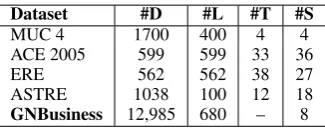
Dataset #D #L #T #S
MUC 4 1700 400 4 4
ACE 2005 599 599 33 36
ERE 562 562 38 27
ASTRE 1038 100 12 18
GNBusiness 12,985 680 – 8
Table 2: Comparison with existing datasets. (D doc-uments or news clusters;Llabeled documents or news clusters;T event types;Sslots.)
We randomly select 18 batches of news clusters, with 680 clusters in total, dividing them into a de-velopment set and a test set by a ratio of 1 : 5. The development set, test set and the rest unla-beled clusters are released as GNBusiness-Dev,
GNBusiness-Test andGNBusiness-Unlabeled, re-spectively. One coauthor and an external anno-tator manually label the events in the news clus-ters as gold standards. For each news cluster, they assign each entity which participants in the event or its head word a beforehand slot. The inter-annotator agreement (IAA) for each slot realiza-tion in the development set has a Cohen’s kappa
(Cohen,1960)κ= 0.7.
The statistics of each data split is shown in Ta-ble 1, and a comparison with existing event ex-traction and event schema induction datasets, in-cluding ASTRE (Nguyen et al.,2016a), MUC 4, ACE 20052and ERE3, is shown in Table2. Com-pared with the other datasets, GNBusiness has a much larger number of documents (i.e., news clus-ters in GNBusiness), and a comparable number of labeled documents.
4 Method
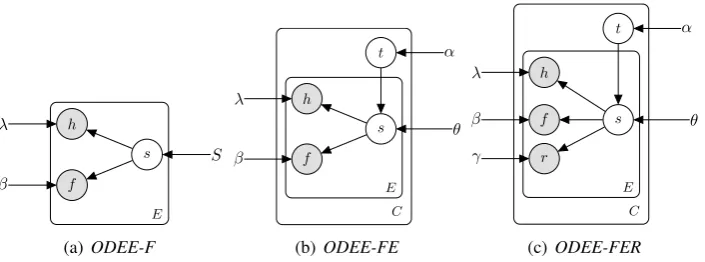
We investigate three incrementally more complex neural latent variable models for ODEE.
4.1 Model 1
Our first model is shown in Figure 2(a). It can be regarded as a neural extension ofNguyen et al.
2
https://catalog.ldc.upenn.edu/ LDC2006T06
3https://catalog.ldc.upenn.edu/
[image:3.595.334.497.163.229.2]s S
h
f
β λ
E
(a) ODEE-F
s h
f
t α
θ
β λ
E
C
(b)ODEE-FE
s h
f
t α
θ β
r
γ λ
E
C
[image:4.595.125.478.66.197.2](c)ODEE-FER
Figure 2: Plate notations for models. (S – # of slots;E– # of entities;C – # of news clusters;V – head word vocabulary size; the grey circles are observed variables and the white circles are hidden variables.)
Algorithm 1ODEE-F
1: foreach entitye∈Edo
2: Sample a slots∼Uniform(1, S)
3: Sample a headh∼Multinomial(1, λs)
4: Sample a feature vectorf∼Normal(β)
5: end for
(2015). Given a corpus N, we sample a slot s
for each entity e from a uniform distribution of
S slots, and then a head wordh from a multino-mial distribution, as well as a continuous feature vectorf ∈ Rnproduced by a contextual encoder. For simplicity, we assume thatf follows a multi-variable normal distribution whose covariance ma-trix is a diagonal mama-trix. We mark all the parame-ters (mean vectors and diagonal vectors of covari-ance matrixes) for the S different normal distri-butions for f asβ ∈ RS×2n, wherenrepresents the dimension off, treating the probability matrix
λ∈RS×V in the slot-head distribution as parame-ters under the row-wise simplex constraint, where
V is the head word vocabulary size. We call this modelODEE-F.
Pre-trained contextualized embeddings such as ELMo (Peters et al.,2018), GPTs (Radford et al.,
2018,2019) and BERT (Devlin et al., 2018) give improvements on a range of natural language pro-cessing tasks by offering rich language model in-formation. We choose ELMo4 as our contex-tual feature encoder, which manipulates unknown words by using character representations.
The generative story is shown in Algorithm 1. The joint probability of an entityeis
pλ,β(e) =p(s)×pλ(h|s)×pβ(f|s) (1)
4In practice, we use the “small” ELMo model with2×
128-d output inhttps://allennlp.org/elmoas ini-tial parameters and fine-tune it onGNBusiness-Full-Text.
Algorithm 2ODEE-FE
1: foreach news clusterc∈ Ndo
2: Sample a latent event type vectort∼Normal(α)
3: foreach entitye∈Ecdo
4: Sample a slots∼Multinomial(MLP(t;θ))
5: Sample a headh∼Multinomial(1, λs)
6: Sample a feature vectorf∼Normal(βs)
7: end for 8: end for
4.2 Model 2
A limitation ofODEE-F is that sampling slot as-signmentsfrom a global uniform distribution does not sufficiently model the fact that different events may have different slot distributions. Thus, in Fig-ure2(b), we further sample a latent event type vec-tor t ∈ Rn for each news cluster from a global normal distribution parameterized byα. We then usetand a multi-layer perceptron (MLP) with pa-rametersθto encode the corresponding slot distri-bution logits, sampling a discrete slot assignment
s ∼ Multinomial(MLP(t;θ)). The output of the MLP is passed through a softmax layer before be-ing used. We name this model asODEE-FE.
The generative story is shown in Algorithm 2. The joint probability of a news clustercis
pα,β,θ,λ(c) =pα(t)× Y
e∈Ec
pθ(s|t)
×pλ(h|s)×pβ(f|s) (2)
4.3 Model 3
intu-Algorithm 3ODEE-FER
1: foreach news clusterc∈ N do
2: Sample a latent event type vectort∼Normal(α)
3: foreach entitye∈Ecdo
4: Sample a slots∼Multinomial(MLP(t;θ))
5: Sample a headh∼Multinomial(1, λs)
6: Sample a feature vectorf∼Normal(βs)
7: Sample a redundancy ratior∼Normal(γs)
8: end for 9: end for
ition is that occurrence frequency is a straightfor-ward measure for word-level redundancy. Thus, in Figure 2(c), we additionally bring in the nor-malized occurrence frequency of a coreferential slot realization as an observed latent variabler ∼
Normal(γs). We call this modelODEE-FER. Formally, a news clustercreceives a latent event type vectortwhere each entitye∈ Ecreceives a slot types. The generative story is shown in Al-gorithm3. The joint distribution of a news clus-ter with head words, redundant contextual features and latent event type is
pα,β,γ,θ,λ(c) =pα(t)× Y
e∈Ec
pθ(s|t)
×pλ(h|s)×pβ(f|s)×pγ(r|s) (3)
4.4 Inference
We now consider two tasks for ODEE-FER: (1) learning the parameters and (2) performing infer-ence to obtain the posterior distribution of the la-tent variablessandt, given a news clusterc. We adapt the amortized variational inference method
ofSrivastava and Sutton(2017), using neural
in-ference network to learn the variational parame-ters. For simplicity, we concatenatef withr as a new observed feature vectorf0inODEE-FERand merge their parameters asβ0 ∈
RS×(2n+2). FollowingSrivastava and Sutton(2017), we col-lapse the discrete latent variable s to obtain an Evidence Lower BOund (ELBO) (Kingma and
Welling,2014) of the log marginal likelihood:
logpα,β0,θ,λ(c) =log
Z
t
[Y
e∈Ec
pλ,θ(h|t)pβ0,θ(f0|t)]pα(t)dt
≥ELBOc(α, β0, θ, λ, ω)
=Eqω(t)logpβ0,θ,λ(c|t)−DKL[qω(t)kpα(t)]
(4)
whereDKL[qωkpα]is the KL divergence between the variational posteriorqω and the priorpα. Due
BatchNorm & Exp BatchNorm
Fully Connected Average Pooling
Dropout Dropout
Concatenate
Head Word Histograms: ℎ Contextual Features: "’ Mean Vector: $ Variance Vector: %&
SoftPlus SoftPlus
[image:5.595.325.508.63.274.2]Fully Connected Fully Connected Fully Connected
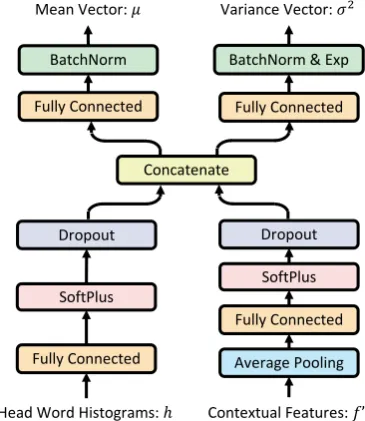
Figure 3: The framework of our inference network.
to the difficulty in computing the KL divergence between different categories of distributions and the existence of simple and effective reparameter-ization tricks for normal distributions, we choose
qω(t)to be a normal distribution parameterized by
ω, which is learned by a neural inference network. As shown in Figure3, our inference network takes the head word histograms h (the times of each head word appears in a news cluster) and contex-tual featuresf0 as inputs, and computes the mean
vectorµand the variance vectorσ2ofq ω(t). Equation4can be solved by obtaining a Monte Carlo sample and applying reparameterization tricks for the first term, and using the closed-form for the KL divergence term. We then use the ADAM optimizer (Kingma and Ba, 2014) to maximumize the ELBO. In addition, to allevi-ate the component collapsing problem (Dinh and
Dumoulin, 2016), we follow Srivastava and
Sut-ton(2017) and use high moment weight (> 0.8) and learning rate (in [0.001,0.1]) in the ADAM optimizer, performing batch normalization (Ioffe
and Szegedy,2015) and dropout (Srivastava et al.,
2014). After learning the model, we make slot as-signment for each entity mention by MLE, choos-ing the slotsthat maximizes the likelihood
pβ0,θ,λ(s|e, t)∝pβ0,θ,λ(s, h, f0, t)
=pθ(s|t)×pλ(h|s)×pβ0(f0|s)
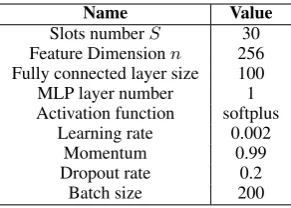
Name Value Slots numberS 30 Feature Dimensionn 256 Fully connected layer size 100 MLP layer number 1 Activation function softplus
Learning rate 0.002
Momentum 0.99
Dropout rate 0.2
[image:6.595.107.253.61.165.2]Batch size 200
Table 3: Hyper-parameters setting.
4.5 Assembling Events for Output
To assemble the events in a news clusterc for fi-nal output, we need to find the predicate for each entity, which now has a slot value. We use POS-tags and parse trees produced by the Stanford de-pendency parser (Klein and Manning,2003) to ex-tract the predicate for the head word of each entity mention. The following rules are applied: (1) if the governor of a head word is VB, or (2) if the governor of a head word isNNand belongs to the
noun.ACT ornoun.EVENT category of WordNet, then it is regarded as a predicate.
We merge the predicates of entity mentions in the same coreference chain as a predicate set. For each predicatevin these sets, we find the entities whose predicate set containsv, treating the entities as arguments of the event triggered byv. Finally, by ranking the numbers of arguments, we obtain top-N open-domain events as the outputEc.
5 Experiments
We verify the effectiveness of neural latent vari-able modeling and redundancy information for ODEE, and conduct case analysis. All our exper-iments are conducted on the GNBusiness dataset. Note that we do not compare our models and ex-isting work on MUC 4 or ACE 2005 due to the fact that these datasets do not consist of news clusters. Settings.The hyper-parameters in our models and inference network are shown in Table 3. Most of the hyper-parameters directly followSrivastava
and Sutton(2017), while the slot numberSis
cho-sen according to development experiments.
5.1 Evaluation Metrics
Schemas Matching. We follow previous work and useprecision,recallandF1-scoreas the met-rics for schema matching (Chambers and
Juraf-sky, 2011;Chambers, 2013;Cheung et al.,2013;
Nguyen et al.,2015;Sha et al.,2016;Ahn,2017).
The matching between model answers and refer-ences is based on the head word. Following pre-vious work, we regard as the head word the right-most word of an entity phrase or the right-right-most word before the first “of”, “that”, “which” and “by” if any.
In addition, we also perform slot mapping, be-tween slots that our model learns and slots in the annotation. Following previous work on MUC 4
(Chambers, 2013; Cheung et al., 2013; Nguyen
et al., 2015; Sha et al., 2016; Ahn, 2017), we
implement automatic greedy slot mapping. Each reference slot is mapped to a learned slot that ranks the best according to theF1-scoremetric on
GNBusiness-Dev.
Slot Coherence. Several metrics of qualitative topic coherence evaluation have been proposed.
Lau et al. (2014) showed that normalized
point-wise mutual information (NPMI) between all the pairs of words in a set of topics the most closely matches human judgment among all the compet-ing metrics. We thus adopt it asslot coherence5.
Formally, the slot coherenceCNPMI(s)of a slot
sis calculated by using its top-N head words as
CNPMI(s) =
2 N2−N
N X
i=2 i−1
X
j=1
NPMI(wi, wj)
(6)
NPMI(wi, wj) =
logp(wi,wj)+
p(wi)·p(wj)
−log(p(wi, wj) +)
(7)
where p(wj) and p(wi, wj) are estimated based on word co-occurrence counts derived within a sliding window over external reference documents andis added to avoid zero logarithm.
Previous work on topic coherence uses Wikipedia and Gigaword as the reference corpus to calculate word frequencies (Newman et al.,
2010; Lau et al., 2014). We use
GNBusiness-Full-Text, in which there are 1.45M sentences and 31M words, which is sufficient for estimating the probabilities. To reduce sparsity, for each news report, we count word co-occurrences in the whole document instead of a sliding window. In addition, for each slot, we keep the top-5, top-10, top-20, and top-100 head words, averaging the
4×Scoherence results over a test set.
5We use the implementation in https://github.
10 15 20 25 30 35 40 45 50 number of slots S
10 20 30 40 50
Performance (%)
Nguyen et al. (2015) F1
Nguyen et al. (2015) CNPMI
Clustering F1
ODEE-F F1
ODEE-F CNPMI
ODEE-FE F1
ODEE-FE CNPMI
ODEE-FER F1
[image:7.595.86.277.60.216.2]ODEE-FER CNPMI
Figure 4:F1scores of schemas matching and averaged slot coherencesCNPMIof the five models with different
numbers of slotsS.
Method Schema Matching (%)
P R F1
Nguyen et al.(2015) 41.5 53.4 46.7 Clustering 41.2 50.6 45.4
ODEE-F 41.7 53.2 46.8
ODEE-FE 42.4 56.1 48.3
[image:7.595.85.273.277.350.2]ODEE-FER 43.4 58.3 49.8
Table 4: Overall performance of schema matching.
5.2 Development Experiments
We learn the models on GNBusiness-Alland use
GNBusiness-Devto determine the slot numberS
by grid search in[10,50]with the step equals to5. Figure4shows theF1scores of schemas matching and averaged slot coherences of the five models we introduce in the next subsection with different numbers of slots S ranging from 10 to 50. We can see that for the bestF1 score ofODEE-FER, the optimal number of slots is 30, while for the best slot coherence, the optimal number of slots is 25. A value of S larger than 30 or smaller than 25 gives lower results on bothF1 score and slot coherence. Considering the balance between F1 score and slot coherence, we choseS = 30as our finalSvalue for the remaining experiments.
5.3 Final Results
Table 4 and Table 5 show the final results. The
p values based on the appropriate t-test are
pro-Method Ave Slot Coherence
Nguyen et al.(2015) 0.10
ODEE-F 0.10
ODEE-FE 0.16
[image:7.595.96.267.691.744.2]ODEE-FER 0.18
Table 5: Averaged slot coherence results.
vided below in cases where the compared values are close. We compare our work with Nguyen
et al. (2015), the state-of-the-art model on MUC
4 representing each entity as a triple containing a head word, a list of attribute relation features and a list of predicate relation features. Features in the model are discrete and extracted from dependency parse trees. The model structure is identical to our
ODEE-Fexcept for the features.
To test the strengths of our external features in isolation, we build another baseline model by taking the continuous features of each entity in ODEE-F and runing spectral clustering (von
Luxburg,2007). We call itClustering.
Schemas Matching. Table 4 shows the overall performance of schema matching on GNBusiness-Test. From the table, we can see thatODEE-FER
achieves the bestF1scores among all the methods. By comparing Nguyen et al. (2015) and ODEE-F (p = 0.01), we can see that using continuous contextual features gives better performance than discrete features. This demonstrates the advan-tages of continuous contextual features for allevi-ating the sparsity of discrete features in texts. We can also see from the result ofClusteringthat us-ing only the contextual features is not sufficient for ODEE, while combining with our neural latent variable model inODEE-Fcan achieve strong re-sults (p= 6×10⁻⁶). This shows that the neural la-tent variable model can better explain the observed data.
These results demonstrate the effectivenesses of our method in incorporating with contextual fea-tures, latent event types and redundancy infor-mation. Among ODEE models, ODEE-FEgives a 2% gain in F1 score against ODEE-F, which shows that the latent event type modeling is ben-eficial and the slot distribution relies on the latent event type. Additionally, there is a1%gain inF1 score by comparing ODEE-FER and ODEE-FE
(p = 2×10⁻⁶), which confirms that leveraging redundancy is also beneficial in exploring which slot an entity should be assigned.
Slot Coherence.Table5shows the comparison of averaged slot coherence results over all the slots in the schemas. Note that we do not report the slot coherence for the Clustering model because it does not output the top-N head words in each slot. The averaged slot coherence ofODEE-FER
Boston Dynamics' reveals its robodog Spot dancing Arby's will debut sous vide duck sandwich Prime Deli Corporation Recalls Salads
Massive recall issued for frozen beef, chicken taquitos Wendy's Offering $1 Any Size Fry For A Limited Time Netflix shares surge
[image:8.595.307.525.59.307.2]IBM drops 4.3% aftermarket Walmart lowered its profit targets UnitedHealth shares rise Intel shares gain
Figure 5: T-SNE visualization results of the latent event type vectors in the test set with colored labels produced by spectral clustering.
ofODEE-Fis comparable to that ofNguyen et al.
(2015) (p = 0.3415), which again demonstrates that the contextual features are a strong alterna-tive to discrete features. The scores ofODEE-FE
(p = 0.06) andODEE-FER(p = 10−5) are both higher than that ofODEE-F, which proves that the latent event type is critical in ODEE.
5.4 Latent Event Type Analysis
We are interested in learning how well the latent event type vectors can be modeled. To this end, for each news cluster inGNBusiness-Dev, we use our inference network in Figure3to calculate the meanµfor the latent event type vector t. T-SNE transformation (Maaten and Hinton,2008) of the mean vectors are shown in Figure 5. Spectral clustering is further applied, and the number of clusters is chosen by the Calinski-Harabasz Score
(Cali´nski and Harabasz,1974) in grid search.
In Figure5, there are four main clusters marked in different colors. Representative titles of news reports are shown as examples. We find that the vectors show salient themes for each main clus-ter. For example, the red cluster contains news re-ports about rise and drop of stocks such asNetflix shares surge,IBM drops,Intel shares gain, etc; the news reports in the purple cluster are mostly about product related activities, such asBoston Dynam-ics’ reveals its robodog Spot dancing,Arby’s will debut sous vide duck sandwich,Wendy’s Offering
$1 Any Size Fry, etc. The green cluster and the
DOC 1
2018-10-16 07:00:03
UnitedHealth shares rise after posting a 28% rise in third-quarter profit, raises 2018 forecast UnitedHealth, the largest U.S. health insurer, reported better-than-expected third-quarter earnings and revenue on Tuesday.
DOC 2
2018-10-16 00:00:00
UnitedHealth's 2018 so far: Three quarters, three boosts to outlook
DOC 3
2018-10-17 00:32:09
UnitedHealth Group predicts Medicare growth The comments came as the insurer beat profit expectations for Q3.
DOC 4
2018-10-16 10:53:06
UnitedHealth beats all around in 3Q, raises outlook again MINNEAPOLIS (AP) — UnitedHealth reported better-than-expected profits and revenue for the third quarter and the company raised its outlook yet again on strong trends in the insurance business.
Trigger raise
Agent UnitedHealth sharesUnitedHealth,
Patient better-than-expected profits,2018 forecast, the insurance business Time the third quarter Variation 28%
Event 1
Trigger report
Agent the largest U.S. health insurerUnitedHealth Group,
Patient third-quarter earningsbetter-than-expected
Time Tuesday
Trigger predict Agent UnitedHealth Group Patient Medicare growth
Event 2
[image:8.595.79.285.60.274.2]Event 3
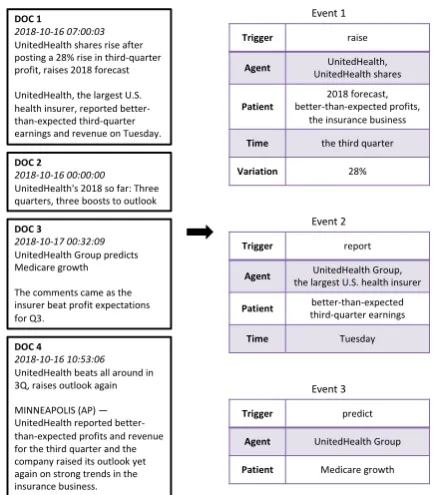
Figure 6: Extracted open domain events for United-Health shares rise.
orange cluster are also interpretable. The former is about organization reporting changes, while the latter is about service related activities.
5.5 Case Study
We further use the news cluster UnitedHealth shares rise in Figure 5 for case study. Figure
6 shows the top-3 open-domain events extracted from the news cluster, where four input news re-ports are shown on the left and three system-generated events are shown on the right with mapped slots.
the preprocessing errors in resolving coreference chains, some entity mentions are missing from the output.
There are also cases where one slot realization is semantically related to one trigger but eventu-ally appears in a different event. One example is the entity “better-than-expected profits”, which is related to the predicate word “report” but finally appears in the “raise” event. The cause can be errors propagated from parsing dependency trees, which confuse the syntactic predicate of the head word of an entity.
6 Conclusion
We presented the task of open domain event ex-traction, extracting unconstraint types of events from news clusters. A novel latent variable neu-ral model was investigated, which explores la-tent event type vectors and entity mention redun-dancy. In addition, GNBusiness dataset, a large-scale dataset annotated with diverse event types and explainable event schemas, is released along with this paper. To our knowledge, we are the first to use neural latent variable model for inducing event schemas and extracting events.
Acknowledgments
We thank the anonymous reviewers for their valu-able comments and suggestions. We thank Kiem-Hieu Nguyen from Hanoi University of Science and Technology for providing source code and solving confusions for their work. We thank Katherine Keith from University of Massachusetts at Amherst for sharing valuable experiences on probabilistic models. This work is supported by National Natural Science Foundation of China No. 61751201, National Key Research and Develop-ment Plan No. 2016QY03D0602, Research Foun-dation of Beijing Municipal Science and Technol-ogy Commission No. Z181100008918002, the funding from Rxhui Inc6 and China Scholarship Council No. 201806030142. The work is done when Xiao Liu is visiting Yue Zhang.
References
Natalie Ahn. 2017. Inducing event types and roles in reverse: Using function to discover theme. In Pro-ceedings of the Events and Stories in the News Work-shop@ACL 2017, pages 66–76.
6https://rxhui.com
Collin F. Baker, Charles J. Fillmore, and John B. Lowe. 1998. The berkeley framenet project. In Proceed-ings of the 36th Annual Meeting of the Associa-tion for ComputaAssocia-tional Linguistics and 17th Inter-national Conference on Computational Linguistics, pages 86–90.
Hila Becker, Mor Naaman, and Luis Gravano. 2011. Beyond trending topics: Real-world event identifi-cation on twitter. InProceedings of the 5th Inter-national Conference on Weblogs and Social Media, pages 438–441.
Edward Benson, Aria Haghighi, and Regina Barzilay. 2011. Event discovery in social media feeds. In
Proceedings of the 49th Annual Meeting of the As-sociation for Computational Linguistics, pages 389– 398.
Tadeusz Cali´nski and Jerzy Harabasz. 1974. A den-drite method for cluster analysis. Communications in Statistics-theory and Methods, 3(1):1–27.
Nathanael Chambers. 2013. Event schema induction with a probabilistic entity-driven model. In Pro-ceedings of the 2013 Conference on Empirical Meth-ods in Natural Language Processing, pages 1797– 1807.
Nathanael Chambers and Dan Jurafsky. 2011. Template-based information extraction without the templates. In Proceedings of the 49th Annual Meeting of the Association for Computational Linguistics, pages 976–986.
Yubo Chen, Liheng Xu, Kang Liu, Daojian Zeng, and Jun Zhao. 2015. Event extraction via dy-namic multi-pooling convolutional neural networks. In Proceedings of the 53rd Annual Meeting of the Association for Computational Linguistics and the 7th International Joint Conference on Natural Lan-guage Processing of the Asian Federation of Natural Language Processing, pages 167–176.
Yubo Chen, Hang Yang, Kang Liu, Jun Zhao, and Yan-tao Jia. 2018. Collective event detection via a hier-archical and bias tagging networks with gated multi-level attention mechanisms. In Proceedings of the 2018 Conference on Empirical Methods in Natural Language Processing, pages 1267–1276.
Jackie Chi Kit Cheung, Hoifung Poon, and Lucy Van-derwende. 2013. Probabilistic frame induction. In
Proceedings of the 2013 Conference of the North American Chapter of the Association for Computa-tional Linguistics: Human Language Technologies, pages 837–846.
Jacob Cohen. 1960. A coefficient of agreement for nominal scales. Educational and psychological measurement, 20(1):37–46.
Jacob Devlin, Ming-Wei Chang, Kenton Lee, and Kristina Toutanova. 2018. BERT: pre-training of deep bidirectional transformers for language under-standing.CoRR, abs/1810.04805.
Laurent Dinh and Vincent Dumoulin. 2016. Training neural bayesian nets. Technical report.
Xiaocheng Feng, Lifu Huang, Duyu Tang, Heng Ji, Bing Qin, and Ting Liu. 2016. A language-independent neural network for event detection. In
Proceedings of the 54th Annual Meeting of the Asso-ciation for Computational Linguistics, pages 66–71.
Elena Filatova, Vasileios Hatzivassiloglou, and Kath-leen R. McKeown. 2006. Automatic creation of do-main templates. InProceedings of the 44th Annual Meeting of the Association for Computational Lin-guistics and the 21st International Conference on Computational Linguistics, pages 207–214.
Yu Hong, Jianfeng Zhang, Bin Ma, Jian-Min Yao, Guodong Zhou, and Qiaoming Zhu. 2011. Using cross-entity inference to improve event extraction. In roceedings of the 49th Annual Meeting of the Association for Computational Linguistics, pages 1127–1136.
Lifu Huang, Taylor Cassidy, Xiaocheng Feng, Heng Ji, Clare R. Voss, Jiawei Han, and Avirup Sil. 2016. Liberal event extraction and event schema induction. InProceedings of the 54th Annual Meeting of the As-sociation for Computational Linguistics, pages 258– 268.
Ruihong Huang and Ellen Riloff. 2012. Bootstrapped training of event extraction classifiers. In Proceed-ings of the 13th Conference of the European Chap-ter of the Association for Computational Linguistics, pages 286–295.
Georgiana Ifrim, Bichen Shi, and Igor Brigadir. 2014. Event detection in twitter using aggressive filter-ing and hierarchical tweet clusterfilter-ing. In Proceed-ings of the SNOW 2014 Data Challenge co-located with 23rd International World Wide Web Confer-ence, pages 33–40.
Sergey Ioffe and Christian Szegedy. 2015. Batch nor-malization: Accelerating deep network training by reducing internal covariate shift. In Proceedings of the 32nd International Conference on Machine Learning, pages 448–456.
Heng Ji and Ralph Grishman. 2008.Refining event ex-traction through cross-document inference. In Pro-ceedings of the 46th Annual Meeting of the Associa-tion for ComputaAssocia-tional Linguistics, pages 254–262.
Diederik P. Kingma and Jimmy Ba. 2014. Adam: A method for stochastic optimization. CoRR, abs/1412.6980.
Diederik P Kingma and Max Welling. 2014. Auto-encoding variational bayes. InProceedings of the 2014 International Conference on Learning Repre-sentations.
Dan Klein and Christopher D. Manning. 2003. Ac-curate unlexicalized parsing. InProceedings of the 41st Annual Meeting of the Association for Compu-tational Linguistics, pages 423–430.
Giridhar Kumaran and James Allan. 2005. Using names and topics for new event detection. In Pro-ceedings of the 2005 Conference on Empirical Meth-ods in Natural Language Processing, pages 121– 128.
Jey Han Lau, David Newman, and Timothy Baldwin. 2014. Machine reading tea leaves: Automatically evaluating topic coherence and topic model quality. InProceedings of the 14th Conference of the Euro-pean Chapter of the Association for Computational Linguistics, pages 530–539.
Chenliang Li, Aixin Sun, and Anwitaman Datta. 2012.Twevent: segment-based event detection from tweets. In Proceedings of the 21st ACM Interna-tional Conference on Information and Knowledge Management, pages 155–164.
Qi Li, Heng Ji, and Liang Huang. 2013. Joint event extraction via structured prediction with global fea-tures. In Proceedings of the 51st Annual Meeting of the Association for Computational Linguistics, pages 73–82.
Shasha Liao and Ralph Grishman. 2010a. Filtered ranking for bootstrapping in event extraction. In
Proceedings of the 23rd International Conference on Computational Linguistics, pages 680–688.
Shasha Liao and Ralph Grishman. 2010b. Using doc-ument level cross-event inference to improve event extraction. InProceedings of the 48th Annual Meet-ing of the Association for Computational LMeet-inguis- Linguis-tics, pages 789–797.
Jian Liu, Yubo Chen, Kang Liu, and Jun Zhao. 2018a. Event detection via gated multilingual attention mechanism. InProceedings of the 32nd AAAI Con-ference on Artificial Intelligence, pages 4865–4872.
Shulin Liu, Yubo Chen, Shizhu He, Kang Liu, and Jun Zhao. 2016. Leveraging framenet to improve automatic event detection. In Proceedings of the 54th Annual Meeting of the Association for Compu-tational Linguistics, pages 2134–2143.
Xiao Liu, Zhunchen Luo, and Heyan Huang. 2018b. Jointly multiple events extraction via attention-based graph information aggregation. In Proceed-ings of the 2018 Conference on Empirical Methods in Natural Language Processing, pages 1247–1256.
Ulrike von Luxburg. 2007. A tutorial on spectral clus-tering.Statistics and Computing, 17(4):395–416.
David McClosky, Mihai Surdeanu, and Christopher D. Manning. 2011. Event extraction as dependency parsing. InProceedings of the 49th Annual Meet-ing of the Association for Computational LMeet-inguis- Linguis-tics, pages 1626–1635.
Andrew James McMinn and Joemon M. Jose. 2015. Real-time entity-based event detection for twitter. In
Proceedings of the Experimental IR Meets Multilin-guality, Multimodality, and Interaction - 6th Inter-national Conference of the CLEF Association, pages 65–77.
Ashutosh Modi and Ivan Titov. 2014. Inducing neu-ral models of script knowledge. InProceedings of the Eighteenth Conference on Computational Natu-ral Language Learning, pages 49–57.
Sean Moran, Richard McCreadie, Craig Macdonald, and Iadh Ounis. 2016. Enhancing first story detec-tion using word embeddings. InProceedings of the 39th International ACM SIGIR conference on Re-search and Development in Information Retrieval, pages 821–824.
David Newman, Jey Han Lau, Karl Grieser, and Tim-othy Baldwin. 2010. Automatic evaluation of topic coherence. InProceedings of the 2010 Conference of the North American Chapter of the Association for Computational Linguistics: Human Language Technologies, pages 100–108.
Kiem-Hieu Nguyen, Xavier Tannier, Olivier Ferret, and Romaric Besanc¸on. 2015. Generative event schema induction with entity disambiguation. In
Proceedings of the 53rd Annual Meeting of the Association for Computational Linguistics and the 7th International Joint Conference on Natural Lan-guage Processing of the Asian Federation of Natural Language Processing, pages 188–197.
Kiem-Hieu Nguyen, Xavier Tannier, Olivier Ferret, and Romaric Besanc¸on. 2016a. A dataset for open event extraction in english. In Proceedings of the 10th International Conference on Language Re-sources and Evaluation, pages 1939–1943.
Thien Huu Nguyen, Kyunghyun Cho, and Ralph Gr-ishman. 2016b. Joint event extraction via recurrent neural networks. InProceedings of the 2016 Con-ference of the North American Chapter of the Asso-ciation for Computational Linguistics: Human Lan-guage Technologies, pages 300–309.
Thien Huu Nguyen and Ralph Grishman. 2016. Mod-eling skip-grams for event detection with convolu-tional neural networks. InProceedings of the 2016 Conference on Empirical Methods in Natural Lan-guage Processing, pages 886–891.
Nikolaos Panagiotou, Cem Akkaya, Kostas Tsiout-siouliklis, Vana Kalogeraki, and Dimitrios Gunop-ulos. 2016. First story detection using entities and relations. In Proceedings of the 26th Inter-national Conference on Computational Linguistics, pages 3237–3244.
Matthew E. Peters, Mark Neumann, Mohit Iyyer, Matt Gardner, Christopher Clark, Kenton Lee, and Luke Zettlemoyer. 2018. Deep contextualized word repre-sentations. InProceedings of the 2018 Conference of the North American Chapter of the Association for Computational Linguistics: Human Language Technologies, pages 2227–2237.
Karl Pichotta and Raymond J. Mooney. 2016. Using sentence-level LSTM language models for script in-ference. InProceedings of the 54th Annual Meeting of the Association for Computational Linguistics.
Yanxia Qin, Yue Zhang, Min Zhang, and Dequan Zheng. 2013. Feature-rich segment-based news event detection on twitter. In Proceedings of the 6th International Joint Conference on Natural Lan-guage Processing, pages 302–310.
Yanxia Qin, Yue Zhang, Min Zhang, and Dequan Zheng. 2017. Semantic-frame representation for event detection on twitter. In Proceedings of the 2017 International Conference on Asian Language Processing, pages 264–267.
Long Qiu, Min-Yen Kan, and Tat-Seng Chua. 2008. Modeling context in scenario template creation. In
Proceedings of the 3rd International Joint Confer-ence on Natural Language Processing, pages 157– 164.
Alec Radford, Karthik Narasimhan, Tim Salimans, and Ilya Sutskever. 2018. Improving language under-standing by generative pre-training.
Alec Radford, Jeffrey Wu, Rewon Child, David Luan, Dario Amodei, and Ilya Sutskever. 2019. Language models are unsupervised multitask learners.
Roi Reichart and Regina Barzilay. 2012. Multi-event extraction guided by global constraints. In Proceed-ings of the 2012 Conference of the North American Chapter of the Association for Computational Lin-guistics: Human Language Technologies, pages 70– 79.
Alan Ritter, Mausam, Oren Etzioni, and Sam Clark. 2012. Open domain event extraction from twitter. In Proceedings of the 18th ACM SIGKDD Inter-national Conference on Knowledge Discovery and Data Mining, pages 1104–1112.
Rachel Rudinger, Pushpendre Rastogi, Francis Ferraro, and Benjamin Van Durme. 2015. Script induction as language modeling. InProceedings of the 2015 Conference on Empirical Methods in Natural Lan-guage Processing, pages 1681–1686.
Lei Sha, Sujian Li, Baobao Chang, and Zhifang Sui. 2016. Joint learning templates and slots for event schema induction. InProceedings of the 2016 Con-ference of the North American Chapter of the Asso-ciation for Computational Linguistics: Human Lan-guage Technologies, pages 428–434.
Lei Sha, Feng Qian, Baobao Chang, and Zhifang Sui. 2018. Jointly extracting event triggers and argu-ments by dependency-bridge RNN and tensor-based argument interaction. In Proceedings of the 32nd AAAI Conference on Artificial Intelligence, pages 5916–5923.
Yusuke Shinyama and Satoshi Sekine. 2006. Preemp-tive information extraction using unrestricted rela-tion discovery. InProceedings of the 2006 Confer-ence of the North American Chapter of the Associ-ation for ComputAssoci-ational Linguistics: Human Lan-guage Technologies, pages 304–311.
Akash Srivastava and Charles Sutton. 2017. Autoen-coding variational inference for topic models. In
Proceedings of the 2017 International Conference on Learning Representations.
Nitish Srivastava, Geoffrey E. Hinton, Alex Krizhevsky, Ilya Sutskever, and Ruslan Salakhutdi-nov. 2014. Dropout: a simple way to prevent neural networks from overfitting. Journal of Machine Learning Research, 15(1):1929–1958.
Beth Sundheim. 1992. Overview of the fourth mes-sage understanding evaluation and conference. In
Proceedings of the 4th Conference on Message Un-derstanding, pages 3–21.
Jeroen B. P. Vuurens and Arjen P. de Vries. 2016.First story detection using multiple nearest neighbors. In
Proceedings of the 39th International ACM SIGIR conference on Research and Development in Infor-mation Retrieval, pages 845–848.
Bishan Yang and Tom M. Mitchell. 2016. Joint ex-traction of events and entities within a document context. InProceedings of the 2016 Conference of the North American Chapter of the Association for Computational Linguistics: Human Language Tech-nologies, pages 289–299.