Proceedings of the 55th Annual Meeting of the Association for Computational Linguistics, pages 518–529 Vancouver, Canada, July 30 - August 4, 2017. c2017 Association for Computational Linguistics Proceedings of the 55th Annual Meeting of the Association for Computational Linguistics, pages 518–529
Vancouver, Canada, July 30 - August 4, 2017. c2017 Association for Computational Linguistics
Joint CTC/attention decoding for end-to-end speech recognition
Takaaki Hori, Shinji Watanabe, John R. Hershey Mitsubishi Electric Research Laboratories (MERL)
{thori,watanabe,hershey}@merl.com
Abstract
End-to-end automatic speech recognition (ASR) has become a popular alterna-tive to conventional DNN/HMM sys-tems because it avoids the need for linguistic resources such as pronuncia-tion dicpronuncia-tionary, tokenizapronuncia-tion, and context-dependency trees, leading to a greatly simplified model-building process. There are two major types of end-to-end archi-tectures for ASR: attention-based meth-ods use an attention mechanism to per-form alignment between acoustic frames and recognized symbols, and connection-ist temporal classification (CTC), uses Markov assumptions to efficiently solve sequential problems by dynamic program-ming. This paper proposes a joint de-coding algorithm for end-to-end ASR with a hybrid CTC/attention architecture, which effectively utilizes both advantages in decoding. We have applied the pro-posed method to two ASR benchmarks (spontaneous Japanese and Mandarin Chi-nese), and showing the comparable per-formance to conventional state-of-the-art DNN/HMM ASR systems without lin-guistic resources.
1 Introduction
Automatic speech recognition (ASR) is currently a mature set of technologies that have been widely deployed, resulting in great success in interface applications such as voice search. A typical ASR system is factorized into several modules includ-ing acoustic, lexicon, and language models based
on a probabilistic noisy channel model (Jelinek,
1976). Over the last decade, dramatic
improve-ments in acoustic and language models have been
driven by machine learning techniques known as deep learning (Hinton et al.,2012).
However, current systems lean heavily on the scaffolding of complicated legacy architectures that grew up around traditional techniques. For example, when we build an acoustic model from scratch, we have to first build hidden Markov model (HMM) and Gaussian mixture model (GMM) followed by deep neural networks (DNN). In addition, the factorization of acoustic, lexicon, and language models is derived by conditional in-dependence assumptions (especially Markov as-sumptions), although the data do not necessarily follow such assumptions leading to model mis-specification. This factorization form also yields a local optimum since the above modules are optimized separately. Further, to well factorize acoustic and language models, the system requires linguistic knowledge based on a lexicon model, which is usually based on a hand-crafted pronun-ciation dictionary to map word to phoneme se-quence. In addition to the pronunciation dictio-nary issue, some languages, which do not ex-plicitly have a word boundary, need
language-specific tokenization modules (Kudo et al.,2004;
Bird, 2006) for language modeling. Finally,
in-ference/decoding has to be performed by integrat-ing all modules resultintegrat-ing in complex decodintegrat-ing. Consequently, it is quite difficult for non-experts to use/develop ASR systems for new applications, especially for new languages.
End-to-end ASR has the goal of simplifying the above module-based architecture into a single-network architecture within a deep learning frame-work, in order to address the above issues. There are two major types of end-to-end architectures for ASR: attention-based methods use an attention mechanism to perform alignment between acous-tic frames and recognized symbols, and connec-tionist temporal classification (CTC), uses Markov
assumptions to efficiently solve sequential
prob-lems by dynamic programming (Chorowski et al.,
2014;Graves and Jaitly,2014).
The attention-based end-to-end method solves the ASR problem as a sequence mapping from speech feature sequences to text by using encoder-decoder architecture. The encoder-decoder network uses an attention mechanism to find an alignment be-tween each element of the output sequence and the hidden states generated by the acoustic en-coder network for each frame of acoustic input (Chorowski et al.,2014,2015;Chan et al.,2015;
Lu et al., 2016). This basic temporal attention mechanism is too flexible in the sense that it allows extremely non-sequential alignments. This may be fine for applications such as machine translation where input and output word order are different (Bahdanau et al., 2014;Wu et al., 2016). How-ever, in speech recognition, the feature inputs and corresponding letter outputs generally proceed in the same order. Another problem is that the input and output sequences in ASR can have very dif-ferent lengths, and these vary greatly from case to case, depending on the speaking rate and writing system, making it more difficult to track the align-ment.
However, an advantage is that the attention mechanism does not require any conditional in-dependence assumptions, and could address all the problems cited above. Although the align-ment problems of attention-based mechanisms have been partially addressed in (Chorowski et al.,
2014;Chorowski and Jaitly, 2016) using various mechanisms, here we propose more rigorous con-straints by using CTC-based alignment to guide the decoding.
CTC permits an efficient computation of a strictly monotonic alignment using dynamic pro-gramming (Graves et al.,2006;Graves and Jaitly,
2014) although it requires language models and
graph-based decoding (Miao et al., 2015) except
in the case of huge training data (Amodei et al.,
2015;Soltau et al.,2016). We propose to take ad-vantage of the constrained CTC alignment in a
hy-brid CTC/attention based system duringdecoding.
The proposed method adopts a CTC/attention hy-brid architecture, which was originally designed to regularize an attention-based encoder network
by additionally using a CTC duringtraining(Kim
et al.,2017). The proposed method extends the ar-chitecture to perform one-pass/rescoring joint
de-coding, where hypotheses of attention-based ASR are boosted by scores obtained by using CTC out-puts. This greatly reduces irregular alignments without any heuristic search techniques.
The proposed method is applied to Japanese and Mandarin ASR tasks, which require extra linguistic resources including morphological
an-alyzer (Kudo et al., 2004) or word segmentation
(Xue et al.,2003) in addition to pronunciation dic-tionary to provide accurate lexicon and language models in conventional DNN/HMM ASR. Sur-prisingly, the method achieved performance com-parable to, and in some cases superior to, several state-of-the-art DNN/HMM ASR systems, with-out using the above linguistic resources.
2 From DNN/HMM to end-to-end ASR
This section briefly provides a formulation of con-ventional DNN/HMM ASR and CTC or attention based end-to-end ASR.
2.1 Conventional DNN/HMM ASR
ASR deals with a sequence mapping from T
-length speech feature sequence X = {xt ∈
RD|t = 1,· · ·, T} to N-length word sequence
W = {wn ∈ V|n = 1,· · · , N}. xt is a D
dimensional speech feature vector (e.g., log Mel
filterbanks) at frame tandwn is a word at
posi-tion n in vocabulary V. ASR is mathematically
formulated with the Bayes decision theory, where
the most probable word sequenceWˆ is estimated
among all possible word sequencesV∗as follows:
ˆ
W = arg max
W∈V∗p(W|X). (1)
The posterior distribution p(W|X) is factorized
into the following three distributions by using the Bayes theorem and introducing HMM state se-quenceS ={st∈ {1,· · · , J}|t= 1,· · · , T}:
Eq. (1)≈arg max
W
X
S
p(X|S)p(S|W)p(W).
The three factors, p(X|S), p(S|W), and p(W),
are acoustic, lexicon, and language models, re-spectively. These are further factorized by using a probabilistic chain rule and conditional indepen-dence assumption as follows:
p(X|S)≈Qt p(st|xt)
p(st) , p(S|W)≈Qtp(st|st−1, W),
where the acoustic model is replaced with the product of framewise posterior distributions
p(st|xt) computed by powerful DNN
classi-fiers by using so-called pseudo likelihood trick (Bourlard and Morgan, 1994). p(st|st−1, W) is
represented by an HMM state transition givenW,
and the conversion fromW to HMM states is
de-terministically performed by using a pronuncia-tion dicpronuncia-tionary through a phoneme representapronuncia-tion.
p(wn|wn−1, . . . , wn−m−1) is obtained based on
an (m−1)th-order Markov assumption as a m
-gram model.
These conditional independence assumptions are often regarded as too strong assumption, lead-ing to model mis-specification. Also, to train the framewise posteriorp(st|xt), we have to provide
a framewise state alignmentst as a target, which
is often provided by a GMM/HMM system. Thus, conventional DNN/HMM systems make the ASR
problem formulated with Eq. (1) feasible by
us-ing factorization and conditional independence as-sumptions, at the cost of the problems discussed in Section1.
2.2 Connectionist Temporal Classification (CTC)
The CTC formulation also follows from Bayes
de-cision theory (Eq. (1)). Note that the CTC
formu-lation uses L-length letter sequence C = {cl ∈
U|l = 1,· · ·, L}with a set of distinct letters U.
Similarly to Section 2.1, by introducing
frame-wise letter sequence with an additional ”blank” (<b>) symbol Z = {zt ∈ U ∪ <b>|t =
1,· · · , T}, and by using the probabilistic chain
rule and conditional independence assumption, the posterior distributionp(C|X)is factorized as
fol-lows:
p(C|X)≈X
Z
Y
t
p(zt|zt−1, C)p(zt|X)
| {z }
,pctc(C|X)
p(C) p(Z)
(2)
As a result, CTC has three distribution com-ponents similar to the DNN/HMM case, i.e.,
framewise posterior distribution p(zt|X),
tran-sition probability p(zt|zt−1, C)1, and prior dis-tributions of letter and hidden-state sequences, 1Note that in the implementation, the transition value is
not normalized (i.e., not a probabilistic value) (Graves and Jaitly, 2014;Miao et al., 2015), similar to the HMM state transition implementation (Povey et al.,2011)
p(C) and p(Z), respectively. We also define
the CTC objective function pctc(C|X) used in
the later formulation. The framewise posterior
distribution p(zt|X) is conditioned on all
in-puts X, and it is quite natural to be modeled
by using bidirectional long short-term memory
(BLSTM): p(zt|X) = Softmax(Lin(ht)) and
ht=BLSTM(X). Softmax(·)is a sofmax
activa-tion funcactiva-tion, and Lin(·)is a linear layer to convert
hidden vectorhtto a(|U|+ 1)dimensional vector
(+1means a blank symbol introduced in CTC).
Although Eq. (2) has to deal with a
summa-tion over all possibleZ, it is efficiently computed
by using dynamic programming (Viterbi/forward-backward algorithm) thanks to the Markov prop-erty. In summary, although CTC and DNN/HMM systems are similar to each other due to condi-tional independence assumptions, CTC does not require pronunciation dictionaries and omits an GMM/HMM construction step.
2.3 Attention mechanism
Compared with hybrid and CTC approaches, the attention-based approach does not make any con-ditional independence assumptions, and directly
estimates the posterior p(C|X) based on a
prob-abilistic chain rule, as follows:
p(C|X) =Y
l
p(cl|c1,· · ·, cl−1, X)
| {z }
,patt(C|X)
, (3)
where patt(C|X) is an attention-based objective
function.p(cl|c1,· · · , cl−1, X)is obtained by
p(cl|c1,· · ·, cl−1, X) =Decoder(rl,ql−1, cl−1)
ht=Encoder(X) (4)
alt=Attention({al−1}t,ql−1,ht) (5)
rl=
X
t
altht. (6)
Eq. (4) converts input feature vectors X into a
framewise hidden vector ht in an encoder
net-work based on BLSTM, i.e., Encoder(X) ,
BLSTM(X). Attention(·) in Eq. (5) is based on
a content-based attention mechanism with convo-lutional features, as described in (Chorowski et al.,
2015) (see AppendixA).altis an attention weight,
and represents a soft alignment of hidden vectorht
for each outputcl based on the weighted
recurrent network conditioned on previous output
cl−1 and hidden vectorql−1, similar to RNNLM,
in addition to letter-wise hidden vectorrl. We use
Decoder(·),Softmax(Lin(LSTM(·))).
Attention-based ASR does not explicitly sep-arate each module, and potentially handles the
all issues pointed out in Section 1. It
implic-itly combines acoustic models, lexicon, and lan-guage models as encoder, attention, and decoder networks, which can be jointly trained as a single deep neural network.
Compared with DNN/HMM and CTC, which
are based on a transition form fromt−1totdue
to the Markov assumption, the attention mecha-nism does not maintain this constraint, and often provides irregular alignments. A major focus of this paper is to address this problem by using joint CTC/attention decoding.
3 Joint CTC/attention decoding
This section explains a hybrid CTC/attention net-work, which potentially utilizes both benefits of CTC and attention in ASR.
3.1 Hybrid CTC/attention architecture
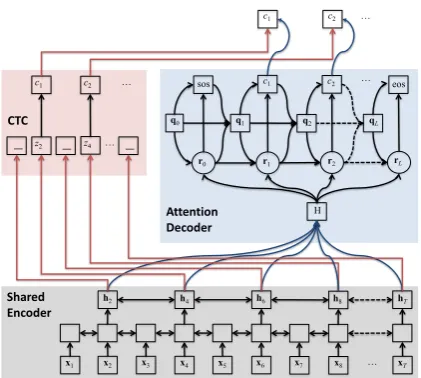
Kim et al.(2017) uses a CTC objective function as an auxiliary task to train the attention model en-coder within the multitask learning (MTL) frame-work, and this paper also uses the same
archi-tecture. Figure 1 illustrates the overall
architec-ture of the framework, where the same BLSTM is shared with CTC and attention encoder networks, respectively). Unlike the sole attention model, the forward-backward algorithm of CTC can enforce monotonic alignment between speech and label sequences during training. That is, rather than solely depending on data-driven attention meth-ods to estimate the desired alignments in long se-quences, the forward-backward algorithm in CTC helps to speed up the process of estimating the de-sired alignment. The objective to be maximized is a logarithmic linear combination of the CTC and attention objectives, i.e.,pctc(C|X)in Eq. (2) and
patt(C|X)in Eq. (3):
LMTL =λlogpctc(C|X) + (1−λ) logpatt(C|X),
(7)
with a tunable parameterλ: 0≤λ≤1.
3.2 Decoding strategies
The inference step of our joint CTC/attention-based end-to-end speech recognition is performed
ㅡ z2 ㅡ … ㅡ
sos c1 eos
q0
r0 r1 rL
H
h2 h4
q1 qL
hT
x1 x2 x3 x4 x5 x6 xT
Shared Encoder CTC
Attention Decoder
x7 x8 z4
h6 h8
…
c2
r2
q2
…
c1 c2 …
[image:4.595.308.519.60.249.2]c1 c2 …
Figure 1: Joint CTC/attention based end-to-end framework: the shared encoder is trained by both CTC and attention model objectives simultane-ously. The shared encoder transforms our input sequence{xt· · ·xT}into high level featuresH = {ht· · ·hT}, and the attention decoder generates the letter sequence{c1· · ·cL}.
by label synchronous decoding with a beam search similar to conventional attention-based ASR. However, we take the CTC probabilities into account to find a hypothesis that is better aligned
to the input speech, as shown in Figure1.
Here-after, we describe the general attention-based de-coding and conventional techniques to mitigate the alignment problem. Then, we propose joint de-coding methods with a hybrid CTC/attention ar-chitecture.
3.2.1 Attention-based decoding in general End-to-end speech recognition inference is gener-ally defined as a problem to find the most probable letter sequenceCˆ given the speech inputX, i.e.
ˆ
C = arg max
C∈U∗logp(C|X). (8)
In attention-based ASR, p(C|X) is computed by
Eq. (3), and Cˆ is found by a beam search
tech-nique.
Let Ωl be a set of partial hypotheses of the
length l. At the beginning of the beam search,
Ω0 contains only one hypothesis with the
start-ing symbol <sos> and the hypothesis score
α(<sos>, X)is set to 0. Forl= 1toLmax, each
partial hypothesis inΩl−1is expanded by
append-ing possible sappend-ingle letters, and the new
length of the hypotheses to be searched. The score of each new hypothesis is computed in the log do-main as
α(h, X) =α(g, X) + logp(c|g, X), (9)
wheregis a partial hypothesis inΩl−1,cis a letter
appended tog, andh is the new hypothesis such
thath = g·c. Ifcis a special symbol that
repre-sents the end of a sequence,<eos>,his added to
ˆ
Ωbut notΩl, whereΩˆ denotes a set of complete
hypotheses. Finally,Cˆis obtained by
ˆ
C = arg max
h∈Ωˆ α(h, X). (10)
In the beam search process,Ωlis allowed to hold
only a limited number of hypotheses with higher scores to improve the search efficiency.
Attention-based ASR, however, may be prone to include deletion and insertion errors because of its flexible alignment property, which can at-tend to any portion of the encoder state sequence to predict the next label, as discussed in Section
2.3. Since attention is generated by the decoder
network, it may prematurely predict the end-of-sequence label, even when it has not attended to all of the encoder frames, making the hypothesis too short. On the other hand, it may predict the next label with a high probability by attending to the same portions as those attended to before. In this case, the hypothesis becomes very long and includes repetitions of the same letter sequence. 3.2.2 Conventional decoding techniques To alleviate the alignment problem, a length penalty term is commonly used to control the
hy-pothesis length to be selected (Chorowski et al.,
2015; Bahdanau et al., 2016). With the length
penalty, the decoding objective in Eq. (8) is
changed to
ˆ
C = arg max
C∈U∗{logp(C|X) +γ|C|}, (11)
where|C|is the length of the sequenceC, andγis
a tunable parameter. However, it is actually diffi-cult to completely exclude hypotheses that are too
long or too short even if γ is carefully tuned. It
is also effective to control the hypothesis length by the minimum and maximum lengths to some extent, where the minimum and maximum are se-lected as fixed ratios to the length of the input speech. However, since there are exceptionally long or short transcripts compared to the input
speech, it is difficult to balance saving such excep-tional transcripts and preventing hypotheses with irrelevant lengths.
Another approach is the coverage term
re-cently proposed in (Chorowski and Jaitly,2016),
which is incorporated in the decoding objective in Eq. (11) as
ˆ
C = arg max
C∈U∗{logp(C|X) +γ|C|
+η·coverage(C|X)}, (12)
where the coverage term is computed by
coverage(C|X) =
T
X
t=1 " L
X
l=1
alt> τ
#
. (13)
ηandτare tunable parameters. The coverage term
represents the number of frames that have received
a cumulative attention greater than τ.
Accord-ingly, it increases when paying close attention to some frames for the first time, but does not in-crease when paying attention again to the same frames. This property is effective for avoiding looping of the same label sequence within a hy-pothesis. However, it is still difficult to obtain a
common parameter setting forγ,η,τ, and the
op-tional min/max lengths so that they are appropriate for any speech data from different tasks.
3.2.3 Joint decoding
Our joint CTC/attention approach combines the CTC and attention-based sequence probabilities in the inference step, as well as the training step. Suppose pctc(C|X) in Eq. (2) and patt(C|X) in
Eq. (3) are the sequence probabilities given by
CTC and the attention model. The decoding ob-jective is defined similarly to Eq. (7) as
ˆ
C= arg max
C∈U∗{λlogpctc(C|X)
+(1−λ) logpatt(C|X)}. (14)
The CTC probability enforces a monotonic align-ment that does not allow large jumps or looping of the same frames. Accordingly, it is possible to choose a hypothesis with a better alignment and exclude irrelevant hypotheses without relying on the coverage term, length penalty, or min/max lengths.
In the beam search process, the decoder needs to compute a score for each partial hypothesis
us-ing Eq. (9). However, it is nontrivial to combine
search, because the attention decoder performs it output-label-synchronously while CTC performs it frame-synchronously. To incorporate the CTC probabilities in the hypothesis score, we propose two methods.
Rescoring
The first method is a two-pass approach, in which the first pass obtains a set of complete hypotheses using the beam search, where only the attention-based sequence probabilities are considered. The second pass rescores the complete hypotheses us-ing the CTC and attention probabilities, where the CTC probabilities are obtained by the forward al-gorithm for CTC (Graves et al.,2006). The rescor-ing pass obtains the final result accordrescor-ing to
ˆ
C= arg max
h∈Ωˆ {λαctc(h, X) + (1−λ)αatt(h, X)}, (15)
where
(
αctc(h, X) ,logpctc(h|X)
αatt(h, X) ,logpatt(h|X) . (16)
One-pass decoding
The second method is one-pass decoding, in which we compute the probability of each partial hypoth-esis using CTC and an attention model. Here, we
utilize the CTC prefix probability (Graves,2008)
defined as the cumulative probability of all label
sequences that have the partial hypothesis h as
their prefix:
pctc(h, . . .|X) = X
ν∈(U∪{<eos>})+
pctc(h·ν|X),
and we define the CTC score as
αctc(h, X),logpctc(h, . . .|X), (17)
whereνrepresents all possible label sequences
ex-cept the empty string. The CTC score cannot be
obtained recursively as in Eq. (9), but it can be
computed efficiently by keeping the forward prob-abilities over the input frames for each partial hy-pothesis. Then it is combined withαatt(h, X).
The beam search algorithm for one-pass
decod-ing is shown in Algorithm 1. Ωl and Ωˆ are
ini-tialized in lines 2 and 3 of the algorithm, which are implemented as queues that accept partial
hy-potheses of the length l and complete
hypothe-ses, respectively. In lines 4–25, each partial
hy-pothesis g in Ωl−1 is extended by each label c
Algorithm 1Joint CTC/attention one-pass decod-ing
1: procedureONEPASSBEAMSEARCH(X,Lmax)
2: Ω0← {<sos>} 3: Ωˆ ← ∅
4: forl= 1. . . Lmaxdo
5: Ωl← ∅
6: whileΩl−16=∅do
7: g←HEAD(Ωl−1)
8: DEQUEUE(Ωl−1)
9: foreachc∈ U ∪ {<eos>}do
10: h←g·c
11: α(h,X)←λαctc(h,X)+(1−λ)αatt(h,X)
12: ifc=<eos>then
13: ENQUEUE( ˆΩ, h)
14: else
15: ENQUEUE(Ωl, h)
16: if|Ωl|>beamWidththen
17: REMOVEWORST(Ωl)
18: end if
19: end if
20: end for
21: end while
22: ifENDDETECT( ˆΩ, l) =truethen
23: break .exit for loop
24: end if
25: end for
26: returnarg maxh∈Ωˆα(h, X)
27: end procedure
in the label set U. Each extended hypothesis h
is scored in line 11, where CTC and attention-based scores are obtained byαctc()andαatt().
Af-ter that, if c = <eos>, the hypothesis h is
as-sumed to be complete and stored inΩˆ in line 13.
Ifc 6=<eos>,his stored inΩlin line 15, where
the number of hypotheses inΩlis checked in line
16. If the number exceeds the beam width, the
hy-pothesis with the worst score inΩlis removed by
REMOVEWORST() in line 17.
In line 11, the CTC and attention model scores are computed for each partial hypothesis. The at-tention score is easily obtained in the same
man-ner as Eq. (9), whereas the CTC score requires
a modified forward algorithm that computes it label-synchronously. The algorithm to compute
the CTC score is summarized in AppendixB. By
considering the attention and CTC scores during the beam search, partial hypotheses with irregu-lar alignments can be excluded, and the number of search errors is reduced.
We can optionally apply an end detection tech-nique to reduce the computation by stopping the
beam search before l reaches Lmax. Function
ENDDETECT(Ω, lˆ ) in line 22 returns true if there is little chance of finding complete
In our implementation, the function returnstrue if
MX−1
m=0 "
max
h∈Ω:ˆ |h|=l−α(h,Xm )−maxh0∈Ωˆα(h
0
, X)< Dend
# =M,
(18)
whereDend andM are predetermined thresholds.
This equation becomes true if complete
hypothe-ses with smaller scores are generated M times
consecutively. This technique is also available in attention-based decoding and rescoring methods described in Sections3.2.1–3.2.3.
4 Experiments
We used Japanese and Mandarin Chinese ASR benchmarks to show the effectiveness of the pro-posed joint CTC/attention decoding approach. The main reason for choosing these two languages is that those ideogram languages have relatively shorter lengths for letter sequences than those in alphabet languages, which reduces computational complexities greatly, and makes it easy to handle context information in a decoder network. Our preliminary investigation shows that Japanese and Mandarin Chinese end-to-end ASR can be eas-ily scaled up, and shows state-of-the-art perfor-mance without using various tricks developed in English tasks. Also, we would like to emphasize that the system did not use language-specific pro-cessing (e.g., morphological analyzer, Pinyin dic-tionary), and simply used all appeared characters in their transcriptions including Japanese syllable and Kanji, Chinese, Arabic number, and alphabet characters, as they are.
4.1 Corpus of Spontaneous Japanese (CSJ) We demonstrated ASR experiments by using the
Corpus of Spontaneous Japanese (CSJ) (Maekawa
et al.,2000). CSJ is a standard Japanese ASR task based on a collection of monologue speech data including academic lectures and simulated presen-tations. It has a total of 581 hours of training data and three types of evaluation data, where each evaluation task consists of 10 lectures (totally 5 hours). As input features, we used 40 mel-scale filterbank coefficients, with their first and second order temporal derivatives to obtain a total of 120-dimensional feature vector per frame. The encoder was a 4-layer BLSTM with 320 cells in each layer and direction, and linear projection layer is fol-lowed by each BLSTM layer. The 2nd and 3rd
bottom layers of the encoder read every second hidden state in the network below, reducing the utterance length by the factor of 4. We used the
content-based attention mechanism (Chorowski
et al., 2015), where the 10 centered convolution filters of width 100 were used to extract the con-volutional features. The decoder network was a 1-layer LSTM with 320 cells. The AdaDelta algo-rithm (Zeiler, 2012) with gradient clipping ( Pas-canu et al., 2012) was used for the optimization.
Dend andM in Eq (18) were set aslog 1e−10and
3, respectively. The hybrid CTC/attention ASR
was implemented by using the Chainer deep learn-ing toolkit (Tokui et al.,2015).
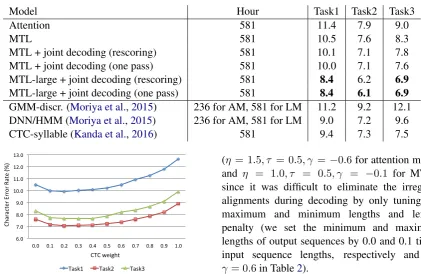
Table 1 first compares the character error rate
(CER) for conventional attention and MTL based
end-to-end ASR without the joint decoding. λin
Eq. (7) was set to 0.1. When decoding, we
man-ually set the minimum and maximum lengths of output sequences by 0.025 and 0.15 times input sequence lengths, respectively. The length penalty
γ in Eq. (11) was set to 0.1. Multitask learning
(MTL) significantly outperformed attention-based ASR in the all evaluation tasks, which confirms the effectiveness of a hybrid CTC/attention
archi-tecture. Table 1 also shows that joint decoding,
described in Section3.2, further improved the
per-formance without setting any search parameters (maximum and minimum lengths, length penalty),
but only setting a weight parameter λ = 0.1 in
Eq. (15) similar to the MTL case. Figure2 also
compares the dependency ofλon the CER for the
CSJ evaluation tasks, and showing thatλwas not
so sensitive to the performance if we setλaround
the value we used at MTL (i.e.,0.1).
We also compare the performance of the proposed MTL-large, which has a larger net-work (5-layer encoder netnet-work), with the con-ventional state-of-the-art techniques obtained by using linguistic resources. The state-of-the-art CERs of GMM discriminative training and DNN-sMBR/HMM systems are obtained from the Kaldi recipe (Moriya et al.,2015) and a system based on
syllable-based CTC with MAP decoding (Kanda
Table 1: Character error rate (CER) for conventional attention and hybrid CTC/attention end-to-end ASR. Corpus of Spontaneous Japanese speech recognition (CSJ) task.
Model Hour Task1 Task2 Task3
Attention 581 11.4 7.9 9.0
MTL 581 10.5 7.6 8.3
MTL + joint decoding (rescoring) 581 10.1 7.1 7.8
MTL + joint decoding (one pass) 581 10.0 7.1 7.6
MTL-large + joint decoding (rescoring) 581 8.4 6.2 6.9
MTL-large + joint decoding (one pass) 581 8.4 6.1 6.9
GMM-discr. (Moriya et al.,2015) 236 for AM, 581 for LM 11.2 9.2 12.1
DNN/HMM (Moriya et al.,2015) 236 for AM, 581 for LM 9.0 7.2 9.6
CTC-syllable (Kanda et al.,2016) 581 9.4 7.3 7.5
6.0 7.0 8.0 9.0 10.0 11.0 12.0 13.0
0.0 0.1 0.2 0.3 0.4 0.5 0.6 0.7 0.8 0.9 1.0
Ch
ar
ac
te
r E
rr
or
Rate
(%
)
CTC weight Task1 Task2 Task3
Figure 2: The effect of weight parameter λ in
Eq. (14) on the CSJ evaluation tasks (The CERs
were obtained by one-pass decoding).
data and experimental configurations of the pro-posed and reference methods are different, it is difficult to compare the performance listed in the table directly. However, since the CERs of the proposed method are superior to those of the best reference results, we can state that the proposed method achieves the state-of-the-art performance.
4.2 Mandarin telephone speech
We demonstrated ASR experiments on HKUST Mandarin Chinese conversational telephone
speech recognition (MTS) (Liu et al., 2006).
It has 5 hours recording for evaluation, and we extracted 5 hours from training data as a development set, and used the rest (167 hours) as a training set. All experimental conditions
were same as those in Section 4.1 except that
we used the λ = 0.5 in training and decoding
instead of 0.1 based on our preliminary
investi-gation and 80 mel-scale filterbank coefficients
with pitch features as suggested in (Miao et al.,
2016). In decoding, we also added a result of
the coverage-term based decoding (Chorowski
and Jaitly, 2016), as discussed in Section 3.2
(η = 1.5, τ = 0.5, γ = −0.6for attention model
and η = 1.0, τ = 0.5, γ = −0.1 for MTL),
since it was difficult to eliminate the irregular alignments during decoding by only tuning the maximum and minimum lengths and length penalty (we set the minimum and maximum lengths of output sequences by 0.0 and 0.1 times input sequence lengths, respectively and set
γ = 0.6in Table2).
Table 2 shows the effectiveness of MTL and
joint decoding over the attention-based approach, especially showing the significant improvement of the joint CTC/attention decoding. Similar to the
CSJ experiments in Section 4.1, we did not use
the length-penalty term or the coverage term in joint decoding. This is an advantage of joint de-coding over conventional approaches that require many tuning parameters. We also generated more training data by linearly scaling the audio lengths by factors of 0.9 and 1.1 (speed perturb.). The
fi-nal model achieved29.9% without using linguistic
resources, which defeats moderate state-of-the-art
systems including CTC-based methods2.
4.3 Decoding speed
We evaluated the speed of the joint decoding
meth-ods described in Section3.2.3. ASR decoding was
performed with different beam widths of 1, 3, 5, 10, and 20, and the processing time and CER were measured using a computer with Intel(R) Xeon(R) processors, E5-2690 v3, 2.6 GHz. Although the processors were multicore CPUs and the computer had GPUs, we ran the decoding program as a
2Although the proposed method did not reach the
perfor-mance obtained by a time delayed neural network (TDNN) with lattice-free sequence discriminative training (Povey
et al., 2016), our recent work scored 28.0%, and
Table 2: Character error rate (CER) for conventional attention and hybrid CTC/attention end-to-end ASR. HKUST Mandarin Chinese conversational telephone speech recognition (MTS) task.
Model dev eval
Attention 40.3 37.8
MTL 38.7 36.6
Attention + coverage 39.4 37.6
MTL + coverage 36.9 35.3
MTL + joint decoding (rescoring) 35.9 34.2
MTL + joint decoding (one pass) 35.5 33.9
MTL-large (speed perturb.) + joint decoding (rescoring) 31.1 30.1
MTL-large (speed perturb.) + joint decoding (one pass) 31.0 29.9
DNN/HMM – 35.9
LSTM/HMM (speed perturb.) – 33.5
CTC with language model (Miao et al.,2016) – 34.8
TDNN/HMM, lattice-free MMI (speed perturb.) (Povey et al.,2016) – 28.2
single-threaded process on a CPU to investigate its basic computational cost.
Table 3: RTF versus CER for the one-pass and rescoring methods.
Beam Rescoring One pass
Task
width RTF CER RTF CER
1 0.66 10.9 0.66 10.7
CSJ 3 1.11 10.3 1.02 10.1
Task1 5 1.50 10.2 1.31 10.0
10 2.46 10.1 2.07 10.0
20 5.02 10.1 3.76 10.0
1 0.68 37.1 0.65 35.9
HKUST 3 0.89 34.9 0.86 34.4
Eval set 5 1.04 34.6 1.03 34.2
10 1.55 34.4 1.50 34.0
20 2.66 34.2 2.55 33.9
Table 3 shows the relationships between the
real-time factor (RTF) and the CER for the CSJ and HKUST tasks. We evaluated the rescoring and one-pass decoding methods when using the end
detection in Eq. (18). In every beam width, we
can see that the one-pass method runs faster with an equal or lower CER than the rescoring method. This result demonstrates that the one-pass decod-ing is effective for reducdecod-ing search errors. Finally, we achieved 1xRT with one-pass decoding when using a beam width around 3 to 5, even though it was a single-threaded process on a CPU. However, the decoding process has not yet achieved real-time ASR since CTC and the attention mechanism need to access all of the frames of the input utter-ance even when predicting the first label. This is an essential problem of most end-to-end ASR ap-proaches and will be solved in future work.
5 Summary and discussion
This paper proposes end-to-end ASR by us-ing joint CTC/attention decodus-ing, which outper-formed ordinary attention-based end-to-end ASR by solving the misalignment issues. The joint de-coding methods actually reduced most of the ir-regular alignments, which can be confirmed from the examples of recognition errors and alignment
plots shown in AppendixC.
The proposed end-to-end ASR does not re-quire linguistic resources, such as morphological analyzer, pronunciation dictionary, and language model, which are essential components of conven-tional Japanese and Mandarin Chinese ASR sys-tems. Nevertheless, the method achieved com-parable/superior performance to the state-of-the-art conventional systems for the CSJ and MTS tasks. In addition, the proposed method does not require GMM/HMM construction for initial align-ments, DNN pre-training, lattice generation for se-quence discriminative training, complex search in decoding (e.g., FST decoder or lexical tree search based decoder). Thus, the method greatly simpli-fies the ASR building process, reducing code size and complexity.
Future work will apply this technique to the other languages including English, where we have to solve an issue of long sequence lengths, which requires heavy computation cost and makes it dif-ficult to train a decoder network. Actually, neu-ral machine translation handles this issue by us-ing a sub word unit (concatenatus-ing several letters
to form a new sub word unit) (Wu et al., 2016),
References
Dario Amodei, Rishita Anubhai, Eric Battenberg, Carl Case, Jared Casper, Bryan Catanzaro, Jingdong Chen, Mike Chrzanowski, Adam Coates, Greg Di-amos, et al. 2015. Deep speech 2: End-to-end speech recognition in english and mandarin. arXiv
preprint arXiv:1512.02595.
Dzmitry Bahdanau, Kyunghyun Cho, and Yoshua Ben-gio. 2014. Neural machine translation by jointly learning to align and translate. arXiv preprint
arXiv:1409.0473.
Dzmitry Bahdanau, Jan Chorowski, Dmitriy Serdyuk, Philemon Brakel, and Yoshua Bengio. 2016. End-to-end attention-based large vocabulary speech recognition. In IEEE International Conference on
Acoustics, Speech and Signal Processing (ICASSP).
pages 4945–4949.
Steven Bird. 2006. NLTK: the natural language toolkit.
In Joint conference of the International Committee
on Computational Linguistics and the Association for Computational Linguistics (COLING/ACL) on
Interactive presentation sessions. pages 69–72.
Herv´e Bourlard and Nelson Morgan. 1994.
Con-nectionist speech recognition: A hybrid approach.
Kluwer Academic Publishers.
William Chan, Navdeep Jaitly, Quoc V Le, and Oriol Vinyals. 2015. Listen, attend and spell. arXiv
preprint arXiv:1508.01211.
Jan Chorowski, Dzmitry Bahdanau, Kyunghyun Cho, and Yoshua Bengio. 2014. End-to-end continuous speech recognition using attention-based recurrent NN: First results. arXiv preprint arXiv:1412.1602
.
Jan Chorowski and Navdeep Jaitly. 2016. Towards better decoding and language model integration in sequence to sequence models. arXiv preprint
arXiv:1612.02695.
Jan K Chorowski, Dzmitry Bahdanau, Dmitriy Serdyuk, Kyunghyun Cho, and Yoshua Bengio. 2015. Attention-based models for speech recogni-tion. InAdvances in Neural Information Processing
Systems (NIPS). pages 577–585.
Alex Graves. 2008. Supervised sequence labelling with recurrent neural networks. PhD thesis,
Tech-nische Universit¨at M¨unchen.
Alex Graves, Santiago Fern´andez, Faustino Gomez, and J¨urgen Schmidhuber. 2006. Connectionist temporal classification: labelling unsegmented se-quence data with recurrent neural networks. In
International Conference on Machine learning
(ICML). pages 369–376.
Alex Graves and Navdeep Jaitly. 2014. Towards end-to-end speech recognition with recurrent neural net-works. In International Conference on Machine
Learning (ICML). pages 1764–1772.
Geoffrey Hinton, Li Deng, Dong Yu, George E Dahl, Abdel-rahman Mohamed, Navdeep Jaitly, Andrew Senior, Vincent Vanhoucke, Patrick Nguyen, Tara N Sainath, et al. 2012. Deep neural networks for acoustic modeling in speech recognition: The shared views of four research groups.IEEE Signal
Process-ing Magazine29(6):82–97.
Frederick Jelinek. 1976. Continuous speech recogni-tion by statistical methods. Proceedings of the IEEE
64(4):532–556.
Naoyuki Kanda, Xugang Lu, and Hisashi Kawai. 2016. Maximum a posteriori based decoding for CTC acoustic models. InInterspeech 2016. pages 1868– 1872.
Suyoun Kim, Takaaki Hori, and Shinji Watanabe. 2017. Joint CTC-attention based end-to-end speech recognition using multi-task learning. InIEEE In-ternational Conference on Acoustics, Speech and
Signal Processing (ICASSP). pages 4835–4839.
Taku Kudo, Kaoru Yamamoto, and Yuji Matsumoto. 2004. Applying conditional random fields to japanese morphological analysis. InConference on Empirical Methods on Natural Language
Process-ing (EMNLP). volume 4, pages 230–237.
Yi Liu, Pascale Fung, Yongsheng Yang, Christopher Cieri, Shudong Huang, and David Graff. 2006. HKUST/MTS: A very large scale mandarin tele-phone speech corpus. InChinese Spoken Language
Processing, Springer, pages 724–735.
Liang Lu, Xingxing Zhang, and Steve Renals. 2016. On training the recurrent neural network encoder-decoder for large vocabulary end-to-end speech recognition. In IEEE International Conference on
Acoustics, Speech and Signal Processing (ICASSP).
pages 5060–5064.
Kikuo Maekawa, Hanae Koiso, Sadaoki Furui, and Hi-toshi Isahara. 2000. Spontaneous speech corpus of japanese. InInternational Conference on Language
Resources and Evaluation (LREC). volume 2, pages
947–952.
Yajie Miao, Mohammad Gowayyed, and Florian Metze. 2015. EESEN: End-to-end speech recogni-tion using deep RNN models and WFST-based de-coding. In IEEE Workshop on Automatic Speech
Recognition and Understanding (ASRU). pages
167–174.
Yajie Miao, Mohammad Gowayyed, Xingyu Na, Tom Ko, Florian Metze, and Alexander Waibel. 2016. An empirical exploration of ctc acoustic mod-els. In IEEE International Conference on
Acous-tics, Speech and Signal Processing (ICASSP). pages
2623–2627.
Takafumi Moriya, Takahiro Shinozaki, and Shinji Watanabe. 2015. Kaldi recipe for Japanese sponta-neous speech recognition and its evaluation. In
Razvan Pascanu, Tomas Mikolov, and Yoshua Bengio. 2012. On the difficulty of training recurrent neural networks. arXiv preprint arXiv:1211.5063. Daniel Povey, Arnab Ghoshal, Gilles Boulianne, Lukas
Burget, Ondrej Glembek, Nagendra Goel, Mirko Hannemann, Petr Motlicek, Yanmin Qian, Petr Schwarz, Jan Silovsky, Georg Stemmer, and Karel Vesely. 2011. The kaldi speech recognition toolkit.
In IEEE Workshop on Automatic Speech
Recogni-tion and Understanding (ASRU).
Daniel Povey, Vijayaditya Peddinti, Daniel Galvez, Pe-gah Ghahrmani, Vimal Manohar, Xingyu Na, Yim-ing Wang, and Sanjeev Khudanpur. 2016. Purely sequence-trained neural networks for asr based on lattice-free MMI. InInterspeech. pages 2751–2755. Hagen Soltau, Hank Liao, and Hasim Sak. 2016. Neu-ral speech recognizer: Acoustic-to-word lstm model for large vocabulary speech recognition. arXiv
preprint arXiv:1610.09975.
Seiya Tokui, Kenta Oono, Shohei Hido, and Justin Clayton. 2015. Chainer: a next-generation open source framework for deep learning. InProceedings of Workshop on Machine Learning Systems
(Learn-ingSys) in NIPS.
Yonghui Wu, Mike Schuster, Zhifeng Chen, Quoc V Le, Mohammad Norouzi, Wolfgang Macherey, Maxim Krikun, Yuan Cao, Qin Gao, Klaus Macherey, et al. 2016. Google’s neural ma-chine translation system: Bridging the gap between human and machine translation. arXiv preprint
arXiv:1609.08144.
Nianwen Xue et al. 2003. Chinese word segmentation as character tagging. Computational Linguistics and
Chinese Language Processing8(1):29–48.
Matthew D Zeiler. 2012. Adadelta: an adaptive learn-ing rate method.arXiv preprint arXiv:1212.5701.
A Location-based attention mechanism
This section provides the equations of a location-based attention mechanism Attention(·)in Eq. (5).
alt=Attention({al−1}t,ql−1,ht),
where{al−1}t= [al−1,1,· · ·, al−1,T]>. To obtain
alt, we use the following equations:
{ft}t=K∗al−1 (19)
elt=g>tanh(Gqql−1+Ghht+Gfft+b) (20)
alt=
exp(etl)
P
texp(etl) (21)
K,Gq,Gh,Gfare matrix parameters. bandgare
vector parameters.∗denotes convolution along
in-put feature axistwith matrixKto produce feature
{ft}t.
Algorithm 2CTC hypothesis score
1: functionαCTC(h, X)
2: g, c←h .splithinto the last labelcand the restg 3: ifc=<eos>then
4: returnlog{γT(n)(g) +γT(b)(g)} 5: else
6: γ1(n)(h)←
p(z1=c|X) ifg=<sos>
0 otherwise
7: γ1(b)(h)←0
8: Ψ←γ(1n)(h)
9: fort= 2. . . T do 10: Φ←γt(−1b)(g) +
0 if last(g) =c
γ(t−n)1(g) otherwise 11: γt(n)(h)←
γt(−1n)(h) + Φp(zt=c|X)
12: γt(b)(h) ←
γt(−b)1(h) +γ (n) t−1(h)
p(zt =
<b>|X)
13: Ψ←Ψ + Φ·p(zt=c|X)
14: end for
15: returnlog(Ψ)
16: end if
17: end function
B CTC-based hypothesis score
The CTC scoreαctc(h, X)in Eq. (17) is computed
as shown in Algorithm2. Letγt(n)(h)andγt(b)(h)
be the forward probabilities of the hypothesis h
over the time frames1. . . t, where the superscripts
(n) and (b) denote different cases in which all
CTC paths end with a nonblank or blank sym-bol, respectively. Before starting the beam search,
γt(n)()andγt(b)()are initialized for t = 1, . . . , T
as
γt(n)(<sos>) = 0, (22)
γt(b)(<sos>) =
t
Y
τ=1
γτ(b−)1(<sos>)p(zτ=<b>|X),
(23)
where we assume thatγ0(b)(<sos>) = 1and<b>
is a blank symbol. Note that the time indextand
input lengthT may differ from those of the input
utteranceX owing to the subsampling technique
for the encoder (Povey et al., 2016; Chan et al.,
2015).
In Algorithm 2, the hypothesis h is first split
into the last labelc and the rest g in line 2. If c
is<eos>, it returns the logarithm of the forward
probability assuming thathis a complete
hypothe-sis in line 4. The forward probability ofhis given
by
pctc(h|X) =γT(n)(g) +γT(b)(g) (24)
according to the definition ofγt(n)()andγt(b)(). If
proba-bilitiesγt(n)(h)andγt(b)(h), and the prefix
proba-bilityΨ = pctc(h, . . .|X) assuming thath is not
a complete hypothesis. The initialization and re-cursion steps for those probabilities are described in lines 6–14. In this function, we assume that whenever we compute the probabilities γt(n)(h), γt(b)(h) andΨ, the forward probabilities γt(n)(g)
and γt(b)(g) have already been obtained through
the beam search process becauseg is a prefix of
hsuch that|g|<|h|.
C Examples of irregular alignments
We list examples of irregular alignments caused by
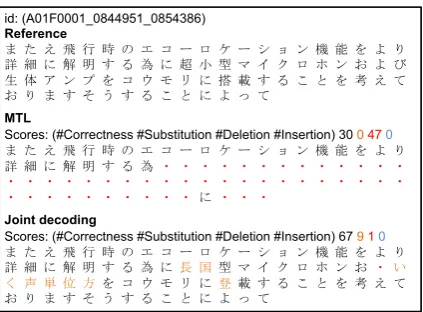
attention-based ASR. Figure3shows an example
of repetitions of word chunks. The first chunk of blue characters in attention-based ASR (MTL) is appeared again, and the whole second chunk part
becomes insertion errors. Figure 4 shows an
ex-ample of deletion errors. The latter half of the sentence in attention-based ASR (MTL) is bro-ken, which causes deletion errors. The hybrid CTC/attention with both multitask learning and
joint decoding avoids these issues. Figures5and6
show alignment plots corresponding to Figs.3and
4, respectively, where X-axis shows time frames
and Y-axis shows the character sequence hypoth-esis. These visual plots also demonstrate that the proposed joint decoding approach can suppress ir-regular alignments.
id: (20040717_152947_A010409_B010408-A-057045-057837)
Reference
但是如果你想想如果回到了 过 去你如果 带 着 这 个 现 在的 记 忆 是不是很痛苦啊
MTL
Scores: (#Correctness #Substitution #Deletion #Insertion) 28 2 3 45
但是如果你想想如果回到了 过 去你如果 带 着 这 个 现 在的 节
如果你想想如果回到了 过 去你如果 带 着 这 个 现 在的 节 如果 你想想如果回到了 过 去你如果 带 着 这 个 现 在 的 机 是不是很
・・・
Joint decoding
Scores: (#Correctness #Substitution #Deletion #Insertion) 31 1 1 0 HYP: 但是如果你想想如果回到了 过 去你如果 带 着 这 个 现
在的・机 是不是很痛苦啊
Figure 3: Example of insertion errors appeared in attention-based ASR with MTL and joint decod-ing.
id: (A01F0001_0844951_0854386) Reference
ま た え 飛 行 時 の エ コ ー ロ ケ ー シ ョ ン 機 能 を よ り 詳 細 に 解 明 す る 為 に 超 小 型 マ イ ク ロ ホ ン お よ び 生 体 ア ン プ を コ ウ モ リ に 搭 載 す る こ と を 考 え て お り ま す そ う す る こ と に よ っ て
MTL
Scores: (#Correctness #Substitution #Deletion #Insertion) 30 047 0
ま た え 飛 行 時 の エ コ ー ロ ケ ー シ ョ ン 機 能 を よ り 詳 細 に 解 明 す る 為 ・ ・ ・ ・ ・ ・ ・ ・ ・ ・ ・ ・ ・ ・ ・ ・ ・ ・ ・ ・ ・ ・ ・ ・ ・ ・ ・ ・ ・ ・ ・ ・ ・ ・ ・ ・ ・ ・ ・ ・ ・ ・ ・ ・ に ・ ・ ・
Joint decoding
Scores: (#Correctness #Substitution #Deletion #Insertion) 67 91 0
[image:12.595.311.523.69.225.2]ま た え 飛 行 時 の エ コ ー ロ ケ ー シ ョ ン 機 能 を よ り 詳 細 に 解 明 す る 為 に 長 国 型 マ イ ク ロ ホ ン お ・ い く 声 単 位 方 を コ ウ モ リ に 登 載 す る こ と を 考 え て お り ま す そ う す る こ と に よ っ て
Figure 4: Example of deletion errors appeared in attention-based ASR with MTL and joint decod-ing.
(a) MTL (b) Joint decoding
Figure 5: Example of alignments
includ-ing insertion errors in attention-based ASR with MTL and joint decoding (Utterance
id: 20040717 152947 A010409
B010408-A-057045-057837).
(a) MTL (b) Joint decoding
Figure 6: Example of alignments