Proceedings of the 57th Annual Meeting of the Association for Computational Linguistics, pages 5786–5796 5786
Generalized Data Augmentation for Low-Resource Translation
Mengzhou Xia, Xiang Kong, Antonios Anastasopoulos, Graham Neubig Language Technologies Institute, Carnegie Mellon University
{mengzhox, xiangk, aanastas, gneubig}@andrew.cmu.edu
Abstract
Translation to or from low-resource languages (LRLs) poses challenges for machine transla-tion in terms of both adequacy and fluency. Data augmentation utilizing large amounts of monolingual data is regarded as an effective way to alleviate these problems. In this pa-per, we propose a general framework for data augmentation in low-resource machine transla-tion that not only uses target-side monolingual data, but also pivots through a related high-resource language (HRL). Specifically, we ex-periment with a two-step pivoting method to convert high-resource data to the LRL, mak-ing use of available resources to better approx-imate the true data distribution of the LRL. First, we injectLRLwords intoHRLsentences
through an induced bilingual dictionary. Sec-ond, we further edit these modified sentences using a modified unsupervised machine trans-lation framework. Extensive experiments on four low-resource datasets show that under ex-treme low-resource settings, our data augmen-tation techniques improve translation quality by up to 1.5 to 8 BLEU points compared to supervised back-translation baselines.1
1 Introduction
The task of Machine Translation (MT) for low re-source languages (LRLs) is notoriously hard due to the lack of the large parallel corpora needed to achieve adequate performance with current Neu-ral Machine Translation (NMT) systems (Koehn and Knowles,2017). A standard practice to im-prove training of models for an LRL of interest (e.g. Azerbaijani) is utilizing data from a related high-resource language (HRL, e.g. Turkish). Both transferring fromHRLto LRL(Zoph et al.,2016;
Nguyen and Chiang, 2017;Gu et al., 2018) and
1Code is available at https://github.com/
xiamengzhou/DataAugForLRL
: Available Resource : Generated Resource
LRL ENG [c]
HRL ENG [b]
ENG [a]
HRL LRL ENG
LRL ENG
LRL ENG
[1] ENG→LRL
[2]
ENG→HRL
[4]
HRL→LRL
[image:1.595.317.520.224.361.2][3] HRL→LRL
Figure 1: With a low-resource language (LRL) and a related high-resource language (HRL), typical data aug-mentation scenarios use any available parallel data [b] and [c] to back-translate English monolingual data [a] and generate parallel resources ([1] and [2]). We addi-tionally propose scenarios [3] and [4], where we pivot throughHRLin order to generate aLRL–ENGresource.
joint training onHRLandLRLparallel data ( John-son et al.,2017;Neubig and Hu,2018) have shown to be effective techniques for low-resource NMT. Incorporating data from other languages can be viewed as one form data augmentation, and particu-larly large improvements can be expected when the HRL shares vocabulary or is syntactically similar with theLRL(Lin et al.,2019). Simple joint train-ing is still not ideal, though, considertrain-ing that there will still be many words and possibly even syntactic structures that will not be shared between the most highly related languages. There are model-based methods that ameliorate the problem through more expressive source-side representations conducive to sharing (Gu et al.,2018;Wang et al.,2019), but they add significant computational and implemen-tation complexity.
access to parallel or monolingual data of anLRL of interest, itsHRL, and the target language, which we will assume is English. We propose methods to create pseudo-parallelLRLdata in this setting. As illustrated in Figure1, we augment parallel data via two main methods: 1) back-translating fromENG toLRLorHRL; 2) converting theHRL-ENGdataset to a pseudoLRL-ENGdataset.
In the first thread, we focus on creating new parallel sentences through back-translation. Back-translating from the target language to the source (Sennrich et al.,2016) is a common practice in data augmentation, but has also been shown to be less effective in low-resource settings where it is hard to train a good back-translation model (Currey et al.,
2017). As a way to ameliorate this problem, we ex-amine methods to instead translate from the target language to a highly-relatedHRL, which remains unexplored in the context of low-resource NMT. This pseudo-HRL-ENGdataset can then be used for joint training with theLRL-ENGdataset.
In the second thread, we focus on converting an HRL-ENGdataset to a pseudo-LRL-to-ENGdataset that better approximates the true LRLdata. Con-verting betweenHRLs andLRLs also suffers from lack of resources, but because theLRLandHRLare related, this is an easier task that we argue can be done to some extent by simple (or unsupervised) methods.2 In our proposed method, for the first step, we substituteHRL words on the source side ofHRL parallel datasets with correspondingLRL words from an induced bilingual dictionary gen-erated by mapping word embedding spaces (Xing et al.,2015;Lample et al.,2018b). In the second step, we further attempt translate the pseudo-LRL sentences to be closer toLRLones utilizing an un-supervised machine translation framework.
In sum, our contributions are four fold:
1. We conduct a thorough empirical evalua-tion of data augmentaevalua-tion methods for low-resource translation that take advantage of all accessible data, across four language pairs. 2. We explore two methods for translating
be-tween related languages: word-by-word sub-stitution using an induced dictionary, and un-supervised machine translation that further uses this word-by-word substituted data as
2This sort of pseudo-corpus creation was examined in a different context of pivoting for SMT (De Gispert and Marino, 2006), but this was usually done with low-resource source-target language pairs with English as the pivot.
input. These methods improve over simple unsupervised translation fromHRLtoLRLby more than 2 to 10 BLEU points.
3. Our proposed data augmentation methods improve over standard supervised back-translation by 1.5 to 8 BLEU points, across all datasets, and an additional improvement of up to 1.1 BLEU points by augmenting from both ENGmonolingual data, as well asHRL-ENG parallel data.
2 A Generalized Framework for Data Augmentation
In this section, we outline a generalized data aug-mentation framework for low-resource NMT.
2.1 Datasets and Notations
Given anLRLof interest and its correspondingHRL, with the goal of translating theLRLto English, we usually have access to 1) a limited-sizedLRL-ENG parallel dataset {SLE,TLE}; 2) a relatively
high-resourceHRL-ENGparallel dataset{SHE,THE}; 3) a
limited-sizedLRL-HRLparallel dataset{SHL,THL};
4) large monolingual datasets in LRL ML, HRL
MHand EnglishME.
To clarify notation, we useSandT to denote the source and target sides of parallel datasets, andM for monolingual data. Created data will be referred to asSˆm
A)B. The superscriptmdenotes a particular
augmentation approach (specified in Section 3). The subscripts denote the translation direction that is used to create the data, with theLRL,HRL, and ENGdenoted with ‘L’, ‘H’, and ‘E’ respectively.
2.2 Augmentation from English
The first two options for data augmentation that we explore are typical back-translation approaches:
1. ENG-LRLWe train anENG-LRLsystem and back-translate English monolingual data to LRL, denoted by{SˆE)L,ME}.
2. ENG-HRLWe train anENG-HRLsystem and back-translate English monolingual data to HRL, denoted by{SˆE)H,ME}.
Since we have access to LRL-ENG and
be of very low quality due to the limited size of training data, which in turn could deteriorate the LRL)ENGtranslation performance. As we show in Section5, this is indeed the case.
The second direction, usingHRLback-translated data for LRL)ENG translation, has not been ex-plored in previous work. However, we suggest that in low-resource scenarios it has potential to be more effective than the first option because the quality of the generatedHRL data will be higher, and theHRLis close enough to theLRLthat joint training of a model on both languages will likely have a positive effect.
2.3 Augmentation via Pivoting
UsingHRL-ENGdata improvesLRL-ENG
transla-tion because (1) adding extraENGdata improves the target-side language model, (2) it is possible to share vocabulary (or subwords) between languages, and (3) because the syntactically similarHRLand LRL can jointly learn parameters of the encoder. However, regardless of how close these related lan-guages might be, there still is a mismatch between the vocabulary, and perhaps syntax, of theHRLand LRL. However, translating betweenHRLandLRL should be an easier task than translating from En-glish, and we argue that this can be achieved by simple methods.
Hence, we propose “Augmentation via Pivoting" where we create anLRL-ENGdataset by translating the source side of HRL-ENG data, into the LRL. There are again two ways in which we can construct a newLRL-ENGdataset:
3. HRL-LRLWe assume access to anHRL-ENG dataset. We then train anHRL-LRLsystem and convert theHRLside ofSHE toLRL, creating
a{SˆH)L,THE}dataset.
4. ENG-HRL-LRLExactly as before, except that the HRL-ENG dataset is the result of back-translation. That means that we have first converted English monolingual dataME to
ˆ
SE)H, and then we convert those to the LRL, creating a dataset{SˆE)H)L,ME}.
Given aLRL-HRLdataset{SLH,TLH}one could
also train supervised back-translation systems. But we still face the same problem of data scarcity, leading to poor quality of the augmented datasets. Based on the fact that anLRLand its corresponding HRLcan be similar in morphology and word order, in the following sections, we propose methods to
convert HRL to LRL for data augmentation in a more reliable way.
3 LRL-HRL Translation Methods
In this section, we introduce two methods for con-vertingHRLtoLRLfor data augmentation.
3.1 Augmentation with Word Substitution
Mikolov et al.(2013) show that the word embed-ding spaces share similar innate structure over dif-ferent languages, making it possible to induce bilin-gual dictionaries with a limited amount of or even without parallel data (Xing et al.,2015;Zhang et al.,
2017;Lample et al.,2018b). Although the capacity of these methods is naturally constrained by the in-trinsic properties of the two mapped languages, it’s more likely to create a high-quality bilingual dictio-nary for two highly-related languages. Given the induced dictionary, we can substituteHRL words withLRLones and construct a word-by-word trans-lated pseudo-LRLcorpus.
Dictionary Induction We use a supervised method to obtain a bilingual dictionary between the two highly-related languages. FollowingXing et al.(2015), we formulate the task of finding the optimal mapping between the source and target word embedding spaces as the Procrustes problem (Schönemann,1966), which can be solved by sin-gular value decomposition (SVD):
min
W kW X−Yk
2
F s.t.WTW =I,
where X andY are the source and target word embedding spaces respectively.
As a seed dictionary to provide supervision, we simply exploit identical words from the two lan-guages. With the learned mappingW, we compute the distance between mapped source and target words with the CSLS similarity measure (Lample et al.,2018b). Moreover, to ensure the quality of the dictionary, a word pair is only added to the dictionary if both words are each other’s closest neighbors. Adding anLRLword to the dictionary for everyHRLword results in relatively poor per-formance due to noise as shown in Section5.3.
Corpus Construction Given an HRL-ENG {SHE,THE} or a back-translated {SˆE)H,ME}
dataset, we substitute the words in SHE with
the original or augmented HRL data into pseudo-LRL, which explicitly increases lexical overlap between the concatenatedLRLandHRLdata. The created datasets are denoted by {Sˆw
H)E,THE} and
{Sˆw
E)H)L,ME} where w denotes augmentation
withword substitution.
3.2 Augmentation with Unsupervised MT
Although we assume LRLand HRLto be similar
with regards to word morphology and word order, the simple word-by-word augmentation process will almost certainly be insufficient to completely replicate actualLRLdata. A natural next step is to further convert the pseudo-LRLdata into a version closer to the real LRL. In order to achieve this in our limited-resource setting, we propose to use unsupervised machine translation (UMT).
UMT Unsupervised Neural Machine Translation
(Artetxe et al.,2018;Lample et al.,2018a,c) makes it possible to translate between languages without parallel data. This is done by coupling denois-ing auto-encoddenois-ing, iterative back-translation, and shared representations of both encoders and de-coders, making it possible for the model to extend the initial naive word-to-word mapping into learn-ing to translate longer sentences.
Initial studies ofUMThave focused on data-rich, morphologically simple languages like English and
French. Applying the UMT framework to
low-resource and morphologically rich languages is largely unexplored, with the exception ofNeubig and Hu(2018) andGuzmán et al.(2019), showing thatUMTperforms exceptionally poorly between dissimilar language pairs with BLEU scores lower than 1. The problem is naturally harder for mor-phologically richLRLs due to two reasons. First, morphologically rich languages have a higher pro-portions of infrequent words (Chahuneau et al.,
2013). Second, even though still larger than the respective parallel datasets, the size of monolin-gual datasets in these languages is much smaller compared toHRLs.
Modified Initialization As pointed out in Lam-ple et al. (2018c), a good initialization plays a critical role in training NMT in an unsupervised fashion. Previously explored initialization methods include: 1) word-for-word translation with an in-duced dictionary to create synthetic sentence pairs for initial training (Lample et al.,2018a;Artetxe et al.,2018); 2) joint Byte-Pair-Encoding (BPE) for both the source and target corpus sides as a
pre-processing step. While the first method intends to give a reasonable prior for parameter search, the second method simply forces the source and target languages to share the same subword vocabulary, which has been shown to be effective for translation between highly related languages.
Inspired by these two methods, we propose a new initialization method that uses our word sub-stitution strategy (§3.1). Our initialization is com-prised of a sequence of three steps:
1. First, we use an induced dictionary to substi-tuteHRLwords inMHtoLRLones, producing
a pseudo-LRLmonolingual datasetMˆL. 2. Second, we learn a joint word segmentation
model on bothML andMˆL and apply it to
both datasets.
3. Third, we train a NMT model in an unsu-pervised fashion betweenMLandMˆL. The
training objectiveLis a weighted sum of two loss terms for denoising auto-encoding and iterative back-translation:
L=λ1 Ex∼ML−logPs)s(x|C(x))
+Ey∼MˆL−logPt)t(y|C(y))
+λ2 Ex∼ML−logPt)s(x|u
∗
(y|x))
+Ey∼Mˆ
L−logPs)t(y|u
∗
(x|y))
whereu∗denotes translations obtained with greedy decoding,Cdenotes a noisy manipula-tion over input including dropping and swap-ping words randomly,λ1andλ2denotes the weight of language modeling and back trans-lation respectively.
In our method, we do not use any synthetic par-allel data for initialization, expecting the model to learn the mappings between a true LRL distri-bution and a pseudo-LRLdistribution. This takes advantage of the fact that the pseudo-LRLis natu-rally closer to the trueLRLthan theHRLis, as the injectedLRLwords increase vocabulary overlap.
Corpus Construction Given the word-level aug-mented datasets {Sˆw
H)E,THE} and {SˆEw)H)L,ME},
we use the UMTmodel trained with this method to translate the pseudo-LRL data from Sˆw
H)E and
from Sˆw
E)H)L. We obtain new parallel datasets
{Sˆm
H)E,THE}and{SˆEm)H)L,ME}with superscriptm
Datasets
LRL(HRL)
AZE BEL GLG SLK
(TUR) (RUS) (POR) (CES)
SLE,TLE 5.9K 4.5K 10K 61K
SHE,THE 182K 208K 185K 103K
SLH,TLH 5.7K 4.2K 3.8K 44K
ML 2.02M 1.95M 1.98M 2M
MH 2M 2M 2M 2M
[image:5.595.85.279.64.196.2]ME 2M/ 200K
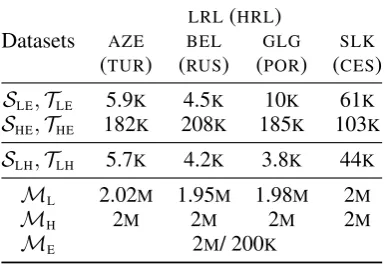
Table 1: Statistics (number of sentences) of all datasets.
3.3 Why Pivot for Back-Translation?
Pivoting through an HRL in order to convert En-glish toLRLwill be a better option compared to directly translatingENGtoLRLunder the follow-ing three conditions: 1)HRLandLRLare related enough to allow for the induction of a high-quality bilingual dictionary; 2) There exists a relatively high-resourceHRL-ENGdataset; 3) A high-quality LRL-ENGdictionary is hard to acquire due to data scarcity or morphological distance.
Essentially, the directENG)LRLback-translation may suffer from both data scarcity and morpholog-ical differences between the two languages. Our proposal breaks the process into two easier steps: ENG)HRLtranslation is easier due to the availability of data, andHRL)LRLtranslation is easier because the two languages are related.
A good example is the agglutinative language of Azerbaijiani, where each word may consist of several morphemes and each morpheme could pos-sibly map to an English word itself. Correspon-dences to (also agglutinative) Turkish, however, are easier to uncover. To give a concrete example, the Azerbijiani word “dü¸süncәlәrim” can be fairly
easily aligned to the Turkish word “dü¸süncelerim” while in English it corresponds to the phrase “my thoughts”, which is unlikely to be perfectly aligned.
4 Experimental Setup
4.1 Data
We use the multilingual TED corpus (Qi et al.,
2018) as a test-bed for evaluating the efficacy of each augmentation method. We conduct ex-tensive experiments over four low-resource lan-guages: Azerbaijani (AZE), Belarusian (BEL), Gali-cian (GLG), and Slovak (SLK), along with their highly related languages Turkish (TUR), Russian (RUS), Portuguese (POR), and Czech (CES)
respec-tively. We also have small-sizedLRL-HRLparallel datasets, and we download Wikipedia dumps to acquire monolingual datasets for all languages.
The statistics of the parallel datasets are shown in Table1. ForAZE,BELandGLG, we use all avail-able Wikipedia data, while for the rest of the lan-guages we sample a similar-sized corpus. We sam-ple 2M/200K English sentences from Wikipedia data, which are used for baselineUMTtraining and augmentation from English respectively.
4.2 Pre-processing
We train a joint sentencepiece3 model for
each LRL-HRL pair by concatenating the mono-lingual corpora of the two languages. The seg-mentation model for English is trained on English monolingual data only. We set the vocabulary size for each model to 20K. All data are then segmented by their respective segmentation model.
We useFastText4to train word embeddings usingMLandMHwith a dimension of 256 (used for the dictionary induction step). We also pre-train subword level embeddings on the segmentedML,
ˆ
MLandMHwith the same dimension.
4.3 Model Architecture
Supervised NMT We use the self-attention Transformer model (Vaswani et al., 2017). We adapt the implementation from the open-source translation toolkitOpenNMT(Klein et al.,2017). Both encoder and decoder consist of 4 layers, with the word embedding and hidden unit dimensions set to 256.5 We use a batch size of 8096 tokens.
Unsupervised NMT We train unsupervised
Transformer models with theUnsupervisedMT
toolkit.6 Layer sizes and dimensions are the same as in the supervised NMT model. The parame-ters of the first three layers of the encoder and the decoder are shared. The embedding layers are ini-tialized with the pre-trained subword embeddings from monolingual data. We set the weight parame-ters for autodenoising language modeling and iter-ative back translation asλ1= 1andλ2 = 1.
4.4 Training and Model Selection
After data augmentation, we follow the pre-train and fine tune paradigm for learning (Zoph et al.,
3
https://github.com/google/sentencepiece 4
https://github.com/facebookresearch/fastText 5
We tuned on multiple settings to find the optimal parame-ters for our datasets.
Training Data
BLEU forX)ENG
AZE BEL GLG SLK
(TUR) (RUS) (POR) (CES)
Results from Literature
SDE (Wang et al.,2019) 12.89 18.71 31.16 29.16
many-to-many (Aharoni et al.,2019) 12.78 21.73 30.65 29.54
StandardNMT
1 {SLESHE, TLETHE} (supervisedMT) 11.83 16.34 29.51 28.12
2 {ML,ME} (unsupervisedMT) 0.47 0.18 1.15 0.75
Standard Supervised Back-translation 3 +{Sˆs
E)L, ME} 11.84 15.72 29.19 29.79
4 +{Sˆs
E)H, ME} 12.46 16.40 30.07 30.60
Augmentation fromHRL-ENG
5 +{Sˆs
H)L, THE} (supervisedMT) 11.92 15.79 29.91 28.52
6 +{Sˆu
H)L, THE} (unsupervisedMT) 11.86 13.83 29.80 28.69
7 +{Sˆw
H)L, THE} (word subst.) 14.87 23.56 32.02 29.60
8 +{Sˆm
H)L, THE} (modifiedUMT) 14.72 23.31 32.27 29.55
9 +{Sˆw
H)LSˆ
m
H)L, THETHE} 15.24 24.25 32.30 30.00
Augmention fromENGby pivoting 10 +{Sˆw
E)H)L, ME} (word subst.) 14.18 21.74 31.72 30.90
11 +{Sˆm
E)H)L, ME} (modifiedUMT) 13.71 19.94 31.39 30.22
Combinations 12 +{Sˆw
H)LSˆ
w
E)H)L, THEME} (word subst.) 15.74 24.51 33.16 32.07
13 +{Sˆ
w
H)LSˆHm)L, THETHE} 15.91 23.69 32.55 31.58
+{Sˆw
E)H)LSˆ
m
[image:6.595.76.518.64.421.2]E)H)L, MEME}
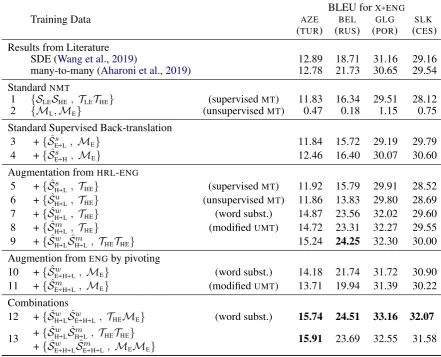
Table 2: Evaluation of translation performance over four language pairs. Rows 1 and 2 show pre-training BLEU scores. Rows 3–13 show scores after fine tuning. Statistically significantly best scores arehighlighted(p <0.05).
2016;Nguyen and Chiang, 2017). We first train a base NMT model on the concatenation of {SLE,TLE} and {SHE,THE}. Then we adopt the mixed fine-tuning strategy of Chu et al. (2017), fine-tuning the base model on the concatenation of the base and augmented datasets. For each setting, we perform a sufficient number of updates to reach convergence in terms of development perplexity.
We use the performance on the development sets (as provided by the TED corpus) as our criterion for selecting the best model, both for augmentation and final model training.
5 Results and Analysis
A collection of our results with the baseline and our proposed methods is shown in Table2.
5.1 Baselines
The performance of the base supervised model (row 1) varies from 11.8 to 29.5 BLEU points. Gener-ally, the more distant the source language is from
English, the worse the performance. A standard un-supervised MT model (row 2) achieves extremely low scores, confirming the results ofGuzmán et al.
(2019), indicating the difficulties of directly
trans-lating between LRLand ENG in an unsupervised
fashion. Rows 3 and 4 show that standard super-vised back-translation from English at best yields very modest improvements. Notable is the excep-tion ofSLK-ENG, which has more parallel data for training than other settings. In the case ofBELand GLG, it even leads to worse performance. Across all four languages, supervised back-translation into theHRL helps more than into theLRL; data is in-sufficient for training a goodLRL-ENGMT model.
5.2 Back-translation fromHRL
HRL-LRL Rows 5–9 show the results when we
5 10 15 20 Pivot BLEU
15 20 25 30
Translation BLEU
AZE BEL
GLG
SLK
[image:7.595.313.523.63.218.2]BASE BASE-UMT Word Subst. M-UMT
Figure 2: Correlation between HRL-LRL (augmenta-tion) pivot BLEU andLRL-ENGtranslation BLEU.
On the other hand, our simple word
substitu-tion approach (row 7) and the modified UMT
approach (row 8) lead to improvements across
the board: +3.0 BLEU points in AZE, +7.8 for
BEL, +2.3 forGLG, +1.1 forSLK. These results are significant, demonstrating that the quality of the back-translated data is indeed important.
In addition, we find that combining the datasets produced by our word substitution andUMT mod-els provide an additional improvement in all cases (row 9). Interestingly, this happens despite the fact that theENGdata are the exact same between rows 5–9.
ENG-HRL-LRL We also show that even in the absence of parallel HRL-LRL data, our pivoting method is still valuable. Rows 10 and 11 in Ta-ble2show the translation accuracy when the aug-mented data are the result of our two-step pivot back-translation. In both cases, monolingualENG is first translated intoHRLand then intoLRLwith either just word substitution (row 10) or modified UMT(row 11). Although these results are slightly worse than our one-step augmentation of a parallel HRL-LRL dataset, they still outperform the base-line standard back-translation (rows 3 and 4). An interesting note is that in this setting, word substi-tution is clearly preferable toUMTfor the second translation pivoting step, which we explain in §5.3.
Combinations We obtain our best results by combining the two sources of data augmentation. Row 12 shows the result of using our simple word substitution technique on the HRLside of both a parallel and an artificially created (back-translated) HRL-ENG dataset. In this setting, we further im-prove not only the encoder side of our model, as before, but we also aid the decoder’s language mod-eling capabilities by providingENGdata from two
SHL Sˆw
HL Sˆ
m
HL Sˆ
w
HL+Sˆ
m
HL Sˆ
w
HL+Sˆ
w
EHL
AZE (TUR) 0.0
0.2 0.4 0.6 0.77
BEL (RUS) 0.0
0.2 0.4 0.6 0.94
GLG (POR) 0.0
0.2 0.4 0.6 0.99
SLK (CES) 0.0
0.2 0.4 0.6 0.96 5
10 15 20 25
15 20 25 30 35
20 25 30 35 40
15 20 25 30 35
Translation BLEU
[image:7.595.75.288.64.191.2]Address Rate
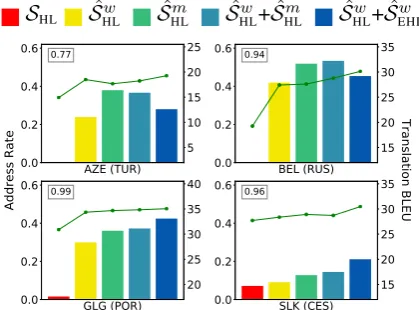
Figure 3: Rare word address rate (bars) andLRL-ENG
BLEU scores (line plot) for each data augmentation method. The numbers in each upper left corner is the Pearson correlation coefficient.
distinct resources. This leads to improvements of 3.6 to 8.2 BLEU points over the base model and 0.3 to 2.1 over our best results fromHRL-ENG augmentation.
Finally, row 13 shows our attempt to obtain fur-ther gains by combining the datasets from both word substitution andUMT, as we did in setting 7. This leads to a small improvement of 0.2 BLEU points inAZE, but also to a slight degradation on the other three datasets.
We also compare the results of our augmenta-tion methods with other state-of-the-art methods that either perform improvements to modeling to improve the ability to do parameter sharing (Wang et al.,2019), or train on many different target lan-guages simultaneously (Aharoni et al.,2019). The results demonstrate that the simple data augmenta-tion strategies presented here improve significantly over these previous methods.
5.3 Analysis
In this section we focus on the quality ofHRL)LRL translation, showing that our betterM-UMT initial-ization method leads to significant improvements compared to standardUMT.
We use the dev sets of the HRL-LRL datasets
to examine the performance ofM-UMT between
related languages. We calculate the pivot BLEU7 score on theLRLside of each created dataset (SHL,
ˆ
Sw
H)L,Sˆ
u
H)L,Sˆ
m
H)L). In Figure2we plot pivot
HRL-LRLBLEU scores against the translationLRL-ENG BLEU ones. First, we observe that across all
7We will refer to
Data Example Sentence Pivot BLEU SLE (GLG) Pero con todo, veste obrigado a agardar nas mans dunha serie de estraños moi profesionais.
SHE (POR) Em vez disso, somos obrigados a esperar nas mãos de uma série de estranhos muito profissionais. 0.09
ˆ
Sw
H)L En vez disso, somos obrigados a esperar nasmansdeunha seriedeestrañosmoitoprofesionais. 0.18
ˆ
Sm
H)L En vez diso, somos obrigados a esperar nasmans dunha seriedeestraños moi profesionais. 0.54
TLE But instead, you are forced there to wait in the hands of a series of very professional strangers.
Table 3: APOR-GLG pivoting example with corresponding pivot BLEU scores. Edits by word substitution or
M-UMTare highlighted.
datasets, the pivot BLEU of ourM-UMTmethod is higher than standardUMT(the squares are all fur-ther right than their corresponding stars). Vanilla UMT’s scores are 2 to 10 BLEU points worse than the M-UMT ones. This means that UMT across related languages significantly benefits from initial-izing with our simple word substitution method.
Second, as illustrated in Figure 2, the pivot BLEU score and the translation BLEU are im-perfectly correlated; even thoughM-UMTreaches the highest pivot BLEU, the resulting translation BLEU is comparable to using the simple word sub-stitution method (rows 7 and 8 in Table2). The reason is that the quality of{Sˆm
H)L , THE}is
natu-rally restricted by the{Sˆw
H)L, THE}, whose quality
is in turn restricted by the induced dictionary. How-ever, by combining the augmented datasets from these two methods, we consistently improve the translation performance over using only word sub-stitution augmentation (compare Table 2 rows 7 and 9). This suggests that the two augmented sets improveLRL-ENGtranslation in an orthogonal way.
Additionally, we observe that augmentation from back-translatedHRLdata leads to generally worse results than augmentation from originalHRLdata (compare rows 7,8 with rows 10,11 in Table 2). We believe this to be the result of noise in the back-translatedHRL, which is then compounded by further errors from the induced dictionary. There-fore, we suggest that the simple word substitution method should be preferred for the second pivoting step when augmenting back-translatedHRLdata.
Table3provides an example conversion of an HRL sentence to pseudo-LRLwith the word sub-stitution strategy, and its translation withM-UMT. FromSHE toSˆHw)L, the word substitution strategy
achieves very high unigram scores (0.50 in this case), largely narrowing the gap between two lan-guages. TheM-UMTmodel then edits the pseudo-LRLsentence to convert all its words toLRL.
AZE BEL GLG SLK
(TUR) (RUS) (POR) (CES)
WT-Bi 35K 42K 34K 51K
WT-Uni 211K 179K 89K 117K
WN-Bi 1.6M 2.5M 3.1M 2.0M
WN-Uni 2.9M 3.8M 3.8M 2.9M
BLEU-Bi 14.33 21.55 31.72 29.09
BLEU-Uni 14.10 21.86 30.51 28.58
Table 4: Injected word type (WT), injected word num-ber (WN) and BLEU score (BLEU) on low-resource translation with different induced dictionaries. Bi denotes bidirectional and Uni denotes unidirectional word induction.
Rare Word Coverage Next, we quantitatively evaluate how our pivoting augmentation methods increase rare word coverage and the correlation withLRL-ENGtranslation quality. For each word in the tested set, we define a word as “rare” if it is in the training set’s lowest 10th frequency per-centile. This is particularly true for LRLtest set words when using concatenatedHRL-LRLtraining data, as theLRLdata will be smaller. We further define rare words to be “addressed” if after adding augmented data the rare word is not in the lowest 10th frequency percentile anymore. Then, we de-fine the “address rate” of a test dataset as the ratio of the number of addressed words to the number of rare words. The address rate of each method, along with the corresponding translation BLEU score is shown in Figure3. As indicated by the Pearson cor-relation coefficients, these two metrics are highly correlated, indicating that our augmentation meth-ods significantly mitigate problems caused by rare words, improving MT quality as a result.
Uni-directional: For eachHRLword, we collect its clos-estLRLword to be added to the dictionary; 2) Bidi-rectional: We only add word pairs the two words of which are each other’s closest neighbor to the dictionary.
In order to know how manyLRLwords are
in-jected into the HRL corpus, we show the
num-ber of injected unique word types, numnum-ber of in-jected words, and the corresponding BLEU score of models trained with bidirectional and unidirec-tional word induction in Table4. It can be seen that the ratio of word numbers is higher than that of word types between bidirectional and unidirec-tional word induction, indicating that the injected words using the bidirectional method are of rel-atively high frequency. The BLEU scores show that bidirectional word induction performs better than unidirectional induction in most cases (except BEL). One explanation could be that adding each word’s closest neighbor as a pair into the dictio-nary introduces additional noise that might harm the low-resource translation to some extent.
6 Related Work
Our work is related to multilingual and unsuper-vised translation, bilingual dictionary induction, as well as approaches for triangulation (pivoting).
In a low-resource MT scenario, multilingual training that aims at sharing parameters by lever-aging parallel datasets of multiple languages is a common practice. Some works target learning a universal representation for all languages either by leveraging semantic sharing between mapped word embeddings (Gu et al.,2018) or by using character n-gram embeddings (Wang et al.,2019) optimizing subword sharing. More related with data augmen-tation,Nishimura et al.(2018) fill in missing data with a multi-source setting to boost multilingual translation.
Unsupervised machine translation enables train-ing NMT models without parallel data (Artetxe et al., 2018; Lample et al., 2018a,c). Recently, multiple methods have been proposed to further improve the framework. By incorporating a statis-tical MT system as posterior regularization, Ren et al.(2019) achieved state-of-the-art for en-fr and en-de MT. Besides MT, the framework has also been applied to other unsupervised tasks like non-parallel style transfer (Subramanian et al., 2018;
Zhang et al.,2018).
Bilingual dictionaries learned in both supervised
and unsupervised ways have been used in low-resource settings for tasks such as named entity recognition (Xie et al., 2018) or information re-trieval (Litschko et al.,2018).Hassan et al.(2017) synthesized data with word embeddings for spoken dialect translation, with a process that requires a LRL-ENGas well as aHRL-LRLdictionary, while our work only uses aHRL-LRLdictionary.
Bridging source and target languages through a pivot language was originally proposed for phrase-based MT (De Gispert and Marino,2006;Cohn and Lapata,2007). It was later adapted for Neural MT (Levinboim and Chiang,2015), and Cheng et al.
(2017) proposed joint training for pivot-based NMT.
Chen et al.(2017) proposed to use an existing pivot-target NMT model to guide the training of source-target model. Lakew et al. (2018) proposed an iterative procedure to realize zero-shot translation by pivoting on a third language.
7 Conclusion
We propose a generalized data augmentation frame-work for low-resource translation, making best use of all available resources. We propose an effective two-step pivoting augmentation method to convert HRLparallel data toLRL. In future work, we will explore methods for controlling the induced dictio-nary quality to improve word substitution as well as M-UMT. We will also attempt to create an end-to-end framework by jointly trainingM-UMTpivoting system and low-resource translation system in an iterative fashion in order to leverage more versions of augmented data.
Acknowledgements
References
Roee Aharoni, Melvin Johnson, and Orhan Firat. 2019. Massively multilingual neural machine translation. InProceedings of the 2019 Conference of the North American Chapter of the Association for Computa-tional Linguistics: Human Language Technologies.
Mikel Artetxe, Gorka Labaka, Eneko Agirre, and Kyunghyun Cho. 2018. Unsupervised neural ma-chine translation. In International Conference on Learning Representations.
Victor Chahuneau, Eva Schlinger, Noah A Smith, and Chris Dyer. 2013. Translating into morphologically rich languages with synthetic phrases. In Proceed-ings of the 2013 Conference on Empirical Methods in Natural Language Processing, pages 1677–1687.
Yun Chen, Yang Liu, Yong Cheng, and Victor OK Li. 2017. A teacher-student framework for zero-resource neural machine translation. InProceedings of the 55th Annual Meeting of the Association for Computational Linguistics (Volume 1: Long Papers), pages 1925–1935.
Yong Cheng, Qian Yang, Yang Liu, Maosong Sun, and Wei Xu. 2017. Joint training for pivot-based neu-ral machine translation. InProceedings of the 26th International Joint Conference on Artificial Intelli-gence, pages 3974–3980.
Chenhui Chu, Raj Dabre, and Sadao Kurohashi. 2017. An empirical comparison of domain adaptation methods for neural machine translation. In Proceed-ings of the 55th Annual Meeting of the Association for Computational Linguistics (Volume 2: Short Pa-pers), volume 2, pages 385–391.
Trevor Cohn and Mirella Lapata. 2007. Machine trans-lation by triangutrans-lation: Making effective use of multi-parallel corpora. In Proceedings of the 45th Annual Meeting of the Association of Computational Linguistics, pages 728–735.
Anna Currey, Antonio Valerio Miceli Barone, and Ken-neth Heafield. 2017. Copied monolingual data im-proves low-resource neural machine translation. In
Proceedings of the Second Conference on Machine Translation, pages 148–156.
Adrià De Gispert and Jose B Marino. 2006. Catalan-english statistical machine translation without paral-lel corpus: bridging through spanish. InProc. of 5th International Conference on Language Resources and Evaluation (LREC), pages 65–68. Citeseer.
Jiatao Gu, Hany Hassan, Jacob Devlin, and Victor OK Li. 2018. Universal neural machine translation for extremely low resource languages. InProceedings of the 2018 Conference of the North American Chap-ter of the Association for Computational Linguistics: Human Language Technologies, Volume 1 (Long Pa-pers), volume 1, pages 344–354.
Francisco Guzmán, Peng-Jen Chen, Myle Ott, Juan Pino, Guillaume Lample, Philipp Koehn, Vishrav Chaudhary, and Marc’Aurelio Ranzato. 2019. Two new evaluation datasets for low-resource machine translation: Nepali-English and Sinhala-English.
arXiv preprint arXiv:1902.01382.
Hany Hassan, Mostafa Elaraby, and Ahmed Taw-fik. 2017. Synthetic data for neural machine translation of spoken-dialects. arXiv preprint arXiv:1707.00079.
Melvin Johnson, Mike Schuster, Quoc V Le, Maxim Krikun, Yonghui Wu, Zhifeng Chen, Nikhil Thorat, Fernanda Viégas, Martin Wattenberg, Greg Corrado, et al. 2017. Google’s multilingual neural machine translation system: Enabling zero-shot translation.
Transactions of the Association for Computational Linguistics, 5:339–351.
Guillaume Klein, Yoon Kim, Yuntian Deng, Jean Senel-lart, and Alexander Rush. 2017. Opennmt: Open-source toolkit for neural machine translation. pages 67–72.
Philipp Koehn and Rebecca Knowles. 2017. Six chal-lenges for neural machine translation. In Proceed-ings of the First Workshop on Neural Machine Trans-lation, pages 28–39.
Surafel M Lakew, Quintino F Lotito, Matteo Negri, Marco Turchi, and Marcello Federico. 2018. Im-proving zero-shot translation of low-resource lan-guages. arXiv preprint arXiv:1811.01389.
Guillaume Lample, Alexis Conneau, Ludovic Denoyer, and Marc’Aurelio Ranzato. 2018a. Unsupervised machine translation using monolingual corpora only. In International Conference on Learning Represen-tations.
Guillaume Lample, Alexis Conneau, Marc’Aurelio Ranzato, Ludovic Denoyer, and Hervé Jégou. 2018b.
Word translation without parallel data. In Interna-tional Conference on Learning Representations.
Guillaume Lample, Myle Ott, Alexis Conneau, Lu-dovic Denoyer, et al. 2018c. Phrase-based & neu-ral unsupervised machine translation. In Proceed-ings of the 2018 Conference on Empirical Methods in Natural Language Processing, pages 5039–5049.
Tomer Levinboim and David Chiang. 2015. Super-vised phrase table triangulation with neural word embeddings for low-resource languages. In Pro-ceedings of the 2015 Conference on Empirical Meth-ods in Natural Language Processing, pages 1079– 1083, Lisbon, Portugal. Association for Computa-tional Linguistics.
learning. InThe 57th Annual Meeting of the Associa-tion for ComputaAssocia-tional Linguistics (ACL), Florence, Italy.
Robert Litschko, Goran Glavaš, Simone Paolo Ponzetto, and Ivan Vuli´c. 2018. Unsupervised cross-lingual information retrieval using monocross-lingual data only. arXiv preprint arXiv:1805.00879.
Tomas Mikolov, Quoc V Le, and Ilya Sutskever. 2013. Exploiting similarities among languages for ma-chine translation. arXiv preprint arXiv:1309.4168.
Graham Neubig and Junjie Hu. 2018.Rapid adaptation of neural machine translation to new languages. In
Conference on Empirical Methods in Natural Lan-guage Processing (EMNLP), Brussels, Belgium.
Toan Q. Nguyen and David Chiang. 2017. Transfer learning across low-resource, related languages for neural machine translation. InProc. IJCNLP, vol-ume 2, pages 296–301.
Yuta Nishimura, Katsuhito Sudoh, Graham Neubig, and Satoshi Nakamura. 2018. Multi-source neural machine translation with data augmentation.
Ye Qi, Devendra Sachan, Matthieu Felix, Sarguna Pad-manabhan, and Graham Neubig. 2018. When and why are pre-trained word embeddings useful for neu-ral machine translation? InProceedings of the 2018 Conference of the North American Chapter of the Association for Computational Linguistics: Human Language Technologies, Volume 2 (Short Papers), volume 2, pages 529–535.
Shuo Ren, Zhirui Zhang, Shujie Liu, Ming Zhou, and Shuai Ma. 2019. Unsupervised neural machine translation with SMT as posterior regularization.
arXiv preprint arXiv:1901.04112.
Peter H Schönemann. 1966. A generalized solution of the orthogonal procrustes problem. Psychometrika, 31(1):1–10.
Rico Sennrich, Barry Haddow, and Alexandra Birch. 2016. Improving neural machine translation mod-els with monolingual data. In Proceedings of the 54th Annual Meeting of the Association for Compu-tational Linguistics (Volume 1: Long Papers), vol-ume 1, pages 86–96.
Sandeep Subramanian, Guillaume Lample, Eric Michael Smith, Ludovic Denoyer, Marc’Aurelio Ranzato, and Y-Lan Boureau. 2018. Multiple-attribute text style transfer. CoRR, abs/1811.00552.
Ashish Vaswani, Noam Shazeer, Niki Parmar, Jakob Uszkoreit, Llion Jones, Aidan N Gomez, Łukasz Kaiser, and Illia Polosukhin. 2017. Attention is all you need. InAdvances in Neural Information Pro-cessing Systems, pages 5998–6008.
Xinyi Wang, Hieu Pham, Philip Arthur, and Graham Neubig. 2019. Multilingual neural machine transla-tion with soft decoupled encoding. InInternational Conference on Learning Representations.
Jiateng Xie, Zhilin Yang, Graham Neubig, Noah A Smith, and Jaime Carbonell. 2018. Neural cross-lingual named entity recognition with minimal re-sources. InProceedings of the 2018 Conference on Empirical Methods in Natural Language Processing, pages 369–379.
Chao Xing, Dong Wang, Chao Liu, and Yiye Lin. 2015.
Normalized word embedding and orthogonal trans-form for bilingual word translation. InProceedings of the 2015 Conference of the North American Chap-ter of the Association for Computational Linguistics: Human Language Technologies, pages 1006–1011, Denver, Colorado. Association for Computational Linguistics.
Meng Zhang, Yang Liu, Huanbo Luan, and Maosong Sun. 2017. Earth mover’s distance minimization for unsupervised bilingual lexicon induction. In Pro-ceedings of the 2017 Conference on Empirical Meth-ods in Natural Language Processing, pages 1934– 1945.
Zhirui Zhang, Shuo Ren, Shujie Liu, Jianyong Wang, Peng Chen, Mu Li, Ming Zhou, and Enhong Chen. 2018. Style transfer as unsupervised machine trans-lation.arXiv preprint arXiv:1808.07894.
![Figure 1: With a low-resource language (LRL) and arelated high-resource language (HRL), typical data aug-mentation scenarios use any available parallel data [b]and [c] to back-translate English monolingual data [a]and generate parallel resources ([1] and [](https://thumb-us.123doks.com/thumbv2/123dok_us/177589.513565/1.595.317.520.224.361/resource-language-mentation-scenarios-available-translate-monolingual-resources.webp)